EDITOR’S NOTE: This episode of Kolchak: The Night Stalker was on the CBS Late Movie on November 9, 1979, August 21, 1981, and December 11, 1987.
Directed by Bruce Kessler and written by Steve Fisher and David Chase, “Chopper” is the kind of Kolchak episode that I love, one where The Bishops biker gang member Harold “The Swordsman” Baker, was decapitated by a rival gang, The Jokers, who were dumb enough to ride around with his head until “The Swordsman’s” ghost came to chop his head off. The gang finally stopped him by putting his head inside his coffin, and everything was normal until a construction project somehow got his head separated from his body.
The old Jokers like Henry “Studs” Spake (Art Metrano) have to look over their shoulders before they lose their heads. Kolchak has to discover the truth, deal with another lousy cop (Captain Jonas, played by Larry Linville from M*A*S*H*) and get out with his head on his shoulders.
Speaking of shoulders, the headless motorcycle rider has shoulders that are a foot above normal. How else would you affect this budget?
Sharon Farrell, who would later be Lone Wolf McQuade‘s wife, as well as Lenore in It’s Alive, Mrs. Mancini in Can’t Buy Me Love and Regina and Samantha’s stepmother in Night of the Comet, is in this episode as is Jim Backus in a cameo as a motorcycle dealer.
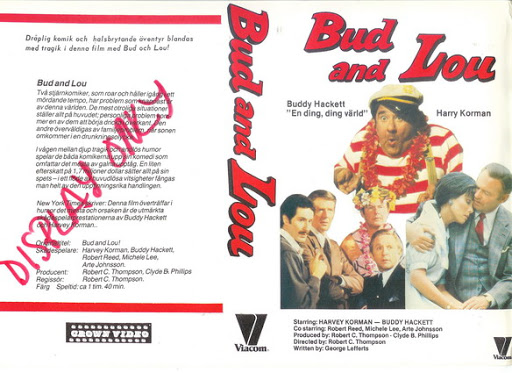
EDITOR’S NOTE: Bud and Lou was on the CBS Late Movie on December 25, 1984 (Merry Christmas!) and June 3, 1987.
This movie crushed me as a child. I had always loved Bud Abbott and Lou Costello, watching their thirty-six films on Sunday mornings, right after Ma and Pa Kettle films. Seriously, weekends in Pittsburgh in the 70s and 80s were amazing. You stayed up all night watching Chiller Theater and then woke up late and took in some Abbott and Costello. Ah, memories.
That said, when this aired on November 15, 1978, I excitedly watched it from my parent’s black and white kitchen TV, ready to have fun reliving my favorite memories of the comedy duo. I wasn’t ready to learn how much they hated one another and their foibles. Cut me some slack — I was six.
Abbott and Costello are played by Buddy Hackett and Harvey Korman. Interestingly, Hackett and Hugh O’Brian replaced the team when Costello’s health forced them to drop out of 1954’s Fireman Save My Child.
The team came together when Abbott’s original partner was ill and it gelled pretty quickly. The film hints that Bud used to date Lou’s wife — this is unproven — but as we’ve learned from tabloid-style films, facts are rarely important. For example, while they did debut on The Kate Smith Hour on February 3, 1938, they didn’t do the “Who’s On First?” routine until a month later and they had developed their distinctive voices (audiences initially thought they sounded alike until Costello came up with his high-pitched, childish affect).
They debuted their own show, The Abbott and Costello Show, as Fred Allen’s summer replacement in 1940 before joining Edgar Bergen and Charlie McCarthy on The Chase and Sanborn Hour in 1941. That was also the year that their first two films — Buck Privates and Hold That Ghost — debuted (they made their actual first film appearance in 1940’s One Night in the Tropics, essentially playing their greatest hits from burlesque on screen).
By 1942, they were the top box office stars in the country, earning over $789,000 ($12 million in today’s money) that year alone. To show how big of stars they were, a 35-day War Bonds tour in the summer of 1942 earned $85 million dollars ($1,299,767,105 today!) in war bonds purchases. This is important — because soon, the government would come calling for this money and forget all about this. That’s a major part of the film.
Here come the bad parts. Abbott had epilepsy, which in the film just means you have to sit down every once in a while, as well as drink way too much. Costello got rheumatic fever from a military base tour and was bedridden for the rest of 1942 and into ’43, when he returned to radio after a year layoff. That very same day, his infant son drowned in the family’s pool and the comedian was never the same. He was quick to anger and constantly vindictive to the point that a major rift happened when In 1945 a rift developed when Abbott hired a servant who Costello had fired. That led to Costello refusing to speak to his partner except when performing. From them on, they would play separate characters in films, rather than be a team. This led to their loss in popularity when faced with other teams like Martin and Lewis.
Abbott resolved the rift when he suggested naming Costello’s charity the “Lou Costello Jr. Youth Foundation.” Finally some good news — this charity still helps underprivileged youth in the Boyle Heights district of Los Angeles.
Despite their dip in popularity, they still starred in several films with the Universal monsters and hosted The Colgate Comedy Hour. From 1952 to 54, Costello created, owned and syndicated The Abbott and Costello Show, paying Abbott a salary, a point this movie hammers home as proof that any reconciliation was only on one man’s part. That said, the movie totally ignores that this show was a success and aired in reruns for a long time.
The film never gets into the point that the duo was overexposed and worried about creating new material, which is one of the reasons why Universal couldn’t reach a contract with them. They were forced to sell all of their assets to the IRS to pay taxes, a point the movie definitely makes.
After one last film, Dance with Me, Henry and Lou appearing on This Is Your Life, the duo split for good in 1957. Errol Flynn claimed in his autobiography that he was the reason. At a party he had invited Bud, Lou and their families to, he showed hardcore pornography and Bud and Lou both blamed the other. This is skipped by the movie, because how would you explain that on TV in 1978?
The movie makes it seem that Costello died quickly after the pair split, but he lived until 1959, after ten appearances on The Steve Allen Show doing old routines without his partner. He died shortly after finishing his last film, The 30 Foot Bride of Candy Rock.
In 1960, Abbott formed a team with Candy Candido, a voice actor in Disney films. He also did his own voice for the Hanna-Barbera Abbott and Costello cartoons. He died of cancer in 1974.
Let’s go back to me being a kid. I always thought that Lou was the nice one, with Bud being the mean adult, always grumpy with him. Little did I know the truth — or what passes for it in this movie. I remember crying my eyes out during the last scene where Lou dies.
This whole movie is based on the book by Hollywood correspondent Bob Thomas and trust me, it’s as over the top and ridiculous as you hope it is. It’s been said that Thomas got most of his gossip from Eddie Sherman, Abbott and Costello’s longtime manager who had been fired by the duo, so obviously there was a reason why it’s so venomous. It’s also remarkably unfunny in the comedy segments, which is weird when you consider who is starring in it. Arte Johnson and Robert Reed also show up, just to remind you this is a made for TV movie.
Both the book and movie upset Lou’s daughter Chris so much that she wrote the book Lou’s on First to refute many of its claims.
I’m not the only one obsessed by this film. On his podcast, Gilbert Gottfried has brought the death scene at the end up several times. I wasn’t the only one shattered by it, I guess.
I guess if you want to catch up on memories, you should skip TV movies and go right back to the real movies. But as you may have learned by now, I love junk.
EDITOR’S NOTE: Bud and Lou was on the CBS Late Movie on December 25, 1984 (Merry Christmas!) and June 3, 1987.
This movie crushed me as a child. I had always loved Bud Abbott and Lou Costello, watching their thirty-six films on Sunday mornings after Ma and Pa Kettle films. Seriously, weekends in Pittsburgh in the 70s and 80s were amazing. You stayed up all Night watching Chiller Theater, then woke up late and took in some Abbott and Costello. Ah, memories.
That said, when this aired on November 15, 1978, I excitedly watched it from my parent’s black and white kitchen TV, ready to have fun reliving my favorite memories of the comedy duo. I wasn’t prepared to learn how much they hated one another and their foibles. Cut me some slack — I was six.
Buddy Hackett and Harvey Korman play Abbott and Costello. Interestingly, Hackett and Hugh O’Brian replaced the team when Costello’s health forced them to drop out of 1954’s Fireman Save My Child.
The team came together when Abbott’s original partner was ill, and it gelled pretty quickly. The film hints that Bud used to date Lou’s wife — this is unproven — but as we’ve learned from tabloid-style films, facts are rarely necessary. For example, while they did debut on The Kate Smith Hour on February 3, 1938, they didn’t do the “Who’s On First?” routine until a month later, and they had developed their distinctive voices (audiences initially thought they sounded alike until Costello came up with his high-pitched, childish effect).
They debuted The Abbott and Costello Show as Fred Allen’s summer replacement in 1940 before joining Edgar Bergen and Charlie McCarthy on The Chase and Sanborn Hour in 1941. That was also the year that their first two films — Buck Privates and Hold That Ghost — debuted (they made their first film appearance in 1940’s One Night in the Tropics, essentially playing their greatest hits from burlesque on screen).
By 1942, they were the top box office stars in the country, earning over $789,000 ($12 million in today’s money) that year alone. A 35-day War Bonds tour in the summer of 1942 earned $85 million ($1,299,767,105 today!) in war bond purchases to show how big of a star they were. This is important because the government would soon call for this money and forget all about it. That’s a significant part of the film.
Here come the bad parts. Abbott had epilepsy, which in the film means you have to sit down every once in a while, as well as drink way too much. Costello got rheumatic fever from a military base tour and was bedridden for the rest of 1942 and into ’43 when he returned to radio after a year layoff. That very same day, his infant son drowned in the family’s pool, and the comedian was never the same. He was quick to anger and constantly vindictive to the point that a significant rift happened.
In 1945, Abbott hired a servant whom Costello had fired. That led to Costello refusing to speak to his partner except when performing. Then, they would play separate characters in films rather than work together, which led to their loss of popularity when faced with other teams like Martin and Lewis.
Abbott resolved the rift by suggesting naming Costello’s charity the Lou Costello Jr. Youth Foundation. Finally, some good news: this charity still helps underprivileged youth in the Boyle Heights district of Los Angeles.
Despite their dip in popularity, they still starred in several films with the Universal Monsters and hosted The Colgate Comedy Hour. From 1952 to 54, Costello created, owned and syndicated The Abbott and Costello Show, paying Abbott a salary, a point this movie hammers home as proof that any reconciliation was only on one man’s part. That said, the film ignores that this show was successful and aired in reruns for a long time.
The film never gets to the point that the duo is overexposed and worried about creating new material, which is one reason Universal couldn’t reach a contract with them. The movie definitely makes the point that they were forced to sell all their assets to the IRS to pay taxes.
After one last film, Dance with Me, Henry, and Lou appeared on This Is Your Life, the duo split for good in 1957. Errol Flynn claimed in his autobiography that he was the reason. At a party he had invited Bud, Lou and their families to, he showed hardcore pornography and Bud and Lou both blamed the other. The movie skipped this because how would you explain that on TV in 1978?
The movie makes it seem that Costello died quickly after the pair split, but he lived until 1959 after ten appearances on The Steve Allen Show doing old routines without his partner. He died shortly after finishing his last film, The 30-Foot Bride of Candy Rock.
In 1960, Abbott formed a team with Candy Candido, a voice actor in Disney films. He also did his voice for the Hanna-Barbera Abbott and Costello cartoons. He died of cancer in 1974.
Let’s go back to when I was a kid. I always thought Lou was the nice one, and Bud was the mean adult who was always grumpy with him. Little did I know the truth—or what passes for it in this movie. I remember crying my eyes out during the last scene when Lou dies.
This movie is based on the book by Hollywood correspondent Bob Thomas, and trust me, it’s as over the top and ridiculous as you hope it is. It’s been said that Thomas got most of his gossip from Eddie Sherman, Abbott and Costello’s longtime manager, who the duo had fired, so obviously, there was a reason why it’s so venomous. It’s also remarkably unfunny in the comedy segments, which is weird when considering who is starring. Arte Johnson and Robert Reed also showed up; to remind you, this is a made-for-TV movie.
The book and movie upset Lou’s daughter, Chris, so much that she wrote Lou’s On First to refute many of its claims.
I’m not the only one obsessed with this film. Gilbert Gottfried repeatedly mentions the death scene at the end of his podcast, and I wasn’t the only one shattered by it.
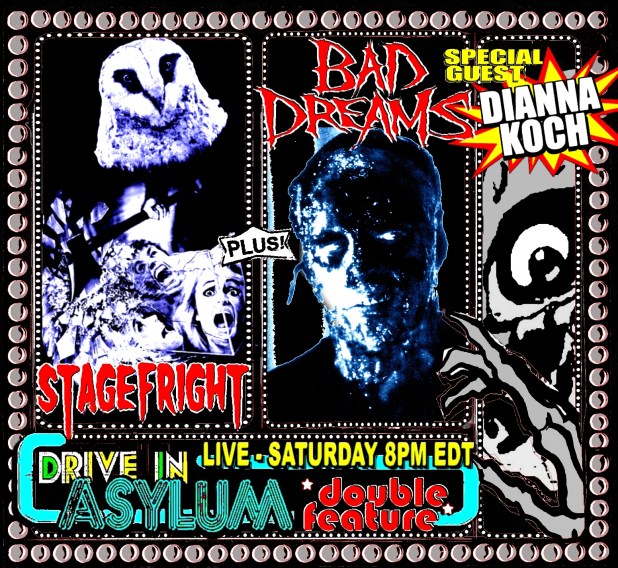
The first movie is Stagefright, which is a near-perfect slasher. You can watch it on Tubi.
Each week, we watch two movies, discuss them, look at the ad campaigns and make drinks for each movie. Here’s the first one.
Mask of the Owl
1.5 oz. tequila
1 oz. blue curacao
.5 oz. orgeat or almond syrup
6 oz. limeonade (I make mine with the juice of a lime, .5 oz. simple syrup and 5 oz. water)
Pour all the ingredients in a glass filled with ice.
Don’t drop the key and mix this up instead.
The second movie is Bad Dreams, which is Freddy without Freddy yet also completely awesome at being its own movie too. You can watch it on the Internet Archive.
Here’s the second recipe.
Unity Fields
1.5 oz. Fireball
1.5 oz. Sour Apple Pucker
3 oz. pineapple juice
Add everything to your shaker with ice and shake it up.
Don’t set yourself on fire and drink this instead.
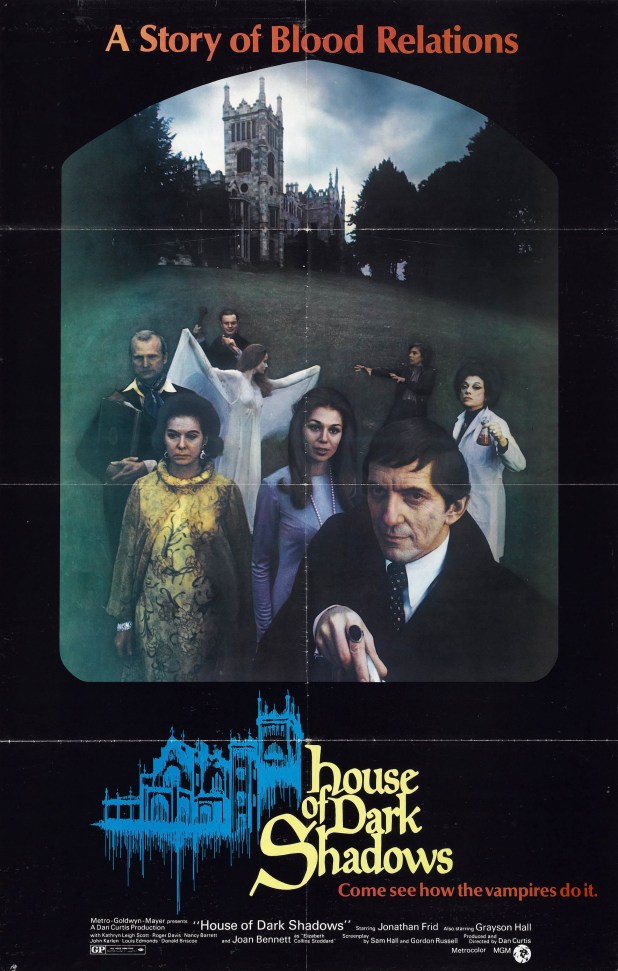
EDITOR’S NOTE: House of Dark Shadows was on the CBS Late Movie on July 16, 1976.
Dark Shadows was a phenomenon. The kind of big cultural deal that needed to be cashed in on is why producer and creator Dan Curtis started pitching a feature-length TV movie from 1968 onwards.
The original idea was to edit together old episodes of the show, but soon, the idea to tell the entire Barnabas Collins saga—complete with bloody bites and gore—took over. Several actors were written out while the TV series was still on the air. A writer trying to use the vampire for a biographical novel trapped Barnabas in a coffin for 28 episodes. Other characters were replaced in the 1970 parallel world story arc.
With a budget of $750,000 — that was probably enough for 750 episodes of the actual series — and on-location shooting at the Lyndhurst Estate in Tarrytown, New York and that town’s Sleepy Hollow Cemetery (as well as the Lockwood–Mathews Mansion in Norwalk, Connecticut), this movie looks gorgeous. And it’s a joy to see so much of the original cast come back and play modified versions of their roles.
However, what takes years on the soap opera now takes moments. It’s a bit disconcerting.
Like his entry on the show, Barnabas (Johnathan Frid) is found by handyman Willie Loomis (John Karlen) and, within moments, introduces himself as a long-lost European relative while taking bites out of almost every female cast member.
Daphne Budd? Bitten. Carolyn Stoddard? She gets a bite. Maggie Evans? Yep, her too.
Barnabas is also transformed into a human by Dr. Julia Hoffman, but she falls for him and jealously transforms him into his true age. No worries — actual bites from his chosen bride, Maggie, bring him back to vitality.
The only part you may not enjoy is Willie turning on Barnabas and the titular vampire succumbing to a crossbow to the back. That said, his bat flies away — Curtis was doing end-credit teases way before the Marvel movies — in a nod to a projected sequel that never happened, Curse of Dark Shadows.
There’s also a moment when Quentin Collins’ theme is heard, but he doesn’t show up. I’m sure many young ladies were crushed by this.
This is a fun movie if you haven’t watched the original episodes. If you have, you may be upset that they are glossed over. Regardless, I saw it at the drive-in, paired with its spiritual sequel, and I enjoyed it.
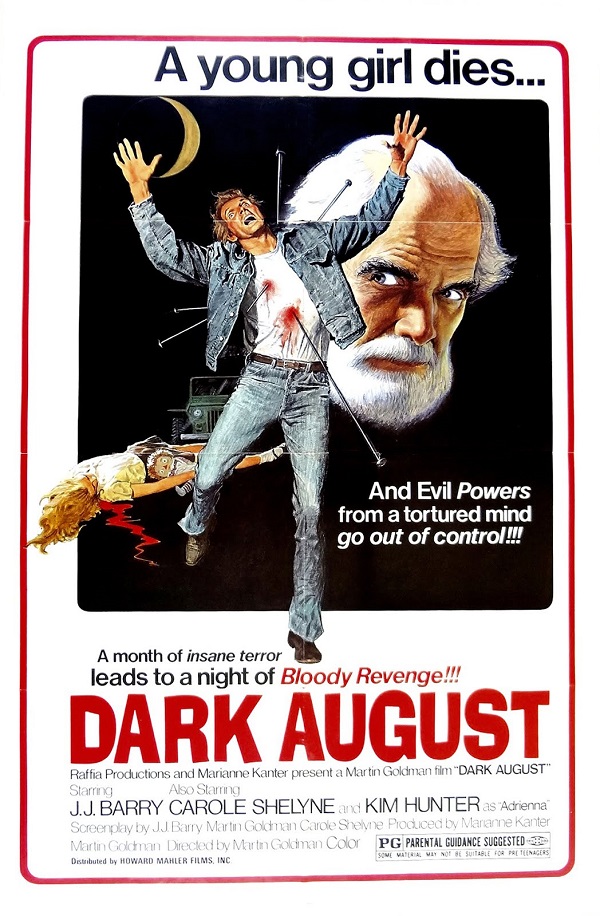
EDITOR’S NOTE: Dark August was on the CBS Late Movie on December 14, 1988; April 21 and August 25, 1989.
This is something I’ve never seen before: Vermont rural horror. It has strange art-house leanings and long takes, like a French film directed by Martin Goldman, who also directed The Legend of CENSORED Charley after a career in advertising. It also has an incredibly unlikeable lead, but it was the 1970s. For being the “Me Decade,” it doesn’t feel like anyone liked themselves or anyone else.
Sal (J.J. Barry, who also co-wrote the film along with Goldman and lead actress Carole Shelyne) is amid a divorce and a resulting mid-life crisis, bringing him to Vermont. He sets up a photography business, starts building a studio and hooks up with an artist named Jackie (Shelyne, who also appeared as Carolyne Barry), who has been through a divorce herself.
It was all going so well — until Sal runs over the granddaughter of Old Man McDermitt, who just so happens to have the powers of the occult at his command. Whoops.
From then on, Sal feels even more out of place than before. His body constantly gives out on him, he has visions of a hooded demon, and everyone around him is getting maimed. One of his friend’s girlfriends tries tarot reading, but that upsets him even further. Even consulting the town’s foremost witch—Academy Award-winning Kim Hunter, getting top billing for her short screen time—can’t stop fate, particularly when Old Man McDermitt busts in with his shotgun.
Much of this film is devoted to the experience of being a stranger in a strange town. Long pauses, worried glances and even moments of weakness add to an overwhelming dread.
The good news is that everything ends if you enjoy movies where things happen slowly. Dark August is for you. Actually, there’s plenty to like here, and you can see how a lesser director would make this into a Blumhouse movie of the month that would end up pissing me off. Here, it just intrigues me, and I end up spending all day doing more research on this film.
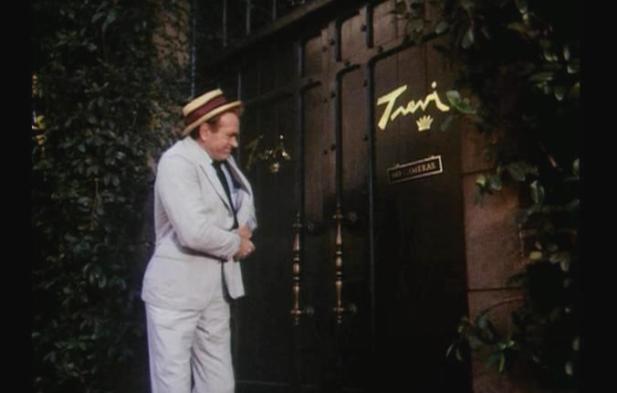
Directed by Don Weis (Beyond Westworld, The Munster’s Revenge) and one of several episodes written by Rudolph Borchert, “The Trevi Collection” has Carl Kolchak find out that fashion model Madeline Parker (Lara Parker, Angelique from Dark Shadows) is an actual witch. On the excellent blog It Couldn’t Happen Here, she told writer Mark Dawidziak that star Darren McGavin gave her some advice: “Nobody really understands the style of this thing. It has to be played seriously, and then the horror will come out naturally.”
She’d already been doing that for years in Collinsport.
She told The Night Stalker Companion, “He kept trying to tell me how to play a witch. It was a fun part, but, to be honest, it wasn’t the most fun acting experience I ever had.”
This episode was made when they were halfway through the season, and one assumes nerves were already shot, what with the long hours and low budgets. At least this episode has a fluffy white cat maul and a model named Ariel (Diane Quick). Another, Melody Sedgwick (Beverly Gill), is killed by a shower that gets way too hot.
The one interesting part is that Carl goes from Madeline helping him to her being the villain. This is a different approach to the show’s formula, and while it’s not an episode I enjoy as much as some of the others, I’ll take any Kolchak over most shows.
EDITOR’S NOTE: Dark Places was on the CBS Late Movie on December 18, 1985.
Edward Foster (Robert Hardy) has inherited a mansion rumored to be haunted. Instead of being scared off, he decides to renovate it. What he doesn’t know is that the doctor of the previous owner, Andrew Carr, Dr. Ian Mandeville (Christopher Lee) and his sister Sarah (Joan Collins), as well as Prescott (Herbert Lom), the solicitor, know that there are two suitcases of money hidden somewhere.
They didn’t count on Edward being violently deranged, as he can see the past of the house, as he looks precisely like Carr and experiences the last days of that man’s life, in which he plans to leave his wife Victoria (Jean Marsh) for a governess named Alta (Jane Birkin). This house seems to lead to mental illness, as Victoria is impossible to be around. She knows Andrew is leaving, so she has her two children kill her rival while she’s seducing her husband. When he finds out, he strangles her and kills the little ones with a sword, bricking up all of the dead bodies — and the money — inside the house.
These flashbacks lead to him ridding his home of the others, just in time for the police to show up. Poor Joan Collins, yet another movie where she gets strangled! For her part, she said in her autobiography Past Imperfect, “I became known by the British press as Queen of the Horror Films — a title I didn’t particularly relish. But I was resilient. A survivor. I was lucky to be working so much after such a long period away from the British screen, particularly since I was well into my thirties.”
Dark Places was directed by Don Sharp, who also made The Creeping Flesh and written by Ed Brennan and Joseph Van Winkle. This was shot in an old asylum, which, while run down, made it the perfect location.
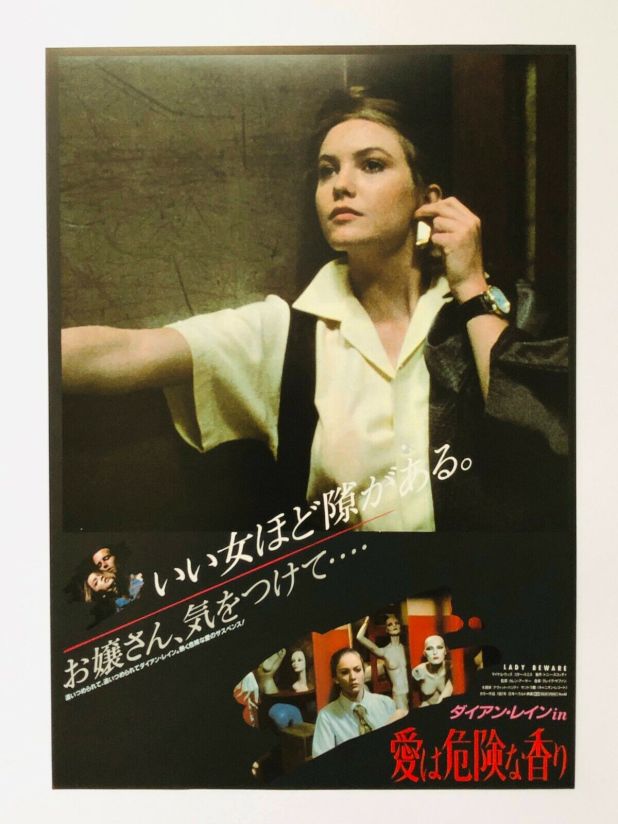
EDITOR’S NOTE: Lady Beware was on the CBS Late Movie on January 5, 1990. You can check out another take here.
There are precisely six movies in the subgenre—well, I invented it, and I don’t know who has to approve it. They are known as Yinzer Giallo. These are movies made in Pittsburgh that must follow these rules. We will test Lady Beware against them.
First off, is it a Giallo?
Has there been a murder, or is the lead character a fish out of water being stalked by someone and exposed to threats of psychosexual violence?
Yes: Katya Yarno (Diane Lane, making her second Pittsburgh/Western PA film appearance, as I always consider Ladies and Gentlemen, The Fabulous Stains as taking place somewhere in the Pennsylvania rust belt called Charlestown here, which is the same town as Slap Shot, so I guess it’s Altoona) is a fashion designer who has gotten the most desirable of all Steel City fashion jobs. She’s a window dresser at Horne’s.
Jennifer Woytek
A quick note: Horne’s was a regional department store chain based in Pittsburgh that, at its height, had twelve locations. The best known was downtown — it’s now offices for Highmark — located on Penn Avenue and Stanwix Street. It was a seven-story department store with a famous Christmas tree still lit as part of Pittsburgh’s Light Up Night. You can also see another Hornes in Dawn of the Dead, which inspired the character of Ben Joseph Horne on Twin Peaks, as co-creator Mark Snow went to Carnegie Mellon.
Other than creating the window displays for their rival store, Kaufmann’s—which leads to the yinzer term for minding your business, “Does Hornes tell Kaufmann’s their business?”—having this job would have been the job in 1987.
Anyways…
Katya is a small-town girl in a big city, which is funny because Pittsburgh is the smallest city. That said, her window dressings are pretty sexual and filled with allusions to BDSM, which leads to Jack Price, a married and obsessive maniac, starting to stalk her and call her with incredibly sexually depraved phone calls.
So, while there’s no murder or black gloves, there’s plenty of stalking. Katya may not feel guilty for her window scenes, but numerous men outside are positively scandalized and probably ran up to St. Mary of Mercy on Stanwix for absolution.
A Yinzer Giallo aside: Much like Rome, the kinda sorta birthplace by way of England and then Germany for the main Giallo form, the large number of Italian — and Catholic — immigrants to Western Pennsylvania makes Catholicism and its morals central to growing up here for many people.
Is there high fashion, beautiful people and abundant nudity?
There’s a ton of fashion in this. The costumes were designed by Patricia Field, who would be much better known for creating the clothes for The Devil Wears Prada and Sex and the City, a job she got after impressing Sarah Jessica Parker years before in the movie Miami Rhapsody.
As for the nudity, the one scene in which Lane is nude was supposedly taken while she was unaware.
Director Karen Arthur (The Mafu Cage) told the Los Angeles Times, “Some distributors asked for more sex, so they took outtakes of Diane Lane standing there naked and incorporated them into the film. To me, that’s exploitative. They printed up negatives where I never said print. I, as a female director, would never exploit a woman’s body and use it as a turn-on.”
The director nearly removed her name from the movie, but didn’t think it was fair to the actors, who couldn’t remove their names and do an Alan Smithee.
To be a Pittsburgh Giallo, the film must accomplish all of the above — when possible — and also:
Be true to its Pittsburgh roots, meaning that the movie must be filmed here while speaking directly to the experience of growing up in the city.
This is true because this movie could have been set in any store and chose Horne’s. Now, we can debate the industrial loft that Katya lives in—maybe it’s in the Strip District—but the fact that she has a bathtub in the middle of the room is very actual to the stylistic ideal of the Pittsburgh toilet, which is just a toilet in the basement with no walls, sitting there for very unprivate moments.
If filmed here, it must reference Pittsburgh and not have the city stand in for another town.
Executive producer Lawrence Mortoff had produced the 1984 Nastassja Kinski-starring Maria’s Lovers in Pittsburgh, so he brought the movie to the City of Bridges, getting 28 shooting days, mainly in Dahntahn and the North Side.
It must feel authentic, which helps several films on this list, as they are movies with moments that only make sense when you’re a lifelong Pittsburgher.
True to 1987, Pittsburgh Magazine shows up to report on the windows. And while there are a few Steelers jerseys and bottles of Iron City, Katya does go on a date to the Grand Concourse, which, other than LeMont, would have been one of the better places for a date back in the late 1980s.
Speaking of Pittsburgh, look for locals like Chef Don Brockett (who appeared on Mr. Roger’s Neighborhood and was legally bound to appear in every movie made in Pittsburgh, as he does in The Silence of the Lambs and Flashdance), Steel City stage legend Bingo O’Malley, and Audrey Roth (Mr. Roger’s friend Miss Paulifficate) in this.
Verdict: Yinzer Giallo.
Sadly, this movie escaped its director, who had worked on it since the late 70s. In the same Los Angeles Times article, Arthur said that the movie had “100 homes, 17 drafts, and eight writers” while being upset by the film’s production team at Scotti Brothers: “The purse-holders are men, and they attempted to make Lady Beware into a violent picture. I’m not interested in making a picture where a woman gets beaten up. I want to show how a lady deals with this kind of insidious violence. A policeman can’t help.”
Starting with the success of Leif Garrett — their record label also had James Brown in the late 80s, Felony, Survivor and “Weird Al” Yankovic — Scotti Brothers moved into movies and TV — they were involved in the production and distribution of Baywatch — and made the films The Resurrected, Eddie and the Cruisers II: Eddie Lives!, Eye of the Tiger (well, that makes sense seeing who was on the label), In the Shadow of Kilimanjaro, He’s My Girl, Stealing Heaven, The Iron Triangle and Death of a Soldier.
Who is to blame? One of the three Scotti brothers who produced this, Tony, would play Tony Polar in Valley of the Dolls; I don’t see any gossip about him. As for Mortoff, in addition to producing movies in nearly every genre, he directed one film, 1993’s Deadly Exposure. None of these things point to anyone, but regardless of who was to blame, Cotter Smith’s performance was cut down — he’d return to Pittsburgh to be in the series Mindhunter — and all of Viveca Lindfors’ parts were cut. She’d also come back to be in Creepshow and North of Pittsburgh.
However, this heavy-handed interference made the film confusing. And, look, Giallo can already be hard to understand.
It’s a shame because Lady Beware does have some moments where you can see that it has the hope of being a great film. The close — using mannequins to attack the male aggressor — suggests a more heroic female Maniac, which is an interesting turn.
EDITOR’S NOTE: Copacabana was on the CBS Late Movie on March 16 and August 1, 1988.
“Her name was Lola; she was a showgirl
With yellow feathers in her hair and a dress cut down to there
She would merengue and do the cha-cha
And while she tried to be a star
Tony always tended bar
Across the crowded floor, they worked from eight til four
They were young and they had each other
Who could ask for more?”
The third single from Barry Manilow’s fifth album, Even Now, “Copacabana (At the Copa),” was written because Mannilow was a regular at the club and asked co-writer Bruce Sussman if anyone had ever written a song about the club. Working with Jack Feldman, Sussman did the words, and Manilow did the music. The result? Mannilow’s first gold record for a song he wrote and his only Grammy, as he won the Best Male Pop Vocal Performance. It peaked at #8 in the U.S. but was a hit worldwide.
Dick Clark asked Manilow to make the movie, which was directed by Waris Hussein and written by James Lipton. Yes, the very same James Lipton you’re thinking of.
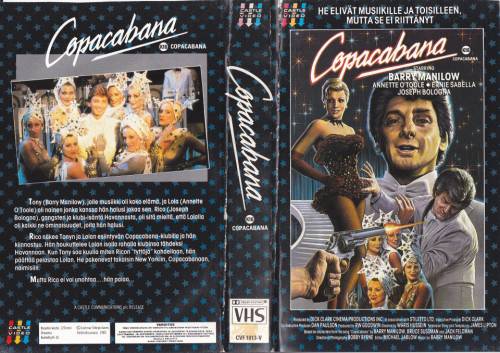
Manilow is Tony Starr, a bartender and aspiring musician who works with Lola Lamar (Annette O’Toole), who becomes a star in Havana working for Rico Castelli (Joseph Bologna). At the same time, Tony gets big at the Copa. The song plays out, and you learn “who shot who,” as the movie ends with an older Lola sitting on a bar stool, drunk and lamenting the loss of Tony and not seeing disco, but instead her dancing with him.
This movie upset my family to the worst of degrees, depressing everyone by the end. I don’t know what we expected, as the song is a downer. But we hoped things would be changed for the movie.
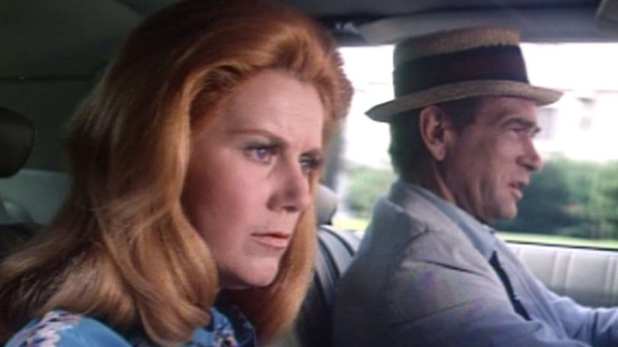
Sadly the last episode with Gordon “Gordy the Ghoul” Spangler (John Fiedler) and nemesis Ron Updike (Jack Grinnage) — the show was already canceled — “The Youth Killer” has great casting for its femme fatale. Cathy Lee Crosby is Helen Surtees, a woman using Max Match, the computer dating company she owns, to find men and then sacrificing them to Hecate so that she can remain eternally gorgeous and young. One of those men is Reb Brown, who just a few years later would play Captain America, a fun bit of trivia as Crosby had played Wonder Woman in a TV movie just a year before.
The authority figures in the way of our reporter hero are Sergeant Orkin — that’s Dwayne Hickman, the grown-up Dobey Gillis — and a cop named Kaz, who is played by someone named Demosthenes. That’s the middle name of George Savalas, Telly’s brother.
Carl, as always, goes up against the supernatural menace all by himself and barely survives, leaving behind a statue of Helen and no way to prove any of it. Sadly, this would be the next to last episode.




 B&S About Movies
You must be logged in to post a comment.