SHUDDER EXCLUSIVE: Boris Karloff: The Man Behind The Monster (2021)

Thomas Hamilton, who directed this movie and co-wrote it with Ron MacCloskey* (also the writer of Karloff and Me), had a big task when making this movie. Horror fans love Boris Karloff, so what new things can we learn about someone that we know so much about? And is what we know merely his roles and not the real man behind the mask?

To tell the story, there’s a tremendous cast of people on hand, everyone from Caroline Munro, Christopher Plummer, Stefanie Powers, Lee Grant and Ron Perlman to Guillermo del Toro, Peter Bogdonovich (who directed what Karloff wanted to be his last film Targets) and John Landis. Oh there’s more — Roger Corman, Jack Hill, Joe Dante, Leonard Martin, Donald Glut and even Bela Lugosi Jr. and Sara Karloff.

I learned from this film the fact that Karloff — born William Henry Pratt — was an Anglo-Indian who dealt with prejudice for his looks and a family scandal, two subjects that he would never discussed. Or that he struggled until 1931’s The Criminal Code, a Howard Hawks movie, and of course Frankenstein.

Even before he was a star, he was once waiting for the bus in the pouring rain and was picked up and given a ride by an actor he didn’t know: Lon Chaney Sr., who told him “to find something different that will set you apart and is different from anything someone else has done or is willing to do and do it better.” At the time, Karloff was working backbreaking — literally — manual labor jobs to subsidize his family when acting wasn’t paying.

Karloff acted in eighty movies before the “overnight success” that came from being discoverd by James Whale and cast in Frankenstein. The part may have typecast him for life, but Karloff even had the opportunity to play Broadway in Arsenic and Old Lace and played non-monster roles for Val Lewton in The Body SnatcherBedlam and Isle of the DeadKarloff said Lewton had the man “rescued him from the living dead and restored his soul.”

Beyond a litany of the roles that Karloff played so well — TV like Thriller, Bava’s Black Sabbath, Michael Reeves’ The Sorcerers, Corman’s The Raven, the voice of the Grinch, the Jack Hill directed Mexican films Isle of the Snake People, The Incredible Invasion, Fear Chamber and House of Evil and many more — the film shows you who Karloff was as a person, including a moving appearance on This Is Your Life.

There’s so much more to discover — how Karloff felt about the Fu Manchu movies, the fact that he wasn’t even invited to the premiere of Frankenstein, the pain he was in at the end of his life yet how he could still turn it on and perform — in this delightful movie. A man that didn’t become a scar until 44, who overcame racism, a lisp and the tough world of Hollywood rejection was able to become not just a star, but a legend.

Trust me — this is more than recommended watching.

*McCloskey travelled internationally to conduct research for the documentary for over a period of 23 years!

You can watch this exclusively on Shudder and learn more at the official site.
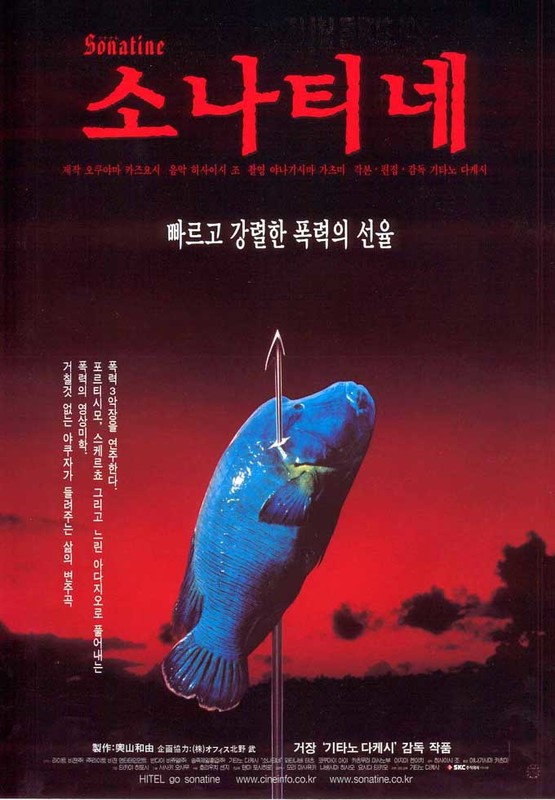
Sonatine (1993)

ABOUT THE AUTHOR: Jennifer Upton is an American (non-werewolf) writer/editor in London. She currently works as a freelance ghostwriter of personal memoirs and writes for several blogs on topics as diverse as film history, punk rock, women’s issues, and international politics. For links to her work, please visit https://www.jennuptonwriter.com or send her a Tweet @Jennxld

In Sonatine (1993), Takeshi Kitano plays Murakawa, a tired Yakuza who is sent to Okinawa with his cohorts to calm a gang feud, which turns out to be a ruse for his boss to take over his territory in Tokyo. The movement of the group of men from the city to a rural location moves the violent gangsters into a state of regressive childhood, allowing for Kitano to explore the theme of identity via travel and humour. Their journey begins with a group shot of the men sitting on a bus waiting to leave the airport in Naha. Not only do they resemble school boys on a field trip with blank, bored expressions on their faces, seated geometrically, but their Yakuza connection who greets them goes so far as to offer them drinks and ice cream, looking very much like a school trip chaperone in his T-shirt and baseball cap. 

Symbolically, this is the beginning of the journey into the final stage of life for the men, which at once is signified by their being represented as children. It’s a theme Kitano would explore again in 1999’s far warmer Kikujiro. 

Once they arrive at the beach house, which serves as the primary location for the rest of the film, the men engage in child’s play acting out Sumo tournaments and having pretend gunfights with fireworks. In this location, at least temporarily, the men are free from the violence of their urban lives as gangsters and in what is effectively a holding pattern, waiting for something to happen between their superiors (the symbolic parents), free to play at their leisure. Unlike Kikujiro, which has a happy ending, Sonatine ends with violent acts of revenge and death. Kitano is a hell of a director, having more than earned the international awards won for this film. 

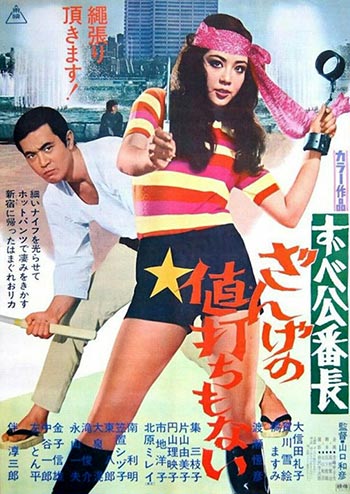
Delinquent Girl Boss: Worthless to Confess (1971)

The fourth film in this series has a similar set-up to Delinquent Girl Boss: Blossoming Girl Dreams, with Reiko Oshida’s Rika getting out of reform school and working for the mechanic father of one of her classmates, who is of course being muscled in on by the Yakuza. Have they learned nothing from the other movies?

The end of this film, where the five female leads wear red overcoats and literally walk in high fashion to the mob boss’ lair with the soundtrack blaring was taken and used by Assassination Nation, but trust me, this movie is a billion times cooler than that film can ever dream of being.

Obviously, reform school has only made Rika tougher, but also more concerned about her friends, her community and others, while the Yakuza only wants to take everything they can. That’s why she’s a hero, even if the world only sees her as a girl that needs tamed.

These films in no way get close to the excesses of this genre, but are certainly worthy of your time.

Meatball Machine (2005)

Yūdai Yamaguchi keeps showing up on our site, but when you make movies like Battlefield Baseball and Versus, you get as many entries as you want.

Based on the 1999 film written, produced and directed by Jun’ichi Yamamoto (who co-directed this) and featuring effects by Yoshihiro Nishimura (Kataude Mashin GâruKyûketsu Shôjo tai Shôjo Furanken), this film has two geeky would-be lovers who never really get together, as Sachiko ends up penetrated not by Yōji, but by the NecroBorg in his room. Instead of the love that they wanted to experience, they must battle to the death, and by battle to the death, I mean a war that explodes viscera and blood and meat and organs all over the place.

As a kid, I always dreamed of getting to transform into something better, like Ultraman, but the reality would probably be that I’d be one of these gory creations, battling for the joy of some high pitched alien floating in space that can’t wait to eat me.

This isn’t the kind of movie I’d watch on a first date, unless you’ve found a partner that likes movies that have ten minute long grossout fights and try to make Tetsuo into something directed by Herschell Gordon Lewis. And if you find them, keep that unicorn and treat them like the magical and special royalty they assuredly are.

You can watch this on Tubi.


Another Heaven (2000)

Tough old cop Inspector Tobitaga (Yoshio Harada) and young Inspector Manabu (Yosuke Eguchi) are on the case of brutal murders that start with a missing brain being found boiling in a stew and everything just gets weirder from there, because the killer can change bodies, so he or she can be anyone.

It’s a great idea — see The Hidden and Fallen — and this would be a much better movie with some trimming. I mean, 130 minutes is a long time and I apologize for my attention span, but I wanted a little more.

That said, the call girl killer for the first half of the film is quite sinister, packing plenty of murderous intensity into her small size. Between this and Audition, I imagine that Western boys who are obsessed with Japanese girls will always have horrible death in the back of their heads.

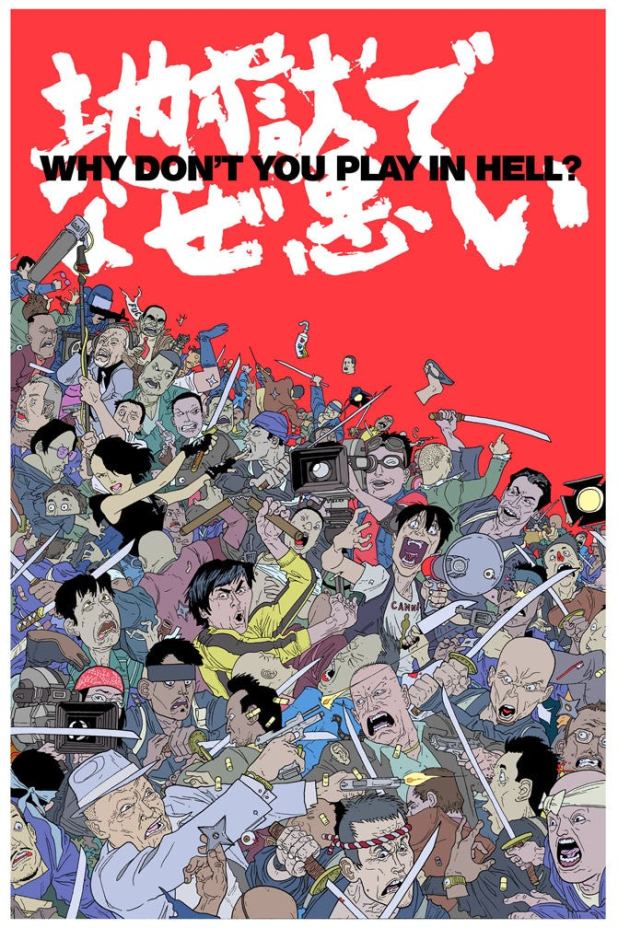
Why Don’t You Play In Hell? (2013)

How much do you love cinema? Are you willing, like the threesome known as the Fuck Bombers in this movie, willing to put your life on the line to film real violence in the guise of creating a good movie? Will you be like the crime boss Ikegami, who is so obsessed by samurai films that he turns his gang’s base into a castle and forces everyone to wear costumes? Or would you be Sasaki, a man who other see as potentially the next Bruce Lee?

Why Don’t You Play In Hell? finds the Fuck Bombers separated ten years after their failed prayer to the God of Cinema, hoping to finally make a movie they can be proud of.

In the past, a mob boss named Muto defeated a home invasion, killing everyone but Ikegami. Now so many years later, they have both gained followers and are destined to battle one another, as the Fuck Bombers have the destiny of capturing it all on film.

Here’s to director and writer Sion Sono, someone who is so willing to make it great while keeping it weird as it gets. I get the feeling that much like his heroes in this film, he is willing to die to create something that pleases the God of Cinema.

We should all love movies. We should all be willing to die for them, but as you will discover, Fuck Bombers never die.

You can watch this on Tubi.

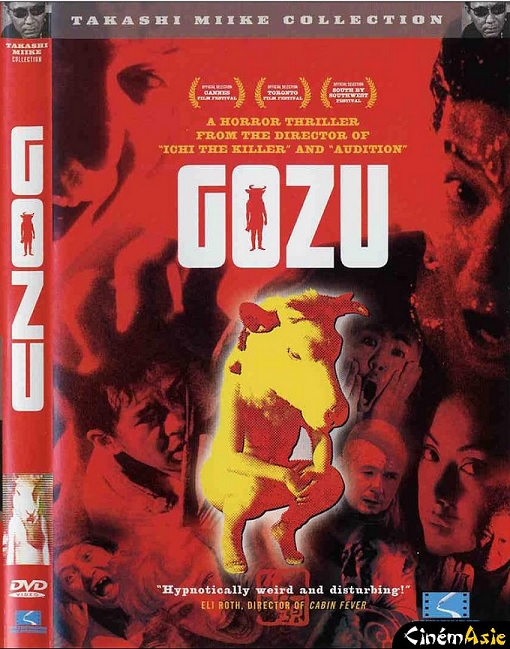
Gozu (2003)

What can I possibly say about this bizarre (which is an understatement if there ever was one) Takashi Miike low-budget direct-to-video horror — with its mix of mobsters and ghosts and breast milk and cow-headed men — that hasn’t already been said. For if you are a Miike fan, you’ve seen it. If you’re a fan of Asian cinema, you know it well. If you’ve seen Miike’s Ichi the Killer (WTF) and Audition (WTF x 10) and you haven’t seen Gozu, then turn in your B&S About Movies’ membership card, for ye were never a member.

You didn’t see his contribution “The Box” in the Japanese portmanteau Three Extremes?

Just stop it. You’re embarrassing yourself. Isn’t there a Jennifer Aniston Oscar-chasing-never winning boondoggle you need to stream?

Sure, everyone drops the justified “David Lynchian” critical modifier to help us dopey Americans get a handle on the twisted insanity. And yeah, I am sure Guillermo Del Toro and Eli Roth — who offer up their own insights with their joint interview with Miike on the DVD — are the go-to guys for Gozu Intel with a whole-lot-of-what-do-we-need-this-digital-critic-from-Pittsburgh-for scoffing.

So, let me give an overview . . . for the ones who haven’t experienced the . . . something else . . . world of Miike. And that the title’s literal translation is: Yakuza Horror Theatre: Cow’s Head. And a caveat: Forget the guy with the cow’s head: if the killing of a chihuahua — an “attack” chihuahua — bothers you: stop watching. No. Watch. Just close your eyes for about twenty-Mississippis, well, in context: twenty-Shinano Rivers, then open. But there’s that gooey . . . and the slimy. . . .

Yes. Gozu is about — partly — a cow’s head. It’s also a gangster film. Then it’s not. Then what is it? A horror film? A comedy? There’s nothing is the works of Lynch, be it from film with Eraserhead to television with Twin Peaks, that can prepare you for this tale of an up-and-coming yakuza who receives orders to assassinate his boss, who happens to be his best friend. And when his boss catches wind, he goes into hiding. And if our young yakuza doesn’t complete the sanction, he dies. So begins our journey into a twisted, mysterious town where nothing is as it seems or nothing is as it should be — with a nightmare that would make Lynch flinch.

Dumplings: More crazy, Asian cinema of the Lynchian variety.

This is a film where you can’t rat-a-tat-tat the plot in a review; for in the tradition of the best Spanish and Italian horrors of ’70s, Gozu — or any Miike Joint — is probably not going to make a hell of a lot of sense (see Dead or Alive and The Happiness of the Katakuris). And the character’s motivations are dumbfounded and sometimes lacking in any development for you to care about them (One Missed Call). But as with those overseas horrors (this is black-comedy-cum-horror, like Sam Raimi’s comedy-gore of The Evil Dead, if that helps) of old, we never came for the plot or the characters in the first place: we came for the atmosphere and what-the-hell-why not Chunk King-toss to the walls. And Miike is brilliant for it.

You can watch the trailer and an extended interview with Takashi Miike on the making of Gozu on You Tube.

You can free-with-ads stream Gozu on Tubi. If fact, Tubi streams several of Miike’s films. They have the sci-fi’er Terra Formars, which I really liked: how can I not, as it’s about cockroach men on Mars, as well as the really fine 13 Assassins. Remember when, in the 2000s, when every single J-horror movie was getting Westernized? Don’t do it: go to the source.

And the “source” is Takashi Miike.

About the Author: You can read the music and film reviews of R.D Francis on Medium and learn more about his work on Facebook. He also writes for B&S About Movies (links to a truncated teaser-listing of his reviews).

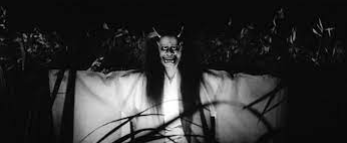
Onibaba (1964)

ABOUT THE AUTHOR: Jennifer Upton is an American (non-werewolf) writer/editor in London. She currently works as a freelance ghostwriter of personal memoirs and writes for several blogs on topics as diverse as film history, punk rock, women’s issues, and international politics. For links to her work, please visit https://www.jennuptonwriter.com or send her a Tweet @Jennxld

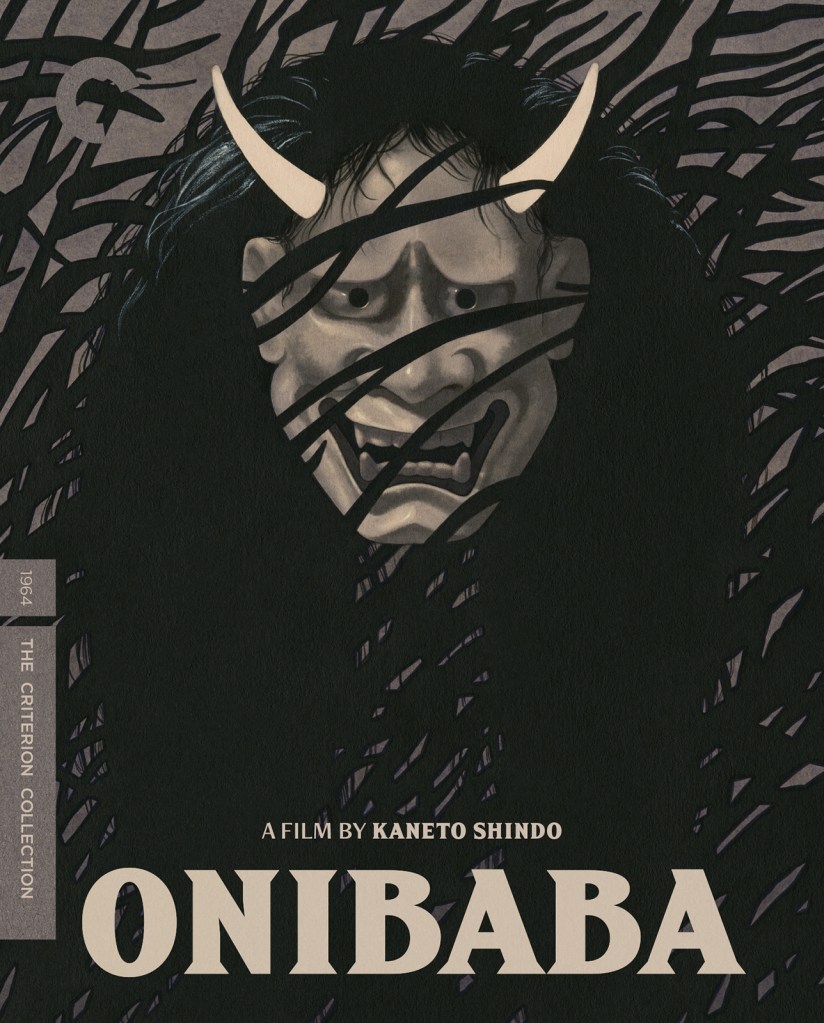
In Japanese, the word oni おにmeans demon andばばmeans old woman or hag. In this case, we are dealing specifically with a sexually repressed meddling mother-in-law. Onibaba is set in feudal Japan during the bloody civil war period that preceded the Tokugawa period. An unnamed old woman (Nobuko Otowa) and her daughter-in-law (Jitsuko Yoshimura) are forced to kill wandering warriors and sell their armor for food in order to survive while they wait for the man of the house to return.  One day, neighbor Hachi (Kei Sato) returns to tell the old woman that her son is dead. The old woman is suspicious of whether or not Hachi killed her son but allows him to stay around because he is useful. Relatively quickly, Hachi and they newly-widowed young woman begin an affair. Needless to say, the old woman is not very happy about this and does everything in her power to keep them apart. She constantly talks of sin and watches her daughter-in-law like a hawk. Despite the old woman’s best efforts, the young woman still manages to sneak out and have hot, sweaty summer sex in the tall grass while the wind blows on the soundtrack.  

One night a Samurai wearing a frightening bull mask visits the old woman and asks her to lead him through the fields to the nearest road. Seeing an opportunity, she kills the Samurai, takes his mask and proceeds to use it to scare her daughter-in-law by pretending to be a demon. For several nights, the young woman’s plans to meet her lover are thwarted, sending her back to her hut in tears. One night, Hachi finds her screaming in the rain and convinces her that demons do not exist. The two make love while voyeuristic mother in-law looks on, her own internal emotions symbolically flashing on the screen and soundtrack via lightning and thunder.  


Nobuko Otowa as the old woman is a stand out.  Her cat-like facial expressions, spying and manipulation might very well ring true to many viewers who have difficult mothers-in-law. Technically, this film is a fine achievement and is today taught in many film schools as a classic example of the post-war Japanese cinema era. The black-and-white cinematography is gorgeous. The grasses of the fields blow ominously in the wind around the characters’ meager huts, conveying a desperation to the characters’ existence rarely seen in modern cinema. The heat of the Japanese summer almost radiates from the screen as the sweat glistens off of the women’s work-stained flesh. Disturbing screams of pain enhance the minimalist soundtrack adding to the uneasy feeling of the whole piece. 

The film concludes in a none-too-happy, supernatural manner for everyone involved, especially the mother in-law. Onibaba was based on a famous Japanese legend/morality tale (which explains the lack of character names) and all humans are punished for their evil deeds. Onibaba is an enjoyable suspense-drama that is definitely worthy of a look. 

Cyber Ninja (1988)

Also known as Mirai Ninja: Keigumo Kinin GaidenWarlord and Robo Ninja, this is one of the few successes I can think of when it comes to making a movie out of a video game.

In a future time — hey let’s call it 200X, that line never gets old — cyborgs and humans at war when one of the cyberninjas decides to save a human princess destined to be sacrificed to the machine gods. And if Shiranui the cyberninja ends up being related to the humans and hoping to find his old body, then so be it, and so be machines that have moved beyond zeros and ones to their own digital religion that can summon demons.

Director Keita Amemiya also made Moon Over Tao: Makaraga, which is another wild take on traditional Japan myth mixed with future tech, and Zeiram amongst many other efforts. This looks absolutely wild and you know, do you need an involved story when you have walking feudal buildings and ninjas with laser swords?

There’s a bad guy named Dark Overlord — at least in the English dub — and the evil army is called the Lords of Darkness, so this is like the drawing a metal kid would make in their notebook when they should be paying more attention in school, but no, they should in no way be paying attention because if I paid less attention and drew more and only cared about movies more, my life would be infinitely better than the drone to the grave workaholic that I grew up to be.

ARROW BLU RAY RELEASE: Sleep (2020)

EDITOR’S NOTE: We originally wrote about this movie on November 2, 2021 when it was offered on the Arrow Player. Now that Arrow Video is releasing it on blu ray, we’re sharing it again. 

The new Arrow blu ray release of Sleep features an audio commentary by film critic and historian Kim Newman with author Sean Hogan, visual essays by film scholar Alexandra Heller-Nicholas and film critic Anton Bitel, an interview with anthropologist, dream researcher, and filmmaker Louise S. Milne, a conversation with director Michael Venus and star Gro Swantje Kohlhof, a compilation of film festival introductions created during lockdown by director Michael Venus and the cast, behind the scenes footage and deleted scenes, a trailer, an image gallery and even a feature called Marlene’s Sketches, which allows you to explore the many obsessive dream journal sketches that are briefly shown in the movie. You can order Sleep now from MVD.

Tormented by recurring nightmares of a place she has never been, Marlene becomes tormented by the idea that this place could be real, so she has a breakdown. Her daughter Mona follows the same path her mother was on and ends up in Stainback, a small village with a big secret and a population as obsessed as her mother.

The Sonnenhugel Hotel leads to ultra-vivid dreams for both mother and daughter, dreams of the suicides of multiple men and visions of strangulation. Meanwhile, the kindly hotel owner Otto actually dreams of bringing Germany’s power back in ways that are frightening in today’s political climate.

Michael Venus has only made shorts before this, but this is a confident blast to the brain filled with murder, strobing lights and abrasive metal when it isn’t about long and languid dreams of death.