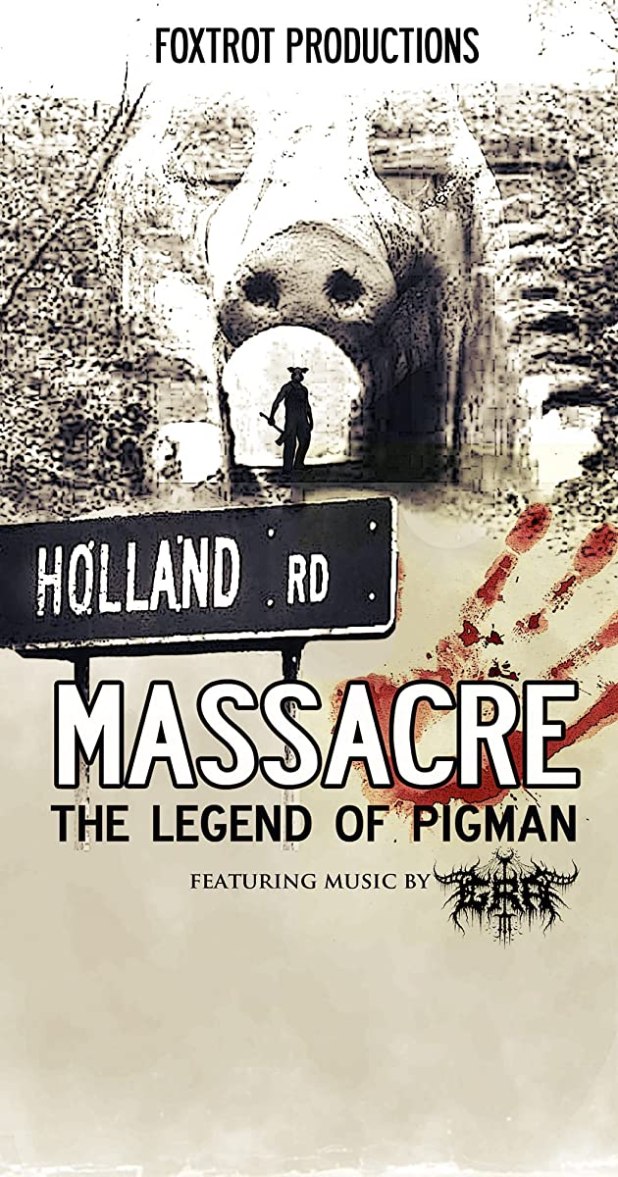
In my town, there were urban legends of the Green Man — which were true, he was burned by either a fallen power line or lightning strike and his face was destroyed — and every town has similar tales. This movie has the Pigman, which a couple soon discovers is an absoutely true and very deadly story.
This movie seems engineered for optimum murderdrone, but I’m not sure that’s a thing you can just make up. It’s like trying to give yourself your own nickname. But the slow motion snow-based murders that are stuttered and cross-cut and smashed together and the multiple storylines all happening at once are all going to try.
That said, Holland Road in Angola, NYis really called Pigman Road because of an urban legend. Turns out that there may have been — but probably wasn’t — a deranged butcher that would put pigs’ heads on stakes outside his shop before one time that he shot a man and hung him outside for cars driving past to see. There was also a major train accident in the 1860s.
Director and writer Emir Skalonj is behind this one. There are some ideas at play here, the killer looks pretty good and it has a budget of what you spent on Christmas gifts this year. You can learn more on the official Facebook page.
Sally and Bob have been married a year and there’s some good news. It seems like she’s pregnant. That means they go to see Dr. West, who has no idea what HiPPA laws are or the privacy of the patient and we learn about how Sally had a baby with Bob’s best friend who died in World War II and their issues with VD and when things get weird, he makes them watch some other movies within the movie like The Story of V.D., The Story of Reproduction and The Story of Life and oh man, throw away your popcorn because you know it’s time to see diseased vaginas and penises. Let’s throw in a cesarian and regular birth, because the people demand it!
After the movie, perhaps you’d like to purchase The Mid-Century Marriage Guide?
Director Howard Bretherton made a hundred or so low budget westerns and was a master of editing in camera, a skill he passed on to his son David Bretherton, who edited Cabaret and Westworld, and his granddaughter Gillian L. Hutshing, who was on the editing team for Blade Runner, Rad, Eyes of Fireand The Monster Squad.
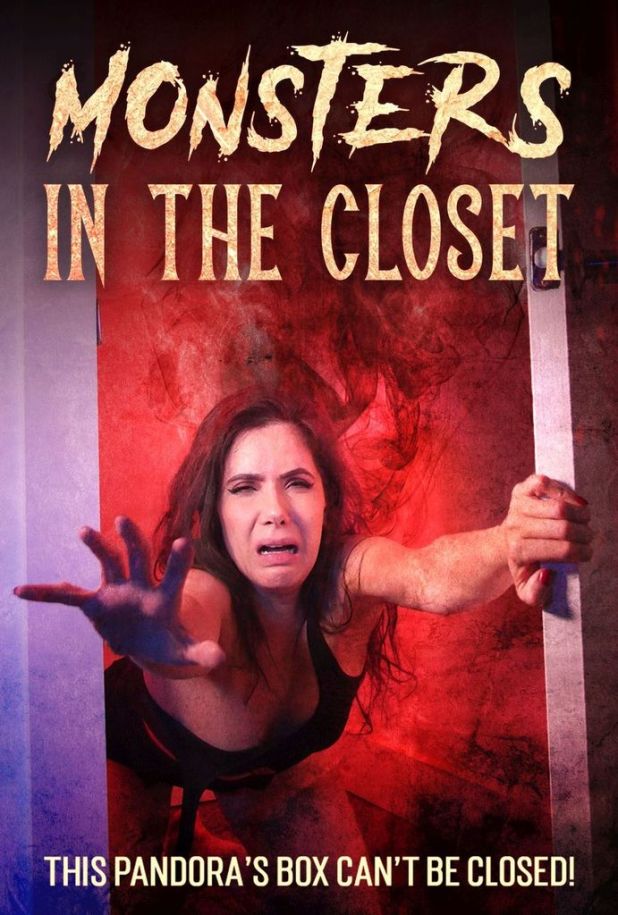
When famous horror author Raymond Grant dies under mysterious circumstances, his daughter returns home — oh man, how many times do I have to tell horror movie characters to never go back home and never settle affairs and never try to get any answers — to investigate his death.
Jasmin learns that her father wasn’t just writing about black magic, he was using it to finish his new book. And when the audiobook gets played, all manner of creatures emerge into our world. This story forms the story around several other shorter tales that play out in this anthology.
In “Please Kill Me Again,” a woman (Denyse Arlene Hollis, who co-wrote the story) is bitten by zombies and then decides that she wants to be killed by a human so she doesn’t have to live in that undead body. “Home Improvement” shows what happens when Tian and Zeke ( Luke Couzens and Carmilla Crawford) can’t agree on a plan to fix up their new home with potentially horrifying results. “The One-Percenters” is about just how far the rich will go to cover up a crime — even a camping trip with numerous people isn’t safe. Finally, “Frankenstein’s Wife” is about a man accidentally killing his wife and bringing her back again and again until she’s happy.
All horror anthologies — even the best ones — have their highs and lows. This one has many more highs though, which is more than I can say from the majority of the unconnected horror portmanteau movies that get sent out way. The connective story and writing by The Snygg Brothers makes this one a winner.
Monsters in the Closet is available on digital and on demand from Gravitas Pictures.
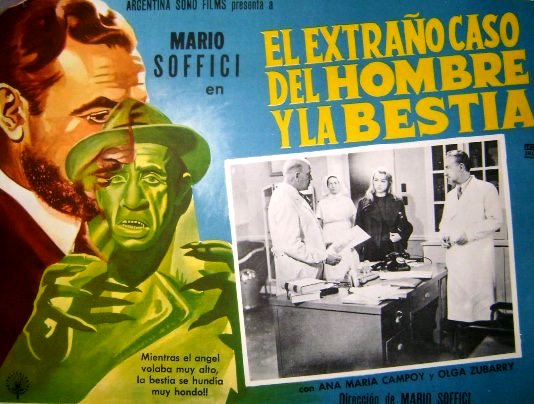
Yet again, Dr. Henry Jekyll has decided to try to discover the dark side of man and the nature of evil, but ends up releasing the dark side. This time, however, the movie is made in Argentina, which at least lends it some level of interest.
This was a dream project of actor/director Mario Soffici, who is the lead. That said, if you’re expecting a movie filled with action, this is not the one you are looking for. It’s mostly talking and even when Mr. Hyde shows up, he just has an odd hairstyle and knocks a kid down. That’s it — nothing much to report of how wild he can be.
That said, how often are you going to get to watch a 1950’s horror movie from Argentina?
One look at that theatrical one-sheet combined with that title: you know you’re getting a space comedy that owes its clever cues to John Carpenter’s Dark Star (1974).
Sure, we could mention the quicky-came-and-quickly-forgotten Space Station 76 (2014), itself a retro-parody of ’70s science fiction television series that used Gerry Anderson’s UFO and Space: 1999 for all of its costume, set and model cues. As result of that Liv Tyler-starrer (in spite of her presence) resembling those British-made, Century 21 Television/ITC Entertainment imports-to-U.S. television, I eagerly anticipated the arrival of Space Station 76 . . . and it was a huge disappointment (Liv Tyler f-ups another movie, for me) ejected from my below-the-waistline, rear celluloid airlock. Remember how Spaceballs was hilarious with its on-the-sleeve humor, while the The Ice Pirates certainly looked better but was “meh” in a post-Star Wars world? Remember how Galaxina was nerf herder-scuffy and Spaced Out (aka Outer Touch) sucked dianoga tentacles?
Well, for me: Space Milkshake spins to the Spaceballs side of the vortex.
Yes, Space Milkshake fluxes my capacitors over the puerile, dead-in-space-before-it-even-hit-the-big-screen Leslie Nielsen-starring Alien parody Naked Space (1983), as well as his other space “comedy,” 2001: A Space Travesty (2000). Don’t even get me started on Eddie Murphy’s The Adventures of Pluto Nash (2002) — a movie so painful that Sam or myself (or any B&S guest writer) wanted to cover that $120 million dollar turd for our “Box Office Failures” week of films (and it is noted as the #1 biggest of bombs). Amid those flurry of “space comedies,” however, I enjoyed — to the chagrin of many — Mike Hodges’s Morons from Outer Space, so what do I know?
Okay, back to Space Milkshake.
While not as deadpan in its its funny-dry humor as Dark Star and not as slapstick as a Mel Brooks galactic joint, Space Milkshake is more aware of its ancestors and goes for the “fan humor” of the genre. So, think Shaun of the Dead (2004) set on a space station in terms of humor. When it comes to the sets, reflect back to your days of watching Hitchhikers Guide to the Galaxy and Red Dwarf on public television (in the States). If you’re a fan of Blake’s 7 or the Tom Baker-era of Dr. Who, you’re in the sector of space you need to be.
Owning up to Dark Star: one of the off-screen characters referenced is named Professor Gary Pinback: after Sergeant Pinback from Dark Star. As with the Carpenter progenitor: the crew deals with the boredom of space and hygiene issues. They play board games. However, unlike Dark Star: there’s two females on board, so there’s a comical, sexual innuendo component. In the second half, as in Dark Star, the tedium breaks when the “monster” appears: Dark Star had a beach ball with claws. Here, we have a mutated-enlarged rubber duck on a rampage. In between, the crew deals with the fact that all life on Earth has ended — and there’s that pesky time flux that zips them between various dimensions and timelines.
QUUUACK! Don’t call me a dianoga, you scruffy nerf herder.Go eat daggit dung!
As with the Nostromo before them (and Buck Henry’s of Get Smart! fame creating the garbage-hauling Quark starring Richard Benjamin in 1977): we have four blue collar astronauts employed on a Sanitation Station responsible for collecting space garbage from Earth orbit.
Jimmy (Robin Dunne) is the station’s newly-arrived, socially awkward computer technician. He’s welcomed by a dickish Captain Anton (Billy Boyd) who’s just broken up with his fellow crew member, the statuesque beauty queen Valentia (Amanda Tapping). The other female of the crew, the Ripleyesque Tilda, quickly becomes Jimmy’s love jones.
The ludicrous plot twists ensue as Anton and Valentia discover a glowing trinket from the salvage of an abandoned space shuttle. The “Time Cube,” accidentally activated, the station loses all contact with Earth as Tilda begins acting oddly — and discovered to be an android. Then a rubber duck — identical to the one given to Valentina by her ex-lover, Professor Gary Pinback — slams into ship. Brought on board by Valentina, it grows (and has George Takei’s voice). It is soon learned that Pinback, via the duck, is possessed by the galactic evil responsible for the “Time Cube” and is bent on universal conquest.
Yes. The above paragraph about mutant tub toys voiced by a Star Trek alumnus, time cubes, and androids is real. I did, in fact, write it.
It is reported this cost $300,000 to make — and this film looks great for a film made for less than a half million dollars; it certainly stands tall against its raison d’etre, Alien (1979), which cost $11 million and came to clear over $100 million during its initial box office. At its reported price, I see no reason why Space Milkshake didn’t — at the very least — break even on its production costs through cable buys and streaming rentals (it never saw a theatrical or hard media release). Again, it’s a fine film that looks great; however, make no mistake that the proceedings in Space Milkshake are still more Full Moon (the monster, seen above, takes me back to the alien mayhem in Bad Channels) than 20th Century Fox: but that’s not a bad thing, for Full Moon (and its previous incarnation as Empire Pictures) had their moments (Robot Jox).
The film had a trouble production that, according to Playback Magazine, began in the winter of 2011. The production was stymied — according to the Hollywood Reporter — by the provincial government of Saskatchewan, where the film was shot, closing out their refundable tax credits program: a tax credit that “funds” productions due to films contributing to the local economy through jobs and crew members frequenting area businesses.
Never intended for a theatrical release in its homeland, Space Milkshake premiered on the Canadian television channels The Movie Network (now known as Crave) in February 2013, then in March on Movie Central (defunct; 2016). Never picked up for U.S. cable distribution (Why, not Syfy? It had Amanda Tapping from Stargate, which you rerun.), Space Milkshake made the U.S. film festival rounds in 2013, in addition to the festival circuits in Australia, New Zealand, and the United Kingdom. It began appearing on streaming platforms outside of Canada in 2015.
Armen Evrensel effectively wrangles all of the touchstone plot elements of the genre, along with cheap, but well-made sets and costumes (think 1980’s Battle Beyond the Stars) and schlocky, but better than ’70s British sci-fi series special effects. The cast is a shaken to perfect chemistry ensemble fronted by the instantly recognizable and perpetually likeable Robin Dunne (TV-familiar “Will Zimmerman” from Sanctuary and a few Lifetime Christmas flicks), along with Billy Boyd (yes, “Pippin” from Lord of the Rings), Kristen Kreuk (“Lana Lang” from TV’s Superman spinoff, Smallville), and Amanda Tapping (the Stargate TV series-verse). Oh, please tell us you do not need us to tell you who George Takei is.
Writer and director Armen Evrensel made his feature film screenwriting debut with the Canadian-produced romantic-drama The Zero Sum (2009), an inventive, unique tale about a mugger (a great turn by Scottish actor Ewen Bremner; yes “Spud” from Trainspotting) who falls in love with one of his victims. While Space Milkshake served as his second feature screenplay and his directorial debut, Evrensel hasn’t made another film, since, and since moved into television in other disciplines. That’s a shame because his wacky take — across the same comedic stars explored in the earlier frames of Galaxy Quest (1999) — is infectiously nuttier than that Tim Allen annoyance. Space Milkshake should have been a harbinger for more feature projects.
You can enjoy Space Milkshake as a VOD on You Tube Movies or as a free-with-ads stream on Tubi. Amazon no longer offers it as a stream, but if you want to avoid the ads and prefer not to use You Tube, it is still available on Google Play, iTunes, and Vudu. Be wary of those DVD-r, as this has never been official issued to DVD. You can sample the trailer on You Tube.
Films like Space Milkshake and the short-lived U.S. television series Quark joke about “junk in space,” but the reality is that it’s a very realproblem. B&S About Movies frequent reader and fellow WordPress’er Peter Adler breaks it down with his “Garbage In Space” post — which turns you on to the 360-degree tracking map, Stuff In Space. See? Fascinating stuff and not just junk films are to be had at B&S.
Be sure to visit these past features with more sci-fi in space and other obscurities! Click those pics!
About the Author: You can read the music and film reviews of R.D Francis on Medium and learn more about his work on Facebook. He also writes for B&S About Movies(links to a truncated teaser-listing of his reviews).
ABOUT THE AUTHOR: Jason Kleeberg is the host, writer, producer, and editor of the Force Five Podcast. In addition to being a podcaster, he’s a Blacklist screenwriter (The Gumshoe, Powerbomb, Anglerfish), filmmaker (Clarks), and Telly Award winner (2005) from the San Francisco Bay Area. He’s also an avid physical media collector. When Jason isn’t watching movies, he’s spending time with my wife, son and Xbox — not always in that particular order. This article originally ran on the Force Five site.
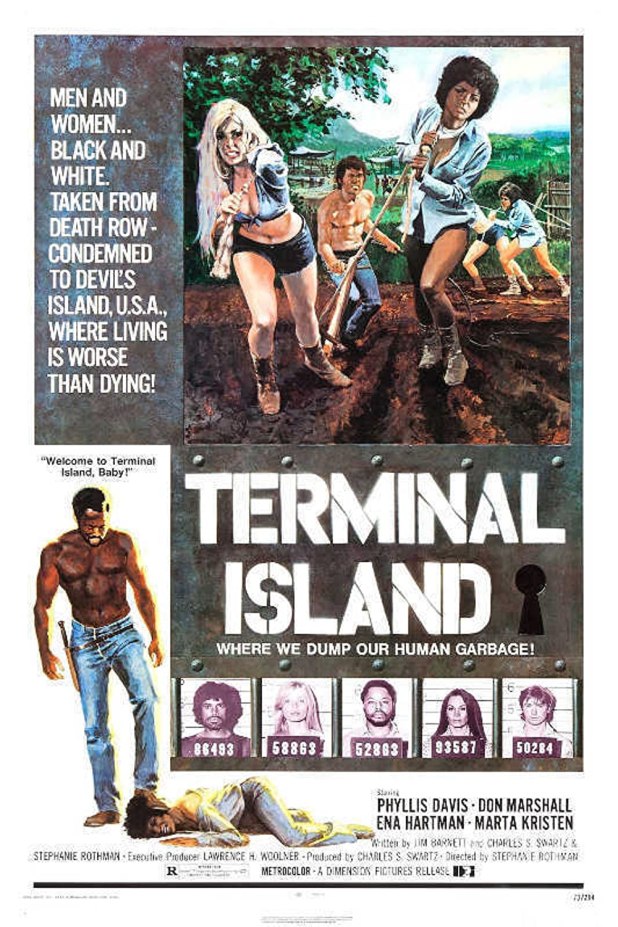
Terminal Island (1973)
Directed by Stephanie Rothman
Written by James Barnett, Charles S. Swartz and Stephanie Rothman
Starring Don Marshall, Phyllis Davis, Tom Selleck, Barbara Lee, and a shit load of denim
California has abolished the death penalty so they chuck all of their worst prisoners onto an island called San Bruno and let them do whatever they want there. The small group of prisoners has split into two factions – one that keeps women as sex slaves, and one that milks goats and has Tom Selleck.
Terminal Island is a slice of pure, 70’s exploitation trash. Directed by Stephanie Rothman, it’s less of a women in prison film and more Lord of the Flies. The story starts as a woman named Carmen Simms is dumped onto the island. She’s the audience surrogate, introducing us to the horrors she’s about to encounter as she’s immediately taken into the camp run by Bobby and Monk. There are a few other women there, but they are used as sex slaves, only there to serve the men…so much so that there’s a literal schedule each night for who each woman is assigned to “service”. AJ, a more liberal prisoner, has started his own society with a few other refugees. One night they free the women, leading to an all-out war between the two factions when Bobby and Monk realize their slaves are gone.
This film checks all of the exploitation boxes – the tough talking black guy, the creepy white chauvinist pig who tries to sexually assault someone every thirty minutes, blood that looks like the brightest candy red nail polish you can buy at Sephora, and killer dialogue like “Are you calling me a liar?” “I’d never call you that…I’d call you DEAD.” It’s quite a bit of fun, and although the typical lulls in between the action that were necessary to pad the run-time for low budget flicks are still here, they’re never really boring enough to allow you to get lost in your phone before the next battle begins.
One standout scene includes a woman getting revenge on the creepy rapey guy as she acts like she’s going to seduce him, puts honey on his dick and ass, and then smacks a beehive as he runs away in a panic. It’s like something straight out of an Austin Powers film. Speaking of dumb decisions, another scene has our bad guys pent up in a small hut, shooting at the heroes out of a small crack in the structure. Conventional wisdom says that it would have been easy to just fan out and run around to the other side of the hut, since the shooting radius was very small…but instead, our heroes send a person down straight into the line of fire…and once he’s dead, they send the next one down the same way…and once she’s dead, they send another one down the same way, like lemmings to the slaughter.
Terminal Island is a fun prison faction flick. If you like films like Ray Liotta’s No Escape or even Escape from New York, you’ll probably like this enough. It’s cheesy and the music sounds like it was peeled off of the floor of a 1970’s Times Square jerk theater, but the dialogue is fun, the violence is bloody, and the nudity is plentiful.
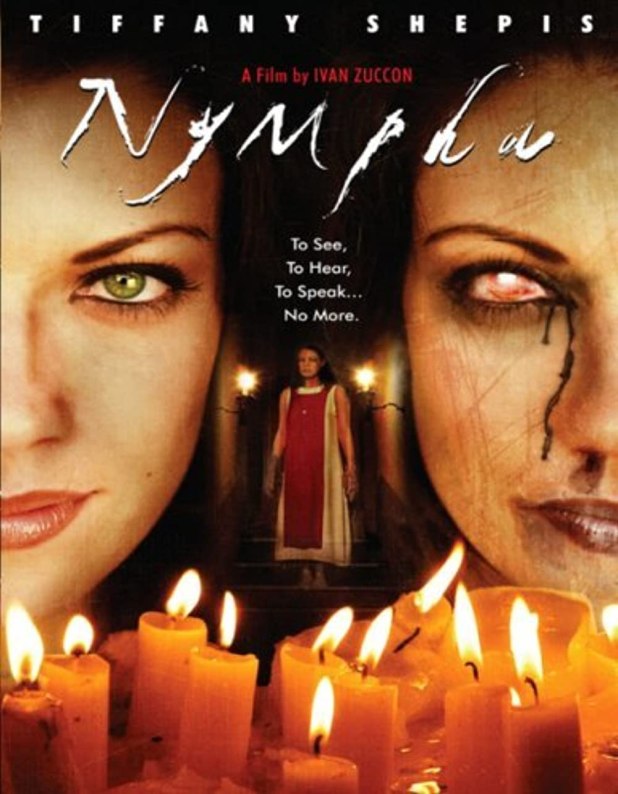
Sarah (Tiffany Shepis!) has come from New York City to Italy on a spiritual quest to become part of the New Order convent where she plans to live out her life as a cloistered nun.
As Bunyan wrote in Pilgrim’s Progress, “Then I saw that there was a way to hell, even from the gate of heaven.”
Sarah begins having visions of a young nun who was on the same journey that she was on and how her life became anything but a serene journey to discover God’s grace. And that means to find the divine, you need to have your ear drums pierced, your eyes filled with acid, your hands burned and your tongue removed. Then she magically heals but not before flashbacks filled with monstrous infants.
For as over the top arty and — at times — silly as this gets, you have to give it to Shepis for being committed. She’s actually a pretty good actress, but most people will only be watching this for the nudity and sapphic scenes that nun movies promise. Well, you’ll get it, but you have to wander the desert like some kind of prophet before you get that revelation. Hope you enjoy eating all those locusts and wild honey.
Directed and written by Ivan Zuccon (The Darkness Beyond), this is another attempt at me trying to find my way into the horrors of Italian film post late 80s. Sometimes, the results are successful. This is around halfway one of those times.
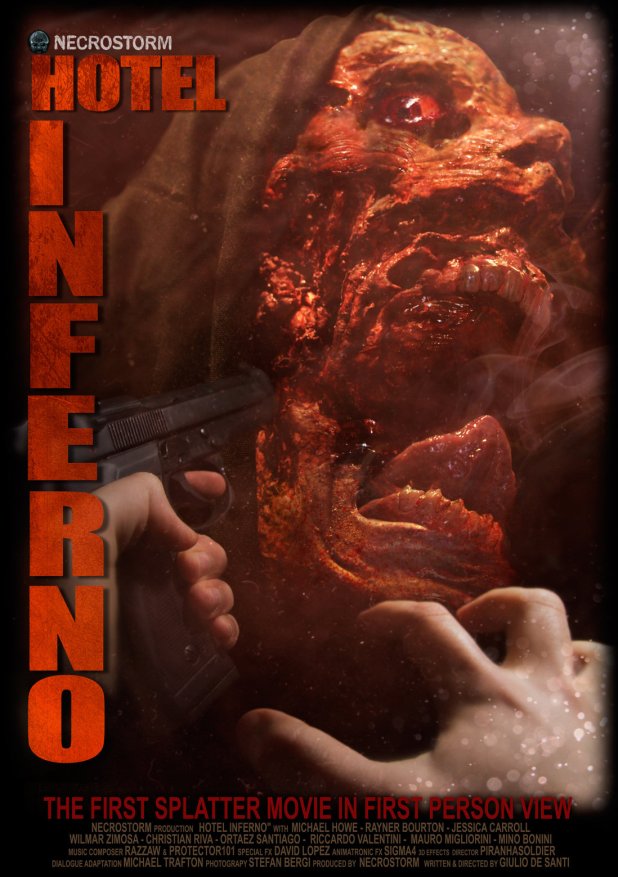
Giving the job of assassinating a couple in their hotel room, contract killer Frank Zimosa finds himself fighting for his life in a maze-like building filled with demons. Yeah, it’s kind of like a first-person shooter, except that it’s an Italian movie literally overloaded with gristle, gore and all manner of gross-out violence. Welcome to Hotel Inferno.
Director and writer Giulio De Santi has made three sequels to this movie with three more n the way. He’s also the founder and president of Necrostorm, a multimedia company that produces and distributes movies, games, cartoons, comics, music and merch, often serving as each production’s writer, director, art director, lead animator, digital effects director, producer and editor.
It soon turns out that everyone in the building is a killer and they’re all here to be offered as a sacrifice, as has been done for hundreds of years. Except that Frank thinks that he can beat the devil.
This came out three years before Hardcore Harry tried the same trick and has about a hundredth of that movie’s budget (and voice acting ability). That said, the scene where the occultist covered in flies writes the spells on a wall approaches near murderdrone levels in its movie drug intensity. This is definitely a movie that you should at least watch for a few minutes, as it’s a pretty insane way to make a movie.
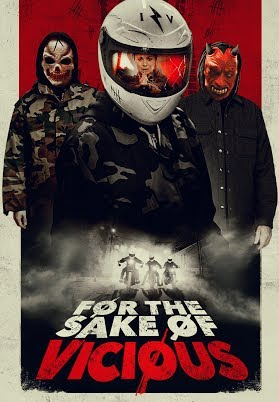
When overworked nurse Romina (Lora Burke) gets back home from another way too long shift, she learns that a bloody stranger (Nick Smyth) has attacked her landlord (Colin Paradine) in her kitchen. Chris wants to kill him for assaulting his daughter. Coincidentally, Romina just treated said daughter in the hospital. Then, three masked men show up and want to kill everyone.
Co-directors and writers Gabriel Carrer and Reese Eveneshen then change things up by putting the three characters we’ve already met against the three maniac masked bikers and everything gets quite messy and eyes pay the price for all the sin they’ve seen.
Sure, there are plenty of home invasion movies, but this is 80 tight minutes and has some real moments of drama from Lora Burke, who plays Romina. There’s also a great moment in the beginning as she starts taping up the bloody landlord all while trying to calm her son down on the phone, showing not only her mothering instinct, but just how she can control a situation. It’s a skill she’ll need if she wants to survive this night.
Also known as The Flesh Merchant,Sex Club andDial 5683 for Love, this W. Merle Connell-directed (Untamed Women, Test Tube Babies) frolic tells the sordid tale of Nancy Sheridan, a twenty-something fresh off the bus looking for her sister in Hollywood. Unlike something like The Seventh Victim, where one finds Satan, instead here one finds sin.
Sure, she finds her sister Paula and falls for the high end opulence she has in her Hollywood apartment, what with all the fancy furniture and fur coats. Older sister tells her to scram, but how do you send a girl back to the farm when she’s seen La-La Land?
Paula’s in-road starts at the art institute, where she poses nude, and let me tell you, I went to an Art Institute and none of our models looked like Joy Reynolds does in this movie.
Let me ask you — inspired by the review that the much more intelligent than me G.G. Graham wrote — what’s the worse prison? Selling your body willingly and making the money that your gifts have earned you from a variety of gentlemen or giving it all away for the slavery that lies behind a white picket fence? Is Nancy right to fall in love with the night? Does Paula wish she hadn’t made the same mistakes? Are we to pull morals out of a movie that has a normal cut and one with smoker inserts?







 B&S About Movies
You must be logged in to post a comment.