The original story for this movie came from John Burke, who for the majority of his career wrote the novelizations for movies such as A Hard Day’s Night, Dr. Terror’s House of Horrors, two volumes of The Hammer Horror Omnibus, Ian Fleming’s Chitty Chitty Bang Bang, Moon Zero Two and many more. Director Michael Reeves and his childhood friend Tom Baker — not the scarf-wearer Time Lord — re-wrote the script, including making Boris Karloff’s character more sympathetic at the actor’s request.
Burke only got an idea by credit, but after his death, his estate published a limited edition of the original script, as well as letters and legal documents related to the film.
The Sorcerers is very 1967 and I mean that in the best of ways. There are places within the London of this film that feel ancient and shopworn while others feel vibrant and new. The technology seems old and the movie is more than fifty years old, but it still feels like something that could be made today.
Dr. Marcus Monserrat (Karloff) has invented a hypnosis-based machine that allows him to control people and feel what they feel. His wife Estelle is part of his experiments and as their device allows them to live the lives of others, a frisson occurs between them. Marcus wants to document and publish his experiments; Estelle wants to live a youth free of consequences through others. She destroys the device, making all of his work meaningless, and asserts herself as the stronger of the twosome. Now that she has complete control of Mike (Ian Ogilvy), she uses the young man to race recklessly, to steal and even to kill.
Reeves had only made The She Beast and would only make one more movie, the amazing Witchfinder General, before sadly dying from an accidental overdose at the age of 25. He’d been suffering from insomnia and depression, with a variety of treatments being prescribed to help him. An investigation proved that this was no suicide, just a horrible tragedy.
In a better world, there would be way more than just one movie with Captain Kronos (Horst Janson, dubbed by Julian Holloway) in it. Along with his partner Professor Hieronymus Grost (John Cater), he’s come to town to investigate a series of vampire-style murders, but while he’s there, why not romance Carla (Caroline Munro), a gypsy girl in jail for dancing on the Sabbath?
The only movie directed by Brian Clemens, who also wrote for the Avengers as well as the movies Dr. Jekyll and Sister Hyde, And Soon the Darkness and — I’m sorry — Highlander 2: The Quickening, this really has everything I want in a movie. A tough hero. A gorgeous girl. Evil incarnate. And enough fighting and swashbuckling to keep me invested for 91 minutes.
You have to love a movie that posits that different vampires need to be killed in different ways, then has a scene where the heroes try every method to kill one of the undead until it stays dead.
For everyone that says that this movie is kind of boring, it’s a movie that has a sword with a mirror on it that kills bloodsuckers and Caroline Munro is in it. I mean, are you that greedy that you want any more than that?
Also, in my perfect world, there would have totally been a Kronos and Christopher Lee face-off. I’m not one for remakes, but this is one that should happen.
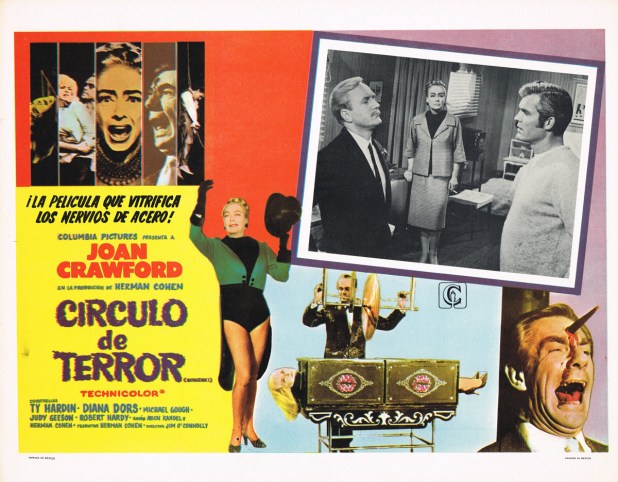
Joan Crawford’s second-to-last big-screen appearance — Trog would be the final movie she made — Berserk! posits a world where the ageless Ms. Crawford rules a circus and of course sleeps with the hottest performer in the show. Is she in her late forties? Fifties? Perhaps even nearing sixty? Who can say and who really cares, as the world of Joan’s late career films are all completely wonderful and I for one wish that I lived within them instead of my own reality.
Joan is Monica Rivers, who owns a traveling circus along with business manager Dorando (Michael Gough). Gaspar the Great is killed when his tightrope breaks. The police get involved but nothing comes of it. Did she kill him? Will she also kill her business partner? Will she hook up with the attractive new tightrope walker (Ty Hardin, who after acting formed the anti-tax group the Arizona Patriots that quickly became an anti-semetic, anti-black and anti-immigrant group that was amassing weapons and threatening the lives of Arizona politicians)? Maybe. Maybe. And yes, she totally will.
Monica’s daughter has been expelled from school, which oddly feels like a page out of Mommie Dearest, but art imitates life as they say. She’s played by Judy Geeson right before she became a star in To Sir, With Love, even if producer Herman Cohen wanted Christina Crawford.
There’s also the matter of a younger and some would say more attractive — look, I love Joan but Diana Dors (Nothing but the Night, From Beyond the Grave) is the kind of woman you ruin your life for — girl trying to get with Joan’s boy. She ends up sawed in half for real.
The end of this goes all The Bad Seed on us, with an electrical wire taking out the evil that bad parenting has created.
Director Jim O’Connolly would later make TheValley of Gwangi and Tower of Evil, but neither of those movies have Joan Crawford wearing Edith Head-designed sheer hose and a majorette uniform in them, do they? You know how much Joan cared about this movie? She got up early to make breakfast for the crew every day.
Shot back-to-back with The Reptile using the same sets, The Plague of the Zombies is all about a Cornish village that finds many of its inhabitants mysteriously dying and then rising from their graves and are working in a tin mine.
This isn’t a fallen satellite or hell bring full. This is voodoo in 1860s England at work! The funny thing is that this movie was made only two years before Night of the Living Dead and it may as well have been made two decades hence. That’s no jab at this film, which I love, but it seems from a totally different era.
That said, this movie has atmosphere galore, with foggy denseness and dread in every frame, the kind of movie I bet Electric Wizard watched when they were little kids and could only dream of the feedback and heaviness that was in their future.
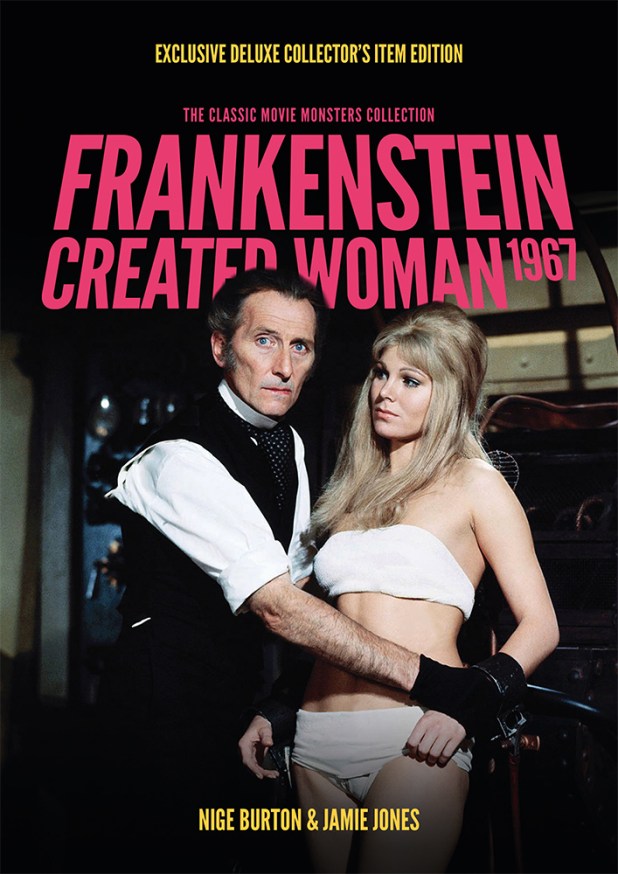
From flesh and innocence, Frankenstein has created the ultimate in evil. A beautiful woman with the soul of the devil!
With a tagline like that, how can you not watch this movie?
The fourth film in Hammer’s Frankenstein series is a thought-provoking exploration of the soul and morality. It’s the one in which we stop thinking about death as a physical matter and start delving into these profound questions.
The movie starts with Hans Werner watching his father executed by the guillotine. Then, we see him as a young man, working as an assistant to Dr. Hertz and Baron Victor Frankenstein (Peter Cushing, as it always must be). The doctors have learned how to trap the soul before it leaves the body — they must have been watching The Asphyx* — and think that they can transfer it into another body.
They get their chance when Hans is put to death defending the honor of his girlfriend Christina (Susan Denberg, Playboy Playmate of the Month for August 1966) after several rich men abuse her for her deformities and kill her father. After he follows in his father’s footsteps, the doctors can extract his soul.
Unable to live without Hans, Christina tragically drowns herself in a river. The doctors, however, decide to transfer Hans’ essence into the body of his lover. For months, the two doctors work to heal her physical maladies and make her the perfect woman. The big problem is that she’s haunted by Hans, who she sees as a ghostly apparition, and begins to hunt down the men who killed him and her father.
As the film closes, Christina realizes that she should have never come back to life, so she drowns herself again as Frankenstein somehow learns a lesson and walks away.
Directed by Terrence Fisher, this is the kind of Hammer film that I love. It boldly moves away from simply being modern versions of classic horror and creates its own unique commentary on the world through the lens of the fantastic.
*I realize that the movie was made five years after this, but the joke was too simple not to use.
Editor’s Note: On June 26, 2021, we had a “Ron Ormond Day” in tribute to his films. You’ll find the links to the reviews from that day of films — and others — within this review.
This is the one Ron Ormond film that eludes the staff of B&S About Movies. Sure, Sam and I are familiar with the film, as our religious schooling and church youth group years exposed us to all of Ron Ormond’s films — including this lost, final film of the Ormond’s from, as we like to call it, their “Damascus Years.”
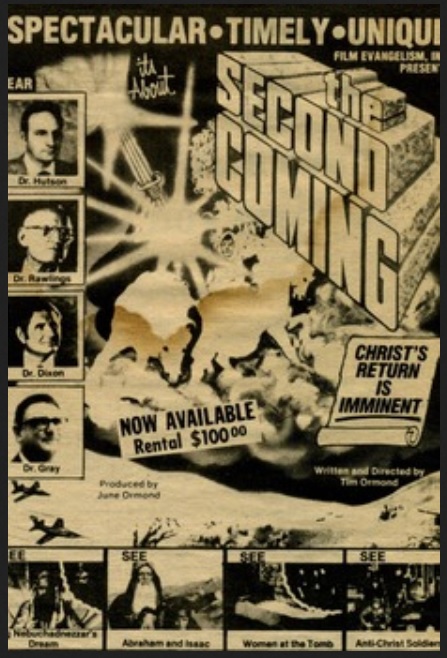
Out of the Ormond’s six Fundamentalist films — seven, if one includes their also-lost, hour-long “travelogue/documentary” feature, The Land Where Jesus Walked (1975) — this is the one film (two, including Land) that is not available as a vintage-resale VHS or reissues DVD. As with all of Ron Ormond’s post-salvation catalogue, The Second Coming did not play in rural Drive-Ins or indoor theaters: it was “rented out” (in this case: $100 a showing, as per the one-sheet) as a “roadshow feature” in churches and tent revivals.
Courtesy of Letterboxd; the only online copy.
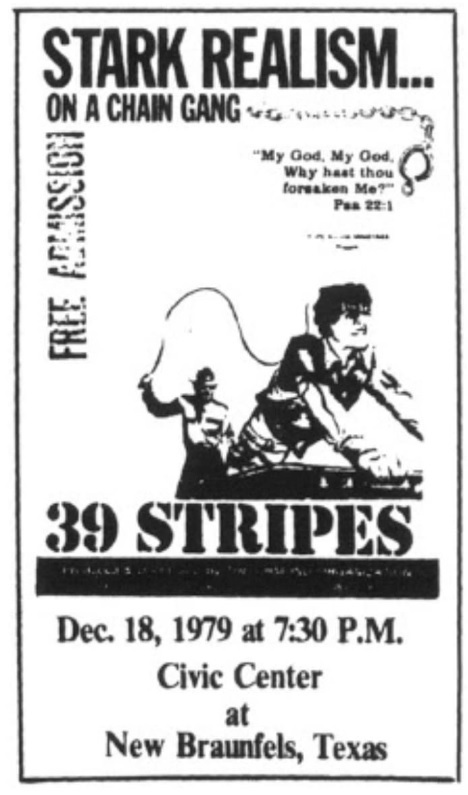
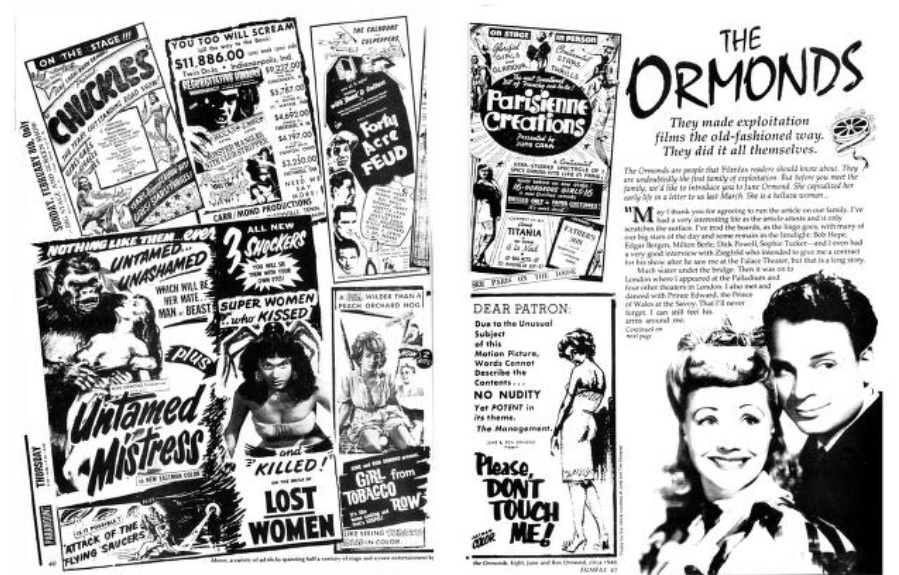
The Second Coming served as the directing debut of Ron’s son, Tim. Starting out as an actor in his father’s films: he starred in the family’s secular works Girl from Tobacco Row, White Lightin’ Road, and The Exotic Ones, then the Christian films If Footmen Tire You, The Burning Hell, The Grim Reaper, The Believer’s Heaven, and 39 Stripes. Tim matured to serve as an editor, cinematographer, writer (39 Stripes, The Second Coming), and director (the lost The Second Coming) on several Ormond family productions, which also included wife and mom, June Carr, on the production staff. Tim came to his directing debut through sadness: Ron Ormond died during the pre-production of The Second Coming — in 1981 at the age of 70s — leaving Tim and Ron’s widow to finish the film. June’s other films — under her maiden, professional name in the producer’s chair and as a Second Unit or Assistant Director include not only the above films, but Forty Acre Feud, The Monster and the Stripper, Please Don’t Touch Me, and the lost “jukebox musicals” Square Dance Jubilee and Kentucky Jubilee.
During our analog excavations to find an online stream or trailer to share (we were unsuccessful), we discovered an extensive, November 2007 interview with Tim Ormond, courtesy of Mondo Stumpo: an interview that assisted us in our additional documentation of The Second Coming. (We enjoyed the staff of Mondo Stumpo referring to the genre as “Christian Gore”; if you’re familiar with the Ormond’s “Pirkle” years, you know that’s a perfect analysis.)
We’d also extend our thanks to B. Earl Sink, Jr. — the son of Earl “Snake” Richards — in assisting us in our preserving of The Second Coming. As we’ve discussed in our previous reviews, Richards starred in two of Ron Ormond’s secular films: Girl From Tobacco Row (1966) and White Lightin’ Road (1967). Richards also starred in the non-Ormond “Jukebox Musical,” That Tennessee Beat (1966), by way of producer Robert L. Lippert, who produced many of the Ormond family’s works. It was during the course of that third film review, in which we came to speak with Earl Jr., who tipped us that he (regardless of the IMBb’s incomplete credits; they also have his mother’s credits split as “Carr” and “Ormond”) also acted in The Second Coming. And, as you read on, you’ll come to learn that four generations of the Sinks appeared in or crewed on Ormond productions.
In addition to writing and directing The Second Coming, Tim Ormond directed a documentary on long-time family friend, Lash LaRue, wrote 39 Stripes, and wrote the Jim Varney-starring Blood, Friends and Money.
If you’re familiar with the contemporary, Christian-apocalyptic oeuvre of Cloud Ten Pictures, with their B-star-studded Apocalypse series and their better known Left Behind series, as well as the films of David A.R. White’s PureFlix shingle (Jerusalem Countdown), or the ’70s Bible-apoc progenitors of Donald W. Thompson (A Thief in the Night), then you’re up-to-speed on the end-times tale in the frames of The Second Coming. But this is an Ormond film. And it is so much better for it: for Christian-based Ormond films come from the heart and, ironically, none are the least bit exploitative, although they appear on critical lists, i.e., “Christploitation,” as such.
As in the Ormond’s previous Estus Pirkle production, The Burning Hell: we have a similar, wayward youth in love with the world coming to find salvation through dreams, i.e., visions. This time, our scoffing youth, who dismisses his God-fearing mother and the family’s pastor, dreams of missing out on The Rapture. As with any Fundamentalist Ormond production — even the ones void of the crazed “Christian Gore” tutelage of Estus Pirkle — the imaginative creativity of the images presented in the frames is the always thing: God smites a Babylonian statue with a mighty rock (in repetitive, slow motion), dead saints of the past rise up out of their earthen graves, and new saints — the proclaimed 144,000 — vanish on the spot in an eye’s twinkle; then, in a grand, stunning piece of against-the-budget filmmaking (which we’ll get into detail, later): Jesus Christ returns with a phalanx of saints on white horses in the clouds.
Of course, our wayward lad returns to Jesus. As he should: Remember, Estus Pirkle warned us that communist invaders from Cuba would ram sharpened bamboo shoots through our brains via the ear canal, then dump our bodies in freshly bulldozed mass graves. Why would anyone want to stick around for those horrors?
As with the Pirkle trilogy — and the non-Pirkle The Grim Reaper — pastors show up, of course — six, in fact — amid the narrative with words of wisdom. Of course, while guys like Jack Van Impe and Jerry Falwell are committed and honorable in the word, it’s just not the same as having Estus ranting with his statistical analysis on the exact percentages of how many people end up in Hell, daily.
Hey, we can joke about the Pirkle trilogy, but the pastor, however off-putting he may be to secularists, he was committed to the cause. The Ormond family, on the other hand, created honorable, truthful films with a lighter touch. Fans of the Ormond’s Pirkle years may miss the “craze” of those films, here, and dismiss The Second Coming as less effective. We, the cubicle warriors of the B&S About Movies digital divide, do not: we adore all of Ron Ormond’s films.
Tim Ormond with mother June at a post-2000 convention signing/image courtesy of Dennis Dermody of Original Cinemanaic.
The Insights of Tim Ormond on the Making of The Second Coming
“After my dad died, I came to the final scene, which was the — and the way we got around things in general — was, someone would say, ‘That’s not the way it’s gonna be,’ and I’d say, ‘Well, this happened as kind of the way this person imagined it or dreamed it: like Daniel would have this dream.’ So that’s the way we would alibi things, [just] in case a theologian would say ‘Well that’s not the way it’s supposed to happen.’
“Anyway, this particular character in The Second Coming was visualizing Christ returning on white horses; wielding the sword, His face aglow. Well, I had to stage this scene. This was, of course, before computer graphics were like they are today. And even so, the cost would be prohibitive. So, I went to Hollywood, along with my Mom, and we looked up old friends; we found the wrangler who did Little House on the Prairie [for NBC-TV], as well as some old friends of my dad who’d worked on the Westerns [with Lash LaRue and Tex Ritter]. And I began to put together a crew and a shoot in Hollywood for staging this last [Christ in the clouds] scene.
“[While this was going on], I made a phone call to my friend in Nashville, Eddie King, who had played my brother in The Grim Reaper, and asked him if he could try to put together the same shoot in Nashville, because it would be much less expensive. So, I guess, just a few days before we were ready to go into production in Hollywood — and I’m just talking about on that one scene — I talked to Eddie, and he had put it together in Nashville. So we came back to Nashville to shoot it, merely from a cost standpoint.
“So, on that particular night, we gathered at the Riverwood Riding Academy, which was a great big field out near a park, not too far from my house, and people began to gather with the horses. We had a searchlight come in from Huntsville, which could basically shine this very bright, illuminating beam of light on Christ’s face: He was wearing a reflective surface so it would reflect the light back as bright as possible. He was dressed in the red robe, all the horses were white and groomed, all of his angels were riding alongside of him wearing white robes, we had fog on the ground, we had lights, we had big blowers running to move the fog. . . .
“And the funniest thing is, right exactly next door — I’m talking about a hundred yards away, but across a fence — was the park patrol. Just sitting there in the dark watching what was going on. And we didn’t know this. They didn’t bother us, but they were talking on their scanner. And one of my crew — actually the wife of the director of photography — was listening to them, and one guy said, ‘Come on, you’ve got to come over and see this! They’re doing a commercial for the Ku Klux Klan!’ So that was kind of a funny incident. But when it was done, it turned out very well. Of course, the ground was fairly dark on purpose, and there was a layer of fog. We superimposed that over the clouds, and it does appear like Christ returning triumphantly in the clouds. Which is a pretty graphical representation of the way it reads in the Bible. So that’s that one little scene.”
Earl and Rita Faye Sinks/courtesy of B. Earl Sinks, Jr. Facebook.
The Insights of B. Earl Sinks, Jr. on the Making of The Second Coming
“Ron [Ormond] wanted me to be in the film, as he wanted a 4th generation of our family to be in the film. Of course, my mother and grandparents were in Ormond films from back in California during the Lash LaRue days, as well as Square Dance Jubilee. My mom and grandparents also appeared in Girl From Tobacco Row, while my mom also did makeups for a few of the movies, like Burning Hell, and so on.
“So, Ron had my part written for me prior to his passing. Then Tim took over [as director]. I remember staying with Tim and June, his mom, rehearsing for the role along with Rev. Martin; he was in the movie 39 Stripes, which, as you know, was the story of his life. The reverend was such a Christ-like man that, to this day, I still think of him as such a sweet soul. When we finally got to the day of shooting, I recall when a cloud would pass over, or something wasn’t right, I would hear Tim call ‘CUT’ to end the scene. So, when we were shooting another scene, and I saw a cloud passing, I shouted, ‘CUT!’ like he did. Tim was tickled by that and let me know, jokingly, that he was the only one to say ‘CUT’ to end a scene. We all laughed.
“At the debut of the opening of the film, there was a man who thought my role, my acting, was good enough, so he asked me to read for a stage [production] of On Golden Pond. However, since it conflicted with school, my parents said ‘no’ to my audition. I also has a walk-on part in Tim’s Blood, Friends and Money with Jim Varney [but not as his character Ernest P. Worrell]; as I recall, my scene ended up on the cutting room floor.”
Bottom Right: Earl Sinks — aka Earl “Snake” Richards, the star of the Ormond’s Girl from Tobacco Row and White Lightin’ Road, as well as That Tennessee Beat — with the Crickets.
When you follow the links to our other Ron and Tim Ormond film reviews, you’ll understand the staff of B&S About Movies are fans, not only of the Ormonds’ secular films, but their Christian films, as well. We are doing our part to expose their films to our readers and preserve the Ormonds’ films for others to discover and enjoy — many for the first time.
To that end: We extend our thanks to Letterbox’d — and the anonymous uploader — who discovered a copy of the theatrical one-sheet of The Second Coming (the only copy of the theatrical one-sheet online). We also appreciate the film journalism efforts of Mondo Stumpo (still active, but ceased publishing in June 2012) and Original Cinemaniac for their previous efforts in preserving this lost Ron Ormond film.
And a special thanks to B. Earl Sinks, Jr. for taking the time to speak with B&S About Movies.
Learn more about the Ormonds in the pages of Filmfax, Issue 27 (1991), preserved on The Internet Archive. (The extensive article begins on Page 40.)
Update: July 14. 2021: Courtesy of film documentarian Brian Rosenquist — who’s currently working on a feature documentary concerning the joint exploitation films of Ron Ormond and Estus Pirkle, and who was involved in securing the original camera elements for Estus Pirkle’s three films, for Nicolas Winding Refn (Only God Forgives, The Neon Demon) to complete restorations — we’ve since learned The Second Coming was, in fact, released to DVD ten years ago on a double-DVD with The Grim Reaper. You can watch an online streaming version of The Second Coming on a Ron Ormond tribute page located at the Internet Archive.
In addition to streaming the only online copy of The Second Coming, the page also offers a copy of The Burning Hell, as well as the once lost “Jukebox Musical” Kentucky Jubilee, and Ormond’s pre-Christian film, Mesa of Lost Women.
You can learn more about the restorations of the Ormond-Pirkle trilogy with the Radio NWR podcast Estus Pirkle: A Celebration.
One of my favorite independent movie games to play is “how will people work Eric Roberts into their movie?” Much like John Carradine, they often shoot him completely independent of their film and then splice him in, getting his name recognition while not having him matter at all narratively. I applaud this notion and a reminder of the better times of Z-grade cinema when a Mexican werewolf movie would suddenly be a mummy film and Carradine would be out there standing in front of a desk trying to scientifically explain it to us while hiding a whiskey neat in the side drawer.
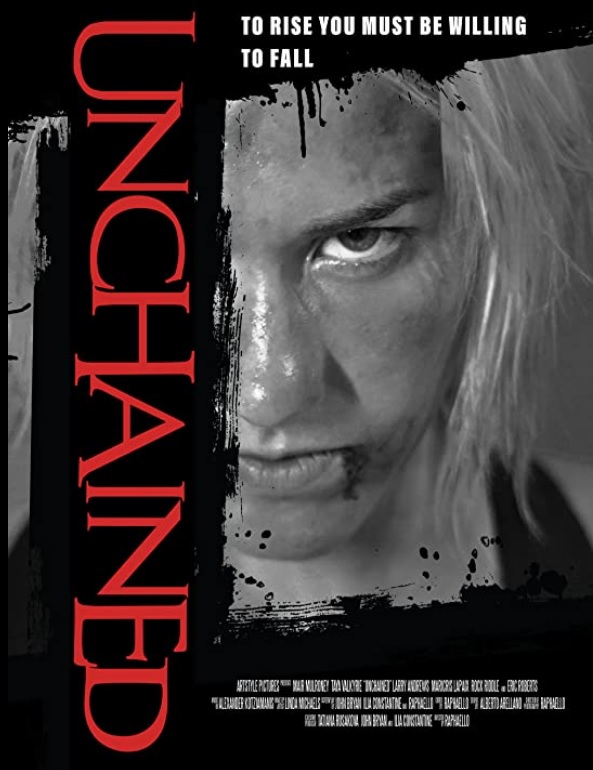
Eric comes in here as the memories of our heroine Aella (Mair Mulroney), a girl who can’t get work until a job offer comes to audition for a movie about a female fight club. She gets hired, knocked out and shows up in a private video feed — hello Red Room — to fight for her life while people watch online.
To make this even better, the director’s name is Raphaello. That’s it — one imagines that he’s two of the Ninja Turtles joined up to make a fighting film. Or maybe just the guy who also made Rogue Planet Gamma and Bloodbath: The Motion Picture.
One of the selling points of this movie is that it features pro wrestler Taya Valkyrie, currently known as Frankie Monet in NXT, who is the wife of WWE superstar — and star of low budget action movies on the side — John Hennigan (Johnny Nitro/Retro/you fill in the blank). She’s the trainer of the girls, Regina, and she’s someone trained to do fighting yet never fights in the film. Instead, she works for The Warden, who threatens women throughout the movie.
Rock Riddle is also in this. He was a pro wrestler who got his start running the Rip Hawk and Swede Hanson fan club before getting into the ring himself. He also shows up in The Van, Blue Sunshine, Paradise Alley and a few other movies.
I mean, we could use more women being coerced into fight club movies. This one barely scratches that itch. But if you want to see it, Unchained is available digitally from Leomark Studios.
I’ll give The Terrornauts two things: It has a great poster with the tagline “The virgin sacrifice to the gods of a ghastly galaxy!” and it’s only 75 minutes long. Based on The Wailing Asteroid by Murray Leinster, this film was double-billed with The Came from Beyond Space (which we’ll review directly after this) and both are considered amongst the worst films that Amicus released.
Project Star Talk has just ninety days to succeed in its mission to listen for radio signals from intelligent life from outer space. A message brings the entire team of Star Talk to an asteroid where they must defeat an entire planet of savages who are the last survivors of a galactic war. If they don’t, their evil planet will make its way to destroy Earth.
This was directed by Montgomery Tully, who also directed the Edgar Wallace story The Man Who Was Nobody twice — once for TV and again for theaters. He also made Battle Beneath the Earth.
I really want to see the movie that the poster is advertising more than what was made.
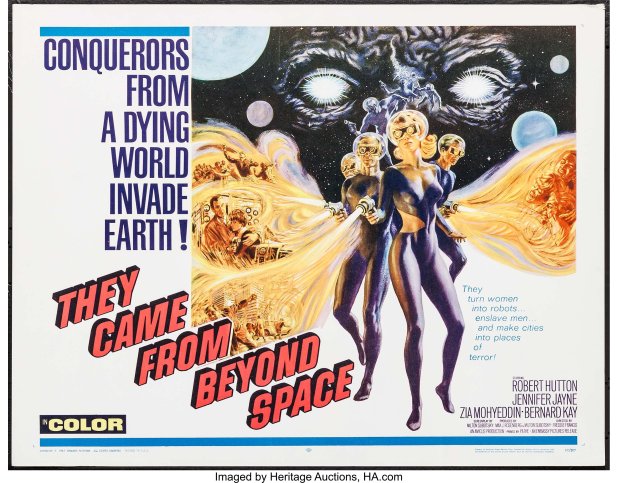
We already covered the film that this played double bills with — The Terrornauts — earlier today. And much like that movie, this one has a great poster that advertises a movie I want to see more than the one that I actually watched.
Based on Joseph Millard’s The Gods Hate Kansas, this was directed by Freddie Francis for Amicus. He claimed that the studio spent all of the budget for this on the aforementioned The Terrornauts, leading to an inferior film.
This one is about the Master of the Moon (Michael Gough!) spreading a “Crimson Plague” that wipes out a whole bunch of humanity so that the government will send the bodies of the victims to the moon to hide what really happened to them, at which point he will bring them back to life and use them to fix his spaceship.
It’s a really complicated plan that gets torn apart at the end by hero Dr. Curtis Temple, who basically tells the Master that if he’d just asked for help, humanity would have done it. This causes one of the most powerful beings in the galaxy to just start crying.
Supposedly this was Anwar Sadat’s favorite movie. I only have IMDB as a source for this, but I find that absolutely hilarious and have decided that it must be true.
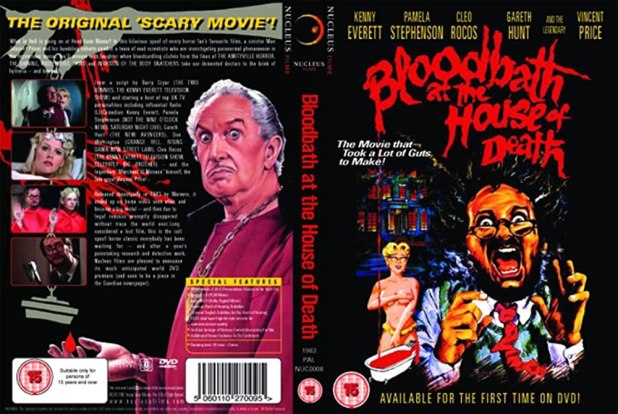
Arriving at the end of the video nasty era, when this British comedy was screened for censor James Ferman, the reels were played in the wrong order. Nonetheless, he enjoyed the movie and it passed.
It was created by British comedian, DJ and television presenter Kenny Everett, who got his start in pirate radio before being part of BBC Radio One. He was dismissed in 1970 after making remarks about the British Transport Minister’s wife. She had recently passed a driving test after several attempts and he joked that she must have bribed her driving test examiner. While this joke seems innocent enough, it was enough to get him fired, at which point he moved into commercial radio and TV.
After Everett’s death, the true story came out that this wasn’t the real reason he had been fired. It was probably because he had threatened to go public on the restrictive practices and deals with the Musicians Union. He was even embargoed from giving any interviews while working for the BBC.
Unlike the more leftist comedians we usually have in the U.S., Everett was to the right, openly supporting the Conservative Party under Margaret Thatcher. Perhaps even stranger, he was a closeted gay man and supported a political party that passed Section 28, which made it illegal for councils to promote gay rights and issues.
During the 1983 general election campaign, Everett appeared at a Young Conservative rally and was dared by director Michael Winner — yes, the man who made Death Wish — to take to the stage, wearing gigantic foam hands and screaming “Let’s bomb Russia!” The media didn’t react well to this and the fallout hurt this movie, which is really a rather silly parody of Hammer movies.
A group of Satanic monks — led by Vincent Price as Sinister Man — have been killing people since the 70s. Doctor Lucas Mandeville (Everett) and Doctor Barbara Coyle (Pamela Stephenson, ) are sent to investigate where it all began: Headstone Manor now known as the House of Death.
This is actually Price’s last appearance in a British movie and makes fun of everything from Alien and The Legend of Hell House to Poltergeist and The Entity, with Doctor Coyle arrdvarking with a spectral lover. It also completely rips its ending off of The Rocky Horror Picture Show. It’s not great, but it’s silly and has plenty of gore, which somehow got through the aforementioned censors.







 B&S About Movies
You must be logged in to post a comment.