This week, we’re doing it up right with two movies that have mineshafts and little henchmen in them. That’s right — Phantasm and The Boogens! Get ready to be with us this Saturday at 8 PM east coast time at the Groovy Doom Facebook page!
You think you go to heaven when you die? No — you get to drink this drink while you watch this movie with us!
Tall Tiki Man
1 oz. blue curacao
1 oz. Kraken rum
3/4 oz. coconut rum
1 1/2 oz. pineapple juice
Splash of orange juice
Splash of lime juice
Line a rocks glass with ice and blue curacao.
Shake pineapple juice and rums in a shaker, boyyyyyyy.
Pour together, then float orange and lime juice.
While you’re running from some Boogens, mix this up!
Kreepin’ It Boogen (based on a recipe from 1,000 Drinks by Paul Knorr)
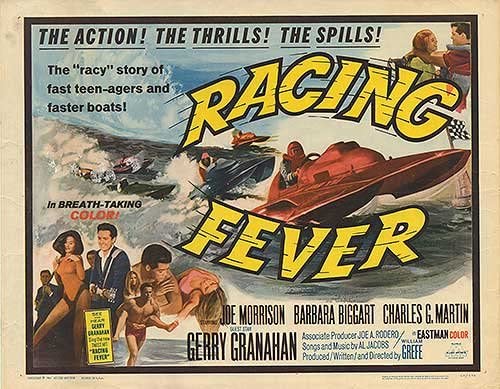
Yes, you go into a movie named Racing Fever expecting b-roll footage and sure, you get it, but this is also a William Gréfe movie, which means that you’re going to get South Florida drama, in this case, the story of professional hydroplane racer Pop Gunner who has one race left in him before he passes the torch to his son Lee. But there’s also the matter of his main competition, Gregg Stevenson, who just so happens to be aardvarking with Pops’ little girl Linda.
So yeah. Gregg is already married and has a kid, which seems to complicate matters, but Linda stay with him even when he gets wasted and hits Pops with his race boat. I never saw Miss Budweiser — seriously, if you grew up in the 70’s, Miss Budweiser was a big deal — hit a human being, but there you go.
This leads Gregg’s wife and daughter to go to Lee — the son — for some reason and the daughter and the son end up shacking up too and getting knocked up and of course, someone has to get shot because this is a Gréfe movie and wow, you thought Thanksgiving was complicated in your family.
There’s also a song in it, because the kids need to dance, man. And a downer ending, because the 60’s were a drag. Look — it has some songs, it has some hunks, it has a cute girl, it has death and plenty of pathos. It’s also the movie that probably played last at the drive-in, when people were sleeping things off or getting one last round off. The IMDB reviews of this eviscerate the film when they should realize that this is exactly the movie that it should be.
Did you ever play with G.I. Joes? Did you ever spend an entire day setting up a gigantic battle with your friends and then wait for the carnage to begin, which soon ends up with nearly every single Joe and Cobra dead except for the two or three favorites of each person playing?
Yep. That’s this movie.
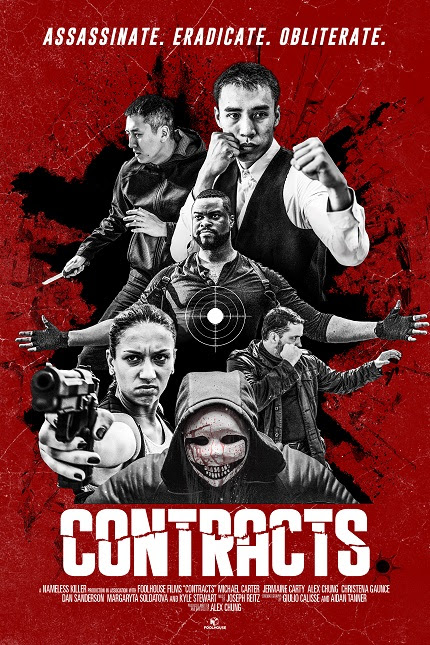
Assassin Anthony Lo (Alex Chung, who also write and directed this) joins hitman Marc Sullivan to battle a rogue gang of killers who are picking off their friends.
This was originally going to be a prequel to some of the shorts that Chung has worked on in the past, but it ended up being a standalone feature, which may explain why some of the story makes little to no sense.
That said, you’re not watching this movie for the story. You’re watching it for the fights. And this movie has just as many, if not more, fights than you were looking for. Honestly, I think people are still fighting despite the movie being over.
Rita Hayworth spent the last few years of her life not knowing who she was anymore, painting when she did, and mostly staring out her window at Central Park. She died with many people thinking that alcoholism had robbed her of her career when the truth was Alzheimer’s had impacted her final years and back then, the world didn’t understand that disease at all.
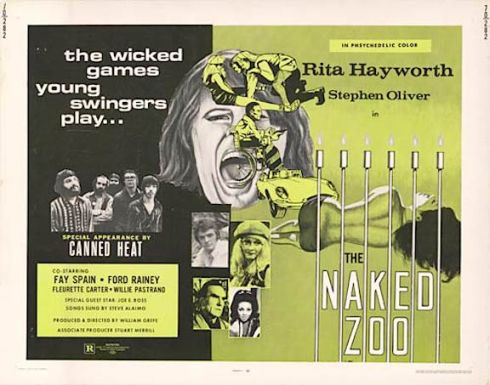
Before she slipped away, she made a movie with William Gréfe, which blows my mind, and that movie is 1970’s The Naked Zoo, which was originally called The Grove, named for Coconut Grove, a former artist’s colony in Miami.
So how did Gréfe — the maker of movies like Sting of Death and Whiskey Mountain — get a big star like Hayworth into a movie made for just $250,000? Well, her agent originally wanted all of that cash, but they were able to make a deal for $50,000 for two weeks of shooting. Her parts were shot in a deserted house near the Pirate’s World theme park (of my dreams, as well as movies like Santa and the Ice Cream Bunnyand Musical Mutiny).
Once known as “The Great American Love Goddess,” Hayworth’s life was filled with men who wanted her to be the seductive woman she was in films only to learn that she was a real person. Or, perhaps even worse, men who only sought to control her, like first husband Edward Charles Judson, a twice her age businessman who remade her into a sex symbol that he could buy and sell to Hollywood. Her marriages to Orson Welles, Prince Aly Khan, Dick Haymes and James Hill were also marked with mental and physical abuse, with only Welles not outright beating and humiliating her in public*.
By 1972 — two years after this film — her health and mental state was so bad that she had to read her lines one at a time while making The Wrath of God. She was to be in Tales That Witness Madness, but left the set before she appearing in one scene.
Back to Willian Gréfe. He had hoped to make a movie closer to The Graduate, but you know, as seen through the Florida drive-in movie haze of sex, drugs and crime. And still, this was edited by its distributor, with cuts made to add a masturbation scene and the band Canned Heat playing at a party. Those scenes were filmed by Barry Mahon, pretty much making this movie a team-up of Florida’s two top exploitation experts.
The film itself concerns Hayworth playing Mrs. Golden, a rich woman who lives with her cockolder, wheelchair-bound husband Harry (Ford Rainey, Dr. Mixter from Halloween II!). She sleeps with an author named Terry Shaw (Steve Oliver from Peyton Place) and when her husband finds out — and tries to gun them down — Terry stops him, but despite the death of the old man being in self-defense, Mrs. Golden starts blackmailing him.
That’s really the whole story, although there’s also plenty of party scenes and romance between Terry and Nadine (Fleurette Carter, who was also in The Hookers) and Pauline (Fay Spain, Dragstrip Girl).
You can get this as part of the He Came from the Swamp box set that Arrow Video has just released. Diabolik DVD has it for sale now.
*Welles would say, a day before her death, that she was “one of the dearest and sweetest women that ever lived.
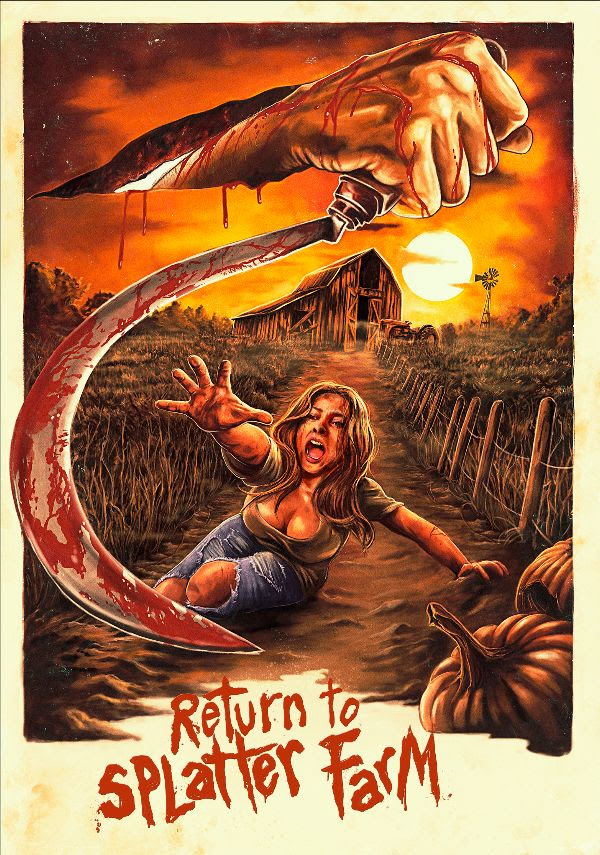
Once upon a time, let’s say 1987, Mark and John Polonia made Splatter Farm, a shot on video slasher all about twins sent to live with their aunt who soon discover that her handyman is a killer.
Thirty years in film time — and thirty-three in real life — and the killings have begun again in Wellsboro, Pennsylvania. What a time for a bunch of teenagers to go and party at the cabin, huh?
This was co-directed by Jeff Kirkendall, who plays Jeremy the killer. He shows up in nearly every Polonia movie, which all have their own strange universe of actors that show up.
While the budget is a challenge — as always in these movies — a slasher doesn’t need hundreds of thousands of dollars to be effective. This sets up the teens — and some older people, as well — and before you know it, the kills come quickly. There’s enough gore — both digital and practical — to keep the bloodthirsty happy.
This doesn’t break any new ground, but it moves quickly and delivers what it promises. It has a great title and poster, which is really half the battle when you think about it. It also has a goofy theme song and only 70 minutes of run time, which is pretty much the length all movies should be.
While John Polonia, Todd Michael Smith and Marion Costly have sadly passed away, for those looking for the next step in the Splatter Farm story, I think you’ll be pretty pleased with this.
You can get Return to Splatter Farm on demand and on DVD from Wild Eye.
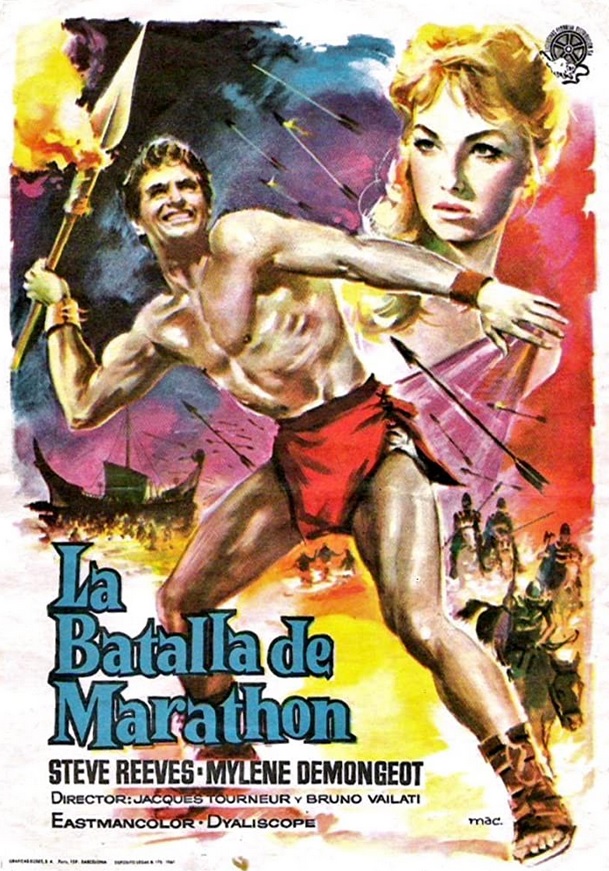
Directed by Jacques Tourneur (Cat People, I Walked With a Zombie, Night of the Demon), this film also has a credit for Mario Bava as directing it. That’s because a few days before it was due to play theaters, major scenes had to be reshot when the editor discovered that several extras were smoking cigarettes on camera*.
Our hero is Phillipides, who if you want something visual and it’s not too abysmal…just kidding. He’s played by Steve Reeves.
In between battles between our hero and the Persians, there’s an attempt to marry him off to Charis (Daniela Rocca, who became famous from the movie Divorce Italian Style, which was written by the same writer as this film, Ennio De Concini; she also fell hard for that movie’s director Pietro Germi and attempted suicide after he turned her down), but his heart is set on Andromeda (Mylène Demongeot).
While this has little of his style, the fact that Bava got the film done in time won him some major favor from Galatea Film, who rewarded him by giving him the chance to make his own project and direct it. That ended up being Black Sunday.
*Bruno Vailati also directed some scenes. He’s listed as the AD, but in Demongeot’s biography, she claimed that Tourneur left most of the directing to his assistant.
You can watch this Metro-Goldwyn Mayer release on Amazon Prime and YouTube. There’s also a Film Crew riff version on Tubi.
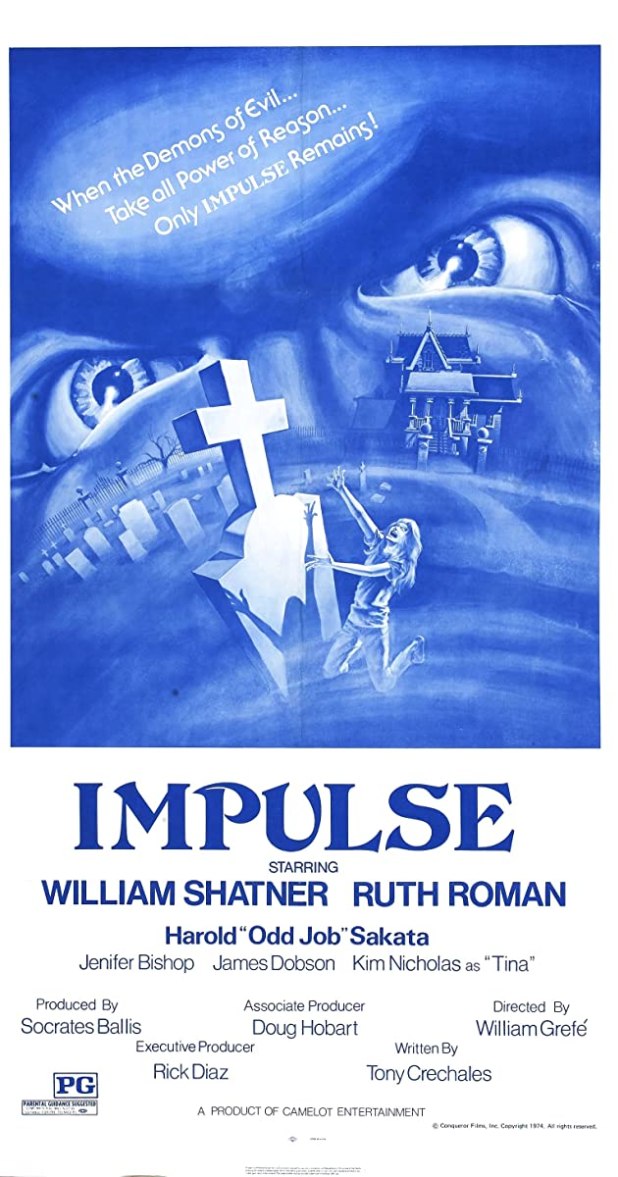
When a movie has the working title Want A Ride, Little Girl? you know it’s going to be scummy. What may surprise you is that William Shatner — who director William Gréfe met at an airport — is in the lead role.
Don’t be fooled by the supernatural looking poster. No, this is a slasher with Shatner’s Matt Stone as the bad guy picking up young women, freaking out Shat-style and getting rid of their bodies. He’s being trailed by a detective named Karate Pete (Harold “Oddjob” Sakata), which is, pardon the pun, pretty odd. He’s on the trail because Stone keeps bilking and killing old women for their money.
Jennifer Bishop (who is also in Gréfe’s Mako the Jaws of Death) plays the daughter of one of these older women who suspects that the leisure suit-wearing Stone is a shyster. And oh yeah — Ruth Roman is in this!
Sakata almost died making this, as the rig that was used for his hanging death failed and he was nearly hung for real. Shatner saved his life — breaking a finger in the process — and the entire accident can be seen on the He Came from the Swamps documentary.
This movie belongs to Shatner. As a child, his character kills William Kerwin with a sword in a kind of pre-Piecesopening, then murders a puppy and gets so worked up in one scene that he supposedly farts on camera. His assortment of 70’s fashions are pretty astounding and every single frame of this feels as sweaty and gross as a night in the Everglades.
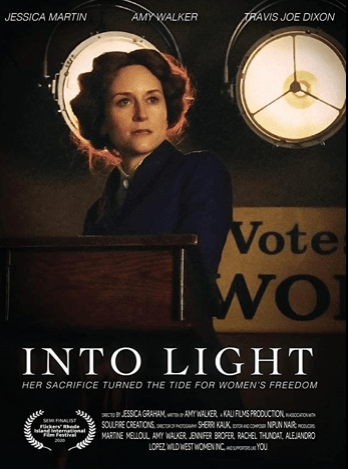
During the election of 1916, suffragist Inez Milholland (Amy Walker, who also wrote this short) will stop at nothing to get people behind the right for women to vote. Even terminal illness won’t hold back her final speech.
While so many men see women voting as a threat, she keeps fighting and collapses at the conclusion of her most important speech. While a doctor begs that she rests, she instead puts her cause ahead of her life.
This was directed by Jessica Graham and despite it being only 12 minutes long, it really sets itself up to make you want to see even more of this story. It’s well-shot and edited, well beyond what you’d expect from a lower budget short.
This is a reminder that the rights that we accept today as normal were once anything but. And if we’ve learned anything from this last election, it’s that the voice that we take for granted today may not be there forever unless we continue to fight.
Also known as Electric Shades of Grey and Jesus Freak, The Psychedelic Priest wasn’t really directed by Stewart “Terry” Merrill, but instead William Gréfe, who was paid for this movie in trading stamps, which he described in Brian Albright’s Regional Horror Films, 1958-1990: A State-by-State Guide with Interviews as “Instead of cash, if you owned a TV store and I owned a garage, and you needed your transmission fixed, you’d give me trading stamps. When I needed a TV, I could go get a TV from you.”
Gréfe got paid $100,000 in trading stamps to make this movie that was never released until thirty years later because everyone felt it would be a bomb. As for Gréfe, he was now the president of Ivan Tors Films, making family movies, so he realized that “I didn’t want some wild hippie drug movie with my name as writer and director.”
The cast and the crew were non-actors, mostly real hippies, and the story is rambling at best, as Father John realizes that he can no longer preach to the young people, so he goes on some sort of quest to learn how to fit into a world that doesn’t need religion any longer. He almost leaves the cloth for a woman named Sunny, but by the end of the movie, he’s come back to his commitment to the church.
This was shot on the fly, with scenes mainly being improvised, as well as a soundtrack that is really solid. It’s a great experiment and whether or not it works for you is, well, up to you. I dug what it was trying to do, even if it’s not always successful.
Originally released by Something Weird, Arrow Video has put this on their new He Came from the Swamp box set. Diabolik DVD has it for sale now.
The 1959 version of The Bat is the fourth version* of the story, all based on the 1908 novel The Circular Staircase. This played a double bill with the Hammer version of The Mummy.
Agnes Moorehead plays Cornelia Van Gorder, a mystery author who gets involved with a bank president and his physical (Vincent Price) who are trying to scam $1 million dollars ($8.9 million adjusted for inflation) when a forest fire breaks out.
Meanwhile, a giallo-esque masked villain named The Bat is tearing out the tender throats of young women with his steel claws. He learns of the scam and terrorizes an entire house full of women, among them Darla Hood. Yes, the very same Darla from Our Gang in her last role.
Crane Wilbur, who directed this, started his career as an actor. He was also a screenwriter and wrote House of Wax.





 B&S About Movies
You must be logged in to post a comment.