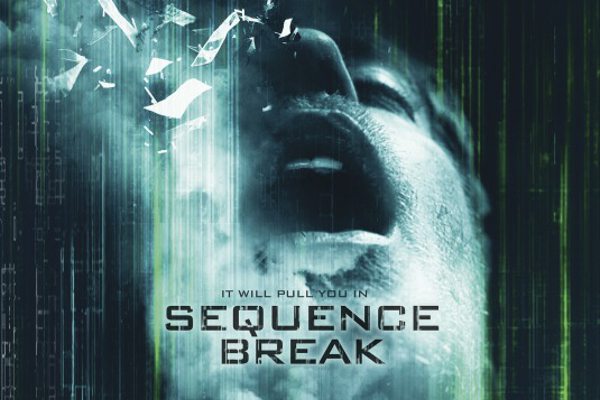
Polybius isn’t a video game. It’s an urban legend. Supposedly, the game was a government experiment, a game that produced not only intense psychoactive symptoms but also became addictive. Even crazier, the Men in Black would data mine these machines and study the users. Why? Who knows — legends like this have gone as far back as The Last Starfighter, stories like how Missile Command was being used to recruit people good enough to save the country when the bombs eventually (inevitably) fell.
Oz (Chase Williamson, John Dies at the End) is content to be alone with the ancient video games — fixing them, playing them, creating them — in his boss Jerry’s arcade. Everything in his life is thrown for a loop in one day: the arcade is closing, he meets a girl named Tess (Fabianne Therese, John Dies at the End) and a strange new game shows up unannounced.
What follows is a Cronenberg-esque body horror odyssey with sexualized video game controls being manipulated, bodies being distorted to add circuits and time loops where multiple versions of Oz can exist. It’s also a love story.
The game, when shown, looks like what Polybius has been described as. It gradually takes over Oz’s reality until he decides that the only person who made the rules for his game is himself.
It’s an interesting effort from actor/writer/director Graham Skipper, who starred in Almost Human and directed the film Space Clown. It’s an obvious tribute to Videodrome, but where that film had volumes to speak about culture, violence and the intersection of both, this movie doesn’t have nearly as much to say. I was kind of hoping for Oz to have more of a redemptive journey after he argued with Tess, telling her that he may have always been the person that he has become post video game freakout.
You can catch this movie on Shudder, where it has recently premiered.
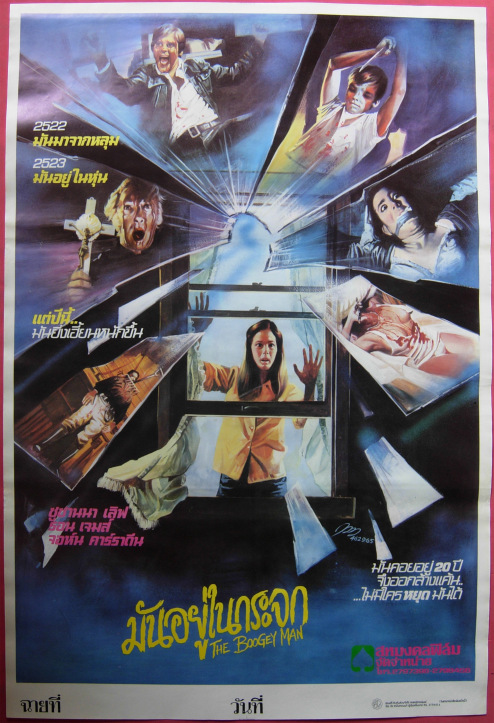
When Willy and Lacey were kids, they watched their mom and her boyfriend — who wore her stockings on his face — make out. Their mother was so upset, she sent Lacey to her room and tied Willy to his bed. It didn’t work, though. Willy would get out and stab the guy to death with a giant knife in front of a mirror. And that’s only the first few minutes of this one!
Now we’re in the present and Lacey (Suzanna Love, who was married to the director of the film Ulli Lommel and appears in all the sequels) is married with a young son, living with her aunt, uncle and Willy (Nicholas Love, Suzanna’s real-life brother)on a farm. Willy’s never gotten over killing a man, so he doesn’t talk and often steals knives.
Over dinner, Lacey announces that their mother wants to see them one last time before she dies. Willy burns their letter and this starts off a series of dreams where she is tied to a bed and nearly stabbed, which makes her husband send her to a shrink.
And that shrink? Skinny Dracula himself, John Carradine, who shot everything in one day. He tells them that she has face her fears and go back to her childhood home. As they look at the house, we see the dead boyfriend reflected in the mirror he died in front of. Lacey goe shithouse and smashes it, which is totally not what you should do. Nor should you take those pieces and try and fix the mirror. Mirrors are cheap. Go to Wal-Mart. Buy a new and uncursed mirror.
The pieces left behind start to glow red and kill everyone in the house after Lacey and Jake leave. Speaking of mirrors, Willy hates them. One of them made him strangle a girl, so he paints them all black.
The shards of glass start doing evil things, like levitate pitchforks, rip off Lacey’s shirt and impale young lovers with a screwdriver. I was cool with the shards of glass until then. You’ve taken it too far, shards of glass! I guess we can blame them for the aunt and uncle dying too, right?
This being 1980, Jake decides to bring a priest in to fix everything. This causes Lacey to get possessed by a mirror shard and attack everyone. She kills the priest, too, but not before he removes the mirror’s control over her.
That’s when the best solution comes up — let’s just throw the mirror in a well. This releases all of the souls, with Lacey, Willy and her son happily exiting a graveyard. Oh no — a piece of the mirror is on her son’s shoe!
I was wondering where so many of the plot points of this movie would go and they’re often lost as if this were a foreign film. But it isn’t! So I did a little digging into the director, Ulli Lommel.
Lommel had one crazy career, starting with appearing in Russ Meyer’s Fanny Hill, then acting in Fassbinder’s surreal western film Whitey (as well as several other of the director’s films). Moving to the U.S. in 1977, Lommel became connected to Andy Warhol, who became involved in his films Cocaine Cowboys and Blank Generation, a movie that starred Richard Hell and was filmed at CBGB.
Seriously — a movie that rips off Halloween, The Amityville Horror and Argento lighting while feeling like more than two movies mashed up into one that also features a girl cut her own throat with scissors, a child get his neck broken and a priest get his face melted? The acting is horrible — but are you here for that? Nope. You want to get freaked out when people’s eyes get replaced with a piece of a mirror.
Part of me wants to make fun of this movie. But another part of me wants to protect it from mean people who say things like its lack of attention to details. Or horrible editing which cuts on action. Or the fact that none of its characters appear to be actual human beings. And the camera angles are more dad doesn’t know how to use the video camera than art. But yet, I love this. I want to love it more, but I love what it can be more than what it is.
The Boogeyman was followed by two sequels that use footage — a lot of footage — from the original. Supposedly, a Boogeyman Chronicles web series is due this year.
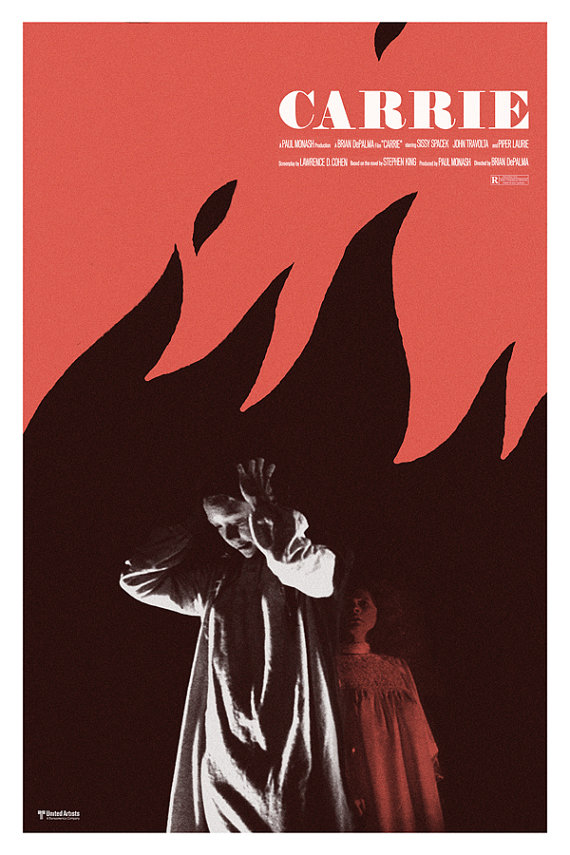
This is King’s first novel to be published and first one to be adapted to the silver screen. And if you ask me, it’s probably my favorite. Credit where it’s due — Brian De Palma presented a master class in how to build intensity and intensity in this film. It’s so perfect that it brings me to tears.
The difference between this film and any other teenager being abused who learns they have powers and gets revenge film is that we actually care about the teenagers. They’re real. Other than one of them being able to move things with her mind, their issues feel genuine. Some characters have shades of gray. And no one emerges unscathed in the end.
The film starts with shy Carrie White (Sissy Spacek) having her first period in the shower, surrounded by other girls. This typical nightmare scenario, one we expect to wake up from, like dreaming we’re stuck in school naked, is happening to her as the other girls pelt her with sanitary napkins. Christine Hargensen (Nancy Allen, Dressed to Kill) leads the others as they yell “Plug it up!” Carrie’s terror goes off as light bulbs explode and her teacher, Miss Collins (Betty Buckley, who is so perfect in this), has to console her.
At home, Carrie is abused further by her mother (Piper Laurie, Twin Peaks) who screams at her for her sinful thoughts. Dragged into a prayer closet, she must beg God to forgive her.
One of Carrie’s classmates, Sue Snell (Amy Irving, the only actress to show up in the sequel — more about that travesty tomorrow) feels guilty, so she asks her boyfriend Tommy (William Katt, House) to take Carrie to the prom. Miss Collins makes the girls pay for the way they treat by sending them to detention, where Chris’ behavior leads the teacher to slap her and suspend her from the prom.
That’s when Chris comes up with a horrible plot: they will name Carrie as prom queen and dump blood upon her, a scheme that she gets her boyfriend Billy (John Travolta) to make happen.
Carrie’s mom learns that she is going to the prom and accuses her of witchcraft. She uses her powers to throw her mother down. While at the prom, Carrie finds a happiness that she has never known until now. She feels accepted. She feels love. And she has her first kiss with Tommy.
What follows is what makes this movie a classic.
Chris’ friend Norma (Totally P.J. Soles!) rigs the election and Tommy and Carrie walk to the stage to be crowned. At the last second, Sue tries to stop things and fails. And that’s when De Palma uses nearly every trick in his book to amp this scene up. Split screen, multiple angles, time distortions…it’s pure cinema.
This scene took two weeks and 35 takes to shoot, including an intense dizzying scene that was created by placing Spacek and Katt on a platform that spun in the opposite direction of a camera that was dollied away from the actors.
After all that build and suspense, the bucket of pig’s blood covers Carrie and knocks out Billy. Our heroine has a hallucination that her mother’s warning of everyone laughing at her has come true and she unleashes the full fury of her powers. Right and wrong, good and evil, everyone pays.
You’d never guess that Sissy Spacek was her high school’s homecoming queen.
Carrie walks away as Chris and Billy try to kill her with his car, but she easily makes it flip over and explode. Soon, she is back home, crying in her mother’s arms. Margaret confesses that Carrie is a child of rape, then stabs her in the back. She fights back by crucifying her mother and burying herself within the house.
As Sue comes to the grave, months after this all happens, she is startled by a bloody hand that emerges from the tomb to attack her. Yet it’s all a dream in a shock ending that has been — and will be — copied over and over.
This is a movie that has lost none of its power. If it’s not in your collection, you don’t have one to speak of. Shout! Factory has a great collector’s edition and you can also stream it at Amazon Prime or Hulu.
Tommy Lee Wallace has made many lasting contributions to genre filmmaking, first on John Carpenter’s Dark Star and Assault on Precinct 13 before appearing as The Shape/Michael Myers in the original Halloween, writing Amityville 2: The Possession, co-writing and directing the original Fright Night Part II and acting and being part of the effects team for The Fog. But this film cements his legacy, with a great build and plenty of scares within the limitations of television.
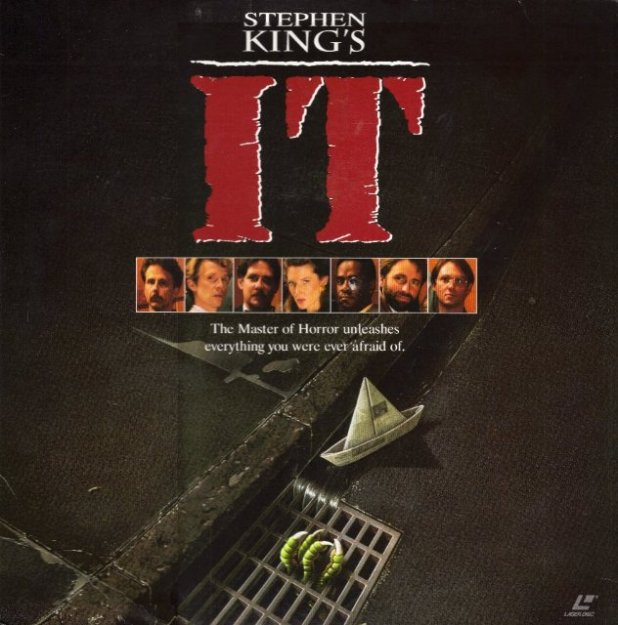
Originally airing from November 18 to 20, 1990, screenwriter Lawrence Cohen turned 1,138 pages of King into a two-part, three-hour TV movie. Wallace — and others — have commented that the first night is near perfect story-wise, but it falls apart on night two.
The story concerns The Lucky Seven, or The Losers Club, a group of outcasts who learn that the shapeshifting creature named Pennywise has taking and killing children in their hometown of Derry, Maine. They first battle him in 1960 as teenagers before coming back to battle him again in 1990.
This might sound like a broken record when it comes to King movies, George Romero had originally been signed on to direct the project when ABC had planned for an eight-to-ten-hour series that would play over four nights. He left the project due to scheduling conflicts, but he would finally direct a King adaptation, The Dark Half. This is considered one of the most faithful treatments of the author’s work.
That said, we’re here to talk about It, which begins with Georgie Denbrough playing with the paper sailboat that his brother Bill (Becca fave Jonathan Brandis) has made for him. As it sails down the sewer, he encounters Pennywise (Tim Curry, whose work in this movie led to thousands of nightmares of 90’s kids), who gnaws his arm off and leaves him to die.
The Losers Club comes together when Bill and Eddie Kaspbrak welcome the new kid, overweight Ben Hanscom. They’re soon joined by Beverly Marsh (Emily Perkins from the Ginger Snaps series of films), Richie Tozier (Seth Green), Stan Uris and Mike Hanlon. They all have two things in common: they’re bullied by Henry Bowers’ gang and they’re all encountered the evil of Pennywise. They soon learn that every thirty years, the shapeshifter comes back to town to claim the lives of children.
When Stan is ambushed by the gang, Pennywise (or It) emerges and kills two of the gang members. Henry is left traumatized and left with white hair. He eventually confesses to all of the murders, although he didn’t commit them. Stanley and the rest of the Losers learn how to use their imagination to stop the creature and drive it into the sewers before making a vow to come back to Derry if it ever comes back.
Thirty years later, Mike (Tim Reid from TV’s WKRP in Cincinnati) is the only member of the Losers Club to stay in Derry. When It returns and begins killing again, he brings everyone back together. Bill (Richard Thomas, Battle Beyond the Stars) is now a famous horror writer married to Audra, a gorgeous British actress (Olivia Hussey, Black Christmas). Ben (John Ritter) is an architect. Beverly (Annette O’Toole) has grown up to be a fashion designer but has transitioned from being abused by her father to being beaten by her husband. Richie (the late, great Harry Anderson) is a comedian. Eddie (Dennis Christopher, Fade to Black) runs a limo service. And Stan is a real estate broker who decides to kill himself rather than come back home to face It.
Meanwhile, Henry has escaped from the mental institution with the help of It. His goal? Kill the rest of the Losers. The shapeshifting monster also draws Bill’s wife to town.
Mike is hospitalized after being stabbed by Henry and the five remaining Losers head to the sewer for a final battle. That’s when the movie falls apart, as the monster can never live up to King’s words. If you ask nearly anyone, they always bring this up. That’s because it’s true.
All of the Losers but Eddie make it out, with Beverly and Ben reconnecting and Bill saving his wife. But at this point, most people have been scorned by the spider that Pennywise becomes.
That’s because it’s hard to beat just how scary Tim Curry is in this movie. Supposedly, he unnerved the cast so much that many avoided him during the production.
The movie eliminates some of the problematic parts of the book for me, such as Beverly taking the virginity of all the male characters in the sewer, but retains Audra becoming a victim who needs to be rescued. Tommy Lee Wallace has noted that he doesn’t think that it works dramatically in the movie or novel.
Of course, It was remade in 2017, with a second part coming soon. But the first night of this miniseries more than holds up. Understandably, the budget issues and unfilmable nature of the second night’s big reveal hurt this film, but that doesn’t mean that it’s bad. I’m a big fan of Wallace as a director and feel that he brought a ton of talent to this adaption.
After years of being hard to find, you can now get the blu-ray of this miniseries in Wal-Mart discount bins for a great price. Or you can turn to Shudder, which has added this movie as part of the King of Horror May promotion.
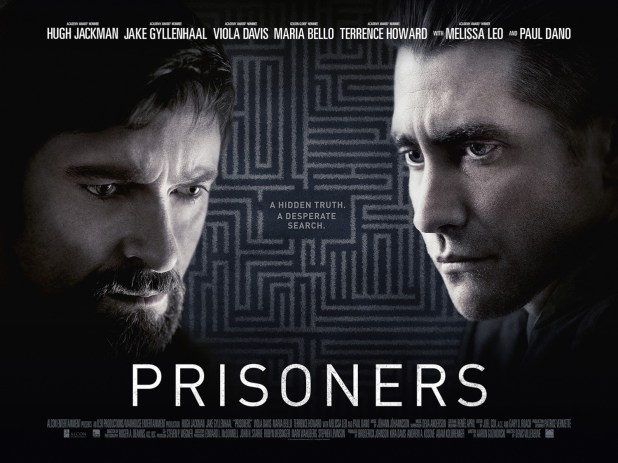
When Becca and I saw the trailer for Prisoners, I knew that it would be a film that I’d be hunting down for her. When it ended, she said, “Why can’t every movie be that perfect?” I asked what she meant. “Nothing dumb happened.”
Kelly Dover (Hugh Jackman, forever Wolverine to me) and his wife Grace (Mario Bello, A History of Violence) are celebrating Thanksgiving with their friends Franklin Birch (Terrence Howard, Hustle & Flow) and his wife Nancy (Viola Davis, about whom I love the fact that she was in both Fences and Suicide Squad). The kids are at play — older kids Ralph (Dylan Minnette, Let Me In) and Eliza (Zoe Soul, The Purge: Anarchy) downstairs watching TV, younger children Anna and Joy outside.
Earlier, the girls had been playing on an RV and the older kids had gotten them away from it. But now, the younger children are nowhere to be found. Soon, a massive police manhunt is underway.
Detective Loki (Jake Gyllenhaal, forever Spider-Man to me) finds the RV outside a gas station and chases its occupant: Alex Jones (Paul Dano, Little Miss Sunshine). The man has the IQ of a child and his RV is clean, but Kelly wants him kept in jail. The police, however, can’t do that.
Loki explores every lead he has, including looking up sex offenders in the area, such as Father Dunn, a priest who killed a man and buried him in his basement. That man informed him that he was at war with God and had already killed 16 children.
Alex is released as TV cameras roll and Kelly attacks him, right after the man says, “They didn’t cry until I left them.” No one but Kelly hears this. He follows the suspect on his own, without the police, and when he hears the man sing the song his daughter sang the day she was taken, he snaps.
Using the building his father willed him that has gone dormant, Alex is beaten and tortured for what he knows. Jackman is excellent in these scenes and was encouraged to push his rage as far as it could go. It shows.
Loki is still on the case but his attention is divided between keeping track of Kelly and searching for a mysterious man who attended the candlelight vigil for the girls. That suspect, Bob Jones, lives in a house covered by mazes, with giant plastic storage bins filled with snakes and articles of children’s’ clothing covered by pig blood. Frustrated that he can’t solve the case — he’s never lost one before — Loki attacks Jones in the interrogation room. In the confusion, Jones grabs a gun and kills himself. The police figure that he never killed the girls or took them — he just wanted to be part of this. Loki thinks there’s something more.
Kelly continues torturing Alex, who also nearly escapes his interrogation in a scene that mirrors the one where Jones grabbed the gun. He finally confesses that the girls are lost in the maze, which is intercut with Loki matching the maze drawings that Bob Jones did with the necklace of the man he found in the basement of Father Dunn.
When Joy is found alive, she says to Kelly, “You were there.” What does this mean? Well, I don’t want to spoil any more of the story. It’s too good.
Jackman, Gyllenhaal, Paul Dano and Melissa Leo (who appears in heavy makeup as Alex Jones’ aunt) are all astounding in this. In particular, Gyllenhaal and Dano make some really interesting choices for their takes on their characters. However, some advice: Dano speaks incredibly low. Watch his scenes with closed captioning on or you will miss some integral parts of the plot.
Denis Villeneuve director is assured, with a slow-building suspense throughout the film, including some long pauses on static shots in the open. He’s since directed Sicario, Arrival and Blade Runner 2049.
Writer Aaron Guzikowski started writing this film back in 2007, where it ended up on The Black List, which contains the most popular unproduced screenplays in Hollywood. Afterward, he wrote the script for the remake of Soviet film Reykjavík-Rotterdam called Contraband (which has nothing to do with Fulci’s movie, despite me getting the wrong DVD several times when I tried to order that film) and he is currently working on a reboot of The Wolf Man.
This is streaming on most of the places where you can purchase films online. I found my used DVD for $6, so it’s affordable and worth adding to your collection.
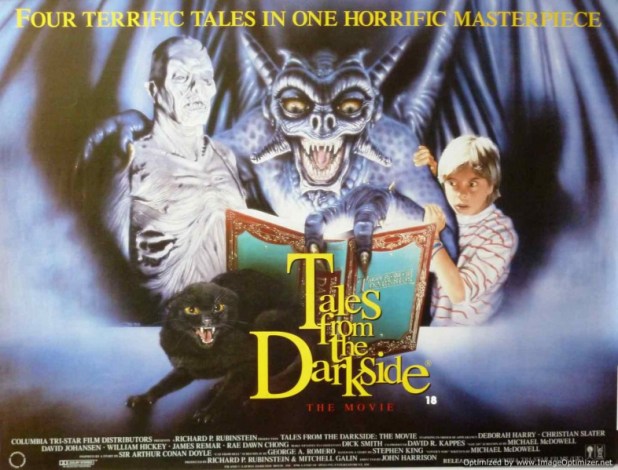
After the two Creepshow movies, where can you turn for a modern portmanteau filled with Stephen King stories? How about the cinematic version of the TV show Tales from the Darkside?
The success of Creepshow led to thoughts of making it into a TV series. Warned Brothers owned some aspects and Laurel Entertainment, who produced the film (its George Romero’s company) opted to create their own version. Two episodes of the show, “Word Processor of the Gods” and “Sorry, Right Number,” were based on King stories.
Starting with the intro “Man lives in the sunlit world of what he believes to be reality. But…there is, unseen by most, an underworld, a place that is just as real, but not as brightly lit…a dark side,” and ending with “The dark side is always there, waiting for us to enter — waiting to enter us. Until next time, try to enjoy the daylight,” the show was a dark journey into the supernatural. It was followed up by Monsters, another anthology show of somewhat lesser quality (although several of the episodes are great fun and there’s a King written episode, “The Moving Finger”).
Several people, including Tom Savini, think that this movie is the real Creepshow 3, but his quote may be referring to the similar nature of the movies and the involvement of King and Romero.
The movie begins with Debbie Harry of all people, playing a housewife who is preparing the main course for a dinner party — Timmy (Matthew Lawrence, brother of Woah! Joey). As the film progresses, they will be our framing device as Timmy reads from the actual book Tales from the Darkside.
In Lot No. 249, based on Sir Arthur Conan Doyle’s short story and adapted by Beetlejuice writer Michael McDowell, a grad student named Edward (Steve Buscemi has never looked so young!) has been framed for a theft which ruins his scholarship. He wants revenge on Susan (Julianne Moore in her screen debut) and Lee (Robert Sedgwick, brother of Kyra) and gets it by reanimating a mummy to kill them both.
Susan’s brother Andy (Christian Slater, Untamed Heart, Robin Hood) kidnaps Edward and brings the mummy to kill him. At the last moment, he can’t do it and releases him. He probably shouldn’t have done that, as Edward soon sends the reanimated versions of Susan and Lee to kill him!
The next story, The Cat from Hell, is based on a King story and was adapted by Romero. A black cat is bedeviling Drogan (William Hickey, National Lampoon’s Christmas Vacation), a pharmaceutical owner whose latest drug has killed over 5,000 cats in testing. One by one, the cat has killed everyone in his house, so he hired a hitman named Halston (New York Dolls frontman David Johansen, who is also Buster Poindexter).
After a comical battle, the cat goes down Halston’s throat (seriously, this special effect is insane and kudos to the special effects crew, which includes KNB) and then emerges to kill the old man.
The third story is also written by McDowell and is based on the Yuki-onna, a spirit in Japanese folklore. Preston is a drunken and depressed artist played by James Remar (Raiden from Mortal Kombat: Annihilation) who witnesses a gargoyle kill a man. The monster swears to not kill Preston as long as he never tells anyone what happened.
Starting with that night, his life changes for the better. He meets and marries the gorgeous Carola (Rae Dawn Chong, Quest for Fire) and they have two children. He becomes a famous artist. He even wins back Robert Klein as his agent. All is well, but he can’t forget the monster.
On their tenth anniversary, he decides to tell his wife, which was the wrong idea. She was the monster all along and their children are also monsters (!). At the end, they all fly away after she kills him.
Finally, Timmy escapes by throwing the woman into the oven, then looks directly at us and says, “Don’t you just love happy endings?”
There was an announced sequel to this movie that was never filmed. A screenplay was written by McDowell and Romero, along with Gahan Wilson. Segments would have included an adaptation of Robert Bloch’s “Almost Human,” as well as Stephen King’s “Pinfall” (originally planned for Creepshow 2) and “Rainy Season.” Sadly, it never was filmed.
Director John Harrison was part of the Image Works, along with Dusty Nelson and Pasquale Buba (whose family name and hometown of Braddock was used for Martin). They produced the film Effects together. Harrison is also a music composer, creating the music for this film, as well as Creepshow and Day of the Dead. He wrote and directed Frank Herbert’s Dune in the early 2000’s, plus he wrote and co-produced the follow-up Frank Herbert’s Children of Dune.
Here’s some trivia I found interesting. Because of the samples and music cues that were used from Day of the Dead, Harrison recieved a co-writing credit on the Gorillaz’s songs “M1 A1” and Hip Albatross.
This is a pretty well-done film. I miss the Creepshow framing device, but it’s a great way to get more stories into one film. I remember catching the end of the third film as a teen and being freaked out by it. It’s still pretty powerful nearly thirty years later.
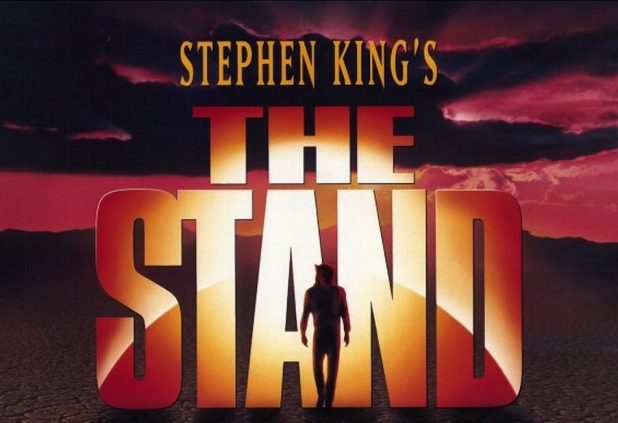
The unabridged version of the stand is 1,152 pages. How do you film that? How do you capture everything? This 1994 miniseries — originally airing from May 8 – 12 of that year — made a valiant effort.
It’s nearly impossible to get in every character from the book, but that doesn’t mean that these guys didn’t try. With a screenplay by King, Mick Garris stepped into the director’s chair, armed with a huge cast that does a great job of capturing their roles.
The hard part of The Stand is that there’s more than one hero and multiple casts to follow. I guess Stu Redman (Gary Sinise) would be the main hero, but you could also argue that the deaf and mute Nick Andros (Rob Lowe, who is deaf in his right ear) is the hero. Or maybe singer Larry Underwood is. When you’re reading the book, you can determine who the protagonist you like best is, you can also see them as you want in your mind. With a film, it’s not so simple.
As Captain Trips, a weaponized flu virus, sweeps across America, the end of the world takes shape and Mother Abagail Freemantle (Ruby Dee) gathers the forces of good against Randall Flagg and his followers. Flagg, otherwise known as the Walkin’ Dude, the Dark Man, the Ageless Stranger, the Man in Black and the Hardcase (as well as Walter Padick, Nyarlathotep, Rudin Filaro and a ton of other names), is the villain of more than one King story. He shows up in The Dark Tower, Hearts in Atlantis and The Eyes of the Dragon. His character goes all the way back to a poem that King wrote in 1969.
Amongst his forces are the bonkers crazy Nadine Cross (Laura San Giacomo), criminal rat eater Lloyd Henreid (Miguel Ferrer), the explosive loving Trashcan Man (Max Headroom himself, Matt Frewer, who has appeared in more King adaptions than anyone else), the Rat Man and so many more. But the good guys also have Judge Ferris (Ossie Davis), the worst dressed heroine ever in Frannie (Molly Ringwald), her wannabe boyfriend and potential traitor Harold (Parker Lewis Can’t Lose star Corin Nemec), simple-minded Tom Cullen (Bill Fagerbakke, Dauber from TV’s Coach), wise Glen Bateman (TV legend Ray Walston, who was also Mr. Hand in Fast Times at Ridgemont High) and many, many more.
This is a film packed with stars, even in small roles, like Ed Harris as General Starkey, Kathy Bates as Rae Flowers, Kareem Abdul-Jabbar as a man proclaiming the end of the world and King, Sam Raimi, Tom Holland and John Landis show up in cameos. Even Joe Bob Briggs is in this!
The four parts, The Plague, The Dreams, The Betrayal and The Stand, tell as much of the story as possible. I was kind of let down by the casting of Flagg, but it’s hard to find anyone to live up to the ultimate evil that he’s presented as in the book.
This is the second King book that George Romero planned to make into a film that ended up as a TV movie (Salem’s Lot is the other).
Interestingly enough, none of the Boulder Free Zone scenes were shot there. Soon before production started, Colorado passed Amendment 2, an amendment to their state Constitution which nullified any existing laws protecting the rights of homosexuals. In protest — and perhaps because King’s daughter Naomi is a lesbian — the production moved to Utah.
The fact that the film was finished is a testament to the production team. With 460 script pages that were shot across 100 days in 6 states, that meant that the final project is nearly 8 hours long. They had to figure out how to dress 95 shooting locations on their budget, including a cornfield and a decimated Las Vegas.
There’s been talk of a digital CBS mini-series, but it seems as if they’ll try to tell the whole story in one movie. Josh Boone, a legitimate Stephen King fan and the director of The Fault In Our Stars, is slated to direct.
I hope however they remake this, they make sure to get better outfits for Frannie. I realize that this mini-series is 24 years old, but her fashion taste has not aged like a fine wine. Every single time she appears, her sartorial splendor — or lack thereof — takes me out of the movie!
That said, the main body of The Stand is quite enjoyable. You can find this film on DVD for a really low price, considering how much movie you get.
By the way, if you’re wondering what my favorite scene is, it’s when Nadine informs everyone that they’re in Hell before she rides up the elevator to be further assaulted by Randall Flagg. I quote this scene way more often than I’d like to. And often, it’s to people who have no idea of the reference.
The Inside View is a tabloid all about blood, gore and Fortean stories that is mentioned in several Stephen King stories, like Desperation, Insomnia, The Waste Land, Bag of Bones, Needful Thingsand Doctor Sleep. In The Night Flier, cynical reporter Richard Dees (the superb and sadly deceased Miguel Ferrer) is the senior reporter for that rag, on the hunt for the titular killer.
The Night Flier is a serial killer who uses a Cessna Skymaster to travel to small airports, where he kills people as if he were a vampire. A pilot himself, Dees follows him to Wilmington International Airport, where in the midst of a violent storm he learns that he’s really after a vampire.
This is no modern vampire. It’s a horrifying creature that looks more beast than man. When he comes to face to face with the monster, it destroys his evidence and leaves him at the crime scene where he’s killed by the police.
Reporting on it all is Dees’ would-be apprentice/rival, Katherine Blair. He abuses her with his language, telling her his rules of reporting and continually judges her. She survives to report on his death, which becomes the front cover of the newest edition of “Inside View.”
The Night Flier movie is the nexus for several King stories and is packed with references. In a scene where Katherine looks at some of Richard’s most famous headlines, they all refer to past King tales: “Kiddie Cultists in Kansas Worship Creepy Voodoo God!” is Children of the Corn, “Satanic Shopkeeper Sells Gory Goodies!” is Needful Things, “Naked Demons Levelled My Lawn” is The Lawnmower Man and “The Ultimate Killer Diet! Gypsy Curse Flays Fat Lawyer’s Flesh” is Thinner.
The character of Dees also appears in the book version of The Dead Zone, as he attempts to interview protagonist Johnny Smith for Inside View. Additionally, the vampire in the tale “Popsy” is also the same one from this story.
The Night Flier depends on Ferrer’s performance, which he aptly delivers. It’s an interesting film and one worthy of watching.
Are you sick of superhero movies? People love to discuss how there have been too many lately. But think about this — in 1950, there were 134 Western/cowboy movies made. So sure, there have been plenty of comic book related movies. But I don’t think we’ve reached saturation point yet.
Deadpool started as a ripoff of DC’s Deathstroke the Terminator, but he quickly grew into his own character, a self-aware, speaking right to the viewer bit of anarchy in the Marvel Universe. Starting his life as Wade Wilson, he gave himself over to Department H, the same group that gave Wolverine his adamantium skeleton, in the hopes of curing his cancer. Yes, I wrote all of the paragraph from memory. I can go deep on the X-Men.
Even more complicated is Cable, the hero/villain of this film. Man, it takes a paragraph to explain him. He’s the son of Cyclops and Madelyne Pryor, who is a clone of Jean Grey. He was given a techno-organic virus by Apocalypse and raised in the future by a psychic projection of his parents before coming back to our time as a much older, much more hardened mercenary who gathered the New Mutants as X-Force to stop the end of the world that his clone Stryfe would bring about. You don’t need to know any of that to enjoy this movie. I know all of it. I also didn’t get laid until I was 23. Such is comic books.
That said — Deadpool screws up and his life is ruined, so he becomes obsessed with ending his life. Then, he meets the teenage mutant Firefist (based on New Mutant Rusty Collins, played by Julian Dennison from Hunt for the Wilderpeople) who needs a friend. Of course, Deadpool screws that up. Then, he joins the X-Men and screws that up. Then, he forms X-Force. And screws that up. Basically, most of the movie is Deadpool being a colossal failure until he learns how he can finally die and be happy. Or not. I’m not gonna spoil it for you.
I’m also not going to spoil the big bad guy reveal either. But along the way, you get appearances by Negasonic Teenage Warhead (a Grant Morrison character named for a Monster Magnet song), Wolverine’s ninja friend Yukio reimagined as an anime girl come to life, Colossus, Black Tom Cassidy, Domino, Shatterstar, the Vanisher and many, many more.
Cable is played by Josh Brolin, who really brings the crusty, always angry spirit of the character to life. I was overjoyed with his casting here, particularly since I didn’t see Pierce Bronson or David Harbour as working in the role.
This is a film that fights to be poignant and achieves it by the end of the film. It’s also an incredibly silly film that wipes out characters as soon as it introduces them. And it’s also packed with references to Yentl. Yes, Yentl.
Basically, if you hate superheroes, you will hate this film. You can make that decision for yourself. If you love them, you will love this. And if you spent most of your teen years drawing pictures of Machine Man, Deathlok and Ulysses Bloodstone, then you’re me and you were incredibly happy at the end of this movie.


 B&S About Movies