BIGFOOT WEEK: Bigfoot vs. D.B. Cooper (2014)

I want you to look at that awesome box art. I want you to imagine just how insane a pairing of legendary hijacker D.B. Cooper and Bigfoot could be. I want you to notice Linnea Quigley and Eric Roberts names above the credits. And then, when you realize that David DeCoteau directed it, you’ll realize that things are about to take a turn.

Sure, DeCoteau started his career making movies like Creepozoids and Sorority Babes in the Slimeball Bowl-O-Rama, but of late, he’s been making cover versions like The Brotherhood, which reimagines The Craft as a homoerotic battle of magical boys.

I started watching this and Eric Roberts’ narration of the legend of D.B. Cooper had me hooked. I put my head down to start writing this review and looked up and thought, why is every guy just wandering around topless? Soon, I realized that no one had on any shirts at all and were all gradually taking more and more of their clothes off. Once a scene turns into a softcore JO event, I decided to do some research, thinking “David DeCoteau has to be behind this.” And yes, pardon the pun, be he sure was.

You have to admire the audacity of a director that promises you a movie where Bigfoot battles another myth and delivers a movie with hairless boys parading around with guns. In fact, I love that this movie is on Amazon Prime, complete with reviews that all contain the phrase “not that there’s anything wrong with it.”

Bigfoot erotica is a thing. David DeCoteau movies of bros with pecs all posing for the voyeuristic lens of the director are a thing. If that’s what you’re looking for and you have no interest in just straight up watching porn or an actual Bigfoot film, then let me recommend this one to you. I’m glad that there’s something for everyone and this film is certainly that something for those that always wanted to watch a movie where dudes stroke themselves until being murdered by a man in a horrible looking Bigfoot costume. But hey! The scenery is nice!

And if you were planning on Linnea Quigley rescuing you from the odd stirrings you’re feeling, bad news. It’s just her voice. You’re gonna have to deal with whatever you’re dealing with like a man.

I love that Fangoria even interviewed DeCoctau about this project, in which he said, “I remember the evening when D.B. Cooper leaped from that plane. I was 9 years old and living with my family in Portland, Oregon, where Cooper boarded it. It was all over the local news. Even at a young age, I knew it would be near-impossible for anyone to survive that jump—at night, during a rainstorm. I knew the area of Washington State where the FBI thought he could have landed. It is so remote and dangerous that if the jump didn’t kill D.B., then maybe something else did. Bigfoot vs. D.B. Cooper is my theory of what actually happened to the hijacker.”

So basically, at nine years old, he imagined a movie where Bigfoot traced the outline of a dude’s package through his boxers before killing him. I love that we live in this reality, everyone.

You might be reading this and wonder, “Should I watch this movie?” I’d say yes. You’re not going to see another film that has this many repeated shots, this much stock footage (there’s literally a 3D render of an airplane used in the place of stock footage) and this much ADR. It’s the kind of movie you can brag that you finished. It’s 76 minutes of running time feels like 76 months. I stuck it out just wondering, “Would Bigfoot ever battle D.B. Cooper?”

I’m going to save you some time and tell you that yes, they battle. And that D.B. Cooper is now Bigfoot. If you want some explanation beyond that, you’re going to need to watch this yourself.

I love that this movie was available on DVD at Wal-Mart and can only imagine that this was made only as a Trojan horse to get male softcore porn into the unwanting hands of far-right conspiracy lovers. And if me sitting through this painful film had to happen to make that come true, I regret that I only have one life to give to my country.
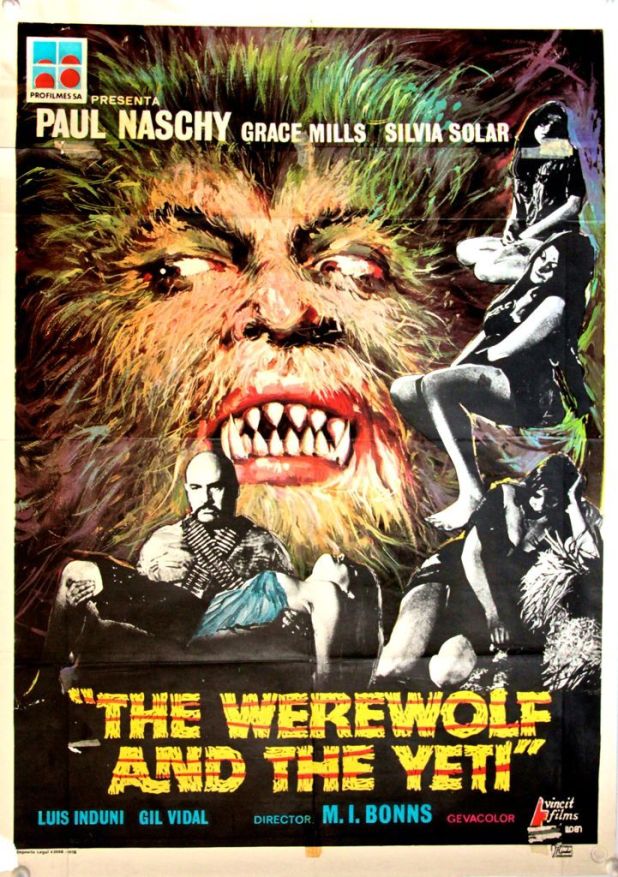
BIGFOOT WEEK: The Werewolf and the Yeti (1975)

Let’s step away from Bigfoot to speak on werewolves. Specifically, a werewolf named Count Waldemar Daninsky. Over twelve movies, his origins have changed as many times as his films have alternate titles. Here, in the eighth film in the series (also known as The Curse of the BeastNight of the Howling Beast and Hall of the Mountain King), Waldemar becomes a werewolf when he’s bitten by not only one, but two vampire woman.

Wait — a vampire can turn you into a werewolf? And how does a yeti get involved? Oh man, welcome to the fever dream that is a Paul Naschy film.

Waldemar Daninsky is in Tibet looking for the legendary yeti when those two vampire women we alluded to before capture him and keep him in their cave. While they’re having sex with him and biting him and making him a werewolf (which seems to be the best way to be transformed), his friends are being captured and tortured by Tibetan pirates.

With eight minutes left in the movie, Waldemar becomes a werewolf and battles a yeti one on one. By the time I got that far — keep in mind I was at a drive-in — I was so inebriated that I was in and out of consciousness. Or perhaps this film is that strange, seeing as how it’s filled with skin being ripped off people’s backs, neon glowing caves, nudity, rituals and stock footage. In short, it’s great.

You’ll find this movie — in way better quality than the night I saw it — in the Paul Naschy Collection volume 2 from Shout! Factory.

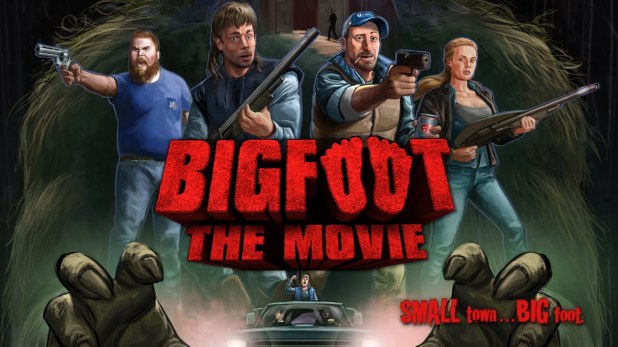
BIGFOOT WEEK: Bigfoot: The Movie (2015)

A lot of this review won’t make sense if you aren’t from Western Pennsylvania.

Becca was born near Detroit, so she doesn’t always get a lot of Pittsburgh. There’s the yinzer accent. The strange customs. And when we were in line at Kennywood to ride the Thunderbolt the other night, she didn’t get the palpable excitement that everyone else felt when Donnie Iris’ “Love is Like a Rock” blared over the speakers.

Sure, this song may have only reached #37 on Billboard’s Hot 100 way back in 1981 (and was covered by Slade too!), but here in Pittsburgh, it’s probably in the top three songs of all time. We may have a strange love for the Styx’s “Renegade,” despite them being from Chicago.

I’m telling you all this because Bigfoot: The Movie opens with a bunch of guys screaming out the lyrics to “Love Is Like a Rock” while cruising down the two-lane blacktop of my hometown, Ellwood City, PA. Yep. Bigfoot is on the loose and he’s haunting the bars that I used to sneak into underage.

Seriously, most of this movie is set in bars like the Hazel Manor, The Shelby and The Oak Grove Inn. This may mean nothing to the folks streaming this movie on Amazon Prime, but it’s incredibly strange for me to see the place I sang my first time in public or the 7-11 I used to skateboard to show up in a horror movie.

Another fact that non-Pittsburgh folks may miss out on is that this movie stars Curt Wooton, who is better known here as the viral star of Pittsburgh Dad. It’s hard to describe our mishmash non-word language of Yinzer to those that are outside our mountainous walls, but Wooton has made a career of this character. Here, he plays Chuck, one of the guys who wants revenge on Bigfoot.

Turns out that the Mayor has one under wraps and it keeps getting out to kill people, like the best friend of Chuck, Burl and Dale. This is as much as drinking buddy film as it is a Bigfoot movie as it is a homage to Jaws.

You also get cameos by Pittsburgh comedians Jim Krenn, Terry Jones, Bill Crawford and Aaron Kleiber, as well as other Burgh celebs like news anchor Darieth Chisolm and actresses Brenna Lee Roth and America’s Next Top Model contender Joanie Dodds as the lead girl Kate, who proves that she can drink and shoot as well as the boys. And director Jared Show grew up and went to school in Ellwood City, so you pretty much will get an unvarnished look at the siding covered houses filled with nic nacs and country looking streets of where I spent my formative years.

Back to how this all began — if you aren’t from here, much of the humor may fall flat. If you are, you’re probably going to love it. After all, it has Donny’s music in it n’at.

You can watch the film on Amazon Prime or check out the official site.

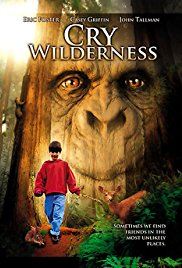
BIGFOOT WEEK: Cry Wilderness (1987)

Cry Wilderness comes from that most painful of all movie genres — the earnest family-friendly film with a message. This is the kind of movie that your church youth group would show on a Saturday afternoon after some lessons on Jesus. But see, I grew up Catholic, so my Saturday afternoons were spent watching Hammer films and hoping that my family would go to church that night so I could stay up watching Chiller Theater and sleeping in.

Once you grow up, some of those movies seem cloying and ridiculous. I didn’t encounter Cry Wilderness as a kid. No, I got blasted with both barrels of its strangeness as a fully grown adult.

This is the kind of movie that demands that you be OK with the fact that Bigfoot can show up and visit young Paul Cooper and warn him that his father will die unless he leaves his fancy school behind and, well, cry wilderness.

It’s also a movie where seasoned outdoorsmen have no idea how to properly handle weapons, continually pointing them directly at people, planting the muzzle of rifles into dirt and even running with their fingers directly on the trigger.

There are also mystical Native Americans, a park ranger who never wears his uniform, raccoons who know how to knock on doors, a child who is obsessed with said raccoons to the point where he allows them to get in the kitchen sink and eat, a bad guy principal who is the worst Xerox of William Daniels ever, a school that’s cool with a student wearing a Bigfoot medallion as part of his uniform and moments where the film goes completely out of focus. Make those numerous moments.

Are you cool with seeing Bigfoot’s zipper? How much b roll footage is too much? And are you ready for earnest country rock and a movie that feels like it was made in 1978, not 1987?

Topping it all off is the fact that many of the people in this film were also involved in one of my favorite bits of sheer lunatic filmmaking, The Nightmare Never Ends, which is also part of the even more manic Night Train to Terror.

You can watch it yourself by grabbing the DVD from Vinegar Syndrome. Or, if you enjoy Mystery Science Theater 3000, you can check out their take on the film on Netflix.

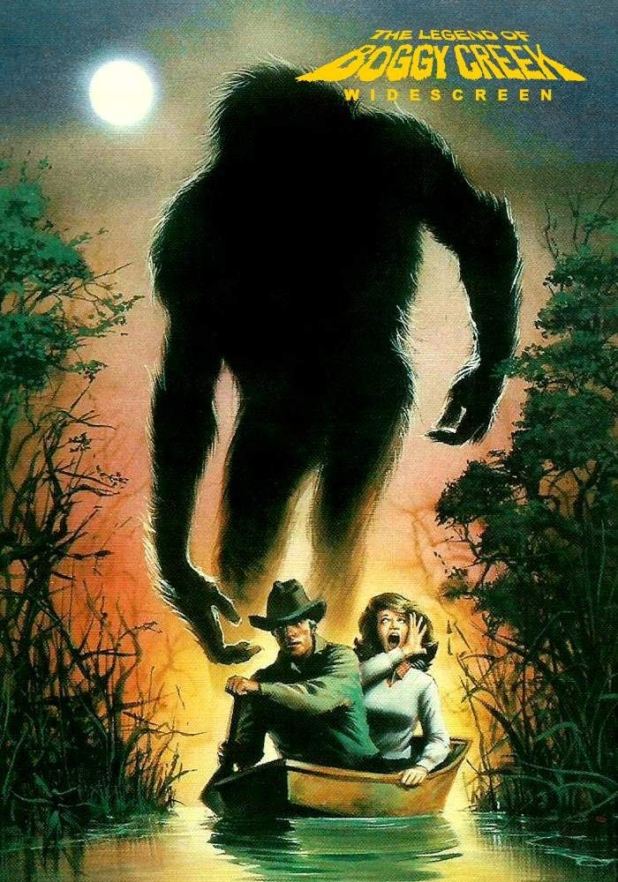
BIGFOOT WEEK: The Legend of Boggy Creek (1972)

The Legend of Boggy Creek is my favorite kind of movie. It’s at once a narrative story and a documentary so that there will be times that you have no idea whether you’re learning the unvarnished truth or being spun a tale. It’s kind of like that movie in Orson Welles’ F for Fake where he tells you that his promise to be truthful ended several minutes ago, except that it lasts for an entire movie and there are no promises whatsoever.

This journey to discover the Fouke Monster tells its story with staged interviews with Arkansas locals while also presenting reenactments of their tales. It comes straight from the fevered imagination of Charles B. Pierce. Once an advertising salesman from Texarkana, he borrowed over $100,000 from local trucking company Ledwell & Son Enterprises, used a movie camera he built himself and relied on an all-local cast that he discovered one by one at a gas station to create this opus.

While Pierce didn’t believe in the local legends himself, he was impressed by the “authenticity and down-to-earth qualities” that the locals brought to their tall tales. He turned to another ad man, Earl eE. Smith, to work their stories into a narrative and shot the film in Fouke, Texarkana and Shreveport.

Unable to find a theater willing to show his film, Pierce bought his own and cleaned it up himself called the Perot Theatre. Within three weeks, lines stretched around the block and Pierce was up $55,000 before selling international and TV rights to AIP.

The Fouke Monster is a skunk ape, a Sasquatch creature that the residents of Fouke have seen since the 1940’s. It has reddish-brown fur, a horrifying smell and three toes.

Locals regale us with stories, such as the time the Fouke monster carried off two 200 pound pigs. Or the time it scared a kitten to death. Or the time when hunters had the beast cornered, but their dogs refused to follow it any closer.

Finally, actual newspaper stories are cited in regards to the beast attacking a family and injuring one of them. The creature was never captured and is said to still stalk the swamps of southern Arkansas to this day. This is a real auteur work, with Pierce not only directing and producing but also interviewing the locals and singing the theme song.

This is my favorite era of cryptozoology when regional legends of the past contended with Cold War mania to create creatures that broke from their dimensions — like some pop culture Ancient Ones — to invade our popular consciousness. If only Pierce had grown up near Point Pleasant, WV, he would have made this movie about mothman!

Pierce would continue to make films about and for his unique Texarcana audiences, such as Bootleggers, the Western films Winterhawk and Winds of Autumn, and 1976’s transcendent The Town That Dreaded Sundown. He’d go on to be an in-demand set decorator, the writer of the Dirty Harry film Sudden Impact (he may have originated the line “Go ahead. Make my day.”) and directed other films like The Evictors and the nowhere near as good sequel to this film.

You can watch this on Shudder with and without Joe Bob Briggs commentary.

BIGFOOT WEEK: An interview with The Weirdest Movie Ever Made author Phil Hall

Yesterday, we reviewed The Weirdest Movie Ever Made, Phil Hall book that traces the convoluted history of how the Patterson and Gimlin film was created and impacted the scientific community and popular culture.
We had the opportunity to talk to Phil about the inspiration behind the book, a lost Bigfoot film and some thoughts on some of his favorite — or not so favorite — Bigfoot films.
B&S ABout Movies: What got you interested in Bigfoot? For me, it was the 1970’s show In Search Of…
Phil Hall: I had the great fortune of being a kid during the 1970’s, when there was a great fascination with subjects outside of the realm of established science. It seemed that you could not turn on the television, go to a movie theater, or open a publication without seeing something related to such topics as the Bermuda Triangle, ancient and contemporary extra-terrestrials and the superstars of cryptozoology, including Bigfoot. My initial interest was not in Bigfoot, per se, but in this wonderful parallel universe of funky subjects that, in many ways, helped define the happy lunacy of that decade.
B&S: When I was a kid, there was a traveling exhibit that came to our local K-Mart parking lot that was similar to the Minnesota Iceman. Did you ever encounter one of those?
Phil: I am from the Bronx in New York City. We didn’t have K-Marts – and, somewhat more disappointingly, we never experienced any of the Bigfoot or UFO sightings that permeated that era. Trust me, growing up in an urban setting comes with disadvantages.
B&S: I really got into the sections of the book that get into the four-walled exploitation film Bigfoot: America’s Abominable Snowman. Have you had a chance to see the film? What are your feelings on it?
Phil: I have yet to see the film. While doing my research, I was afraid that the film was lost – it’s not even listed in the Internet Movie Database. Mercifully, it survives in private collections, but it cannot be released on DVD due to copyright issues.
The most striking aspect of the Patterson-Gimlin Film story is how that film managed to reach so many people. In many ways, the distribution of Bigfoot: America’s Abominable Snowman is a milestone in the distribution of independent film productions. Sadly, very few people today know about the film because it has been out of circulation for so long.
B&S: Additionally, we’ve discussed the Sunn Classic Pictures 70’s documentaries on our site. Any recollections on those?
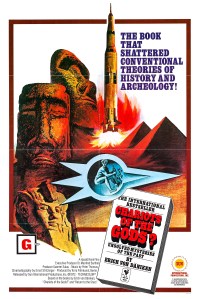
Phil: I have very fond memories of seeing Chariots of the Gods and The Lincoln Conspiracy during their theatrical releases, and I still have the paperback tie-ins to those films. Sunn Classic Pictures was the rare company that brought documentary films to mainstream audiences. I saw Chariots of the Gods at the Dale Theater in the Bronx, which was a neighborhood movie house.
I have looked at a few of the Sunn Classic films recently and, sadly, they are not as wonderful as I remembered them some forty years ago. But, then again, how many films that we loved in childhood still resonate with us as adults?
B&S: We’ve covered the Bigfoot films A Wish for Giants and Bigfoot on our site recently. I loved how you covered the latter, it’s a real piece of 1970’s drive-in weirdness. Do you have a favorite Bigfoot related film?
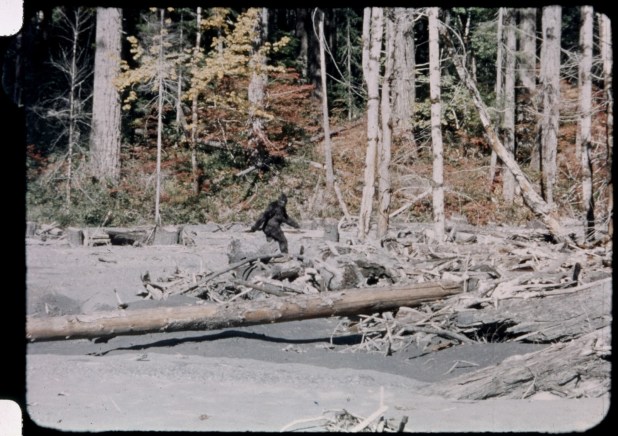
Phil: The answer may be a cop-out, but I have to say that I don’t have a favorite Bigfoot related film. The beauty of the Patterson-Gimlin Film is the elusive nature of Bigfoot, who is walking away from the camera and is mostly uninterested in human contact. There is also the blink-and-you-miss-it element of the film when Bigfoot very briefly turns around to acknowledge the camera, which is still shocking no matter how many times you watch it. Bigfoot films place our favorite hominid front-and-center, often in a cartoonishly violent situation, and then the film just becomes another monster movie.
B&S: The Legend of Boggy Creek is another favorite. I’ve debated the strangeness of that film and how it moves from straight ahead narrative to an attempted documentary. Why do you think it’s so strange?
Phil: I think the film works because it was made outside of the Hollywood studio system, so the filmmakers had the freedom to shoot their production in a style that would have been hack-chopped to death by studio editors. That’s the beauty of the indie films of the 1970’s — they don’t look like anything that came before or since.
B&S: I’m so glad you brought up some of the lesser known Bigfoot films, like the bonkers Cry Wilderness. Is that the strangest one you’ve seen?
Phil: It’s not a film, but I feel that the television series Bigfoot and Wildboy was the strangest in how it presented Bigfoot. Even for the 1970s, it was utterly bizarre – a crime-fighting Sasquatch teamed with a feral child sporting a Farrah Fawcett hairdo?
B&S: We often discuss the emotion of belief in our articles here, how we want something to be true even if it obviously isn’t. Do you think that’s why the footage has been so famous for so long?
Phil: I think the Patterson-Gimlin Film continues to haunt us because it doesn’t make logical sense. We are seeing something that we should not be seeing, if only because we’ve been told that what is on the screen cannot possibly exist. But it is there, which leads to the obvious questioning of whether it is real or fake. The weird thing is that there has never been a conclusive be-all/end-all answer to the question of the authenticity of the being that is caught on camera. Some people claim they were part of the hoax, but they never presented evidence that backed that claim. And those insist that the image of Bigfoot is real also need to explain the murky circumstances on how the film was shot and processed. A half-century later, we’re still on that cryptozoological carousel — we go in circles, but never really get anywhere.
B&S: In a world where we all carry incredibly high-quality cameras with us at all times, are you shocked there are not more cryptozoological videos?
Phil: The cynical answer is: You cannot film what does not exist. The optimistic answer is: You cannot film what does not want to be filmed. Bigfoot and the other creatures of cryptozoology are not attention hogs, and sightings of these creatures were always accidental surprises.
B&S: I loved the essays from other film fans. How did you choose who would appear?
Phil: I chose filmmakers and culture journalists whose opinions I trust and enjoy. It was a completely subjective decision.
B&S: Finally, what are some of your favorite films outside the cryptozoological spectrum?
Phil: Oh, I can watch anything from the classics of Akira Kurosawa and Satyajit Ray to the knockabout of the Three Stooges. As long as the film is not boring, I will be happy to watch it.
You can buy The Weirdest Movie Ever Made directly from the publisher, BearManor Media. You can also catch Phil’s podcast  “The Online Movie Show” on SoundCloud and his weekly column “The Bootleg Files” on Cinema Crazed.

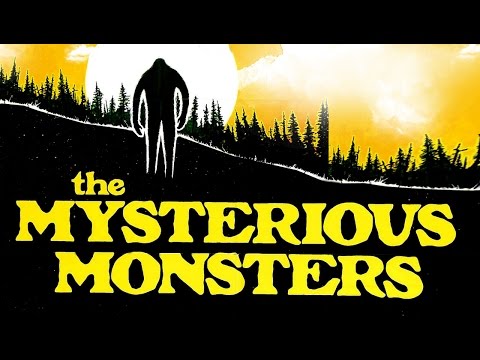
BIGFOOT WEEK: The Mysterious Monsters (1975)

At the start of this movie, Peter Graves looks right at the camera and totally bullshits you: “Scientists representing the world’s most foremost research centers took part in the examination of the evidence. The facts that will be presented are true. This may be the most startling film you’ll ever see.”

Get ready for another piece of Sunn Classic Pictures magic. Yes, the same people who forced you to watch Chariots of the Gods and Hangar 18. This one reached an even bigger audience thanks to being broadcast in prime time on NBC.

Director Robert Guenette, according to Wikipedia, “was an American film producer, screenwriter, film director, television director and television producer, recipient of the Directors Guild of America Award. Guenette is considered as one of the first documentary directors to introduce the “newsreel style” in documentaries. He and his son, Mark, were co-founders of the International Documentary Association.”

Now I bet you $3 that Mark Guenette or someone else in the family wrote this Wiki page, because we’re also talking about the same dude who directed the movie that gave me nightmares every time HBO aired it (which is to say, nearly every afternoon for three years) The Man Who Saw Tomorrow.

From Bigfoot to the Loch Ness Monster, the Yeti and, well, that’s it — this movie is a mix of dramatic reenactments and Peter Graves going all over the world to get the story. It’s like no one told the future host of A&E’s Biography that he could simply do all his narration from the studio.

This is a movie replete with lie detectors, hypnosis, the Patterson-Gimlin footage, Bigfoot hunters, blurry photos and incredulous scientists forced to debate the existence of monsters with Jim Phelps from Mission: Impossible. In one of these instances, Graves wonders why the cops are good with verbal statements and scientists aren’t. The incredulous scientist responds with the simple fact that we know humans exist so it’s simple to believe the things they say. I was waiting for Graves to say, well, you I believe that my brother is The Thing.

To you kids with your streaming channels and cable TV, I opine that this movie was once awesome. We had to go to the theaters to see ridiculous stuff like this. There wasn’t an entire channel or ten devoted to it. In the 1970’s, we took what we could get and we liked it!

You can grab this at Amazon.

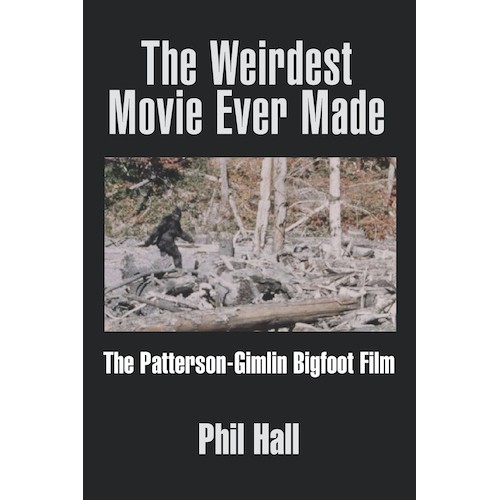
BIGFOOT WEEK: Phil Hall’s The Weirdest Movie Ever Made reviewed

On October 20, 1967, Roger Patterson and Bob Gimlin emerged from a North California forest with a little less than one minute of silent, grainy and shaky 16mm footage that they claimed offered irrefutable proof of the existence of Sasquatch. Neither man had any previous experience in filmmaking or zoology, yet presented their remarkable footage as the first motion picture confirmation that Bigfoot is real.

Not everyone was convinced that the Patterson-Gimlin film was genuine. There was a lot of strangeness behind the film’s creation and plenty of rumors, such as the story of an Academy Award-winning make-up artist’s alleged role in the footage.

In The Weirdest Movie Ever Made, film journalist Phil Hall reveals how the Patterson and Gimlin supposedly wound up in the right place at the right time with their camera, how they got their movie into the hands of scientists and the path that it took to become an integral part of pop culture.

I loved how this book details all the ins and outs of how two cowboys somehow stumbled — or cunningly created — the footage. There’s a lot to learn here, such as how Patterson made an unsuccessful effort a year before the filming to secure the copyright for the word Bigfoot, how Gimlin was cut out of the profits and the lost film Bigfoot: America’s Abominable Snowman, a four-walled piece of exploitation magic that brought Patterson out amongst the public to tell his story.

Hall fills the book with asides on Bigfoot’s influence on culture, the history of cryptozoology, Bigfoot instances and encounters over the past 50 years and brief reviews of the many Sasquatch appearances in film and television. He leaves no stone unturned, giving as much ink to expected films like The Legend of Boggy Creek and Harry and the Hendersons as he does to lesser-known fare like Cry Wilderness and The Geek, a pornographic recounting of a Bigfoot attack.

There’s even a section on John Chambers, the Academy Award-winning special effects artist who worked on the original Planet of the Apes and the man who John Landis claimed created the Bigfoot suit in the Patterson-Gimlin film.

Hall writes the book in a breeze, fun style that makes page turning a pleasure. And I really enjoyed the chapter where several critics, scholars, and creative artists gave their views on the footage, including Troy Howarth (So Deadly, So Perverse: 50 Years of Italian Giallo Films and Splintered Visions: The Films of Lucio Fulci).

The book stops short of revealing the author’s true opinion as to the truth of the footage, although you can infer that he’s a skeptic. Whether or not you believe it yourself, you have to agree that it’s an amazing bit of filmmaking and that one minute has garnered way more debate and fame than movies made with more budget and pedigree.

You can grab the book at Bearmanor Media and come back tomorrow to read an exclusive interview with the author!

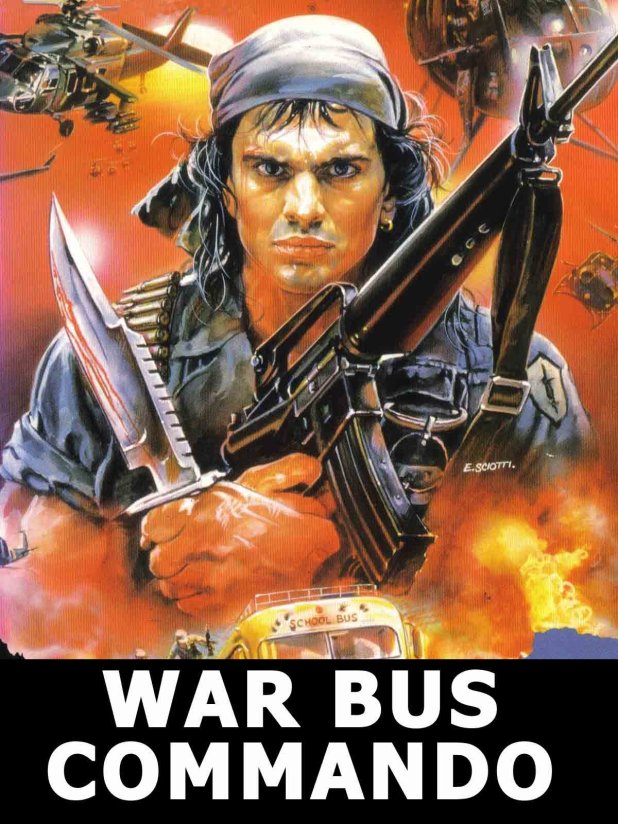
MARK GREGORY WEEK: War Bus Commando (1989)

When I was a very young child, my grandfather would come home from working night shift at the J&L Steel Mill and sit in front of the TV drinking Pabst and watching war movies. The entire house would be bathed in blue light and the sounds of machine gun fire. Forty some years later and here I am, doing the same thing. I’m not slaving away in the furnace, but I am writing a project for my real job while watching war movies. I’d like to think the films my grandpa watched were better than the junk I end up watching.

Yes, this is a movie where John Vernon and Mark Gregory somehow end up in the same frame. This blew my mind and made me wonder if I was on my death bed and my brain was attempting to calm me as my soul transitions to the next plane with the kind of Jacob’s Ladder scenario that I have heard so much about.

This time, Mark is playing Johnny Hondo, a special forces commando who never dresses in any form of camouflage whatsoever. I mean, the dude dresses all in black for daytime missions and all in white for night missions. He kills lots of people all over the world when he isn’t chillaxing on his Montana ranch. That’s where General Ross (Vernon) finds him and arranges for Johnny to meet his estranged and dying father.

It turns out that Johnny’s dad once drove a school bus filled with the Shah of Iran’s gold from that country to Afghanistan. With my poor US school system education, I never realized that that’s only a distance of around 800 miles. To get his father’s honor back, he has to complete the mission. And if you’ve seen any 1980’s post-Rambo films, you know that the system is corrupt and against our hero Johnny Hondo.

Luckily, Johnny has backup. There’s a plucky young Dondi-like child and his sister. The moment we meet her, we know that she has only been placed in this movie to die. And then there’s the mechanic who gets the war bus moving again. He’s played by Bobby Rhodes from Demons and Endgame, so he instantly becomes my favorite person in this movie. Literally, every line of his dialogue is profanity, much like talking to me in person.

This movie also has some of the most chipper 1980’s synth on its soundtrack, to the point that you forget that we’ve basically been waging war in Afghanistan since this one was made back in 1989.

This one’s directed by Pierluigi Ciriaci, who brought us pretty much all of the Mark Gregory war movies that we’ve covered this week. And much like every Italian movie made in the 1980’s, it was written by Dardano Sacchetti.

Much like the films that entertained my grandfather, this is filled with explosions, gunfire and plenty of people being riddled with bullets. Unlike the movies that he enjoyed, it also has a hero that has decided to wear a white turtleneck with a beige coat and drive a schoolbus into a warzone.

Want to experience all the action and bus driving for yourself? Then I recommend you head to Amazon Prime, a place where there is nothing but Mark Gregory films as far as the eye can see!

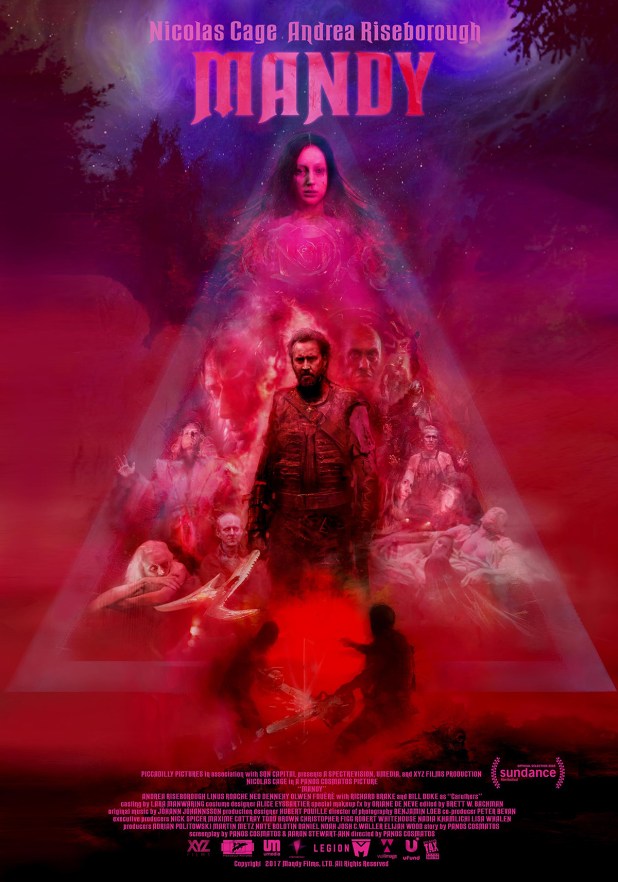
Mandy (2018)

“It didn’t make any sense. They were bikers and gnarly psychos and…crazy evil.” That’s a line from one of Nicolas Cage’s many breakdowns in Mandy and there’s no better line to describe this to those not ready to behold its majesty.

This movie is pure heavy metal. Not the pablum that passes for metal today, trying in vain to frighten old people inside dying malls from shiny black plastic fake Hot Topic environs, but the kind of metal that envelopes you within its darkness. From the opening strains of King Crimson’s “Starless” to the slow, druggy doom drone that each scene in the first hour or so makes you feel to the actual bravura moment that the title of the film appears 75 minutes into the picture and transforms into a black metal spiral of roots and trees and black infinity, this isn’t a movie influenced by metal or referencing it. It has become pure heavy metal. This is a t-shirt with holes in it that the kid in the back of the class wears. This is staring at the details on the cover painting of “Somewhere in Time.” This is slowly losing your mind as you stare at a blacklight poster and that thudding slow bass and wait for the riff to slow down enough for the screaming to begin.

Let’s get one thing straight: Nicolas Cage is the only person who could be in this movie. One of my friends has often scoffed that no actor has squandered their promise more than Cage, following his Best Actor Oscar win for Leaving Las Vegas with Face/Off. I disagree. This is the actor who has referred to himself as the “California Klaus Kinski.” Someone who has inspired impressions that refer to the Cage Rage. No one else could bring such a feral intensity to films that probably don’t deserve it. I would argue that true art is the kind found in the gutter; if that is true, then Cage has imbued films like Con Air with a heart and bloody soul that a lesser actor would just see as dollar signs.

At heart, Mandy is a simple story. In 1983, logger Red Miller (Cage) has settled into a quiet life in the woods with his soulmate, an artist named Mandy (Andrea Riseborough, Birdman). A gang of “homicidal Jesus freaks” kidnaps her when their leader, Jeremiah (Linus Roache, Thomas Wayne from Nolan’s Batman Begins), falls for her. When she rebuffs his advances and has the gall to laugh at his music, the gang unleashes its fury by torturing Red and setting his love ablaze.

As her ashes fall through his fingers, we’re treated to Cage doing what he does best — pure raw emotion, screaming and sobbing as he washes blood and pain away with a bottle of vodka, shrieking in a 70’s style bathroom clad only on tighty whities and a t-shirt with a tiger’s face on it. If you watched this scene and any other actor attempted to essay it, it would derail the film, forcing it into parody or low pathos. But this is Nicolas Cage, an actor who you can’t avoid or look away from. You are forced to see Red’s pain as he marshalls his energies and begins to rebuild.

Oh — did I mention that the gang isn’t all human and that there are demon bikers among their number? Or that Cage responds by grabbing a crossbow and hammering boiling hot metal into a gigantic scythe?

Beyond metal, Mandy also draws inspiration from the artwork you’d shouting at you from 1970’s science fiction and horror paperbacks, with title cards torn directly from those pulpy pageturners.

This is the kind of work that only emerges when an artist has pure control of his vision. Here, that artist is Panos Cosmatos, who bestowed on us the truly touched film Beyond the Black Rainbow. The inherent promise of that film is realized here. Forget pundits blabbing about how horror must be elevated so that the stigma of the genre title doesn’t impact art. This is a movie that recognizes that the only difference between the arthouse and the grindhouse is the neighborhood your film plays in.

I always wonder if films can still surprise me after all of the craziness that I’ve witnessed. I’m happy to report that Mandy has shown me — in one scene — that I am not jaded. Not yet. Have you ever seen a movie where the hero comes upon one of the villains doing coke and watching scummy looking 1970’s porn, only to attack said hero with a demonic sword penis? And what if the hero slices open the villain and laughs like a lunatic while blood sprays all over his face and in his mouth? And then that hero decides to do some of that leftover coke? Until you see this one, you haven’t seen anything yet.

Beyond Cage, there are also great performances here from Richard Brake (the only good part of Rob Zombie’s 31) as The Chemist whose drugs have set the Children of the New Dawn cult on a path they may never walk away from; Bill Duke (Predator) in a brief role as Caruthers; and the aforementioned Riseborough and Roache. And the music by the late Jóhann Jóhannsson (who scored Prisoners and mother!) is a drone masterpiece, echoing the sounds of bands like Sleep.

I have so many questions. In the end, does Red become Kali, the destroyer of worlds, as he hacks off head after head in his quest for vengeance? Part of me thinks this is true, with his distorted voice saying lines like, “I’m your god now.” How amazing is that shot of Cage’s face while his truck speeds through the night his face awash in blood, dreaming of his dead love with big eyes and a maniacal look on his face? And how frightening is that scene of Ronald Regan’s disembodied voice on the radio, reminding us of the uncertainty and terror that 1983 had, the year that both this film and Beyond the Black Rainbow share? How rad is the artwork that Boris Vallejo’s collaborator and wife Julie Bell created for the film?

Honestly, this is the best movie I’ve seen all year. It may be the best movie I’ll see for a couple of years. It’s as if I asked Cosmatos to include everything that I want to see in one film: demon bikers, chainsaw battles, animated sequences that echo Heavy Metal, commercial parodies where goblins vomit mac and cheese, tigers roaring against a dayglo night sky and geysers of gore. And after all that noise, the credits roll to total silence. I often remark that certain movies are better with various substances. Mandy needs no other stimulants. It is a powerful and transformative hallucinogen all its own.

UPDATE: This movie is now streaming on Shudder.

UPDATE: “Nic Cage Bitch” is our Nicolas Cage blowout written by Paul Andolina of Wrestling with Film. It’s a must read for all fans of the Cage, so check it out and learn about some Cage films you may have missed, such as A Score to Settle, Between Worlds, Kill Chain, Outcast, Rage, and Seeking Justice.