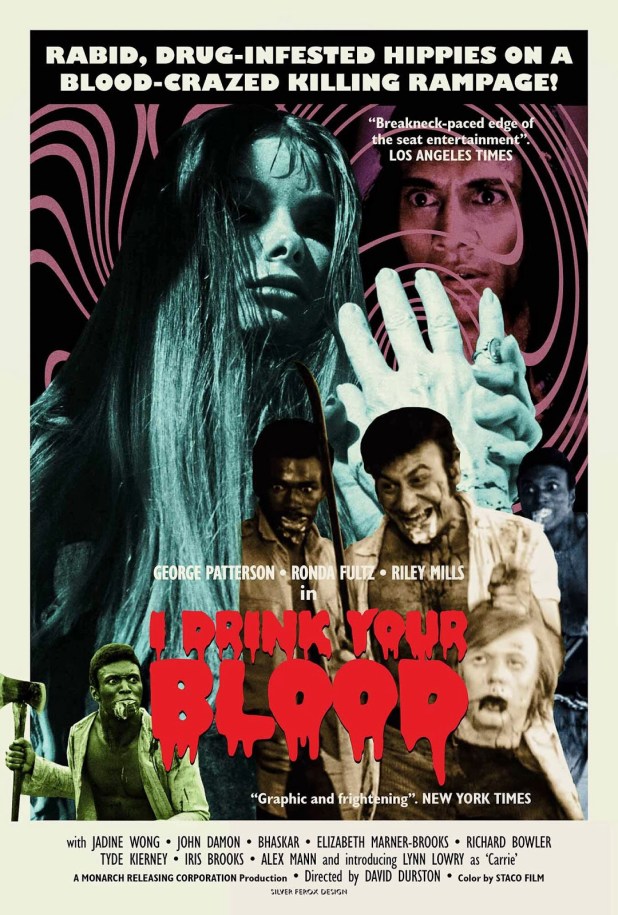
I Drink Your Blood (1970)

“Let all the spirits hear. I am the first born Son of Satan. He commands my thoughts. I speak his words. The Book of the Dead! Sons and daughters of Satan. Put aside your worldly things and come to me. Let it be known, sons and daughters, that Satan was an acid head. Drink from his cup; pledge yourselves. And together, we’ll all freak out.”

Has a movie ever started better? I don’t think so. I Drink Your Blood will take you prisoner, stab in the stomach with a fork and write on the walls with your blood!

In fact, I watched that opening at last year’s April Ghouls Drive-In Monster-Rama in the middle of the night, surrounded by fog and inebriated on a variety of vices. It was a transcendent moment.

Horace Bones leads a cult that worships Satan and drops acid. A young girl, Sylvia, watches from the woods but is caught, then raped by the cult members before she escapes. She’s found the next morning by Mildred, a baker, and Sylvia’s brother Pete. They get her back to her father, Doc Banner, the town’s veterinarian. And oh the town — it’s been abandoned due to dam project. The hippies break down and decide to stick around.

The only food in town? Meat pies from Mildred’s bakery, which Horace and family take as they set up their home in a house scheduled for demolition. And when Doc comes for revenge, the gang smashes his glasses and force him to take LSD.

So how do you get revenge? Well, if you’re Pete, you kill a rabies infected dog and inject the blood into meat pies, which infects the gang and makes them go crazy. They begin to attack one another as Molly runs away, finding the mill workers, who she ends up having sex with all night long until she bites one of the men.

Horace goes full-on insane, even more insane than the beginning of the film, attacking two of the construction workers. Only Andy from the group is not infected and he finds Sylvia and Pete. Meanwhile, the infection spreads to the rest of the town. 

Banner gets impaled. Horace is stabbed by Rollo, the African-American member of the family. Mildred is barricaded inside her bakery and Andy is beheaded before they get in. The Japanese member of the family sets herself on fire. Everyone other than Mildred, her boyfriend Oaks (who comes to save them), Sylvia and Pete dies horribly. 

Director David Durston worked with producer and CEO of Cinemation Industries Jerry Gross to write and direct this film. He said that “wanted to make the most graphic horror film ever produced, but he didn’t want any vampires, man-made monsters, werewolves, mad doctors, or little people.” The director couldn’t come up with an idea until he read an article about a village in Iran where a pack of rabid wolves infected several villagers, making them insane and homicidal. Dunston found a doctor who had been to the village and that had filmed the evidence. He was further inspired by the Manson family trials.

This is the first film to be given an X rating for violence instead of sex. And while originally entitled Phobia, the name change to I Drink Your Blood and pairing with  1964’s Zombies, also retitled as I Eat Your Skin, proved a potent blend for audiences. The two movies are almost always thought of together.

This film is unafraid to be the exploitation junk that normal people avoid. It’s grimy, filthy and ultimately entertaining as hell. It takes everyone’s worst fears of the hippies and shows you in graphic detail what happens when those fears come true.

Want to see it for yourself? It’s available on Shudder.

Julie Darling (1983)

Between Pin, Cathy’s Curse and this film, what is it about Canadian families in horror films? Beneath a surface of politeness, is everyone this psychotic north of the border?

Julie (Isabelle Mejias, Scanners II: The New Order) just wants to play with her pet snake, hunt with her dad and, well, lie in bed with him. But when her mom takes away her snake, she just watches a delivery boy (Paul Hubbard, who played Flash Gordon in the deleted scenes in A Christmas Story) violate her and does nothing to save her life, even though she’s holding a gun. It’s a horrifying scene, as the man is shocked that he’s knocked the woman’s head so hard into the ground. He’s more upset than Julie when he sees the blood seeping out of the back of her brains. Julie just watches, fascinated yet removed.

Julie thinks she has her father (Anthony Franciosa, Tenebre) all to herself, but he soon finds a new wife, the alluring Susan (Sybil Danning!). She brings sex appeal and a stepson. And because she may have been dating daddy before mommy died, maybe Julie’s dad is taking advantage of the death she caused.

One thing he’s definitely taking advantage of is the opportunity to make sweet, sweet love to Susan. He doesn’t know that his daughter is watching the entire time and enjoying things way too much, imagining herself in bed with her father! Ugh!

And it gets worse and worse, as Julie does things like lock her stepbrother in a refrigerator, nearly killing him, and then brings the rapist who killed her mother back to the house to take out her new mom in a blackmail plot. Yep, she even tells him, “You can rape her all you want!” It all adds up to an ending that totally shocked me that I don’t want to cheat you out of.

Yep. This is one rough little film, which makes sense when you realize it’s by the writer and director of Chained Heat, Paul Nicolas (that movie also has Danning in it, plus Linda Blair, Henry Silva, Tamara Dobson, John Vernon and Stella Stevens for a movie that transcends the WIP genre).

It’s not for everyone. But Mejias is great in it. And it’s the kind of movie that you are amazed that exists and even more astounded as it plays in your DVD player (or streams over YouTube).

This movie was nearly impossible to find until Code Red put it out on blu ray awhile back. The good people at Diabolik DVD have it right here. You can also watch it under its alternative title, Daughter of Death, on Amazon Prime.

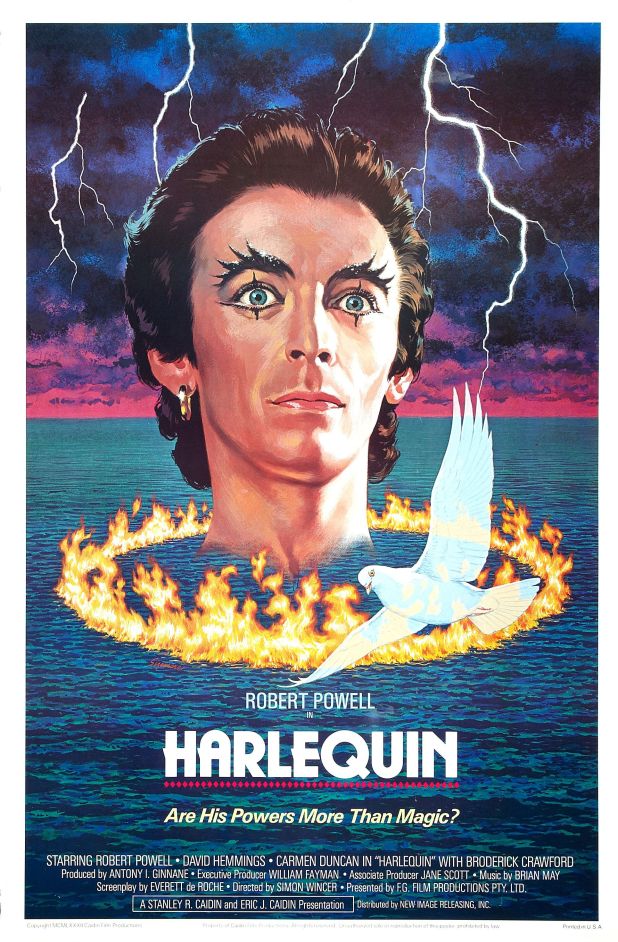
Harlequin (1980)

The great part of this site is that I’ve discovered so many movies that I’d never experience otherwise. Like this one, that I found searching through Ronin Flix. I had absolutely no idea what to expect and I was rewarded with a well made, yet incredibly strange film.

Senator Nick Rast (David Hemmings, Blowup, Barbarella, Deep Red) has a son, Alex, with leukemia and a loveless marriage to his wife, Sandy (Carmen Duncan, Turkey Shoot). In fact, a doctor goes as far to tell them that they should just let their son die as the film begins.

At a birthday party, Alex meets a clown who makes him smile. That clown ends up being Gregory Wolfe (Robert Powell, AsylumThe Asphyx), a faith healer in the mold of Rasputin (hint: the name Rast is tsar backward). The more time he spends with Alex, the better the child feels. Sandy also falls in love with Wolfe, despite the fact that he does some insane feats, like holding Alex over a cliff to make him come to grips with death.

Meanwhile, the senator is controlled by Doc Wheelan (Broderick Crawford, All the King’s Men and you know the rules when it comes to Old Hollywood actors) and he warns him that Wolfe isn’t what he seems and could be a danger to his family.

Also called Dark ForcesHarlequin was to originally star David Bowie as Wolfe and Orson Welles as Doc Wheelan. Director Simon Wincer has quite the strange directorial history, with films like Free WillyThe Phantom (the Smash Evil! version), plenty of episodes of The Young Indiana Jones ChroniclesCrocodile Dundee in Los Angeles and NASCAR: The IMAX Experience.

If you know the story of Rasputin, this film follows it, with Wheelan’s men killing Wolfe over and over again, but the results of meeting the Harlequin make Rast reconsider his life as his son takes over the mantle that Wolfe leaves behind.

This is seriously one odd movie, but Powell’s performance (and frequent costume changes) make it something truly special. It feels like more viewings will unearth more hidden meanings, but upon watching it once, I’m hooked.

Again — as seems to be a theme this week — this film should have a bigger cult than it does. Then again, the Alamo Drafthouse programming team shared it as one of their 2017 discoveries, so perhaps more folks will start sharing their love of this film. Has anyone reading this seen it?

UPDATE: You can watch this on Shudder.

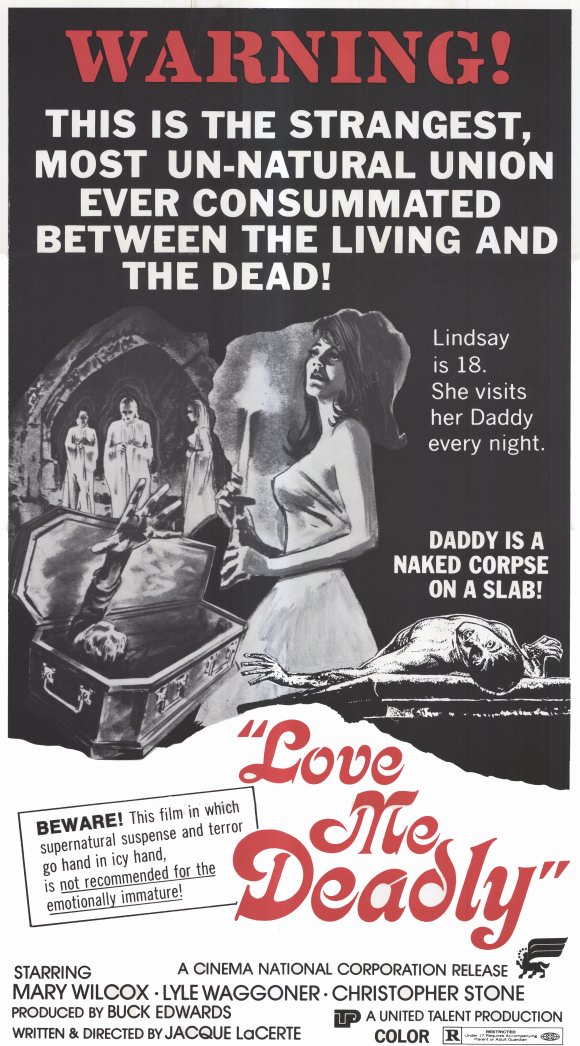
Love Me Deadly (1973)

Lindsay Finch (Mary Charlotte Wilcox, The Beast of the Yellow Night and Psychic Killer) loves to go to funerals, where she mourns and then kisses the dead men passionately after everyone else leaves. Throw in a theme song that sounds like it comes out of James Bond while we see flashbacks of her relationship with her dead father and visiting his grave and pigtails and I’m all in.

She has swinging hippie parties at her pad and her friend Wade (Christopher Stone, the late husband of Dee Wallace who appeared with her in Cujo and The Howling)  tries to get with her. Just when it seems she’s giving in to his makeout moves, she screams at him to stop and he calls her a bitch, because this is 1973. She dreams of her father in yellow hued flashbacks and hugs a stuffed animal.

Later, she goes through the funeral notices to find the services for young men. We then meet Fred McSweeney, a mortician, as he picks up a male prostitute. That job is just a cover for his true love — a Satanic coven that meets at night, inside the mortuary, where they have orgies with dead bodies. McSweeney takes the young man to his workplace where he pumps the manwhore full of embalming fluid while he’s still alive, all while Lindsay goes to another funeral where she tries to make out with Bobby. She’s surprised by Alex (Lyle Waggoner, TV’s The Carol Burnett Show and Wonder Woman, as well as the honor of being the first nude centerfold in Playgirl and the appointed mayor of Encino, California), the man’s brother.

Speaking of that embalming scene, it goes on and on and on, with the young man screaming, “I’m blind!” over and over. It’s nearly campy instead of frightening. To say this film has an issue with tone is an understatement.

Lindsay sneaks out to Bobby’s funeral, where she starts to associate Alex with her father. He’s a rich gallery owner and they begin a romance — one she refuses to consummate, even after they are eventually married. Every time she sees him, we get yellow hued flashbacks with a music box soundtrack of her playing with her father. But more about that in a little, OK?

McSweeney speaks to Lindsay after he catches her at a funeral, telling her that he has a group that she should join. Yet she tries to remain normal, even going on a date with  Wade that fails. That’s when she decides to see what McSweeney’s group is all about.

She walks into an orgy with the dead, which freaks her out enough to go back home. Then she and Alex fall in love with no dialogue, just a montage. It’s a strange part of an incredibly strange film, with this happy go lucky relationship coming out of nowhere in a film otherwise about sex with dead people.

Lindsay keeps talking to the cult and ends up getting a dead body of her very own. But Wade follows her and is killed by McSweeney. She screams in horror. This scene wasn’t n the original script, nor was the Satanic group in the one that follows, but were used to pad out the film and add more horror elements so that it would potentially play drive-ins better.

Again — tone being all over the place — we’re treated to a nude cult disrobing Wade’s corpse and having their way with it before Lindsay awakes screaming. But the marriage isn’t working out well, with Alex following her all over town and their maid — complete with the most stereotypical Irish accent ever — telling him that his wife spends her days at her father’s grave, wearing pigtails and dressed like a little girl. You should see the look on Alex’s face when he catches her as she yells, “This is not your place, go away!”

Alex tries to get Lindsay to go on a holiday to visit his mother, but he discovers a registered letter from McSweeney to his wife for a meeting at 10 PM. He follows her to the mortuary where he discovers his wife surrounded by nude devil worshippers as she makes love to a dead body. She looks frightened and then McSweeney murders Alex, which calms her.

McSweeney drugs her as she lies in her bed, then brings in her husband, now embalmed so he can last forever, finally a man who she can be attracted to: the combination of her father — who we see in flashback being shot accidentally by her — and the man she fell in love with. The editing here — combined with dissonate instruments and a remix of the title theme — is crazy, like this film has suddenly become Beyond the Valley of the Dolls.

We see intercut shots of Lindsay getting under the covers with her dead husband and her getting in the coffin with her father as everything goes sepia tone and the theme song returns.

Love Me Deadly isn’t for everyone. It’s one of those films that I hesitate to recommend to normal folks. But it is the kind of movie I text people about in the middle of the night.

Code Red has released this film on DVD, but it’s still rather hard to find. It’s up on YouTube, where I found it. It’s…well, it’s something. If you enjoyed The Baby, well, then you’re on the right wavelength of this one.

Feed Shark

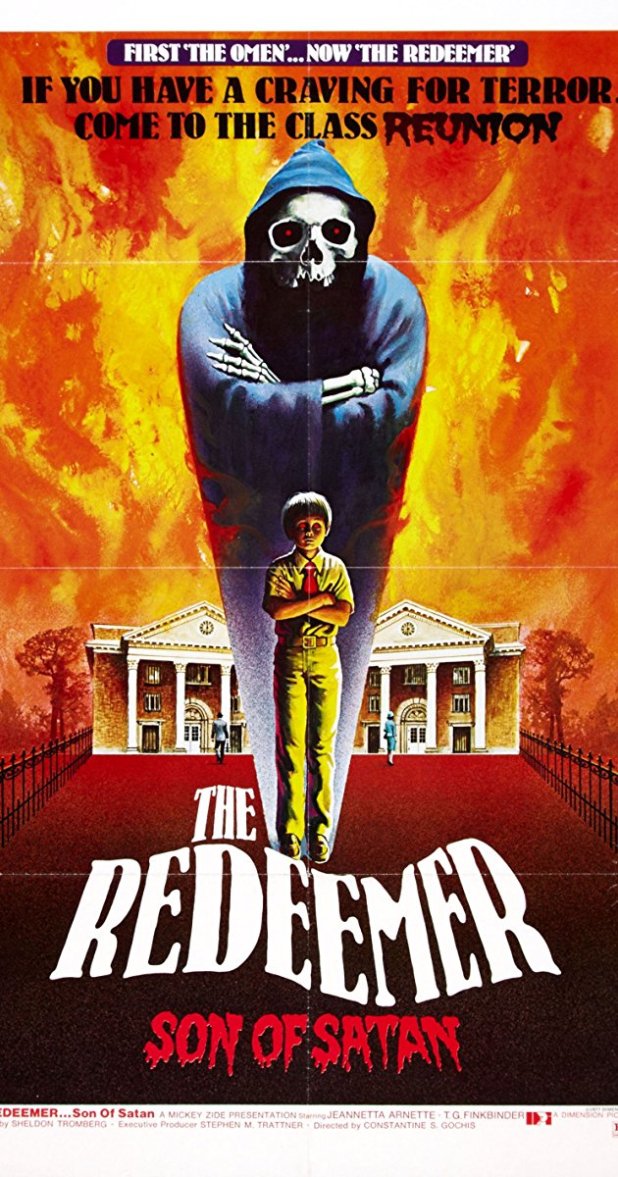
The Redeemer: Son of Satan (1978)

A young boy rises from a lake, fully clothed, and travels to church where a priest delivers a fire and brimstone speech about the sins of the world, in particular, six people.

Afterward, the other choir members bully the boy, even putting a knife to his throat.

Those six people have been invited to a ten-year class reunion: John, a lawyer who doesn’t care if his clients are guilty. Cindy, a promiscuous party girl. Terry, an overweight ne’er-do-well. Jane, a wealthy and immoral heiress. Roger, a vain actor. And Kirsten, a lesbian.

The event will be at their old high school, where a mysterious man arrives to kill the janitor and make a mask of his face.

None of the six people really knew one another. Yet they enjoy a room appointed with plenty of room and drink. It’s all fun and games until they find the dead body of the janitor filled with maggots and that the school is locked.

Am I really spoiling anything if I tell you that everyone dies? Terry gets his crotch set on fire with a flamethrower. Jane meets a hunter in disguise who recites poetry to her before killing her with a shotgun. Roger is killed by a magician and his deadly trick. Cindy is attacked by a clown and drowned in a sink, an attack that seems to take forever.

John meets the killer face to unmasked face. He reveals that he has lured them to the school to punish them for lives of sin, such as John being a criminal lawyer who helps guilty criminals go free. The killer is a Redeemer, one who has decided to rid the world of the wicked starting with a few sinners. They fight and John shoots the killer in the side, but he recovers and graphically shoots John in the head.

Kirsten is chased through the school and even gets the gun, but a giant puppet stabs her.

The Redeemer is revealed to be the priest, who returns to the church to finish his sermon, claiming that the six sinners will be given redemption. He then meets with the boy, who reveals that he has killed one of the boys who bullied him, as well as a Bible salesman. The boy tells him that all will be right.

The priest goes home to tend to his wounds and we notice he has an extra thumb, which disappears. The boy goes back to the lake, where he walks into the water and disappears.

The movie closes with this: “From out of the darkness the hand of the Redeemer shall appear to punish those who have lived in sin… and return to the watery depths of Hell.”

Shot in July 1976 and also known as Class Reunion Massacre, this movie is way ahead of its time. And it also seems like it wasn’t created by human beings. It’s legitimately unsettling at times and raises plenty of questions. Who is behind everything? The kid or the priest? Why are they really doing it? Why pick these exact people and this exact school? Why the masks and deathtraps?

Why ask why? This film is closer to a surrealist art film than a horror movie. Just watch the scene with the Grim Reaper costume and the Redeemer screaming and yelling, but locked outside the gates. It’s just…off. And I loved it.

You can catch this for yourself on Amazon Prime and as a with-ads stream on TubiTV and a copy on You Tube. I’m interested to hear what other people think of this one, because I feel that this should be a much bigger cult film than it is.

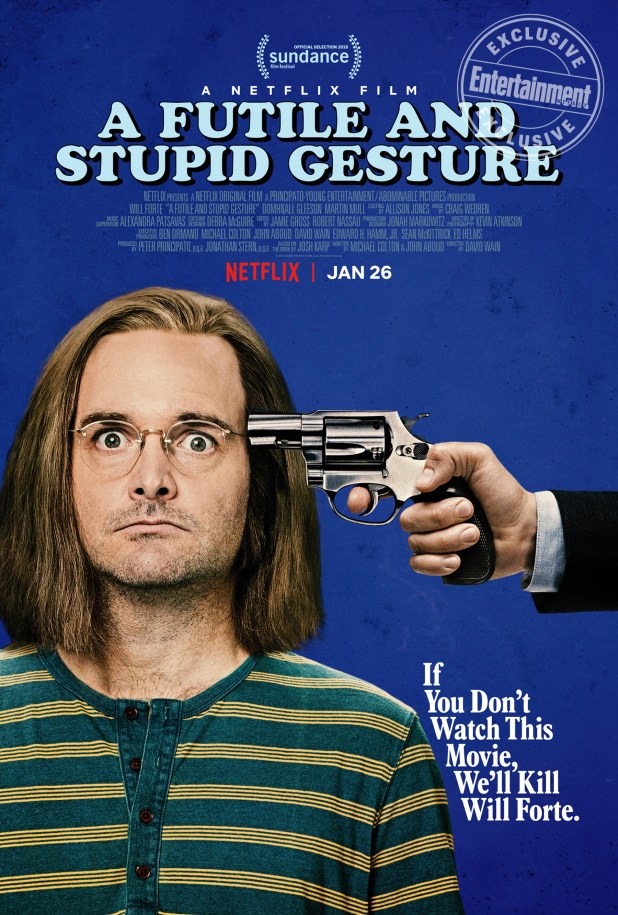
A Futile and Stupid Gesture (2018)

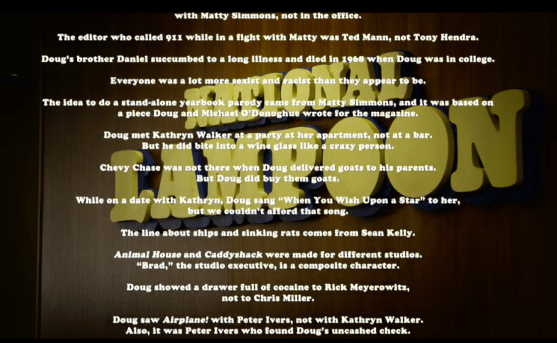
When I was a kid, we’d often go to a pharmacy after church. I’d sit in front of the magazine rack while my parents shopped and would read everything I could. Up above where I could reach was a shelf that was blocked off, where I couldn’t see the covers. That’s where the Playboy magazines were. And that’s where National Lampoon resided, too.

I was born too late for the heydey of the magazine*, which would probably be from 1970 to 1976. During that time, American comedy for the foreseeable future until the end of time would be decided. No. This is not hyperbole. This is fact. The voices within the Lampoon magazine, radio show, stage show and films are the backbone of American comedy. The sheer amount of comedic talent in this film portrayed by the sheer amount of comedic talent proves that.

The force that these comedic talents orbited around was Doug Kenney and Henry Beard, who turned their stint at the Harvard Lampoon and nationally published parodies into a regular magazine in 1970.

If all Kenney did was write National Lampoon’s 1964 High School YearbookCaddyshack and Animal House, he’d still be remembered. So why does he deserve a book, much less a movie?

Based on A Futile and Stupid Gesture: How Doug Kenney and National Lampoon Changed Comedy Forever, Kenney basically assembled the cast of Saturday Night Live before the show even aired. From John Hughes, Anne Beatts and P.J. O’Rourke to Tony Hendra (Spinal Tap’s manager Ian Faith) and Chris Miller (who co-wrote Animal House) on the writing side to Chevy Chase, John Belushi, Bill Murray and Gilda Radner (and more) on the performance side, you can see how nearly every comedy in the 1980’s had the Lampoon stamp — and stink — all over it.

As for the film, it’s pretty much made for comedy geeks who have the hardback of Drunk Stoned Brilliant Dead and have watched the documentary that ensured ad nauseam, that have read and re-read every book on SNL, that can breathlessly tell you of the relevance of 1970’s comedy. Yes, I am looking at the man in the mirror.

If you knew nothing about Kenney, I’m not sure you’ll come out of this film loving him. In my reading of him, I’ve always seen him as this mysterious force that would write and write and write and then disappear, only to come back and prove himself all over again until he fell into a whirlwind of drugs and depression and faded away from this reality. I’ve always found myself more drawn to the pure menace and in your face nature of Michael O’Donoghue, who is portrayed in the film by The State‘s Thomas Lennon. His intro scene, where he goes into a manic rant that sounds life and death and is really only directed to a record club operator is perfect. So if you’re looking for a memoir of his greatest hits, this film is for you (indeed, the movie ending food fight has Beatts and O’Donoghue locked in a romantic embrace, making him near heroic).

This is almost a game to spot the comedian and who they are playing, kind of like The Greatest Story Ever Told, but for comedy. That’s Will Forte and Martin Mull as Kenney (I hoped against hope that I had been Mandala Effected into a world where Kenney survived, but no dice). Domhnall Gleeson (General Hux!) as Henry Beard. Pittsburgh’s own Jon Daly as Bill Murray. John Gemberling (Bevers from Broad City) as Belushi. Ed Helms as a picture perfect Tom Snyder. Natasha Lyonne as Anne Beatts. Even Joel McHale, portraying his old Community castmate Chevy Chase, who comes off as much an enabler as a friend. Tony Hendra is the only person who really gets a hatchet job here, coming off as a joke and girlfriend thief (and his daughter’s allegations of sexual abuse make him a troubling figure to enjoy these days). Paul Scheer even shows up as Paul Schaffer! Seriously, this film is just about a laundry list.

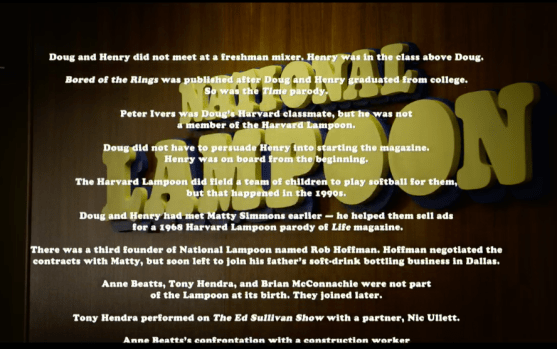
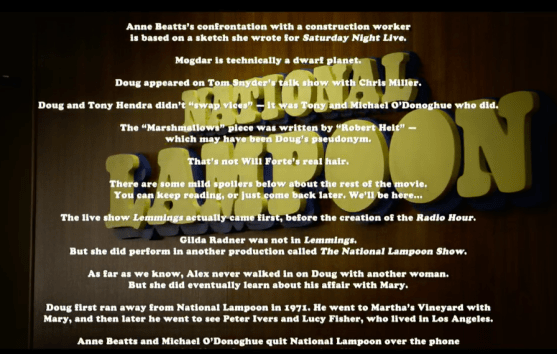
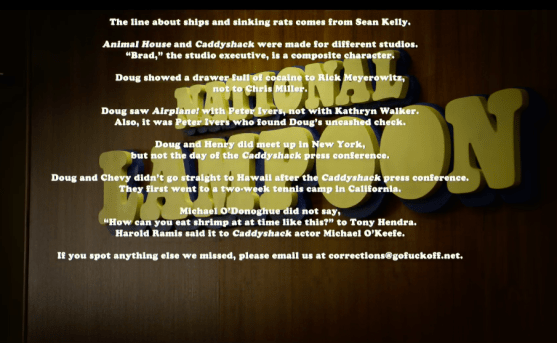
I really liked some of David Wain (The StateWet Hot American Summer) transitions in the film, such as how he uses the Lampoon Foto Funny style to explain Kenney’s divorce and then how he decides to escape to Los Angeles with his girlfriend, Kathryn Walker. There’s also plenty of explanation for why no one really looks like the people they’re playing, an attempted explanation for the Lampoon‘s lack of minorities and a laundry list of the way the movie plays fast and loose with what really happened (“some other things we changed from real life for pacing, dramatic impact, or just cause we felt like it.”).

There are some great in-jokes in the film, such as Martha Smith, who played Babs in Animal House, reprising her role. At the end of the film, it’s said that Babs became a tour guide at Universal Studios. And yep, that’s her leading the tour during the filming of Caddyshack. There’s also an appearance by Mark Metcalf (Doug Niedermeyer from Animal House and the Twisted Sister videos) who asks Kinney and Beard “What do you wanna do with your life?”

A lot of this hit close to home for me, the idea of throwing yourself into your work without worrying about anyone else in your life and thinking you’re a good person because you continually deliver (but don’t at home or to anyone else). It was, frankly, sobering. Despite the efforts of the film, Kenney does not come off as a good guy at all and his main excuse, not having the love of his family, rings hollow even to him at the end as his grieving father says, “They all loved him so much.”

Obviously, this is a movie basically made for me to enjoy. And I did, but it’s difficult for me to recommend it to anyone who doesn’t really care about where comedy comes from. Also, if you are one of those people, please go fuck yourself.

You can see the movie on Netflix right now. You can also watch Drunk Stoned Brilliant Dead there, too.

*My parents, to their credit, paid for years of a National Lampoon subscription for me until the magazine became unreadable. I also have a vivid memory of reading the National Lampoon True Facts book while an ex-girlfriend spent two consecutive nights in the ER and trying not to laugh while surrounded by people — like me, to be honest — who had no reason to laugh. That anecdote sums up the National Lampoon pretty well, I think.

An interview with the creators of the Super Mario Brothers Archive!

Steve Applebaum and Ryan Hoss are behind the Super Mario Brothers Archive, a website originally founded in 2007 by Ryan to showcase his vast collection of memorabilia related to the film’s production and merchandising efforts. Steve joined later, helping the site with its mission to provide insight into the film’s production and development.

I know no one better to talk about Super Mario Brothers — a film we reviewed last week — than these guys! Steve was good enough to answer some of our questions.

B AND S ABOUT MOVIES: Did you come to the movie first or the video game first?

Steven Applebaum: Although I was too young to experience Super Mario Bros. on the original NES or to see the film in theaters, I still came to the franchise through the games before ever discovering the live-action adaptation. I barely had any idea of the animated shows or their live-action segments, either. My favorites were SMB2 and World: the Black Sheep and Dark Horse titles of the series!

B AND S: On our site, my wife and I review movies and she’d never played the game before she saw the movie as a kid, so her entire experience of SMB is just the film. Isn’t that maybe more pure?

Steven: People have argued that the premise of the film is strong enough to stand as an original work independent from the videogames. I agree so far as the directors themselves intended to deconstruct the formula of the games, so the narrative is more about fairytale archetypes in general. If not for its association with the videogames, the film might instead more naturally be compared to The Wizard of Oz or Alice in Wonderland.

B AND S: Why is it so beloved?

Steven: I’m not sure I can pin it down exactly! I imagine part of it is just having seen the film at such an early age that it became a sort of touchstone from which to compare future creative works. It is by no means a traditional film, let alone a traditional adaptation, so where it diverges from the standard entertainment formula is where you remember it the most!

B AND S: What motivated you to take that love and create the site?

Steven: I first joined the site forums in 2010 before offering to help Ryan with research, writing, and arranging interviews. I had been working on a Pokémon-themed project that unfortunately never fully came together, so the fact that Ryan already had a full site made it easy for me to shift focus.

B AND S: Have you met/spoken to any of the creatives involved?

Steven: I’m actually friends on Facebook with much of the people we’ve interviewed. It makes it easy to reach out with a quick question or event request. Most of the production are also based in California, so I on occasion will drive to the L.A. area for a screening event or other get-together. They’re always inviting me out for a drink!

B AND S: The film is seen by so many as a failure. What qualifies it as a success to you?

Steven: Super Mario Bros.: The Movie wasn’t intended to be a carbon-copy of the games or like any other summer blockbuster: it was very much an experiment in transmedia adaptation. Co-directors Rocky Morton & Annabel Jankel were known at the time for their brilliantly thoughtful and visually exciting commercials. They cared less about a narrative that made sense and more about just making you think. It’s 25 year since and we’re still discussing the film, so that in itself is a success.

B AND S: How did you get the blu-ray release moving?

Steven: I actually went through our archives myself to compile the special features for the release, so I’m proud to assure potential buyers that we included everything of note we had available at the time. The Blu-Ray offers about as much as our site!

B AND S: How many times have you seen the film?

Steven: In my research I’ve probably watched it on the laptop dozens of times, though only seen it in theaters twice. The theater stood out more than any other– It’s how the film was meant to be experienced!

B AND S: Does it still hold surprises?

Steven: The better quality we have the more of Dinohattan we discover! It’s always fun to see the different outfits and makeup effects for the denizens of the other world, though there is also incredible world-building in characters like a street preacher whose sandwich-board proselytizes the virtues of the Fungus King as a savior-figure. Without knowing this background detail you might not otherwise have any idea why Toad so fervently supports the Fungus!

B AND S: Is there a big moment for you?

Steven: The Brooklyn-set first act rarely gets as much love as the later narrative in Dinohattan, so I want to highlight two scenes in particular: the opening death of Daisy’s mother juxtaposed with Daisy’s birth, and the later moment between Daisy and Luigi in the subway system digsite overlooking the fossils of a humanoid dinosaur. Daisy comments that the fossils resemble a “monster trying to be a human being,” and that’s it’s beautiful. Daisy does not realize at this time that she herself is descended from dinosaurs, nor that these particular fossils could very well belong to her own mother. These two scenes perfectly establishes Daisy’s character arc, which unfortunately was not fully explored later in the film due to constant script rewrites. It’s also important to note that we only have evidence for Rocky & Annabel filming these early scenes, so we can confirm their narrative vision was at least partially realized.

B AND S: What other films are favorites?

Steven: I look to escapist entertainment that offers philosophical commentary or genre deconstruction like Donnie Darko, Galaxy Quest, Stardust, or Mad Max: Fury Road. My favorite animated films are The Secret of NIMH, The Great Mouse Detective, The Prince of Egypt, and The Road to El Dorado.

Thanks guys. Please visit their site, as it’s a constantly updated source for everything great about the movie and add them on Twitter at @smbmovie.


Burial Ground (1981)

I’ve often said that I prefer Zombi 2 to Dawn of the Dead — at least if I am looking for a more fun movie — because it skips the political allegory and gets right to what the zombie splatter that I really want to see.

Burial Ground (also known as Le Notti del terrore, Nights of Terror, Zombi Horror, The Zombie Dead and most confusingly, Zombi 3) raises you that lack of Romero’s restraint and storytelling, doubles down by ripping off Fulci’s work which is in itself a ripoff (but a masterful one) and piles on the sleaze. No, really. This is a film that is ready to outright offend everyone.

The film starts with a professor accidentally unleashing an evil curse that reanimates the dead. He’s instantly killed. Meanwhile, three “jet-set couples” (I’ve heard them referred to this way several times and it always makes me laugh) and a creepy man child named Michael (who was played by Pietro Barzocchini, who was 25-years-old at the time…more on that soon) arrive at a nearby mansion, invited by the professor. We catch Evelyn (Mariangela Giordano, The Sect) stealing lingerie that she found in the mansion, to which her boyfriend James replies, “You look just like a little whore, but I like that in a girl.” At that point, that creepy manchild of hers, Michael, comes in and freaks out while his mom absentmindedly just stands there, nude.

It doesn’t take long before the dead attack. A maid is decapitated with a scythe because these living dead can use tools. Why are they more evolved than Romero or Fulci zombies? We never learn.

The zombies break into the mansion and attack everyone. This leads to that young creep, Michael, becoming totally shell-shocked. Evelyn, his mother, attempts to confront him, so he becomes to fondle her breasts. As he kisses her, he tries to get his hand between her legs. She slaps him as he runs away, shouting “What’s wrong? I’m your son!” He runs right into one of the party guests, Leslie, who is now a zombie. Like a Fulci librarian, he stares at her as she makes her way toward him.

At this point, everyone reasons that they should just let the zombies into the house, because they are slow and it will allow them to escape. Sure. That always works. Evelyn goes to find her son, who has been killed by Leslie. She flips out and smashes Leslie’s head against a tub, screaming as loudly as possible all the while.

Everyone runs toward a monastery, where the film decides to become a Blind Dead film. The zombie monks chase everyone to a workshop where they kill Mark with power tools. Creepy Michael has now become an even creepier zombie. Evelyn has lost her mind and thinks it’s a miracle, so she bares her breasts for her son to suck on. He replies by eating her breast off in graphic detail.

Finally, Janet is menaced by multiple zombie hands as the film ends with the Profecy of the Black Spider. Yes, that’s how they spell prophecy. “The earth shall tremble, graves shall open, they shall come among the living as messengers of death and there shall be the nigths of terror.” And yes, they also spelled nights incorrectly.

Director Andrea Bianchi isn’t one for subtlety, which films like Strip Nude for Your Killer and Confessions of a Frustrated Housewife on his IMDB credits. If you’re looking for unrepentant gore (Fulci’s through the door eye gouge is repeated here with a window), bad special effects (the latex zombie heads are near Troll 2 in their quality), playing with guts and gore ala Blood Feast and a total lack of storyline or sense, then I’d advise you watch this one.

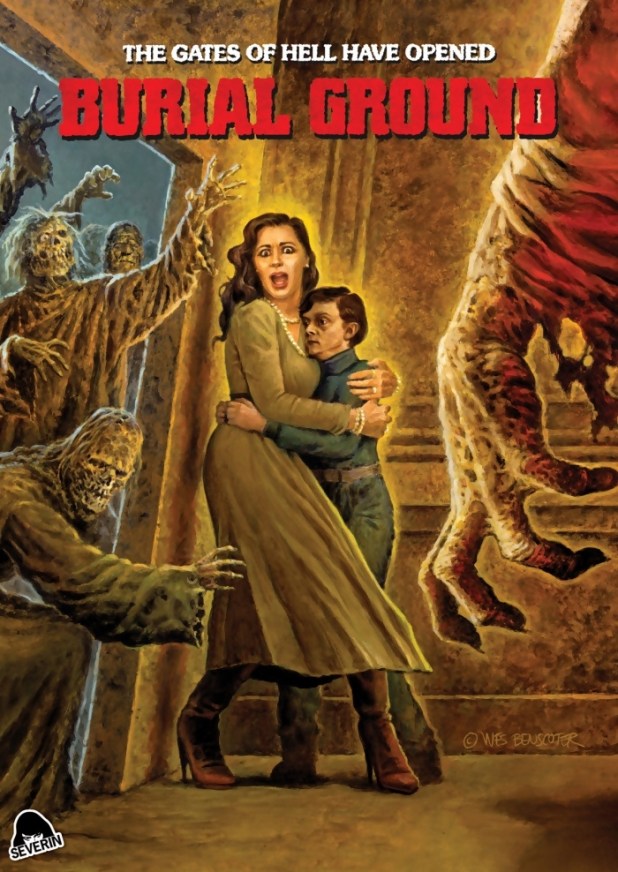
Of course, Severin Films is the place to grab it. They claim they are “improbably proud to present the definitive version of this gorehound/sex-fiend favorite.” They’ve even completely restored a print of the film that they found beneath the floorboards of a Trastevere church rectory. You’ll get a ton of extras, including a Q and A with creepy little Pietro Barzocchini! Plus, they made “Smells of Death” shotglasses and shirts. And the artwork — which accompanies this article — is amazing. Keep in mind, this isn’t an ad. I just love that Severin is spending more time and energy restoring and packaging these films than their creators did making them.

You can also find this on Shudder if you prefer to stream your films.

This movie is a real piece of shit. But you know, it’s an entertaining piece of shit. It’s the kind of film you can say, “But yeah, did you see Burial Ground? That one is totally insane.” And I love Berto Pisano’s atonal goofy soundtrack that blares any time the zombies show up. But if you’re looking for a movie with any class, well, don’t say I didn’t warn you.

Here’s a drink to enjoy during this movie.

This Cocktail Smells of Death

  • 1/2 oz. vodka
  • 1/2 oz. rum
  • 1/2 oz. apple schnapps
  • 1/2 oz. blue curacao
  • 1/2 oz. Chambord
  • 1/2 oz. blueberry vodka
  • 1/2 oz. orange juice
  • 2 oz. cranberry juice
  • Frozen blueberries
  1. Fill a glass a quarter way with frozen blueberries.
  2. Combine all ingredients in a shaker and mix with ice, then pour over blueberries.

The Living Dead at the Manchester Morgue (1974)

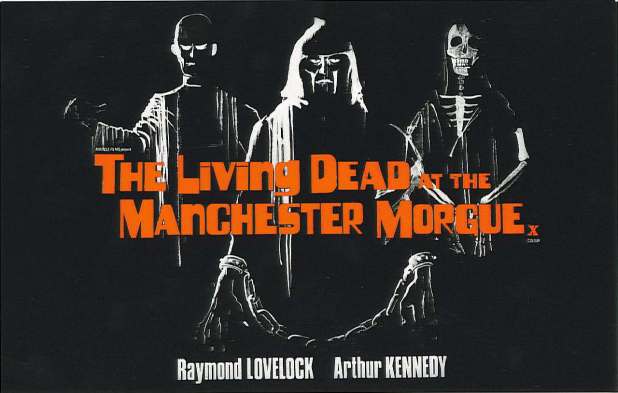
No matter what title you watch this movie under —  from the original Spanish title, No Profanar el Sueño de los Muertos (Don’t Disturb the Sleep of the Dead) or alternates like Let Sleeping Corpses LieThe Living DeadBreakfast at Manchester Morgue and Don’t Open the Window — it’s an intriguing slice of early 70’s shock. At once a portrait of the young, hip and now generation and a zombie film, Jorge Grau’s film features scenes that still freak people out over forty years later.

I first learned of this film from the Electric Wizard song “Wizard in Black,” as a sample of the Inspector arguing with George starts the song.

George (Ray Lovelock, Murder Rock) runs an antique shop in Manchester and decides to go work on a house with some friends. At a gas station, Edna (Cristina Galbó, What Have You Done to Solange?) hits his motorcycle with her car, so she agrees to give him a ride. On the way to see Edna’s sister, they hit a dead end. George finds a short cut that takes them past an experimental insect killing machine in the fields. It uses ultrasonic radiation and is supposed to be safer than DDT. Meanwhile, a mysterious man attacks Edna.

That night, Edna’s sister Katie and her husband Martin (Jóse Lifante, Dr. Death from The Adventures of Baron Munchausen) argue. Martin goes to take photographs while the same man who attacked Edna menaces Katie. Martin tries to save her, but is killed just as Edna and George arrive.

They go to the police to report the death, but the police sergeant thinks Katie was the killer. They all decide to stay at the Old Owl Hotel, as George gets the photos developed that Martin was taking to see what was really happening.

Meanwhile, Katie has gone insane and is hospitalized. For some reason, newborn babies are biting people with murderous intent — something which is not followed up on in this movie.

The developed photos show a homeless man, who later returns to trap our heroes in a crypt and bring back to life numerous bodies simply by touching their eyes with his bloody fingers. George and Edna cut their way out of the ground itself to escape, but only Edna makes it out, as the zombies won’t let go of George. A police officer named Craig, who has been following them, saves them but the zombies give chase. He soon discovers his gun has no effect as they overwhelm him and rip him apart, eating his vital organs.

As the zombies trap George and Edna all over again, they throw an oil lamp at the horde, which saves them. They decide to split up. Edna will inform the police and George will destroy the machine. Unbeknownst to them, the police — and more specifically, the inspector (Arthur Kennedy, The Antichrist) — think that they are Manson-like Satanic killers and have issued an order to shoot to kill.

Edna is nearly killed by her brother-in-law in zombie form, but is saved again by George, who drops her off at a gas station. He’s then caught by the police, who take him and Martin’s body to the hospital and switch the machine on again. The zombies — now including Katie — come to life, killing everyone in their path and menacing a sedated Edna.

Sadly, George is too late. Edna is a zombie and pushes him into a room where the police inspector shoots him four times, killing him. He even claims that he wishes that George would come to life again just so he could kill him one more time.

He gets his wish, as an undead form of George comes for him, but now, bullets cannot stop him. And in the field, the machine keeps working.

I’m in pure love with this movie. From the way it depicts the blight of early 70’s England to the way the cops treat our heroes to the downbeat ending, it’s everything that is perfect about horror movies. And the close in the hospital is packed with shocking gore that will truly stay with you. No matter what title you see this as, make sure to see it.

You can watch it on Amazon Prime.