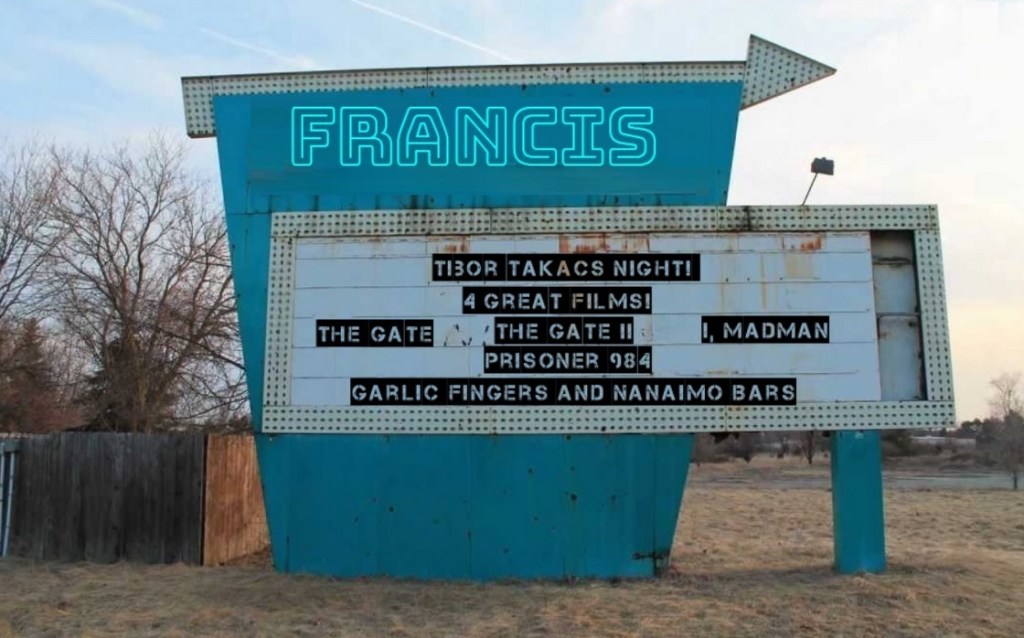
Hungarian born director Tibor Takacs was the recording engineer behind Toronto punk bands The Viletones and the Cardboard Brains before he became a director. He’s probably best known for the 1987 movie The Gate, of course, which leads us to today’s film. He also made the pilot movie for the original Sabrina the Teenage Witch, which makes some sense somehow.
This was written — as was the original — by Michael Nankin. His first film was Midnight Madness, but he’s since moved on to directing, working on TV shows like American Gothic, Life Goes On, CSI, Battlestar Galactica, Caprica, Defiance, Van Helsing and more.
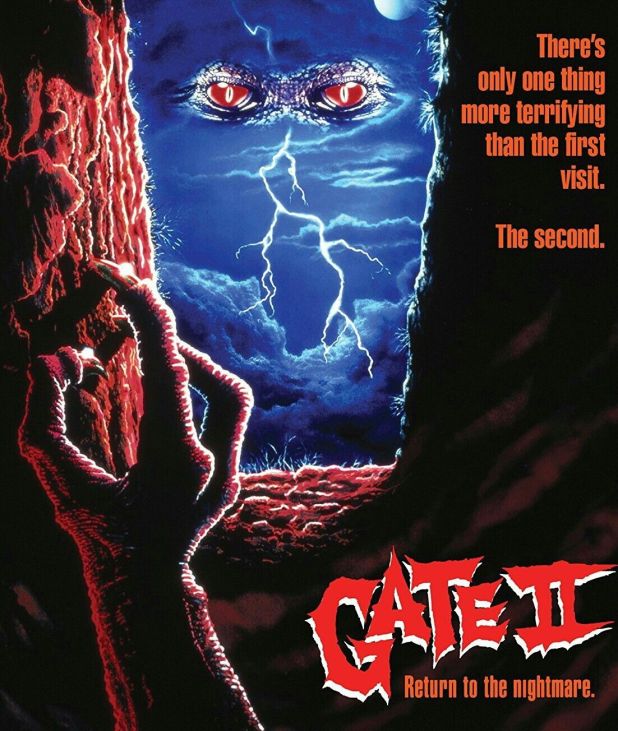
Five years after the events of the first movie, Terrence has had to say goodbye to Glen, who moved away. His own family has gotten much worse, as his father’s drinking has gotten out of control after the death of his mother. That means that the lure of the gate — and its power — is now stronger than ever.
Terrence breaks into Glen’s old house and begins the ritual all over again with the hopes of getting his father’s life together. Meanwhile, three teens — John (James Villemaire, who was in another movie I watched this week, Zombi 5: Killing Birds), Moe and Liz (Pamela Adlon, who in addition to being in Grease 2 was the voice of Bobby Hill on King of the Hill) — break in.
Liz is super down with demonology, so she convinces the others to help Terrance with his ritual. One of the minions from the last film comes through the Gate and John freaks out and shoots it. Luckily — or unluckily — it survives and Terrance keeps it as a pet.
The next day, Terrance’s wish comes true as his father gets a job flying for a major carrier. However, all of the wishes literally turn into, well, excrement. The food that John and Moe devour and the car that Liz wishes for turn into giant cow pies while the plane Terrance’s dad is flying crashes, critically injuring him.
Soon, the two boys are demons after the minion gets loose and turns them. They want to sacrifice Liz to Satan, as you do, but Terrence stops them with his mother’s jewelry box, which he’s transformed into a vessel of light.
Despite dying, Terrance is able to escape his coffin, followed by the human forms of John and Moe. Our hero gets the girl and even his hamster returns from the dead.
The Gate II is in no way as good as the original, but it’s still plenty of fun. It also boasts some great non-CGI effects from Randall William Cook, who started at Disney and also worked with Takacs on the original film and I, Madman (he’s actually the title character, in addition to doing the effects). Since then, he’s been the Animation Director for all of Peter Jackson’s Middle Earth films, as well as working on Fright Night and numerous Full Moon films.
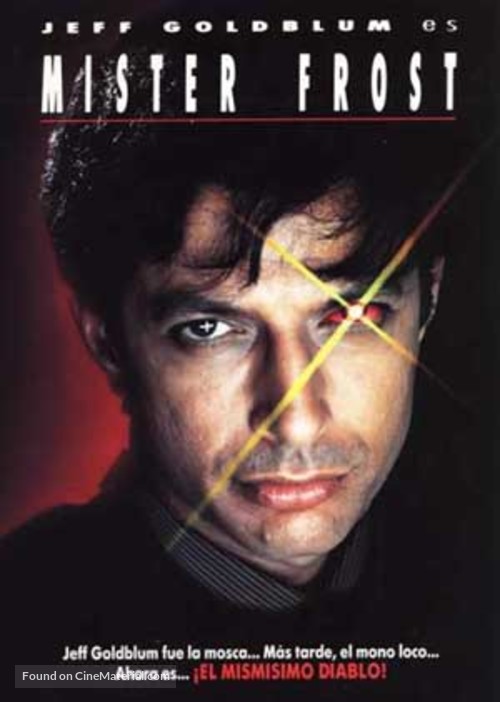
As you may know, I love lost films or movies that no one pays attention to any longer. Can you believe that I found one from 1990 with Jeff Goldblum in it? How does that happen?
Alan Bates (The Shout, The Wicked Lady) plays Felix Detweiler, a detective that starts the film by arresting the titular Mister Frost (Goldblum), who happily announces that he has all manner of bodies buried on his property.
Frost is arrested and goes to an insane asylum, where he doesn’t speak for two years. His identity can’t be figured out and Detweiler becomes obsessed by the case and the twenty four bodies they found at Frost’s home.
Frost finally speaks when he meets Dr. Sarah Day (Kathy Baker, The Right Stuff), telling her that he refuses to talk to anyone but her. Also, he’s Satan. Also also, he plans on getting her to murder him someday.
Detweiler, for one, is convinced that Frost really could be the devil. He might be right — Frost can do crazy things, like heal Day’s brother so that he can walk for the first time in years. Also, her patients and fellow doctors are being changed by Frost and not for the better.
To keep anyone else from Frost’s powers, Day agrees to kill him. He thanks her for believing in him, telling her that he’s now more powerful than anything or anyone in the world. Day shoots him mid-speech, yet finishes his last sentence in Frost’s voice. Now, she too refuses to speak.
It’s not a great movie, but it’s a fun one. And it’s not one you’re going to find easy — well, YouTube is your friend here — but one that you won’t be upset that you sat through. Goldblum as the devil? Yeah, I can see it.
Roslyn Frost shared a great list of holiday movies that no one else considers on her Twitter, which inspired this watch. You should totally check out her YouTube channel, which is awesome.
We were just discussing this movie as we opened Christmas gifts, because it has a different title now. Over the last few years, people have started referring to it by its original title Dark Angel, which was changed in the U.S. because there were two movies with that title in 1925 and 1935.
Director Craig R. Baxley started his career as a stuntman before moving into stunt coordination and second unit directing. Since then, he’s directed one of my favorite movies no one ever talks about — Stone Cold— as well as Action Jackson and the Stephen King adaptions Storm of the Century, Rose Red, The Diary of Ellen Rimbauer and Kingdom Hospital.
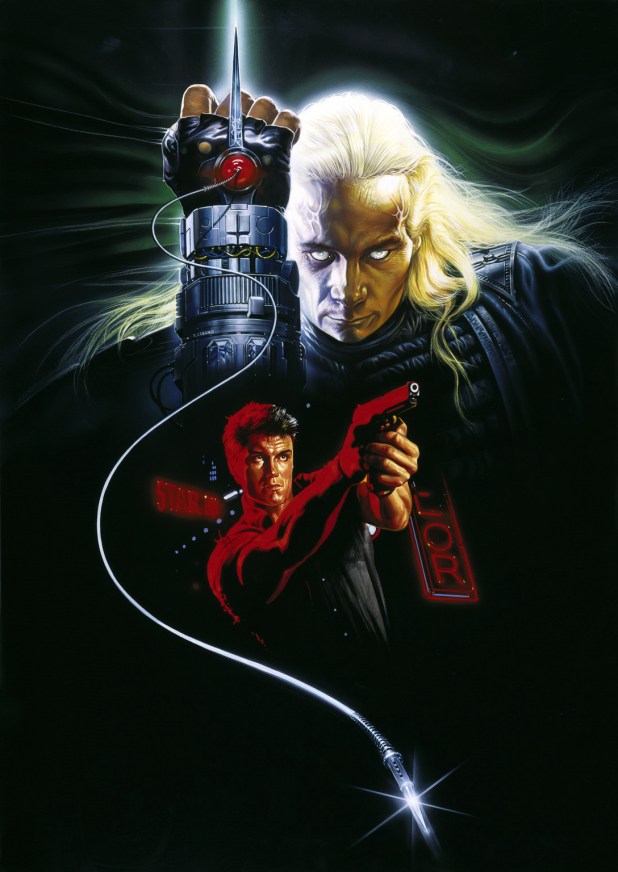
Jack Caine is a rough around the edges cop — he’s Dolph Lundgren, too — who is at war with the White Boys, a gang of white collar drug dealers who do stuff like kill partners and blow up police stations. They’re led by Victor Manning, played by Sherman Howard, who was Bub in Day of the Dead.
Caine is partnered with a by-the-book federal agent named Arwood “Larry” Smith, played by Brian Benben who you may remember from the HBO series Dream On. If you were a teen when there was no internet and you wanted guaranteed nudity.
Meanwhile, an alien drug dealer named Talec has come to Earth to leech out peoples’ brains. He’s portrayed by Matthias Hues, who is related to Engelbert Humperdinck and took over Van Damme’s role for No Retreat, No Surrender 2. He’s being pursued by Azeck, an alien cop. The guy who played him Jay Bilas, is on ESPN as a college basketball announcer, as he played for Duke University and was drafted fifth in the 1986 NBA Draft by the Dallas Mavericks. He was an assistant coach at Duke and is a practicing attorney in North Carolina.
David Ackroyd, who was in the TV movies Exo-Man and The Dark Secret of Harvest Home, plays Smith’s boss. Betsy Brantley (the body model for Jessica Rabbit in Who Framed Roger Rabbit?) is Lundgren’s girlfriend, a coroner who helps him track the alien criminal. Michael J. Pollard has a cameo as a criminal, World Celebrity Chess Champion Jesse Vint (Forbidden World, Deathsport) is Talec’s first victim and Al Leong shows up too, because he has to in any movie with cops and/or aliens.
Screenwriter David Koepp would move from this movie into some real blockbusters, like Death Becomes Her, Jurassic Park, Carlito’s Way, The Shadow, Mission: Impossible, Stir of Echoes (he also directed), Panic Room, Spider-Man, Indiana Jones and the Kingdom of the Crystal Skull and many more. He’s had an incredibly successful career and it all really got rolling here.
There’s been talk of a sequel for years, but at this point, I think only people like me — and maybe you reading this — would care. That said — I’m there whenever it comes out.
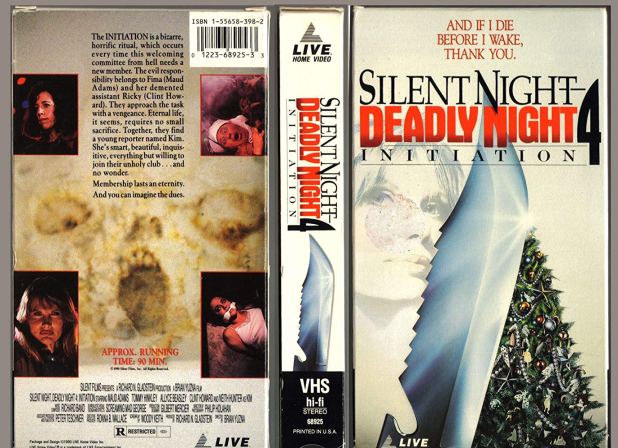
This entry in the Silent Night, Deadly Night series has nothing to do with any of the others, dropping the killer Santa Caldwell brothers for an entirely new plot. It was directed by Brian Yuzna and written by Yuzna, Woody Keith and Arthur Gorson. In the UK, it’s called Bugs, which is a much more descriptive title.
Keith took several of the ideas he had for the movie Society but was unable to get into that movie. Thanks to the miracle of how movies are released, that film came out two years after this one.
Kim Levitt (Neith Hunter, who is also in Less Than Zero and Carnosaur 2) is an aspiring journalist working at the L.A. Eye. Her boss gives breaks to all the guys, including her boyfriend Hank.
However, when she finds a spontaneously combusted body on her sidewalk, she starts her own investigation. That brings her to the bookstore of Fima (Maud Adams, the titular heroine of the James Bond film Octopussy), who gives her a book on feminism and the occult.
On Christmas Eve, Kim spends a rough evening with her boyfriend’s family, dealing with way too many questions and anger about her lack of religious faith. On Christmas Day, she attends a picnic Fima invited her to, where she meets Katherine Harrison (Jeanne Bates, Mrs. X from Eraserhead) and Jane Yanana (Sheeva from Mortal Kombat: Annihilation), who tells her about Adam’s first wife Lilith.
Merry Christmas, huh?
Soon, our heroine’s writing career is going well but she’s eating bugs and drinking weird tea and you know, it’s tannis root all over again. She passes out, only to awaken to Jane, Fima, Katherine, and Li performing a ritual where they cut open a live rat, pulls out some larva and shoves it inside her secret garden. It then comes out of her mouth as a vomited giant roach, which their assistant Ricky (Clint Howard!) slices up and drips all over her face.
The mania continues with her running to her man’s apartment and Ricky following her to stab Hank to death. Her co-worker Janice comes to help — no she doesn’t she’s in on all this — before taking her back to meet Fima. Janice is played by Allyce Beasley, who you may remember as the secretary from TV’s Moonlighting.
This all leads to the Curse of Lilith, burning bugs, Ricky wiping out a family, an office holiday party and Reggie Bannister from Phantasm playing Eli, the horrible boss. Oh yeah — you also get to watch a gigantic insect eat Clint Howard, which really sounds like the best Christmas gift possible for me. Thank you, everyone involved.
Greydon Clark. We have him to thank for Satan’s Cheerleaders, Without Warning, Wacko and many more.
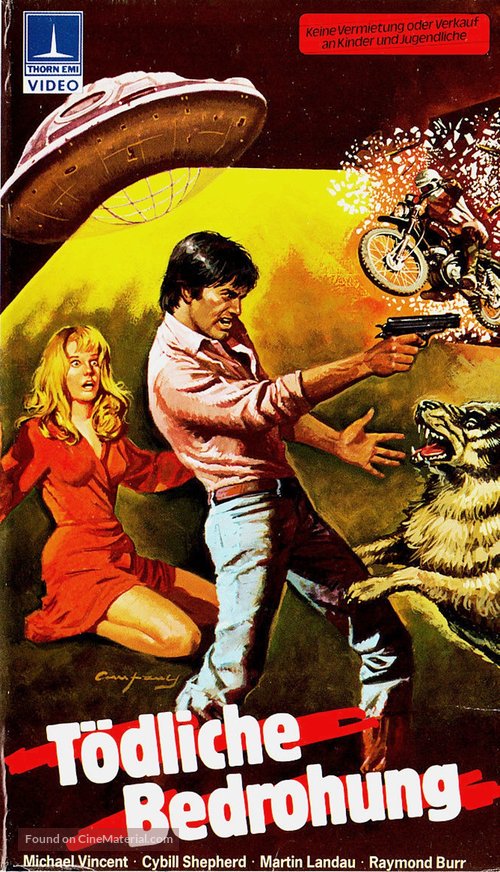
Here he brings together Cybil Shepherd and Jan-Michael Vincent as a couple that were taken by aliens as children. Yes, the romance is anything but torrid, but sometimes, we work with what we’ve got.
While stopping at a gas station late one night, a young girl on vacation and a local boy are taken by a UFO.
Twenty-five years later, that boy is Wayne (Vincent), the sheriff of that town. There have been several cattle mutilations in town, which brings Jennifer (Shepherd), a scientist in to help. Of course, she’s the girl from the beginning.
It turns out that the cows are getting all messed up because the aliens also visited a prospector (Vincent Schiavelli!) who has been using an energy knife to slice up the bovines and send them into space using a teleporter the extraterrestrials left behind.
Somehow, this movie was able to acquire the star power of Martin Landau, Raymond Burr and Neville Brand. In her book Cybill Disobedience: How I Survived Beauty Pageants, Elvis, Sex, Bruce Willis, Lies, Marriage, Motherhood, Hollywood, and the Irrepressible Urge to Say What I Think, Shepherd said that the cast was “a rather sad group of actors, all trying to resurrect our diminished careers. Raymond Burr read his lines off a TelePrompter.”
But wait — there’s more! Darby Hinton, yes, the star of Malibu Express, also makes an appearance, as does Playboy Playmate of the Month for January 1977 Susan Kiger, who also appeared in Andy Sidaris’ Seven.
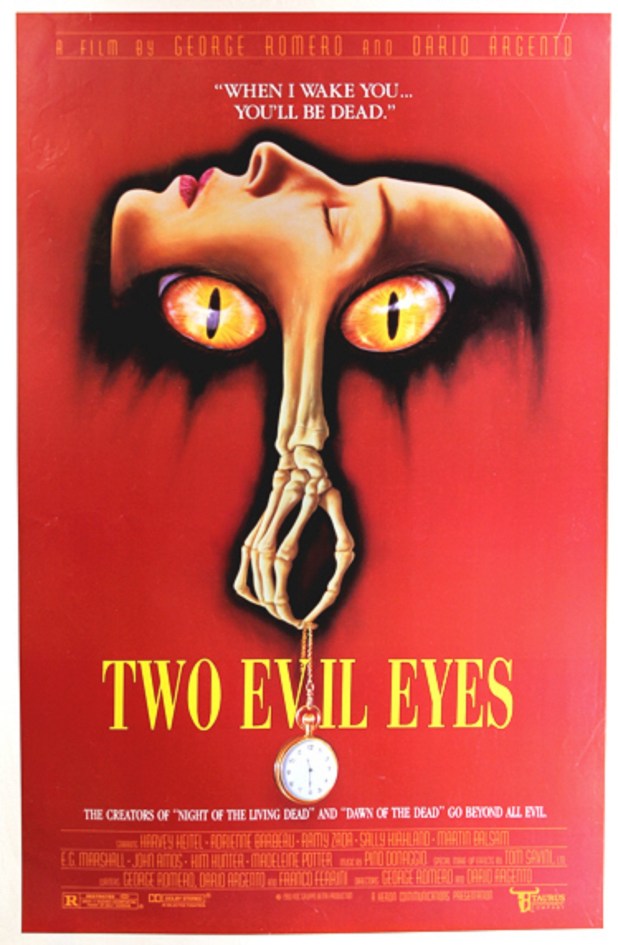
Two Evil Eyes is a very personal movie to me. It was filmed when I was 18, in my hometown of Pittsburgh, by two of the greatest minds to ever work in horror, George Romero and Dario Argento, who also brought along Luigi Cozzi and Tom Savini to aid and abet. It’s an anthology film inspired by Edgar Allan Poe, with both directors using their own unique vision to make one disjointed but interesting film. If you were around town at the time of its filming, Savini was often bringing the props to conventions, so seeing the incredibly gory “Pit and the Pendulum” girl up close was a shocking event.
The Facts In the Case of M. Valdemar is directed by Romero and is all about life beyond death. Jessica Valdemar (Adrienne Barbeau) travels to dahntahn Pittsburgh to meet with her husband’s lawyer (E.G. Marshall) about her husband Ernest’s (Pittsburgh acting legend Bingo O’Malley) will. Pike believes that Jessica is exerting undue influence on him, but the old man explains over the phone that his wife is entitled to his money.
Of course, she’s been having an affair with the man taking care of him, Dr. Robert Hoffman (Ramy Zada) and they’ve both been hypnotizing him to ensure that they get his $3 million when he dies. However, while he’s still hypnotized, the old man dies and the couple hide him in a freezer.
Soon, the body is making noises and even able to speak, explaining that he is trapped in a void with other souls that want to bring others into their dark world. Jessica panics and shoots the corpse, but that’s not the end. Soon, she’s dead and Robert is being haunted by the others, who show up as strange human shapes only visible through the flashes of lightning.
When the police, led by Detective Grogan (Tom Atkins), break in to his apartment, it’s scattered with bloody cash and Robert has become a zombie who is awake forever.
Look for Romero’s second wife Christine Forrest in this, too.
The second story, directed by Argento, is The Black Cat, which is all about Rod Usher (Harvey Keitel) who is a crime scene photographer who often works with Detective LeGrand (John Amos). It also seems like the city of my birth was host to some insane giallo-style murders in 1990!
Rod’s home life isn’t fun. Sure, he has an attractive, if strange, violin-teaching girl named Annabel (Madeleine Potter), but they aren’t compatible and he’s given to abusing the black cat that she’s adopted, all the way to strangling it while he takes photos for his new book.
Annabel searches for her missing cat as Rod goes insane, even dreaming of a pagan festival where he’s murdered in retaliation for killing the cat.
Soon, a bartender (Sally Kirkland) gives him another cat that looks exactly like the cat he’s killed, so when he tries to repeat the crime, Annabel stops him and gets murdered instead. I love that Kim Hunter and Martin Balsam play the elderly couple who tries to investigate — it’s as if Argento is indulging in complete play instead of work here, excited to work with an American crew who worships him (this is apparent in the behind the scenes footage) and working with stars from his favorite movies of the past.
Of course, Annabel’s students — Julie Benz is one of them in her first film role — suspect Rod of her murder and the black cat keeps coming back to get killed again and again. It all ends in completely disgusting fashion, as the wall Annabel was buried behind is taken down to reveal that she’s been consumed by cats and then all hell breaks loose.
Argento originally wanted the film to be a collaboration between Romero, John Carpenter, Wes Craven and himself. Carpenter and Craven pulled out, but there were also plans to make this into a cable series, with Michele Soavi making The Masque of the Red Death and Richard Stanley directing The Cask of Amontillado. It’s a tragedy that none of this ever happened.
For the best possible viewing experience, get the Blue Underground blu ray release of this film. It’s packed with extras, like a soundtrack CD and an entire disc of behind the scenes features, including interviews with the directors, a visit to Tom Savini’s home and new interviews with Barbeau, Ramy Zada, Madeleine Potter, composer Pino Donaggio, writer Franco Ferrini, assistant director Luigi Cozzi and more.
Blue Underground has had an amazing year of releases and this is a worthy addition.
The second disc astounded me, seeing Argento and Cozzi walking the streets that I have walked. The connection to my heroes and the place that I love moved me.
Two Evil Eyes didn’t get the release it deserved when it came out. You should rectify that by watching it as soon as possible.
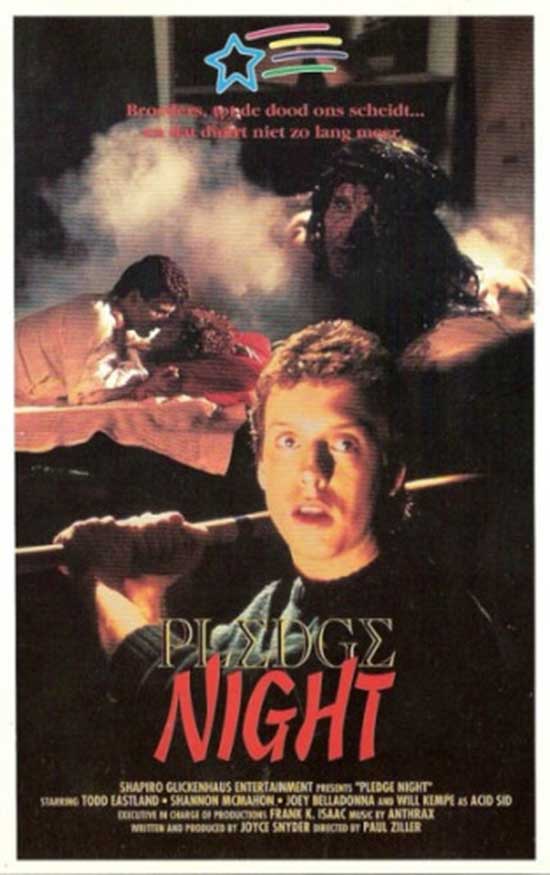
If you didn’t get enough of hazing gone wrong in Slaughter High, good news.
Way back in the 1960s, Sidney Scheider was one of the pledges who got hazed, having to bathe in cornflakes, coffee and vinegar, but someone replaced the water with pure acid — which of course didn’t eat the pipes or tub — and Sidney died a melty death. Also, Sid was played by Joey Belladonna, one of the seven singers the band has had (John Connelley who formed Nuclear Assault with former Anthrax member Dan Lilker, Jason Rosenfeld, Neil Turbin, Matt Fallon, a brief period of time where Scott Ian sang and the band called themselves The Diseased, Joey Belladonna and John Bush, before Belladonna returned to the band).
The rest of the movie is your typical college-aged slasher, albeit with an evil Joey Belladonna clone stabbing people with a sword from Medieval Times. One cast member quit right before shooting, as he took offense with the homoerotic nature of the hazing practices featured in this film. So there’s that.
The crazy thing is, most of them are based on reality, as writer/producer Joyce Synder meticulously researched the truth about fraternities. She also wrote the adult film Raw Talent starring Jerry Butler, which was also the title of that noted cocksman’s book.
So if you want some frat boy moments and gory kills set to Anthrax, head on over to Vinegar Syndrome.
Day 18 Only on VHS: Watch something on the true psychotronic format
Editor’s Desk: Upon the news of his medical hardships, we’ve seen an uptick in our reviews of Tom Sizemore films, which is no way for anyone to discover an actor’s films. Regrettably, Tom—whose credits included the major studio films Natural Born Killers, True Romance, and Black Hawk Down—has died at the age of 61 after having been been hospitalized in a coma for two weeks as result of a brain aneurysm brought on by a stroke.
If not mentioning Tom in passing another review, we’ve reviewed many of Tom’s films, which you can easily discover at B&S About Movies.
Tom Sizemore November 29, 1961 —March 3, 2023
A Little History of Grunge . . .
By 1988, underground “college rock” bands began to bubble under the mainstream and crossed over onto mainstream AOR stations still waste deep in the likes of the hair metal bands Winger, Slaughter, and Poison. And while the audio nimrods didn’t play the newly “major label signed” Husker Du (to Warner Bros.) and The Replacements (Sire), and gave record-industry guru David Geffen of Asylum Records (home of classic rock mainstays, the Eagles) the snub when his new label, DGC, signed New York noise-merchants, Sonic Youth, those spandex bastions did begin to “experiment” with the “more commercial” likes of the Cure, Jane’s Addiction, and Love and Rockets. Yeah, they spun Alice in Chains, but were still not quite ready to pluck Soundgarden from Seattledom.
Then, slowly, while those stations still bowed to the dynasties built by Led Zeppelin and Hendrix, you began to hear less Winger and more of the “false grunge” of Candlebox, Pearl Jam and Stone Temple Pilots, and (B&S Movies’ proprietor Sam’s favorite bands) Creed and Bush. Then, instead of Slaughter ad nauseam, you heard a little trio out of Seattle ad nauseam—and overnight America became a nation of coffee houses with hep-baristas adorned in $50 JC Penny designer flannel shirts and $150 Macy’s faux Doc Martins.
I started my radio career in the early breakers of the Seattle new-wave, working at a small, technically inept, stodgy and dying non-commercial FM that somehow, we, the staffers, convinced our clueless “L7” bosses to give an all-“alternative” format a try and dare rock ‘n’ roll lovers—not interested in blues babbling, folk hootenannies, jazz noodling, plunked banjos, and book reviews—to tune into our audio graveyard left of the dial. And it worked.
And thanks to an indifferent “voice of a generation” who blew his brains out a few years later, the two battling classic (ass-ic) rock stations in town became “rock alternative” outlets overnight and decided the alt-nation wanted to hear the (bane of my existence) Crash Test Dummies and Spin Doctors, and some chick named Torn Anus, I mean, Tori Amos, caterwauling like humping cats on a hot summer night about girls and corkflakes.
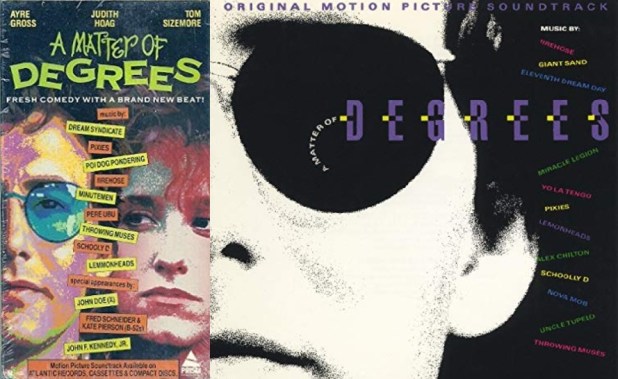
So, the tales of WXOX 90.6 Providence, Rhode Island, in the frames of A Matter of Degrees are near and dear to this DJ’s heart. The new film through 20th Century Fox’s specialty arm, Fox Lorber (Independent Magazinearticle), along with its accompanying soundtrack on Atlantic (the track-listing read like the playlist of one of my airshifts), was heavily promoted in all of the alt-rock mags of the day: Alternative Press, B-Side, CMJ, and Option (good reads!). It was probably even in the alt-section of the mainstream radio trades The Hard Report, FMQB, and Rockpool; it’s been so long, I can’t recall.
The staff of my radio station was stoked. The film was directed by W.T Morgan, who directed the alt-essential concert doc,X—The Unheard Music, and X’s John Doe was starring (later of the radio-connected The Red Right Hand). Fred Schneider and Kate Pierson from the B-52s had roles as DJs alongside Doe, and North Carolina’s hottest college-rock band, Fetchin’ Bones, who just got bumped up to Capitol Records, had a role.
And we were eventually crushed. What we thought was going to be a 1990 college rock radio version of the 1978 progressive rock radio chronicle FM—ended up being Friends: The College Campus Years. Then, we got alt-fucked again, by Cameron Crowe, with Friends: The First Year out of College, aka Singles (1993). Yeah, we got more “radio” with Airheads (1994)—but got more caterwauling cats in the “false grunge” screeches of 4 Non Blondes instead of Throwing Muses and the Breeders. At least Christian Slater’s alt-rock pirate in Pump Up the Volume (1990) cleaned out our Eustachian tubes. And I don’t need any Reality Bites (1994) from Lisa Loeb, either.
Well, at the time, courtesy of our Husker Du and Sonic Youth snobbishness, A Matter of Degrees seemed like a mainstream boondoggle produced by the same “suits” who decided to program songs about frolicking princes, chicks into cornflakes, and creepy, long-haired baritone Dean Martins humming stupid Canadian shite that was giving us A Flock of Seagulls when we wanted the Ramones. But as the VHS box patinas and the tape forecasts snow, I have come to love A Matter of Degrees—and its VHS and CD are a prized part of my collection because: it’s a time capsule that I wished never dissolved into the past.
The Review
A Matter of Degrees, written by Brown University alumni Jack Mason and Randall Poster, we come to find out, wasn’t about a radio station: the radio station served as a backdrop-linking device to a clever, ‘90s version The Graduate (1967), only with The Lemonheads (who ironically cut a cover of “Mrs. Robinson” for an early ‘90’s DVD reissue of the Dustin Hoffman hit) instead of Simon and Garfunkel backing the life-undecided, college campus hippiedom tales of Maxwell Glass (Ayre Gross; House II, Minority Report).
For Max, Providence, Rhode Island, isn’t a place: it’s a state of mind and that “mind” has been rattled by his being accepted into law school (he applied only to the hardest schools so he’d be rejected; he gets accepted to Columbia, the hardest of them all). Then he discovers his cherished campus radio station, which employs his friends Welles Dennard (the incredible Wendell Pierce; USA Network’s Suits, HBO’s The Wire, NBC’s Chicago P.D, Nicolas Cage’s It Could Happen to You) and Scuzz (the amazing-in-his-small-role Tom Gilroy; went onto work with R.E.M’s Michael Stipe and taught at Columbia University) is going to be torn down to make way for a research laboratory backed by a corporation that services the military. And when the station is rebuilt: the free-form format is out.
So, with an Abbie Hoffman-tenacity augmented with coursework titled “Interdisciplinary Approaches to Ethnicity,” Max is going to save the radio station—with arguments invoking the name of infamous ‘80s insider trader Ivan Boesky as a verb: Max speaks ill of the boyfriend of his feisty, Jerry and Elaine-styled best friend, Kate Blum (Judith Hoag; April O’Neill in Teenage Ninja Mutant Turtles, pick a U.S TV series), who runs the radio station: “[Roger] Ivan Boeskied it for them.” Not even their college-dropout/car mechanic roommate, Zeno Stefanos (Tom Sizemore, Zyzzyx Road), who has a propensity to lug car bumpers through the house and make sandwiches by slapping undiluted Campbell’s pea soup between two piece of white bread, can’t get Max off his disillusioned, high sparklehorse: “Remember, women and animals hold up two-thirds of the sky,” Zeno zens. (Now I had my share of Ramdan noodles and peanut butter sandwiches for dinner back in the day, but raw soup sandwiches? I’m glad I didn’t get accepted into Brown.)
“Hey, whatever happened to John Doe? I thought he was in the movie?”
Doe is Peter Downs, the founder of the station who “blew five years in San Francisco recycling the hits like a goddamned monkey” (been there, done that) and returned to his job as the program director of WXOX because, “this is paradise.” Oh, and Peter has a bitch-be-crazy girlfriend, Isabella Allen (Christina Haag), who has Max’s nose wide open. (See what I mean about the Friends-relationship dithering and not enough radio station? Get the Aniston out of here!) In the end, the station and sounds of “Peter Downs and WXOX 90.6 Providence” that Max man-love croons from a shark-toyed bubble bath to a toilet-perched Kate, serves as a plot-character linking device (just like Taj Mahal’s Dix Mayal on WKOK in Outside Ozona).
A Matter of Degrees is a case of “you had to be there.” If you never experienced college campus life and being enamored by the left-of-the-dial “hits” crackling over the airwaves of its tin-can station or a local non-com, you’ll have a lukewarm response to the film. The fun Mason and Poster-penned script reminds me of The Graduate; however, it won’t be in the same classic league as The Graduate when it bounces off your retinas. Your gray matter will populate it as a Singles rip-off—only this film came first. It is, in fact, the first Gen-X, well “grunge,” film in our $5.00 cup-of-coffee flannelled landscape (and you can visit with those films in our “Exploring: 50 Gen-X Grunge Films of the Alt-Rock ’90s” overview.).
Chalk it up to nostalgia fogging my sight; with eyes that see all of my friends from the grunge epoch as I flashback to my views from the glass booth (as I cracked open a new album called Bleach by some band called Nirvana) in the spot-on-miscreant Scuzz, the cucumber-cool Welles, and the rest of the WXOX satellites.
“Rock and roll can save you!” urges Peter Downs.
It did, Peter. More than you will ever know.
Where to get and how to hear the CD soundtrack and see the VHS movie:
While A Matter of Degrees tanked as a theatrical feature (the Sundance crowd shrugged), it blossomed on the international home video marketplace, carrying the titles of Louco Por Rock (Crazy for Rock, Brazil), A tutto rock (Too All, Rock Italy), and in Poland, Radio Maxa (Maximum Radio), or, more accurately, “Radio to the Max.”
As with most of the failed films in the pre-DVD era unceremoniously dumped to VHS, A Matter of Degrees has never been released on DVD—not officially nor as a grey market DVD-R—and there are no online VHS rips. There are no CD rips (of the non-vinyl) soundtrack, but you can listen to this re-creation of the soundtrack I patched together on You Tube. You can also see the soundtrack’s liner notes at Discogs. Multiple copies of the CD soundtrack, the even rarer cassette version, and the VHS can be found on numerous seller sites, eBay in particular. Not finding it won’t be a problem.
Caveat Emptor: John Doe’s incredible theme song for the film, “A Matter of Degrees,” which appears on his debut solo album, Meet Joe Doe (1990; DGC) and the promotional EP single, A Matter of Degrees, does not appear on the soundtrack, which is baffling, considering he’s one of the leads of the film. You can watch John Doe perform the single on the study-helper-for-the-late-night college crowd (good times): The Late Show with David Letterman (there is just something “off” seeing John Doe as a “traditional” lead singer clutching a mic-stand and not wearing a bass). Let the video play through to watch David Letterman’s 1983 clueless-awkward interview with X (really, Dave: alphabet jokes?) as they promote “Breathless,” the soundtrack single to the Richard Geer remake of Francois Truffaut’s film (1960) of the same name. X also covered the ‘60s hit “Wild Thing” for Major League (1989).
As with John Doe: Fetchin’ Bones are in the film—performing their MTV 120 Minutes hit, “Love Crushing,” for a “Save WXOX Benefit” (where John F. Kennedy, Jr. shows up and serenades a girl with an acoustic guitar)—but their song doesn’t appear on the soundtrack. Go figure. And the film is dedicated to D.Boon (backed by Doe’s title-cut song in the film only), the late guitarist-singer of the Minutemen. Why does the post-D.Boon outgrowth of the Minutemen, Firehose, appear on the CD soundtrack, and the Minutemen do not? Double go figure. And don’t bother (poi-dog) pondering how the B-52s got soundtrack skunked. Seriously, this film needed to pull a Dazed and Confused (1993) and release an “Even more . . .” Volume 2 to contain all the great “college rock” in the film. (Oh, hey Kris Erikson, Uncle Tupelo made it onto the soundtrack!)
You can also learn more about Randall Poster’s success as a music supervisor, the art behind movie soundtracks, and his longtime collaborations with director Wes Anderson (2014’s Grand Budapest Hotel) courtesy of these print interviews conducted by WIPO Radio, The AVClub and New Music Express. As it seems there will never be a DVD restoration replete with a commentary track, these interviews are the only way to gain insights on how A Matter of Degrees was and came to be made. (Jim Dunbar, who portrayed DJ Frank Dell, also amassed over 60 credits as a music supervisor, some in the company of Poster.)
In Poster’s post-1990 interview with the alternative music trade NME—New Music Express, he had this say on why he gave up on screenwriting and producing to work exclusively as a music supervisor on films (2012’s Skyfall, 2013’s The Wolf of Wall Street; he won a 2011 Grammy for “Best Compilation Soundtrack” for HBO’s Boardwalk Empire):
“I was always a big music lover, a record collector and an avid movie fan. I got through university studying English Literature, and I found myself without any professional direction. I wrote a screenplay with a friend of mine [Jack Mason] about a college radio station. We did a lot of new songs for it, and we did a record and I just felt that that was really what I wanted to focus on. I wanted to work with great directors, so I figured if I made music my focus, and that would enable me to do [work with great directors; like Wes Anderson].”
Poster also tells us that his college radio love letter was not only filmed in Providence: much of it was shot at Brown University. Poster and Mason were inspired by the college’s campus radio station, WBRU, changeover from a free-form to commercial format in 1985. They wrote the screenplay after graduation. It took them five years, but they got it made. And that’s awesome.
How beloved is A Matter of Degrees? This post at the Radio Survivor blog, written by fellow AMOD fan, Jennifer Waits, proves this cherished time capsule of ‘80s college radio has fans that want, and need, a DVD release of the movie (hint to Kino Lorber!).
Then there’s new fans—of this almost 30 year old movie—like General Manager Sharon Scott of the streaming-community station Art x FM. When she put the new, low-powered community FM (LPFM) outlet in Louisville on the air, she was granted the WXOX-LP call letters. According to Sharon, she didn’t know about A Matter of Degrees or its fictional radio station until well after the station received the call letters. Then, she spotted the movie’s promotional sticker on the door at WRFL and was taken aback that it was the same call letters she had chosen.
It looks like Louisville has found its audio salvation! “WXOX Louisville can save you!”
You can learn more about the new WXOX and Sharon Scott’s fight to save WRVU-FM, Vanderbilt College’s radio station, after students lost access to its terrestrial signal. The Radio Survivor article also provides links to learn more about the history of Brown University’s WBRU.
Peter Downs was right: “Rock ‘n’ Roll Can Save You!”
(And don’t believe the Hype! (1996; full movie/TubiTV) they’re selling!)
Editor’s Note: This review re-ran on December 21, 2020 (with updates), as part of our “John Doe Week” of reviews. You can watch the trailer for A Matter of Degrees on You Tube.
About the Author:You can read the music and film reviews of R.D Francis on Medium and learn more about his work on Facebook. He also writes for B&S Movies.
DAY 12. THE FRACAS AND THE FUZZ: Something revolving around cops and criminals.
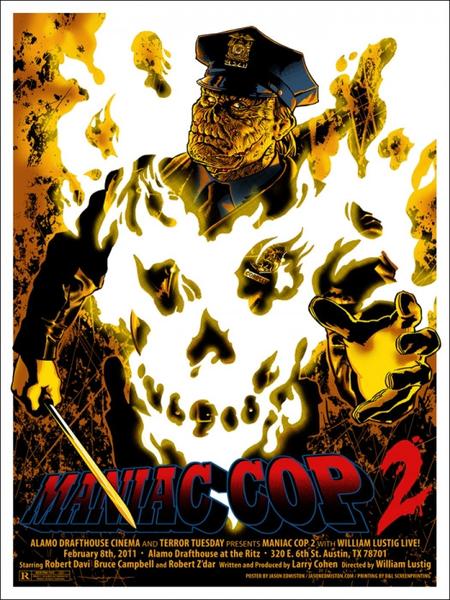
Bill Lustig and Larry Cohen return to tell the next adventure of Maniac Cop Matthew Cordell, who somehow survived being skewered with a pole and a dunk in the rivers of New York City last time. Now, he’s got a junked out police car and is patrolling the city and killing past enemies like officers Jack Forrest and Theresa Mallory (Bruce Campbell and Laurene Landon).
Officer Susan Riley (Claudia Christian, Calendar Girl Murders) is now on the case of not only the Maniac Cop, but a killer named Steven Turkell (Leo Rossi, Bud from Halloween II) who has joined forces with the titular character. Turns out that for some reason, the Maniac Cop wants an entire army of criminals on his side. Look for Clarence Williams III from Mod Squad as one of those crooks named Joseph T. Blum.
Detective Lieutenant Sean McKinney (Robert Davi!) is also trying to stop the Maniac Cop, even promising him an honorable burial and exoneration for his crimes. For what it’s worth, our antagonist gets to kill the three inmates who scarred him and then takes our Turkell in a fiery explosion.
Of course, the credits roll with Maniac Cop’s hand bursting out of his coffin. You can’t keep a bad cop down.
Charles Napier, James Earl Jones, Danny Trejo and Hank Garrett, who once wrestled as The Minnesota Farmboy before going into comedy and appearing as Officer Nicholson on Car 54, Where Are You?
Sadly, Joe Spinell was to play Turkell the murderer, which would have united Maniac Cop with Maniac. However, Spinell died before filming began and the film is dedicated to him.
Although top billed in the credits and on the posters, Bruce Campbell is killed 17 minutes into the movie and has about 3 minutes of screen time. He also hates when people bring this movie up, as it reminds him of a painful time in his life. He always fires back — in a hilarious way — on hecklers who don’t follow this rule at conventions, which has led to goofballs purposefully asking queries about it just to get roasted by him.
While not a household name in the U.S., director Claude Chabrol (with films like Bluebeard and 1975’s Innocents with Dirty Hands) is revered in his homeland—and throughout Europe—alongside other prominent, “mainstream” filmmakers birthed from the ‘50s French New Wave: Francois Truffaut (1966’s sci-fi Fahrenheit 451) and Jean-Luc Godard (1965’s sci-fi Alphaville).
Inspired by German Expressionist filmmaker Fritz Lang (1932’s apoc-futuristic Metropolis) and Alfred Hitchcock’s oeuvre, Chabrol is best known to U.S. audiences for his 1969 (written/directed) foreign hit, La Femme infidel (The Unfaithful Wife). A Fatal Attraction-esque husband-murders-lover-of-cheating-wife thriller, Chabrol’s film received renewed interest when remade by that film’s director, Adrian Lynne, as Unfaithful (2002; with Richard Gere and Diane Lane).
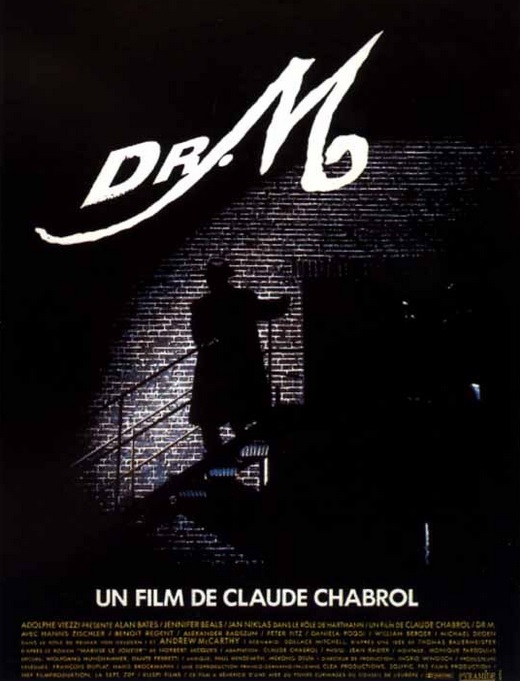
When the centenary year of Lang’s birthday came around, Chabrol decided to pay tribute to his cinematic idol with a futurist-Metropolis spin to Fritz Lang’s 1922 silent, two-part mystery-masterpiece, Dr. Mabuse: The Great Gambler and Inferno*. Most likely—with a cast featuring Jennifer Beals of Flashdance fame (as Sonja Vogler) and Andrew McCarthy (as an “assassin”; his appearance, so brief, it doesn’t warrant his top-billing)—this admittedly low-budget yet engrossing film (titled Dr. M throughout Europe) was criminally slapped with a hackneyed, U.S. teen-slasher title due to its American-based stars: Club Extinction, for its domestic home video bow.
In a cost-effective, not-too-distant Bladerunner future, Berlin (remember, the Berlin Wall didn’t fall until November 1991; so it is still standing in this “future”), a police inspector (as in the aforementioned-linkedAlphaville) traverses the city in his investigation of an “outbreak” of shocking-spectacular suicides that “plague” the city. Clues soon lead him to a “Big Brother” multimedia combine (as in Kamikaze ’89). The combine employs his lover, Sonja, as the spokeswoman for a series of commercials with a sinister, clandestine purpose (as in John Carpenter’s They Live; more accurately, David Cronenberg’s Videodrome): to hypnotize and control, and eventually destroy humanity (in Charbrol’s case: a Hitler metaphor).
The “Fuhrer” behind the plot: Dr. Mardsfeldt (the always incredible Alan Bates; Paul Newman’s post-apoc bow, 1979’s Quintet), who passes himself off as a self-help guru at a remote holiday “health” resort—complete with a “life support system” in a control room (read: brainwashing) for a Jim Jones-styled religious cult. And, Crazy Imagery Alert: One that only Chabrol can dream and commit to film: Bates and Beals having sex—intercut with images of war and destruction (interpret that how you will).
This examination of the life of Adolf Hitler and the goals of a Fascist dictatorship reminds us that, while the world reviled him as evil incarnate, Hitler saw himself as sane, righteous and justified. In most films, we encounter evil, cackling, mustache-twisting Castor Troy’s (Nicolas Cage in Face/Off). That is not how an “evil reality” thinks or operates. Dr. M doesn’t see himself as evil. In his mind, his goal is a logically sane endgame (and Bates plays it close to the chest; no histrionics). And technology, in the wrong hands—as we now experience in today’s modern world (as with the current vaping epidemic)—can be detrimental to humanity.
* Lang brought the character back for two sound-sequels: The Testament of Dr. Mabuse (1933) and The Thousand Eyes of Dr. Mabuse (1960), each starring Rudolf Klein-Rogge as the doctor. Then, five more German sequels were made, after Lang’s final Mabuse film in 1960 and prior to Chabrol’s variant: The Return of Dr. Mabuse (1961), The Invisible Dr. Mabuse (1962), The Testament of Dr. Mabuse (1962), Scotland Yard Hunts Dr. Mabuse (1963), and The Secret of Dr. Mabuse (1964). Dr. Mabuse fans will, of course, note, there are other sequels: The Vengeance of Dr. Mabuse (1972), along with sequels in 2013, 2014, and 2020.
Update: April 2022: Arrow Video has since honored Claude Chabrol‘s career with two box sets: Twisting the Knife and Lies & Deceit—sets which we have reviewed in full. Within those reviews, you’ll find individual reviews for each film in the set. Other Chabrol films we’ve reviewed include his Eurospy romp, Blue Panther, and his retelling of Alice in Wonderland, as Alice or the Last Escapade.
About the Author: You can read the music and film reviews of R.D Francis on Medium and learn more about his work on Facebook.




 B&S About Movies
You must be logged in to post a comment.