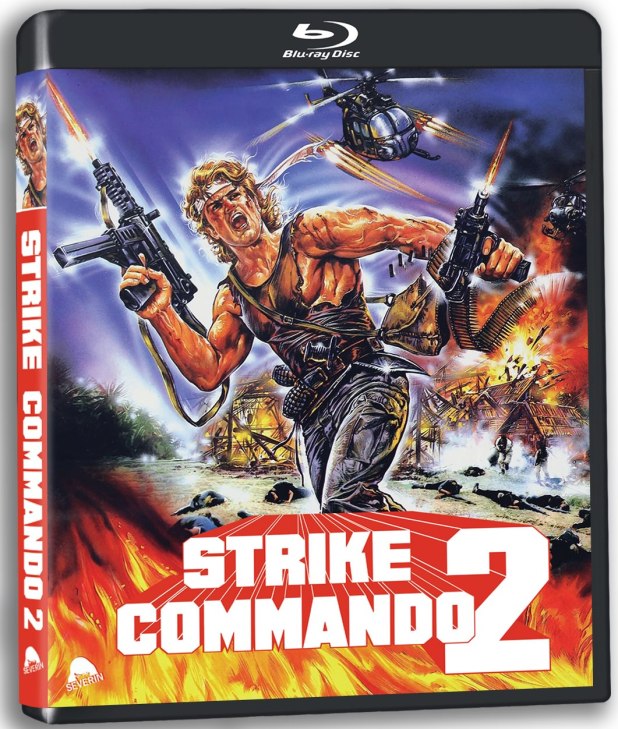
Only the genius — or madness — of Bruno Mattei, Claudio Fragasso and Rossella Drudi could take a Rambo ripoff made in the Philippines and decide to add ninjas, the KGB and no small amount of inspiration from Raiders of the Lost Ark.
Sgt. Michael Ransom’s (Brent Huff!) owes a debt of honor to his Vietnam squad leader Vic Jenkins (Richard Harris!), who has been captured by heroin-selling terrorists who want ten million dollars worth of diamonds. Now, everyone is going to pay.
How else can I sell this movie to you? Oh yeah, Vic Diaz is in it! Plus, the Strike Commando works with a girl he meets in a bar who is in the midst of a drinking contest named Rosanna Boom. Yes, that’s her name, but I’d forgive you if you called her Marion Ravenwood. She swears more than me, which is saying something, and is played by 1977 Miss World Mary Stavin, who was also in Mattei’s Born to Fight, A View to a Kill, House and Adam Ant’s video for “Strip.”
Italian stalwarts Ottaviano Dell’Acqua and Massimo Vanni also appear in this movie, which was shot concurrently with Zombie 4: After Death. And speaking of recycling, a lot of the jungle action here also shows up in Mattei’s Cop Game, which is also beloved in my world.
The movie has a great twist which I didn’t see coming. Then I realized that the movie had been missing one of the essential Rambo ingredients. We had not yet seen our hero get tortured. Yes, like a southern tag team babyface, he must sell and sell to build for his comeback on the man who has turned heel on him, then emerge from the mud and the blood and the filth and unleash unholy hell on people who only care about diamonds when the Strike Commando’s one true love is the unending thrill of bullets, brawls and blowing things up real good.
You have no idea how excited I am that Severin is releasing a 4K version of this movie.
If you’ve surfed around our little ol’ slice of the web for a time, you know us QWERTY-bangin’ fools of the B&S About Movies cubicle farm in good ol’ Allegheny County love our regional and SOV filmmakers. Be it Don Dohler (The Alien Factor, Nightbeast) or Brett Piper (Queen Crab) — and regardless what the mainstream audience thinks of those filmmakers — we run the banners on-high for those ambitious, up-against-the-budget self-made auteurs. Our extensive reviews for such shoe-string produced, regional ditties as Richmond, Virginia’s Rock ‘N’ Roll Hotel, Providence, Rhode Island’s It’s a Complex World, Atlanta, Georgia’s Evil in the Woods, and SOV’ers like John Howard’s Spine, Christopher Lewis’s Blood Cult, and Blair Murphy’s Jugular Wine, are evidence of that fact. Now we’re adding — it’s about frackin’ time — William J. Murray’s Primal Scream to the list. However, unlike most regional and SOV films, which take the more cost-effective shot-in-the-woods horror route, Murray, along with his writing partner Dan Smeddy, upped the game by deciding to honor their sci-fi idol, Ridley Scott.
Yes. I said Ridley Scott. On a shoe-string budget.
It took guts, four sets of balls, and helleva lotta misguided hootspa. And we love Murray and his crew of intrepid, novice dreamers for it. Call Primal Scream dime-store. Call it inept. But the in-camera miniatures, space suits and plastic-cum-cardboard set designs work and the just-staring-out, unknown cast sells the Murray-Smeddy sci-noir verse with class. As with Tommy Wiseau’s years later The Room: Primal Scream displays a lot of heart and you can’t help but enjoy the ride.
The Primal Scream VHS released in 1988 by Magnum Entertainment that I remember/images courtesy of cassiescottagets/eBay.
Beginning its production in 1981 and starting its two-year stop-start production process in 1983 under the title Hellfire — and shot, not on 16mm or video, but in 35mm — this Blade Runner-cum-Alien-inspired future world set in a Chinatown-styled 1997 concerns the discovery Hellfire, a new, highly volatile energy source mined on Saturn’s moons (for a pinch of Peter Hyams’s Outland from 1981). The mining operation leads to the usual sociopolitical bickering between a Weyland-inspired multinational corporate and interplanetary ecologists, as well corporations vying for a piece of the “green new deal.” Who cares if Hellfire earned its name by igniting human flesh and boiling internal body parts into goo. Hey, it’s “clean energy,” so says John Kerry, and it’s everywhere in space. So mine it!
When the controversy over Hellfire results in the brutal murder of a high-ranking Thesaurus corporate executive, Caitlin Foster (Julie Miller), his femme fatale sister (uh, oh), hires the Philip-Marlowe-inspired Corby McHale (Ken McGregor; yeah, he was in X-Men and Prom Night IV, but we remember him best for Ed Hunt’s The Brain), a burnt-out private investigator slumming in what’s left of Atlantic City, New Jersey, to sort out who’s behind the sabotage of the Hellfire project (foretelling Moon 44, Roland Emmerich’s own Ridley Scott-inspired film noir). Along the way, McHale picks up a spunky sidekick in the form of Lt. Sam Keller (Sharon Mason). Part of the interstellar corporate intrigue is Charlie Waxman, a seedy local bookie (Mickey Shaughnessy in his final film role; yes, he was in the classics From Here to Eternity and Jailhouse Rock, but this writer remembers ol’ Mickey best for his first sci-fi bow in the Stanley Kubrickian forefather, 1955’s Conquest of Space).
Impressive! I’m convinced.
When it came time to take advantage of the Blu-ray format to give Primal Scream a well-deserved, proper digital reissue in 2018, William J. Murray set forth to create the 45-minute making-of documentary Made a Movie, Lived to Tell, which is included on the Code Red Blu-ray reissue. The Blus are also easily available on Amazon, but analog purists (moi) can still find used VHS copies on eBay. (It took a few years of diving the discount bins of a couple-dozen home video store close outs before I had my own, beat-to-hell copy for my personal collection.) You can learn more about Primal Scream and its accompanying documentary at its official Facebook page and Dark Force Entertainment Facebook. If you’re into caveat emptor’in your Blus before you buy, you can get the technical specs at Blu-Ray.com.
What I love about this Primal Scream reissue is that William J. Murray, unlike Philip Cook’s low-budgeted similar space romp Beyond the Rising Moon (1987; equally-enjoyed and reviewed this week), stuck to his original vision and didn’t add any years-after-the-fact CGI patches. The 2018 Blu is the same movie we enjoyed in 1988 on VHS — only in a crisp and clean restoration.
If you’re into passionate, low-budget sci-fi, be sure to check out our reviews for not only Beyond the Rising Moon, but Ares 11, Space Trucker Bruce, and Monty Light’s recent offering, Space. And Primal Scream is a great addition to your sci-fi digital library.
Here’s the film’s trailer and the revised-reissue trailer because, well, you know how temperamental the video embed elves are.
About the Author: You can learn more about the writings of R.D Francis on Facebook.He also writes forB&S About Movies.
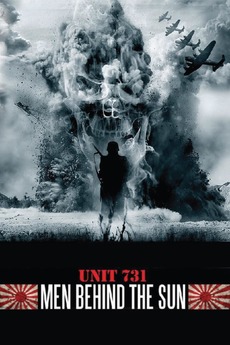
Man, when Hong Kong filmmakers make a video nasty in no way do they fuck around.
The first category III rated film in Hong Kong, this movie sets out to document the World War II atrocities committed by the Japanese at Unit 731, the secret biological weapons experimentation unit of the Imperial Japanese Army during World War II.
Of course, by proclaiming this as educational, it’s equally about watching Chinese and Siberian prisoners being horribly tortured and killed.
Director Mou Tun-fei went to a film school that had so little money that its graduates could only learn from watching and never getting to make their own movies. The style of his early work is based on the Italian neorealist movement and while he made numerous movies for Shaw Brothers*, he was the first Taiwanese director to make movies on the mainland. After this film — he was working on a children’s kung fu movie when the idea came to him — Tun-Fei would make two more movies, the pornographic Trilogy of Lust and the sequel to this movie, Black Sun: The Nanking Massacre.
The main goal of the facility is to learn how to weaponize the bubonic play and destroy China. Somehow, this also means capturing children and operating on their organs while they’re still alive and freezing the hands of people and shattering them with hammers. There’s also a harrowing scene where a cat is attacked by rats and then prisoners are crucified and a flea bomb is meant to be dropped on them before they escape and are run down.
If that doesn’t bother you enough, the effects in this movie include the corpse of a child and the arms of another corpse, this time held by the director’s niece, the only actress brave enough to stand in the cold holding the arms of a dead man.
This is the kind of movie that I don’t think I could make it through again, but for the sake of the sight, my need to see every infamous movie and just plain morbid curiosity, I made it.
*His 1980 film for the studio, Lost Souls, has been compared to Pasolini’s Salò.
It’s time for more high school kids with computer-tech skills!
But thanks to the presence of ubiquitous TV character actor Monte Markham (who lost out on the Steve Austin role in The Six Million Dollar Man; but we’ve enjoyed him in such TV movie and drive-in fare as The Astronaut, Hotline, and Ginger in the Morning) as the lead adult and (experienced) director, this obscure, up-against-the-budget clone is much better than the better known ’80s teen hacker clones Prime Risk and Terminal Entry, both which benefited from incessant pay cable replays not bestowed to Defense Play.
What’s the Airwolf doing here? Blue Thunder? Nope, it’s just a drone.
Now, if the film’s “Ancient Future” backwash to teen-tech romps WarGames and The Manhattan Project, and the presence of Monte Markham (as the military dad who heads the top secret shenanigans), doesn’t stir the cockles of your mainframe, this is the movie that answers the question: “Whatever happened to Boof from Teen Wolf?”
This time, instead of the U.S. Air Force firing up the WOPR, they’re firing up a (stock footage) Saturn V (in 1988, no less, although the shuttle program was in full swing) from Vandenberg AFV topped with a top secret (and aren’t they all) satellite. To foil the launch, KGB agents (natch) are out to steal — in a plot that foresees today’s drones — DART, a miniaturized, remote-piloted stealth helicopter under development at a local university. (And there’s LOTS of stock footage and stock sound EFX at “play,” here. You’ll notice what’s what.)
Not Saturn V’s, but Deltas — based on Space Shuttle technology — were used to launch satellites in the ’80s . . . but when you’re on a budget, you take what stock footage you can get.
The “David Lightman” for this go-around-the-mainframe is Scott Denton (David Oliver from Night of the Creeps; passed away at 30 in 1992), just another one of those 30-year-old high school students with a knack for computers. He’s the project’s team leader alongside Karen Vandemeer (Susan “Boof” Ursitti, who, before and after this, has smaller support roles in Funland and The Runnin’ Kind) and other older-than-high school age whiz kids on the DART program. When Karen’s dad, the school’s computer professor, is murdered-by-laser from one of the prototype DART copters, Scott and Karen — as is the case with the other ’80s teen-tech hero romps Iron Eagle and Red Dawn, My Science Project and (ugh, another mention of the abysmal) The Manhattan Project — spring into action to find the murderer and thwart those Ruskies from thwarting the satellite launch.
If you’re into the nostalgia of Apple IIs, dot-matrix printers, and dial-up modems running those drone forefathers, then enjoy the show. While this received a limited theatrical release and ended up on VHS, it’s never been — and more than likely never will be — released on DVD. Amazingly, there’s a VHS rip to watch on You Tube. And with Susan Ursitti (sigh goes the heart) starring, how can you not watch? Boof is a PTA soccer mom these days. Wild, right? We should all be so lucky to have a wife like the Boofster.
Caveat Mainframe: Ulli Lommel (Blank Generation, The Boogeyman), never one to not cheap-jack the films of others, has his own WarGames brat with a high-tech mini-copter that came out in 1987 as I.F.O. – Identified Flying Object — that was reissued to video as Defense Play.
This unsold TV pilot — made in 1988 for ABC — tried to take advantage of the boom in all things post-apocalyptic. It was even shot in some of the same places that Max Rockatansky race across, like Bourke-Wilcannia Road, Broken Hills and The Barrier Highway in New South Wales, Australia. And directing it? George Miller.
No, not that George Miller.
The George Miller that directed The Man From Snowy River and The Journey to the Center of the Earth TV mini-series.
That said, this movie also features Hugh Keays-Byrne, who was Toecutter in Mad Max and would one day become Immortan Joe in Mad Max: Fury Road. It’s also got Gus Mercurio (he was in plenty of Australian films like Harlequin and Turkey Shoot), Justin Monjo (who was in the post-apocalyptic The Blood of Heroes), Debra Engle (who played Blanche’s daughter Rebecca on Golden Girls), Caitlin O’Heaney (He Knows You’re Alone) and even Sharon Stone in an early role.
It goes so far to be a Mad Max-style film that they used stunt coordinator Glen Boswell (The Road Warrior, Razorback, Mad Max Beyond Thunderdome, Dead End Drive-In). A lot of the crew — art director Rob Robinson and assistant directors Tony Wellington and Nikki Long — also worked on the end times film Sons of Steel.
It’s all about the aftermath of a severe drought that has pushed America away from the west and made water the most precious resource there is. As settlers move back into the destroyed cities, U.S. Marshalls like Garson MacBeth (Lewis Smith, Perfect Tommy from The Adventures of Buckaroo Banzai) and his cyborg partner, Rex (Miguel Ferrer, who a year earlier had helped build RoboCop) are there to protect them.
Sure, it’s kind of silly, but I loved the idea of MacBeth being obsessed with the idea of the west that he only knows from old movies and TV shows. And any post-apocalyptic movie that ends with Miguel Ferrer becoming a T-800 style robot and unleashing a barrage of bullets is something that I’m totally going to enjoy. Oh yeah — and it’s written by Rueben Leder, who also wrote A*P*E*!
I discovered this I-never-heard-of-it before and somewhat newly-uploaded ditty back in September of last year during one of my many You Tube-rabbit hole excursions. And knowing a B&S About Movies’ movie when I see one . . . I left it on my “need to watch” back burners, waiting for the right moment . . . then Sam the Bossman came up with another apoc-theme week. So blame him for this review. And video purveyors Trans World Entertainment for releasing it.
Paul at VHS Collector comes through again with the clean JPEG of the VHS.
At first glance at the VHS sleeve description, you want to call out this direct-to-video writing and directing debut by Scott Pfeiffer as a ripoff of Kevin Costner’s The Postman — only Costner’s apoc romp was released a decade later. You may know Scott Pfeiffer’s work courtesy of his next effort, the Asian white slavery romp Merchants of Evil (1993) — and that’s only because no one ever passes up a film starring William Smith (his B&S resume). After that, Pfeiffer produced a dozen other low-budget direct-to-video features, the best known of those being a sequel to Hell Comes to Frogtown. And, in a David A. Prior twist: Scott cast his brother, James, as the lead in his two writing-directing efforts.
In this apoc-obscurity, we meet a bickering husband and wife (James Pfeiffer and Janice Carraher; she vanished from the biz shortly after) — she wants a divorce and he won’t give her one — as a radio station voice-over advises us the world is on the brink of world war. Then the ubiquitous phone call: we come to learn hubby is not only a dickhead of a husband, but a dickhead of businessman involved in a nefarious South American business deal that has “the feds sniffing around.”
Luckily, our fair lady runs off into the mountains to be with her grandad. And in those same woods, a merry band of prisoners commandeer their police transport van. And hubby has to hightail it to South America to cover up his company’s corruption, because, well, everyone needs to end up in the same patch of woods. . . .
So, all of our key players are in place. Cue the apocalypse.
America is wiped out by a voice over and stock footage nuclear war. And our just another run-of-the-mill businessman in the pre-apoc world sees the all-new, wiped-out America — well, at least west of the Rockies — as the land of opportunity. Now, is it possible that Scott Pfeiffer read David Brin’s The Postman source novel released in 1985 (Costner greatly detracted from the novel in his film version) . . . because we have another psycho-businessman (in The Postman, General Bethlehem, played by Will Patton, was a photocopier salesman) with aspirations to become the land’s new neo-fascist ruler with his merry band of warriors — courtesy of those less-educated escaped prisoners. And as they travel the countryside, the rules are simple: join us or die, just like in The Postman. Meanwhile, our ex-wife and ‘ol grandad are the leaders of a peaceful, wooded enclave. And she finds love again in the arms of — not a postman — but Wilkes (co-writer Butch Engle), a wandering trader.
Do you see where this is all going? If not for the holocaust, we’d have ended up in divorce court or ended up in a ripoff of Kramer vs. Kramer — or worse: one of those psycho-husband romps of the ’90s. Now their divorce plays out — the husband’s Raiders vs. the wife’s Traders (and let’s not forget the poor Radiated People) — in the wooded battlefields of Northern California.
Is this as bad as the Canadian in-the-woods-talking SOV apoc-romp Survival: 1990? Nope. Is it any better than the Gary Lockwood-starring South America-doubling-for-Texas apoc slop that is Survival Zone? Nope. Did this all need a touch of David A. Prior? God help me, but yes . . . for once, where was David A. Prior when we needed him with his fleet of post-apoc Jeep Cherokees and his celluloid partner-in-crime David Winters’s concrete-blocked wall space ships (i.e., the not-the Battlestar Galactica Southern Star in Space Mutiny).
The end.
You can watch Fire Fight on You Tube and here’s the trailer.
About the Author: You can read the music and film reviews of R.D Francis on Medium and learn more about his work on Facebook.
Tom DiSimone was back to make another Angel film, but for the third one in a row, we have a brand new Molly “Angel” Stewart. Mitzi Kapture, who was Sgt. Rita Lee Lance on Silk Stalkings takes over the lead and instead of being a lawyer, Angel is now a photographer.
While taking photos, she ends up taking a photo of her mother, the woman that left her fourteen years ago and sent her off to that world of the streets. The same thing is happening with her sister, so she heads out to Los Angeles just in time for her mom to explode. Now, Molly must become Angel again to rescue Michele (Tawny Ellis, Rockula).
Maud Adams, who played two different Bond girls (Andrea Anders in The Man With the Golden Gun and Octopussy, as well as a cameo in A View to a Kill) plays the madam who is keeping Angel’s sister in her white slavery porn empire.
After the first two Angel films, this is seriously a let-down. It’s not bad, but the whole idea of Angel’s street family was what made those films work for me. Sure, Dick Miller, Toni Basil, Ashlyn Gere and Julie Smith are in this, which I appreciate, but I’m left missing Susan Tyrrell.
If The Abomination is a Shot On Video (SOV) exploration of disease and religion, madness and murder straight out of Texas, this is its oddball rural Michigan brother that has much higher production values.
This is a movie where if I describe it to you, you’ll say, “There’s no way that that is a movie and no way that that much weird can be sustained across an entire movie.”
But you’d be wrong.
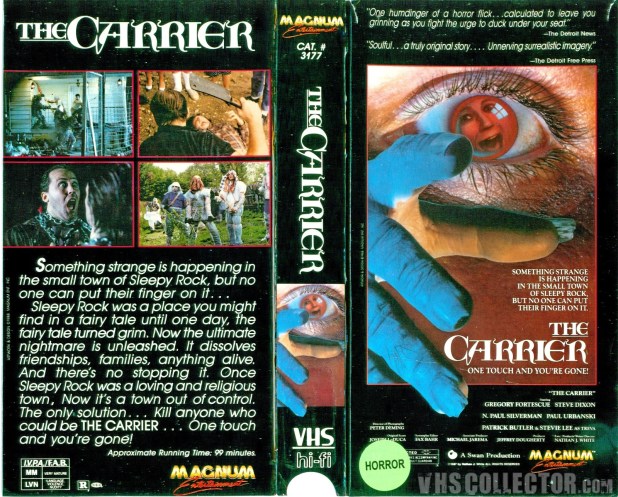
Jake’s parents died in a fire that some in town blame him for. He just wants to come to the bar, get drunk and be left alone, but someone has to call him out as a killer. And maybe someone in the bar actually did the killing and not him. But no matter what, Jake really does encounter some black creature in the woods, the kind that people whisper about in that weird bar that Jake should have avoided. But then, even though Jake survives the attack, he’s left with a scar and a disease that makes him — unknown to all in town — the carrier of a strange plague which spreads to every inanimate object that he touches. When anyone touches what Jake has touched, they are dissolved into that object.
Not long into this movie and everyone in town is covered in garbage bags and post-apocalyptic gear and breaking into religious madness and herding cats to use to test anything that has been claimed by the carrier’s horrible touch.
1950’s Sleepy Rock, Oregon may as well be your town during COVID-19, a disease that no one was sure where it came from and how they could get it and all turning against one another. Of course, this movie was about AIDS way back in 1988, but its theme is even more in your face true today than way back when.
Director and writer Nathan J. White honestly should have made more movies than this one and done effort. He was aided by Peter Deming, who was the director of photography on Evil Dead II, Lost Highway and the Twin Peaks 2017 series.
Every time I thought, “This is getting way too silly,” the movie would redeem itself or get even weirder and sillier, which I appreciate to no end. This is why regional films are so important: there were no studio notes or people saying, “None of this makes any sense.” Therefore, it all makes perfect sense.
I’m still trying to figure out what to call the genre where a woman goes back to her childhood home or has a memory from her past or who inherits some family plot or goes away on a vacation to find herself and always, always, always runs directly into the supernatural.
This is one more to add the the list.
When Cathy (Christine Moore, Prime Evil) was young, her mother murdered her father right in front of her. Now, her life is dominated by the nightmares of that memory, which leads her back to her childhood home.
Cathy has no idea, but her boyfriend Bob got into her life just to lure her back to the apartment building that she grew up in so that he and his friends can shove her off the building to die. That’s because Vathy’s old home really is Hell and everyone born there must be destroyed and come back as a spiritual being referred to as a lurker. And once Bob has a new woman, can Cathy save her?
Man, Roberta Findlay movies have really been a theme this week, but that’s just because every one I’ve seen has totally entertained me. This one seems to pull from her bad childhood, which she also referenced in Tenement. This is a dark film in the most entertaining of ways.
You can get this on a double blu ray set from Vinegar Syndrome. You also get Prime Evil, which is so close to this that you can consider them spiritual sequels to one another.
ABOUT THE AUTHOR: Sean Mitus grew up watching Chiller Theater from Pittsburgh and has been a drive-in enthusiast for the last six years. Sean enjoys all genres but has become interested in Italian horror, thriller and action movies most recently.
“Anyone on death row can be a contestant. Man or woman. Young or old. I do not discriminate.” – Chuck Toedan (John McCafferty)
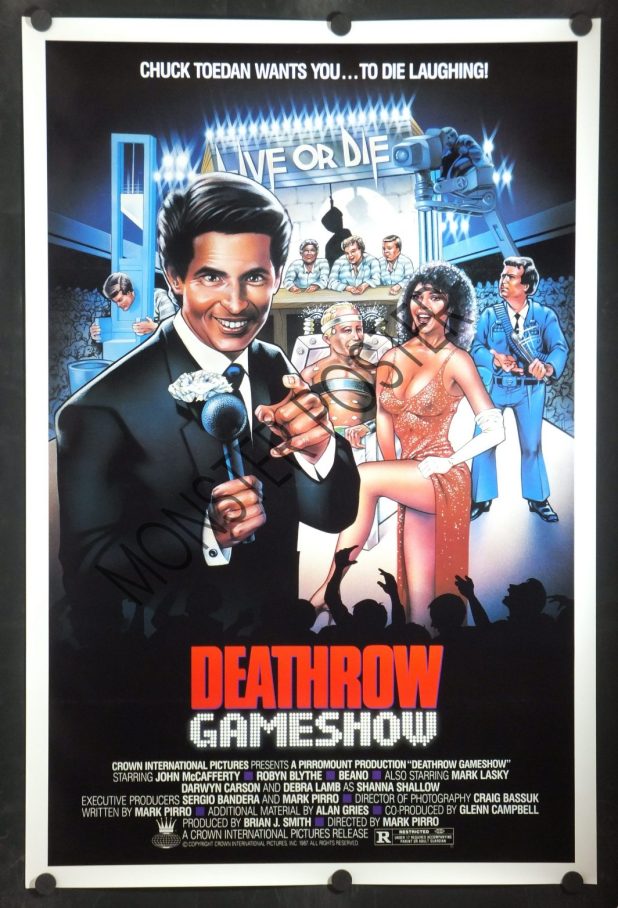
Deathrow Gameshow was director Mark Pirro’s first 35 mm feature. Pirro had made several shorts with a small company of friends which caught the attention of Crown International Pictures. Pirro’s shorts A Polish Vampire in Beverly Hills and The Spy Who Did It Better mixed comedy with other genres which appealed to David Baughn at Crown who gave Pirro $200,000 to make Deathrow Gameshow.
Deathrow Gameshow plays like a warped mashup of National Lampoon comedy and New World Pictures schlocker. Many of the jokes fall flat but that doesn’t stop Pirro and company from trying. The lead Chuck Toedan, producer and star of the Live or Die gameshow, which features death row inmates play for a stay of execution or a grisly death a la Monty Hall’s Let’s Make A Deal, is beset on all sides by his horny secretary Trudy (Darwyn Carson), protesters and picketers, and the Spumoni crime family’s hitman Luigi Papillardo. Chuck is trying to put on the most entertaining show he can, even if the odds are stacked against the inmates. It’s all proper because the inmates sign a release before taking their chances.
Deathrow Gameshow’s premise aims for fun and schlock but is undermined by the broad comedy and the low budget’s impact on the sets, props, and special effects. There’s a guillotine that barely accommodates the inmate’s head. There’s simply a rope hangman’s noose. And there’s a gas chamber barely big enough fit the intended victim. However, there’s no gore or actual showing of the contestants (inmates) reaching their demise. All end with a cutaway or the action moves off-screen. There are also tongue and check commercials featuring inmates demonstrating products the lead to their demise.
The plot centers on sleazebag Chuck meeting Gloria Sternvirgen (Robyn Blythe), a staunch opponent of the show who falls for him and running afoul of hitman Luigi Papillardo, (played over the top by Benjamin Agundez credited as Beano) who initially wants to put the squeeze on Chuck for “protection money” but later wants to kill Chuck after Luigi’s mother accidentally becomes a contestant on Live or Die and goes up in a spectacular explosion. Chuck tries to get rid of Luigi as another contestant. However, Luigi survives for the climax at the end of the film involving a rabid fan who’s desperate to be a contestant on the show.
Deathrow Gameshow was intended for the right kind of crowd at a festival screening or a group of like-minded friends watching home video. Fans of schlock cinema will certainly enjoy this game effort by Pirro and company. Deathrow Gameshow is a great fit in Mill Creek’s Rare Cult Cinema boxed set. Fans wanting more can look for Vinegar Syndrome’s stacked Blu-ray/DVD combo.









 B&S About Movies
You must be logged in to post a comment.