CANNON CANON CATCH-UP: Enemy Territory (1987)

EDITOR’S NOTE: Nothing gives me greater joy than when our site gets mentioned on my favorite podcast, The Cannon Canon. There are a few movies they’ve covered that I haven’t, so it’s time to fix that.

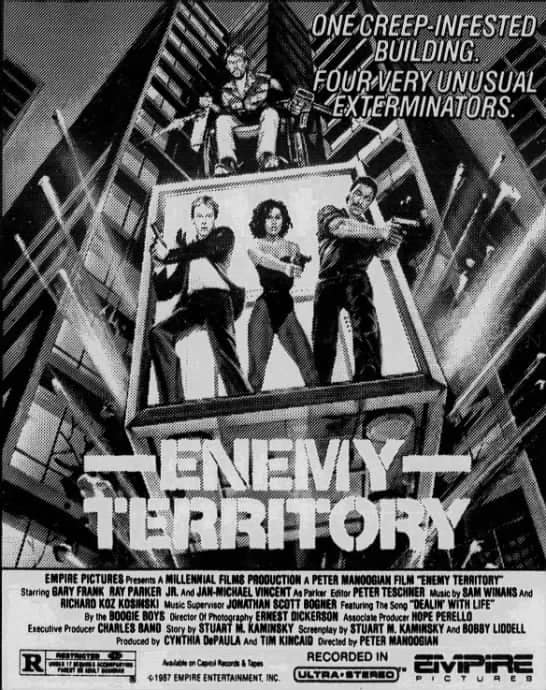
Enemy Territory isn’t available on DVD even and to find it, you have to look on YouTube. And you know, I think it’s worth tracking down. It’s such a strange film, directed by Peter Manoogian. He also made parts of The DungeonmasterDemonic ToysThe Eliminators and Arena, which I would say is a pretty great run of films. It was written by Stuart Kaminsky and Bobby Lindell, who don’t have all that many credits.

It’s the kind of movie that John Carpenter really likes to make, you know, a siege of a building or a film about escaping one of those places whole being surrounded by superior forces. Or even Roberta Findlay, who made Tenement or Maura O’Connell and Paul Donovan’s Canadian urban invasion movie Siege. Or Walter Hill’s Trespass or the Stephen Hopkins movie Judgement Night.

Barry Rapchick (Gary Frank, who mainly has worked in TV) was once a successful insurance execution, but now he’s more interested in drinking. To save what’s left of his career, he has to go to Lincoln Towers, perhaps the most frightening place in New York City, to complete the life insurance policy of Elva (Frances Foster). At the same time, Will Jackson (Ray Parker Jr.) comes to repair the phone lines and see his girlfriend.

Barry doesn’t understand the many rules that comes with living in Lincoln Towers, like how the Vampires see it as their castle. They’re a cult, more than a gang, led by the Count (an absolutely deranged Tony Todd who as always is the best thing in this movie), who mark Barry for death just for touching one of their young members, Decon (Theo Caesar).

As they try and stop him from leaving, the building’s security guard and Decon are both killed. He’s soon trapped in Elva’s apartment along with Will as his reluctant partner, as he wants to get out just as bad. Elva sends them to find her granddaughter Toni (Stacey Dash) and they all go to find Mr. Parker (Jan-Michael Vincent), who is pretty much the only person the Vampires fear. He’s a disabled Vietnam vet who hates just about every race and who has armed himself with an arsenal including a weapon-launching wheelchair.

The Vampires have taken Elva and Toni and want to exchange them for Barry, but Mr. Parker goes wild, shooting everyone he can before taking one to the chest and dying himself. The trio of Barry, Will and Toni learn that a young kid named Chet Cole (Deon Richmond) knows of a way out that no one else does. The little guy sneaks out of bed and takes them there. You may wonder if a kid being in danger is too much. Well, that kid has a baseball bat that he uses to knock one of the Vampires, Psycho (Robert Lee Rush), down an elevator shaft.

Can they make it the rest of the way out? Is the Count unkillable? Will the cops come even after refusing to get near a place where so many of their number have been killed?

Enemy Territory has the budget of a TV movie, but has a great idea that getting rid of the money that is weighing you down is the only thing that can save your life. Ernest Dickerson replaced the other DP when he was let go and as always he knows how to get so much out of so little. He shot this the same year he did Eddie Murphy Raw and would go on to direct some great movies of his own like JuiceSurviving the Game (another movie I need to see), Tales from the Crypt: Demon Knight and Bones.

It also has Ray Parker Jr. not singing the theme but in the movie. He’s also in Disorderlies and seeing as how I’ve written about that movie twice today, I should probably get to that soon.

Tony Todd is the heart of this movie. I could say that for nearly everything he’s done, but he takes this from a simple trapped in a building movie to outright audacity. He deserves all the credit he gets.

You can listen to The Cannon Canon episode of Enemy Territory here.
THE FILMS OF ANDY MILLIGAN: Monstrosity (1987)

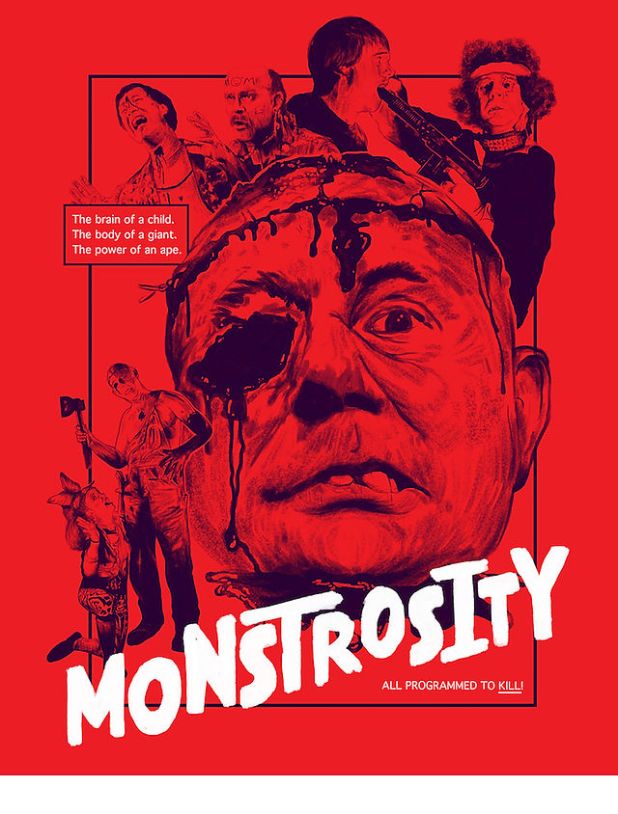
Three maniacs —  Clay (Tommy Voager), Kyle (Joe Darrel) and Savage (Charles Prior) — have assaulted Ronnie (Audra Marie Ribeiro) and then Clay goes even further, dressing as an orderly and killing her as she heals in a hospital bed, then even going further to tear the pages out of the police mugshot book that has their photos.

Her boyfriend Mark (David Homb) is, as you can imagine, destroyed. He tells his friends Scott (Michael Lunsford and Carlos (Joe Balogh) that he wants revenge, but then they bring him down to Earth. He could go to jail. Worse, he could be killed. But, Carlos wonders, what if they made a golem?

It’s at this point that you realize that this movie is not a normal movie and instead you are in the world of Andy Milligan. Carlos studied religion in college and man, if I knew they taught you how to make golem, well, I wouldn’t have gone to art school. Scott goes to med school and has some dead bodies. I have no idea where they got the gorilla parts, to be honest. And soon, Frankie (Haal Borske) is ready to hunt down those three people who ruined Mark’s life.

That’s when Milligan decides that maybe instead of this being a revenge-o-matic, it should be a comedy about Frankenstein trying to fit in and his love story with a girl named Jamie Lee Curtis Wackowski (Carrie Anita), who helpfully explains that her mother is obsessed with horror movies. Seeing as how this movie was made nine years after Halloween

This movie has the wildest punks — these ones blow away the TV ones on Quincy — and for some reason, Frankie kills the gang leader first. Who knows why, yet again. Mark and Scott are also using Frankie to kill every criminal in the city and there’s also a guardian angel (Joel Weiss) who tells Frankie and Jamie Lee that God wants them together.

This movie is pretty much as weird as you can get and who knew that it would come at the end of a lifetime of odd movies, an almost hopeful monster movie made far from Staten Island.

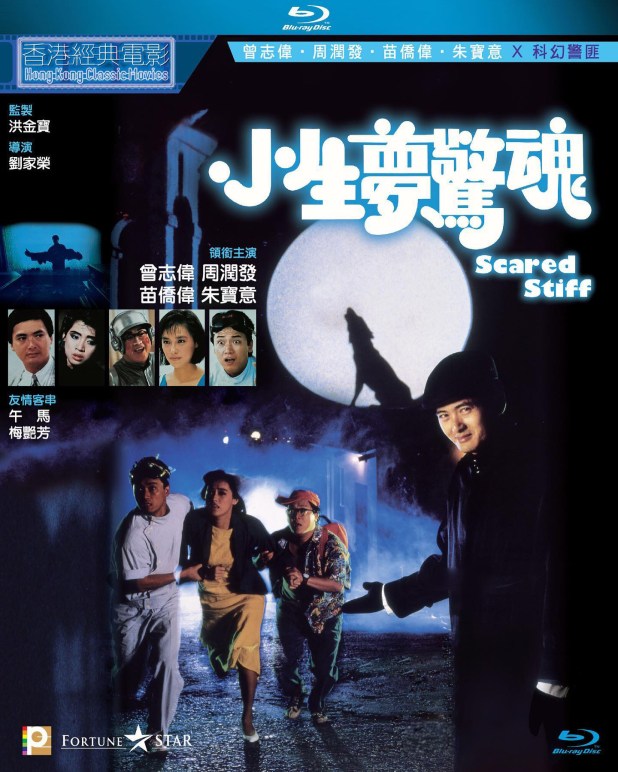
Scared Stiff (1987)

Yes, 1987 had two movies named Scared Stiff.

This is the Lau Kar-wing-directed remix of Dreamscape.

Maybe some Scanners, too.

David Miu Tai-wai (Michael Miu) is a psychiatrist helping street people who is followed around by his friend Halley Tsang Siu-wai (Eric Tsang). For the first part of the movie, they get into wacky guy hijinks like pretending that Halley is a robot so that he can spills water all over a girl so that she’ll take her clothes off. Just when you start to follow that, David gets into a car accident, discovers that he can see inside dreams and has strange adventures like imagining he’s Van Helsing all while a researcher named Alice (Emily Chu) conducts experiments on his brain.

Then the movie turns into a chase, with the men who caused the accident chasing Halley into a parking garage where he finds a dead body and almost knocks out May (Anita Mui). As he recovers, he’s questioned by Inspector Chow (Chow Yun-fat) and another cop (Phillip Ko). Dabid decides to enter Halley’s dreams to learn what happened and discovers that the killer with a knife who murdered the person that Halley found — whew! — was Inspector Chow and he knows that they know that he’s a killer. And now this movie is pretty much a giallo!

What a strange movie that becomes a totally different story every few minutes. I loved it!

You can watch this on iQIYI.

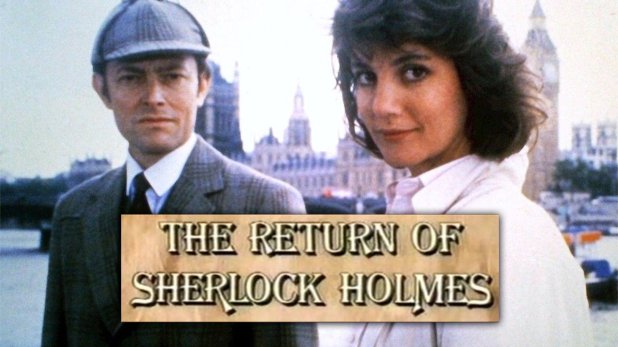
CBS LATE MOVIE MONTH: The Return of Sherlock Holmes (1987)

EDITOR’S NOTE: The Return of Sherlock Holmes was on the CBS Late Movie on November 28, 1988; November 10, 1989 and April 20, 1990.

Directed by Kevin Conner (Motel HellThe House Where Evil Dwells) and written by Bob Shayne, this made for TV movie feels a little bit like Adam Adamant Lives! Or for those that don’t obsess over 1960s British TV shows Austin Powers.

Sherlock Holmes (Michael Pennington) has been taken out of cryogenic sleep by Watson’s ancestor Jane Watson (Margaret Colin), who is a private detective in Boston.  He was infected by the bubonic plague by his enemy Moriarty and frozen until a cure could be found.

Using the alias Holmes Sigerson, the detective works with Watson to help her solve her cases. Holmes falls for Violet (Connie Booth), the daughter of a man killed in an FBI robbery, while Watson and an agent named Tobias (Nicholas Guest) have some glances between each other. This was a pilot for a series that was never picked up, so one assumes that Holmes and Watson would have ended up together if the show was ever a longer series. There’s a fun little Murder, She Wrote cameo as one of the characters is reading a book by Jessica Fletcher.

Shayne also wrote the TV movies Sherlock Holmes and the Leading Lady, which starred Christopher Lee as Holmes and Patrick Macnee as Watson, along with Morgan Fairchild and Engelbert Humperdinck, as well as a sequel to that TV movie, Sherlock Holmes: Incident at Victoria Falls. He also created the show Whiz Kids and wrote episodes of the show Legend, in which author Ernest Pratt (Richard Dean Anderson) plays the hero of his books, Nicodemus Legend, with the help of his friend Professor Janos Bartok (John de Lancie).

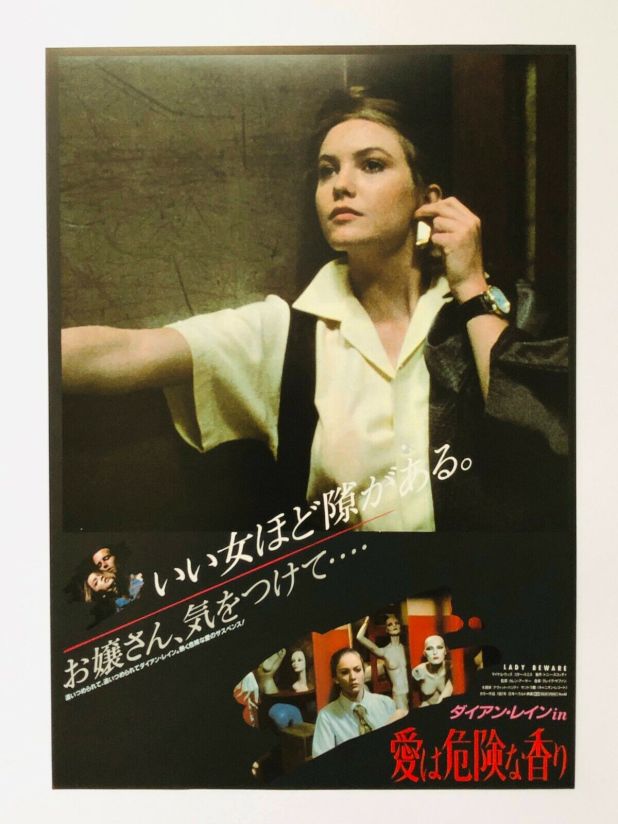
CBS LATE MOVIE: Lady Beware (1987)

EDITOR’S NOTE: Lady Beware was on the CBS Late Movie on January 5, 1990. You can check out another take here.

There are precisely six movies in the subgenre—well, I invented it, and I don’t know who has to approve it. They are known as Yinzer Giallo. These are movies made in Pittsburgh that must follow these rules. We will test Lady Beware against them.

First off, is it a Giallo?

Has there been a murder, or is the lead character a fish out of water being stalked by someone and exposed to threats of psychosexual violence?

Yes: Katya Yarno (Diane Lane, making her second Pittsburgh/Western PA film appearance, as I always consider Ladies and Gentlemen, The Fabulous Stains as taking place somewhere in the Pennsylvania rust belt called Charlestown here, which is the same town as Slap Shot, so I guess it’s Altoona) is a fashion designer who has gotten the most desirable of all Steel City fashion jobs. She’s a window dresser at Horne’s.

Jennifer Woytek

A quick note: Horne’s was a regional department store chain based in Pittsburgh that, at its height, had twelve locations. The best known was downtown — it’s now offices for Highmark — located on Penn Avenue and Stanwix Street. It was a seven-story department store with a famous Christmas tree still lit as part of Pittsburgh’s Light Up Night. You can also see another Hornes in Dawn of the Dead, which inspired the character of Ben Joseph Horne on Twin Peaks, as co-creator Mark Snow went to Carnegie Mellon.

Other than creating the window displays for their rival store, Kaufmann’s—which leads to the yinzer term for minding your business, “Does Hornes tell Kaufmann’s their business?”—having this job would have been the job in 1987.

Anyways…

Katya is a small-town girl in a big city, which is funny because Pittsburgh is the smallest city. That said, her window dressings are pretty sexual and filled with allusions to BDSM, which leads to Jack Price, a married and obsessive maniac, starting to stalk her and call her with incredibly sexually depraved phone calls.

So, while there’s no murder or black gloves, there’s plenty of stalking. Katya may not feel guilty for her window scenes, but numerous men outside are positively scandalized and probably ran up to St. Mary of Mercy on Stanwix for absolution.

A Yinzer Giallo aside: Much like Rome, the kinda sorta birthplace by way of England and then Germany for the main Giallo form, the large number of Italian — and Catholic — immigrants to Western Pennsylvania makes Catholicism and its morals central to growing up here for many people.

Is there high fashion, beautiful people and abundant nudity?

There’s a ton of fashion in this. The costumes were designed by Patricia Field, who would be much better known for creating the clothes for The Devil Wears Prada and Sex and the City, a job she got after impressing Sarah Jessica Parker years before in the movie Miami Rhapsody.

As for the nudity, the one scene in which Lane is nude was supposedly taken while she was unaware.

Director Karen Arthur (The Mafu Cage) told the Los Angeles Times, “Some distributors asked for more sex, so they took outtakes of Diane Lane standing there naked and incorporated them into the film. To me, that’s exploitative. They printed up negatives where I never said print. I, as a female director, would never exploit a woman’s body and use it as a turn-on.”

The director nearly removed her name from the movie, but didn’t think it was fair to the actors, who couldn’t remove their names and do an Alan Smithee.

To be a Pittsburgh Giallo, the film must accomplish all of the above — when possible — and also:

Be true to its Pittsburgh roots, meaning that the movie must be filmed here while speaking directly to the experience of growing up in the city.

This is true because this movie could have been set in any store and chose Horne’s. Now, we can debate the industrial loft that Katya lives in—maybe it’s in the Strip District—but the fact that she has a bathtub in the middle of the room is very actual to the stylistic ideal of the Pittsburgh toilet, which is just a toilet in the basement with no walls, sitting there for very unprivate moments.

If filmed here, it must reference Pittsburgh and not have the city stand in for another town.

Executive producer Lawrence Mortoff had produced the 1984 Nastassja Kinski-starring Maria’s Lovers in Pittsburgh, so he brought the movie to the City of Bridges, getting 28 shooting days, mainly in Dahntahn and the North Side.

It must feel authentic, which helps several films on this list, as they are movies with moments that only make sense when you’re a lifelong Pittsburgher.

True to 1987, Pittsburgh Magazine shows up to report on the windows. And while there are a few Steelers jerseys and bottles of Iron City, Katya does go on a date to the Grand Concourse, which, other than LeMont, would have been one of the better places for a date back in the late 1980s.

Speaking of Pittsburgh, look for locals like Chef Don Brockett (who appeared on Mr. Roger’s Neighborhood and was legally bound to appear in every movie made in Pittsburgh, as he does in The Silence of the Lambs and Flashdance), Steel City stage legend Bingo O’Malley, and Audrey Roth (Mr. Roger’s friend Miss Paulifficate) in this.

Verdict: Yinzer Giallo

Sadly, this movie escaped its director, who had worked on it since the late 70s. In the same Los Angeles Times article, Arthur said that the movie had “100 homes, 17 drafts, and eight writers” while being upset by the film’s production team at Scotti Brothers: “The purse-holders are men, and they attempted to make Lady Beware into a violent picture. I’m not interested in making a picture where a woman gets beaten up. I want to show how a lady deals with this kind of insidious violence. A policeman can’t help.”

Starting with the success of Leif Garrett — their record label also had James Brown in the late 80s, Felony, Survivor and “Weird Al” Yankovic — Scotti Brothers moved into movies and TV — they were involved in the production and distribution of Baywatch — and made the films The ResurrectedEddie and the Cruisers II: Eddie Lives!Eye of the Tiger (well, that makes sense seeing who was on the label), In the Shadow of Kilimanjaro, He’s My Girl, Stealing HeavenThe Iron Triangle and Death of a Soldier.

Who is to blame? One of the three Scotti brothers who produced this, Tony, would play Tony Polar in Valley of the Dolls; I don’t see any gossip about him. As for Mortoff, in addition to producing movies in nearly every genre, he directed one film, 1993’s Deadly Exposure. None of these things point to anyone, but regardless of who was to blame, Cotter Smith’s performance was cut down — he’d return to Pittsburgh to be in the series Mindhunter — and all of Viveca Lindfors’ parts were cut. She’d also come back to be in Creepshow and North of Pittsburgh.

However, this heavy-handed interference made the film confusing. And, look, Giallo can already be hard to understand.

It’s a shame because Lady Beware does have some moments where you can see that it has the hope of being a great film. The close — using mannequins to attack the male aggressor — suggests a more heroic female Maniac, which is an interesting turn.

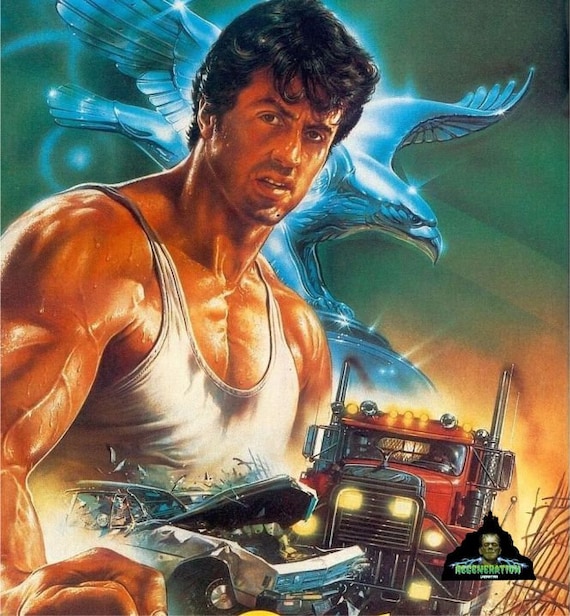
CBS LATE MOVIE MONTH: Over the Top (1987)

EDITOR’S NOTE: Over the Top was on the CBS Late Movie on the next to last month of its run, airing on October 19, 1990.

Stirling Silliphant wrote the Oscar-winning screenplay for 1967’s In the Heat of the Night, as well as The Towering InfernoThe Poseidon AdventureVillage of the Damned,  TelefonThe EnforcerShaft In Africa and more than 700 hours of prime-time television drama to his credit. He was also a close friend and student of Bruce Lee, who he featured in the movie Marlowe and four episodes of the series Longstreet. They also worked together on a script called The Silent Flute, which was eventually filmed as Circle of Iron.

Those are some fantastic credits. Somehow, someway, he eventually found himself working with Sylvester Stallone to write the screenplay for the movie that would take arm wrestling from the bar to the mainstream. And who was ready to direct?

None other than Cannon Group co-owner Menahem Golan, the director of Delta ForceEnter the Ninja and The Apple. Yes, that Menahem Golan.

https://www.youtube.com/watch?v=jJ8d_czhqeA

Lincoln Hawk (Stallone) is a man trying to rebuild his life. While he does that, he’s driving a truck and arm wrestling. His ex-wife Christina (Susan Blakely, My Mom’s a WerewolfThe Concorde … Airport ’79) wants him to bond with their son Michael (David Mendenhall, Space RaidersStreets and the 12-year-old drug dealer in the Diff’rent Strokes episode where Nancy Reagan shows up) because she knows that she’s dying.

Michael has been in military school and calls everyone “sir.” His grandfather, Jason Cutler (this movie is yet another in my quest to see every film with Robert Loggia in it), hates Hawk and never wants him in their family.

On the journey from Colorado to California, Michael develops a deep bond with his father, who teaches him the art of arm wrestling and the essence of manhood. However, their reunion at the hospital is marred by the news of Christina’s demise. Blaming his father for not being there in her final moments, Michael returns to his grandfather’s home. Hawk, in a desperate attempt to free his son, ends up getting arrested. The mansion where Cutler resides may look familiar, as it was also featured in The Beverly Hillbillies.

Michael visits Hawk in jail, informing him of his decision to stay with his grandfather. Determined to win back his son’s trust, Hawk sets off to compete in the World Armwrestling Championship in Las Vegas, with a grand prize of $100,000 and a new, larger semi-truck. In a bold move, he sells his truck and places a $7,000 bet on himself at twenty-to-one odds. The discovery of the letters Hawk had written to him over the years, trying to establish a connection, further fuels Michael’s belief in his father.

Hawk advances to the final eight but suffers his first loss in the double-elimination tournament and hurts his arm. Cutler summons our hero and tells him that he’s always been a loser, but if he leaves forever, he’ll give him $500,000 and a better truck than the prize.

Hawk refuses and makes it to the finals, taking on his rival, the undefeated Bull Hurley. His son finds him and gives him the emotional energy he needs to survive, just as Hawk doesn’t only beat Bull but gains his respect. Somehow, Cutler gets over ten years of being a complete asshole and is happy about Michael and Hawk being reunited because that’s how eighties movies work. The guys get so sweaty in the final battle that they have to get the strap, and people go wild for it. It’s pretty impressive, and you’ll yell, “Get the strap!” too.

The film’s climactic finals were shot during a tournament organized by Cannon, the production company. This year-long competition, starting in Beverly Hills, featured events across North America, Europe, Israel, and Japan. The actual crowd and the B-roll footage of matches at the Las Vegas Hilton are what you see in the movie. The scene where Michael Bociu breaks his elbow? That’s as real as it gets.

If you’re into pro wrestling, Terry Funk, Reggie Bennett and Scott Norton show up here (Ox Baker, who was in Escape from New York, and Manny Fernandez and The Barbarian almost made it into the movie). Plenty of professional arm wrestlers like professional arm wrestling personalities such as Allen Fisher, John Vreeland, Andrew “Cobra” Rhodes, John Brzenk (who inspired the story) and Cleve Dean are also on hand.

The music in this movie is astounding. Kenny Loggins sings “Meet Me Halfway” numerous times, and there is also some Giorgio Moroder, some Asia, some Robin Zander, some Eddie Money and Sammy Hagar singing “Winner Takes It All,” which was also made into a music video to promote the film.

The film received three nominations at the 8th Golden Raspberry Awards in 1988. David Mendenhall won two for both Worst Supporting Actor and Worst New Star, which seems kind of crappy for them to abuse a kid. Sylvester Stallone was nominated for Worst Actor, an award he’s won four times, but he lost to Bill Cosby in Leonard Part 6 this time.

Stallone has claimed that if he had directed this, he would’ve changed the setting to an urban environment, used scored music instead of rock songs, and made the Las Vegas finale more ominous. These changes would have significantly altered the film’s tone and atmosphere. So why was he in it? He answered, “Menahem Golan kept offering me more and more money until I finally thought, “What the hell – no one will see it!””

Speaking of Stirling Silliphant, he only did the screenplay. Actor/writer Gary Conway (American Ninja 2: The Confrontation) and director/writer David Engelbach (America 3000Death Wish II) created the original story. Engelbach cried when he saw the finished movie, remarking that his original draft “wasn’t nearly as dumb as the final film and was more about truck driving and arm-wrestling than it should’ve been.”

When this movie came out, my brother and I were in our early teens and couldn’t wait for it. There was an entire line of toys that had knobs in their backs that allowed them to arm wrestle and, even better, an actual competition table. We begged our parents for it nearly every day for six months, but our mother continually told us to use an actual table. She had no vision. At this point, I could have a father-in-law who hates me, a bedridden ex-wife and a son who doesn’t know me, but I could flash anyone and put their arm down in no time. Get the strap!

Even more magical, fifty miles from the filming of this movie, Sergio Martino had assembled an Italian/American crew to create Hands of Steel, the only Road Warrior by way of The Terminator truck driving movie that also has arm wrestling in it. Coincidence? Do you know anything about Italian cinema?

Chattanooga Film Festival Red Eye #6: Club Life (1987)

Norman Thaddeus Vane lived a life.

After an early conversion from Judaism to Roman Catholicism, a year in the Merchant Marine and two years in the Air Force, he attended Columbia University on the G.I. Bill.

After graduation, his first play, The Penguin, opened Off-Broadway with Martin Landau in the cast and received rave reviews—reviews that eluded his Broadway debut, Harbor Lights. He then spent the next two decades in London, where he wrote and directed Conscience Bay and The Fledglings when he wasn’t running nightclubs—one of which he sold to the Krays—and contributing to Penthouse.

He also married 16-year-old Sarah Caldwell when he was nearly forty, which formed the basis of his script for Lola (AKA Twinky AKA London Affair), a movie in which Susan George stands in for his wife — his wife did act in his film Mrs. Brown, You’ve Got a Lovely Daughter — and Charles Bronson basically played him.

As the seventies began, he wrote the Italian film 1931: Once Upon a Time in New York, AKA Pete, Pearl & the Pole, which had Tony Anthony as Pete, Adolfo Celi as the Pole and Lucretia Love as the Pearl. He also wrote the Native Americansploitation film — is there a genre? — Shadow of the Hawk stars Jan-Michael Vincent, Marilyn Hassett and Chief Dan George.

Somewhere in the middle of the 70s, he shot the second unit on the adult horror comedy Dracula Sucks, which would serve him well when he made the mainstream Frightmare, a movie that has references to the Universal Dracula.

Perhaps his most interesting film is 1984’s The Black Room, which Vane revealed to Nightmare USA based on his real life, as he cheated on his wife in his black room with Penthouse centerfolds that he met while working at that publication. It’s also the only movie I’ve ever seen where a man rents a sex room from a brother and sister-couple who may or may not be vampires.

The last few movies of Vane’s career are hit and miss: Midnight, in which he was unhappy with the final cut, which was taken from him; Taxi Dancers, a sex film shot in the same nightclub used for Club Life and You’re So Dead, made when Vane was 79 years old and never shown, as far as I know.

Vane wrote an op-ed for the Los Angeles Times in 1991 in which he confessed to how hard agism had hit him, saying, “After being dropped by William Morris some years ago, I managed to sell several scripts to studios. But in recent years, the wall has been impenetrable. Instead of disappearing, I decided to write, produce and direct low-budget, independent features.”

If you want to know more, the incredible Hidden Films was lucky enough to interview Vane before he died in 2015.

But hey — we’re here to talk about Club Life.

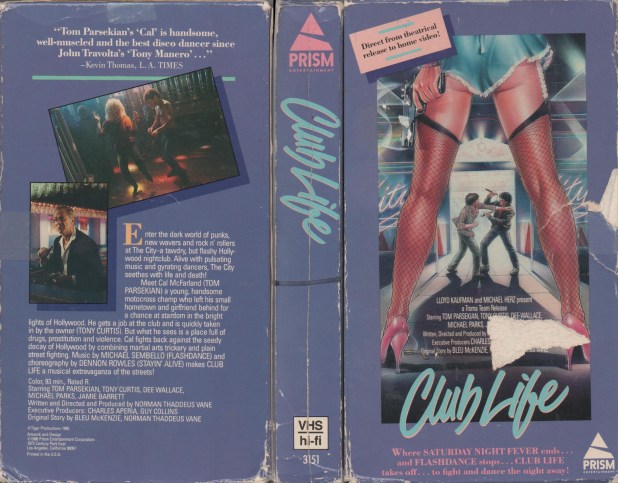
Cal (Tom Parsekian) is a kid from a small town with dreams of Hollywood stardom. His journey takes him to The City, a nightclub owned by the coked-out Hector (Tony Curtis), who is in debt to organized crime but also loves to watch his wife Tilly (Dee Wallace) sing. Cal’s Hollywood dream leads him to become a bouncer, learning from the seasoned Tank (Michael Parks). The film features a unique scene where Tank effortlessly dodges every move Cal makes, leading to a moment of shared laughter and pain.

The girl Cal left behind, Sissy (Jamie Barrett), has come to Los Angeles looking for him, but she falls into a bad crowd at the same time as Cal leaving behind The City, as he comes to work at a lesbian bar called Different Drummer. Sissy also sings, and her number “First Class Man” gets her both booed off the stage at the ladies-only club and also catcalled.

This movie is awash in neon and fog. It also has one of the most fantastic sex scenes ever, as Cal and Sissy work it out on a clear waterbed lit from the inside and filled with fish. This is the movie that proves to you that you haven’t seen everything.

It’s not done yet.

After Tank gets killed, during which one of the tough guys says, “The cat can’t sleep if he wants to breathe.” Cal returns to The City and tries to keep Hector safe from all his debts. Did I mention that Cal can also dance? Or that he uses — and here’s the part that might be better than the waterbed filled with sea life — neon nunchucks that get a slow-motion dance fight scene that blew my brains out my nose.

This is a movie filled with strange BDSM fog-enhanced dancing set to music by Frank Musker (who is credited on the Stardust song “Music Sounds Better with You” thanks to a sample it contains from the song “Fate” that he did with Chaka Khan), Michael Sembello (the Flashdance force is strong within this) and Terry Shaddick (who co-wrote Olivia Newton-John’s “Physical”).

Smiley-faced balloons intrude on breakups, graffiti clowns watch over overdoses, and a funeral happens inside a nightclub. It’s also shot by Joel King, whose resume includes camera work on Just Before DawnThe BeastmasterCarrieOut of the Blue and Embrace of the Vampire. That should give you an idea that this movie looks everywhere. As for the wild dance numbers were choreographed by Dennon Rawles, who also worked on Voyage of the Rock Aliens and Staying Alive.

Also, Kristine DeBell shows up, and again, her career has some wild choices, from Meatballs and the erotic Alice in Wonderland to playing Jackie Chan’s love interest in The Big Brawl to being in A Talking Cat!?!

This film ends as only it can. Cal smashes the hall of mirrors where his friend Tank died and basically decimates the entire club with his neon nunchucks. He then splits the disco ball and throws his brightly colored martial arts weapon over the Hollywood hills.

You best believe I was crying.

PS: Norman Thaddeus Vane was not paid for the movie, and when it was nearly finished, he stole the film itself. He told Hidden Films, ” The movie was being edited at Consolidated Film Industries, and I went over and stole these really heavy cans of negatives and put them in the cellar of a friend’s house. And then I told our representative, “Listen, tell Guy Collins that I’m not giving the negatives back until I get some serious money.”  They called the police and I said to them, “I’ve been working for this company for three months and I haven’t been paid dollar one. I’m holding the negative as a lien against the money they owe me by contract.” The police took my side. Guy’s brother came over and paid me $40,000  and said he’d owe me another $40-50,000, but I never got it.”

You can watch this on YouTube or download it from the Internet Archive.

You can listen to the podcast I did on this movie on YouTube.

Junesploitation: Munchies (1987)

June 28: Junesploitation’s topic of the day — as suggested by F This Movie— is 80s comedy! We’re excited to tackle a different genre every day, so check back and see what’s next.

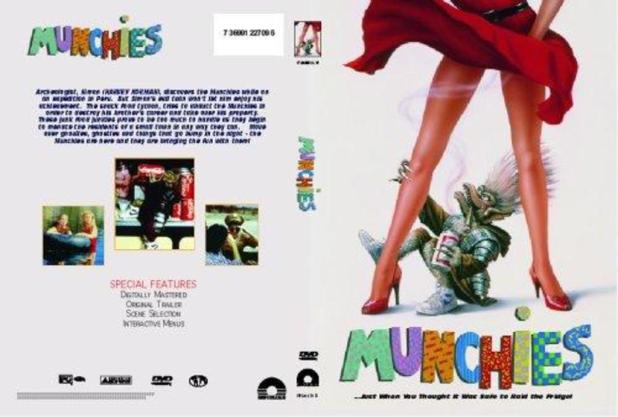
Any movie that has Harvey Korman as a space archaeologist is pretty much one I’m going to watch. I don’t know why it took me so long. I used to stare at this box in the video store and was just amazed that it had a little monster drinking a beer, smoking a cigar and looking up someone’s dress.

That lil’ guy’s name is Arnold and he came from a cave in Peru. Simon’s son Paul (Charles Stratton) and his girlfriend Cindy (Nadine Van Der Velde, who was also in Critters) lose him to Simon’s evil twin, snack food magnate Cecil. The problems kick in when Cecil decides to draw and quarter Arnold after he tries to attack the snack king’s son. Instead of dying, he splits into four more creatures.

How do you stop a Munchie? You electrocute it and that turns it into stone. I would not have guessed that, nor would I figure out that Machu Pichu was the toxic waste dump of the gods.

Director Tina Hirsch was assistant editor on Woodstock and Hi, Mom! before heading out West and working for Roger Corman, editing Death Race 2000Big Bad Mama and Eat My Dust. She also edited a lot of Joe Dante’s films, like Gremlins and Explorers. She’d always wanted to direct, Corman always wanted to make a Gremlins rip-off and hey, they made this in 12 days of human shooting and 3 days of puppet pick-ups.

Seeing as how the Munchies drive an AMC Gremlim with an OHGIZMO license plate, I think that Hirsch, Corman and Dante were all on the same page.

I am also legally obligated to mention that Paul Bartel is in this.

THE FILMS OF BRIAN DE PALMA: The Untouchables (1987)

Robert DeNiro* had not worked with Brian De Palma since Greetings and Hi Mom. That theme for taking forever to make something happen also is something that Ned Tanen knew all about.

He spent years trying to obtain the rights to Eliot Ness’s life story while working as an executive at Universal Pictures. After becoming head of motion picture productions at Paramount Pictures, which owned the film and television rights to Ness’s memoir The Untouchables, he hired Art Linson to begin producing a film adaptation.

Linson didn’t have any interest in remaking the TV series. Instead, he wanted to show the real world Ness and his career in Chicago. He hired playwright David Mamet to write the script, which other than a few changes for the sake of new locations, went unchanged. De Palma wouldn’t take much credit for what he did, telling The New York Times, “Being a writer myself, I don’t like to take credit for things I didn’t do. I didn’t develop this script. David used some of my ideas and he didn’t use some of them. I looked upon it more clinically, as a piece of material that has to be shaped, with certain scenes here or there. But as for the moral dimension, that’s more or less the conception of the script, and I just implemented it with my skills – which are well developed. It’s good to walk in somebody else’s shoes for a while. You get out of your own obsessions; you are in the service of somebody else’s vision, and that’s a great discipline for a director.”

While De Palma’s movie is based on historic events, most of the film is inaccurate. For example, there was no border raid, no shootouts at the train station or courthouse. Ness didn’t even have much to do with Capone’s conviction at the end of everything. Frank Nitti killed himself 12 years after the trial. And Capone ordered his men to not kill or harm Ness or any of his agents. Sure, he tried to bribe them. But he knew that any violence against him would only bring more government interest.

Movies don’t have to be real to be great.

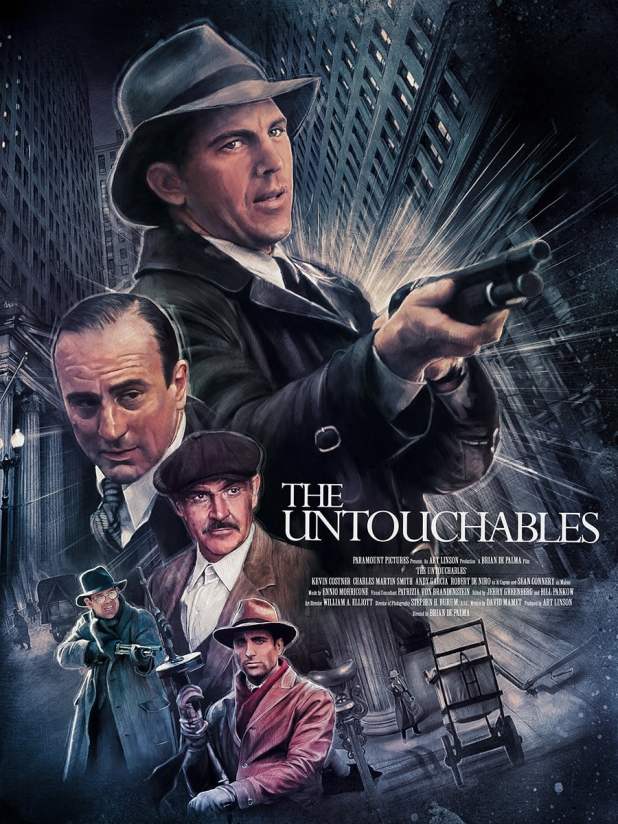
Instead, let’s indulge in the world of this film, where Ness (Kevin Costner) and James Malone (Sean Connery) form their Untouchables with George Stone (Andy Garcia) and Oscar Wallace (Charles Martin Smith) to go up against Capone and his henchmen like the sinister Nitti (Billy Drago, incredible as always). Let’s thrill to De Palma restaging the Odessa Steps scene in Sergei Eisenstein’s Battleship Potemkin on the stairs of a train station. Let’s watch moments that have transcended just this movie and become part of the film language for everyone.

It really is astounding when you think of the highs and lows of De Palma. For all the attacks he received for his violent films and talk of misogyny, he made movies that have become iconic parts of our mythology.

*De Niro almost didn’t make the film. He was on Broadway at the time and his schedule wasn’t lining up. De Palma then had Bob Hoskins ready for the part. When it. all worked out, he mailed Hoskins a check for £20,000 with a “Thank You” note. Hoskins called the directed to ask him if there were any more films he didn’t want him to be in.

Karate Warrior (1987)

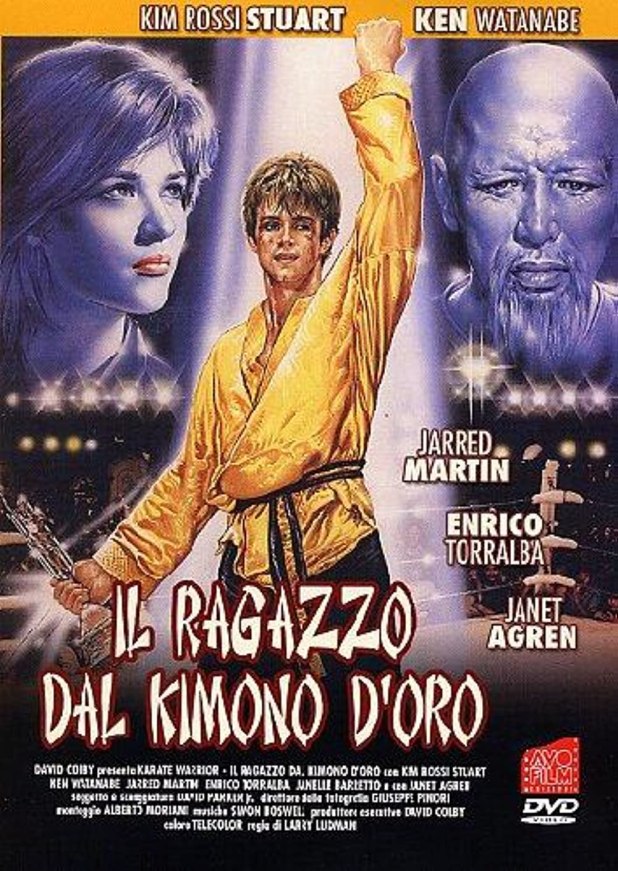
Also known as Fist of Power or Il Ragazzo Dal Kimono D’oro The Boy in the Golden Kimono), Karate Warrior was directed by Larry Ludman, who is really Fabrizio De Angelis. He also wrote this along with Dardano Sacchetti, using The Karate Kid as the obvious playbook but taking the Italian exploitation way of going harder and weirder.

Anthony Scott (Kim Rossi Stuart, who was in Lamberto Bava’s Fantaghiro series of made for TV movies) is in the Philippines visiting his estranged father Paul (Jared Martin, Steve Farlow from Dallas) against the wishes of his mother Juliet (Janet Agren, who got so much work in the 80s and 90s). While there, he falls for Maria (Jannelle Barretto), a girl whose father is being shaken down by a gang led by Quino (Enrico Torralba). Quino was once the student of Miyagi figure Master Kimura (Ken Watanabe), who may as well be Yoda the way the locals speak of him in hushed tones, but now he loves to hurt people. He’s won the local karate tournament five times in a row, a fact that Anthony gets to see for himself.

He can’t keep his mouth shut and the white savior flashbulbs the karate master with his camera and then spin kicks him, leading to a chase all across the Manilla scenery, ending with Anthony getting the beating of his life. Or death, just about. Luckily, he’s nursed back to health by Kimura.

When Anthony recovers, Kimura teaches him how to defend himself in Drunken Master training style, ending with giving him the Stroke of the Dragon, a special martial arts strike that should only be used when he has to defend his life.

This training involves punching cows with karate magic and finding a jungle cat and staring it directly in the eyes. This is way more intense than painting a fence or waxing a car, as Daniel-San will not be able to tell you.

Also in true Italian style, we are asked to believe that Anthony is a true blue American citizen who loves the American football. Except that he’s always wearing a Jacksonville Bulls jersey from the USFL, a team that played their last game two years before this movie was made. And yes, Kim Rossi Stuart is from Rome.

It takes decades to learn martial arts and a lifetime to master them, much less be able to fight blindfolded and throw magic fireballs. Somehow, Karate Warrior does it in ten days and is able to defeat the outfight a killing machine. Cool story, dude.

That said, I totally love that every time Anthony gets beat up, it’s the most violent beatdown you’ve ever seen. I never feared for Daniel’s life in The Karate Kid but in this, I am sure every time that Karate Warrior is about to die. And how about the ending, where his dad tells his ex-wife that yes, their son is going to an expensive Ivy League school, but now he has to prove himself as a man and in the very next scene he gets beaten so badly that he bleeds out of his eyeballs and needs to go into the last round blindfolded.

This was so successful that there are six of these movies, which is way more than The Karate Kid got before Cobra Kai started. I am probably the only person demanding a new Karate Warrior series.