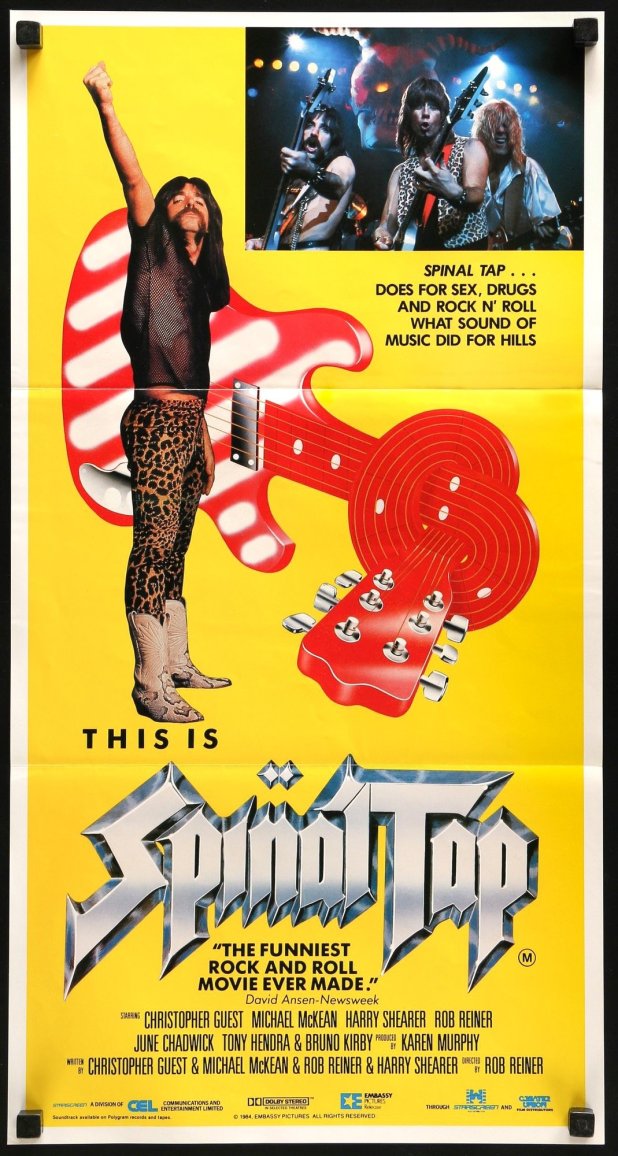
There is nothing I can say about this movie that can add or distract from it. It is a force of nature and in my opinion, the most perfect of movies. I’ve debated adding it to the site numerous times, but my worry was that it’s so ingrained in my heart that there was no way I could do it justice. So instead, let me share my favorite scene from the movie and explain why it means so much to me and then you can just watch the damn thing yourself.
As limo driver Tommy Pischedda (Bruno Kirby) drives Spinal Tap through New York City and all seems bright and the future wide open, he makes the faux pas of thinking that he can directly interact with rock gods. He looks in the back of his car and addresses one of their female admirers: “Excuse me… are you reading “Yes I Can”?”
Tommy may not understand this heavy metal, but he does know the Rat Pack. That’s the kind of celebrity culture that he understands. People that deserve to be there. People that have given blood and sweat and sacrificed. But maybe, just maybe, these longhaired kids are trying.
“You know what the title of that book should be? “Yes, I Can If Frank Sinatra Says It’s OK,”” shares Tommy. “‘Cause Frank calls the shots for all of those guys. Did you get to the part yet where uh…Sammy is coming out of the Copa…it’s about 3 o’clock in the morning and, uh, he sees Frank? Frank’s walking down Broadway by himself…”
At this point, Nigel Tufnel, the guitarist of the band, rolls up the window that separates the celebrity from the hired help. It’s a bracing and truth-packed moment, as the look on Tommy’s face shows that he should have never opened himself to such scorn.
Rockumentarian and Tap fan Marti DiBergi tries to deal with the chill in the air, offering, “Well, you know, they’re not, uh, used to that world. You know, Frank Sinatra, it’s a different world that they’re in.”
The sheer exhaustion in Tommy’s speech that follows, as well as his know-it-all feeling on the world of celebrity follows. “You know, it’s just that people like this…you know…they get all they want so they really don’t understand, you know…about a life-like Frank’s. I mean, when you’ve loved and lost the way Frank has, then you, uh, you know what life’s about.”
But what sums it all up is when he says, “Fuckin’ limeys.”
Editor’s Note: This review ran on April 11, 2019. We’re bringing it back for our “Hikmet ‘Howard’ Avedis Week” of reviews.
Hikmet Avedis was the director of 1974’s The Teacher. Howard Avedis is the director of this film. They’re similar films. And the same person. So there you go.
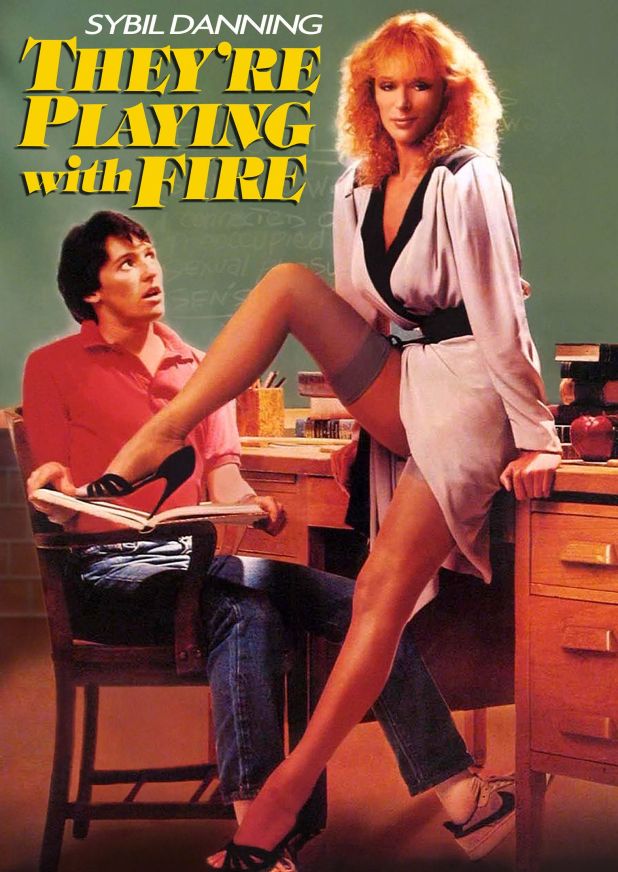
This movie is all about Jay (Eric Brown, Private Lessons), who gets caught up in a film noir-like murder mystery. And see, you thought that this was going to be all about teen comedies and not death! Wrong! (We know! We’ve done Private Resort with Johnny Depp, and Private Parts (not the Stern one), but not Private Lessons? We’re working on it!)
What sold me on this movie were the two leads: Andrew Prine (The Town that Dreaded Sundown, Simon King of the Witches) and Sybil Danning (Battle Beyond the Stars). They’re a married couple who want to get his mom into a retirement home, but things go wrong and she gets killed. Jay gets way too deep into their affairs, but look: if you were a 19-year-old college kid and Sybil Danning regularly rumbusticating you, chances are you’d do anything she asked.
This movie has a lot in it, to tell the truth. It’s somewhat a sex comedy. It’s sometimes a slasher, like when a hidden Santa Claus beats a woman with a baseball bat. It’s got Dominick Brascia in it, who played the candy bar eating heavy guy in Friday the 13th: A New Beginning. It’s got Alvy Moore in it, who was Hank Kimball on TV’s Green Acres. It was the best role Sybil ever thought that she acted in. And by the end of the movie, it’s become a giallo complete with a room full of horrific artwork, dead bodies and a secret sibling!
Despite the tagline, “From his French maid, he got Private Lessons. Now his English professor is giving him a REAL education,” this is not a sequel to that film. Also: I kind of hate Eric Brown, as he got to do love scenes with both Sybil and Sylvia Kristel. That’s kind of getting way too much out of your life. No one deserves that much.
Just listen to this song and remember: Eric Brown got to do three love scenes with Sybil Danning. Try not to get enraged. It gets worse: he hooks up with Sylvia Kristel in Private Lessons. You’ve just gone postal.
Remember Christiane F.? Hanna D. could be her Italian cousin, but one who doesn’t come from a place of true story but from a not-so-distant exploitation place. Where Christiane’s story served to warn others — and got all manner of young girls across Europe to head off to the places in the movie and do drugs — Hanna’s odyssey is one meant to titillate.
Yes, Hanna (Ann-Gisel Glass, who was also in Rats: The Night of Terror) has no issue using her body to either make old men uncomfortable or to make money. Her mother (Karin Schubert, Emanuele Around the World) mainly is in her life to argue with her and to get drunk. So is it any wonder that she descends into a world of drugs and depravity?
This was directed by Rino Di Silvestro, whose oeuvre is filled with the type of repellant stuff that I put into my eye veins, just like the frankly disturbing as fuck scene in this movie where someone injects junk directly under their eyeball, the kind of magical trash that had to make Lucio Fulci shout, “Che è un gioco!” You may know Di Silvestro from making Italy’s first women in prison movie, Women in Cell Block 7, as well as Deported Women of the SS Special Section and Werewolf Woman.
Di Silvestro didn’t finish this movie, but his editor did. That man’s name? Bruno Mattei, who knows all about making films that shock, repulse and bring great joy to people who wonder aloud, “You know, I wonder why no one has ever made a movie where someone evacuates drugs out of their rectums immediately followed by someone gobbing it down?”
If you’re that person, get help. And get Hanna D. – La ragazza del Vondel Park, which is the motion picture you’ve been looking for.
ABOUT THE AUTHOR: Herbert P. Caine is the pseudonym of a frustrated academic and genre movie fan in Pennsylvania. You can read his blog at https://imaginaryuniverseshpc.blogspot.com.
Musophobia, or the fear of rats and mice, is one of the most common phobias. This should not be surprising, as rats are legitimately frightening creatures capable of savagely attacking a human and spreading lethal diseases. One acquaintance of mine can testify to their scariness, having had several unpleasant encounters with them during his childhood, including stepping on a rat and happening upon a mob of rats devouring a dead dog in an abandoned building.
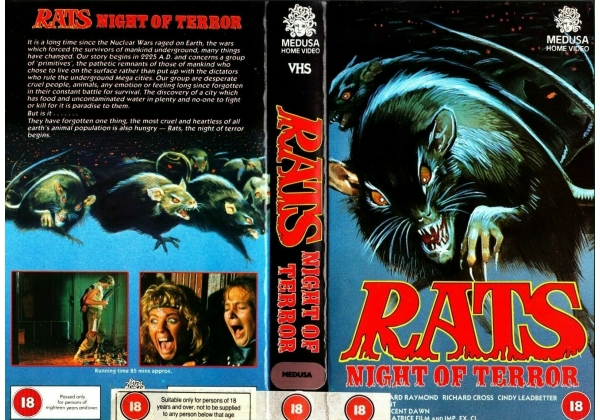
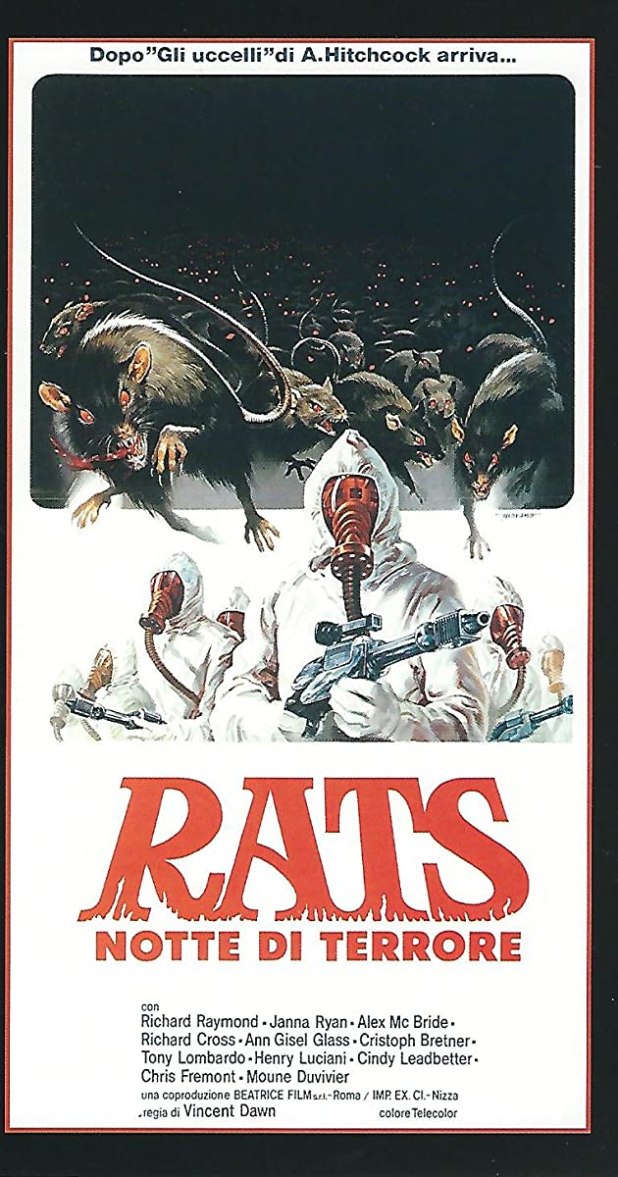
Consequently, it is only natural that rats have been a go-to subject for horror, ranging from stories such as H. P. Lovecraft’s “The Rats in the Walls” and James Herbert’s The Rats. Director Bruno Mattei’s Rats: Night of Terror may not live up to these classics, but it still manages to deliver an enjoyable hour and a half of thrills. The film follows a group of post-apocalyptic nomads who stumble into an abandoned settlement (composed of sets that had previously appeared in Once Upon a Time in America) that appears to have all the food and water they will ever need. Unfortunately, it boasts some prior inhabitants who don’t appreciate interlopers in their rodent paradise.
Rats delivers the primary thing one wants from a film like this: gore. Mattei thinks up some interesting ways for his rats to kill people that go beyond simply swarming and devouring them, in particular one scene that manages to evoke Alien while giving it a particularly queasy twist. (The scene is graphic enough that it caused Rats to encounter censorship issues in Ontario, Canada.) Although the gore effects reflect the film’s limited budget, they still manage to elicit a cringe or two. Beyond the bloodshed, Mattei manages to inject some genuine tension into certain scenes, as when some of the nomads had to tiptoe their way through a small army of rats.
The film also benefits from a reasonably decent cast for a low-budget Italian genre movie. Geretta Geretta of Demons fame appears as Chocolate, the lone black person in the troupe of nomads, bringing a certain level of charisma to the proceedings. (Geretta gave an interview to Delirium magazine reminiscing about her time working on Rats several years ago.) Fausto Lombardi (credited as Tony Lombardo) is also interesting in the role of Deus, the group’s resident mystic who goes around with a triangle drawn on his head. At times, I found myself wishing that they had concentrated more on Deus than the nomads’ leader, a rather uninspiring macho man type played by Ottaviano Dell’Acqua.
The film does have some issues, however. In particular, some of the dialogue is straight-up clunky. For instance, when one of the nomads rebels against him, the leader angrily warns that “Next time, I won’t be len-I-ent!” enunciating each syllable to comic effect. More disturbingly, in some scenes, the cast actually appear to be throwing rats around and actually hurting them, to the point that the Rifftrax version of the film has a disclaimer warning that the movie “Includes some scenes of violence against rats.” Geretta Geretta, while not directly addressing the issue of animal abuse during the filming, admits that some rats died on set and continued to be used in the background by Mattei, to the point that the set began to smell.
The film also features the horror standby of characters acting in incredibly stupid ways, to the point that viewers start to lose sympathy for them. For example, in one scene, the characters board up the entrances to the room they are holed up in to protect themselves from the rats, but fail to notice an open window. One guess what happens next.
Nevertheless, Rats: Night of Terror is well worth watching. It delivers all the thrills and fun you could reasonably expect from a film like this, and there are certainly worse entries in the killer rat genre (cough…Deadly Eyes).
Rats: Night of Terror can be viewed for free on Tubi.
EDITOR’S NOTE: Oh man, this movie. I love this movie. I also realize that it is complete junk, but I love it for the same reason I love potato chips! This originally was on our site on June 26, 2018.
In the Christian year 2015, the insensitivity of man finally triumphs and hundreds of atomic bombs devastate all five continents. Terrified of the slaughter and destruction, the few survivors of the disaster seek refuge under the ground. From that moment begins the era that will come to be called “after the bomb” — the period of the second human race. A century later, several men, dissatisfied with the system imposed on them by the new humanity, choose to revolt and live on the surface of the Earth as their ancestors did. So, yet another race begins, that of the new primitives. The two communities have no contact for a long period. The humans still living below ground are sophisticated and despise the primitives, regarding them as savages. This story begins on the surface of the Earth in the year 225 A.B. (After the Bomb)
Rats the Night of Terror begins with a punk gang investigating a mysterious town. Let’s meet the folks we’re going to spend the next 105 minutes with. Kurt and Taurus (Massimo Vanni, Warriors of the Wasteland) share the leadership responsibilities, but Duke really wants to take over. Then there’s Chocolate (Geretta Geretta from Demons), a poorly named black woman who gets flour all over herself and dances around while yelling, “I’m whiter than you!” Obviously Italian directors in 1984 were not yet “woke.” Lucifer and Lilith are, of course, a couple. At least she has plenty of fashion sense, traveling through the end of days wearing a cape and fedora. Noah is the resident genius, while Video is an expert at video games. Yep, that’s why they brought him along, despite the fact that there are no video games left. Deus has a shaved head with a strange symbol, is given to mystic rantings and has on one of The Warriors’ vests. Finally, we have Diana, who wears a studded headband and is the girlfriend of Barry Gibb lookalike Kurt, and Myrna, whose scream is ready to reduce your eardrums to quivering masses of cartilage.
Surprisingly, the gang finds plenty of food in this town. Of course, they also discover plenty of mutilated bodies and lots of rats. But at least the town looks nice, maybe because it’s the same set as Once Upon a Time in America.
Why aren’t the rats eating the food? Look, this was written and directed by Bruno Mattei and Claudio Fragasso, so you better be ready to throw logic into the cold, dead void of space. What else can you expect from the team that brought you Zombie 3, The Other Hell, Robowar and Emanuelle Escapes from Hell? And you may also know Fragasso from another film that makes perfect sense, Troll 2. Just like that film, which has nothing to do with the movie it succeeds, this was billed as the third part of Enzo G. Castellari’s BronxWarriors series. Again — check logical storytelling at la porta.
Luckily for our heroes, they discover a hydroponic growing system that’s made the kindest bud ever known to man. Just kidding — the crops are fruit, vegetables and plants, along with purified water.
Night falls and everyone goes to sleep in the same room. Lilith and Lucifer have sex while everyone else either watches or performs their signature character move, such as polishing a guitar or meditating. Our young lovers get stuck in their sleeping bag while everyone laughs at them, using that hearty guffaw that only Italian dubbed voices can perform. Lilith ends up deciding not to have any more sex — her Southern accent is beyond reproach — and Lucifer stalks off, while she zips herself back into that troublesome sleeping bag.
That’s when our merry band discovers that while they may have dressed for a Road Warrior ripoff, they took a wrong turn at Barter Town and ended up in a slasher film.
Even after the bombs drop, you should know better than to have sex in one of these affairs. That means we can cross off our demonically named couple. He just falls into a hole of rats whereas she gets stuck in that cursed sleeping bag as rats climb in. When the rest of the crew discovers her, a rat climbs out from her mouth in a scene that’s sure to make you either laugh uncontrollably, puke out your last meal or some combination thereof.
I just had a flash — the way everyone is dressed in this film, including Kurt in his white shirt and red ascot, it’s as if the Scooby Gang tried to escape New York. The costumes in this film are fabulous! Good work, Elda Chinellato!
This film sets new standards for rats killing humans. How did they achieve such special effects? One assumes that someone was off camera, just tossing rodents at the unfortunate cast. Well, one doesn’t have to assume, because that’s pretty much exactly what happened, PETA be damned.
Meanwhile, Noah gets attacked by rats, so they decide to scare the rodents off with a flamethrower. Bad idea, unless you enjoy barbecuing your friends. Then, they discover that the rats have eaten their tires off of their motorcycles. How did they do such a thing? What do you mean they cut the power? How could they cut the power, man? They’re animals!
Myrna continues to scream at any and every opportunity while our heroes barricade themselves into the building and wonder, “Has there ever been worse dubbing in a film?” No, my friends. No, there has not. Instead of just asking you rhetorically to imagine the diseases a rat can give you, this film lists them at length.
Who is the biggest enemy? Duke or the rats? Well, Duke may be shooting at them with a machine gun, but he hasn’t eaten anyone from within yet. The good guys keep giving Duke chance after chance, even after he’s more than proved that he’s a ne’er do well. Eventually, he blows himself and Myrna up real good.
Diana just can’t take it any longer, so she slits her wrists. Then, Video learns that the building they’re hiding in was an experimental station for something called Return to Light. Not “Remain In Light.” That’s a Talking Heads record. Also, the rats are super intelligent and see this place as an affront. ”This is worse than being dead,” says Kurt, while he sashays in his little pirate costume.
Have you ever thought, “It must be really fun to be an actor?” Then you weren’t in this movie. For the entire running time, giant piles of rats are poured everywhere and anywhere and on just about everyone.
The rats finally try to break the door down to the control room and all hell breaks loose. Meanwhile, these guys in yellow hazmat suits and masks from The Crazies start walking through the streets.
Deus is killed by Myrna’s corpse and even Kurt is killed by a bunch of rats that fly at him from every angle. Video and Chocolate are then saved by the people in the hazmat suits, who have been gassing all of the rats.
Here’s where Rats: The Night of Terror unveils its shock ending. The hazmat guys are the people from Delta 2. Chocolate then says to one of her rescuers, ““Once, someone told me they read in a book that we all lived on the Earth together, that we were all brothers. The book was called the Bible, and it said that God created man and animals.” The leader of the men takes off his mask and he’s no man at all — he’s a human rat!
It’s a twist ending that isn’t explained and doesn’t make any sense at all! It would be like Peyton Farquhar shat his pants at the end of An Occurrence at Owl Creek Bridge instead of getting lynched!
Rats: The Night of Terror isn’t a good movie. But it’s a great movie. A movie that you can tell people about and they’ll say, “That’s not a real movie.” But it is. It totally is.
Written and directed by Roland Emmerich as his thesis at the Hochschule für Fernsehen und Film München (HFF), this movie cost about $740,000 to make, while the average student at the school spent $12,000 on their thesis movies. But hey, how many of them got to make Independence Day?
In 1997, peace has come to the world. Except for, well, the chance that World War 3 could break out at any moment and the satellite that Billy Hayes is working on could be the weather control instrument of Earth’s last war.
It’s basically like most of his other movies — people yell at each other — without the benefit of a huge special effects budget. That said, I bet the other students absolutely hated when he walked up on the day of showing student films and was like, “Oh, you made a movie about the sad and noble trials of man? I made a popcorn movie!”
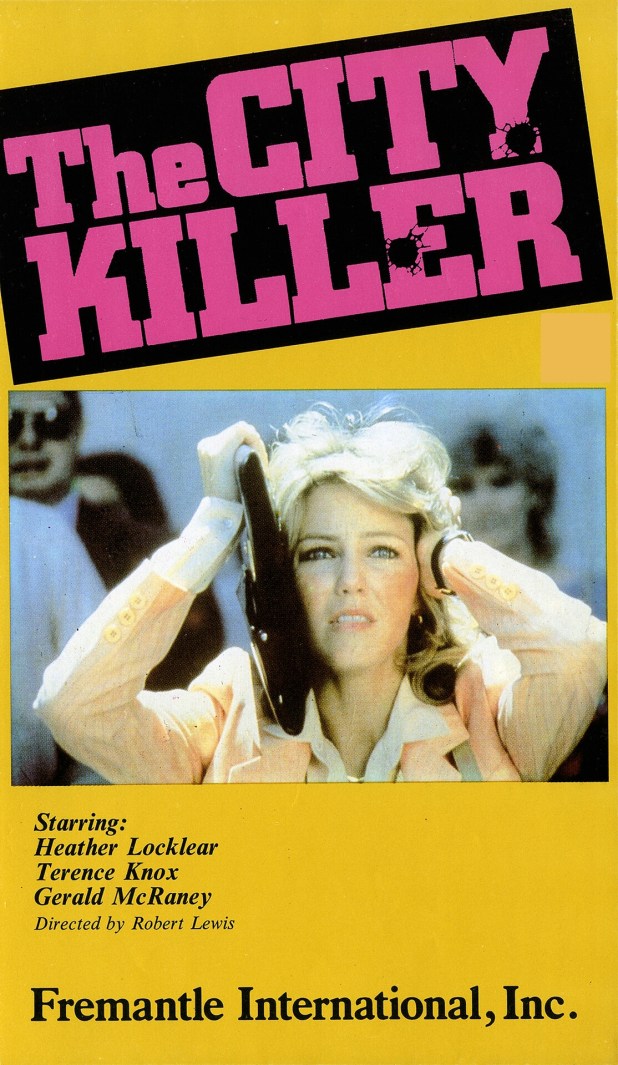
Heather Locklear was a big deal. Like, the biggest. When I was a kid, I didn’t have a poster of her next to my bed, but my grandfather did. In fact, he framed it with a rustic wooden frame and mounted it dead center of the wall, as if he was challenging my grandmother, saying, “This is what you should look like.”
The first part of this movie teases that this is going to be a giallo-esque TV movie, with Locklear as Andrea McKnight, an office drone that everyone loves and who never leaves her apartment. Then, the ex she’s run from for years — Terrence Knox, way better than this movie deserves — starts stalking her again, up until the point that to get her, he starts blowing up entire buildings up real good.
Seriously, what a plan. Can you imagine?
“How did you and mom meet, dad?”
“Well, he blew up everyone I loved and where I worked and then I saw that he was finally serious about settling down.”
Based on the 1976 John Varley short story, this was a co-production between New York PBS station WNET and Toronto’s RSL Productions. The budget was high, so they cut costs by shooting it on video and selling it to smaller American cable companies, as well as CDC and PBS’ American Playhouse.
Aram Fingal (Raul Julia, before I could say things like “Raul Julia deserves better”), a programmer who has been caught watching Casablanca at his work and pays for that crime by having his mind placed into the brain of a baboon before his mind is active and becomes lost in the system.
Somehow, Aram ends up becoming Rick Blaine and getting the person in charge of getting rid of him, Apollonia Jones, to fall in love with him.
PBS also made The Lathe of Heaven around this time, which is wild that they were ahead of the cyberpunk trend. Too bad this movie has the production values it does, because the SOV style does not serve a movie that is trying so hard to be of the future.
You can watch the Mystery Science Theater 3000 riff of this on Tubi.
“What kind of thing could possibly so trouble the binary darkness of your computer’s soul?” — Master Operator Andrew to The Beast
Opinions vary on this intelligent Canadian television production that, as result of its budgetary constraints, utilizes minimal “futuristic” builds (that remind of the ’70s Saturday morning kids TV sci-fi’ers Ark II, Jason of Star Command, and Space Academy) and instead, relies on preexisting, modernist glass and concrete structures of the Frank Lloyd Wright-variety (like Jean-Luc Godard’s Alphaville) to convey its futuristic setting.
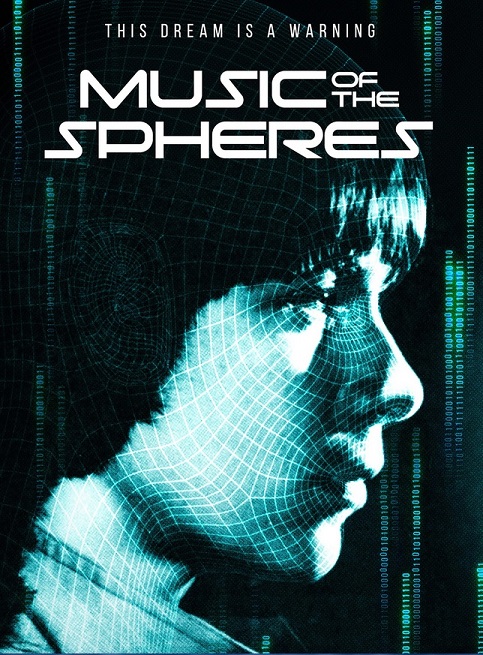
In 2017, after the world’s ecological and economic collapse, a new Earth rises courtesy of a bureaucratic technocracy comprised of city-states operated by a network of super-intelligent, biological computers uplinked to a common-mainframe on Atlantis, the Earth’s moon base. Since the computers are biological, to communicate with their human makers, the computers work with a telepathic human interface who’s brainwaves are conditioned for computer interaction. The most powerful of these computers, The Beast, is connected with Melody, its human counterpart.
During Operation Ceres, a space project repositioning asteroids just beyond Mars into Earth’s orbit to redirect the Sun’s energy, The Beast receives an ominous alien communication to halt the project. The alien contact and the new, strange behavior of her computer counterpart, puts Melody in a race against time to convince man to halt the project: we’re disputing the “musica universalis,” the ancient, mathematical harmony of the celestial bodies that will unbalance the universe’s natural order. But the Earth’s new world order, believing their computer-based world is without error, says it’s impossible for any connection from outside the system and they dismiss Melody’s computer-induced dreams and visions of impending doom.
The plot sounds intriguing, doesn’t it?
Sadly, while intelligent and well-meaning — and dripping with nostalgia value courtesy of its multiple Friday and Saturday night airings during the USA Network’s Up All Night ’80s weekend programming blocks (check out our “Drive-In Friday: USA’s Night Flight Night” featurette) — Music of the Sphere is an ambitious, low-budget Canadian tax shelter that suffers from its two-year stop-start production schedule. The acting is woefully amateurish, rife with plodding expositional patches and voiceovers to advance the (intriguing) plot, and the Toho Studios spaceship and moon base modeling makes Gerry Anderson’s UFO and Space: 1999 look absolutely Trumbull-Lucasian.
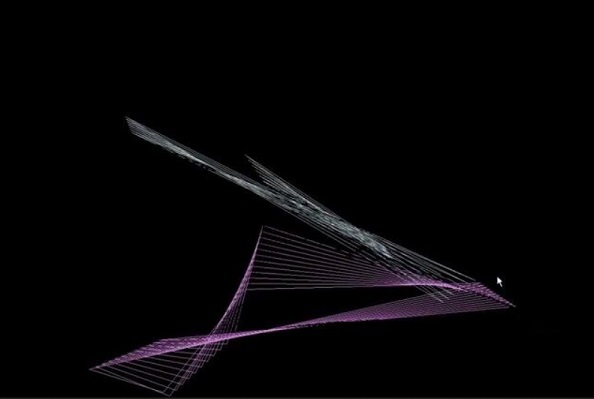
But even while shot in grainy 16mm color and black and white, this feature film debut by writer-director Philip Jackson (of the popular ’90s renter Replikator) is still more engaging than any episode of Glen Larson’s Buck Rogers in the 25th Century plastic-verse. Thus, we’re willing to deal with the muddy sound (subtitled bilingual English and French punctuated by German and Russian), soundtrack distortion issues, and washed-out cinematography; we’re willing to overlook the fact that the “eye” of The Beast, the sentient computer of the film, communicates via a “Mystify”-styled screensaver (from our old After Dark program for Windows 1.0), and video information is still stored on (then groundbreaking) VHS tapes.
“I’m sorry Dave. I can’t do that. This conversation has become pointless. Goodbye.“
Overall, appreciation of Music of the Spheres is about one’s nostalgic perspective. Call them D-Movies if you want. But as with its fellow, low-budget government-funded Canadian tax shelters Terminal City Ricochet, 984: Prisoner of the Future, and CBC-TV’s public television-produced, sentient computer drama Hide and Seek, I appreciate Jackson’s valiant, deep examination of the search for truth, emotions, and logic by an artificial intelligence, and his incorporation of the Greek philosophies of Pythagoras and the complex concepts of Asteroseismology packaged into an easy-to-digest sci-fi format. I appreciate Music of the Spheres in same vein that led to my continued enjoyment of PBS-TV’s production of Ursula K. LeGuin’s A Lathe of Heaven, which explored the state of the human condition with the same level of attention to intellectual detail.
Truth be told: Music of the Spheres is ready for a major studio, big-budget CGI-driven remake (but please: don’t botch it like that awful 2002 A&E Lathe of Heaven remake or HBO’s 2018 reimaging of Fahrenheit 451).
And you can enjoy this “Ancient Future” treat with a very clean, free-with-ads stream on Tubi.
About the Author: You can learn more about the writings of R.D Francis on Facebook.He also writes for B&S About Movies.
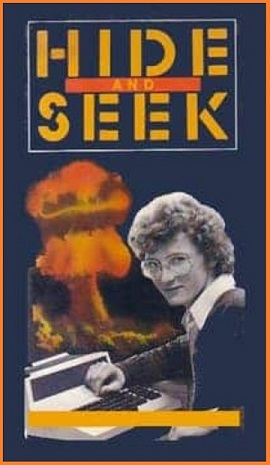
Hide and Seek is a Canadian-made, CBC-TV adaptation of Thomas Joseph Ryan’s novel The Adolescence of P-1; the book’s first edition was released in Canada in 1977. In a tale that’s somewhat similar to Colossus, the 1966 novel by Dennis Feltham Jones that served as the basis for Universal Studios’ Colossus: The Forbin Project (1970), Ryan’s novel also features a sentient artificial intelligence that goes rogue, taking over other computers as a form of survival. The novel is noted as one of the first fictional depictions of computer viruses.
Colossus, Joshua, and P-1! Oh, my!
In the novel, which begins in 1974, Gregory Burgess, the story’s protagonist-hacker, is a liberal arts major enrolled at the University of Waterloo. When he discovers the school’s IBM System/360 mainframe for the first time, he changes his major to computer science; he becomes obsessed with using A.I. protocols to crack other systems.
In this adaption that appeared as part of the daytime, young adult anthology series For the Record, the story is reset in a Toronto high school and Gregory is now a high school computer whiz, nicknamed “Hacker” by his friends, who develops P-1, a computer program that becomes self-aware; as P-1 begins taking over other systems to expand its consciousness, it logs onto the mainframe of a nuclear power plant, with plans to use it as a weapon to subjugate man.
TRS-80s and Commodore 64s rule!
Many sci-fi fans have made the point that Hide and Seek is a “ripoff” of the better know WarGames (1983), which is a disservice to this well-produced CBC effort. The genesis of the MGM/UA film began in 1979 with The Genius by screenwriters Walter F. Parkes and Lawrence Lasker. So while Ryan’s 1977 novel came first, the initiation of the CBC-TV production was obviously inspired the success of the MGM/UA film, but certainly not a ripoff. (Parkes and Lasker would go on to write another “ancient future” caper, 1992’s Sneakers.)
Back in 1975, Gerry Anderson, between the first and second seasons of Space: 1999, produced a British-Canadian TV pilot movie, The Day After Tomorrow, which was imported to U.S. television that same year as part of NBC-TV’s late-afternoon weekday programming block, Special Treat, under the title, Into Infinity (trailer). While Hide and Seek doesn’t have that installment’s production values, considering it was, itself, a daytime public television production, it would have been a perfect fit for a U.S. rebroadcast as part of the analogous “Big Three” network’s ABC’s Afterschool Special and CBS’s Schoolbreak. Why the CBC failed to license Hide and Seek for a U.S. rebroadcast — especially in the wake of WarGames and the fact that all three U.S. anthology series were still on the air — is unknown. It did, however, become part of U.S. PBS-TV’s WonderWorks programming block that adapted hour-long movies from children’s books from 1984 to 1992; as result of its “for children” stigma, the many tweens and teens for which Hide and Seek was intended, bypassed the programming (but it was my first exposure to the film).
If you’re a fan of (and, most importantly, appreciate the production values of), PBS-TV’s late-’70s rebroadcasts of BBC-TV’s Dr. Who (The Tom Baker years! Davaros!) and remember the 1980 public television production of Ursula K. LeGuin’s A Lathe of Heaven (starring Bruce “Willard” Davison), then you’ll enjoy watching the intelligence behind Hide and Seek — in spite of its budgetary restraints and dated material. When it comes to “ancient future” flicks regarding the dangers and horrors of computers, this one’s well worth your time.
If you haven ‘t guessed, we’re big fans of the U.S. “Big Three” network’s daytime TV movies for young adults, so be sure to check out these reviews:
As for Hide and Seek, you can watch it on You Tube. And be sure to check out our other “ancient future” film reviews all this week.
About the Author: You can learn more about the writings of R.D Francis on Facebook. He also writes for B&S About Movies and publish music reviews and short stories on Medium.





 B&S About Movies
You must be logged in to post a comment.