DAY 22. MURKIN: Something underwater or ocean related. It sure is dark down there, what was that?
If you are a regular visitor to our site, you may realize that we love shark movies. We have a whole Letterboxd list devoted to them. While Sam’s taste may veer toward the ripoff side of the Jaws equation, Becca’s heart is with the sequels, even Jaws: The Revenge.
After a career as a production designer — he built the awesome New York City model in Escape from New York — Joe Alves took his experience onJaws 2 to make this one. Earning the 1983 Golden Raspberry for Worst Director, he went back to production design for movies like Starman and Freejack.
But this wasn’t even the movie the producers wanted to make.
David Brown and Richard Zanuck, the producers for the first Jaws films, brought in Matty Simmons, who produced National Lampoon’s Animal House, and Lampoon writers John Hughes and Todd Carroll to write a script called Jaws 3, People 0. With Joe Dante directing, it would have started with author Peter Benchley being devoured in his swimming pool. The studio didn’t want to turn what was fast becoming a joke into a joke and demanded another legitimate film. Brown and Zanuck responded by quitting the studio.
Richard Matheson was brought on to write this script, which was filled with studio demands, including needing to have Brody’s sons in the movie and a part for Mickey Rooney. The studio heads had never checked to see if Rooney was available so that shoehorning was all for naught. As for anyone from the previous films, Roy Schnieder said, “Mephistopheles couldn’t talk me into doing it. They knew better than to even ask.” He specifically took the movie Blue Thunder so that he would be unavailable.
“The third dimension is terror.”
Yes, in 1983, 3D was back, thanks to movies like Comin’ At Ya!Any movie in its third iteration — I’m looking at you Friday the 13th Part 3 and Amityville 3-D — were made ala Dr. Tongue, with things coming directly at your face.
Back in the days before Blackfish, Seaworld was a big name. Somehow, the producers were able to talk the brand — specifically SeaWorld Orlando — into being the location for this movie. I remember as an 11-year-old seeing ads all over the Cleveland park for this movie and wondering, “Why are they advertising something that scares everyone inside a place that is supposed to be making us happy?”
Young Mike Brody has grown up to be Dennis Quaid, who told Watch What Happens Live that this movie had the biggest cocaine budget of any film that he worked on. He told Andy Cohen that he was on cocaine in every frame of the movie. He and Kathryn Morgan (Bess Armstrong) are in charge of the park, which has somehow allowed a great white shark to swim on in and kill people, including some dudes who are there to steal some coral.
Louis Gossett Jr. is also here as Calvin Bouchard, the park manager, who for some reason is best friends with a hunter played by Simon MacCorkindale, which feels counter-intuitive to running a park that is all about the love of animals. Then again, knowing what we know about SeaWorld today, it all makes sense.
There are also two dolphin stars, Cindy and Sandy, who were not on blow but have a bigger role than many of the humans, including Kelly Ann Bukowski (Lea Thompson) and Sean Brody (John Putch). You have to admire the stupidity of someone who wants to ride in bumper boats when the deadliest predator known to man is on the loose.
Somehow, the stupidity continues to the point where a second and much larger shark gets in the park, which seems like the kind of thing that should get everyone fired and the park closed. There’s only one way to deal with this kind of thing: we gotta blow another shark up real good*. Luckily, the 3-D effect is here to show us this in graphic — and below-average even in 1983 — detail. You know how some effects look bad years afterward and you attribute them to the fact that the movie has aged? This looked bad in the time it took from filming to playing in theaters.
Ironically, this movie has a lot in common with Halloween III: Season of the Witch. Both of their original films were big successes in the 70’s that made their directors big names. Those directors didn’t come back for the sequels (well, Carpenter did reshoot plenty) and both were directed by the production designers of the original movies. They also moved the location and tried to do something different. While the Silver Shamrock caper is today much more well-regarded, Jaws 3D is still a joke to many.
By the way, for all the scorn through at Bruno Mattei for outright ripping off shark footage for Cruel Jaws, this movie had to pay a lawsuit to National Geographic for taking scenes from its 1983 documentary film The Sharks without authorization. Strangely, that makes me love this movie even more.
*Some of the entrails that fly out of the screen in 3-D are actually a brown leather ET doll.
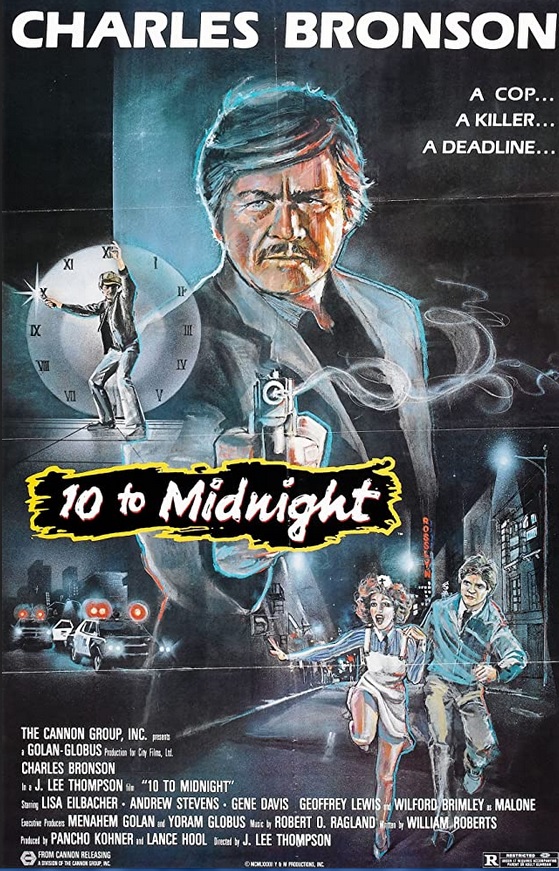
What if Charles Bronson made a film to compete in the John Carpenter Slasher ’80s — and no one came?
So goes this J. Lee Thompson effort for Menahem Golan’s Cannon Films.
Watch the Shout Factory! reissue trailer and the epic, “final scene” clip.
It all looked pretty good on paper: Bronson was a still popular, aging action star; Thompson’s resume included The Guns of Navarone (1961), Cape Fear (1962), and Mackenna’s Gold (1969). And let’s forget J. Lee’s two POTA flicks: Conquest of the Planet of the Apes (1972) and Battle for the Planet of the Apes (1973), and one of the slasher era’s most unconventional slashers, Happy Birthday to Me (1981). Behind the Brother typewriter was William Roberts, who gave us The MagnificentSeven (1960) and a really great war movie with The Bridge at Remagen (1969). He also gave us (soon to be reviewed for “Fast and Furious Week II”) The Last American Hero (1973), and a pretty fine TV movie with SST: Death Flight (1977).
So where did this self-described “crime-horror-thriller” go wrong?
When I went to see this during its initial theatrical run, I enjoyed it; the general consensus, however, was that it just an unnecessarily bloodier and more violent knock-off of Clint Eastwood’s “Dirty Harry” series of films embodied in Charles Bronson’s rough-hewn,”shoot first, ask questions later,” LAPD Detective Leo Kessler. (His aprehensive, wet-behind-the ears partner is Andrew Stevens of Massacre at Central High.)
Mainstream critics, such as Roger Ebert, pounced on the film’s “gratuitous” violence and nudity and its overabundance of vulgar language, profanity, and sexual situations. (Those moments of nudity and sexual scenes were cut out and re-edited with alternate, clean-clothed scene (underwear instead of full nudity) for television.)
It seems Cannon Pictures was shooting for a Italian Poliziotteschi (which were much violent and bloodier than any U.S. “Dirty Harry” flick) and Giallo (which were even more graphic than any U.S. John Carpenter-knockoff) hybrid-homage of the two genres that would have likely played well to Euro-audiences. And it did. In the U.S. it barely cleared its almost $5 million budget. So, while not exactly a flop, thanks to its international box office, it wasn’t exactly a hit, either.
It certainly seems that Bronson and Thompson’s efforts had an effect on Sly Stallone, as it’s easy to see a creative through line of 10 to Midnight‘s “detective vs. serial killer” plot to Sly’s Cobra (1986) to — even more so — D-Tox (2002). And it definitely had an effect on the production of the “mainstream” porn-slasher hybrid of Spine, a film that did its best — against its budget — to emulate John Carpenter’s Halloween (1978) and Brian De Palma’s Dressed to Kill (1980).
That comparison to Spine comes as result of that film’s Lawrence Aston and 10 to Midnight’s Warren Stacy both with an affinity for nurses — a trait shared by real-life serial killer Richard Speck and his July 1966 Chicago murders of eight student nurses. However, while Speck’s exploits served as the inspiration behind William Roberts’s script, John Howard and Justin Simonds have stated that the similarity to Speck’s crimes was mere coincidence and it was, in fact, Brian De Palma and John Carpenter who influenced their development of Spine.
The roots of 10 to Midnight began with Cannon’s (initial) failed attempt to adapt R. Lance Hill’s novel The Evil That Men Do (1978), an action tale about an ex-assassin that comes out of retirement to avenge the death of a friend. During a “brainstorming session” at that year’s Cannes Film Festival, with Cannon still wanting to do a film with Bronson, came up with new project — 10 to Midnight. To sell the film, Golan did what he did best: the ol’ Hollywood shuffle, selling a film filled with “action, danger, and revenge” — but no script. And the buyers bought it. Now, they need a script.
The script they found — based on the exploits of Richard Speck — was a William Roberts spec script, Bloody Sunday. And, as for the Evil that Men Do: that became one of the final film’s produced by ITC Entertainment, which went bankrupt after the dual failures of Raise the Titanic and Saturn 3.
In all, Bronson and Thompson made five films: St. Ives (1976), The White Buffalo (1977), Caboblanco (1980), 10 to Midnight (1983), and The Evil That Men Do (1984). And while it failed at the box office and with critics — Bronson’s lone foray into the horror-slasher genre is the lone Thompson-Bronson project everyone remembers and revers as a “classic” film in the Bronson canons.
You can purchase DVDs and Blus from Shout! Factory and stream it via Cinemax-Amazon Prime. There’s also a great, hour-long documentary about Bronson’s career, Charles Bronson: Hollywood’s Lone Wolf, on TubiTv.
Other films we reviewed — for this month’s “All Horror, All Slasher Month” for October — that are based on real life serial killers, include Black Circle Boys, River’s Edge, and Naked Fear (both on the way this month, search for ’em!). And we discussed the Cropsey urban legend that resulted in the more traditional slashers The Burning(1981) and Madman (1982).
DAY 7. THEY’RE OUT TO GET YOU: One with heavy paranoid (real or imagined).
I was going to do A Scanner Darkly for the Scarecrow Challenge today, but somehow, someway I found a movie that might be even more off the wall insane than a Phillip K. Dick adaption. Just imagine that.
This only came out in the UK and Spain, as far as I know, and went straight to video in the U.S. Somehow, in a world where it seems like every mom and pop horror movie section rental has been pulled off the shelf and transformed into a 4K clean print with a million extras and a collectible slip cover, this one somehow escaped.
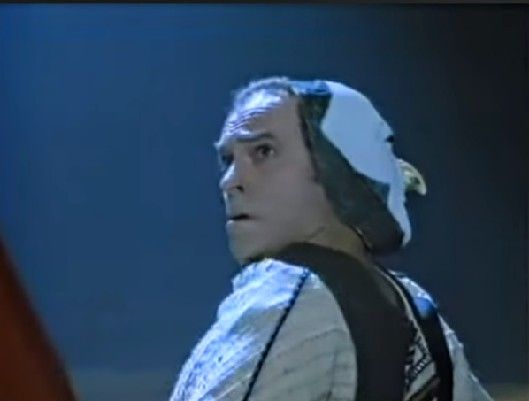
We begin with Rip Torn — yes, the Oscar and Emmy-nominated actor from The Larry Sanders Show and, of course, Freddy Got Fingered — screaming in Egyptian at a bug at the top of his lungs before transforming from a Nazi scientist who has somehow escaped war crimes before becoming the Egyptian god Khepera, the scarab-faced representation of the rising or morning sun. Sure, he represents creation and the renewal of life. But isn’t Lucifer also the light bringer?
Meanwhile, in a completely different movie, Murphy (Robert Gintry, The Exterminator) is getting decimated in a bar before he walks into an ambassador’s house and easily cucking him. Then he gets arrested.
Then, in the third movie of one movie, we watch a politican fencing with his graddaughter before one of his servants places a scarab on him and he ends up killing himself.
As if this barrage of stories doesn’t make you disoriented, we get back to Murphy, who watches another politican kill himself with a gun after anotehr scarab gets put on him and then a nun named Elena (Cristina S. Pascual, who played a night club singer hiding out with gay nuns in Pedro Almodóvar’s Dark Habits the very same year) runs away before revealing that she is the daughter of the Nazi scientist/Egyptian god.
Also, she has psychic powers.
This movie has it all. By all, I mean that it has two movies in one.
The first is all about Rip Torn dressed like a bird/bug human god who has long rituals of women dancing near-nude when he isn’t making love to women who transform into cows, at which point he spits milk into their faces. He also transforms outfits throughout the film, becoming the scuzzy direct to VHS version of Serpentor by the end of the proceedings.
The other movie is about Ginty strolling around, getting wasted, having sex with the wrong women and then using an axe to battle hooded bad guys.
At some point, the two movies come together and all them witches paint Rip Torn’s daughter’s bosom with weird squiggly black lines and make her up like Ming’s concubine took care of Dale Arden.
The tagline for this movie was “Evil, plotted by a mad sorcerer… bizarre beyond imagination.”
They’re more than half right.
This was written by Robert and Steve-Charles Jaffe (who also were behind Motel Hell; Robert also wrote Nightflyers and Demon Seed), with Steven-Charles directing*. Ned Miller and Jim Block, who were behind the Ashutosh Gowariker in America vehicle West Is West, were also on hand to presumably say things like, “Guys. Guys. Guys! This movie makes no sense.” Thank Khepera the brothers Jaffe had the good sense to tell them to shut the fuck up.
You know what I’m looking for in a movie? Half-nude dancers in Satanic rituals, screaming at bugs with microphones, Robert Ginty in anything and a movie that despite featuring human sacrifices throughout ends with the kind of music that you’d hear over the end of a failed McLean Stevenson sitcom and not bat at eye.
This is the kind of movie that I drive people nuts talking about. Trust me, you should be glad to be quarantined because if parties were still a thing, I’d sit next to you in a maniacal rage screaming “Ginty and Torn in the same film!”
There aren’t enough stars in every parallel reality to properly rate this batshit paen to…something. I’m just glad these crazy bastards had the gumption to go to Spain and convince people to give them money to make their politcial conspiracy of a scarab Nazi scientist god movie. Their balls are as huge Set’s testicles, which of course are healed at the same time as Horus’ eye after their comsic conflict.
It should be a cheap cash in on the novelty song that Frank Zappa had recorded with his daughter Moon Unit. Recorded when she was just 14 and appearing on his album Ship Arriving Too Late to Save a Drowning Witch, it’s his only top 40 hit despite a career in music.
It’s not typical Zappa, staying mainly in conventional 4/4 time (until the end) and being mainly all about the conversations Moon Unit had overheard at the mall, but meant to be a deliberate attack on typical Valley Girls.In fact, Zappa saw the San Fernando Valley as “a most depressing place.”
While he was distressed that this song would make hi a novelty act, Zappa did try to see if a film could be made. He’d later try to stop production of the film through a lawsuit, claiming that it infringed on his trademark.
Regardless, no one got the point of the song. It wasn’t cool to be a Valley Girl. Try telling that to everyone else.
Speaking of music, the songs in this movie ended up costing $250,000 over the film’s $350,000 budget. As a result, some of the clearances — like “Who Can It Be Now?” by Men at Work, which was replaced by Josie Cotton’s “Systematic Way” — changed the songs and ended up canceling the original Epic Records soundtrack. Some copies did get out and there’s also a bootleg with the title Valley Girls that are both collectors’ items. There was a six-song mini-LP that Roadshow Records — a one-off Atlantic imprint — put out and that was all fans got until 1994 and 1995, when Rhino released two CDs of the movie’s songs.
The songs are what drive this music, as it’s powered by KROQ, taking that station’s playlist to the entire county with standouts like Cotton’s “Johnny Are You Queer?,” Bonnie Hayes’ “Girls Like Me,” The Plimsouls’ “A Million Miles Away,” The Payolas’ “Eyes of a Stranger” and, of course, Modern English’s “I Melt With You,” which appears twice in the movie. Director Martha Coolidge heard it on the ROQ and felt that it was the song for her story, but since the station didn’t announce songs, she was forced to call them and sing it to have it be identified. Cotton, the Plimsouls and the Psychedelic Furs all show up in the actual movie, too.
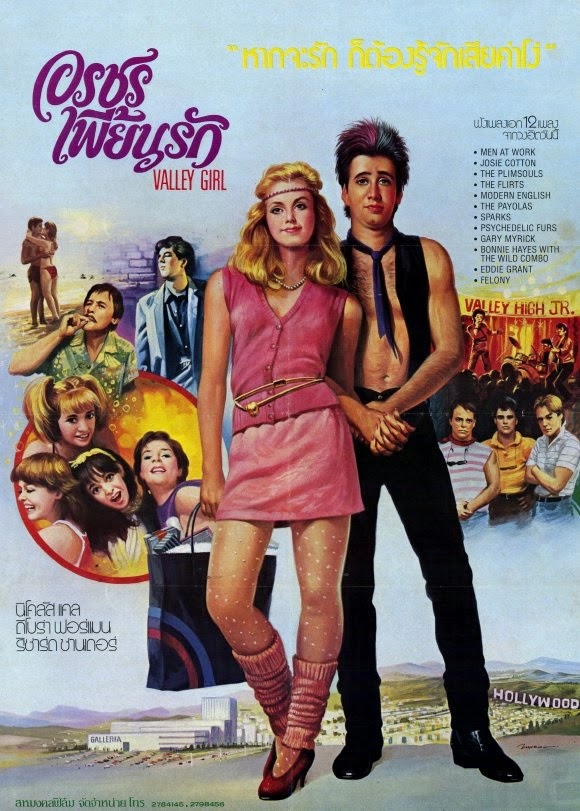
The actual story is a mix of Romeo and Juliet with an allusion to The Graduate at the end, as the Valley side — Sherman Oaks Galleria being their Mecca (and the home of Commando, Chopping Mall and many, many other films) — is represented by Julie (Deborah Foreman, whose credits endear her to horror fans everywhere with April Fool’s Day and Waxwork on her resume) and Hollywood being personified by Randy (California Kinski Nicolas Cage). Their relationship begins as just looks at a beach — hints of Grease, huh? — but progresses to show the difference between classes that has only grown since 1983.
There’s also a subplot between Suzi (Michelle Meyrink, the female nerd Judy in Revenge of the Nerds) and her stepmother Beth (Lee Purcell, Necromancy) vying for the same boy. A more conventional relationship exists between Julie and her parents (Coleen Camp, who has been in everything from the Police Academyseries to Wicked Stepmother, Sliver, Apocalypse Now and The Swinging Cheerleaders along with Frederic Forrest, who was also several Coppola films, including One from the Heart), who despite owning a health food business really want their daughter to experience life.
Joyce Hayser is also in this and she’s made quite the career of showing up in teh pop culture moments of my life. She’s the girl in the Dan Hartman video for “I Can Dream About You” (which comes from the soundtrack for Streets of Fire), she’s in the strange as hell Saturday Night Fever sequel Staying Alive and if you were 13 in 1985, you’d know her as Teri/Terry from the cable juggernaut Just One of the Guys.
Oh! Valley Girl has even more! E.G. Daily — who would also appear in the aforementioned Streets of Fire, a movie that I cannot implore you enough to watch — is here. Most folks know her as Dottie from Pee-Wee’s Big Adventure, but she was also in Better Off Dead, provided the voice for Babe the Pig and Tommy Pickles on Rugrats, was in the video for Rod Stewart’s “Young Turks” and was Sex-Head in Rob Zombie’s 31. She also dated Jon-Eric Hexum before his untimely death and was married to Rick Salomon. Yes, the same guy in the Paris Hilton sex tape, who was also married to Pam Anderson and Shannen Doherty. Hollywood is crazy.
The club scenes in this movie were shot at a place that was once called Filthy McNasty’s and The Central. Today, you would know it as The Viper Room. Seeing the Sunset Strip in this movie made me dream of one day being there, surrounded by all this energy and rock and roll. I mean, just look at the marquees — Kitten Natividad is dancing!
Allan Arkush based most of his early films on his real life. Rock ‘n Roll High School is pretty much about going to New Jersey’s Fort Lee High School. And this film is all about his experiences working at The Fillmore East as an usher, stage crew member and in the psychedelic light show Joe’s Lights, which got him on stage with everyone from The Who, Grateful Dead and Santana to the Allman Brothers and Fleetwood Mac.
I have no idea what experiences helped shape Heartbeeps, Caddyshack II and Deathsport, which he helped finish.
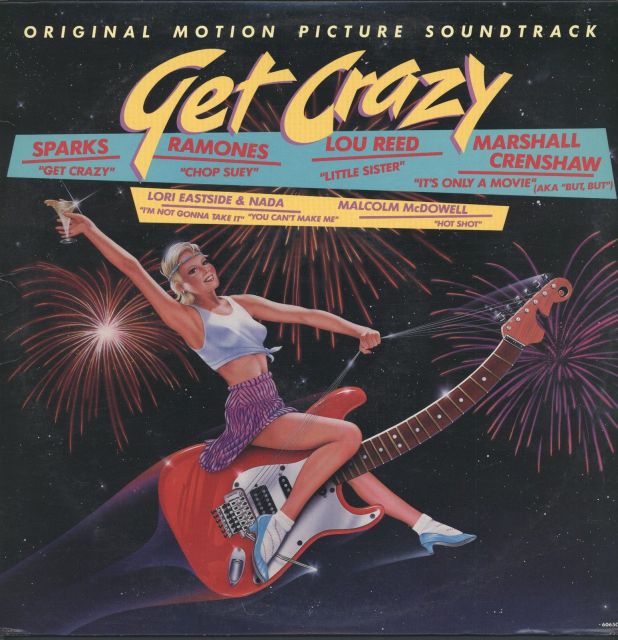
That said — Get Crazy lives in the exact heart of everything I love: hijinks movies, huge casts, rock and roll and cult films. It’s pretty much, well, everything.
This movie takes place on one night, December 31, 1982, as the Saturn Theater is getting ready for its annual New Year’s Eve blowout when its owner Max Wolfe (Allen Garfield, who sadly died of COVID-19 this past April) has a heart attack when arguing with concert promoter Colin Beverly (Ed Begley Jr.), leaving his stage manager Neil Allen (Daniel Stern) in charge, along with past stage manager Willy Loman (Gail Edwards). Man’s nephew Sammy (Mile Chapin) is trying to find his uncle so that he can get the rights to the club and sell them while everyone else tries to put on one last show.
This is a movie packed with familiar faces, like Bobby Sherman and Fabian as Beverly’s goons, who continually try to destroy the building and ruin the show. Seriously, there are so many people to get into, like Stacey Nelkin (Ellie Grimbridge!), Anne Bjorn (The Sword and the Sorcerer), Robert Picardo, Franklyn Ajaye, Dan Frischman (Arvid!), Denise Galik (Don’t Answer the Phone), Jackie Joseph (Mrs. Futterman!) and Linnea Quigley..
At this point, you may be saying, “Where are Clint Howard, Dick Miller, Paul Bartel and Mary Woronov?” They’re here. Of course they’re here.
I haven’t even gotten into the bands in this!
Nada (Lori Eastside from Kid Creole and the Coconuts) has a 15-member girl group that plays New Wave, garage rock, bubble gum and when Lee Ving jumps on stage, punk rock. Beyond Ving, Fear members Derf Scratch and Philo Cramer also appear.
King Blues is, well, the King of the Blues. He’s played by Bill Henderson (who was also Blind Lemon Yankovic and the cop in Clue, which also features Ving as Mr. Boddy).
Auden (Lou Reed!) is Bob Dylan, hiding from his fans, driving in a cab all night trying to write a song.
Reggie Wanker (Malcolm McDowell) is Mick Jagger, bedding groupies the whole show before he has a moment of mystic revelation. His drummer, Toad, is John Densmore of The Doors.
Captain Cloud (the Turtles’ Howard Kaylan) and the Rainbow Telegraph have a van just like Merry Pranksters and drugs just as powerful.
I mean, how can I not love a film that has a theme song by Sparks? Come on!
This was directed at the same time that Arkush did Bette Midler’s cover of “Beast of Burden,” complete with an appearance by Stacy Nelkin.
Anyways — forgive the fanboyishness nature of this. Actually. don’t. We should all love movies this much and feel this strongly about them.
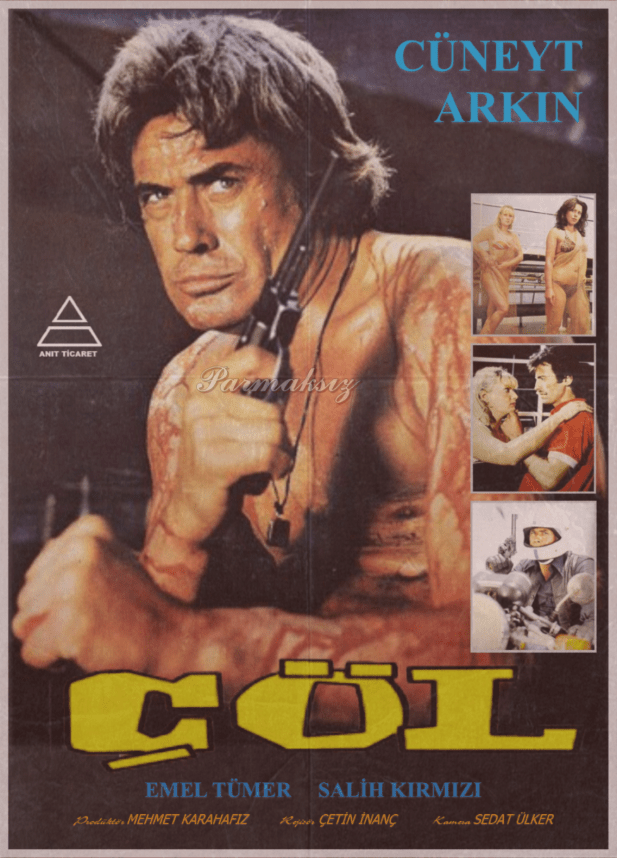
While this movie is known by many as the Turkish Jaws, it really has nothing to do with that movie other than a shark attack — and of course, the ripped off theme song — near the end of the movie.
If this movie is about the ocean, why is it called Desert? That’s because the title was supposed to be The Blue Desert, but the printer making the posters coudn’t understand how a desert could be blue, so he just cut the title to Çöl. The filmmakers couldn’t afford to print more, so that’s how we got here.
Çetin Inanc directs Cunyet Arkin again in this film that has him playing a supercop and Emel Tümer being as gorgeous as she always is. However, there is some betrayal in this one that makes this more a tragedy than most of Arkin’s films.
If you’re looking for ripped off music, good news. The theme from Psycho? It’s in here. Songs from Enter the Dragon? Yeah. How about a flute cover of Whole Lotta Love that plays over and over, only to be interrupted by just as many repeat plays of Eye of the Tiger? You know you want it.
I’ve never been let down by any movie that Arkin has been in. He’s like the film analogue of grain alcohol. It’s not fancy, but you’re guaranteed to get black out drunk.
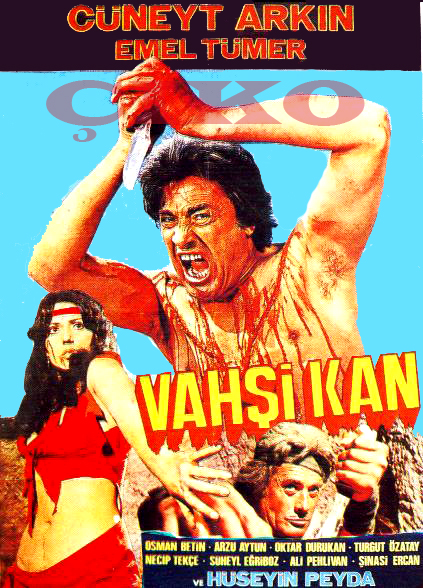
The team of Çetin Inanç and Cüneyt Arkin create movies that make my head hurt so badly in the best of ways. Wild Blood, known by some as Turkish Rambo, is a movie that will own you. Buckle up, get your motion sickness pills and leave your ideas of what makes a good or bad movie behind — we’re going to Turkey.
Arkin plays Riza, a man who gets harassed as soon as he gets to town. He kicks their asses so badly that the army has to get involved. They were sent by a deformed man who blames our hero, but other than that, nearly every single scene and much of the dialogue of this movie comes straight out of Stallone’s second and more populist take on John Rambo.
It also isn’t afraid to outright steal the soundtrack of that movie either.
Unlike Rambo’s films, this movie also begins with an army of zombies menacing Emel Tümer, pawing at her in a scene that feels like it came from another movie, which is pretty much a compliment in this world. Except they aren’t zombies, but you could totally be excused if you wondered if they were. She responds by stabbing the leader of the gang with a tree branch and running away.
This is followed by the gang attacking Riza and him basically jumping off a cliff and surviving because, well, he’s Cüneyt Arkin. He lives in a cave and rescues the girl, but the wheelchair bad guy and a gangster blow it up and she dies, so our hero decides to kill everyone and everything and everybody.
You know when you would see a movie as a kid and then draw your own versions of it? Imagine if the paper you were drawing it on was coated with LSD and you have an idea of just how jaw-droppingly audacious this movie gets.
Inanç liked Rambo: First Blood Part II so much that he made it twice, following this movie with 1986’s Korkusuz (Rampage), starring bodybuilder Serdar Kebapçılar.
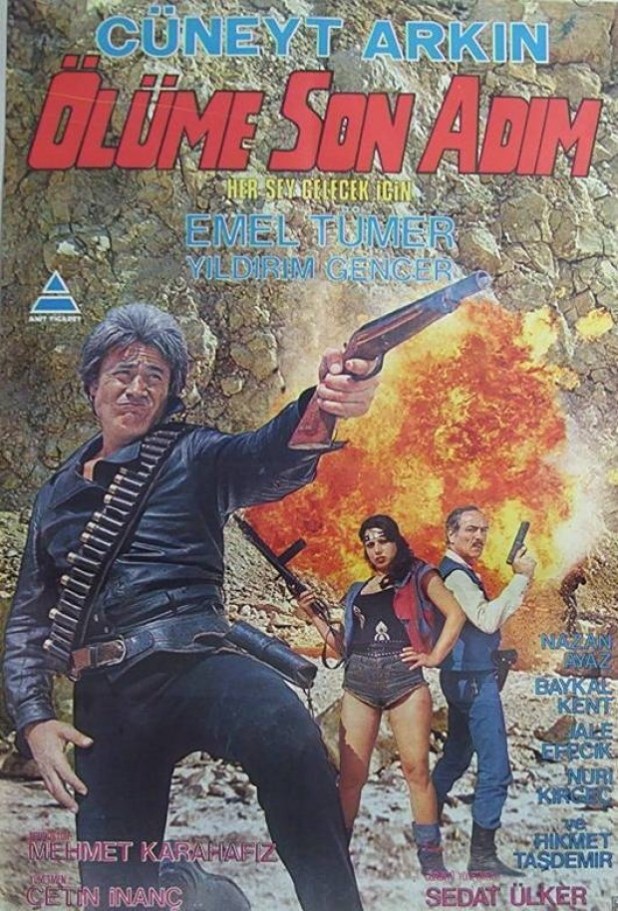
Whether you watch this under its true title or the translation Death’s Last Step or Last Step to Death or just prefer to call it Turkish Mad Max, I have to tell you, this is one of the greatest movies that I’ve ever seen. It somehow has everything I want in one movie — blood, brawls, black-haired thick thighed women kicking ass, stunts, stabbings and so much more. It’s as if the Turkish folks knew that someday I’d claim that Willy Milan’s W Is War and Mad Warrior rivaled even the most incredible Italian post-apocalyptic shenanigans and decided to raise the stakes. 1983, you were more than a good year. You were the best year.
Actually. the only thing making this like Mad Max is the leather jacket that Kaan (Cüneyt Arkin) wears. You may have seen Cüneyt in movies like Dünyayi Kurtaran Adam, which is referred to as The Man Who Saved the World and Turkish Star Wars. Then again, maybe you don’t sit around and watch ten Turkish movies a day for several days in a row like I do.
A doctor of medicine, Cüneyt does all of his own stunts and has never played a villain in his entire career. He’s been in a ton of films obviously, but the best title of his films that I could find was 1981’s Zombi 65: The Water That Killed Everyone. He was also in Çöl, which some call Turkish Jaws, and 1984’s Ölüm savasçisi (Death Warrior), another mind destroyer that is pretty much a Turkish Sho Kosugi movie.
Emel Tümer, who was also in Çöl and Vahsi Kan (Turkish First Blood) is also in this as Leyla and she’s spectacular, outdrinking an entire bar full of men, fighting nearly every single one of them and even driving a huge truck while someone stabs her. She shows up at the end of the movie in a suit and fedora that stopped my heart cold. Seriously, Emel, where have you been all of our lives?
This is the kind of movie where the main good guy force feeds a bag of heroin to a drug dealer while the bad guy’s underage bikini-wearing girlfriend watched in horror. A movie with more butt shots and upskirts than a John Stagliano movie.
Anyways, Kaan (or Kagan, no one can agree on the web), Leyla and Ali set out to rescue a professor who has discovered the cure to leukemia. That means that lots of people are going to get killed in spectacular ways, ways that look legitimately painful and shocking in the world of unions, CGI and people trying not to die on film.
This is the kind of movie that will ruin all other movies for you. It made my head hurt in the best of ways, because it’s just too astounding. It never lets you get bored, throwing literally hundreds of bad guys at our heroes, who shrug off all manner of damage as if they are the living embodiment of the Contra Code.
You can watch the whole thing right here on YouTube.
Imagine a film so plagued with legal and productions issues that even the pseudonymised Alan Smithee doesn’t want to take a credit—and it took almost 30 years before the film screened to a mass audience.
Such a film is Rock ‘N’ Roll Hotel . . . yes, we know the hotel’s sign uses an ampersand, while film title uses the contraction . . . that’s just one of this film’s many problems.
Image courtesy of Spectacle Theatre, New York
And those problems began in the fall of October 1982 in Richmond, Virginia, at the once opulent Jefferson Hotel, a location where French director Louis Malle previously completed his 1981 independent comedy-drama My Dinner with Andre (which Gene Siskel and Roger Ebert gave “two thumbs up”). By the time Hollywood came a-callin’ in Richmond for its next film, the hotel fell into urban decay and became the home of transients.
But no one ever got a chance to give a thumb—up or down (but probably a lot of middle fingers)—for Rock ‘N’ Roll Hotel. Well, they did . . . 27 years after the fact, in 2010. But more on that later. . . .
Executive Producers Howard and Francine Schuster, along with producers Peter Rodis and William Gilmore (who saw the film as a “tax-shelter” movie), and Stiff Records’ signee Rachel Sweet and her father/manager (who envisioned the film as her transition from music into film) rose about a $4 million for the project. None had produced a film prior—or since. And speaking of “taxes”: the reason Richmond was chosen over the also-scouted locations of Atlanta and Orlando was Virginia’s generous “tax incentive/tax break” program for film and television productions.
The film’s genesis was rooted in the 3-D craze sweeping cinemas in the early ‘80s with the likes of Amityville 3-D, Comin’ at Ya!, Jaws 3-D, and Friday the 13th 3-D,” and Treasure of the Four Crowns cleaning up at the box office. The Schusters, along with cinematographer and stereoscopic film expert John Rupkolvis, were behind the development of a new type of inexpensive 3-D filmmaking called Arrivision—and the Schusters wanted to make their own movie to showcase the new 3-D technology.
The director the Schusters chose for their “3-D rock ‘n’ roll teen horror musical”—a “director” who never directed a film before—was film composer and arranger Richard Baskin (Nashville, Welcome to L.A., Honeysuckle Rose), a Baskin-Robbins ice cream scion, Barbara Streisand’s then live-in boyfriend, and brother to Saturday Night Live writer Edie Baskin. Richard Baskin’s street cred as a songwriter and composer for films is what got him the job on this planned musical—actually a long-form MTV-style rock video. The set director, just starting out in the feature film business, was noted music video director Mary Lambert (the Go-Go’s, Madonna, Motley Crue, Janet Jackson), who became a film director in her own right (1989’s Stephen King’s Pet Cemetery). Also on the set as the film’s music consultant was Seth Justman, the longtime keyboardist and songwriter for the J.Geils Band.
Okay, so all of these people have skills. So far, so good. . . .
The script, described as “unfinished and unfocused” and “unyielding” over the years by those involved in the production, centered on the career of the Third Dimension, a young n’ sassy, new-wave rock trio fronted by Lisa, portrayed by Akron, Ohio, born and U.K.-transplanted singer Rachel Sweet, who issued European hit singles on the Stiff Records label (home to Elvis Costello and Nick Lowe). The faux band also featured Johnny, a leather-jacket clad guitar player portrayed by Judd Nelson in his feature film debut (two years away from his back-to-back breakthrough roles in The Breakfast Club and St. Elmo’s Fire), and Rick, a scarf-clad bassist portrayed by the big screen-debuting Matthew Penn, he the son of director Arthur Penn (Bonnie and Clyde, Alice’s Restaurant, Little Big Man). (These days, Matt is a prolific TV series director with over one hundred fifty credits.)
The cast was rounded out by older, fading actors brought in as fading classic ’50s rockers: comedian Dick Shawn (It’s a Mad, Mad World, The Producers), now ubiquitous character actor Joe Grifasi (Brewster’s Millions, Honky Tonk Freeway), and Broadway singer-actress Donna McKechnie (TV’s Dark Shadows), who replaced Stella Stevens (The Poseidon Adventure). Also starring was Bruce Springsteen’s E-Street Band saxophonist Clarence Clemons (himself a Chesapeake, Virginia native) as a motorcycle-riding disc jockey, along with MTV VJ Colin Quinn as a fast-pattering DJ.
Judd Nelson, Rachel Sweet, and Matthew Penn as the Third Dimension
The plot—such as it is—is your typical good vs. evil story centered around a rock ‘n’ roll battle of the bands contest held in the old, sinister “Rock ‘N’ Roll Hotel.” Sweet’s new wave-inspired Third Dimension are, of course, the good guys; the washed-up ’50s rock-crooning the Weevils, fronted by Shawn and backed by the cougaresque McKenchnie and the piano-playing Grifasi, are determined to win the contest at any cost.
As you’ll can see from the two trailers and promotional video we’ve linked-up below (at the end of the review): everything is way out there—and not making a whole lot of sense, as continuity and narrative are out the window.
It seems the sinister, evil classic ’50s rockers, the Weevils (escaping from Brian De Palma’s Phantom of the Paradise), have perfected the skills of hypnotism, have control of three white-clad tempting Fates to lure men to their sexual demise (always on the make for Nelson and Penn), and have access to a time machine—which comes in handy when you need an inebriated Beethoven and stoned Jimi Hendrix to show up for few laughs; Frankenstein lumbers around the halls amid zombies; there’s a dancing chorus of haunted pants; an old, snoring corspe takes a nap in front of a television; there’s a wheel-chair bound, rat-faced talent agent; Shawn’s Weevil King of Evil sashays around in wares typical of King Ludwig II of Bavaria; Joe Grifasi cops n’ mocs Elton John’s wardrobe and stage antics. There’s sad trombone “Wah-Wah-Wah” fanfare-styled humor that would give T.L.P Swicegood (The Undertaker and his Pals) pause. There’s a ten-minute, song-and-dance car crusin’ number with Nelson and Penn shredding guitars as Sweet sings. There’s homages to Devo paired with Shawn crooning ’50s rockabilly tunes. Oh, and everyone is shoving things into the camera to play up the the “3-D” effects.
So, yes . . . the mise-en-scène kinetics of The Rocky Horror Picture Show is definitely a touchstone in the rock ‘n’ roll tomfoolery, as Rock ‘N’ Roll Hotel wears its hopes as another Rock ‘n’ Roll High School on its sleeves. The more discerning rock flick connoisseurs will reference Allan Arkush’s Get Crazy (1983; his gonzo tribute to the closing of the Lower East Side New York rock club, the Fillmore East), Menahem Golan’s crazed, futurist rock tale, The Apple (1980), and the Weinstein’s Miramax debut release, the obscure Playing for Keeps (1983; which also deals with the shenanigans at a “rock ‘n’ roll” hotel). Then there’s the VHS aficionados who will go deeper with It’s a Complex World (1991), a nutty tribute (Elvis and Captain Lou Albano show up) to Providence, Rhode Island’s late rock club, Lupo’s Heartbreak Hotel.
No way this is going to work. . . .
Almost immediately, Baskin, it’s been said, found himself in way over his head—and all hell broke loose over the script, shooting schedule, and budgets one week into shooting. And the production shut down for a week. Then Seth Justman—who was also new to feature film directing—took the director’s chair based on his heavily-rotated MTV videos for J.Geils’ “Love Stinks” and “Centerfold,” along with “Shake it Up” by the Cars. Of course, by this point, the screenplay, written by Russ Dvonch of Rock ‘n’ Roll High School fame (and worked in various capacities on Roger Corman’s Deathsport and Avalanche), was rewritten by an unknown writer-friend of Justman’s, Janice Shaprio (with no other credits to her name since).
Needless to say, the new director and script doctoring didn’t help.
The film disintegrated in a flurry of lawsuits, speculations and accusations. There were claims the original negatives were lost or stolen, lost in a lab accident, or it was because the film lab processing the negative went bankrupt. The ensuing lawsuits quickly bankrupted the Schusters—and they fled to Australia. Other rumors claim the film was cut up by Bob and Harvey Weinstein and spliced into Playing for Keeps (1986), their debut feature for Miramax Studios—which was another Matthew Penn-starring film (thus assuring some sense of continuity) that also served as the leading lady debut of Marisa Tomei. (The practice of cutting a failed, unfinished film into another also occurred with the Runaways feature film, We’re All Crazy Now, which ended up in the film duBeat-e-o.) And why was that assumed? Because the Weinstein’s film also centered on a trio of New York high schoolers who decide to turn an old, grand mansion into a “Rock n’ Roll Hotel” (a claim which has been reportedly disproven, at least according to the materials-research I’ve read).
In truth: The Sweet and Nelson-starring film finally appeared in a March 1983 issue of Variety—released under the auspices of another set of filmmaking relations: Menahem Golan (who just directed an equally wacked out rock flick, The Apple) and his cousin, Yoram Globus, for their Cannon Pictures. The press release stated they were set to debut the film at the Movie Lab on Santa Monica Boulevard in Los Angeles on March 9 and 10 at 3 p.m; and that it would have a New York showing at the Waverley Theater on Sixth Street during the weekend of March 11 and 12.
Variety ’83 ad courtesy of Cinedelphia Film Festival
But alas, the showing weren’t a serious attempt to distribute the film, but simply to fulfill the terms of the project’s “tax shelter” agreement to investors that that film must appear in a major city over the course of a weekend (see Tom Sizemore’s Zyzzyx Road and Christian Slater’s Playback for examples; Roger Corman’s abortive 1994 version of The Fantastic Four also applies). At that point, Rachel Sweet and her father shanghaied the film and claimed they “finished it,” shooting new footage and shifting more of the film’s focus on Rachel—and that the film aired on HBO in the mid-eighties (a claim which the programmers of HBO deny).
Then, in February 2010, Craig Hodgetts, one of the set designers on the film working under Mary Lambert, discovered a raw VHS tape labeled “‘Rock and Roll Hotel,’ 83 min., 1986,” in a box of production sketches and photo stills from the film in the archives room of his architectural firm in Culver City, California. And that copy does, in fact, carry a “Richard Sweet Productions” title card. So, it seems, the Sweet’s claims that they finished the film and that it aired on HBO are true. And this is the version that has no director credit—not even Alan Smithee.
So what happened to the original 35mm “3-D Wondervision” version showing off all that great 3-D camera work? What happened to the print shown in Los Angeles and New York in 1983? Where’s the 1986 version?
Today, all that exists is the digitized, low-tech 2-D direct-from-VHS copy that occasional plays around the Richmond area in an art house-drafthouse environment and the occasional U.S film festival—the one found in a box in Hodgetts’s closet.
TRAILERS ‘n’ CLIPS: Yes, we have ’em! But you know those ‘ol HTML bugs and video sharing sites. Code breaks and “unofficial” uploads by fans — and not reissue shingles — are sometimes deleted. So, you can link-out to watch this trailer and promotional video on You Tube and another trailer on Vimeo.
MANY THANKS: To Dale Brumfield of Style Weekly Magazine, Cinedelphia Film Festival (as of 2021, the site is currently dead/festival no longer exists), and James River Film Journal for their efforts in preserving the memory of this truly lost rock ‘n’ roll film that assisted in preparing this review for our first “Rock ‘n’ Roll Week” at B&S About Movies.
MORE THANKS, 2022: Just when you think your review-writing was for naught, only to be lost somewhere, forgotten on a file server . . . someone discovers it, shares it on social media, and the subsequent readers reach out to express their enjoyment of the piece. So, thanks to those half-dozen or so that FB’d me (including two who worked on the film!) with their gratitude. Yeah, it is fun to reminisce with these films and chat them up with the fans and the crew. Your vibes keep me bangin’ at the keys! Turns out it is not as fruitless as it sometimes feels (my “Exploring 50 Grunge Films” piece received the same, positive social media responses).
MORE MOVIE LINKS: Oh, and since Rock ‘N’ Roll Hotel qualifies as a Box Office Failure—hey, everyone gave it their best, for sure—be sure to check out out recent, week long February tribute week to “Box Office Failures.” Do you need more faux rock band flicks? Sure you do! Then check out our “Ten Bands Made Up for Movies (and a whole lot more)” featurette.
About the Author: You can learn more about the writings of R.D Francis on Facebook.He also writes forB&S About Movies.
You’re Penelope Spheeris and you amazed the disenfranchised punk and metal hoards with your debut feature film: 1981’s epic punkumentary The Decline of Western Civilization. (Yes, we did DoWC II and DoWC III). Yeah, we know her most popular film—and the highest-grossing film of her career—is the rock-centric (and very cool) Wayne’s World. But that’s for the mainstream Queen and Alice Cooper fans. (Okay, so for two Halloweens I dressed up as Wayne: once recruiting my blonde sister, then my blonde girlfriend, as Garth.)
For guys like me and Sam (he bullied for wearing a Samhain t-shirt to school; me, The Clash), this dark tale of two Los Angeles brothers escaping their alcoholic mother and a runaway escaping her pedophile father that come find solace in the surrogate family formed by a band of punk-rock squatters, who end up battling the local rednecks for supremacy of an abandoned housing tract, is Penelope’s best known film.
. . . And if wishes were horses, beggars would ride, so says the Scottish proverb. And if VHS-repeat viewings (today, it’s DVDs and online streams) were dollars, Suburbia would be Penelope Spheeris’s highest-grossing film—so goes the B&S About Movies analog edict. That’s right, Wayne. Don’t let the door on Stan Mikita’s Donuts hit you in the arse on the way out . . . and party on.
The original Vestron Video VHS with New World Pictures’ dopey post-apoc artwork.
The formula that makes Suburbia work is the same formula that makes Jonathan Kaplan’s juvenile delinquency rock fest Over the Edge (1979) work: Instead of casting the ubiquitous 30-year-actors as “teenagers” that is typical of a major studio, teen-centric flick (outside of two newbie-trained actors, OTE’s teen cast were first timers), Spheeris not only cast real teenagers, she cast the film with non-professional street kids and punk rock musicians to play all of the roles. One of those punks (the pet rat-loving and stray doberman-training Razzle) was Flea, who would later star in Spheeris’s punk-inspired western, Dudes (1987); he soon surpass the musical careers of D.I, T.S.O.L, the Vandals (all who perform and act in the film) as the bassist of the Red Hot Chilli Peppers. (D.I performs “Richard Hung Himself,” T.S.O.L “Wash Away” and “Darker My Love,” and The Vandals “The Legend of Pat Brown.” The Vandals would also appear in Dudes to perform “Urban Struggle.”)
It’s that neophyte casting that feeds the cinéma vérité narrative style of Suburbia and lends to natural actions and authentic dialog that, while scripted and staged, ranks Suburbia alongside Adam Small’s punkumentary Another State of Mind (1984) as one of the greatest punk films—and teenagers-in-revolt (i.e., juvenile delinquency flicks)—ever made. Yeah, we watched Francis Ford Coppola’s adaptations of S.E Hinton’s beloved early ’70s young adult novels The Outsiders and Rumblefish—both released the same year as Suburbia—but while competently crafted and acted, neither rings with the true sounds of celluloid liberty.
Courtesy of Shout Factory reissuing Suburbia as part of their Roger Corman Cult Classics DVD series in 2010, you can’t not find a copy. In fact, two of my local county library branches carry it. That’s more than I can say for the old Vestron Video VHS: I was a member of six video stores (three mom n’ pops, three chains) and only two carried it. And the two stores that did, thanks to New World Pictures’ dopey post-apoc artwork, they filed it in the sci-fi section—right next to copies of duBeat-e-o. Thankfully, the subsequent DVD and soundtrack CD reissues retained the original artwork of the theatrical one-sheet and Engima Records’ soundtrack LP (images via IMDb/Discogs).
You can stream that Shout Factory version for free on TubiTV, which also carries Spheeris’s follow ups to Suburbia: 1985’s The Boys Next Door (Tubi), itself a juvenile delinquency classic (that also ranks alongside 1979’s Over the Edge), and 1987’s Dudes (Tubi) . But if you’d rather ditch the ads, there’s a rip of Suburbia on You Tube. You can also listen to the soundtrack in its entirety on You Tube as you read the liner notes over on Discogs.
Music trivia flotsam and jetsam: Alex Gibson led L.A.’s BPeople for several years in the late ‘70s; the quartet started out as the Little Cripples (never recorded) with bassist Paul B. Cutler. When BPeople (a somber Joy Division-styled quartet with synths and saxophone) disbanded as result of lead singer Michael Gira relocating to New York to form the Swans (doing shows alongside Sonic Youth (Desolation Center), Gibson embarked on a solo career; Paul B. Cutler formed 45 Grave with Don Bolles of the Germs.
We all came to know 45 Grave with their death-punk classic “Party Time” from their debut album Sleep in Safety (1983; Enigma) via its inclusion on another punk flick classic, Return of the Living Dead. And we know the Germs courtesy of their appearance in The Decline of Western Civilization, which featured songs from their Joan Jett-produced debut, GI (1979; Slash).
The Vandals and D.I (an outgrowth of the Adolescents) each continued recording into the mid-2000. As The Vandals contributed songs to several more soundtracks (Glory Daze), drummer-bassist Joe Escalante made his leading man debut in the direct-to-video punk flick, That Darn Punk (1996).
T.S.O.L, through a plethora of roster upheavals and style changes (hard core, metal, and back again), continue to record. They also performed “Hit and Run” in another L.A. punk flick, The Runnin’ Kind (1989), as well as provide songs to The Return of the Living Dead and Dangerously Close. They also provided “Flowers by the Door” and “Hear Me Cry” to Hear Me Cry, an ’80s installment of the CBS Schoolbreak Special (yeah, we found it on You Tube).
Gibson parlayed his scoring work on Suburbia into a career as a music editor, most notably for the resume of Christopher Nolan, which culminated with his winning an Academy Award in 2018 for sound editing on the film for Nolan’s Dunkirk.
And good ol’ Roger Corman, never one never one to waste a set, costume, or frame of footage (Battle Beyond the Stars into Galaxy of Terror into Space Raiders; Eat My Dust recycled into Grand Theft Auto), used the concert sequences from Suburbia in White Star (1983), a Dennis Hopper-starring German rock flick that New World repurposed for the U.S. VHS market under the lame title, Let it Rock.
Update, May 2023: Our thanks to the gang at Film Scene for pull-quoting our review as part of their promotional materials for their May 10th showing of Suburbia as part of their Late Shift at the Grindhouse Film Series. It happens every Wednesday at Film Scene at the Chauncey in Downtown Iowa City.
About the Author: You can learn more about the writings of R.D Francis on Facebook. He also writes for B&S About Movies.






 B&S About Movies
You must be logged in to post a comment.