Middletown, U.S.A. is the biggest show on TV. Sure, it’s controversial, but the ratings are through the roof. The only problem is that every time a major villain gets any traction, they end up dying for real.
Last year, we interviewed Amanda Reyes from Made for TV Mayhem. She recommended this film and it’s been on our list for awhile. Trying to get in sixty slashers that aren’t all that well-known for October gave us the perfect opportunity to watch it. If you’d like to read Amanda’s take on the movie, check out her site.
Director William Wiard was also behind This House Possessed, a fine example of made for TV horror. Here, he’s working from a script by David Levinson, who also worked on that film.
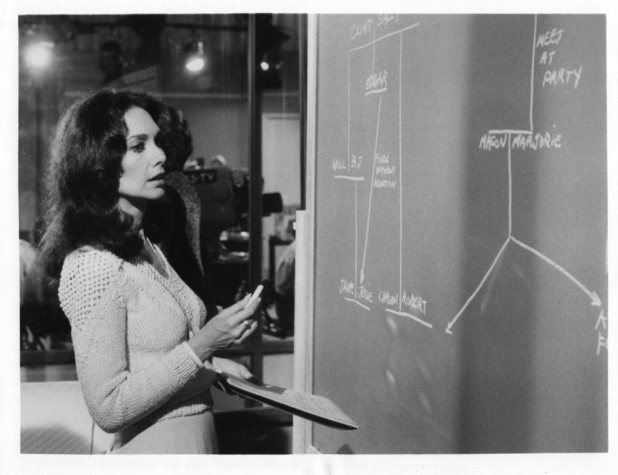
Suzanne Pleshette plays Carla Webber, who after being left by her husband decided that she’d become an independent woman. After watching daytime soaps, she soon learned that she was pretty good at writing for them, which leads to her running the biggest soap around. Barry Newman from Vanishing Point shows up as her love interest, plus Robert Vaughn is the slimy network president.
While this film doesn’t have much gore, it doesn’t skimp on the murders. It’s close to giallo territory with a humming killer only seen from their own POV, as well as a duplicitous identity and mental disorders at the end.
It’s not perfect, but Pleshette is. It’s fun to see her fully embracing a leading role after so many only knew her as Newhart’s wife. I know that Lifetime exists now to create movies similar to this, but there’s just something missing in a world that no longer has made for TV movies quite like this. Sure, TV is going through a golden age now, but give me the 1970s and 1980s past.
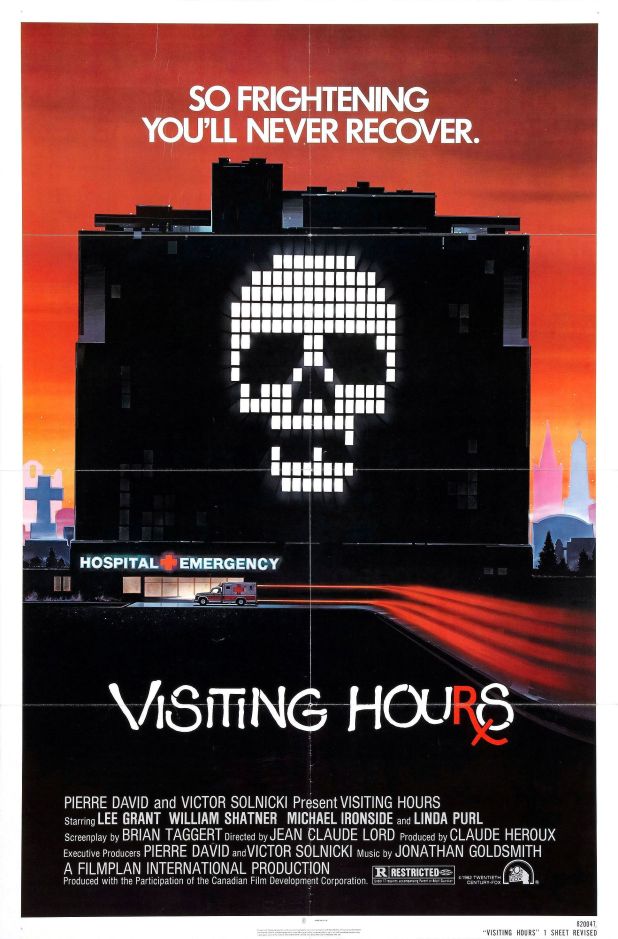
Oh Visiting Hours — I’ve stared at your box art so many times and never watched you, despite you being on rental shelves and in my collection for years. I’ve been meaning to watch it for awhile, but every time I grab the case of the Shout! Factory DVD, I just end up watching Bad Dreams, which is one of my favorite films despite just how much it rips off of the Elm Street films.
Oh Canada — your tax laws are just as responsible for slashers as much as sex and drinking in the woods!
Also known as Get Well Soon and The Fright, this movie tells the tale of Deborah Ballin, a feminist journalist and activist, who is played by Lee Grant (The Swarm, Valley of the Dolls). She gets under the skin of misogynistic serial killer Colt Hawker (Michael Ironside!), who has a name like a gay porn star. He attacks her, but she survives and is placed in the generically named County General Hospital.
As Deborah befriends a nurse named Sheila, Colt starts killing old people and other nurses. He also starts dating a girl named Lisa (Lenore Zann, who is also in Happy Birthday to Me) only to assault and torture her.
Our heroine is convinced that Colt is stalker her, but everyone — including her boss, played by Canada’s greatest export William Shatner — thinks she’s gone crazy.
Speaking of crazy, we learn that Colt got that way because his father was disfigured by his mother. That’s how these things happen, one assumes. He’s also nuts enough to take out everyone connected to our protagonist and then stab himself with a beer bottle so he can go to the same hospital as her.
Despite featuring little to no outright gore, Visiting Hours made the video nasty category 2 list, causing issues in the UK throughout the 80’s. Ironside really has a focused and evil performance, but I don’t know why this would make that list. Maybe I’m jaded.
Visiting Hours doesn’t live up to its poster art. Even by ripping off the theme to Halloween and aping Halloween 2‘s hospital setting, it can’t live up to other slash classics. Watch it for Ironside and Shatner, or just because you love Canadian tax shelter laws.
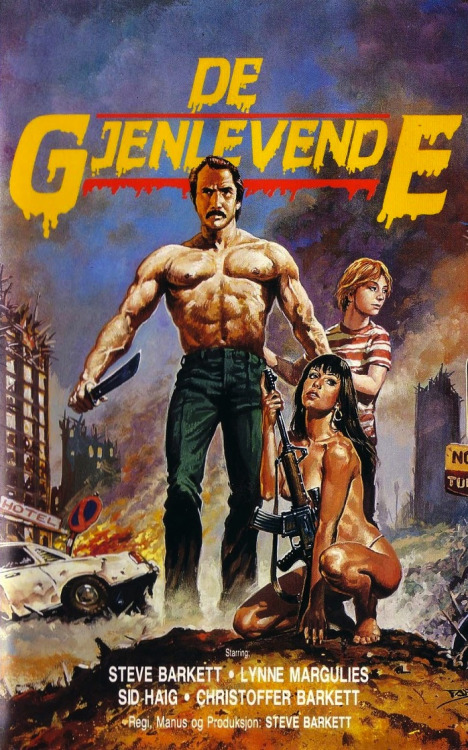
Writer/producer/director/lead actor Steve Barkett only would create one other movie — 1990’s Empire of the Dark, in which a private detective battles a Satanic cult, monsters and ninjas — but he lent his auteur spirit to this post-apocalyptic bit of strangeness.
Barkett was such an artist that while he originally filmed this in 1978, he wasn’t happy and re-shot most of the footage with different actors.
Just like Def Con 4 — or more to the point Planet of the Apes, as the film was shot in many of the same locations — Newman (Barkett) watches the world end from space and comes back to try and survive in the end times. Of course, he does that by undergoing a montage where he tidies up a mansion, so you’ll have that. Incidentally, that mansion belonged to Ted V. Mikels. It was literally the castle that he referred to when he kept a harem of women he called his “Castle Girls.”
Newman looks like every stepfather in the late 70’s and early 80’s, the kind of guy that takes you fishing even though you don’t really want to go and says stuff like, “I really care about your mother” and “You don’t have to call me dad, unless you want to” while at nights you ball your fists up and sob hot, wet tears while he and your beloved mother act out the next ten pages in Dr. Alex Comfort’s The Joy of Sex.
Yeah, Newman is no Snake Plissken. Or Max Rocktansky. Or even Paco Queruak. He is our bastard step-fathers of old.
Stop motion animator Jim Danforth plays a fellow astronaut and Forrest J. Ackerman — wearing the prop rings from Universal’s The Mummy and Dracula — shows up as a museum curator dying from radiation (he even plays Newman a tape with Dick Miller’s voice on it). And Sarah is played by Lynn Margulies. You may recognize her for her romantic involvement with comedian Andy Kaufman. However, the real star of the show is Sid Haig, who plays Cutter, the leader of a gang of cannibalistic mutants who kill all the men and children, only keeping the wives. All of the meanness and brutality of this whole sordid mess can directly be traced back to Cutter. For some reason, our hero is so stupid that he allows Cutter to escape — so Cutter can come back and kill everyone to get back at Newman.
Oh, and there’s also a laser gun that gets made in this movie and we’re just supposed to say, “Yeah, lasers exist.”
If you read our Section 3 video nasties article, you already know that this film was seized and confiscated, but not prosecuted for obscenity. And did former fill-in Duke boy Chip Mayer remake all this — with Richard Moll in the Sid Haig role — as Survivor in 1987? Yeah, pretty much. And if this all wasn’t weird enough: Aftermath was co-written by Stanley Livingston — Chip Douglas from My Three Sons — who also played Jeff in Paul Bartel’s astounding Private Parts, Russ in Smokey and the Hotwire Gang, and, somehow, ended up as a sidekick to Dolph Lundgren in Masters of the Universe, so as to diddle with the “cosmic key.”
The single most difficult hurtle in bringing speculative fiction portrayals of future societies to the big screen is financial: without the backing of a major studio, it’s difficult to create a new world off the racks, whether its clothing, technology, vehicles, or architecture. So while major and mid-level studios can dazzle filmgoers with a future built from scratch in films such Blade Runner (1982) and Escape from New York (1981), the little guy has to make do with what’s available and compromises with a simplified version of the future that pretty much resembles our present—with a few splashes of “futuristic” accoutrements. Jean-Luc Godard’s neo-noir Alphaville, Elio Petri’s pop-art romp The 10th Victim (both 1965), Francois Truffaut’s Fahrenheit 451 (1967), and the American PBS-TV adaptation of Ursula K. LeGuin’s A Lathe of Heaven (1980) are each fine examples of this celluloid ingenuity. Another is Claude Chabrol’s futuristic updating of Germany’s famed “Dr. Mabuse” in Docteur M (1990).
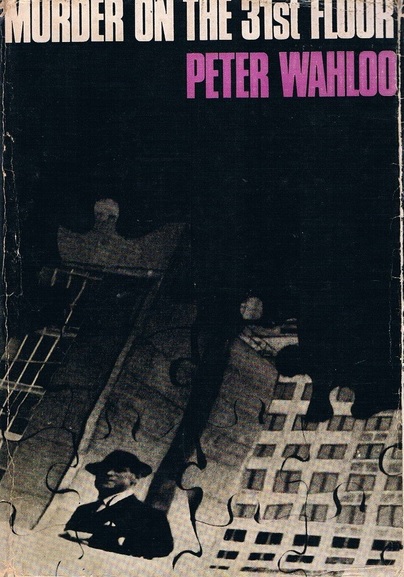
It’s important to understand these economic restraints to the creative process when watching Kamikaze ’89 as the reason for German director (and Fassbinder confidant) Wolf Gremm eschewing the serious-dramatic approaches of the three previous adaptations of Per Wahlöö’s 1964 best-selling, futurist neo-noir novel, Murder on the 31st Floor (twice for Russian TV as a mini-series and TV movie; then as a Hungarian TV movie), instead taking a black comedic, social satire approach that detracts from the novel’s serious sociopolitical and technocratic statements and bears little resemblance to those previous adaptations.
Regardless of its unorthodox approach with its garish character development and set design, Kamikaze ’89 garnered nominations and awards at the 1983 Fantasporto International Film Festival held in Portugal—which honors sci-fi, fantasy and horror films. As result of those festival honors, the film was marketed for an American release; the film subsequently flopped on the U.S art house circuit, grossing less than $25,000 in its initial release (but became a popular U.S VHS rental among sci-fi buffs and Fassbinder disciples).
In the “future” of 1989, Communism has fallen and the happy days of the good ol’ 1940’s—when the Federal Republic of Germany was the world’s dominate economic superpower—has returned. But since this is the “future” on a budget, the country has become a day glow, neon soaked, new-wave dystopia filled with Billy Idols, Boy Georges, and Madonnas prancing around in a low-budget Clockwork Orange-styled society. This is a world where male (female?) assassins dress in black lingerie and matching go-go boots—complete with ski masks and goggles. Women swim wearing leg warmers. Everyone mimics the police force’s logo seen throughout the film—a “thumbs up”—as some type of pseudo “Heil Hitler” salute in greeting each other. This is a world where citizens tool around on three-wheeled choppers, cops wear green crushed-velvet and peppermint-striped blazers, ambulances have six wheels, nurses wear gleaming-white lamé uniforms, and corporation executives make phone calls from Superman telephones (the handset cradles into his cape).
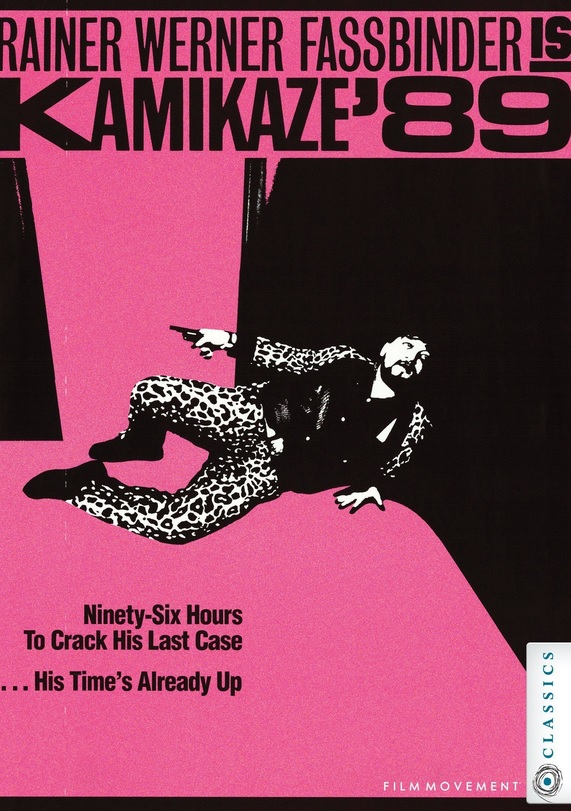
Meandering through this brain dead police-welfare state of citizens blinded by an endless stream of propaganda that proclaims “everything is perfect” is acclaimed German director Rainer Werner Fassbinder. He stars as Jansen, a rogue police lieutenant whose proclivities include a penchant for leopard-print suits and a revolver with a matching leopard-skinned grip. (Why? The film never tells us.) He works out in a gym—in leopard work out sweats—playing a solitary form of badminton-racket ball. He perpetually gulps down bicarbonate soda and relaxes on his lunch breaks in a dentist chair next to a ‘60s jukebox inside his rundown, paint-peeling “Bat Cave,” so to speak. And what’s the message behind the larger-than-life poster of Neil Armstrong on the Moon in his office, and the voice-over moon-transmission chatter between Armstrong and President Richard Nixon that Jensen listens to as he masturbates hip-thrusts into the poster, you ask?
Well, can you tell me the meaning behind the cackling villain-assassin dressed in a dinosaur costume (I think?) behind the driving wheel trying to run Jansen off the road with a car adorned bumper-to-bumper with the pages of comic books—complete with a full-sized Spider-Man plastered on the hood and a Captain America image stuck on the rear window? And what’s the deal with the Reality TV series watched by 99.3% of the population where contestants try to win prizes based on who laughs the longest—and the shows been going on for four days?
Yep. This film is way out there . . . and is only for those who enjoy the terminally weird and are brimming with patience to fulfill their Fassbinder fix—and decipher the hidden meanings, such as Gremm’s endless comic book references. All others are better off watching a Mark Gregory or Michael Sopkiw Italian-future world romp. Or, if you can handle the tomfoolery of Paul Bartel’s Death Race 2000 (1975), perhaps you’ll be able to stick with Kamikaze ’89’s black comedy slant to the bitter end. (It’s interesting to note that Ridley Scott’s similarly themed neo-noir sci-fi romp, Blade Runner, was issued a month prior to Kamikaze ‘89’s release.)
As in the future world of 1975’s Rollerball, Germany’s new totalitarian government-corporation has pacified and dehumanized the citizens through the legalized use of barbiturates and resolved all of the country’s social and political ills. There’s no more pollution. There’s no more murder or suicide (only “accidental death”). Alcohol and gardening (because the seeds are poisoned) are outlawed. But everyone is so miserable, they get drunk anyway . . . and they get locked up and fined . . . and get plastered again. And the wheel goes round and round and it all goes into the corporate coffers. And the rest that don’t get tanked, they garden the illegal seeds and eat the spoils in an act of suicide . . . oh, “accidental death,” so says the corporate edict. Everything is fine. Everyone is laughing on TV, after all.
Yep, you guessed it. Everyone is ignorant to the unhappiness perpetuated by this Soylent Green-inspired government-corporate . . . because the corporate also controls the broadcast and print media and perpetuates a “Group Think” mentality through a nascent forefather to the Internet via a media-soaked culture controlled by the few to manipulate the many. Things have gotten so out of control that Konzernchef, the Trumpian-Rupert Murdock leader of the family-run corporate concern, is immortalized as a villainous superhero, “The Blue Panther,” in a line of comic books published in protest against corporate regime . . . and he loves the attention. (Ack! No “Orange Panther” comments, wise guy!)
It turns out the underground protest comic is the product of a handful of intellectuals that ran the corporation’s Orwellian “cultural department” from the perch of the corporate headquarter’s hidden “31st floor.” Reasoning the corporate is evil, the corporate rogues work for a phantom terrorist group, “Krysmopompas,” to liberate the citizens. When their activities to overthrow the government crescendos with a fake bomb threat that results in the first “real” suicide-murder (of a corporate executive ready to spill the beans that takes a header off the “31st Floor”) in four years, they call in the world’s foremost and successful detective—Jansen—to solve the case. But the family-run corporate—and the in-the-pocket police department—doesn’t want the case solved . . . the world can’t know what going on up on the mysterious “31st Floor.”
Sweden-based crime novelist Per Wahlöö is best known for his series of ten best-selling novels regarding the exploits of Stockholm police detective Martin Beck published between 1965 and 1975. In 1971, one of those books, The Laughing Policeman (an English translation of Den skrattande polisen originally published in 1968) was adapted into the Walter Matthau and Bruce Dern starring film, The Laughing Policeman (1973).
Film Movement Classics honored Kamikaze ’89 with a 2016, 4K restoration issued to Blu-ray. You can watch the full movie for free on TubiTV and enjoy the Edgar Froese (of Tangerine Dream; Thief, Risky Business, and Grand Theft Auto V) soundtrack on You Tube. The 1980 Russian film version—for comparison—is also on You Tube.
The sad post-script to the film: Fassbinder died six weeks before the film was released. As you watch, you can clearly see the heavy and bloated Fassbinder was in poor health and looks much older that his 37 years. The professional momentum Gremm gained from his previous feature, Fabian (1980), being chosen as West Germany’s official submission to the 53rd Academy Awards for Best Foreign Language Film (it wasn’t nominated) was lost. While critically lauded, the box office failure of Kamikaze ’89 on the European circuit lead to it being Wolf Gremm’s last feature film; he then worked strictly in German television.
There are more, budget-inventive German dystopian visions to enjoy in the celluloid frames of the somewhat similar, previously mentioned Docteur M, and the Jupiter-to-Earth psychological adventure, Operation Ganymed.
About the Author: You can read the music and film reviews of R.D Francis on Medium and learn more about his work on Facebook. He also writes for B&S Movies.
Imagine you’re a Hollywood studio. Let’s say you’re New World Pictures. You want to ride this wave of post-apocalyptic goodness from Mad Max, but you’re just been hit by the 1981 Writers Guild of America strike. What will you do now?
Go to New Zealand, that’s what.
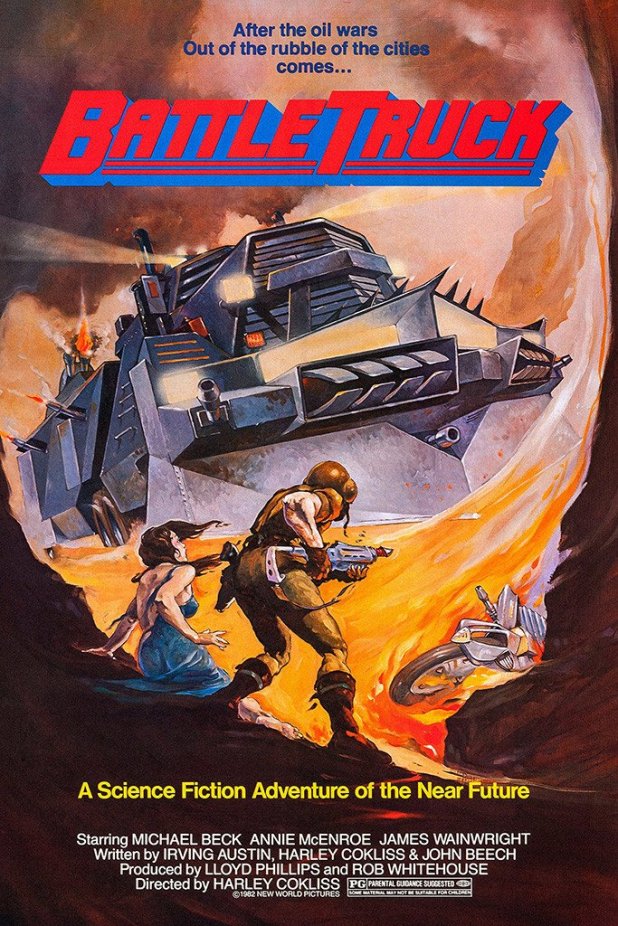
Also known as Warlords of the 21st Century and Destructors in Italy, this film doesn’t really break any new ground. But it does live up to its title — it has a battletruck.
As it usually happens in thee films, Earth has been wiped out as the result of a thermonuclear war that started over fossil fuels. Now, gas is the most precious of all commodities.
The opening narration that tells us all of this is awesome. That’s because its actor Randy Powell, who also plays Judd in the movie, transmitting a ham radio broadcast in Los Angeles, California to the filmmakers back in New Zealand.
While exploring a compound once thought to be radioactive, Straker (James Wainwright, Killdozer) discovers all the diesel fuel that the world will need. But his orders to kill the owners are ignored by his daughter Corlie (Annie McEnroe, who was in Snowbeast and is married to Edward R. Pressman, who produced Christmas Evil, Conan the Barbarian and all of The Crow movies, amongst many others). On the run and lost in the desert, she meets our hero, Hunter (Michael Beck, The Warriors, Xanadu, Megaforce).
What’s up with all of the heroes after the end of the world getting names like Hunter and Stryker? I mean, I dig it, but their parents really must have all been consulting the same Refinery 29 articles about “What to name your child after the bomb drops.”
Hunter has a bad ass motorbike and lives in the walled city of Clearwater Farm, an actual democracy in the midst of all this lawlessness, but soon Colie’s father finds her and attacks. As her dad’s mercs destroy the city and torture Rusty the mechanic (John Ratzenberger in a post-nuke movie!) to learn the secret location of where Hunter really lives.
If our hero is going to defeat Straker and his battletruck, he’s going to need more than just a bike. He’s going to need an armored car of his own. Hunter doesn’t care about anything, even blowing up all of the fuel just to prove a point. Of course, he’s going to kill everyone in his path, save the girl and then take off into the desert all by himself. That’s how these movies work.
Director and co-writer Harley Cokeliss would go on to direct several episodes of Hercules and Xena, as well as Black Moon Rising and Dream Demon.
You can get this movie on a double DVD along with Deathsportfrom Shout! Factory. It doesn’t break much new ground, but it’s still a fun movie.
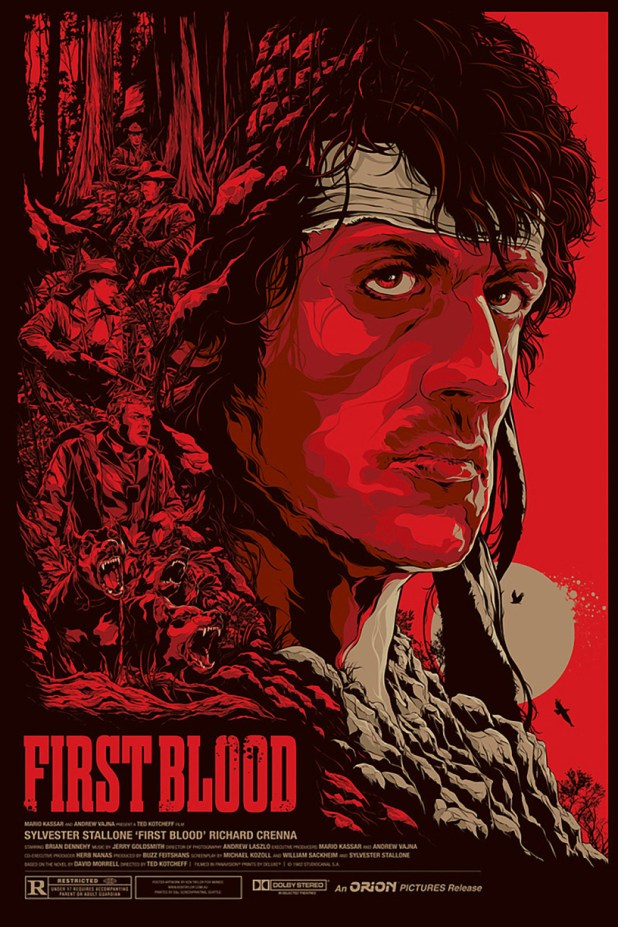
The first of the Rambo films has an interesting pedigree. It comes from director Ted Kotcheff (the original Dick and Jane, North Dallas Forty, Uncommonn Valor, Weekend at Bernies) and was based on a downbeat 1972 book by David Morrell. When Stephen King taught creative writing at the University of Maine, he used First Blood as a textbook. Ten years, eighteen screenplays and three studios later, the film finally got made.
Back in 1982 when the film rights were first sold, producers considered Steve McQueen for the lead. Sheriff Teasle was offered to both Gene Hackman and Robert Duvall, but they turned the part down. Lee Marvin turned down playing Colonel Trautman, but Kirk Douglas eventually took the role. He quit just before shooting began, as he wanted the movie to end like the book, where Rambo and the sheriff fatally would one another, Trautman kills Rambo and sits with the dying lawman. Rock Hudson also signed up to be in the film, but he had to undergo heart surgery, leaving Brian Dennehy to play Sheriff William Teasle and Richard Crenna to play Colonel Samuel Trautman in what would become the character actor’s most iconic role.
Seven years after his discharge, he left Vietnam, John Rambo (Sylvester Stallone) is wandering America. A visit to Hope, Washington to see an old friend is cut short when he learns that his former military brother has died from cancer that was caused by Agent Orange.
As he wanders the highway, Sheriff Teasle begins to harass him, finally driving him to the unskirts of town and telling him not to come back. When he does, he’s arrested for vagrancy, resisting arrest and possession of a knife. The police are brutal to the former war hero, as Deputy Art Galt (Jack Starrett, Nam’s Angels, Race with the Devil) and the other cops spray him down with a hose and even attempt to dry shave his face. Rambo snaps and decimates the outmatched lawmen; he;s a former Green Beret who won the Medal of Honor.
Galt chases him from helicopter, taking shots at him even though he’s been warned not to, which leads to his death. Rambo informs the police that the man’s death was his own fault, but the rest of the police come in shooting. Our hero, such as it is, dispatches each of them with non-lethal traps until only Teasle remains.
Even more officials — state police and national guard — come in, along with Rambo’s mentor and former commanding officer Colonel Sam Trautman, who advises that Rambo just be allowed to leave town. All hell breaks loose with Rambo nearly killed in an abandoned mine before escaping and destroying much of the small town. As he prepares to kill the sheriff, Trautman convinces him to surrender and Rambo collapses in tears, screaming “Nothing is over! Nothing! You just don’t turn it off! It wasn’t my war! You asked me, I didn’t ask you! And I did what I had to do to win! But somebody wouldn’t let us win!”
The first rough cut of this movie lasted three and a half hours long and was so bad that Stallone wanted to buy it and destroy it before it ruined his career. After heavy re-editing and a second ending, where Rambo doesn’t commit suicide, the film became a great success. The character itself would change as America moved from a country unsure of how to deal with the war in Vietnam to one that embraced its status as the world’s policeman; the next Rambo film would present the character in a completely new way.
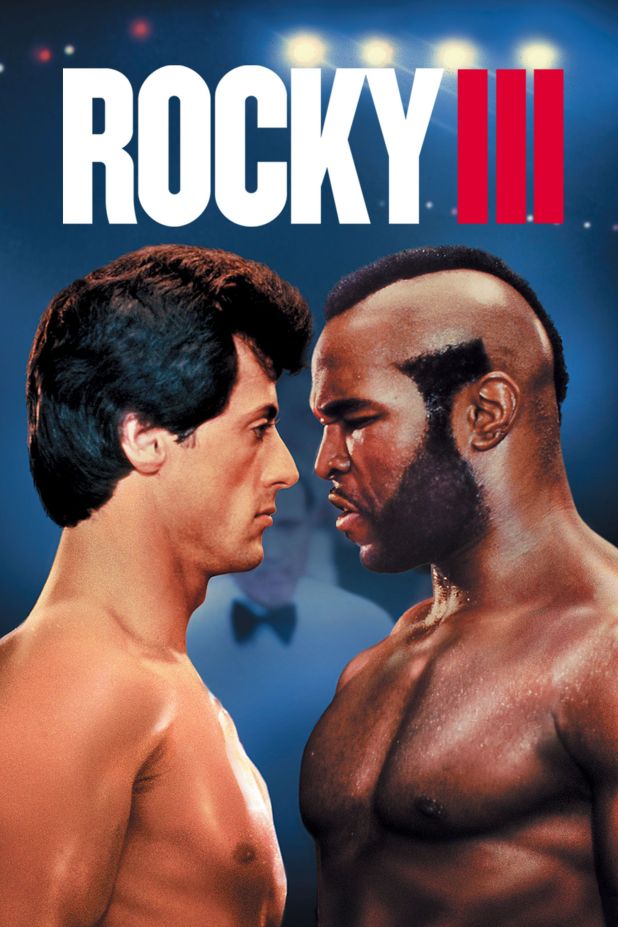
Rocky III did more than just extend the franchise. It boosted the careers of two nascent superheroic characters, Mr. T and Hulk Hogan, as they made their way into the 1980’s cultural zeitgeist and even a titanic team-up at WrestleMania. Yet here, they’re just enemies for Rocky to gather his wits and eventually defeat. 1,200 people auditioned to be Clubber Lang, but there couldn’t be anyone else but Mr. T in this role.
Stallone went hard to get into shape for this movie, getting his body fat percentage down to his record low of 2.8%. He did that by eating only ten egg whites and a piece of toast a day, with fruit every third day, along with two miles of jogging, two hours of weight training, eighteen rounds of sparring, two more hours of weight training and swimming every single day.
Rocky has held the heavyweight championship for five years and defended it ten times, leading to fame, wealth and celebrity. In fact, he’s even moved into boxing versus wrestling matches against opponents like Thunderlips (Hulk Hogan). But his manager, Mickey (Burgess Meredith) knows that James “Clubber” Lang (Mr. T) is the man who can beat him.
While unveiling a statue of himself, Lang shows up and challenges him to a title match, claiming that Rocky has been hiding from him. That turns out to be true, because unbeknownst to our hero, Mickey has been keeping Rocky away from anyone who would hurt him as badly as Apollo Creed did. He goes on to tell him that Lang is hungry and that Rocky will never last three rounds with him because he’s become civilized and lost the eye of the tiger.
The training montage here shows that Rocky is distracted while Lang has risen from the Chicago streets and is very much like a younger Balboa, save that he’s cocky and brutal. When the two first meet, it erupts into a brawl that causes Mickey to suffer a heart attack before the match even starts. After the fight — a second round KO title win for Lang — Rocky tells his mentor that the fight is over and that it ended in the second round. He doesn’t tell him that he lost and his father figure dies happily.
Rocky slips into a deep depression that is only stopped when Apollo Creed (Carl Weathers), his former arch enemy, offers to train him in exchange for a favor. Along with Tony “Duke” Evers (Tony Burton), Apollo brings Rocky into his Tough Gym, giving him the footwork, style and speed that he lacked, finally becoming the gladiator that he was born to be.
The fight between Lang and Rocky is different the next time — Rocky destroys him in the first round, then allows his opponent to batter him in the second, taunting Land and claiming that he can’t put him away. This is all a ruse, as Rocky defeats him in the third, finally finding, as the song sings, “The Eye of the Tiger.”
Apollo’s favor? One more rematch, this time in private at Mickey’s gym. Now the men have become friends and finally are on the same level as the film ends.
When Mr. T took his mother to the premiere, she angrily walked out, upset at the lurid way that he yelled at Rocky’s wife Adrian (Talia Shire), saying “I did not raise you to talk to a lady like that.”
As always, Stallone knows where his characters ended up. He saw Clubber Lang as later becoming a born-again Christian and a ringside announcer.
This would be the last time that Rocky would battle for the title. Now, it would be time to go to Russia and then back to the streets. Stay tuned.
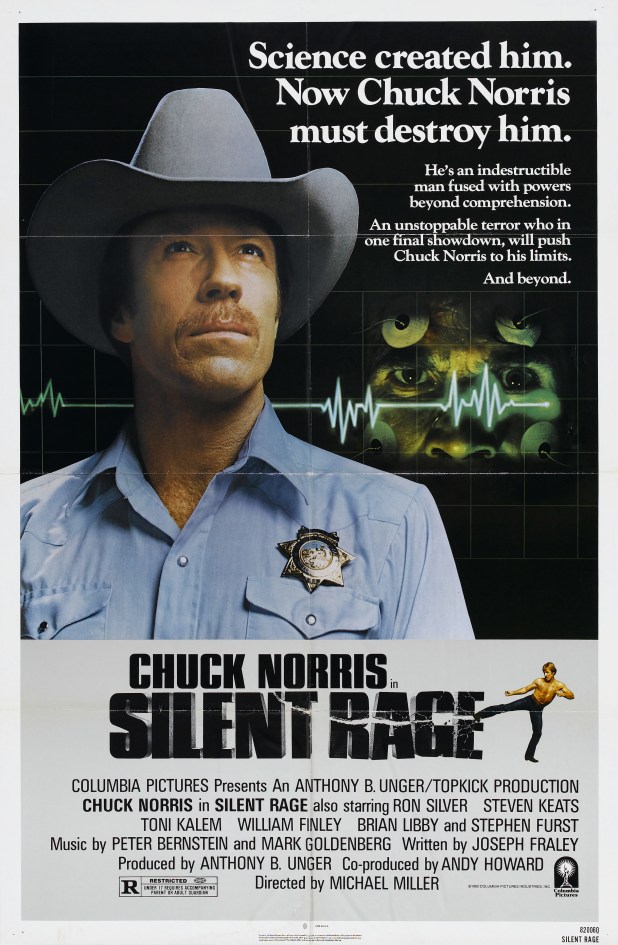
What if you combine the director of Jackson County Jail — Michael Miller — and Chuck Norris, America’s favorite karate man, then make Chuck fight the Frankenstein Monster in a movie that’s as if John Wayne wandered into a slasher? Then you’d have 1982’s utterly bizarre Silent Rage (or the 2009 remake, Indestructible).
Seriously — Chuck Noris sidekicks an unstoppable killer. Why you’re reading this and not looking for this movie is beyond me.
Somewhere in Texas, John Kirby (Brian Libby, Floyd from The Shawshank Redemption) kills two of his family members and is stopped by Sheriff Daniel Stevens (Norris) and his deputy Charlie (Stephen Furst, Animal House). Kirby breaks free and is shot several times before being brought back to life by his psychiatrist, Dr. Thomas Halman (Ron Silver!), who is working along with genetics experts Dr. Phillip Spires (Steven Keats, Death Wish) and Dr. Paul Vaughn (William Kinley, the Phantom of Paradise himself!).
Now the killing machine is mute and unkillable and even worse, on the run. Somehow, Sheriff Dan is dating Alison, the sister of Dr. Tom, and Kirby is killing everyone in his way. So Chuck Norris does what he does best — sidekicking. After lots of murder, he sidekicks the monster down a well, where he survives to set up a sequel that never came.
Michael Miller said the film was written with Norris in mind, telling Coming Soon: “You don’t hire Chuck Norris not to do karate. It wasn’t like it was an old John Wayne script that they ended up giving to Chuck. He does his thing. I think the idea was to try and broaden the audience in that it wasn’t a karate movie. In my mind, it was a Frankenstein movie. It was like Frankenstein meets Chuck.” What it wasn’t was inspired by slashers, as Miller wasn’t a fan.
“At the end, the guy is still not dead. But that never happened. I would have liked that. You can see that this guy is not a slasher. He kills people the way Frankenstein’s creature kills people. He throws them and bang,” said Miller.
Meanwhile, Miller worked with most of the crew for this movie and Stephen Furst on another film that came out in 1982, National Lampoon’s Class Reunion. And listen for the song “It’s The Time For Love” on the soundtrack. That’s Peg Bundy, Katey Sagal, singing.
All actors have to start somewhere and that “somewhere,” for some actors, is a hicksploitation flick. So, before he gained mainstream recognition as Dr. Peter White on the early ‘80s TV series St. Elsewhere, and the late ‘80s series Tour of Duty as Sgt. Zeke Anderson, Terrance Knox made his leading man debut as the country truckin’ good ‘ol boy, Buddy McCoy.
Buddy is an unemployed man-child who loves to party hard and raise ‘emself sum good ‘ol boy hell, much to the chagrin of his loyal model-photographer girlfriend. He suddenly finds his preferred, irresponsible lifestyle financed by a streak of good luck: he enters a trucker’s magazine contest and wins a shiny new, 1981 Mack Super-Liner and $50,000 in cash. So what’s the right thing to do? Do you marry your longtime girlfriend and build a stable life? Or do you go all “Easy Rider” in a big rig?
Yep. Buddy chooses a Two Lane Blacktop existence crossed with some Smokey and the Bandit shenanigans as he sets off on a cross-country, L.A to Oklahoma road trip. As is the case with these hick romps: Buddy meets the usual array of country-eclectic bumpkins; however, there’s no corrupt sheriffs, no car chases n’ crashes, no bar fights, no falsely-accused-of-a-crime inciting incidents to start the manhunt, and no Sally “Frog” Field to bring on the trouble. So, if you’re looking for some White Line Fever or Rolling Thunder* action, this isn’t the film to watch. It’s just Buddy having good times on the road with some harmless PG-rated sexcapades.
If this all sounds familiar, then it’ll be no shock to you that during the course of the film, when Buddy picks up a rider by the name of “B.J,” Buddy makes a joke about where his “bear” is. Yep, it’s an in-joke to the 1978 to 1981 trucker-themed TV series, BJ and the Bear, which is the same “road” our Buddy McCoy travels.
Truckin’ Buddy McCoy was marketed overseas as Convoy 3—as a sequel to Kris Kristofferson’s 1978 trucker flick, Convoy. Only one problem: Convoy is a straight action film and Truckin’ Buddy McCoy is a pseudo-Smokey and the Bandit comedy romp. Which post-1978 trucksploitation flick was marketed as Convoy 2? Your guess is as good as ours. The B&S Movies research team came up empty.
While Truckin’ Buddy McCoy served as the only directing credit for Richard Demarco, writer Rick Blumenthal’s work as a producer goes back to an early Sylvester Stallone flick, No Place to Hide (1973, aka Rebel), and into the early ‘90s with the portmanteau Grim Prairie Tales, and the kickboxing flick, Bloodmatch.
The cinematographer behind John Carpenter’s Black Moon Rising, Russian-born Misha Suslov, lensed this hicksploitation classic (yes, they are classics in the analog hearts of the B&S crew!), as well as Smokey and the Judge and the “dark” Christmas romp, Prancer. While we lost our inner Suslov-ness over the years, we were happy to discover Suslov is still keepin’ the eye-in-the-glass with the 2020 country-romance The Girls of Summer.
There’s no trailer available, but you can watch the full movie on You Tube.
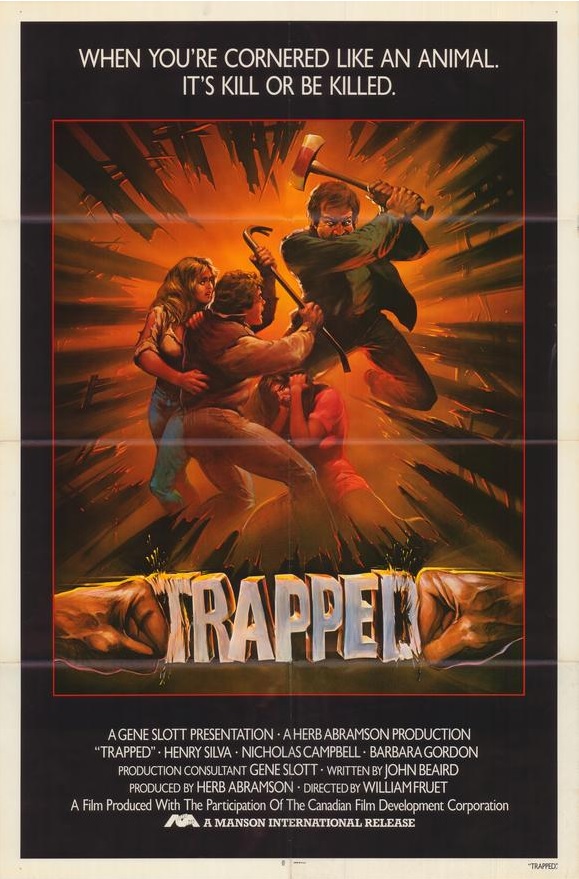
Here’s another one of those hicksploitation romps, like Ruckus and Kiss My Grits, that can be whatever a distributor wants it to be: a Smokey and the Bandit good ‘ol boy potboiler (Baker County, U.S.A), a Deliverance-styled suspense thriller (Trapped), or a straight up slasher flick (The Killer Instinct). Call it whatever you want, the film, shot for $2 million by William Fruet, the “Roger Corman of Canada,” is basically the canuxploitation-version of the later-shot Hunter’s Blood (1986), itself a retread of John Boorman’s 1972 hicksploitation trendsetter, Deliverance. So this movie is a two-in-one: a canux and hicks exploitation flick!
The real jewel of this entertaining and well-shot, yet familiar rural-revenge retread is the always awesome-in-everything-he-does Henry Silva (1983’s Escape from the Bronx) who goes off the rails as Henry Chatwill, the overseer of a backwood-inbred Tennessee enclave. Henry’s the type of good ‘ol boy who can shimmy-sham in the woods with any woman he wants when he goes trap settin’, but heavens to betsy his young wife cheats on him with a citified county inspector. (Beware of that perpetually-boiling hot tar vat, you dumb city varmint!)
So . . . when the obligatory school of out-of-water college fishies searching for a backwoods cave for a school research project—led by Nicholas Campbell (2017’s Neverknock, HBO’s The Hitchhiker), along with Joy Thompson (1980’s Prom Night) and Gina Dick (1981’s My Bloody Valentine) in tow—stumbles into Silva torturing his wife’s lover via a good ‘ol fashion tar and featherin’, Silva goes into Jason Vorhees-mode to distribute some redneck justice to those snoopin’ city kids. And don’t ya’ll be botherin’ the town sheriff for help—this here be Blood Salvage country and the sheriff, well he be “kinfolk” who covers up the killin’.
If all of this backwoods shenanigans sounds the same (but offers a unique hick-impaled-by-TV antenna scene and an unstoppable Silva doused in hot tar) that’s because it’s penned by ‘80s slasher-scribe John Beaird, who penned the entertaining My Bloody Valentine and Happy Birthday to Me. The director’s chair is filled by the man who also brought you the UK Section 3 backwoods-rape video nasty Death Weekend (1976, aka House by the Lake), the Alien-inspired AIDS cautionary tale, Blue Monkey (1987), and one my personal, oft-run HBO favorites: Search and Destroy (1979) starring the one-two punch of Perry King and Don Stroud.
B&S Movies will be reviewing more fully, UK Section 3 Video Nasties in the upcoming weeks. In the meantime, be sure to catch up on B&S Movies’ exploration of the films on the UK’s Video Nasties Section 1 and Section 2 rosters. You can also visit B&S Movies to catch up on more North of the Border Horror, aka canuxploitation.
Here’s the link to our listing-reviews of the UK Section 3 flicks.
About the Author: You can read the music and film reviews of R.D Francis on Medium and learn more about his work on Facebook.



 B&S About Movies
You must be logged in to post a comment.