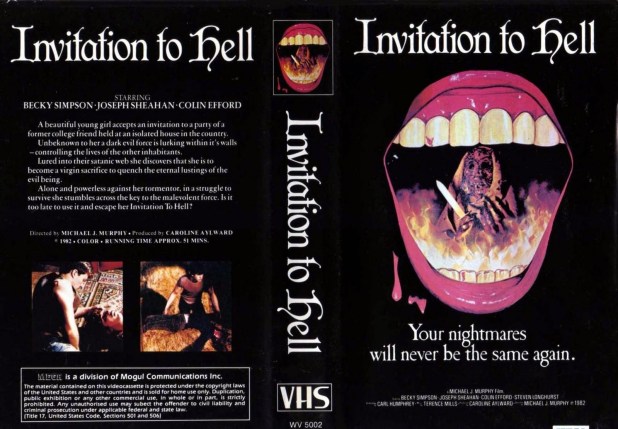
No, not the 1984 Wes Craven-directed, Susan Lucci-starring Invitation to Hell — which is great — but instead the British 1982 SOV movie!
Jackie has been invited to her high school reunion — which for some reason is a costume party, which I guess must be a British thing, UK readers please inform us — but because she’s a virgin, she’s selected as a sacrifice for the spring by the druids amongst her classmates.
Some dude tries to do our heroine the favor of taking away her virginity so that she survives, but then a latex-masked demon shows up and his eyes glow and he crucifies one character against a wall of Page 3 girls and then gorily pulls out his insides and hey — isn’t that why we watch movies? I mean, maybe isn’t that why I watch movies?
The same dude also wore an old-school paper Hulk mask for much of the early part of the movie, so copyrights — and the video nasty controversy which was going on at the time — be damned.
You know, I kind of like something in this movie. Like, I know it’s really bad but there’s something in it — and not just a young Demi Moore — that made me enjoy it. I have no idea what that was, but sometimes a movie just makes you feel like you’re taking a relaxing swim.
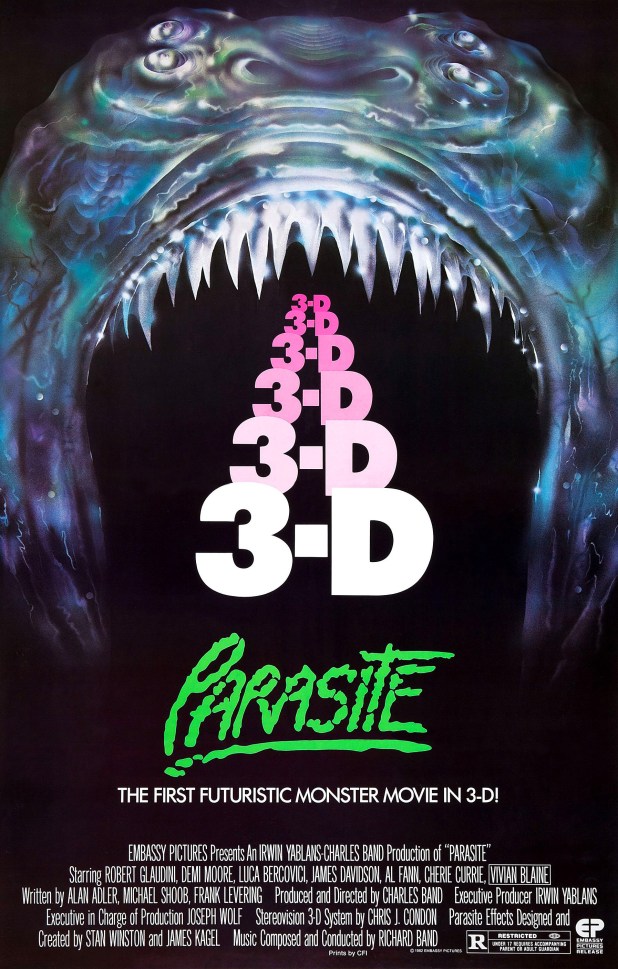
Sometime after the bombs got dropped, America is run by a criminal organization called the Merchants. To better control the population — and no, I have no idea how this plan is supposed to work — they get Dr. Paul Dean (Robert Glaudini, whose roles in movies like this and Cutting Classled him to somehow write the play Jack Goes Boating, which became a movie directed by Philip Seymour Hoffman) to create a parasite. Also, because this movie has no plan for what is about to happen, he infects himself to study the parasite, yet is upset when it infects the gang in the small town he finds himself trapped in.
And Demi plays the young lemon grower who helps him.
Actually, I’ve totally figured out why I like this movie. That’s because it cast Cherie Currie (the ex-Runaway who was on a run of scream queen roles between this, The Alchemist and The Twilight Zone: The Movie) as a post-apocalyptic gang member and Cheryl Rainbeaux Smith as a slave girl. And it was made by Charles Band between Crash! and Metalstorm: The Destruction of Jared-Synin a time when he wasn’t yet making puppet movies.
A section 3 video nasty, this was in 3D in its original theatrical run. It owes just as big a debt to Alien as it does to Mad Max.
Elly Kenner was born in Israel and went from working in the advertising industry and movies to creating documentaries about healing, channeling and mysticism.
Norman Thaddeus Vaine wrote Herman’s Hermits’ film, Mrs. Brown, You’ve Got a Lovely Daughter, as well as Lola — which has a romance between a forty-something porn writer Charles Bronson and a teen-something Susan George which seems like the most male fantasy movie of all time* — and directed Shadow of the Hawk and Frightmare.
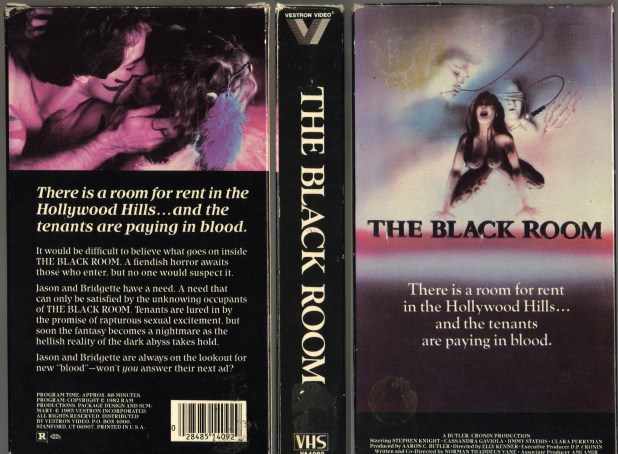
Together, they would make The Black Room, a movie made at the very start of the AIDS crisis and the end of the free-loving 1970s. The world was about to get very different, and this movie was about to get very weird.
Larry (Jimmy Stathis) has decided that married life is dragging him down, so he rents a room somewhere in the Hollywood Hills from brother and sister Bridget (Cassandra Gava, who was the sorceress who made love to Arnold in Conan the Barbarian) and Jason (Stephen Knight, Necromancy).
Jason has a rare blood disorder, which means that he must constantly get blood transfusions, but perhaps he’s something more than human. After all, he and his sister have been capturing Larry’s partners and using them for their blood. And oh yeah, they’re watching him couple with them, too.
Much like the need for blood, Larry needs to be with other women. He loves telling his wife, Robin (Clara Perryman), his fantasies while they’re in bed together, and she goes along with the game until she learns that this is more than a fantasy. Now, once she discovers her husband’s secret apartment, she rents out her own place within the mansion.
Now, she’s not getting just the stories. She’s living them with Jason. Of course, when her husband discovers what’s happening, he’s enraged that she’s giving herself to others and demands that they both stop. But can you stop taking drugs and live an everyday life when you’ve had the rush of kink and secrets?
But now, Jason and Bridget are exacting their own penalty on the couple by taking their children. And even if they can die, the twosome keep returning to the dead because, as Robin wonders, “Can people like that ever die?”
Is this a furniture movie? Just look at the black room itself: black velvet curtains, wax candles burning and a glowing table. Sexy, right? Well, one thing is for sure: this is a section 3 video nasty, a movie that lingers on scenes of needles, track marks and blood.
The thing is, in the hopes of getting back to the sexual life they had before kids and suburbia, our protagonists must be unwilling accessories to the murders of prostitutes, all blood for the veins of someone whose own source has become contaminated. You know, I would prefer this film if it was never supernatural and was just creepy, with a brother and sister who sleep with one another and suddenly date a married couple who they drag deeper and deeper into hell.
Two more reasons to love this: an impossibly young Linnea Quigley as the couple’s babysitter and an incredibly youthful Christopher McDonald—yes, Shooter McGavin—as the college student who watches Larry take his woman while he writes about it for his doctoral thesis because, yes, the 70s.
The copy I found is as dark and beat up as possible. And you know, I might love that this is how I’m watching this instead of a pristine blu ray boutique reissue because I’m seeing something that so many have watched over and over, battering the original until what ended up online was the last media itself’s last gasp.
(EDITOR’S NOTE: Since this was written, Vinegar Syndrome has released it on Blu-ray.)
In Nightmare USA — thanks to Hidden Films for bringing this up — Vane revealed that The Black Room was based on his real life, as he cheated on his wife in his own black room with Penthouse centerfolds that he met while working at that publication. Wow, huh?
*It’s totally based on Vane’s life. He married 16-year-old model Sarah Caldwell in the mid-1960s, when he was 38.
You can listen to the podcast I did on this film on YouTube.
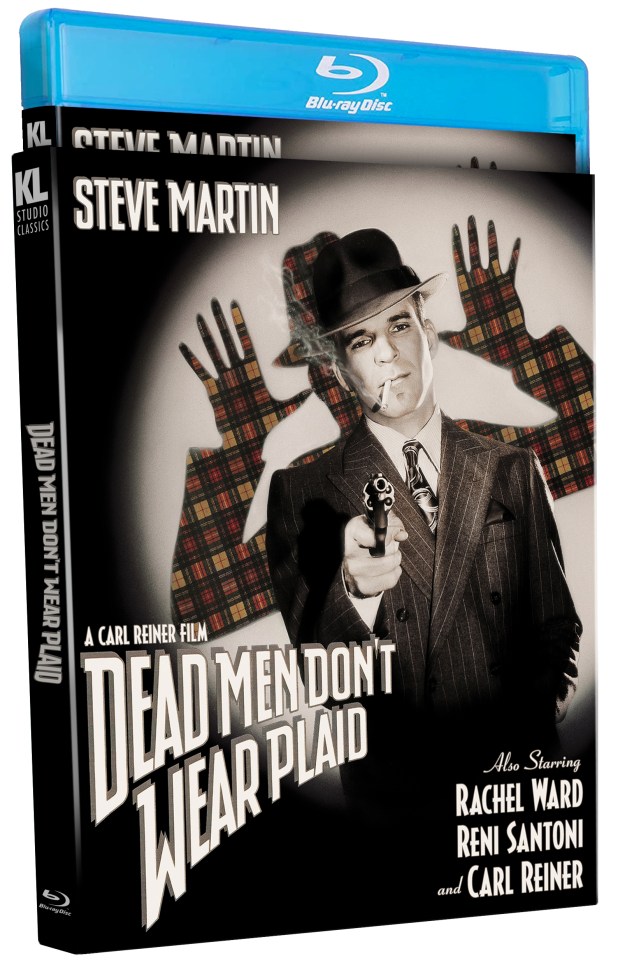
Where could Steve Martin and Carl Reiner go after The Jerk and The Man with Two Brains? How about to the world of film noir?
At lunch with Reiner and screenwriter George Gip, Martin discussed using a clip from an old film as part of a story he was writing. From that came the idea to use old clips throughout a movie to remix, recut and reframe an entirely new narrative that would place Martin into the world of film noir, using some of those that helped make those classic films, like costume designer Edith Head*, who made more than twenty suits and production designer John DeCuir, who designed 85 sets for the film.
Dead Men Don’t Wear Plaid casts Martin as Rigby Reardon, who comes to the aid of cheese heiress Juliet Forrest (Sela Ward) after the mysterious death of her father. Throughout the narrative, they come into contact with all manner of famous actors and characters, including Alan Ladd as The Exterminator who attacks Martin (taken from This Gun for Hire), Barbara Stanwyck from Sorry, Wrong Number, Ray Milland from The Lost Weekend, Ava Gardner footage taken from both The Killers and The Bribe, Burt Lancaster from The Killers, Humphrey Bogart as Philip Marlowe using scenes from The Big Sleep, In a Lonely Place and Dark Passage, Cary Grant from Suspicion, Ingrid Bergman from Notorious, Veronica Lake** from The Glass Key, Bette David from Deception, Lana Turner footage from Johnny Eager and The Postman Always Rings Twice, Edward Arnold from Johnny Eager, Kirk Douglas from Walk Alone, Fred MacMurray from Double Indemnity, James Cagney from White Heat, Joan Crawford from Humoresque and Charles Laughton and Vincent Price from The Bribe. Whew!
These eighteen movies*** — plus footage shot at Culver City’s Laird International Studios, the same place where Suspicion, Rebecca and Spellbound were all made — creates a narrative all its own, much how beats and samples come together to make a new song within the world of hip hop.
There’s so much detail in this movie, which is because of the talents of the filmmakers, including director of photography Michael Chapman , who worked with Technicolor to seamlessly match the old film clips with his new footage.
I find it really intriguing that Martin came out of another period piece, Pennies from Heaven, into this movie, while Sela Ward played the woman at the center of the modern noir Sharky’s Machine before this.
The new blu ray re-release of this movie from Kino Lorber includes new commentary by filmmaker Allan Arkush and film historian/filmmaker Daniel Kremer, as well as four radio commercials, three TV ads, a theatrical trailer and the Buttometer teaser trailer. I’m beyond excited to have this movie in my library.
* *The film was dedicated to Head, who died soon after it was completed, with the credits saying, “To her, and to all the brilliant technical and creative people who worked on the films of the 1940’s and 1950’s, this motion picture is affectionately dedicated.”
**Cheryl Rainbwaux Smith also was the double for Lake in this scene, which I heartily endorse.
*** Nineteen if you count the car crash in the beginning, which came from Keeper of the Flame.
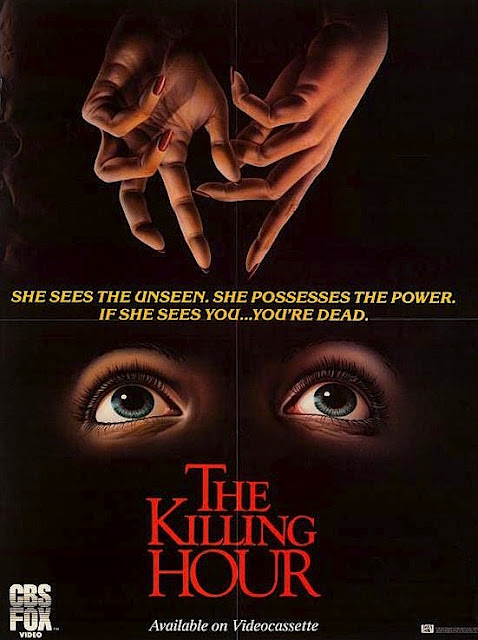
“Beyond the five senses lies a sixth. To possess it is to see the unseen. If she sees you…you’re dead.” That’s a pretty great tagline. This is kind of a sleeper of a film.
Armand Mastroianni (He Knows You’re Alone, The Supernaturals, plenty of stuff for the Hallmark Channel like their Pandemic mini-series) made this one and while he has an Italian name, he was born in Brooklyn. But the roots of this film are firmly in the world of the giallo, at least the later fantastic era and less in the early detective films.
Handcuffed bodes have been showing up all over New York City — yes, the end of the world NYC as seen in films like The Eyes of Laura Mars and The New York Ripper — which leads talk show host Paul “Mac” McCormack (Perry King) and police detective/stand-up comedian Larry Weeks (Norman Parker) to team up. They soon meet Virna Nightbourne (He Knows You’re Alone, Sticky Fingers), an art student whose work somehow perfectly captures details of the crimes that even the police don’t know.
I mean, in case if you’re wondering, as I always do, “Is this a giallo?” just the idea that a cop is also a comedian and the name Virna NIghtbourne should tell you all that you need to know.
Virna is able to basically switch off her brain and free her hand to draw whatever it wants, a talent that led her to rescue a young girl named Elizabeth many years ago. The police have to tell her the horrible news that Elizabeth was one of the Handcuff Killer’s victims, which is a strange coincidence or because this is a giallo.
Now, Virna is having dreams of being tied to a bed and murdered, turning that scene into her art. At the same time, other people who were close to Elizabeth, like a male prostitute, are being killed and even Mac is attacked in his apartment by a man paid to attack him. He’s shot by the police before he can give them any further answers.
Somehow, our heroine begins dating both men and stands up Mac one night to see Larry perform stand-up (it’s the comic strip and you can see Dennis Wolfberg’s act) when she gets a call that the killer has her roommate tied up to a car and plans on murdering her. She runs outside and is nearly hit by the Handcuff Killer’s car.
Mac brings Virna on his show and she starts to draw a murder that is paralleled by Muriel being murdered by being handcuffed and bound before being placed in a car that crashes into the river. She’s gotten too close, so she’s kept with Mac, but the drawings, when analyzed, show that she’s not out of danger yet.
The clues all make sense in this — American giallo feels the need to explain things a bit better than their Italian counterparts — and it gets pretty boring before the psychic parts come out. Then again, ask yourself: how many old Hollywood romantic triangles infused into a police procedural with giallo elements are you going to find? Throw some Perry King in as the smoldering sizzle on the steak and hey, you won’t be too upset that you spent time watching this.
You can watch this on Tubi or buy it from Blue Underground under its alternate title, The Killing Hour. It’s also a category III video nasty, which you can find on our list of these infamous films.
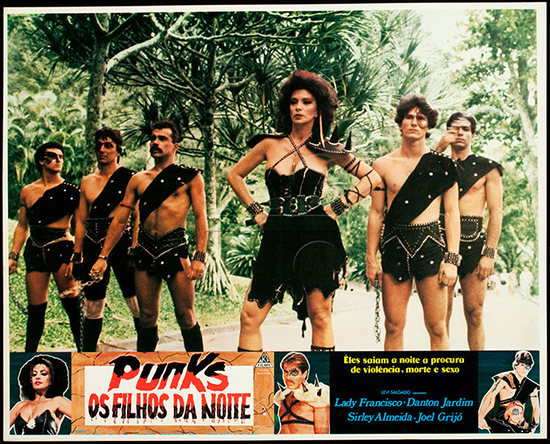
Let me tell you what, punks in movies that look nothing like real life punks? Now that’s my thing. Sure, Repo Man gets it right. But what about stuff like La Venganza de los Punks? I want huge colored mohawks and a near end of this world vibe and man, what the heck is going on with this movie, also known as Wild Sex of the Children of the Night?
At some point in the future — let’s be all Capcom and call it 19XX — two punk gangs are going to get all into The Warriors and start cosplaying it and taking things way too far. Actually, there are a whole bunch of gangs like The Ladies, The Rats, The Babies and The Dragos, as well as a man called Big Cat who is kind of like the future punk Batman that exists outside the gangs, standing for something other than sex, drugs and death.
There’s also a version of this with sex inserts called Sexo Selvagem dos Filhos da Noite (Night Children’s Wild Sex). Everybody in this wears fur, has facepaint and often Road Warriors-style shoulder pads. So yeah, Brazil, everybody. Well done.
“We wish this movie was about sex, drugs, and rock ‘n’ roll . . . but two out of three ain’t bad.” — Wishing thinking from the Film Ventures International marketing department, because they don’t have the other “two,” either
My eyes widened with glee. My irises twinkled. I discovered VHS gold; for there sat two dusty copies of the elusive rock ‘n’ roll and radio flicks I long pined for my collection: Splitz and Zoo Radio. It’s amazing, in those youthful, analog years, how elated my crappy life could become by the mere spending of $4.00.
Then I injected the tapes into my VCR. And I wish I’d hit up the McDonald’s in the strip mall lot and got a Big Mac.
Instead of those VHS rock ditties that lent themselves to multiple viewings, such as The Rocky Horror Picture Show, Cannon’s whacked rock fable, The Apple, and Brian De Palma’s Phantom of the Paradise, I ended up with another musical-snoozorama, à la Playing for Keeps, Scenes from the Goldmine, Suffering Bastards, and It’s a Complex World. And just as Zoo Radio did not prove to be another FM, Splitz would not prove to be another Times Square. Remember how Allan Moyle’s Pump Up the Volume was pirate radio gold and Ferd Sebastian’s On the Air Live with Captain Midnight (1979) was a dented, tarnished pewter ale stein crusted in barnacles?
Welcome to the celluloid ship(shit)wreck that is Splitz. Remember that iconic, two word review of Spinal Tap’s 1980 album, Shark Sandwich, you known, their big “comeback album” and their first with Polymer and their first release after the death of drummer Peter “James” Bond? Remember: Shit Sandwich?
Yeah, it’s like that. Only we don’t get a cool song like “Sex Farm” in the bargain to help us swallow this celluloid defecate.
To assure us the full “split” effect, FVI gave us a sideways VHS sleeve/thanks again, Paul!
When your film has four screenwriters and nine producers, it’s a foregone conclusion that the movie is going to have problems. And looking at the credits and seeing the names of producers Kelly Van Horn (who also scripts) and Joan Van Horn (then credited as Joan Speigel Feinstein), we are dealing with a future husband and wife production team coming up with a script for a film that started out as Phi Beta Rockers. It’s an Animal House-cum-Porky’s* T&A rock ‘n’ roll romp about an all-female rock band coming to the aid of a down-and-out sorority house of the Delta House variety about to be shut down by the faux-Faber College of the film (but here it’s, yuk-yuk ha-ha, Hooter College). And like both of this film’s raison d’etre — which was promoted as a “female Animal House” — the final cut of Phi Beta Rockers carried an R-rating.
But when you’re in business with director-producer Domonic Paris’s New Empire Features, the shingle that gave us (in more ways than one) the suck fest (well, another shit sandwich) that is Dracula’s Last Rites, aka Last Rites (1980), and then signed on the dotted line with Film Ventures International (who we oft mention in the pages of B&S) as your distributor . . . well, your film is . . . it’s a foregone conclusion that your movie will suffer a PG-13 chop shop edit and be ye dubbed Splitz . . . for the sole purpose of having a cheerleader on the theatrical one-sheets and VHS sleeves doing, well, a split, because comedy is supposed to be a sexy n’ smutty double entendre.
After wowing us in Times Square, our beloved Robin Johnson deserved so much more from Tinselville, U.S.A. No wonder the ex-Sleez Sister left the business to become a helicopter traffic reporter for KFWB/Los Angeles.
As with Matt Dillon, a non-thespian who left an indelible impressions in his feature film debut with Over the Edge (1979), Robin Johnson — an engaging hybrid best described as Joan Jett meets Jo Polniaczek (actress Nancy McKeon’s character on NBC-TV’s The Facts of Life) — was plucked off the street by a member of RSO Records/Films (Robert Stigwood Organization) for the starring role of Nicky Marotta.
According to the Times Square backstory: Johnson signed with RSO (which oversaw the career of the Bee Gees, then stuck them in the bomb that was Sgt. Pepper’s Lonely Hearts Club Band — and killed Peter Frampton’s career in the process) with a promise the studio would develop more projects for her in which to star. When Times Square flopped at the box office (as well as its double-LP soundtrack on the charts) and RSO’s excitement for Johnson (both as an actress and singer) cooled, she was left scrambling to find to find work. She ended up in this, well, a career killer that even Robert Stigwood couldn’t cook up. (Can you see Robin Johnson, instead of Joan Jett, alongside Michael J. Fox in Light of Day? I can; Robin would have killed it.)
Here, Johnson is Gina Napoliani: just another street wise Italian girl with musical aptitude and leader of the new wave trio, Splitz, alon with Joan (Patti Lee; co-starred with a down-and-out Aldo Ray in something called Drug Runners before vanishing from the business) and Susie (Barbara Bingham; Terror at London Bridge and Friday the 13th Part VIII). Of course, since Gina is a sassy Neapolitan, her father must be a cliché mobster (Raymond Serra of too many TV series to mention, but the film Wolfen and the Teenage Mutant Ninja Turtles franchise). And the band’s manager must be a clichéd, well-intentioned ne’er-do-well with zero talent always on the make for the easy buck.
And to keep that Animal House vibe alive — but without the budget to afford John Vernon — be sure to hire Shirley Stoler from The Honeymoon Killers (1970) as your faux-Dean Wormer, aka Dean Hunta, here. And for the “comedy” of it all: whenever her name is spoken, ye shall hear the claps of thunder and the shall lights flicker in fear. And to thread together what those four screenwriters cooked up: be sure there’s lots of narration by the band’s manager, you know, so the viewers don’t get lost, which is a sure sign you’re at the Suckville Diner outside of Hoboken ordering a Shit Sandwich with a side of Tap Fries. (To her credit, while the movie stinks, Stoler’s very good in the role.)
Of course, Dean Hunta is evil, and has a little side hustle to make way for a sewage treatment plant to be built next to the campus (hey, that’s the plot from Playing For Keeps!). So ol’ Hunny pits the Sigma Phi (run by the Dean’s pet, Lois Scagliani; played by Forbes Riley, aka Francine Forbes, who made her debut in Splatter University and turned up later in Megiddo: The Omega Code 2) and the Delta Phi houses against the Phi Betas — with the fix being in, so the Phi Betas, aka the female Delta House slobs, lose.
And here’s when the ol’ “ensues” come in: A jiggle n’ skimpy shorts soccer match, ensues; a lingerie wrestling match, ensues; and a strip-basketball match, yes, ensues. Also along the way, Dean Hunta’s horny husband is a lecherous dentist who falls to sorority blackmail and our evil school mistress is hypnotized into being a stripper (Shirley Stoler is a robust woman, so, you know, a large woman stripping is, well, “funny,” we think). And then the trope-ridden mobsters show up. And Splitz get a record deal. And, also along the way, ’80s comedian Don Irrera mugs for the cameras as a trope-laden gangster (and makes it clear why he never got his own sitcom . . . and makes you wish Lord God of the Camera Mugging, Joe Piscopo, was here to do his Sinatra bit as a mobster-gag, or something). And, believe it or not, the filmmakers managed to shoot Splitz inside of the world famous CBGBs (and if only the Ramones showed up . . . or the Tuff Darts . . . or Blondie).
Okay, so much for the film. Now let’s crack open the soundtrack (trivia) to pump up the word count and achieve B&S About Movies editorial policy oneness.
The R-rated theatrical print has never been issued to VHS, but the subsequent PG-13 VHS version, which also played on cable TV via HBO and Cinemax, as well as USA’s Night Flight and Up All Night overnight-weekend programming blocks, found its way — surprisingly, considering the usual music licensing snafus that plague most soundtrack-laden ’80s comedies — to DVD in 2003 and 2014; that later Code Red version features an interview with director Domonic Paris.
Ack!
Don’t go trolling Discogs or the online marketplace copies of the film’s soundtrack, because there ain’t one to be had — which includes several songs that have never been commercially available in other formats beyond the film itself. While the film features new wave tunes by the never-heard-of-and-never-were Arlene Gold, Jana Jillo, and Sarah Larson, as well as the bands the Clonetones and American Patrol, the film also features the more established sound of Blondie (“Heart of Glass” and “One Way or Another”), John Haitt (“Crash Your Party”), Rick Derringer (“Mistake Magnifique” and “When Love Attacks”), and a couple of old Del Shannon tunes (“Sue’s Gotta Be Mine” and “So Long Baby”).
Needless to say, the presence of Blondie’s music makes all of the faux-new wave caterwauling sound like the D-List cat screeches that they were destined to be; for not every ’80s comedy soundtrack can be as cool as The Last American Virgin and Valley Girl, which this ain’t — by a longshot . . . or split.
The woman behind Splitz.
Another artist credited in the frames of Splitz is French singer Diane Scanlon, who recorded for Polydor and RCA Records in Europe, and doubles as Splitz. Scanlon has since stated she was unaware — for over thirty years — that her 1980 demo recording of “Suburban Nights” appeared in the U.S.-made film. And she claims she did not sing the other song in the film credited to her, “We’re a Miracle.”
Meanwhile, behind the lens: It turns out Kelly Van Horn’s meager beginnings with Dominic Paris on Last Rites and Splitz lead to bigger and better pictures, such as the Crocodile Dundee and City Slickers franchises, as well as Independence Day, Eight Legged Freaks, and Roland Emmerich’s Godzilla and The Day After Tomorrow. Joan Van Horn also enjoyed a long career behind the cameras on the sets of TV’s Seinfeld and the long-running Castle, as well as several theatrical reboots of classic ’70s Disney films. And proving all actors have to start somewhere: Tom McCleister, who stars, here, in his acting debut as the neanderthal college dope Warwick, carved himself a nice TV career that lead to a recurring role as Ike, one of Al Bundy’s buddies on Married with Children, and as Kolos on Star Trek: Deep Space Nine.
And here is where the film trivia really goes weird: Ronnie Taylor, who serves as the cinematographer, here, won an Oscar for lensing Gandhi (1982) the same year Splitz was released. Taylor’s final two films, for you Dario Argento fans, were the maestro’s The Phantom of the Opera (1998) and Sleepless (2001), for whome he also shot Opera (1987). Oh, and Ronnie Taylor shot the Who’s Tommy (1975). No, really.
From an innocuous, ’80s T&A comedy to Dario Argento by the guy who lensed Tommy. Only in the digitized pages of B&S About Movies. Go figure.
You can stream Splitz for free on Tubi. We’ve found the VHS original trailer and the new, restored trailer on You Tube, as well. And we found the Acting Reel of actress Forbes Riley — from her official page — from the film to enjoy.
You can click on these links to listen to the songs from the film on You Tube.
The uploads of the songs by American Patrol, Jana Jillio, and Diane Scanlon are courtesy of Phota You Tube. Thank you for your efforts in preserving these lost artists and making for a better film review.
* We dive deep into all of those Animal House and Porky’s knockoffs with our “Exploring: ’80s Comedies” featurette. And we dive deeper into the snobs vs. slobs genre of ’80s comedies with our “Drive-In Friday: Snobs vs. Slobs” feature. We also explore the history of Film Ventures International with a “Drive-In Friday” featurette dedicated to their films.
ABOUT THE AUTHOR: Jennifer Upton is an American (non-werewolf) writer/editor in London.A member of the Society of Authors, she currently works as a ghostwriter of personal memoirs for Story Terrace London and writes for several blogs on topics as diverse as film history, punk rock, women’s issues, and international politics.
An underappreciated gem of a film that plays almost like a documentary, Ladies and Gentlemen the Fabulous Stains stars a very young Diane Lane as Corrine “Third-Degree Burns”, Marin Kanter as Tracy and Laura Dern as Jessica. Three disenfranchised working-class American teenagers who start an all-girl punk band to escape their bleak, futureless lives in rural Pennsylvania. They quickly find themselves on tour with a past their sell-date English band The Metal Corpses and English punk support band The Looters, composed of real-life punk legends Paul Simonon (bassist for The Clash), Paul Cook and Steve Jones (drummer and guitarist from The Sex Pistols) and baby-faced Ray Winstone, who convincingly plays illiterate vocalist Billy in one of his earliest roles.
The performances and scenarios are pitch-perfect in every way, accurately representing both how punk quickly overtook their over-produced metal predecessors and how management manipulation, and the potential to earn large sums of money caused bands like The Sex Pistols to self-implode. One of the film’s best characters–Lawn Boy, the Rastafarian bus driver played by Barry Ford. He represents not only conviction in the face of success, but the often-overlooked (by Americans, anyway) connection between Reggae and punk in its infancy in the UK. Kudos to director Lou Adler for doing his homework. The fashions (with help of consultant Caroline Coon) are as spot-on as are the nihilistic attitudes of the main three characters, who learn to navigate the perils of a rock ‘n roll lifestyle while gaining a cult teen-girl following. The band’s fans enthusiastically embrace their feminist message, “We don’t put out,” only to abandon them when it looks like they’ve been conned into buying a manufactured product.
The film’s finale, where we see the Stains transform into something akin to the Go-Go’s (a band whose career followed a strikingly similar trajectory) was added two years after filming wrapped, giving it a happier ending than was originally intended. It’s a powerhouse of music and performances for a cast so young. More than worthy of its current cult status, the film holds up as a perfect fictional rendering of a true-life short time period that gave us some of the best music ever made.
David Nelson broke out of his family’s show The Adventures of Ozzie and Harriet in the movie The Big Circus, in which he was a disturbed man who may be a murderer. He also directed a few episodes of the aforementioned TV show, as well as its spinoff Ozzie’s Girl, the Linda Evans movie Childish Things (co-directed with her husband at the time John Derek), and kept acting, showing up in movies like High School U.S.A. and Cry-Baby.
It might surprise some people therefore, when one of the Nelson kids ended up making a slasher.
During the last night of the carnival, the local kids decide to sleep down at the river, despite a bunch of murders just a few nights before. That killer — carrying a machete and a need to work out his past pain by killing everyone that he or she can — has followed everyone back to their campground and wants to make sure that no one leaves alive.
Waitress Lily Carpenter is played by Susan Kiger, a three-time Playboy cover girl (March 1977, November 1977 and April 1978) and January 1977 Playmate of the Year. She was also in plenty of great exploitation and horror movies throughout the 70s and 80s like H.O.T.S., Angels Revenge, Seven, The Happy Hooked Goes to Hollywood, Galaxina and The Return. Several of the actors in this also appeared in Tales from the Third Dimension, like Helene Tryon (Edna Sharpe in this, the evil grandma in that 3D anthology) and William Hicks (who was a cop in this and is in “The Guardians” chapter of Tales) and a few were in other North Carolina movies like A Day of Judgement and Rottweiler 3-D (AKA Dogs of Hell).
This may seem slow, but stick with it. Nearly every kill is in the last fifteen minutes, as all manner of insanity goes does, like two decapitations, hands chopped off at the wrists, a throat-slashing and even someone chopped in half in a moment that had to have inspired Michele Soavi when he made one of the best slashers with the dumbest cops ever, Stagefright. Do not gather in an abandoned house by the cemetery and tell urban legends with twenty-something teens or you will die.
If you’re wondering, how good is this movie? It has the same cinematographer as Carnival Magic, Darrell Cathcart, who also worked on Trucker’s Womanand Final Exam. Speaking of that other slasher, it also shares several crew members with this movie, including editor John A. O’Connor, makeup artist Barbara Galloway, production manager Mike Allen, assistant director Dawn Easterling, second unit director Charles Reynolds and stuntman Jere Beery. There’s also plenty of crossover with Savage Streets, as most of this film’s producers made that movie.
From that, you should see the pedigree of this. It’s junk, but great junk, the kind we checked off our slasher rental list in the 80s. Here’s to regional slashers! And for those looking for both full frontal female — and male — nudity you get some of that as well. Sure, the killer can teleport and do a lot of things in not so much time while not being terribly interesting when you discover who he or she is, but you know, it’s better than any slasher that will come out after you read this.
The music in this is bombastic and feels like it belongs to a way bigger and more expensive movie, too. It’s by Dee Barton, who also did the music for Play Misty for Me, Every Which Way But Loose, Thunderbolt and Lightfoot, High Plains Drifter and, there it is again, Tales of the Third Dimension.
The Arrow Video blu ray of Death Sceams features a brand new 2K restoration from the only existing 35mm print, as well as two commentary tracks, one by producer Charles Ison and special effects artist Worth Keeter moderated by filmmaker Phil Smoot Brand, as well as another commentary by The Hysteria Continues. There’s also a new making of documentary, radio and TV commercials, two versions of the screenplay and the alternate VHS House of Death opening titles. You can get this from MVD. Here’s to Arrow releasing more underseen slashers!
Death Screams will also be a future selection on the ARROW player. Head over to ARROW to start your 30 day free trial (subscriptions are available for $4.99 monthly or $49.99 yearly). ARROW is available in the US, Canada and the UK on the following Apps/devices: Roku (all Roku sticks, boxes, devices, etc), Apple TV & iOS devices, Android TV and mobile devices , Fire TV (all Amazon Fire TV Sticks, boxes, etc), and on all web browsers at https://www.arrow-player.com.
Also known as Suicide Force, this film comes to us from the dual directing team of Nick Cacas (Jungle Fighters and the Ron Marchini-starring Forgotten Warrior) and Segundo Ramos (who has fifty-six films to his credit, but let’s go with Eastwood and Bronson as an example, a movie that has Richard Gomez and Joey Marquez playing the two action heroes in a parody film).
An American general has been kidnapped by Muslim separatists and Captain Borbon and his Savage Six have been released from a military prison to bring him back alive. They’re joined by Adora, a rebel whose brother is the very person who kidnapped the general and wants nothing more than for the war to never end.
Every one of these Vietnam in the Philippines movies ends with a gigantic explosion and this one is no different, however, the last minute of this movie is completely wild.
You must be logged in to post a comment.