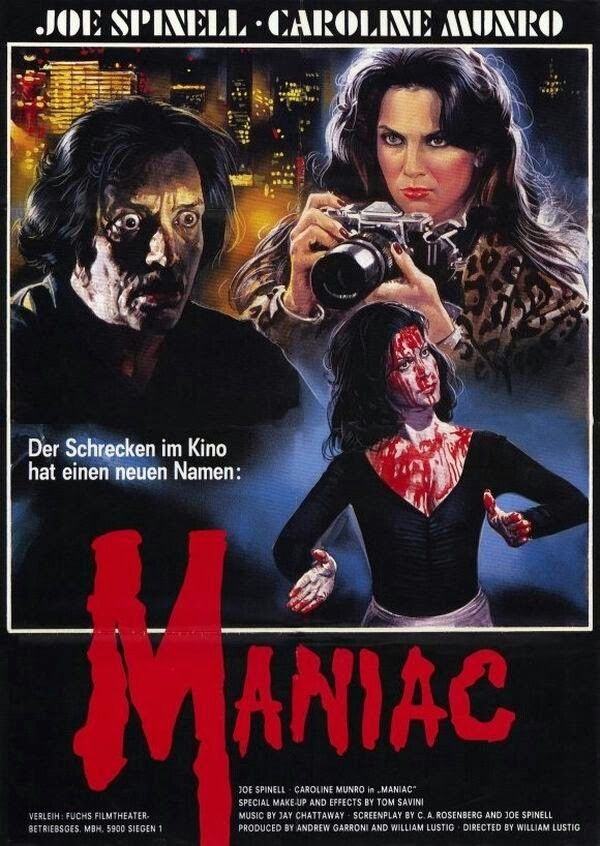
William Lustig took the profits from 1977’s Hot Honey to make this guerilla shot piece of sleazy, slimy slasher brilliance. The other money came from half of star Joe Spinell’s salary from Nighthawks and British producer Judd Hamilton came up with the rest of the money (around $200,000) with one condition: his then-wife Caroline Munro would be the heroine.
Originally, her role was to be played by Daria Nicolodi, but she was unable to go to New York for filming because she was still filming her scenes for Inferno in Italy. Supposedly, Susan Tyrrell and Jason Miller were both going to be in the movie too.
Just to give you an idea of how outlaw this movie was, for the scene where Frank Zito — the film’s titular maniac — kills Tom Savini in a scene inspired by the Son of Sam, Savini had a cast waiting filled with blood and leftover food. He blasted it with a live shotgun, threw it in the trunk of assistant Luke Walter’s car and they all drove off. No permits. No asking for permission. No prisoners.
PS — That body that gets its head blown off? Its name was Boris and it also shows up in Dawn of the Dead. After this movie, According to Savini, it was locked in the trunk of the car used in the shotgun scene and both were sunk in the East River.
Maniac is nothing without Spinell, whose rantings and maniacal look lend this movie its soul, as gross and covered with muck as it may be. He was abused by his prostitute mother and has turned his rage into a need to destroy women. He does so in all manner of ways, always ending up by scalping them and placing their hair on the mannequins he keeps in his squalid apartment.
This movie is everything horrible that everyone ever told you that horror movies were. It has no redeeming qualities or pretentions to art. It’s as rough as it gets, like Pieces if that movie wasn’t so funny.
Believe it or not — this is a positive review.
I’ve always held off from watching this movie but I’m glad I did. Spinell was nothing short of brilliant in everything I’ve ever seen him in and this one just keeps that trend going. I love him in Cruising, Nighthawks and the Rockyfilms.
The only strange thing to me is how Anna (Caroline Munro!) is willing to be in the same orbit as Zito. It’s a small point. After all, they did three movies together (Starcrash and The Last Horror Film are the other two).
Abigail Clayton, who plays a victim named Rita, was an adult actress who successfully moved into mainstream roles. Sharon Mitchell also shows up as a nurse, as does Carol Henry (Bloodsucking Freaks), Hyla Marrow (also in Lustig’s Vigilante), Rita Montone (who was in Bloodsucking Freaks and The Children) and Kelly Piper (Rawhead Rex and Vice Squad),.
Maniac was a green movie, as it recycled two big things from past films: you can spot the headless corpse of Betsy Palmer from Friday the 13th in Zito’s hovel and the helicopter shots were taken from Argento’s Inferno.
This was remade in 2012, but I still haven’t seen that yet. I kind of don’t want to ruin the power of this movie, a film so strange that it’s not even sure of the fate of its main character even as the film draws to a close.
You can watch this on Vudu and Shudder. Also, Blue Underground — Lustig’s company — has an incredible 3-disc version of this that is the last word on the film, at least until we can beam movies directly into brains.
Pittsburgh is more than just my hometown. If you believe a source as vaunted as Joe Bob Briggs, we’re also the birthplace of modern horror, thanks to George Romero and friends creating Night of the Living Dead right here (well, actually Evans City, 45 minutes north of the city).
Horror may have laid dormant for a decade or so, but the 70’s and 80’s were packed with genre defining creations made right here in the City of Bridges. There’s Dawn of the Dead, Martin and Day of the Dead just to name a few.
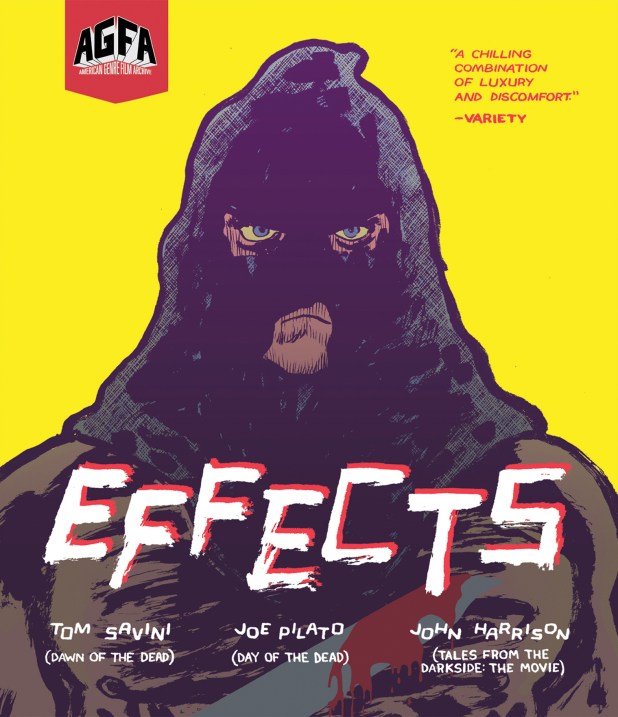
Then there’s the 1980 fim Effects, made by several of Romero’s friends and all about the actual process of making a scary movie and the philosophy of horror. Much like every fright flick that emerged from the Steel City — let’s not include 1988’s Flesh Eater, a movie I’m not sure anyone but S. William Hinzman has any pride in — it goes beyond simple shocks to delve into the complex nature of reality, man’s place in the world and what it means to be afraid.
Pittsburgh is also a complex city, one that started last century as “Hell with the lid off,” died in the late 1970’s and rose, much like the living dead, to become a hub for tech many years later. Effects is a document of what it once was decades ago and holds powerful memories for those that grew up here.
Joe Pilato (Captain Rhodes from Day of the Dead) stars as Dominic, a cinematographer who has travelled out of the city to the mountains — around here, anything east of the city is referred to as “going to the mountains” — to be the cameraman and special effects creator for a low-budget horror movie.
In case you are from here, he’s going to Ligionier. For the rest of the world, imagine a rural wooded area, the area where Rolling Rock beer once came from — yes, I know it’s Latrobe yinzers — Anheuser-Busch bought it, moved the plant to Newark, New Jersey and stopped making it in glass lined tanks. As a result, it now tastes like every mass produced beer out there. It’s also a place with a Story Book Forest theme park.
I tell you that to tell you this — imagine a team of horror maniacs descending on this quiet little town to make a movie about coked up psychopaths making a snuff film in the woods.
Director Lacey Bickle (John Harrison, who created the music for many of Romero’s films and directed Tales from the Darkside: The Movie) is a strange duck, one who wants to push his crew to film scenes days and nights.
Luckily, Dominick meets Celeste, a gaffer who is disliked by the rest of the crew. They quickly fall in love at the same time as our protagonist discovers that an entirely different film is being made, one whose special effects don’t need any technical wizardry. As secret cameras begin to roll, what is real and what is Hollywood by way of Allegheny County wizardy?
Dusty Nelson, Pasquale Buba, and John Harrison — the three main filmmakers — all met at public TV station WQED, the home of Mr. Roger’s Neighborhood and all worked together on the aforementioned Martin. Inspired by their work on that film, they started an LLC and raised $55,000 from friends and family to make this movie.
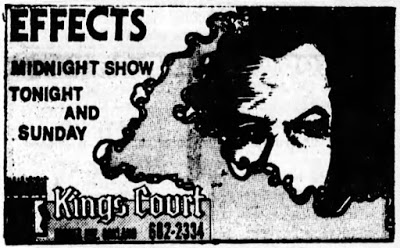
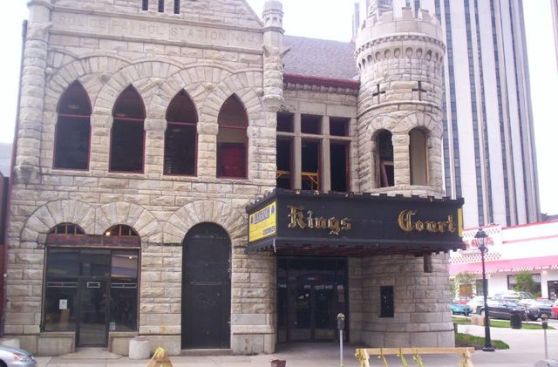
Due to a distributor problem, Effects was never released in theaters or on home video. It’s lone theatrical screenings were at the U.S. Film Fest — which is now the Sundance Film Festival — and it had its world premiere at the Kings Court theater in Oakland, right down the street from Pitt, on November 9, 1979.
According to the website Temple of Schlock, Effects was picked up by Stuart S. Shapiro, a distributor who specialized in offbeat music, horror and cult films like Shame of the Jungle and The Psychotronic Man. His International Harmony company distributed the film, but it played few, if any, theaters. Shapiro would go on to create Night Flight for the USA Network. In October 2005, Synapse would finally release this film on DVD for the first time ever.
Pittsburgh is a lot different now. The Kings Court, once a police station turned movie theater transformed into the Beehive, a combination coffee shop movie theater, is now a T-Mobile store, a sad reminder that at one time, we rejected the homogenization of America here in Pittsburgh. Nowehere is this feeling more telling than at the end of this film, where the movie within a movie has its premiere on Liberty Avenue. Now in the midst of Theater Square, this mini-42nd Street went the very same way, with establishments like the Roman V giving way to magic and comedy clubs. As a kid, when my parents drove down this street, I was at once fascinated and frightened by dahntahn. But no longer.
You can also get the AGFA blu ray release of this from Amazon. It’s made from a rare 35mm print that was made before the distributor backed out. You can also watch this on Shudder.
Kevin Connor directed the Amicus-produced From Beyond the Grave, as well as several fantasy films for that studio and others in the 1970’s that included The Land That Time Forgot, At the Earth’s Core, The People That Time Forgot, Warlords of Atlantis and Arabian Adventure. It was almost made by Tobe Hooper, which seems like the kind of urban legend that follows so many late 70’s and early 80’s horror movies.
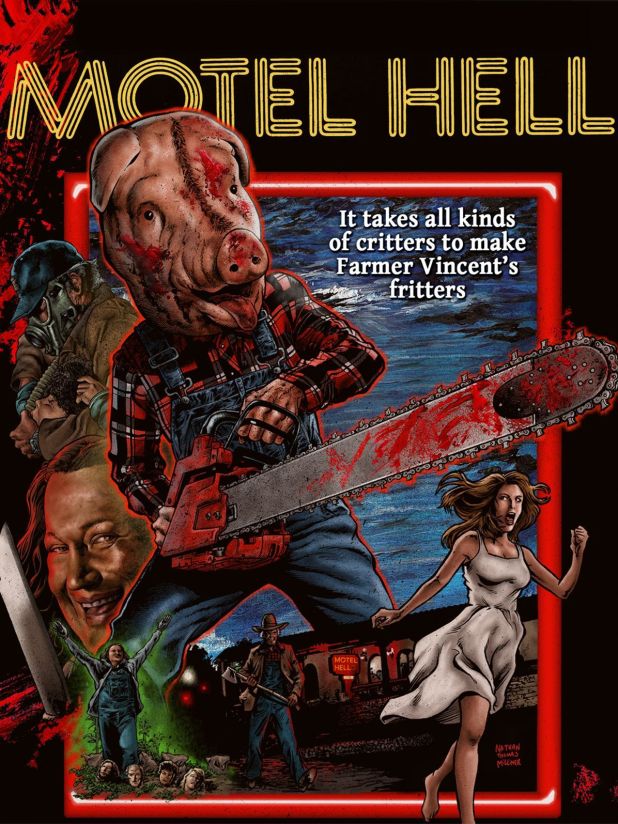
That brings us to Motel Hell, which arrived as the slasher boom was about two and a half years in. While this was intended as a serious film at one point, it certainly ended up anything but.
It was shot at the Sable Ranch in Santa Clarita, California, the same location where The Devil’s Rejects, The Lords of Salem, Hatchet and many more films were lensed.
Farmer Vincent Smith (cowboy actor Rory Calhoun) and his sister Ida (Nancy Parsons, Beulah Ballbricker from the Porky’s series) own a farm with the Motel Hello on the grounds. Their smoked meats are famous everywhere, because as the tagline says, “It takes all kinds of critters to make Farmer Vincent’s fritters.”
That’s because — no spoiler really — they’re human flesh. The farmer sets traps, catches drivers on the roads nearby, cuts their throats and then buries their bodies in his secret garden until they’re ready for harvest.
One of those victims is a motorcyclist named Bo, who is buried deep while his girlfriend Terry (Nina Axelrod, Roller Boogie) is taken to the motel. After being told her man is dead, she settles in and is unsuccessfully wooed by Sheriff Bruce (Paule Link, TV’s CHiPs and Grand Theft Auto). Much to Bruce’s chagrin, she seems attracted to his brother, Farmer Vincent.
Meanwhile, our protagonist — I guess Farmer Vincent is the kinda sorta lead of this — is luring in more victims via wooden cows that cause accidents and ads in swingers magazines. Soon, he decides to teach Terry how to smoke meat, which causes Ida to go bonkers and attempt to drown the young girl. Vincent saves her, she falls head over heels and instead of having sex — as she hoped — he asks her to marry him. She agrees.
Bruce tries to protest, saying that his brother is simple and has syphilis of the brain, but Vincent chases him off with a shotgun. That causes him to start to investigate all of the disappearances.
After a champagne toast, Terry passes out due to her spiked drink and our brother and sister tea, start prepping the wedding feast. As they head to the slaughterhouse, Bo gets loose and frees the other people planted in the garden. And as Vincent tells Terry his secret recipe, she freaks out.
What follows is slasher movie history, as Farmer Vincent dons a pig’s head and duels his brother with chainsaws before dying, gasping out that he was a hypocrite for using preservatives. As the survivors leave the farm, the sign finally malfunctions, leaving behind the words Motel Hell.
There are plenty of great secondary players in this, from radio DJ turned entertainment personality Wolfman Jack as a TV evangelist named Reverend Billy to Elaine Joyce (Ragman’s mother in the slasher par excellence Trick or Treat), Monique St. Pierre (November 1978 Playboy Playmate of the Month and 1979 Playmate of the Year who is also Cerce in post-nuke treat Stryker), Rosanne Katon (September 1978 Playmate of the Month, also in Bachelor Party and the Swinging Cheerleaders before leaving acting behind to do stand-up comedy, raise her autistic son to be an expert cellist and working with her husband to do good around the world with Operation USA, which supplies relief to areas impacted by natural disasters and poverty) and a rock band that has John Ratzenberger (yes, from Cheers but also from House II) in it.
For some reason, old Hollywood actors often show up in slashers. Jackie Coogan, whose career stretched from silent films to playing Uncle Fester on The Addams Family to, well, The Prey appears in this, his last film. Coogan also was the reason for the California Child Actors Bill, the first known legal protection for the earnings of child performers, which is better known as the Coogan Act.
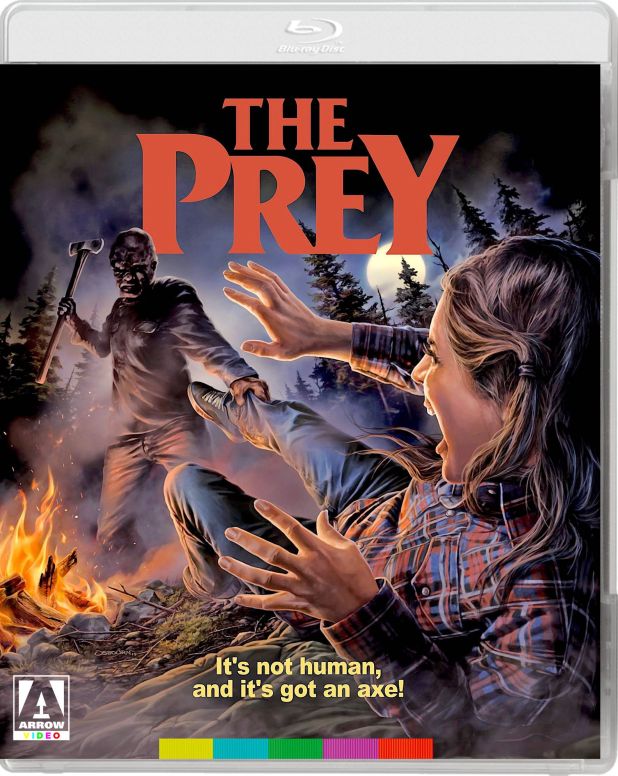
The Prey didn’t play theaters until nearly four years after it was made. It was created by the husband and wife team of Edwin and Summer Brown, who had previously worked on the video nasty Human Experiments. This was their first non-adult movie.
Back in the late 1940’s, a fire raged through the Rocky Mountains and wiped out a family of gypsies that all lived in a cave. Of course, one of them survived.
It all starts with two old people getting killed as they cook around a campfire. Then, the film alternates between an increasingly intense pace and long stretches of nature footage that was supposed to prove the difference between killer and his prey, but also padded the film so it had a decent run time.
Let’s meet our teen couples. There’s Nancy and Joel, played by Debbie Thureson and Steve Bond, who we all know better as Travis Abilene from Picasso Trigger. Here’s Bobbie and Skip, played by Lori Lethin from Bloody Birthday and Robert Waid from Summer Camp. Finally, we have Greg and Gail, who are played by Philip Wenckus in his lone acting role and Gayle Gannes from Human Experiments.
They’re helped on their camping trip by hunky ranger Mark O’Brien (Jackson Bostick, Shazam! himself!) and crusty older ranger Lester Tole (Coogan). Gail’s convinced before too long that someone is watching them and before you can say Jason Vorhees, she’s dead and so is Greg.
That burned up gypsy boy goes after everyone with a real vengeance, including a scene where he leaves Gail and Greg’s bodies for the vultures, a moment that’s poignantly intercut with the group’s first meeting.
I love the ending of this film, where it feels like Ranger Mark has taken out the clawed and disfigured killing machine, only to have his neck snapped as if it were nothing. Then, the killer slowly approaches Nancy and caresses her hair.
After some nature footage — get ready for so much nature footage — we move several months into the future, where we see the cave where the killer’s family died in the fire and hear the cries of a baby. Now that’s dark.
The monster in this is played by Carel Struycken who would go on to play not just Lurch in the modern Addams Family movies, but also the Giant in Twin Peaks.
You can grab the Arrow Video re-issue of this film from Diabolik DVD. It’s packed with all manner of extras, from cast Q and A’s to a tour of the shooting locations. It even has two cuts of the film: the U.S. theatrical cut and the so-called gypsy cut with the extended beginning. You can run a composite cut of the film so you get the ultimate version of the film. Plus, there’s an audience reaction track from this year’s Texas Frightmare so that you can pretend you’re sitting with a rabid crowd!
Seeing as how this was shot around the same time as Friday the 13th, it may have been seen as imitator when originally released, but it totally stands on its own. After all, what movie has a better tagline? “It’s not human and it’s got an axe!”
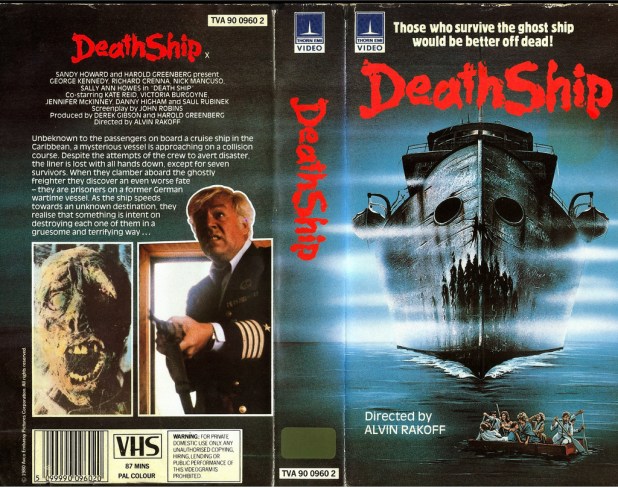
Alvin Rakoff is a Canadian television, stage, and film director who has spent most of his career working in England. This is the lone horror film on a resume that includes more than a hundred television works. It’s certainly not the only horror film on the IMDB list for co-writer Jack Hill, who wrote and directed Spider Baby, as well as Switchblade Sisters, Foxy Brown, Sorceress and so many more.
Imagine if you will — a combination of a slasher and The Shiningon a boat. That’s probably how this got sold, with a logline just like that.
Captain Ashland (George Kennedy, who as we all know will never turn down a role. Sadly, this is not his worse cruise ship film, as he’d save that honor for Uninvited, a film in which he battles a genetically altered housecat on a drug dealer’s boat) is on his final voyage around the Caribbean, a fact that makes him angry about life in general. His replacement, Trevor Marshall (Richard Crenna) tries to connect with him, but it isn’t happening. Also: Marshall never got that old salty sailor memo about wives being bad luck on ships.
Before the movie even gets out of port, a black freighter appears and sinks the ship, leaving a small band of survivors in a rescue boat. Don’t get to know many of them all that well — they’re fodder for the slasher gods.
Beyond Marshall and the captain, there’s Marshall’s wife Margaret (Sally Ann Howes, who played Truly Scrumptious in Chitty Chitty Bang Bang. Seriously, was Ian Fleming the most ridiculous, the most sexist or the most ridiculously sexist namer of female characters ever? I can almost see him sipping on tea and saying, “I’m going to name her Scrumptious. Truly Scrumptious.”) and kids, Robin and Ben. As the movie moves from scare to scare, Ben is truly the little engine that moves this death ship onward, all because he can’t stop peeing. Seriously — 90% of this movie is this kid looking for a place to piss and then getting lost and leading others to their doom.
There’s also a young officer named Nick (Nick Mancuso, following “The Danza” trope here; he’d go on to be in TV’s Stingray and play the improbably named Antichrist Franco Macalousso in an extension of the Left Behind franchise) and his girl Lori, as well as an older passenger named Mrs. Morgan and the ship’s comedian, Jackie (Saul Rubinek, who was in True Romance and SyFy’ Warehouse 13).
They all managed to find their way on to the black freighter — no, not the one from Watchmen — and instantly Jackie the funnyman is grabbed by a cable, held aloft and repeatedly dunked into the ocean until he’s swept away. Jackie didn’t seem like all that popular of a crewmember, because the attempts to rescue him are laughable in their half-heartedness.
In the midst of all these shenanigans, the captain meets the Nazi ghosts that run the ship and — shades of the aforementioned Kubrick film which came out the very same year — he becomes the new captain of the ship, doing fun things like menacing children and strangling old women. He even manages to find an old Kriegsmarine officer’s uniform, a fact that no one really finds as troublesome as it should be.
This being a slasher, we’re going to need some nudity and plenty of blood. A scene where Lori takes a shower — I love this character choice, made in the midst of a once-trusted captain going full on bonkers and Nazi ghosts singing in the hallways — that turns into a bloody deluge before she’s casually tossed into the drink. She’s soon followed by her lover, Nick.
Of course, the family gets away and we’re treated to the image of George Kennedy getting ground up in the gears of the ship. Speaking of ship parts — if you play the drinking game that involves having a drink every time b-roll footage of the ship’s engine room is shown, you’ll die faster than any character in this movie. Some of that footage — including the actual flooding of the ship — comes from 1960’s The Last Voyage. There’s also some footage cribbed from the 1970’s remake of King Kong!
The actual death ship used for this movie broke down in the first hour of filming, so any of the shots of it cruising through the ocean are all trick photography. That’s probably the best thing I can say about this movie, other than after watching a scene where George Kennedy is blasted full in the face with sewage for an extended period of time, I really felt for him. He had kids — and grandkids and ex-wives — to feed, so he gamely just stood there and took it right in the kisser. God bless you, George. PS — he also played Captains in three other films: Police Captain Ed Hocken in the Police Squad series, a captain in the movie Mean Dog Blues and mechanic Joe Patroni, who eventually became a captain for the truly baffling The Concorde … Airport ’79). Before you say that’s typecasting, please know that Kennedy was a captain in the U.S. Army, serving for 16 years before retiring due to a back injury. He actually broke in to Hollywood as a technical advisor on The Phil Silvers Show.
You can watch this for free on Tubi or get the blu ray from RoninFlix.
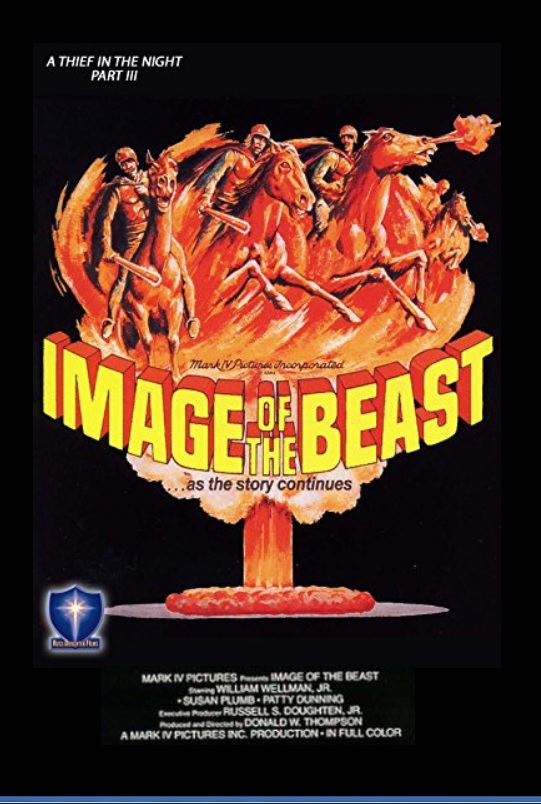
This is the third of a series of films that began all the way back with A Thief In the Night. After two movies that focused on Patty, this movie brings in David, who is a Christian guerrilla battling the UNITE forces. While the first two films just dealt with the beginning of the end times, this one goes all in and goes completely wild, bringing in all manner of sheer lunacy as the Antichrist ruses and God begins to reign his fury on the sinful men and women left behind.
The beginning of this film is probably the tensest of all of the series, as it begins with a young couple shopping for groceries with Patty — remember our old friend Patty who pretty much as a goner in the last two endings? — checks them out. They discuss a Beverly Kay book on Biblical prophecy and computers and how scary it all is before we smash cut back to the end of A Distant Thunder with Patty goes to get her head cut off. Run-on sentence much? Well, with this movie, you have to!
While Patty is waiting to die, an earthquake hits and she’s trapped, all alone, with each tremor of the earth making the blade one step closer to decapitating her. It’s harrowing and well-shot, ending only when Patty gives and begs to be given the Mark and the blade chops her head clean off. The moral of Image of the Beast is such: God is done fooling around.
It’s time for a new hero in this film, who would be Kathy, who joins Leslie and David Michaels, our aforementioned freedom fighter who just killed an officer in self-defense and stole his uniform. They escape in a jeep but Leslie is shot, so our other two heroes and Kathy’s son spend the night sleeping under the car because that’s exactly what you do in the post-Rapture. In the morning, the precocious kid runs right into Reverend Turner (Russell Doughten, the dude behind all of this).
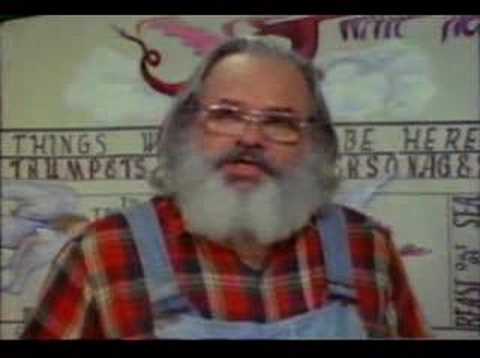
If you missed the last two movies, Turner was Patty’s old pastor who failed to preach the message that God wanted and is now left behind. He’s living a sweet Apocalyptic life, what with his farm, an apple tree and biggest and raddest map of how the end of all things will unfold.
That’s when everyone gets the plan that will take up the bulk of this movie: Fake Marks that work on the gigantic UNITE computer and allow our heroes to eat while they try and hack into said computer. Being that this was made in 1980, a lot of said hacking is done with calculators, pencil and paper. There’s also a subplot of the BUMS (Believers Underground Movement Squad) trying to find the Christians and take them to get their heads cut off. Of course, Jerry and Diane Bradford from the first two movies are in said group of villains.
I wonder — did PreMillenialist Dispensationalism Christians have a convention where they all decided that the UPC code was bad and that guillotines would be the weapon of choice for the UN?
There’s also the hint at the end of this movie that giant locusts have descended on the Earth, which would be awesome to see. And at the end, David sends a kid to his death and walks to the guillotine rather than take the Mark. There’s also a nuke that gets dropped.
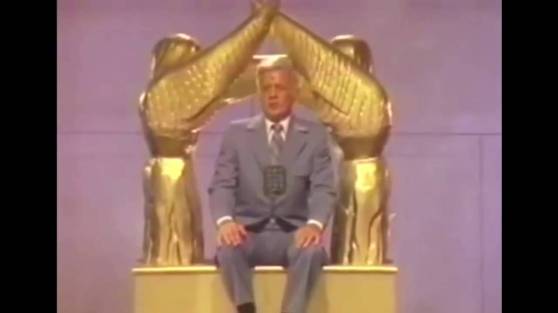
My wife tried to watch this with me and when I was telling her how the stories of the Antichrist coming back to life and the prophets being killed and rising from the dead and the talking statue were all really in the Bible, she just left the room rather than deal with the realization that her husband was insane when he was a small child, often highlighting his Bible and looking up the exact passages to try and figure out when the end would come so he would be ready.
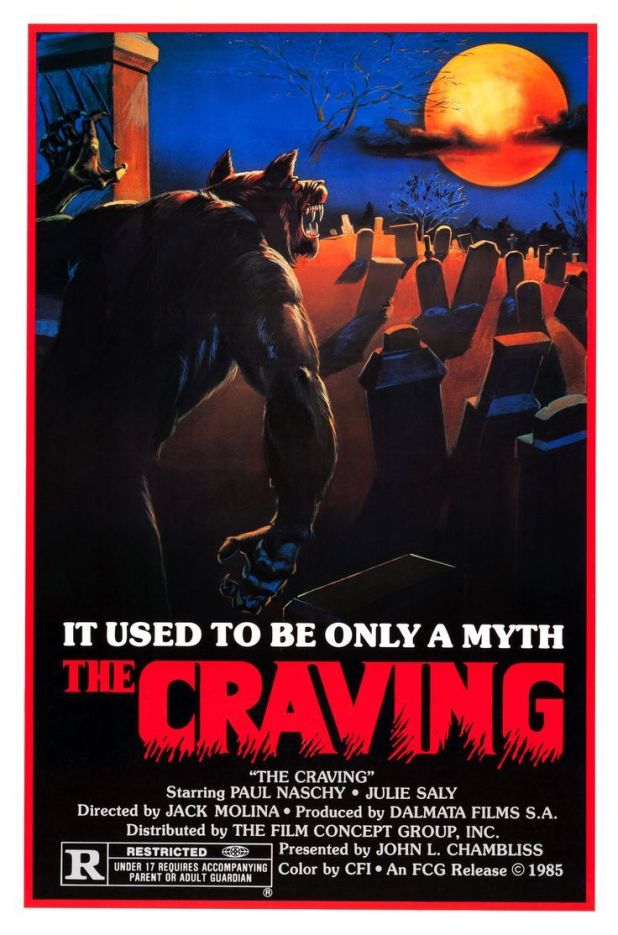
The ninth movie in the saga of Count Waldemar Daninsky — as always played by Paul Naschy — this movie wasn’t released in the United States until 1985 when it was renamed from its original title, El Retorno del Hombre Lobo (The Return of the Wolfman). The last Naschy movie to play the U.S. theatrically, it’s also been released here on DVD and blu ray as Night of the Werewolf.
Naschy has gone on record saying that this was his favorite Hombre Lobo film and considered it a remake of his 1970 effort La Noche de Walpurgis (Walpurgis Night).
Waldemar Daninsky is sentenced to be executed along with a number of witches, including Elizabeth Bathory. He actually prays for his suffering to end, but it’s nearly impossible to truly kill him. That means the authorities have to pretty much bury him alive, with a silver dagger piercing his heart and an iron mask to keep him from biting anyone dumb enough to let him loose.
Of course, that’s exactly what happens centuries later when the dagger is removed. That said — it’s just in time, as Bathory is back and needs to be stopped. Oen of the women that Daninsky meets in our time — Karin — will become his great love, but if you’ve watched any Spanish werewolf movies, love is often doomed to mutual death and funeral flames.
This higher budgeted effort — created by Naschy’s own Dalmata Films — failed to score in foreign markets and spelled doom for its studio. That’s a true shame, as it’s probably the best looking version of Naschy’s werewolf vision.
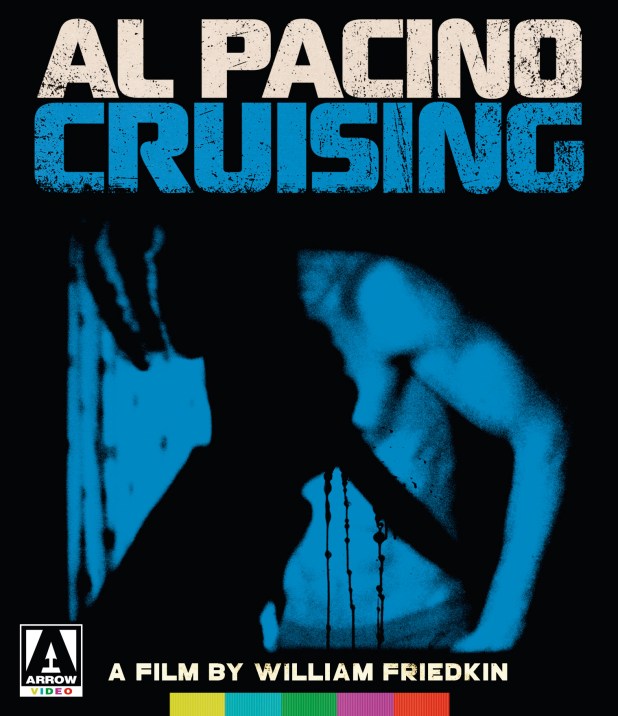
Despite being approached several times with New York Times reporter Gerald Walker’s 1970 novel Cruising, William Friedkin (The Exorcist, Sorcerer and perhaps not as successfully, Jade) wasn’t interested. He changed his mind after an unsolved series of murders in New York’s leather bars.
Articles by Village Voice journalist Arthur Bell and NYPD officer Randy Jurgensen helped inform this film. The latter went into the same deep cover as this film’s protagonist, Steve Burns. Then, Friedkin learned that Paul Bateson, a doctor’s assistant who appeared in The Exorcist, had been implicated in the crimes while serving a sentence for another murder.
Friedkin did some of his research for the film by attending gay bars dressed in only a jockstrap, but by the time the movie began filming, he had been barred from two of the most oversized bars, the Mine Shaft and Eagle’s Nest, due to the controversy surrounding the movie.
Much like The New York Ripper and God Told Me To, this movie feels like one set at the end of the world — New York City near the close of the 20th century. Someone is picking up gay men, murdering them and leaving their body parts in the Hudson.
Officer Steve Burns (Al Pacino)—exactly the type of man the killer has been after—is on the case. Captain Edelson (Paul Sorvino) has assigned him to infiltrate the foreign world of S&M and leather bars. However, as the case progresses, he begins to lose himself and his relationship with Nancy (Karen Allen).
Soon, he learns of just how brutal the NYPD is to gay men — even if they’re just suspects. And he finds himself growing closer to his neighbor Ted (Don Scardino, Squirm).
By the end, nothing is truly clear. While the killer may be Stuart Richards, a schizophrenic who attacks Burns with a knife in Morningside Park, it could also be Ted’s angry boyfriend Gregory (James Remar). After all, Ted’s mutilated body is discovered while Stuart is in custody. Or the real killer is still out there — perhaps he’s even a patrol cop (Joe Spinell). The truth is never told.
Spinell is incredible in this, which is no surprise. He used his real life for inspiration, as there’s a line about his wife, Jean Jennings, leaving him and moving to Florida with his daughter. His wife had just done exactly that before this movie was shot.
The actual version of this movie may never be released. Friedkin claims it took fifty rounds to get the MPAA to award the film an R rating. Over 40 minutes of footage was cut, which consisted of time spent in gay bars. The director claims that these scenes showed “the most graphic homosexuality with Pacino watching and with the intimation that he may have been participating.”
This footage also creates another suspect — Burns himself may have become a killer.
When Friedkin sought to restore the missing footage for the film’s DVD release, he discovered that United Artists no longer had it and may have even destroyed all the cut footage.
In 2013, James Franco and Travis Mathews released Interior. Leather Bar is a metafictionalized account of the two filmmakers’ attempts to recreate the lost 40 minutes of Cruising.
There’s a disclaimer at the start that says, “This film is not intended as an indictment of the homosexual world. It is set in one small segment of that world, which is not meant to be representative of the whole.” Years later, Friedkin would claim that MPAA and United Artists required this, hoping that it would absolve them of the controversy that had been all over this production.
That’s because protests had started at the urging of gay journalist Arthur Bell, the aforementioned Village Voice writer whose series of articles on the Doodler’s killing of gay men inspired this movie. There were numerous disruptions to the filming, as protesters blasted music and loud noises at all filming locations, leading to hours of ADR to fix the ruined dialogue.
Arrow Video has released a spectacular new Blu-ray of this film. This is no surprise — Arrow always has excellent releases.
This release features a new restoration from a 4K scan of the original camera negative, supervised and approved by writer-director William Friedkin, and audio commentary from the 2007 DVD. The two features from that release, The History of Cruising and Exorcizing Cruising, are also on the disc.
What else can be said about The Shining that hasn’t been said before? How many times have I personally seen this film and what can I do to add to the conversation? That’s why I held off on writing anything about it, but after watching the new 4K version of the film at the Carnegie Science Center’s Rangos Giant Cinema — which features a 70-by-38-foot Certified Giant Screen, two industry-leading Christie® laser-illuminated 4K laser digital projectors and a premium Dolby Atmos®surround sound system with 45 speakers — I felt like I saw it again for the first time.
When projected across a screen that large, even the smallest moments in this film take on a dizzying new life. From the initial lone drive through the trees and mountains to the Overlook to being able to see every pore of skin on faces in the film’s numerous close-ups, the perceptions of the way that you traditionally view this film have been changed, which enables you to see it differently. Stephen King has famously hated the places that writer/director Stanley Kubrick took his story, even as this year’s Dr. Sleep will be presented as a sequel to both the King book and in canon with Kubrick’s visionary masterwork.
The issue that King has always had is that Jack Torrance (Jack Nicholson) is evil right from the start of this film instead of being driven mad by whatever lurks inside the gigantic hotel. King was struggling with alcoholism as he wrote the novel, so you can understand how personal it is to him. He felt that the two main themes of the book — the disintegration of family and the dangers of alcoholism — aren’t really present in the film.
He also had issues with the casting of Nicholson, reasoning that audiences wouldn’t be surprised when he’d go over the edge, and disliked the way Shelley Duvall played Wendy, saying, “She’s basically just there to scream and be stupid, and that’s not the woman that I wrote about.”
He’s also gone on record about how the movie downplays the supernatural and I think that that claim is bogus. If anything, the movie is more otherworldly, presenting a place where even the physical space of the hotel cannot be trusted. He said, “What’s basically wrong with Kubrick’s version of The Shining is that it’s a film by a man who thinks too much and feels too little; and that’s why, for all its virtuoso effects, it never gets you by the throat and hangs on the way real horror should.”
I must have been watching the wrong film all these years.
That said, like any movie worthy of being watched multiple times, The Shining has all manner of explanations for what it’s really about: the history of America, the Holocaust, the treatment of Native Americans, Kubrick’s role in the mission to the moon and so on. I’m always struck by the nature of duality: the past caretaker named Grady followed the same path that Jack is on — and he’s always been at the Overlook and if we follow the photo at the end, so has Jack — but they have also both had a moment where they could change their destinies. Yet was their destiny to just be the monster? In King’s book, Jack becomes that monster. In Kubrick’s, to quote Laura Miller’s interpretation, the director is the monster, guiding his characters toward a conclusion while watching them in the same way that Jack watched his wife and child in the maze, from above, as if they were insects.
To back this up, there’s the fact that Nicholson and Duvall have expressed open resentment against the fact that Kubrick received sole credit for the film’s success above and beyond the efforts of the crew and the actors. Nicholson has gone on record saying that Duvall’s performance is the most difficult he’s ever seen an actress take on.
That may be because of Kubrick’s mercurial nature. For the scene where Jack finally breaks through the door with the axe, there were hundreds of takes and over sixty doors used over three days of filming. Sure, it’s an iconic scene, but that many takes had to ruin nerves. And the scene of blood coming out of the elevators took an entire year to get right.
There’s also an interesting duality in the difference between Jack in the book and in the movie. Book: a man struggling to remain sane; movie: an insane man struggling to seem sane. Duality is an intriguing concept when it comes to film, as the set of one movie is often the same set in another. For example, The Shining‘s Colorado Lounge is also the Well of Souls from Raiders of the Lost Ark. And much of the fake snow made for this movie ended up on Hoth in The Empire Strikes Back.
Even more duality — composer Walter Carlos was transitioning to become Wendy Carlos as this film was being made. As a kid, when I’d go through my father’s many Moog and synth albums, I always wondered if they were married or brother and sister. I didn’t learn the truth until I was older.
Fueling even more strangeness is the fact that this is also a movie with three unreliable narrators. Jack, Wendy and their son Danny are all trapped within a place that warps reality and presents images that may or may not be real. Jack is seeing these visions through the eyes of madness; Wendy through her cabin fever and Danny as a child interprets the reality of adults.
The unsung hero of all of this is Scatman Crothers, who had a rough time on the film, often needing a hundred takes for each scene. If you ever watch Vivian Kubrick’s documentary Making The Shining, you can see just how emotional he is. When he moved on to make Clint Eastwood’s Bronco Billy as his next film, he broke down in tears of gratitude on his first scene in the film. Eastwood, famous for often only needing one take, had to be such a welcome relief for Scatman. Yet even in the briefest of scenes that he appears in, he owns the moment, even when juxtaposed with the acting power of the two leads. He’s also the only objective adult voice in the film — you can argue that every single other person inside the hotel could be a figment of the imagination.
As a writer by trade, however, I often see Jack as a sympathetic character. My wife continually tells me that I react like him to interruptions, but to anyone that doesn’t know the sheer terror of writer’s block and the amount of time that it takes to feel ready to write and that inspiration takes hold, anything that gets in the way honestly feels like the worst physical pain possible. The Shining is one of few depictions of this feeling I’ve ever seen that gets it right. And even when you write your heart out, often it just looks like the same words written on a page over and over and over to the uninitiated. Nicholson said that when Jack snaps at Wendy, that scene hit home. He’d often been in a similar situation when girlfriends had interrupted him and drew on those feelings when he added the line that makes this scene sing: “If you come in here and you DON’T hear me typing, if I’m in here that means I’m working!” Writing isn’t just the actual act of putting the words down. I feel like I’m in the throes of writing, editing and dealing with how people react to my words on an endless cycle.
Even the keys of the typewriter are authentic, with the actual sounds of the keys typing “All work and no play makes Jack a dull boy” being hammered out. Kubrick’s assistant spent months typing and retyping those words without the aid of a Xerox machine. And in each country, different words are used:
Italy: “Il mattino ha l’ oro in bocca,” which means “He who wakes up early meets a golden day.”
Germany: “Was Du heute kannst besorgen, das verschiebe nicht auf Morgen,” which says “Never put off until tomorrow what you can do today.”
Spain: “No por mucho madrugar amanece más temprano” or “Rising early will not make dawn sooner.”
France: “Un ‘Tiens’ vaut mieux que deux ‘Tu l’auras’,” which translates to “A bird in the hand is worth two in the bush.”
However you see The Shining, whatever your interpretation, I feel that you are correct. Works of true art and vision are able to do this, to take on the feelings and emotions of the viewer and reward others with your interpretation.
Kyle Hanson (Dirk Benedict, Body Slam) spent eight months as a POW and stuck in the jungle, never speaking, which left him a damaged man, unable to adjust to life back at home. When he passes through a small town, local bullies harass him, which he easily handles, but things spiral out of control when local deputies and the townies just can’t let him be.
Only one person, Jenny Bellows (Blair) understands. She’s the daughter-in-law of Sam Bellows (Ben Johnson, The Town That Dreaded Sundown), the richest man in town. His son was killed in action during the war, but his body hasn’t been found yet. Instead of the rich guy being the villain here, he’s actually one of the most sympathetic people in the picture.
Jenny brings Hanson out of the darkness, but after being attacked by local bullies and the police time and time again, Hanson claims a small island. Only the intervention of Sam stops the carnage, as they decide that Hanson can keep the land for himself.
Richard Farnsworth plays the only good cop in the film. You’ll remember him from a ton of movies, like him playing Buster in Misery, as the lead in David Lynch’s The Straight Story and as Red in The Natural.
I was struck by this film’s similarities to the first Rambo film, First Blood. That may not be a total coincidence. The original rights the David Morell’s novel that First Blood was based on spent a decade making the Hollywood rounds, went through 10 years of passing hands before culminating in the 1982 Sylvester Stallone film, so this movie could have been based upon that script. There are parts that are just too close to believe otherwise.
This movie is a million times better than I thought it was going to be. It’s pretty entertaining and I’m surprised that it isn’t discussed more. Director Max Kleven would go on to work with Blair again in the film W.B., Blue and the Bean. A stuntman by trade, the supporting cast is filled with his fellow daredevils, all of whom go all out to deliver some great action. Dirk Benedict did the gool ol’ Bandit thing, again, with Terry “Berlin” Nunn and the “hot” country singer Tanya Tucker, in The Georgia Peaches, which was a TV movie pilot for a failed series. But after the failure of Chopper One (the one Aaron Spelling series that didn’t become a success) and Battlestar Galactica, Dirk did alright with The A-Team.
The Ruckus soundtrack is packed with a mix of songs by Willie Nelson and Hank Cochran, along with Janie Fricke singing a few of them. It’s the perfect music, including the song “Ain’t Life Hell.” Ruckus also has some great alternate titles, like The Intruder of Madoc County, Big Ruckus In a Small Town, The Devastator, Eat My Dust, Destructor, The Loner and Ruckus in Madoc Country. For example: Some regional newsprint ads carried The Loner title; the national TV ads ran as Ruckus, and The Loner title was used when it ran on HBO, but UHF-TV channels carried it as Ruckus.
Here are some of the amazing posters discovered that place it across a variety of genres, from Smokey-style car race fun to Rambo-esque military vengeance. It’s truly amazing how one movie could play to so many styles and audiences.
You can check out the poster for Ron Howard’s Eat My Dust and see how similar it is to the Eat My Smoke version (seen below). There was also art work swapping done with Jack Starlett’s Kiss My Grits, which was also cross-marketed as a comedy, action, and steamy adult thriller. During our “Linda Blair Retrospective” feature, we pointed out the artwork theft from Micheal Sopkiw’s Blastfighter and Mark Gregory’s Afghanistan: The Last War Bus, aka War Bus Commando, for Ruckus: a war movie starring Dirk Benedict, Michael Sopkiw, and Mark Gregory—and Linda Blair in a cameo as a kidnapped American oil heiress—is in order! Now that’s an exploitation film.
A COMEDY!
ACTION! Artwork ripped from Michael Sopkiw’s Blastfighter, but also used for Mark Gregory’s Afghanistan: The Last War Bus, aka War Bus Commando.
U.S Ruckus poster artwork refitted for the overseas, Middle East markets.
Gotta make it look like Smokey and the Bandit, while ripping off Eat My Dust.
You must be logged in to post a comment.