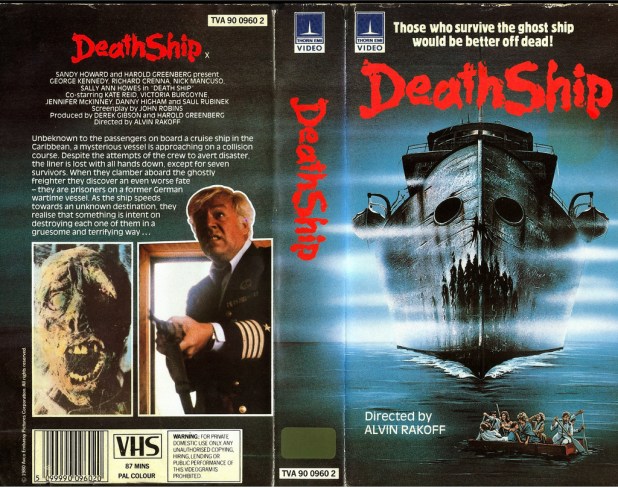
Death Ship (1980)

Alvin Rakoff is a Canadian television, stage, and film director who has spent most of his career working in England. This is the lone horror film on a resume that includes more than a hundred television works. It’s certainly not the only horror film on the IMDB list for co-writer Jack Hill, who wrote and directed Spider Baby, as well as Switchblade SistersFoxy BrownSorceress and so many more.

Imagine if you will — a combination of a slasher and The Shining on a boat. That’s probably how this got sold, with a logline just like that.

Captain Ashland (George Kennedy, who as we all know will never turn down a role. Sadly, this is not his worse cruise ship film, as he’d save that honor for Uninvited, a film in which he battles a genetically altered housecat on a drug dealer’s boat) is on his final voyage around the Caribbean, a fact that makes him angry about life in general. His replacement, Trevor Marshall (Richard Crenna) tries to connect with him, but it isn’t happening. Also: Marshall never got that old salty sailor memo about wives being bad luck on ships.

Before the movie even gets out of port, a black freighter appears and sinks the ship, leaving a small band of survivors in a rescue boat. Don’t get to know many of them all that well — they’re fodder for the slasher gods.

Beyond Marshall and the captain, there’s Marshall’s wife Margaret (Sally Ann Howes, who played Truly Scrumptious in Chitty Chitty Bang Bang. Seriously, was Ian Fleming the most ridiculous, the most sexist or the most ridiculously sexist namer of female characters ever? I can almost see him sipping on tea and saying, “I’m going to name her Scrumptious. Truly Scrumptious.”) and kids, Robin and Ben. As the movie moves from scare to scare, Ben is truly the little engine that moves this death ship onward, all because he can’t stop peeing. Seriously — 90% of this movie is this kid looking for a place to piss and then getting lost and leading others to their doom.

There’s also a young officer named Nick (Nick Mancuso, following “The Danza” trope here; he’d go on to be in TV’s Stingray and play the improbably named Antichrist Franco Macalousso in an extension of the Left Behind franchise) and his girl Lori, as well as an older passenger named Mrs. Morgan and the ship’s comedian, Jackie (Saul Rubinek, who was in True Romance and SyFy’ Warehouse 13).

They all managed to find their way on to the black freighter — no, not the one from Watchmen — and instantly Jackie the funnyman is grabbed by a cable, held aloft and repeatedly dunked into the ocean until he’s swept away. Jackie didn’t seem like all that popular of a crewmember, because the attempts to rescue him are laughable in their half-heartedness.

In the midst of all these shenanigans, the captain meets the Nazi ghosts that run the ship and — shades of the aforementioned Kubrick film which came out the very same year — he becomes the new captain of the ship, doing fun things like menacing children and strangling old women. He even manages to find an old Kriegsmarine officer’s uniform, a fact that no one really finds as troublesome as it should be.

This being a slasher, we’re going to need some nudity and plenty of blood. A scene where Lori takes a shower — I love this character choice, made in the midst of a once-trusted captain going full on bonkers and Nazi ghosts singing in the hallways — that turns into a bloody deluge before she’s casually tossed into the drink. She’s soon followed by her lover, Nick.

Of course, the family gets away and we’re treated to the image of George Kennedy getting ground up in the gears of the ship. Speaking of ship parts — if you play the drinking game that involves having a drink every time b-roll footage of the ship’s engine room is shown, you’ll die faster than any character in this movie. Some of that footage — including the actual flooding of the ship — comes from 1960’s The Last Voyage. There’s also some footage cribbed from the 1970’s remake of King Kong!

The actual death ship used for this movie broke down in the first hour of filming, so any of the shots of it cruising through the ocean are all trick photography. That’s probably the best thing I can say about this movie, other than after watching a scene where George Kennedy is blasted full in the face with sewage for an extended period of time, I really felt for him. He had kids — and grandkids and ex-wives — to feed, so he gamely just stood there and took it right in the kisser. God bless you, George. PS — he also played Captains in three other films: Police Captain Ed Hocken in the Police Squad series, a captain in the movie Mean Dog Blues and mechanic Joe Patroni, who eventually became a captain for the truly baffling The Concorde … Airport ’79). Before you say that’s typecasting, please know that Kennedy was a captain in the U.S. Army, serving for 16 years before retiring due to a back injury. He actually broke in to Hollywood as a technical advisor on The Phil Silvers Show.

You can watch this for free on Tubi or get the blu ray from RoninFlix.
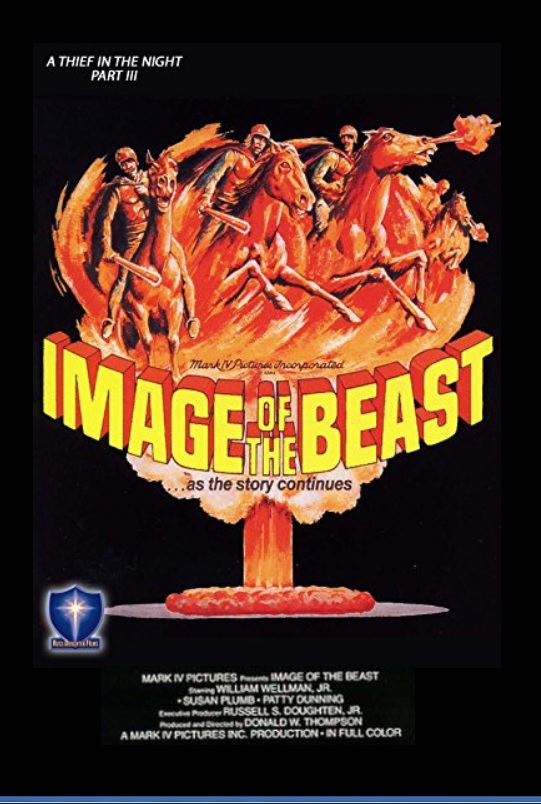
Image of the Beast (1980)

This is the third of a series of films that began all the way back with A Thief In the Night. After two movies that focused on Patty, this movie brings in David, who is a Christian guerrilla battling the UNITE forces. While the first two films just dealt with the beginning of the end times, this one goes all in and goes completely wild, bringing in all manner of sheer lunacy as the Antichrist ruses and God begins to reign his fury on the sinful men and women left behind.

The beginning of this film is probably the tensest of all of the series, as it begins with a young couple shopping for groceries with Patty — remember our old friend Patty who pretty much as a goner in the last two endings? — checks them out. They discuss a Beverly Kay book on Biblical prophecy and computers and how scary it all is before we smash cut back to the end of A Distant Thunder with Patty goes to get her head cut off. Run-on sentence much? Well, with this movie, you have to!

While Patty is waiting to die, an earthquake hits and she’s trapped, all alone, with each tremor of the earth making the blade one step closer to decapitating her. It’s harrowing and well-shot, ending only when Patty gives and begs to be given the Mark and the blade chops her head clean off. The moral of Image of the Beast is such: God is done fooling around.

It’s time for a new hero in this film, who would be Kathy, who joins Leslie and David Michaels, our aforementioned freedom fighter who just killed an officer in self-defense and stole his uniform. They escape in a jeep but Leslie is shot, so our other two heroes and Kathy’s son spend the night sleeping under the car because that’s exactly what you do in the post-Rapture. In the morning, the precocious kid runs right into Reverend Turner (Russell Doughten, the dude behind all of this).

If you missed the last two movies, Turner was Patty’s old pastor who failed to preach the message that God wanted and is now left behind. He’s living a sweet Apocalyptic life, what with his farm, an apple tree and biggest and raddest map of how the end of all things will unfold.

That’s when everyone gets the plan that will take up the bulk of this movie: Fake Marks that work on the gigantic UNITE computer and allow our heroes to eat while they try and hack into said computer. Being that this was made in 1980, a lot of said hacking is done with calculators, pencil and paper. There’s also a subplot of the BUMS (Believers Underground Movement Squad) trying to find the Christians and take them to get their heads cut off. Of course, Jerry and Diane Bradford from the first two movies are in said group of villains.

I wonder — did PreMillenialist Dispensationalism Christians have a convention where they all decided that the UPC code was bad and that guillotines would be the weapon of choice for the UN?

There’s also the hint at the end of this movie that giant locusts have descended on the Earth, which would be awesome to see. And at the end, David sends a kid to his death and walks to the guillotine rather than take the Mark. There’s also a nuke that gets dropped.

My wife tried to watch this with me and when I was telling her how the stories of the Antichrist coming back to life and the prophets being killed and rising from the dead and the talking statue were all really in the Bible, she just left the room rather than deal with the realization that her husband was insane when he was a small child, often highlighting his Bible and looking up the exact passages to try and figure out when the end would come so he would be ready.

You can watch this for free on Amazon Prime or Archive.org, as well as the You Tube Christian Cinema portal. There’s even an official website if you want to learn more.

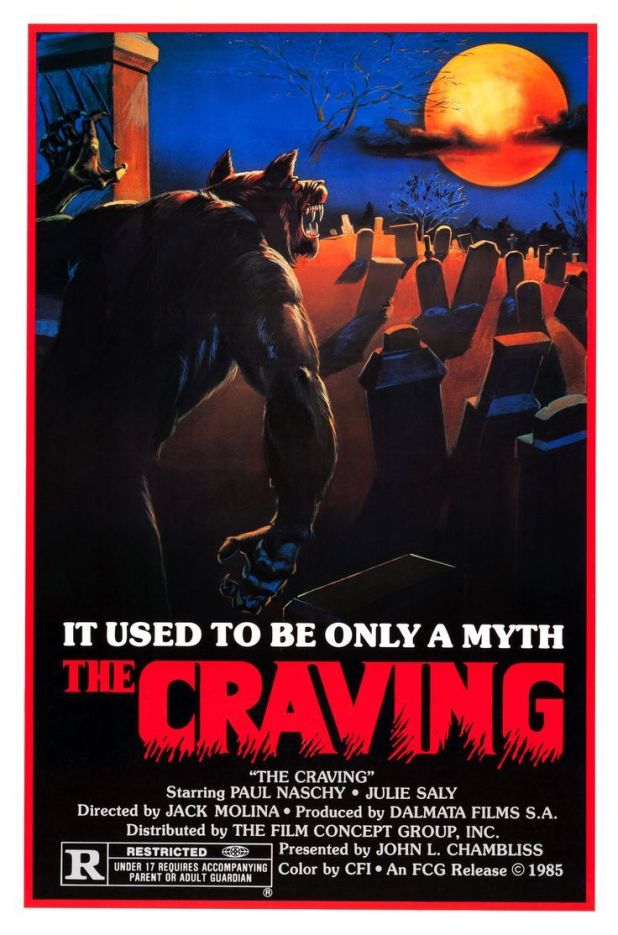
The Craving (1980)

The ninth movie in the saga of Count Waldemar Daninsky — as always played by Paul Naschy —  this movie wasn’t released in the United States until 1985 when it was renamed from its original title, El Retorno del Hombre Lobo (The Return of the Wolfman). The last Naschy movie to play the U.S. theatrically, it’s also been released here on DVD and blu ray as Night of the Werewolf.

Naschy has gone on record saying that this was his favorite Hombre Lobo film and considered it a remake of his 1970 effort La Noche de Walpurgis (Walpurgis Night).

Waldemar Daninsky is sentenced to be executed along with a number of witches, including Elizabeth Bathory. He actually prays for his suffering to end, but it’s nearly impossible to truly kill him. That means the authorities have to pretty much bury him alive, with a silver dagger piercing his heart and an iron mask to keep him from biting anyone dumb enough to let him loose.

Of course, that’s exactly what happens centuries later when the dagger is removed. That said — it’s just in time, as Bathory is back and needs to be stopped. Oen of the women that Daninsky meets in our time — Karin — will become his great love, but if you’ve watched any Spanish werewolf movies, love is often doomed to mutual death and funeral flames.

This higher budgeted effort — created by Naschy’s own Dalmata Films — failed to score in foreign markets and spelled doom for its studio. That’s a true shame, as it’s probably the best looking version of Naschy’s werewolf vision.

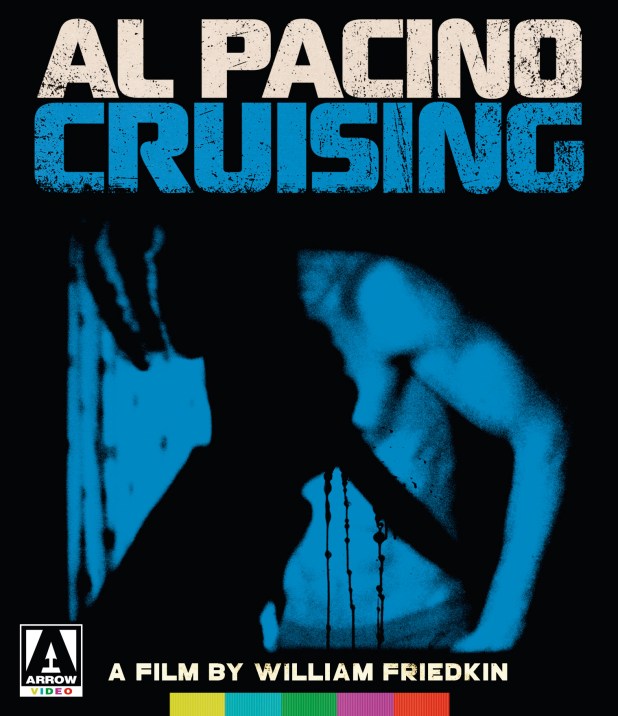
Cruising (1980)

Despite being approached several times with New York Times reporter Gerald Walker’s 1970 novel Cruising, William Friedkin (The Exorcist, Sorcerer and perhaps not as successfully, Jade) wasn’t interested. He changed his mind after an unsolved series of murders in New York’s leather bars.

Articles by Village Voice journalist Arthur Bell and NYPD officer Randy Jurgensen helped inform this film. The latter went into the same deep cover as this film’s protagonist, Steve Burns. Then, Friedkin learned that Paul Bateson, a doctor’s assistant who appeared in The Exorcist, had been implicated in the crimes while serving a sentence for another murder.

Friedkin did some of his research for the film by attending gay bars dressed in only a jockstrap, but by the time the movie began filming, he had been barred from two of the most oversized bars, the Mine Shaft and Eagle’s Nest, due to the controversy surrounding the movie.

Much like The New York Ripper and God Told Me To, this movie feels like one set at the end of the world — New York City near the close of the 20th century. Someone is picking up gay men, murdering them and leaving their body parts in the Hudson.

Officer Steve Burns (Al Pacino)—exactly the type of man the killer has been after—is on the case. Captain Edelson (Paul Sorvino) has assigned him to infiltrate the foreign world of S&M and leather bars. However, as the case progresses, he begins to lose himself and his relationship with Nancy (Karen Allen).

Soon, he learns of just how brutal the NYPD is to gay men — even if they’re just suspects. And he finds himself growing closer to his neighbor Ted (Don Scardino, Squirm).

By the end, nothing is truly clear. While the killer may be Stuart Richards, a schizophrenic who attacks Burns with a knife in Morningside Park, it could also be Ted’s angry boyfriend Gregory (James Remar). After all, Ted’s mutilated body is discovered while Stuart is in custody. Or the real killer is still out there — perhaps he’s even a patrol cop (Joe Spinell). The truth is never told.

Spinell is incredible in this, which is no surprise. He used his real life for inspiration, as there’s a line about his wife, Jean Jennings, leaving him and moving to Florida with his daughter. His wife had just done exactly that before this movie was shot.

The actual version of this movie may never be released. Friedkin claims it took fifty rounds to get the MPAA to award the film an R rating. Over 40 minutes of footage was cut, which consisted of time spent in gay bars. The director claims that these scenes showed “the most graphic homosexuality with Pacino watching and with the intimation that he may have been participating.”

This footage also creates another suspect — Burns himself may have become a killer.

When Friedkin sought to restore the missing footage for the film’s DVD release, he discovered that United Artists no longer had it and may have even destroyed all the cut footage.

In 2013, James Franco and Travis Mathews released Interior. Leather Bar is a metafictionalized account of the two filmmakers’ attempts to recreate the lost 40 minutes of Cruising.

There’s a disclaimer at the start that says, “This film is not intended as an indictment of the homosexual world. It is set in one small segment of that world, which is not meant to be representative of the whole.” Years later, Friedkin would claim that MPAA and United Artists required this, hoping that it would absolve them of the controversy that had been all over this production.

That’s because protests had started at the urging of gay journalist Arthur Bell, the aforementioned Village Voice writer whose series of articles on the Doodler’s killing of gay men inspired this movie. There were numerous disruptions to the filming, as protesters blasted music and loud noises at all filming locations, leading to hours of ADR to fix the ruined dialogue.

Arrow Video has released a spectacular new Blu-ray of this film. This is no surprise — Arrow always has excellent releases.

This release features a new restoration from a 4K scan of the original camera negative, supervised and approved by writer-director William Friedkin, and audio commentary from the 2007 DVD. The two features from that release, The History of Cruising and Exorcizing Cruising, are also on the disc.

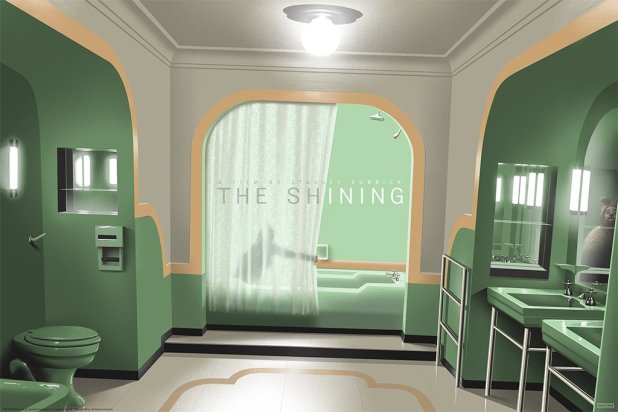
The Shining (1980)

What else can be said about The Shining that hasn’t been said before? How many times have I personally seen this film and what can I do to add to the conversation? That’s why I held off on writing anything about it, but after watching the new 4K version of the film at the Carnegie Science Center’s Rangos Giant Cinema — which features a 70-by-38-foot Certified Giant Screen, two industry-leading Christie® laser-illuminated 4K laser digital projectors and a premium Dolby Atmos®surround sound system with 45 speakers — I felt like I saw it again for the first time.

When projected across a screen that large, even the smallest moments in this film take on a dizzying new life. From the initial lone drive through the trees and mountains to the Overlook to being able to see every pore of skin on faces in the film’s numerous close-ups, the perceptions of the way that you traditionally view this film have been changed, which enables you to see it differently. Stephen King has famously hated the places that writer/director Stanley Kubrick took his story, even as this year’s Dr. Sleep will be presented as a sequel to both the King book and in canon with Kubrick’s visionary masterwork.

The issue that King has always had is that Jack Torrance (Jack Nicholson) is evil right from the start of this film instead of being driven mad by whatever lurks inside the gigantic hotel. King was struggling with alcoholism as he wrote the novel, so you can understand how personal it is to him. He felt that the two main themes of the book — the disintegration of family and the dangers of alcoholism — aren’t really present in the film.

He also had issues with the casting of Nicholson, reasoning that audiences wouldn’t be surprised when he’d go over the edge, and disliked the way Shelley Duvall played Wendy, saying, “She’s basically just there to scream and be stupid, and that’s not the woman that I wrote about.”

He’s also gone on record about how the movie downplays the supernatural and I think that that claim is bogus. If anything, the movie is more otherworldly, presenting a place where even the physical space of the hotel cannot be trusted. He said, “What’s basically wrong with Kubrick’s version of The Shining is that it’s a film by a man who thinks too much and feels too little; and that’s why, for all its virtuoso effects, it never gets you by the throat and hangs on the way real horror should.”

I must have been watching the wrong film all these years.

That said, like any movie worthy of being watched multiple times, The Shining has all manner of explanations for what it’s really about: the history of America, the Holocaust, the treatment of Native Americans, Kubrick’s role in the mission to the moon and so on. I’m always struck by the nature of duality: the past caretaker named Grady followed the same path that Jack is on — and he’s always been at the Overlook and if we follow the photo at the end, so has Jack — but they have also both had a moment where they could change their destinies. Yet was their destiny to just be the monster? In King’s book, Jack becomes that monster. In Kubrick’s, to quote Laura Miller’s interpretation, the director is the monster, guiding his characters toward a conclusion while watching them in the same way that Jack watched his wife and child in the maze, from above, as if they were insects.

To back this up, there’s the fact that Nicholson and Duvall have expressed open resentment against the fact that Kubrick received sole credit for the film’s success above and beyond the efforts of the crew and the actors. Nicholson has gone on record saying that Duvall’s performance is the most difficult he’s ever seen an actress take on.

That may be because of Kubrick’s mercurial nature. For the scene where Jack finally breaks through the door with the axe, there were hundreds of takes and over sixty doors used over three days of filming. Sure, it’s an iconic scene, but that many takes had to ruin nerves. And the scene of blood coming out of the elevators took an entire year to get right.

There’s also an interesting duality in the difference between Jack in the book and in the movie. Book: a man struggling to remain sane; movie: an insane man struggling to seem sane. Duality is an intriguing concept when it comes to film, as the set of one movie is often the same set in another. For example, The Shining‘s Colorado Lounge is also the Well of Souls from Raiders of the Lost Ark. And much of the fake snow made for this movie ended up on Hoth in The Empire Strikes Back.

Even more duality — composer Walter Carlos was transitioning to become Wendy Carlos as this film was being made. As a kid, when I’d go through my father’s many Moog and synth albums, I always wondered if they were married or brother and sister. I didn’t learn the truth until I was older.

Fueling even more strangeness is the fact that this is also a movie with three unreliable narrators. Jack, Wendy and their son Danny are all trapped within a place that warps reality and presents images that may or may not be real. Jack is seeing these visions through the eyes of madness; Wendy through her cabin fever and Danny as a child interprets the reality of adults.

The unsung hero of all of this is Scatman Crothers, who had a rough time on the film, often needing a hundred takes for each scene. If you ever watch Vivian Kubrick’s documentary Making The Shining, you can see just how emotional he is. When he moved on to make Clint Eastwood’s Bronco Billy as his next film, he broke down in tears of gratitude on his first scene in the film. Eastwood, famous for often only needing one take, had to be such a welcome relief for Scatman. Yet even in the briefest of scenes that he appears in, he owns the moment, even when juxtaposed with the acting power of the two leads. He’s also the only objective adult voice in the film — you can argue that every single other person inside the hotel could be a figment of the imagination.

As a writer by trade, however, I often see Jack as a sympathetic character. My wife continually tells me that I react like him to interruptions, but to anyone that doesn’t know the sheer terror of writer’s block and the amount of time that it takes to feel ready to write and that inspiration takes hold, anything that gets in the way honestly feels like the worst physical pain possible. The Shining is one of few depictions of this feeling I’ve ever seen that gets it right. And even when you write your heart out, often it just looks like the same words written on a page over and over and over to the uninitiated. Nicholson said that when Jack snaps at Wendy, that scene hit home. He’d often been in a similar situation when girlfriends had interrupted him and drew on those feelings when he added the line that makes this scene sing: “If you come in here and you DON’T hear me typing, if I’m in here that means I’m working!” Writing isn’t just the actual act of putting the words down. I feel like I’m in the throes of writing, editing and dealing with how people react to my words on an endless cycle.

Even the keys of the typewriter are authentic, with the actual sounds of the keys typing “All work and no play makes Jack a dull boy” being hammered out. Kubrick’s assistant spent months typing and retyping those words without the aid of a Xerox machine. And in each country, different words are used:

  • Italy: “Il mattino ha l’ oro in bocca,” which means “He who wakes up early meets a golden day.”
  • Germany: “Was Du heute kannst besorgen, das verschiebe nicht auf Morgen,” which says “Never put off until tomorrow what you can do today.”
  • Spain: “No por mucho madrugar amanece más temprano” or “Rising early will not make dawn sooner.”
  • France: “Un ‘Tiens’ vaut mieux que deux ‘Tu l’auras’,” which translates to “A bird in the hand is worth two in the bush.”

However you see The Shining, whatever your interpretation, I feel that you are correct. Works of true art and vision are able to do this, to take on the feelings and emotions of the viewer and reward others with your interpretation.


Ruckus (1980)

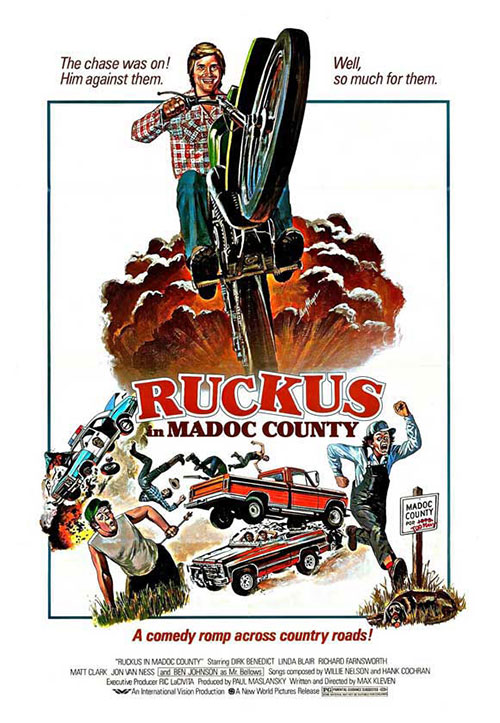
Ruckus arrives at the end of the 1970s, a time when The Dukes of Hazzard and Smokey and the Bandit led a redneck renaissance in pop culture.

Kyle Hanson (Dirk Benedict, Body Slam) spent eight months as a POW and stuck in the jungle, never speaking, which left him a damaged man, unable to adjust to life back at home. When he passes through a small town, local bullies harass him, which he easily handles, but things spiral out of control when local deputies and the townies just can’t let him be.

Only one person, Jenny Bellows (Blair) understands. She’s the daughter-in-law of Sam Bellows (Ben Johnson, The Town That Dreaded Sundown), the richest man in town. His son was killed in action during the war, but his body hasn’t been found yet. Instead of the rich guy being the villain here, he’s actually one of the most sympathetic people in the picture.

Jenny brings Hanson out of the darkness, but after being attacked by local bullies and the police time and time again, Hanson claims a small island. Only the intervention of Sam stops the carnage, as they decide that Hanson can keep the land for himself.

Richard Farnsworth plays the only good cop in the film. You’ll remember him from a ton of movies, like him playing Buster in Misery, as the lead in David Lynch’s The Straight Story and as Red in The Natural.

I was struck by this film’s similarities to the first Rambo film, First Blood. That may not be a total coincidence. The original rights the David Morell’s novel that First Blood was based on spent a decade making the Hollywood rounds, went through 10 years of passing hands before culminating in the 1982 Sylvester Stallone film, so this movie could have been based upon that script. There are parts that are just too close to believe otherwise.

This movie is a million times better than I thought it was going to be. It’s pretty entertaining and I’m surprised that it isn’t discussed more. Director Max Kleven would go on to work with Blair again in the film W.B., Blue and the Bean. A stuntman by trade, the supporting cast is filled with his fellow daredevils, all of whom go all out to deliver some great action. Dirk Benedict did the gool ol’ Bandit thing, again, with Terry “Berlin” Nunn and the “hot” country singer Tanya Tucker, in The Georgia Peaches, which was a TV movie pilot for a failed series. But after the failure of Chopper One (the one Aaron Spelling series that didn’t become a success) and Battlestar Galactica, Dirk did alright with The A-Team.

The Ruckus soundtrack is packed with a mix of songs by Willie Nelson and Hank Cochran, along with Janie Fricke singing a few of them. It’s the perfect music, including the song “Ain’t Life Hell.” Ruckus also has some great alternate titles, like The Intruder of Madoc County, Big Ruckus In a Small TownThe Devastator, Eat My DustDestructorThe Loner and Ruckus in Madoc Country. For example: Some regional newsprint ads carried The Loner title; the national TV ads ran as Ruckus, and The Loner title was used when it ran on HBO, but UHF-TV channels carried it as Ruckus.

Here are some of the amazing posters discovered that place it across a variety of genres, from Smokey-style car race fun to Rambo-esque military vengeance. It’s truly amazing how one movie could play to so many styles and audiences.

You can check out the poster for Ron Howard’s Eat My Dust and see how similar it is to the Eat My Smoke version (seen below). There was also art work swapping done with Jack Starlett’s Kiss My Grits, which was also cross-marketed as a comedy, action, and steamy adult thriller. During our “Linda Blair Retrospective” feature, we pointed out the artwork theft from Micheal Sopkiw’s Blastfighter and Mark Gregory’s Afghanistan: The Last War Bus, aka War Bus Commando, for Ruckus: a war movie starring Dirk Benedict, Michael Sopkiw, and Mark Gregory—and Linda Blair in a cameo as a kidnapped American oil heiress—is in order! Now that’s an exploitation film.

A COMEDY!
ACTION! Artwork ripped from Michael Sopkiw’s Blastfighter, but also used for Mark Gregory’s Afghanistan: The Last War Bus, aka War Bus Commando.
U.S Ruckus poster artwork refitted for the overseas, Middle East markets.
Gotta make it look like Smokey and the Bandit, while ripping off Eat My Dust.

The Apple (1980)

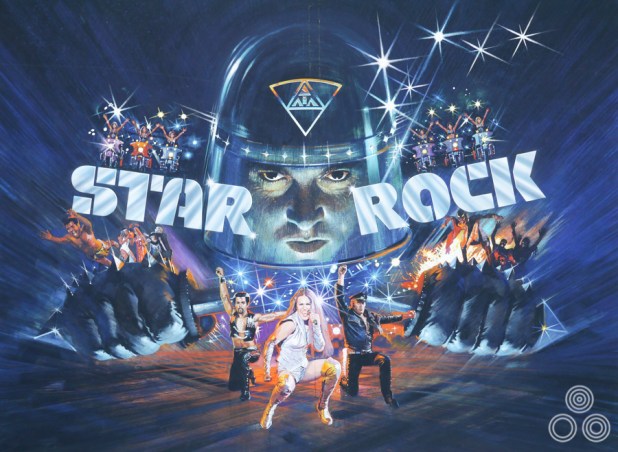
You know how everyone thinks Cannon put out some completely crazy movies? If you haven’t seen The Apple (also known as Star Rock), you haven’t seen their full power. Directed by Menahem Golan, this slice of sheer madness is a movie I use to test the resolve of anyone brave enough to watch movies with me.

The genesis of this film begins in 1975. Israeli rock producer Coby Recht was signed to Barclay Records and began to feel distrustful of show business. He worked it into a story with his wife Iris Yotvat and brought it to the attention of his longtime friend Menahem. After hearing the demos for the songs, the producer/director instructed Recht to go to Los Angeles immediately. They were making the movie.

Yotvat said, “That was marvelous. That was just fantastic to think that it was going to be a movie all of the sudden. It was just amazing.”

It wasn’t going to stay that way.

Recht and Yotvat lived in a villa that Menahem provided, writing six screenplay drafts in three weeks. As those drafts progressed, the story became more comical and less Orwellian. Soon, things were getting corny, out of touch and out of date. If you’ve seen any of the movies that Golan was involved in, you can see how that might be true.

After auditioning thousands of hopefuls, Recht settled on Catherine Marie Stewart for the lead role of Bibi. Who is a singer. Not a dancer, like Stewart. He figured she could learn, but the producers decided to have her voice dubbed.

Tensions only got worse once filming began, as what started as a $4 million dollar movie turned into $10 million and then more. Editor Alain Jakubowicz claimed that Golan shot around a million feet of footage, with six cameras of coverage for every dance number, ending up with a four-hour rough cut.

The movie got way bigger than its scriptwriters intended. Shooting in West Berlin lasted forever, with a five-day shoot for the opening number, the song “Speed” being filmed at the Metropol nightclub (which held the world record for biggest indoor laser show) and some scenes were actually shot inside a gas chamber that had killed people during World War II.

Nigel Lythgoe, who later was a big part of American Idol, choreographed the film, saying that some days were “really, really depressing” and others “very, very stressful.” The cast and crew hated the script, but here they were, making the film.

Menahem and Recht’s battles soon got worse. The writer felt he should be in London mixing the songs (the sessions had more than 200 artists involved), but Menahem demanded that he show up at the shoot. The first day he was there, he witnessed the uncut version “Paradise Day” which featured fifteen dinosaurs and a tiger that broke free and escaped. This scene also contained elephants getting their trunks stuck in the set, actors collapsing while wearing a too hot brontosaurus costume and a set that made it near impossible for people to dance on and cameras to move around. Removing this scene makes the Biblical end of the movie come out of nowhere. That’s right. None of this is in the film.

Catherine Marie Stewart has stated that none of this rattled Menahem. In fact, he was convinced that The Apple was going to be embraced: “Menahem was very passionate about what he was doing. He had very lofty ideas about the project. He thought this was going to break him into the American film industry. It had, you know, all the elements that he thought were necessary at that time. It was the early eighties and there were a lot of musicals. And Menahem thought that was his ticket into the American film industry.”

So what happened?

The plot is basically Adam and Eve meets Faust. Bibi (Stewart) and Alphie (George Gilmour) are contestants in the 1994 Worldvision Song Festival. They’re talented but easily defeated by the machinations of Mr. Boogalow (Vladek Sheybal, Kronsteen in From Russian With Love) and BIM (Boogalow International Music).

The evil leader soon signs the duo but they soon fall victim to the darkness of show business. Bibi is caught up in the drugs and sex and glamour, while Alphie is beaten by cops and nearly dies to save her. He also lives with a woman who is either his mother or lover or landlady and no one ever explains it to us.

Eventually, they escape and live as hippies, having a child. Mr. Boogalow finds them and claims that Bibi owes him $10 million dollars, but soon God, known here as Mr. Topps (Joss Acklund, The House That Dripped BloodBill & Ted’s Bogus Journey) takes them away in his Rolls Royce and the Rapture occurs.

There are numerous scenes where people put stickers, called BIM Marks, all over their faces. Everyone has camel toe. And the movie is nearly 100% disco.

The movie premiered at the 1980 Montreal World Film Festival. To say it did not go well is an understatement.

Attendees hated the film so much that they launched giveaway records of the soundtrack at the screen. Menahem was so devastated that he almost jumped off his hotel balcony before being saved by his business partner, Yoram Globus. A similar scene happened at its second premiere at the Paramount Theater in Hollywood.

The director said, “It’s impossible that I’m so wrong about it. I cannot be that wrong about the movie. They just don’t understand what I was trying to do.”

I get it, Menahem. You were just trying to get people to understand the power of love and music and being hippies a full decade after any of that mattered. You didn’t care if anyone else got it. You had a vision. And we’re not talking about any of those critics today. No, we’re talking about you. We’re talking about The Apple.

This is a movie that wears its heart messily all over its spandex crotch. The songs are ridiculous. The dancing is, at times, poor. The story makes no sense at all. You’re lucky to sit and witness it. I can’t even tell you how many times I’ve watched it!

You can get the Scorpion Releasing blu ray of this film on Diabolik DVD or watch it for free on Tubi.

BONUS! You can hear Becca and me talk all about The Apple on our podcast.

Xanadu (1980)

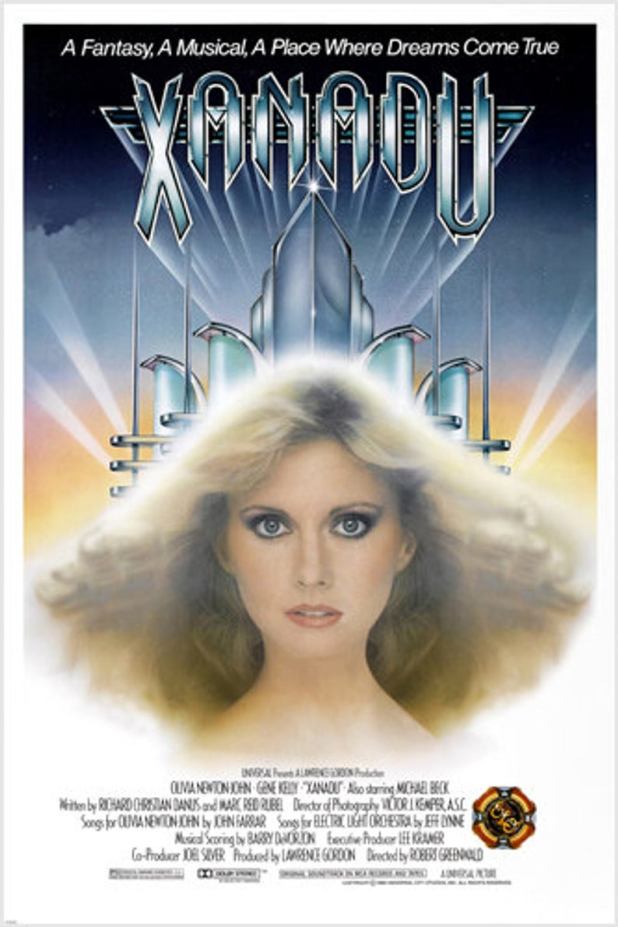
Xanadu was more than a flop. As part of a double bill with Can’t Stop the Music, it was the inspiration for the Golden Raspberry Awards, which recognize the worst films of the year. Yes, somehow a disco rollerskating remake of Down to Earth — itself the sequel to Here Comes Mr. Jordan — ended up being a critically reviled mess. Go figure.

The film was originally going to be a relatively low-budget roller disco picture. But as more prominent performers joined the production, it grew larger and larger in scope. Yet rollerskating improbably remained a recurring theme. Also, the strange mix of Jeff Lynne’s Electric Light Orchestra and Olivia Newton-John — along with Cliff Richard and The Tubes — made for an eclectic soundtrack that became a hit independent of the moribund status of the film that inspired it.

But hey — what do you want from a movie that quotes from Samuel Taylor Coleridge’s “Kubla Khan,” a poem written after a night of opium indulgence?

A large mural of the Nine Muses of Olympus comes to life, with women emerging from it and flying away. In the original script, Sonny Malone (Michael Beck from The WarriorsMegaforce and TV movie giallo lost gem Blackout) painted that mural, which makes sense. In the movie, it’s just the start of things as we follow one of those muses to Earth and meet Sonny as he’s about to give up on his dream of being an artist.

Sonny’s latest job is painting an album cover for a band called The Nine Sisters, which has a beautiful woman in front of an art deco auditorium, who just happens to look like the roller skater who kissed him and ran away. Sonny’s obsessed with her and learns that her name is Kira and well, she’s Olivia Newton-John and also one of the legendary Muses.

Later, Sonny befriends Daniel “Danny” McGuire (Gene Kelly!) who was once a big band leader but is now a construction mogul. Turns out he had a Muse once who looked just like Kira, who gets the two men to build a gigantic nightclub. For some reason, both of these guys got mad when they learned that the woman they love is some Olympian ideal.

Of course, Kira has gone against the Prime Directive and fallen in love, so shes called back to Xanadu, but Sonny can get there by roller skating as hard as he can through the mural. After debating her father Zeus, he and his wife Mnemosyne agree to allow Kira to return to Earth for a moment or maybe forever — you know, that whole time is different between the afterlife and here kind of conundrum.

Kira and the Muses perform at the new nightclub — also called Xanadu — before flying back to the real Xanadu. Yet a waitress who looks just like Kira stays behind, giving no easy answers.

Xanadu is the second movie of this week of musicals that features Adolfo Quinones, also known as the breakdancer Shabba Doo. You may remember him as Ozone in the two Breakin’ movies. And one of the Muses is Sandahl Bergman, who would soon be amazing in movies like Conan the Barbarian and She. This is also strangely the second movie this week that John “Fee” Waybill and Vince Welnick of The Tubes showed up in.

Somehow, director Robert Greenwald emerged to create the celebrated TV movie The Burning Bed before starting a new career in the next century creative left wing documentaries like Outfoxed: Rupert Murdoch’s War on Journalism and Wal-Mart: The High Cost of Low Price.

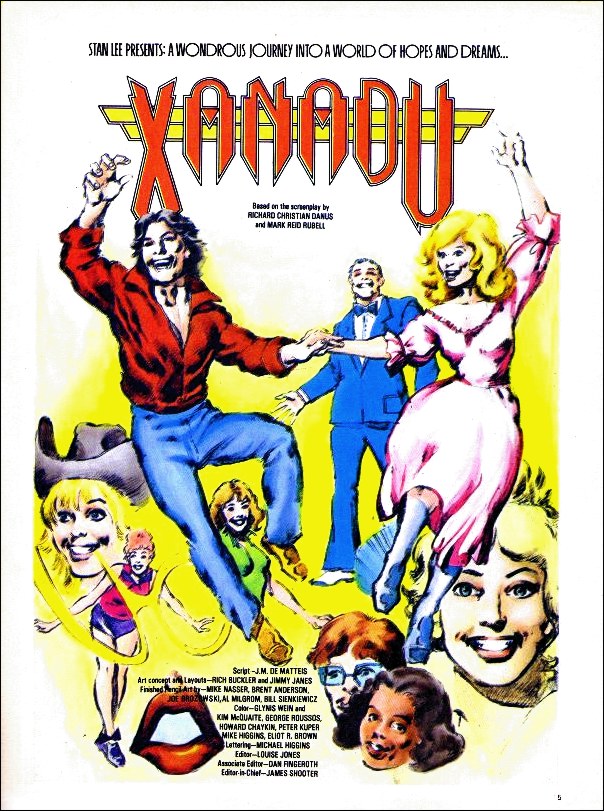
Amazingly, this became a well-received musical years after it failed as a movie. Me, I remember Marvel Super Special #17, the comic book adaption and wondering why anyone would want to read it.

Xanadu is a movie that could only emerge in 1980. That said, it has some great songs like “Magic” and “Suddenly,” but somehow this is a musical that proves that you can make a bad movie from great songs. It’s all too much — too much skating, too much gloss, too much schmaltz. Yet there’s something to love under all that glitter.

You can watch this for free on Tubi.

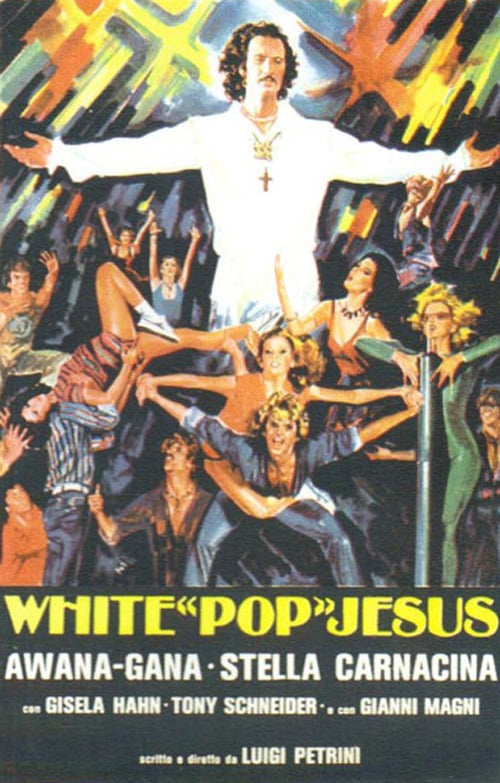
White Pop Jesus (1980)

Six years after starring in Enter the Devil (also known as The Eerie Midnight Horror Show), Stella Carnacina would double down on the blasphemy of a movie where a statue gets down off the cross and makes love to her by starring in this disco story of the Second Coming of the Son of God. Here, she plays Lattuga Pop, the daughter of a police commissioner who falls in love with Jesus.

If you don’t understand why I’ve been absolutely excited to share this movie with you, dear reader, you’re on the wrong website.

Jesus starts the movie in an insane asylum that we’re supposed to believe is Heaven. He emerges from the waves and battles a biker gang before the Word of God is enough to cause them to crash. Soon, he’s met Lattuga, saved her from the mafia (who stand in for the Roman Empire) and run from her love.

Jesus has several adventures with His new followers, converting machine gun-toting nuns into singers for him, making sandwiches grow out of the ground and generally getting the Good News out there as he rides a donkey. He even battles Satan and one of his demons, who transforms from a ballerina into a syringe to symbolize drugs. Or maybe not — I’m watching this in Italian and if I were more fluent, I wonder how much of it would make sense. At the end, Jesus has a huge concert where he’s betrayed and taken back to the mental asylum while his followers stand inside a giant red metal cross begging for God to save them. Or they’re His enemies. I’m not sure, because everything gets Apocalyptic in the last few moments.

Jesus is played by Italian singer Awana Gana, who looks nothing like you would imagine the Messiah to appear. Instead, think a Gibb brother crossed over with Reggie from Phantasm while wearing His best disco white suit.

I really have no idea who this movie is for. It seems so strange that people on drugs would love it, but it takes a major stance against them. One imagines that it’s trying for a Jesus Christ Superstar reinvention of Jesus in the time of disco, but it’s just sacrilegious enough to upset them without being so much that others would fall in love with it.

The music, however, is great. It was written by Franco Bixio and Vince Tempera, who also created the score for Fulci’s The Psychic.

This obviously has never been released in the US — as far as I know — so I have no legal way to tell you to see it for yourself. Ah hell, just watch the whole thing bootlegged on YouTube and tell me what you thought of it.

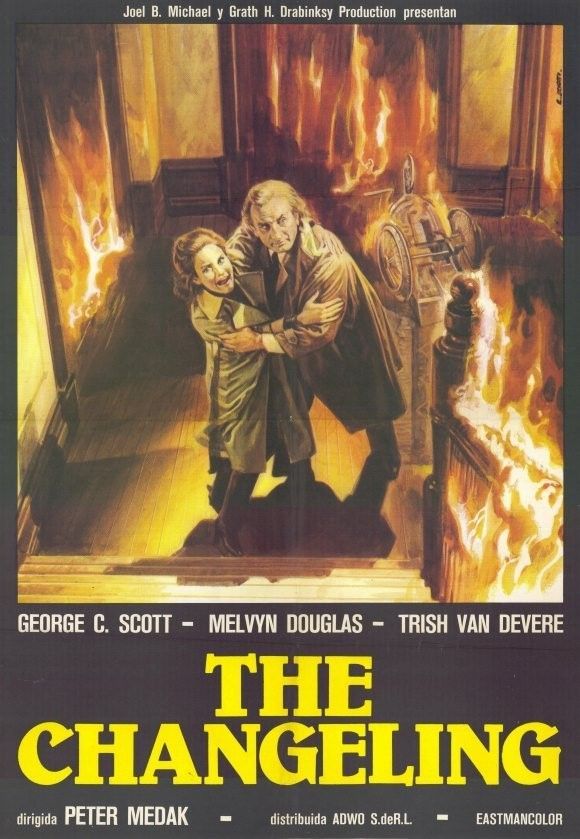
The Changeling (1980)

Peter Medak has one of the most all over the places IMDB credit pages ever. He’s directed everything from the Peter Sellers Satanic farce The Ruling Class to the made-for-TV movie The Babysitter to Zorro, The Gay BladeThe Krays; Romeo Is BleedingSpecies II and episodes of The Wire and Carnivale.  Here, he made a “based on true events” tale inspired by the book by author Russell Hunter, who alleged that these events actually happened to him.

John Russell (George C. Scott, bringing the A list talent) has moved from New York City to Seattle in the wake of the deaths of his wife and daughter. He’s moving into a huge Victorian mansion all by himself, thanks to love interest, real estate agent and local historical society member Claire Norman (Scott’s wife Trish Van Devere, The Hearse).

The strangeness starts right away, with loud sounds every morning at 6 AM, a hidden room complete with an ancient wheelchair, his daughter’s rubber ball bouncing all over the house, an awesome seance scene, rumors of a girl killed by a coal cart and the conspiracy that powerful Senator Joseph Carmichael was really a replacement child adopted to keep his father wealthy.

Just because this movie tries to keep it classy doesn’t mean it isn’t effective. The scene where the mirror explodes and reveals the police detective’s dead face before his accident is really effective. And the scene where the Senator climbs the flaming steps is perfectly shot.

Medak wasn’t the first choice to direct this. Originally, Performance and Demon Seed director Donald Cammell — who claimed to have bounced on Aleister Crowley’s knee as a baby — and Tom Jones director Tony Richardson both started work before leaving due to creative differences.

In 1988, Lamberto Bava directed a made-for-TV film called Until Death that was marketed as The Changeling 2. It was written by Dardano Sacchetti and is one of the reasons why Lucio Fulci stopped working with him. Fulci claimed to have written the story based on The Postman Always Rings Twice. His claim was that Sacchetti used the Fulci name to get the script to seen by producers and once they did, he took his name off it.

Regardless, this is a great movie. It’s a bit slow by today’s standards, but you can see its influence in all manner of haunted house films. According to Mendak, “I was in London at the BAFTA Awards and Guillermo was screaming, ‘You’re my mentor! You’re my mentor! I said, ‘What are you talking about?’ He said, ‘Your movie The Changeling is just a masterpiece.’ It’s just nice to hear that from fellow directors whose work I love and respect.”

I’m always amazed that the entire front of the house is a facade. That’s moviemaking magic at its best, really. I’m also amazed that Mendak came onto the project with only a month’s lead time, yet was able to rely on his experience of watching the making of The Haunting.

You can watch this on Shudder with and without commentary by Joe Bob Briggs. Want to get even more? Then get the new re-release from Severin, complete with plenty of documentaries and commentaries that will totally improve your knowledge and love of this haunted house film.