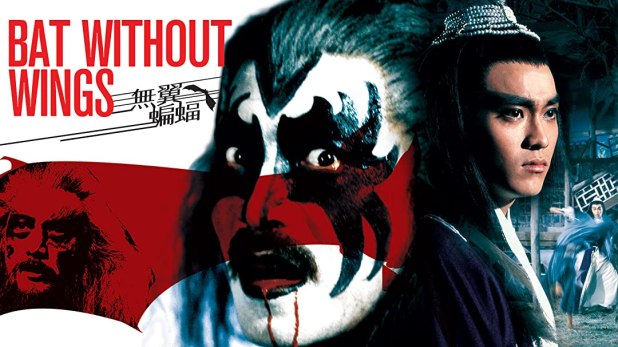
The Bat looks like Gene Simmons and that’s exactly why I chose to watch this. He’s some kind of martial arts supervillain who assaults and murders women and then sends back their body parts one at a time to their husbands. He’s also so strong that he kills twenty-six martial artists before he gets stopped. However, five years later, the killings begin again, despite the original Bat being chained up in a cave, surrounded by the dead bodies of his victims kind of like a Far East Frank Zito.
Oh yeah and the bad guy can fly.
And his real name is Red Baron.
And he has a cave lair filled with traps, like exploding boxes and a pond filled with poison.
Look, this isn’t the best movie you’ve ever seen, but it also has a KISS-looking evil wizard martial artist in an insane cape that can leap hundreds of feet in the air sucking the blood from women and killing men in combat.
If you can’t find a reason to enjoy that, there really is no hope for you.
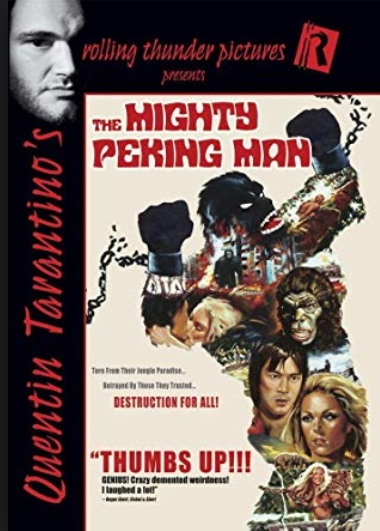
The Mighty Peking Manis a 1977 monster film whose Mandarin title, Xingxing Wang, translates as “Gorilla King” in English (let’s forget the dopey U.S. title of Goliathon). Yep, you guessed it: made to cash in on the 1976 King Kong remake. While Quentin Tarantino’s Rolling Thunder imprint reissued the film in 1998, MPM initially rolled out as a second-biller on the U.S. Drive-In circuit in 1980. It’s the same old story—only told with tongue firmly planted in cheek—featuring greedy explorers who exploit a very large Himalayan Yeti—with a twist: Peking Man raised a beautiful, Tarzaneque woman orphaned in a plane crash who pals around the jungle with a pet leopard. The climax: The Peking Man takes a header off Hong Kong’s Jardine Tower in a hail of helicopter gunfire and jet bombers.
And that Roger Ebert “Thumbs Up!” on the VHS sleeve ain’t no scam: it’s the real deal, as he sites MPM as his “favorite Hong Kong monster film.” And mine too, Rog. Mine, too, as it’s a very well made film. And it should be, as The Mighty Peking Man had a budget of six million Hong Kong dollars under the Shaw Bros. studio (Corpse Mania). The film took over a year to complete—and that time and care shows, in spades—and it was shot in Mysore, India.
While I love it equally, the Shaw Bros. didn’t fair as well with their Hammer Studios co-production of their martial arts vamps going against Peter Cushing’s vamp hunter in The Legend of the Seven Golden Vampires. Their other co-production—the lesser known Shatter—was intended as a weekly TV series, but ended up being a theatrical film dovetailed into the U.S. martial arts drive-in craze of the mid-70s. Oh, and Roger Ebert enjoyed The Mighty Peking Man so much that he re-watched—22 years later and upped on his two and a half star review, for—the Shaw’s 1975 release, Infra-Man. That’s the power of the Q: you gotta love it. And when it comes to Hong Kong cinema, none meets the power of the Shaw Bros.: you gotta love it. As you will this film. Pure awesome.
In a production twist only a B&S Movies reader can love: Koichi Kawaktia, MPM’s assistant director, later worked on Yonggary, the 1999 South Korean remake by Hyung-rae Shims of Yongary, Monster from the Deep (1967). Yonggary ’99’s co-scripter is Marty Poole, who wrote the 1997 Richard Lynch-fronted Rollerball homage, Ground Rules (oh, you gotta watch that film!!).
There’s a lot of online opportunities to watch The Mighty Peking Man, but you know us: we always try to find you the freebie. So watch it on You Tube. It’s campy, it’s whacked, it’s funny and entertaining. Strap on the popcorn bucket and snap the caps off the Dr. Pepper sixer and roll it. It’s the perfect “must watch” of this week’s “Hong Kong Week” tribute of reviews to pencil into your schedule.
Reissue Update: Here we go with another Delirium, UFO: Target Earth, and Calamity of Snakes surprise, again! In this case we were simple scratching a movie off of our above noted Quentin feature . . . or was it our “Planet of the Apes” tribute week . . . no, wait, it was for our “Kaiju Day Marathon” . . . and months later, a DVD restore was announced for release in December 2021. (Duh, it was for our “Hong Kong Week” of films. Hey, gotta work in the links.)
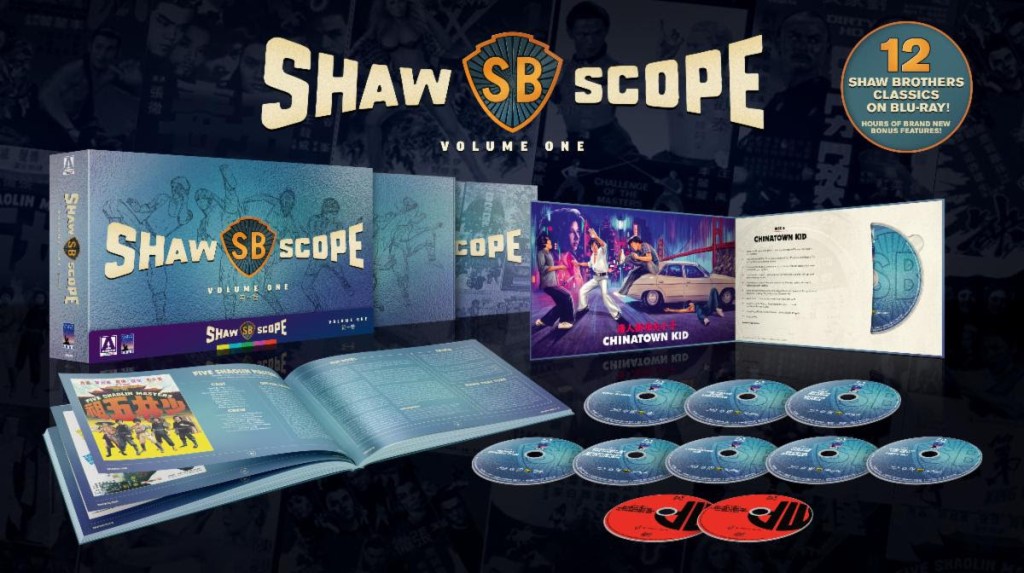
Yes! A reissue of The Might Peking Man is now available as part of Arrow Video’s “Shaw Scope” box set, in this case, Volume One. You don’t want the box set and you’d rather stream it? No worries. It’s also available on the Arrow Player service.
This new Arrow version of The Mighty Peking Man features the film in both uncompressed Mandarin and English original-mono audio, as well as newly translated English subtitles for the Mandarin audio, plus English hard-of-hearing subtitles for the English dub.
The new features also include: A new commentary track by Travis Crawford, a new interview with suit designer Keizo Murase, a 2003 iInterview with director Ho Meng-hua, a 2004 interview with star Ku Feng, a behind-the-scenes vignette of Super 8 footage from the archives of Keizo Murase, an un-restored standard-definition version of the film, alternate opening credits from the U.S.-version of The Mighty Peking Man, known as Goliathon, trailers from the Hong Kong and U.S., German and Dutch versions, as well as the U.S. TV commercial (Oh, boy, I remember seeing that on TV!), and a stills-image gallery.
Streaming online: You can also stream The Might Peking Man by visiting ARROW to start your 30-day free trial. Subscriptions are available for $4.99 monthly or $49.99 yearly. The ARROW Player is available in the U.S. and Canada, the U.K. and Ireland on the following Apps/devices: Roku (all Roku sticks, boxes, devices, etc.), Apple TV and iOS devices, Android TV and mobile devices, Fire TV (all Amazon Fire TV Sticks, boxes, etc.), and on all web browsers at at Arrow Player.com.
About the Author: You can read the music and film reviews of R.D Francis on Medium and learn more about his work on Facebook. He also writes for B&S Movies.
Rankin/Bass had some experience working with Japanese filmmakers after making King Kong Escapes, the Desi Arnaz Jr. feature Marco, Rudolph and Frosty’s Christmas in July, Willy McBean and His Magic Machine, The Bushido Blade (which has Mako, Sonny Chiba, James Earl Jones, Richard Boone and Laura Gemser all in the same movie), The Bermuda Depths and The Last Dinosaur there.
The last two movies we mentioned and this one were made with Tsuburaya Productions, the company that brought us Ultraman.
While this debuted on ABC on April 18, 1980, an extended version would later play theaters in Japan.
A rare albino gorilla has escaped somewhere in Bermuda, and the hunter who caught it once before (Jack Palance!) is set to destroy it. Can Steven Keats (Bronson’s son-in-law in Death Wish) and Céline Lomez (originally going to play Linda Thorson’s part in Curtains) stop him in time?
Kotani’s work, including The Bushido Blade, is a fascinating blend of Western and Eastern elements. The film, which stars Richard Boone leading sailors versus samurais under the command of Toshirô Mifune, is a unique exploration of cultural dynamics. If that’s not enough to pique your interest, the fact that Laura Gemser is in it might. Kotani’s diverse filmography also includesPinku redi no katsudoshashin, a feature-length movie about Mie and Keiko Masuda, two idol singers whose Japanese success was imported to the shores of the U.S. Their song “Kiss in the Dark” reached #37 in America, making them the first Japanese act to chart here since Kyu Sakamoto’s “Sukiyaki” in 1961. Sadly, their Sid and Marty Krofft developed series – The Pink Lady and Jeff – only lasted six weeks on NBC during Fred Silverman’s disastrous year of 1980, which also unleashed the Supertrain on an uncaring television audience. Kotani’s other works include The Last Dinosaur and The Bermuda Depths.
There’s something truly unique about the 1970s TV movies from Rankin/Bass. Each one carries a certain level of darkness and palpable sadness, making them the perfect choice for a snowy day in 1981 when all you wanted to do was stay under the covers. They still possess that same strange magic today, evoking a sense of nostalgia and appreciation for their historical significance.
Editor’s Note:We planned our “Lee Majors Week” before we came up with our month-long February blowout of Mill Creek box sets . . . and it just so happened this Lee Majors ditty appeared on Mill Creek’s Excellent Eighties 50-movie set (Agency). So, actually, this April review of Agency isn’t a repost: the Mill Creek review from February is the repost. Not that anyone cares.
A millionaire is suspected of buying an ad agency to use it as a way of brainwashing the public for his political ends. Hmm . . . subliminal messaging through inaudible sounds and images hidden in TV audio signals and magazine spreads . . . John Carpenter’s They Live, anyone?
The millionaire here is the mysterious Ted Quinn (Robert Mitchum) who buys out the giant Montreal ad agency Porter & Stripe where Philip Morgan (Lee Majors) serves as its top copywriter and project manager. Of course, as with any corporate takeover, half of the firm’s staff is soon blown out the door and replaced by “Quinn’s people.” And Morgan is getting the old “do you like your job” trope when he complains about being kept out of the loop on the firm’s new accounts.
Next thing you know, the firm’s geeky-and-too-nosey-for-his-own-good Sam Goldstein (very familiar Canadian actor Saul Rubinek), who discovered Quinn is using the firm’s new slew of commercial spots to influence a political election, ends up dead. Now it’s up to Lee and Valerie Perrine, as his love interest, natch, to get to the bottom of the advertising-cum-political tomfoolery.
I love Lee Majors, and Robert Mitchum is always cool in-the-role (but barely here; this is a Lee Majors joint, after all), but when cheapo Canadian tax shelters films masquerade as an American-made film by casting beloved U.S. actors in lead roles, what we usual end up with is, not a theatrical film, but a telefilm that pisses us off by baiting us with Lee Majors.
If this had been made in the early ’70s by a major U.S. studio, say MGM or 20th Century Fox — and cast Charlton Heston as the ad man discovering the subliminal political campaign — and had Paddy Chayefsky adapt Paul Gottlieb’s superior, best-selling novel for Sidney Lumet to direct — Agency could have been a twisted sci-fi version of the Academy Award-winning Network. Or we could have had Madison Avenue taken to task in a political paranoia thriller that reminded of director Alan J. Pakula and screenwriter Robert Towne’s The Parallax View.
I love my Lee Majors joints, but — through no fault of his own (his Fawcett-Majors Productions didn’t back this one) — Agency is a flat-as-a-pancake conspiracy thriller providing a non-intriguing conspiracy devoid of thrills. If you’re in the market for sci-fi conspiracy thrillers of the ’80s HBO-variety, then stick with Micheal Crichton’s Looker from 1981 starring Albert Finney — at least that one had some computer 3D modeling and funky light-hypnosis guns to wow us. Of course, when it comes to subliminal conspiracies of the Canadian variety, none is finer than David Cronenberg’s Videodrome.
You can watch Agency on You Tube or watch it as a free-with-ads stream courtesy of IMDb TV’s Amazon Prime channel (caveat: both are fuzzy VHS-to-DVD rips). In 2001, Anchor Bay issued a now out-of-print DVD version, which, no surprise, is the best of the DVD transfers in the market. If you’re a Lee Majors Canadian film completist, then you’ll want to seek out the 1984 TV movie The Cowboy and the Ballerina (we found a clip on You Tube).
About the Author: You can learn more about the writings of R.D Francis on Facebook. He also writes for B&S About Movies.
You know, it takes some balls to make a sequel to High Noon.
But hey — Elmore Leonard is a heck of a writer and Jerry Jameson made The Bat People and Airport ’77, so he’s OK in my book. And if you’re going to replace Gary Cooper, I guess Lee Majors will do for a TV movie.
Will Kane is now a private citizen and goes back to Hadleyville a year after he threw away at the end of High Noon. Now, the law is J.D. Ward (Pernell Roberts), who allows his deputies to outright terrorize everyone in town and even shoots the horses that Kane came to town to purchase. And now, Ward is hunting down Ben Irons (David Carradine), despite him being an innocent man.
Kane tries to help the wrongly accused man, but can’t save him. Ward attempts to have our hero arrested for aiding a fugitive, but the townspeople turn on him and the local authorities. They reinstate Kane as marshal and he ends up gunning down Ward for resisting arrest.
This film also has some great character actors going for it, like Michael Pataki, M. Emmet Walsh and Tracey Walter AKA Bob the Goon. It was shot at Old Tucson Studio, which was also where The Bells of St. Mary’s, Winchester ’73, Rio Bravo, C.C. & Company, Death Wish, Three Amigos, Tombstone and many more movies were made.
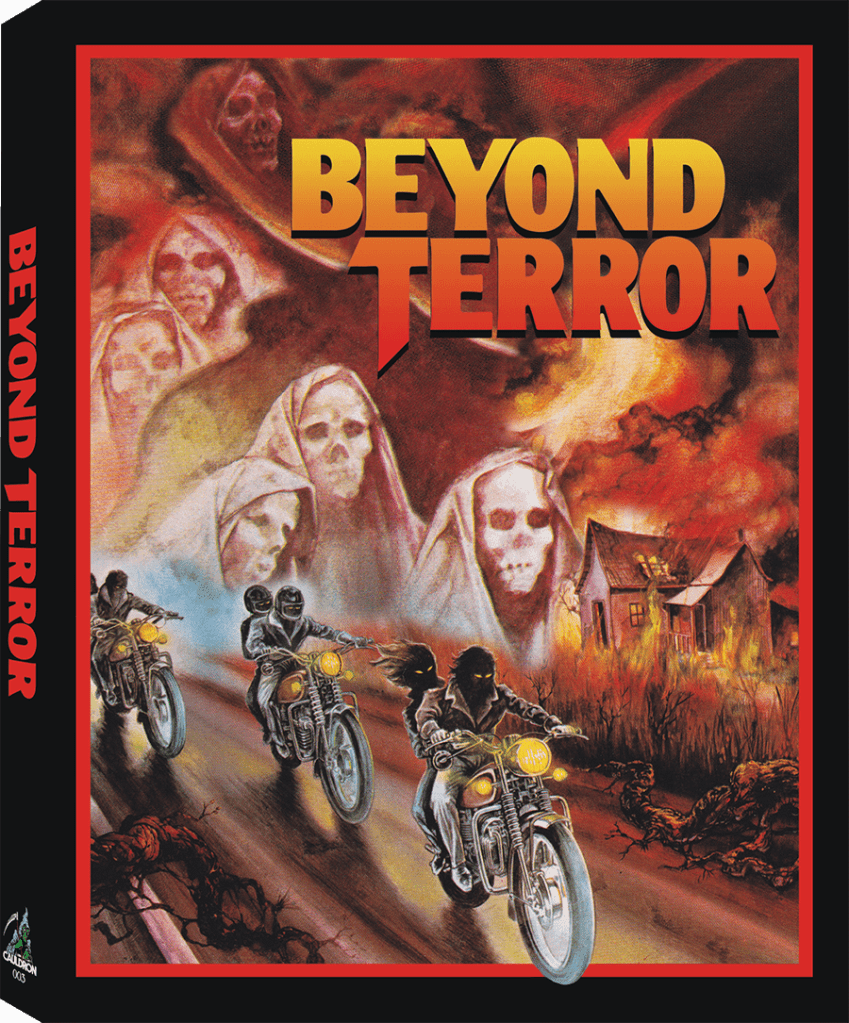
Cauldron Films has put our four movies* and as far as I’m concerned, they’re four for four.
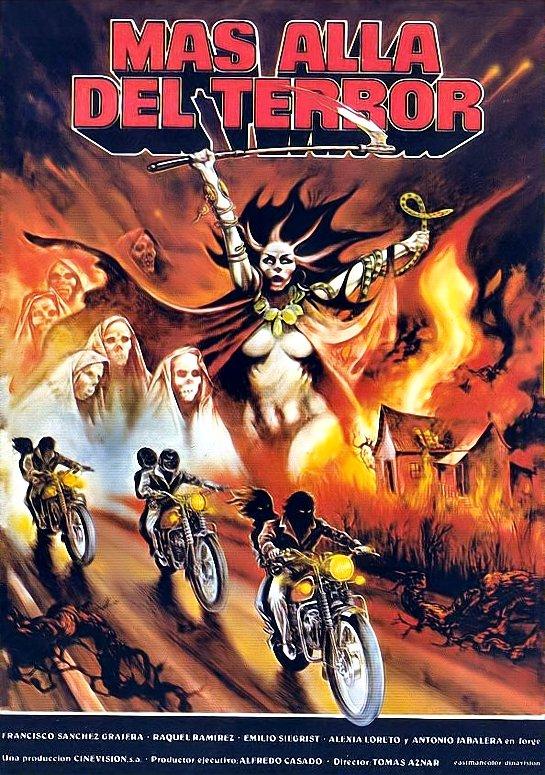
Written and directed by Tomás Aznar, this Spanish biker/slasher/occult freakout thrilled me with every single frame. It starts with one of a group of robbers posing as a prostitute before she brutally knifes a man, then she joins three others to rob a bar.
Taking a middle-class couple hostage and holding out in the home of an old woman and her grandson, they act just like you’d expect a home invasion biker gang to behave, killing everyone in their path when they’re not screwing in churches.
Before they kill her, the grandmother prays to Satan to destroy the bikers and from there on, they see ghastly visions of her dead grandson, you know, when they’re not having sex and killing more people or being chased by Ossorio-like Templars through a desiccated chapel. Oh yeah — there’s also supposedly a fortune guarded by those very same Blind Dead-ish mummies in thecatacombs beneath the ruins.
It’s packed with menace, gore, sex and meanness — exactly the kind of Eurohorror that always played well over here. It has that glorious shot on film soft darkness that I love so much, as well as drugs, shootouts and a final twenty minutes that are a delirious thrill ride.
Más allá Del Terror was never released ever in the United States until now and I have no idea why.
You can right that wrong by grabbing a copy from Cauldron Films. The limited edition slipcase version may be sold out, but there’s another edition coming soon. We’ll update this post when that happens.
If you’re a fan of Asian cinema from Japan, then you know the name of Kinji Fukasaku. In addition to directing the Japanese portion of the Hollywood war film Tora! Tora! Tora! (1970), he directed Toho’s Star Wars hopeful, Message from Space (1978), and the controversial and influential—and his final film—Battle Royale (2000).
After the international failure of Message from Space, Fukasaku set off to make what he hoped would be his masterpiece: an apocalyptic epic based on Sakyo Komatsu’s best-selling novel Fukkatsu no hi, aka Day of Resurrection, intended to rival the likes of Hollywood’s A-List apocalypse pieces such as Soylent Green and The Omega Man and Irwin Allen-styled disaster films such as Earthquake and The Towering Inferno. Westerners—courtesy of their film adaptations—may also know Komatsu’s best-selling Eastern novels Japan Sinks (1973) and Sayonara Jupiter (1982), which were turned into the disaster films Tidal Wave (1973; the U.S. cut featured Lorne Greene from Earthquake) and the space opera Bye, Bye Jupiter (1984). (You may recall Tidal Wave was Roger Corman’s Americanized cut of Japan’s highest-grossing film of 1973 and 1974, Nihon Chinbotsu, aka Submersion of Japan, aka Japan Sinks!, from Komatsu’s best seller.)
Upon its release, Kinji Fukasaku’s Virus was the most expensive film Japan ever produced—at $16 million U.S. It was also one of the country’s biggest box-office failures: even more so than Message from Space.
To make a return on their investment, Toho decided that the film needed to cast familiar western actors—albeit from Hollywood’s B-List—alongside their homeland’s familiar actors to successfully break into the Western markets of Europe and the United States. So an English-speaking international cast featuring Chuck Connors, Glenn Ford, British actress Olivia Hussey, George Kennedy, an up-and-coming Edward James Olmos and Canadian actor Nicholas Campbell, Henry Silva, Bo Svensen, and Robert Vaughn was assembled to star alongside Sonny Chiba and Masao Kusakari. Not only was the cast of an international persuasion, the film was shot on-location, not only in Tokyo, but in various locations in and around Ottawa, Canada, and Halifax, Nova Scotia. The film was supported by the Chilean Navy (Olmos stars as Russian-speaking Chilean), which lent their submarine the CNS Simpson for the production, as did the Canadian Navy, which lent out their submarine the HMCS Okanagan (Connors stars as a British naval officer).
The original cut of the film, which played in the Pacific Rim territories and was intended to play internationally, clocked in at 156 minutes (2 hours and 36 minutes). The film, of course, heavily features Sonny Chiba and Masao Kusakari, as their characters developed during the course of the film through a series of pre-apocalypse flashbacks to their earlier life.
Say it was too long; say it relied too heavily on its Japanese stars; or say that the film’s “blaming” the U.S. and other Western countries for unleashing a deadly pandemic—then nuclear devastation—upon the world was a tad too realistic (the scenes depicting marital law and infected bodies burnt in piles are undeniably dark) and not the dumbed-down Irwin Allen disaster epic with a happily ever after ending that Hollywood was expecting. And there was no way Hollywood was putting a two and a half-hour epic*—filmed mostly in English-subtitled Japanese—into theaters. So, instead of a full, worldwide theatrical release, the majesty of Kinji Fukasaku’s to-be crowning cinematic achievement was cut into a syndicated television version that ran at 108 minutes (1 hour 48 minutes). There’s also a third, shorter TV version that runs seven minutes shorter at 101 minutes (1 hour 41 minutes).
The missing 48 minutes eliminates all of the Tokyo-based flashbacks and most all of the scenes that take place at a remote, isolated Japanese station—which conveniently eliminated all of the English subtitled Japanese. While the 156 minute cut is the suggested watch—which finally seen an official U.S. DVD release in 2006; the original cut is also part of the Sonny Chiba Action Pack—you’re better off, of course, if you can only get a copy of the TV version, watching the longer of TV 108-minute cut. Sadly, the U.S. TV versions—which are now in the public domain on cheapjack DVD sets—reduce Sonny Chiba and Masao Kusakari from the “stars” of the film to peripheral characters; a heart-wrenching scene with the Japanese station making a contact with an orphaned U.S. child begging for help, is lost; Kusakari’s epic trek from a decimated Washington D.C.—which he and Svenson’s soldier tried to stop—is also deleted, which also cuts another great scene with Kusakari carrying a conversation with a burnt-out skeleton—and Jesus Christ on a cross—in a church. And whole scenes are also rearranged, most notably with Chuck Connors’s naval officer’s part not only reduced, but appearing in different parts of the film, depending on the cut you watch.
So, yeah, we’re telling you to watch the original, “too bleak for the U.S.” theatrical cut as Kinji Fukasaku intended. And it’s important to take into account that this is all pre-CGI and shot with practical in-camera effects and seamlessly incorporated stock footage, but those effects—wow, especially those showing the world’s devastated cities, including an overgrown nation’s White House—are stunning set pieces. And if you take the time to watch the original—and are able to, considering our current COVID circumstances, digest a film about a global pandemic unleashed by man’s own greedy stupidity—you’ll agree this is one of the best—if not the best—post-apoc movies you’ll ever watch**.
In a timeline that runs from the year 1982 to 1988, the apocalypse begins as East German and American scientists bicker over the deadly MM88 virus—a virus that absorbs and amplifies other viruses, making them more deadly. Of course, its creation was “accidental,” and it was stolen from a U.S. lab. Successfully recovered, the plane transporting the virus to the states, crashes, and what becomes known as the “Italian Flu,” is unleashed. Oh, and a goody-two shoes lab tech that discovered the truth behind MM88 is murdered to keep it all quiet. (Sakyo Komatsu’s based his book’s “Italian Flu” on the Spanish Flu pandemic of 1918 to 1920, which started in Kansas, USA.)
In a mere seven months, most of the world’s population is dead—and eventually claims the lives of Glenn Ford and Robert Vaughn (starring as the President and VP). Henry Silva (Silva, Ford, and Vaughn are excellent) is their paranoid-mad military Chief of Staff insistent that the new ARS Defense system must be armed to protect a now weakened America from a Soviet invasion. And being the crackpot that he is—after his bosses are all dead, he arms the system just before the flu claims his life.
Seven years later, all that’s left of humanity is 855 men and eight women at Palmer Station Antarctica, as the virus can’t survive in temperatures below 10-degrees Celsius. Their somewhat peaceful existence (women are forced into sexual servitude to propagate the species) is upended when it’s discovered the Soviets also have—and armed—their own ARS system: and one of the missiles is aimed at Palmer Station (because it’s a “secret military base”). Then, if the virus and the threat of nuclear war isn’t enough, the station’s seismological team discovers an earthquake will hit the U.S. eastern seaboard—and the magnitude of the quake will be interpreted by the ARS system as an “attack” and launch its rockets.
So, Bo Svenson’s Major Carter and Masao Kusakari’s Dr. Yoshizumi head off to Washington D.C. on an icebreaker to shut down the ARS. Only they’re too late: the earthquake hits and the U.S. ARS launches—and Carter dies in the earthquake rubble. Then the Soviet’s ARS counterstrikes. The world is destroyed.
And that’s how the TV movie version ends.
The theatrical version continues—with those extra seven minutes cut from the 108-minute TV version—as Yoshizumi treks south across the wastelands back to Tierra del Fuego, Antarctica, where the Earth’s final survivors—from the ocean-bound ice breaker, escaped, and successfully created a vaccine.
As far as this reviewer is concerned: Kinji Fukasaku, in fact, created a masterpiece. And, if you’ve spent any amount of time on the digitized terrains of B&S About Movies and are familiar with the later, collective schlock ‘80s resumes of Chuck Conners (Tourist Trap), George Kennedy (Top Line), Henry Silva (Megaforce), Bo Svensen (Night Warning) and Robert Vaughn (Starship Invasions), you’ll realize that they’re all very good here—and Virus gave them their last great film roles before the Italian and Filipino film industries got their low-budget hooks in them. (Nicholas Campbell and Silva later worked together on the Canux-slasher Baker County, U.S.A; Campbell was “Luke Skywalker” in the Canux-star slop that was The Shape of Things to Come; Olivia Hussey ended up in things like Ice Cream Man.)
You can watch the full-length director’s cut courtesy of Tubi. You can watch-compare to the U.S. TV version on You Tube and the VHS version on You Tube.
* We discussed, extensively, those epic “intermission” films of the ‘60s and ‘70s in our review of the 2021 release of the Australian film Rage.
** We discuss a few of our ’70s apoc favorites with our “Drive-In Friday” tribute to Hollywood’s A-List Apocalypse. Then there’s . . .
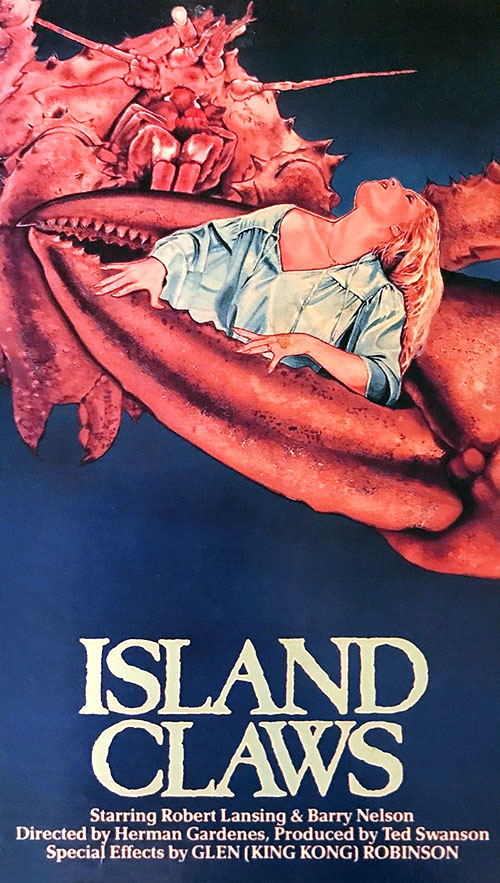
Remember when they had crabs in the grocery store and you’d stare at them in wonder until realizing that people were going to bring them home and boil them while they were still alive? Yeah, your childhood can die pretty quick.
Don’t expect something out of Guy N. Smith’s crab novels. No, this is by the same people who brought you Flipper, Jack Cowden and Ricou Browning (yes, the man who was The Creature from the Black Lagoon). Do expect to spend much of this movie’s running time waiting to see the creature and not getting to see as much of it as you’d like.
I mean, if you’re going to spend $1 million on the crab, show the crab.
Why would you, as a scientist, test groth hormone on a crab? I used to date a professor who was famous within insect study circles for the research she had published about how bug brains act as radio wave receivers. She’d often cut open their heads, dye their brains and then research how they acted. I would tell her the dangers of experimenting on insects and messing with nature, as she didn’t grow up with a steady diet of 1950’s science fiction and 1970’s ecological horror movies. So if the bugs ever come, cut our heads open and experiment on us, you can blame her.
Also, all of that paragraph is much more exciting than Island Claws.
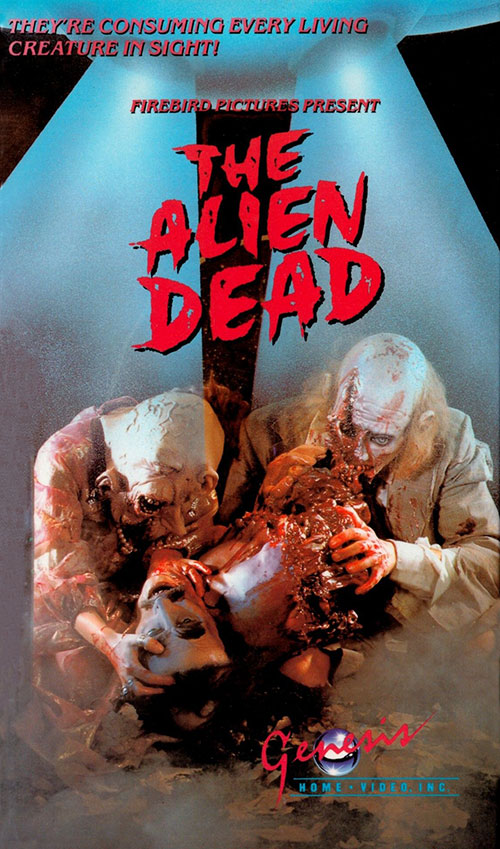
We’re flying to Florida for this film, a Fred Olen Ray directed effort that features Buster Crabbe — yes, the original Flash Gordon and Buck Rogers — as Sheriff Kowalski, a man who must battle the mutants who rise from the swamps when a meteor lands.
This isn’t near the movie that Ray’s follow-up, Scalps, would be, but there’s still lots of fun to be had. It was originally going to be about giant leeches, but then it turned out that those monsters would be too expensive. Zombies, however, are relatively cost-efficient.
Shot over eight weekends for no money, this has zombies eating gators. Really, we should not want more out of life. This should be satisfying knowledge, knowing that giant apex predators face off with the shambling redneck dead and a geriatric former space opera hero is here to save every one of us one more time.
Also, as I’ve learned from Shock Waves, I’m all about watching zombies rise from the dirtiest of water, so that is also a reason to watch, if you have similar predilections.
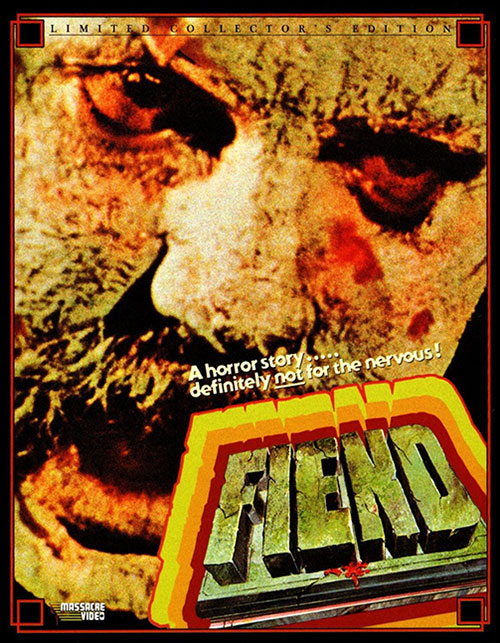
John Waters is from Lutherville. Don Dohler was in the next neighborhood over in Perry Hall. Together they made some astounding movies on a small scale that remain influential within their very specific genres. Waters is the Pope of Trash. Doehler was more on the side of comix, horror and science fiction.
Writer, teacher and film historian Donald Leifert plays the dead body of Eric Longfellow, which has been brought back to life by an evil spirit — that’s all the reason the movie gives — and starts roaming suburban Baltimore and choking the life force of people into his body.
Fiend stayed unwatched for years, which is a shame. It’s a blast with basically no story to get in the way, just a monstrous force out to kill everyone.
Doehler didn’t just shoot this in his hometown. He shot it in his house. This is lo-fi regional horror, which is pretty much all we love around here. At one point, people made movies because they wanted to, not because Amazon monetized content. Watch this and dream back on better days, like, well, 1980.





 B&S About Movies
You must be logged in to post a comment.