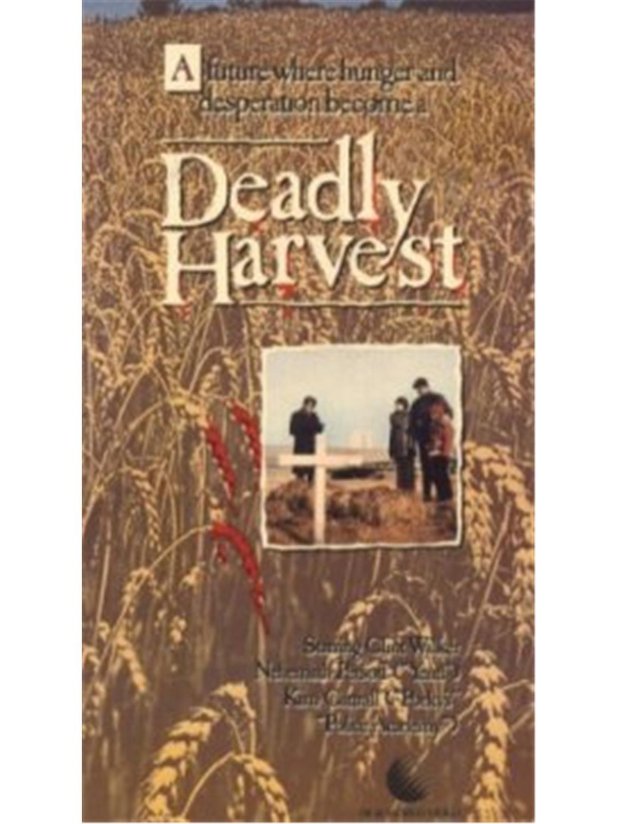
In the midst of a worldwide famine — brought on by global cooling, not warming — farmer Grant Franklin (Clint Walker) and his family are some of the few to have food, thanks to hydroponics. Yeah, it was 1977.
The drama starts when cattle thief Mort Logan (Nehemiah Persoff) steals the family’s last cow from daughter Susan (Kim Cattrall), which causes Grant’s son Michael (Geraint Wyn Davies) to join the militia that’s been fighting back. Then, Charles Ennis (David Brown) and his father (Tim Whelan) come from Toronto to the country, begging the Franklin family for produce for his sick sister (Nuala Fitzgerald). When the militia finds the food, they think he stole it and Ennis’ father dies of a heart attack. This all ends up with a battle at Susan’s wedding, where Grant’s wife (Dawn Greenhalgh) and Susan’s groom are both murdered. But hey — there are only 27 days of food left for the whole world.
Deadly Harvest is a downer, as you can tell, but it’s a different end of the world film. The combat is all from frustration and pain; this is no fun Mad Max world. It’s the type of movie that has a credit for scientific consultation by City Green Hydroponics.
Director Timothy Bond also made the My Pet Monster movie, along with episodes of Friday the 13th: The Series, The Hitchhiker, Goosebumps and Animorphs. Writer Martin Lager also wrote The Shape of Things To Come and the TV series The Starlost.
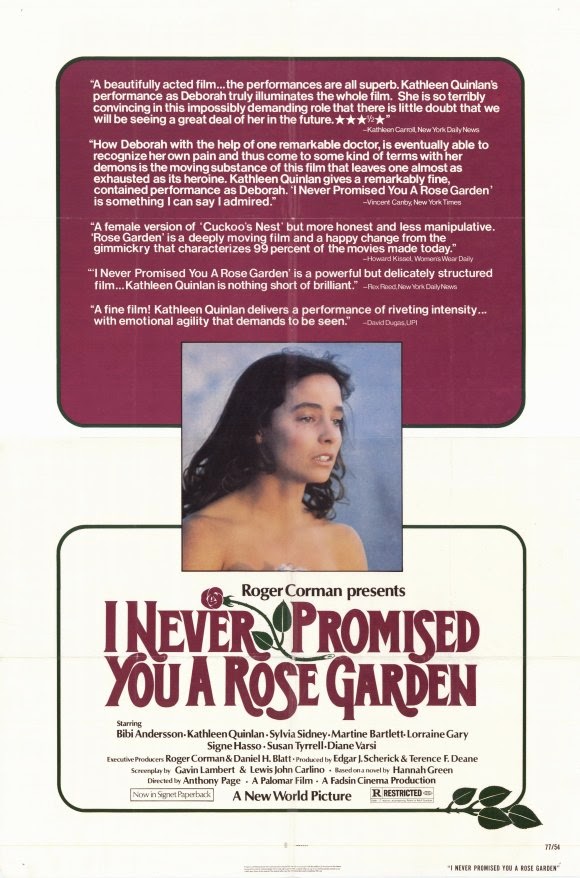
Based on the novel I Never Promised You a Rose Garden by Joanne Greenberg, this was directed by Anthony Page (Absolution, Chernobyl: The Final Warning) and written by Gavin Lambert and Lewis John Carlino (Where Have All the People Gone?, The Mechanic).
It stars Kathleen Quinlan as Deborah Blake, a borderline schizophrenic who lives in a world of fantasy that is rudely intruded upon when she ends up in a brutal institution. Luckily, she’s saved by Dr. Fried (Bibi Andersson), who helps her learn what’s real and what isn’t.
After One Flew Over the Cuckoo’s Nest was a success, Roger Corman was able to get this made. All of the Jewish content was removed, including the anti-Semetic abuse that the protagonist endures. How did Greenberg feel about that? She said that the Jewish moments left the producers “terrified” and the way that mental illness was treated “stank on ice.” Of the actors, only Andersson contacted her to learn the character and she claimed that the producers had told her that the author was “hopelessly insane.” She’d know, as the novel was based on her life.
One of the most expensive New World Pictures, this was nominated for an Academy Award for Best Adapted Screenplay and won two Golden Globe nominations for Best Actress for Quinlan and Best Picture.
This movie also has Dennis Quaid, Susan Tyrell, Lorraine Gary (Ellen Brodie!), Martin Bartlett, Ben Piazza and Sylvia Sidney in the cast. I want to know more about the deleted scenes, as Barbara Steele was in those. And when the movie shows scenes in Blake’s imagination — The Kingdom of Yr — the warriors ‘Anterrabae’ and ‘Lactameaon are Robert Viharo and Jeff Conaway.
Directed, written and produced by Larry Savadove (the executive producer of In Search of Ancient Mysteries, The Outer Space Connection and In Search of Ancient Astronauts and the writer and director of the UFO religion film Contact), Catastrophe is similar to the Sunn Classics films that were a big deal in the 70s. If you wonder what they’re like, just watch any of the UFO, cryptozoological or conspiracy shows that are all over basic cable today as Sunn walked so they could run.
Back. in 1977, you couldn’t pick the show you wanted to watch. So if you wanted a movie filled with disasters, you had to head to the theater. This delivers everything from the Hindenburg and the Xenia, Ohio tornado to Hurricane Camille. the Great Depression Dust Bowl, the Joelma fire in Brazil, Mount Etna erupting, the sinking of the SS Andrea Doria and accidents at the Indianapolis 500 all in one burst of death and horror, narrated by William Conrad.
It’s not perfect — when discussing the Xenia Tornado, Conrad recites the poem “Who Has Seen the Wind?” and claims that it’s by Robert Louis Stevenson. It’s not. It was written by Christina Rossetti. That said, today you’d just watch whole series about these things. But in 1977, we had this. It’s kind of a mondo, except it doesn’t have racist journeys into seeing native tribes or tries to shock you with sex. Mondo kind of makes a move from world travelogue to disasters to outright death by the VHS era, as Faces of Death faked out the world.
Using the name that came in second for Eat My Dust and working on the script with his father Rance, this was the first movie that Ron Howard directed. It takes what worked in that aforementioned New World Pictures movie and makes it even more charming.
Paula Powers (Nancy Morgan) wants to marry Sam Freeman (Howard) but as far as her parents — Bigby (Barry Cahill) and Priscilla Powers (Elizabeth Rogers, who was the substitute communications officer for Uhara on Star Trek) — are interested, she should be with the wealthy Collins Hedgeworth (Paul Linke, Motel Hell) instead of a poor kid who is studying the environment. She responds by stealing their Rolls-Royce Silver Cloud and racing out to Las Vegas.
Bigby is running for political office, so he sends Ned Slinke (Rance Howard) after the couple to stop this whole foolish enterprise, while Collins heads out after his would-be fiancee, but not before he steals a car, which sends the police — and his mother, played by Howard’s Happy Days castmate Marion Ross — after him.
He also calls KTNQ’s DJ Curly Q, who is the “Real Deal” Don Steele, a fixture in so many Corman movies like The Student Teachers, Death Race 2000 and Rock ‘n’ Roll High Schoolas well as Corman alumni films like Gremlins and Eating Raoul. Speaking of high speed and cars, one of the promotions Steele was involved in ended in tragedy. When he was at KHJ in the summer of 1970, the station had a “Super Summer Spectacular” with Steele driving around Los Angeles in a red sports car. They would broadcast clues about his location and. give $25 to anyone who found him. During this contest, two teenagers attempting to track Steele by car at speeds of roughly 80 miles per hour rammed another car into a highway divider, causing the death of Ronald Weirum. Weirum’s family sued and won, saying that the promotion caused recklessness. Steele would also often yell. “Tina Delgado is alive! Alive!” on the air and would never reveal why. I’ve heard two stories: one that she was a girl whose obituary was incorrectly written and he was always trying to make up for it. Or it was the scary version, where she was a teenager listening to Steele on the air and not paying attention, which led to her walking right into a train. His guilt led to him saying her name on every broadcast to pay tribute. You can also hear him in the Cheap Trick song “On the Radio” (“Heaven Tonight”) and when his career was down in the 80s, Ernie Anderson — the one-time Ghoulardi and the father of Paul Thomas Anderson — got him the agent he needed to return to stardom, to the point that he has a star on the Hollywood Walk of Fame.
I digress, but man, whenever Don Steele shows up in a movie, I love it.
By this point, our leads are being chased — for a $25,000 reward given by Collins’ mother for the safe return of her beloved boy — by all manner of weirdos like mechanics Ace (Ron’s brother Clint) and Sparky (Pete Isacksen); a preacher (Hoke Howell, who had been on The Andy Griffith Show with Howard); a demolition derby and even an organized crime family led by Garry Marshall (Howard was calling in all his Happy Days people) that has Leo Rossi — Bud from Halloween 2! — amongst its members.
I love how the radio station takes the couple as bad guys, then good guys, then bad, then by the end Don Steele is chasing them from their wedding on the way to their honeymoon, promising coverage of their lovemaking before crashing into a house. A total New World all-star film, this also has Allan Arkush as a clown and Paul Bartel as a groom.
Shot without permits in 15 days, Howard impressed the crew with how fast he was able to understand directing a movie. Then again, he’d been on films sets for a decade. Corman told him, “Do a really good job on this one, kid, and you’ll never have to work for me again.”
EDITOR’S NOTE: This was originally on the site on December 15, 2018.
The Hammer Sisters are the kind of tough Southern girls that deal with their daddy’s murder by taking over his moonshine business, grabbing some weapons and being way tougher than any of the men they battle. Is that enough to get you to watch this movie?
Not yet? How does John Saxon playing a Southern stock car racer and moonshine runner sound? Not yet?
How about Susan Howard, former Dallas actress turned 700 Club host and NRA supporter?
William Conrad? Jeff Corey? Len “Uncle Leo” Lasser? Maurine “Marcia Brady” McCormick? Still not sold?
I get it. John Saxon was enough for me. But then I thought, I bet this movie has Claudia Jennings in it. And I was right. And that’s all it took.
What was it about American pop culture that took hicksploitation from the drive-in to the mainstream? I remember it myself — everyone had a CB radio, we all turned into The Dukes of Hazzard and watched Smokey and the Banditon HBO. Heck, I even had a silver NASCAR jacket that made me look like a 5-year-old pit crew member.
From the very first moment that John Saxon appears on screen and does his best version of a Southern accent, I was thoroughly entertained by this silly trifle of a film. It’s a Roger Corman 1970’s drive-in movie, so you’re going to get plenty of cars getting smashed up, scummy bad guys and “100 proof women” like Candice Rialson (Chatterbox, Pets).
Hollywood stuntman Jingo Johnson (Jesse Vint, Pigs) has come back home to see his mother before she dies. The family farm has been taken over by a mining company, his old girl Lucy (Karen Carlson, The Student Nurses) is dating one of the mining crew (Robert F. Lyons) and Sheriff Otis Grimes (Albert Salmi) has it in for him.
He learns from Nurse Beulah Barnes (Mary Charlotte Wilcox, Beast of the Yellow Night and, strangely, two seasons of SCTV) that the mining company also owns the hospital that his mother is in, amongst other farmers, and has been keeping them asleep with a concoction of narcotics. Even worse, the pills they gave her caused the disease that soon takes her life.
It turns out that the law is behind all of this — the title makes sense! — and they want Jingo to take the fall for several murders. Oh man, the 70s, a time when redneck — I say this in the kindest of ways as taught by Joe Bob — movies played with conspiracy film!
EDITOR’S NOTE: This was first on the site on July 17, 2018.
I’ve stayed away from talking about David Cronenberg movies on here because, well, better and smarter people have already done so. After all, there’s an entire zine devoted to discussing his works, House of Skin. And friend of the site Bill Van Ryn has already written an incredibly well-written appreciation of this one. But hey — I made it through the whole Joe Bob Briggs marathon and am trying to share my thoughts with you. So please indulge me. Thank you.
The film starts with Rose and her boyfriend Hart getting into an accident in the remote countryside. With no other option, they are sent to the Keloid Clinic for Plastic Surgery, with Hart suffering only a broken hand, a separated shoulder and a concussion. Rose, however, is barely alive, needing several operations and skin grafts from being burned. Dr. Dan Keloid decides to try something new: he uses “morphogenetically neutral grafts” to heal her damaged tissue, hoping that it will heal on its own. A month later, Hart is ready to go home, but she remains in a coma.
Sometime later — time isn’t really of the essence in this nightmare world — Rose awakens screaming. When Lloyd, another patient in the clinic, comes to help her, she somehow cuts him. He doesn’t remember how it happened, but his blood no longer clots and he can no longer feel pain. And Rose? Well, now she has a wound in her armpit that looks sexual — male and female at the same time. Shades of God Told Me To?
Now, Rose can only subsist on human blood, which she discovers after cow’s blood causes her to puke. A farmer watches and tries to rape her, but she is the predator now, soon devouring him and turning him into a zombie-like monster.
All hell soon breaks loose — Lloyd attacks a taxi driver after escaping from the clinic, killing them both. Dr. Keloid attacks everyone within his own clinic. Rose tries to get Hart to save her, but escapes on her own, infecting people all along the way.
Soon, Quebec is a nightmare city, with maniacs using jackhammers to tear people from cars, Santa Claus getting shot and a shoot to kill martial law policy being enacted on anyone showing signs of the virus.
Hart tries to reason with Rose — she is the cause of all of this and needs to be stopped. Of course, things can’t work out well. The world of Soylent Green has become near truth — there are so many dead people, garbage trucks are the only solution.
Cronenberg wanted to cast Sissy Spacek in the lead, but her accent didn’t work for the film’s producers. He heard from Ivan Reitman, the executive producer, that adult film star Marilyn Chambers was looking for a mainstream role. Her being in the film would help sell it and she put in plenty of work, so Cronenberg was happy with the results. In fact, he had never seen the movie that made her famous, Behind the Green Door.
Chambers was quite literally a pure Ivory Soap girl — appearing on a box of that cleaning product as a young mother with the tag “99 & 44/100% pure.” Her appearance in the Mitchell Brothers’ film — released at the height of post-Deep Throat porn chic, when adult films entered mainsteam consciousness — was a sensation. It didn’t hurt that she was also the first white woman in a major adult film to have a scene with a black man, Johnnie Keyes.
Chambers was in the midst of trying a singing career — her song “Benihana” can be heard in this film — and she was married to Chuck Traynor, ex-husband of Linda Lovelace. You could write a novel about the mania of that dude.
That said — for being a sex queen, Chambers comes off as cold in this film. That’s probably Cronenberg’s goal, to subvert notions. Even his heroes are no heroes. No one can stop what is set in motion and everyone is ineffectual. Such is the Cronenberg universe.
One thing I’ve always wondered — why did they spoil the ending of this film in the original poster?
If you want to see Rabid, you can grab the Shout! Factory reissue. Or turn in to Shudder, who has versions with and without commentary from Joe Bob Briggs.
This is a vansploitation movie. Yes, that’s really a genre and there are several films in it, of which I can name Blue Summer, The Van (obviously), Best Friends, C.B. Hustlers (which has Uschi Digard in it), Mag Wheels, Van Nuys Blvd. and I guess you could almost count On the Air Live with Captain Midnight. There’s a great article on it by Jason Coffman that goes deep into the genre that I totally recommend.
The beauty of this movie is that it posits a world where solar energy is already happening, van culture is the driving force in society and there is no AIDS to worry about, so all of the vans are a rocking and absolutely no one is knocking. It is surely paradise, if paradise only gets 11 miles to the gallon, fuel crisis be damned.
Our hero Clint Morgan has traveled to The Invitational Freak-Out, a major event for custom van enthusiasts, which means that any time we’re near it, we get to see plenty of b-roll footage of painted vans and all of the accouterments — this is not a word you want to use when selling Winnebagos — that they have inside.
Clint saves Karen (Katie Saylor, Invasion of the Bee Girls) from some bikers from another exploitation genre and they destroy his van The Sea Witch. That’s when he goes to the super genius van designer Bosley and together, they all make Supervan, which uses solar power and lasers. It was really made by George Barris — who designed so many other Hollywood cars — and was based on a stock Dodge Sportsman van. This thing was so big that it had a phone intercom system inside it.
Oh yeah. It turns out that Karen’s dad owns a car company that is out to make a van that uses more gas than ever before — what does it get 3 miles to the gallon? — and they have to take Supervan to the show to prevent him from making it happen, but he puts the cops on their tail.
We’ve seen Clint before on our site, as Mark Schneider is also in the Crown International Pictures movie Burnout, which is one of the few dragsterpolitation movies I can think of, so perhaps he is the perfect star for all things vehicular in nature.
Director Lamar Card is also there, in the nooks and crannies of strange movies that I find myself obsessed with, like producing the scumtastic Nashville Girl and directing the only Fabian-starring, Casey Kasem-coke sniffing disco freakout Disco Fever.
Beyond the near gynecological explorations of all of these vans at the absolute expense of story, this movie has a cameo by Charles Bukowski — the firebrand of a man who wrote “what matters most is how well you walk through the fire” — judging a wet t-shirt contest. I am in no way making that up.
There’s never really been a movie like Supervan. To be fair, I don’t think the world could have handled two. To quote the love ballad from the film, when I think of Supervan, “I’ll always remember you as a milestone in my life.”
Vansploitation got so insane during the ’70s, A&M Records gave away a Styx Van. Yes, Styx had a van you could enter to win!
Has a movie ever been more cast for me? I mean, not just Carroll Baker but Susan Tyrell? Can the screen contain that much magic? Directed by Jed Johnson, who also edited Andy Warhol’s Dracula and designed the offices of his magazine Interview, it was written by Pat Hackett and George Abagnalo, and was the last film that Warhol would produce.
Hazel Aiken (Carroll Baker) lives in Brooklyn, where she does electralysis out of her home. But her real job is hiring out women like P.G. (Stefania Casini, who followed this movie with Suspiria and this fact makes me overjoyed) and R.C. (Cyrinda Foxe, who left David Johnansen for Steven Tyler and was the mother of his daughter Mia) to perform dirty deeds for those who need them. Always women, until drifter L.T. (Perry King, coming off Mandingo) comes into her home and throws everything into a mess.
With $1.5 million to spend — the most of any Warhol film — this pretty much ended up being a non-John Waters John Waters movie. The cast is a mix of up and coming actors like King, non-actors from Warhol’s orbit and, in her first U.S. movie in nearly a decade, Baker.
Her part was meant to be played by Vivian Vance — Shelley Winters also turned down the role — but she left the production. Baker was looking to escape the films she made in Europe, saying “I’m looking to get away from that. People don’t realize you’re acting. They just see you’re sexy and they won’t take you seriously.” Oh Carol. I’ve watched every movie you made there — I recommend everything she did with Umberto Lenzi, like So Sweet, So Perverse, The Fourth Victim, Orgasmo, A Quiet Place to Kill, Knife of Ice and The Sweet Body of Deborah.
King and Baker struggled with their roles and asked Tyrell for advice, who told them their mistake was even reading the script. In a movie where everyone is horrible, the fact that Tyrell is the only somewhat good person is pretty insane.
Don Schain is probably best known for directing his wife Cheri Caffaro in the Ginger trilogy of Ginger, The Abductors and Girls Are For Loving. This is her last film before disappearing from the public eye. As for her one-time husband, he would go on to line produce H.O.T.S. and High School Musical.
Written with Jan-Michael Sherman and Don Buday (KISS Meets the Phantom of the Park), Too Hot to Handle has Caffaro as Samantha Fox, a socialite assassin who has come to the Phillippines on her yacht and proceeds to kill some bad people in wild ways, like suffocating an S&M enthusiast with a plastic bag and shoving a woman into a mudbath complete with electrodes.
She’s being chased by policeman Domingo De La Torres (Aharon Ipalé). and his partner Sanchez (Vic Diaz). Of course, he falls for her and you probably will too. Caffaro isn’t a typical sex symbol, she’s not the best at action scenes but she has some kind of unexplainable charisma that carries this entire movie.
You must be logged in to post a comment.