NEW WORLD PICTURES MONTH: Rabid (1977)

EDITOR’S NOTE: This was first on the site on July 17, 2018.

I’ve stayed away from talking about David Cronenberg movies on here because, well, better and smarter people have already done so. After all, there’s an entire zine devoted to discussing his works, House of Skin. And friend of the site Bill Van Ryn has already written an incredibly well-written appreciation of this one. But hey — I made it through the whole Joe Bob Briggs marathon and am trying to share my thoughts with you. So please indulge me. Thank you.

The film starts with Rose and her boyfriend Hart getting into an accident in the remote countryside. With no other option, they are sent to the Keloid Clinic for Plastic Surgery, with Hart suffering only a broken hand, a separated shoulder and a concussion. Rose, however, is barely alive, needing several operations and skin grafts from being burned. Dr. Dan Keloid decides to try something new: he uses “morphogenetically neutral grafts” to heal her damaged tissue, hoping that it will heal on its own. A month later, Hart is ready to go home, but she remains in a coma.

Sometime later — time isn’t really of the essence in this nightmare world — Rose awakens screaming. When Lloyd, another patient in the clinic, comes to help her, she somehow cuts him. He doesn’t remember how it happened, but his blood no longer clots and he can no longer feel pain. And Rose? Well, now she has a wound in her armpit that looks sexual — male and female at the same time. Shades of God Told Me To?

Now, Rose can only subsist on human blood, which she discovers after cow’s blood causes her to puke. A farmer watches and tries to rape her, but she is the predator now, soon devouring him and turning him into a zombie-like monster.

All hell soon breaks loose — Lloyd attacks a taxi driver after escaping from the clinic, killing them both. Dr. Keloid attacks everyone within his own clinic. Rose tries to get Hart to save her, but escapes on her own, infecting people all along the way.

Soon, Quebec is a nightmare city, with maniacs using jackhammers to tear people from cars, Santa Claus getting shot and a shoot to kill martial law policy being enacted on anyone showing signs of the virus.

Hart tries to reason with Rose — she is the cause of all of this and needs to be stopped. Of course, things can’t work out well. The world of Soylent Green has become near truth — there are so many dead people, garbage trucks are the only solution.

Cronenberg wanted to cast Sissy Spacek in the lead, but her accent didn’t work for the film’s producers. He heard from Ivan  Reitman, the executive producer, that adult film star Marilyn Chambers was looking for a mainstream role. Her being in the film would help sell it and she put in plenty of work, so Cronenberg was happy with the results. In fact, he had never seen the movie that made her famous, Behind the Green Door.

Chambers was quite literally a pure Ivory Soap girl — appearing on a box of that cleaning product as a young mother with the tag “99 & 44/100% pure.” Her appearance in the Mitchell Brothers’ film — released at the height of post-Deep Throat porn chic, when adult films entered mainsteam consciousness — was a sensation. It didn’t hurt that she was also the first white woman in a major adult film to have a scene with a black man, Johnnie Keyes.

Chambers was in the midst of trying a singing career — her song “Benihana” can be heard in this film — and she was married to Chuck Traynor, ex-husband of Linda Lovelace. You could write a novel about the mania of that dude.

That said — for being a sex queen, Chambers comes off as cold in this film. That’s probably Cronenberg’s goal, to subvert notions. Even his heroes are no heroes. No one can stop what is set in motion and everyone is ineffectual. Such is the Cronenberg universe.

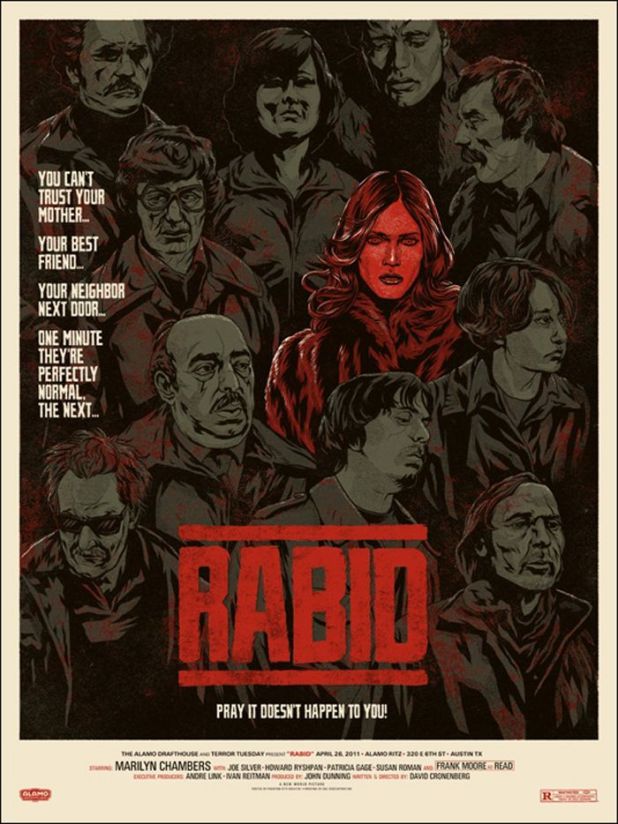
One thing I’ve always wondered — why did they spoil the ending of this film in the original poster?

If you want to see Rabid, you can grab the Shout! Factory reissue. Or turn in to Shudder, who has versions with and without commentary from Joe Bob Briggs.
NEW WORLD PICTURES MONTH: Supervan (1977)

EDITOR’S NOT: This was first on the site on December 7, 2020.

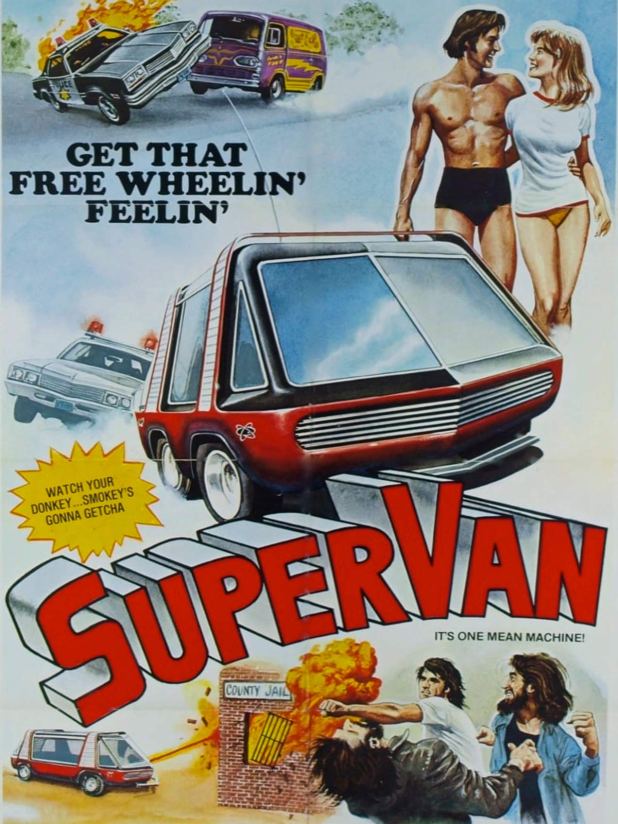
This is a vansploitation movie. Yes, that’s really a genre and there are several films in it, of which I can name Blue SummerThe Van (obviously), Best Friends, C.B. Hustlers (which has Uschi Digard in it), Mag WheelsVan Nuys Blvd. and I guess you could almost count On the Air Live with Captain Midnight. There’s a great article on it by Jason Coffman that goes deep into the genre that I totally recommend.

The beauty of this movie is that it posits a world where solar energy is already happening, van culture is the driving force in society and there is no AIDS to worry about, so all of the vans are a rocking and absolutely no one is knocking. It is surely paradise, if paradise only gets 11 miles to the gallon, fuel crisis be damned.

Our hero Clint Morgan has traveled to The Invitational Freak-Out, a major event for custom van enthusiasts, which means that any time we’re near it, we get to see plenty of b-roll footage of painted vans and all of the accouterments — this is not a word you want to use when selling Winnebagos — that they have inside.

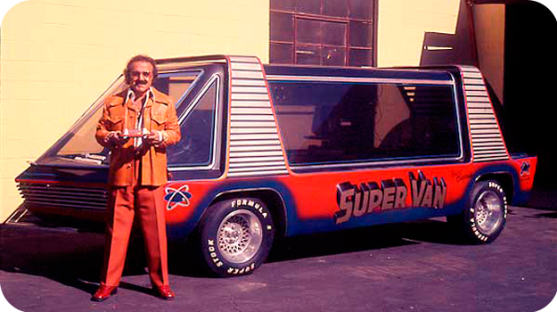
Clint saves Karen (Katie Saylor, Invasion of the Bee Girls) from some bikers from another exploitation genre and they destroy his van The Sea Witch. That’s when he goes to the super genius van designer Bosley and together, they all make Supervan, which uses solar power and lasers. It was really made by George Barris — who designed so many other Hollywood cars — and was based on a stock Dodge Sportsman van. This thing was so big that it had a phone intercom system inside it.

Oh yeah. It turns out that Karen’s dad owns a car company that is out to make a van that uses more gas than ever before — what does it get 3 miles to the gallon? — and they have to take Supervan to the show to prevent him from making it happen, but he puts the cops on their tail.

We’ve seen Clint before on our site, as Mark Schneider is also in the Crown International Pictures movie Burnout, which is one of the few dragsterpolitation movies I can think of, so perhaps he is the perfect star for all things vehicular in nature.

Director Lamar Card is also there, in the nooks and crannies of strange movies that I find myself obsessed with, like producing the scumtastic Nashville Girl and directing the only Fabian-starring, Casey Kasem-coke sniffing disco freakout Disco Fever.

Beyond the near gynecological explorations of all of these vans at the absolute expense of story,  this movie has a cameo by Charles Bukowski — the firebrand of a man who wrote “what matters most is how well you walk through the fire” — judging a wet t-shirt contest. I am in no way making that up.

There’s never really been a movie like Supervan. To be fair, I don’t think the world could have handled two. To quote the love ballad from the film, when I think of Supervan, “I’ll always remember you as a milestone in my life.”

Vansploitation got so insane during the ’70s, A&M Records gave away a Styx Van. Yes, Styx had a van you could enter to win!

Courtesy of Detroit Rock Art Gallery, Splatt Gallery Facebook.

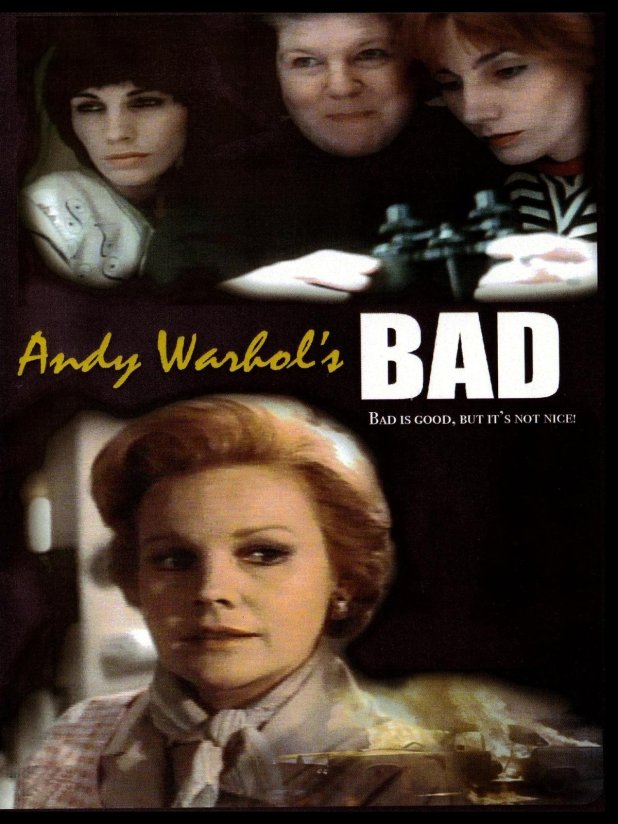
NEW WORLD PICTURES MONTH: Andy Warhol’s Bad (1977)

Has a movie ever been more cast for me? I mean, not just Carroll Baker but Susan Tyrell? Can the screen contain that much magic? Directed by Jed Johnson, who also edited Andy Warhol’s Dracula and designed the offices of his magazine Interview, it was written by Pat Hackett and George Abagnalo, and was the last film that Warhol would produce.

Hazel Aiken (Carroll Baker) lives in Brooklyn, where she does electralysis out of her home. But her real job is hiring out women like P.G. (Stefania Casini, who followed this movie with Suspiria and this fact makes me overjoyed) and R.C. (Cyrinda Foxe, who left David Johnansen for Steven Tyler and was the mother of his daughter Mia) to perform dirty deeds for those who need them. Always women, until drifter L.T. (Perry King, coming off Mandingo) comes into her home and throws everything into a mess.

With $1.5 million to spend — the most of any Warhol film — this pretty much ended up being a non-John Waters John Waters movie. The cast is a mix of up and coming actors like King, non-actors from Warhol’s orbit and, in her first U.S. movie in nearly a decade, Baker.

Her part was meant to be played by Vivian Vance — Shelley Winters also turned down the role — but she left the production. Baker was looking to escape the films she made in Europe, saying “I’m looking to get away from that. People don’t realize you’re acting. They just see you’re sexy and they won’t take you seriously.” Oh Carol. I’ve watched every movie you made there — I recommend everything she did with Umberto Lenzi, like So Sweet, So PerverseThe Fourth VictimOrgasmoA Quiet Place to KillKnife of Ice and The Sweet Body of Deborah.

King and Baker struggled with their roles and asked Tyrell for advice, who told them their mistake was even reading the script. In a movie where everyone is horrible, the fact that Tyrell is the only somewhat good person is pretty insane.

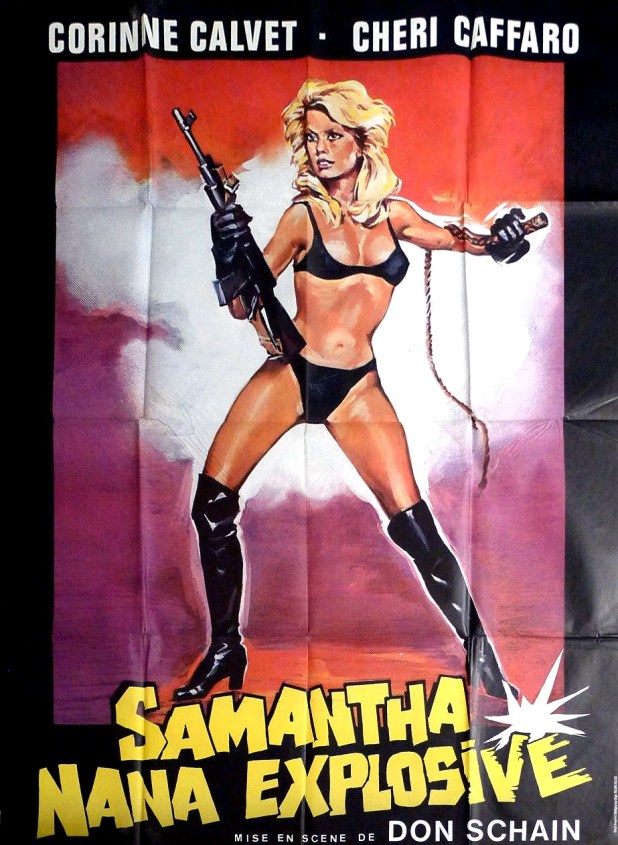
NEW WORLD PICTURES MONTH: Too Hot to Handle (1977)

Don Schain is probably best known for directing his wife Cheri Caffaro in the Ginger trilogy of Ginger, The Abductors and Girls Are For Loving. This is her last film before disappearing from the public eye. As for her one-time husband, he would go on to line produce H.O.T.S. and High School Musical.

Written with Jan-Michael Sherman and Don Buday (KISS Meets the Phantom of the Park), Too Hot to Handle has Caffaro as Samantha Fox, a socialite assassin who has come to the Phillippines on her yacht and proceeds to kill some bad people in wild ways, like suffocating an S&M enthusiast with a plastic bag and shoving a woman into a mudbath complete with electrodes.

She’s being chased by policeman Domingo De La Torres (Aharon Ipalé). and his partner Sanchez (Vic Diaz). Of course, he falls for her and you probably will too. Caffaro isn’t a typical sex symbol, she’s not the best at action scenes but she has some kind of unexplainable charisma that carries this entire movie.

You can watch this on Tubi.

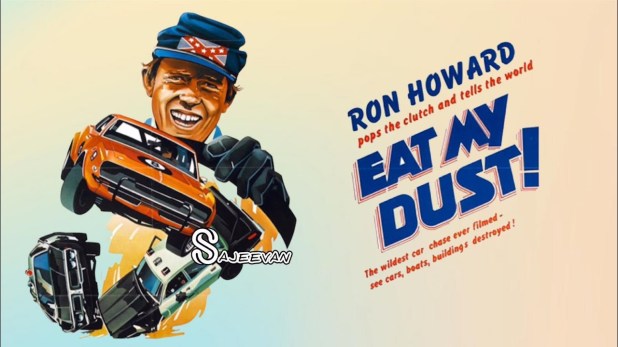
NEW WORLD PICTURES MONTH: Eat My Dust (1977)

Eat My Dust perfectly fits the cultural zeitgeist at the end of the 70s, which matches the end of the 60s, as culture looked toward southern influences and maybe never stopped. During the 1970-71 season, CBS famously canceled all of its rural programming — Mayberry R.F.D., The Beverly Hillbillies, Petticoat Junction and Green Acres — despite it being highly rated but not as appealing to those that bought commercials. Ironically, by 1979, the network would return to the same shows it turned its back on when The Dukes of Hazzard became a ratings success.

Star Ron Howard had written a comedy with his dad Rance called Tis the Season. He already half the budget and if Corman put up the rest, he’d be in this movie and direct and star in another, which ended up being Grand Theft Auto.

Charles B. Griffith, who directed and wrote the movie, suggested the title as a joke. He’d know about car films, as he wrote Death Race 2000

Hoover Niebold (Howard) is the son of the sheriff who is in love with Darlene (Christopher Norris, yes that’s her name) but she’s really in love with the car owned by Bubba Jones (Dave Madden). Hoover steals it and that’s pretty much the movie. All the Howards — including Clint — are in this and it’s more episodic humor than an actual narrative, but that’s perfect for what the kind of movie it is. This is meant to play drive-ins and be just enough entertainment but not enough distraction for what the drive-in is really all about to younger audiences.

But yeah — back to my point. Hollywood will always return to being inspired by and courting southern audiences and those that want to be part of what that audience is all about.

You can watch this on Tubi.

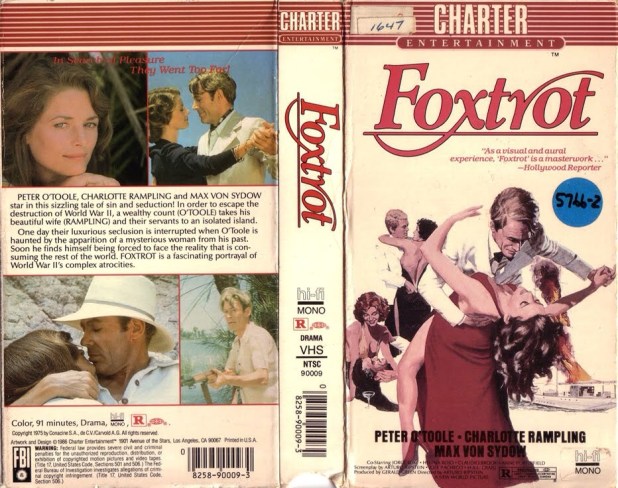
NEW WORLD PICTURES MONTH: Foxtrot (1977)

The Godfather of Mexican independent cinema, Arturo Ripstein got his start working for Luis Buñuel and this film has a very similar feel to that director’s work.

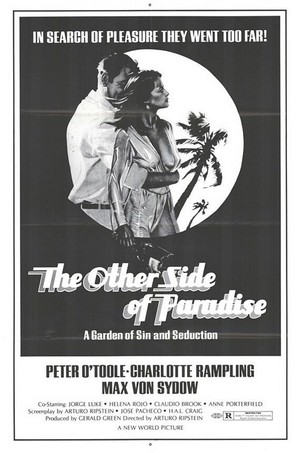
Before World War II begins, Romanian count Liviu (Peter O’Toole) and countess Julia (Charlotte Rampling) have set up an Art Deco tent on a deserted island in the hopes of escaping their past and the war. All of their servants have come along and all of the conveniences of their palatial home, but before long, their friends start to arrive and take most of the servants and kill every animal that is near the island. They leave Liviu and Julia without supplies and without anyone else but Larson (Max von Sydow) and their servant Eusebio (Jorge Luke). There are no supplies coming but there is a war simmering between the three men and the one available woman.

Irish writer H.A.L. Craig was a contributor to the recut Lisa and the Devil known by the name House of Exorcism. He wrote the script along with Ripstein and José Emilio Pacheco. This was re-released with more sex scenes as The Far Side of Paradise and The Other Side of Paradise.

You can watch this on Tubi.

NEW WORLD PICTURES MONTH: Darktown Strutters (1977)

EDITOR’S NOTE: This was originally on the site on July 23, 2020.

George Armitage wrote Gas-s-s-sPrivate Duty NursesNight Call Nurses and Vigilante Force before scoring mainstream success with Miami Blues and Grosse Point Blank. He told Film Comment, “I wrote Darktown Strutters in three days, and the script form is all one sentence, the entire script is one sentence.”

While he had wanted to direct this, William Witney ended up making it. Witney was a Hollywood vet, starting all the way back at Republic where he worked n movie serials. He worked a lot with Roy Rogers and at the end of his career, made a few movies with Gene Corman, including I Escaped from Devil’s Island and this movie.

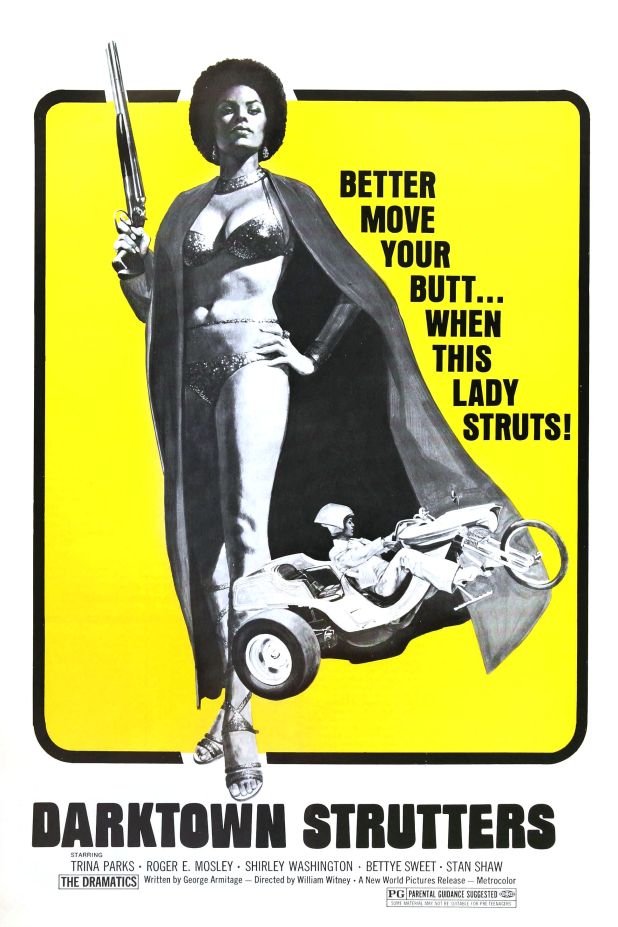
This is less a narrative film and more a collection of hijinks as a gang of black bikers interacts with the police, all until Syreena starts to search for her missing mother, Cinderella. Turns out an evil barbecue chain — with an owner in full Klan regalia — has her.

Trina Parks from Beyond the Valley of the Dolls and Diamonds Are Forever is Syreena, backed up by a cast featuring former Ikette Edna Richardson, Roger E. Mosley (TC from Magnum, P.I.), Stan Shaw (Detective Sapir from The Monster Squad), Alvin Childress (Amos of the Amos ‘n Andy TV show), Zara Cully (Mother Jefferson!) and, this being a Corman family film, Dick Miller.

Get ready for a fairy tale mixed with blaxploitation, basically, with plenty of great tunes from The Dramatics as well as John Gary Williams and The Newcomers.

And remember: “Any similarity between this true life adventure and the story Cinderella … is bullshit.”

ARROW BLU RAY RELEASE: Black Sunday (1977)

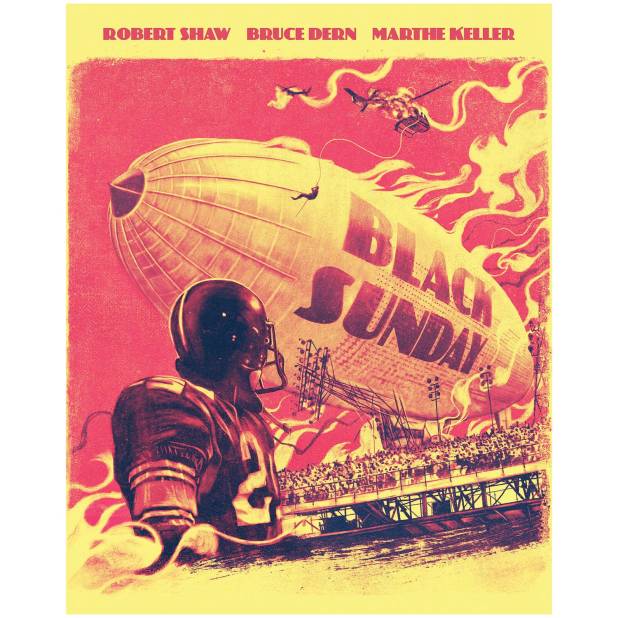
Black Sunday was an always on HBO film in my childhood — the HBO Guide from January 1978 confirms this, I would have been six years old — and it was pure childhood trauma. There were my beloved Pittsburgh Steelers under attack by a terrorist piloting the Goodyear blimp! It was too much for my young mind to handle and I had nightmares of seeing that happy little zeppelin turned into a tool of death.

Director John Frankenheimer was the only director who could make this. That’s because he had already built a relationship with Goodyear Tire and Rubber Company head Robert Lane while working on the movie Grand Prix. In fact, Lane once told the director,  “You’re the only person I’ve ever worked with who has kept his word.”

The film could use Goodyear’s blimps on four conditions: the terrorists couldn’t work for Goodyear, when the blimp blew up it couldn’t show the logo, the Goodyear logo couldn’t sell the movie and the blimp itself couldn’t kill anyone.

The other part of the deal that allowed this movie to capture the Thomas Harris — yes, the same man who created Hannibal Lecter — novel. That was the National Football League. Only one man could pull off the kind of carny hustle to get camera crews the access to not only shoot all around Super Bowl X — even during the final half hour of the game as the Steelers beat the Cowboys — and bring back the teams to the Orange Bowl two weeks later to get the footage of the blimp menacing the players and crowd. That would be Robert Evans, who also got the crowd from United Way volunteers, provided that Frankenheimer would make a movie for the charity and Robert Shaw narrated it. That said, those aren’t the Cowboys and Steelers in that final scene, it’s players from the Miami Dolphins.

Bruce Dern is incredible in this film, owning every scene he’s in as Michael Lander, a pilot who flies the blimp over NFL games while seething with anger, seeing all these free people when he spent years in a tiger cage as a Vietnam War POW, a time when he was court-martialed upon his return and soon left by his wife. His dream of killing himself and as many people around him as possible and his relationship with terrorist Dahlia Iyad (Marthe Keller) may be the way that he can make it happen. They have a plan of detonating a bomb and thousands of small razor-sharp objects into the Super Bowl audience to achieve her plan of calling attention to the plight of the Palestinians and punishing the U.S. for supporting Israel.

Major David Kabakov (Robert Shaw) kills all of her Black September terrorist cell except for Ilyad, as he finds her unarmed and naked. He comes to regret sparing her life once he learns the level of death and destruction that she has planned. He, his partner Robert Moshevsky (Steven Keats) and FBI agent Sam Corley (Fritz Weaver) get on the trail of the terrorists, who remain many steps ahead of them at every turn.

Black Sunday ends with a thriller helicopter chase and the blimp literally crash landing inside the Orange Bowl before Kabakov climbs onto the blimp and attempts to stop it. You have to keep in mind that these are real stuntmen in this scene without a green screen pulling off an incredible stunt, something we rarely see in cinema these days.

In Kill Bill, Quentin Tarantino edited the scene where Elle Driver attempts to murder The Bride in the hospital as a homage to the nurse scene in Black Sunday. He also used the split screens in homage to the trailer for this film.

I definitely remember reliving this movie — as I usually did in my child years — through Mad Magazine. In issue #195, Dick DeBartolo and Mort Drucker redid the movie as Blimp Sunday.  

Paramount planned for Black Sunday to be their biggest blockbuster of the year. After all, it had the highest-ever pre-release scoring films from test screenings and they thought this would make more than Jaws. A few things went wrong. It was banned in Germany and Japan. The movie Two-Minute Warning came out before it played theaters. And the movie that became the biggest story of 1977 was Star Wars.

Another theory? Comment cards during Black Sunday‘s first showings in Los Angeles discovered that 91% of the audience was disappointed that the blimp didn’t blow up the Super Bowl and kill everyone.

The Arrow Video blu ray of Black Sunday has the film in a high definition 1080p presentation, along with extras like new audio commentary by film scholar Josh Nelson; It Could Be Tomorrow,“ a new visual essay by critic Sergio Angelini that explores the film’s adaptation and production, and its place within the pantheon of 70s terrorism thrillers; The Directors: John Frankenheimer, an hour-long portrait of the director from 2003, including interviews with Frankenheimer, Kirk Douglas, Samuel L. Jackson, Roy Scheider, Rod Steiger and others; an image gallery, a reversible sleeve featuring original and newly commissioned artwork by Peter Strain and an illustrated collector’s booklet featuring new writing on the film by Barry Forshaw. You can get it from MVD.

JESS FRANCO MONTH: Love Camp (1977)

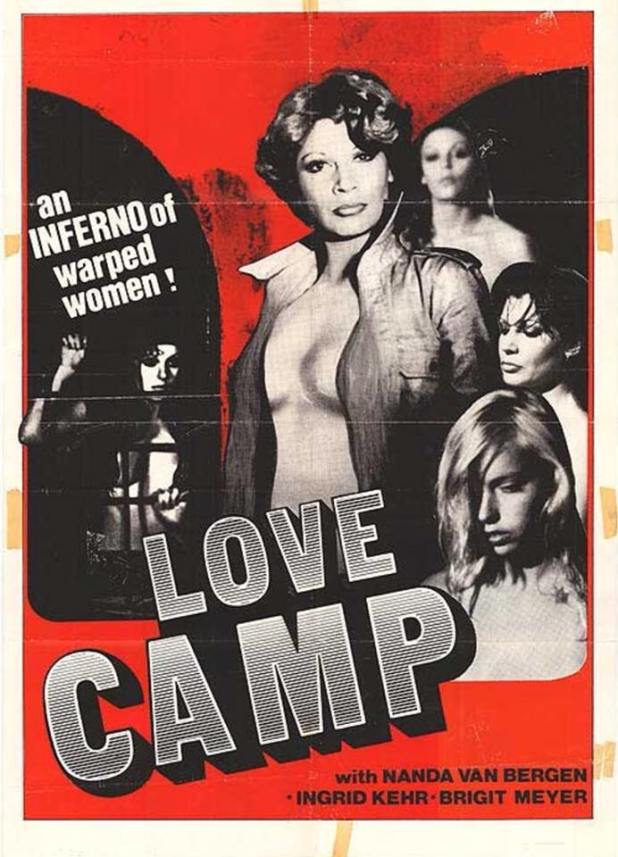
Jess Franco and Erwin C. Dietrich go back to prison again, except that this is about a women’s prison camp that really is used to gather sex slaves to serve as comfort women for a revolutionary army. That means that while the soldiers are fighting for some level of equality, they also need inspiration of their own and that means women taken right off the streets and from their homes and even from their wedding and asked to be concubines for the glory of freedom.

It’d be troubling but not the kind of movie that Jess Franco would make until we meet Isla (Muriel Montossé, using the name Nanda Van Bergen; she also used the names Vicky Adams and Anna Marc), the lesbian warden –with a talking parrot which is something I have yet to see in a women in prison movie — who is here to enact all the things expected from the WIP genre as well as something beyond that. Decapitations, sure. How about nude women tied to crosses and shot full of holes by a topless firing squad?

Beyond Franco naming one of the revolutionaries after Spanish Socialist Labour Party leader, you have to wonder what the moral is when heroine Angela (Ada Tauler) leaves her husband for the revolutionary leader who turned her and most of her friends out. And then Isla gets away without punishment?

Why am I looking for a moral in a Jess Franco movie? I should just stare at Monica Swinn and forget about things like morals when the revolution needs a love camp.

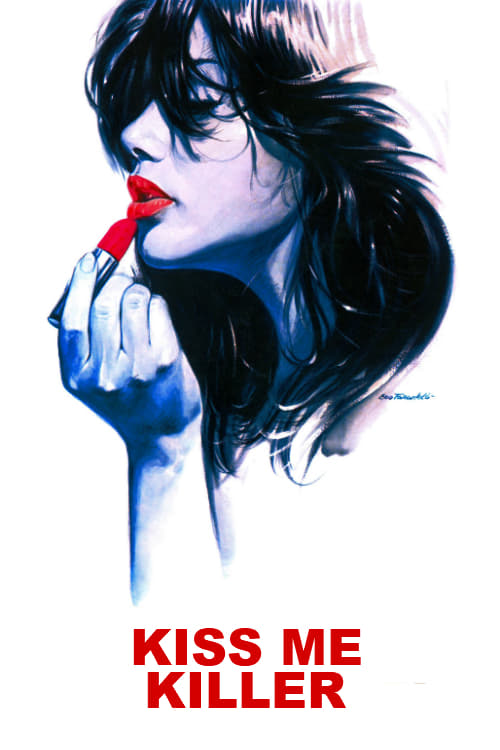
JESS FRANCO MONTH: Kiss Me Killer (1977)

Death Whistles the Blues was 15 years ago, but Jess Franco loves jazz and understands the refrain and sometimes his universe opens to revise films that he has already made to try — sometimes with success — to recreate them now that he has more experience in this world.

Alberto Dalbés is Freddy Carter, which would be Federico de Castro from the original, a role much better acted by Conrado San Martin.

So yeah, Freddy’s dead after a crime gone bad and his two co-criminals — Paul Radeck (Francisco Acosta) and Carlos Moroni (Olivier Mathot) — have run away and assumed those new names. Even more of a punch in the heart is that Radeck also stole away Freddy’s wife Linda (Alice Arno). Now, Moiry Ray (Lina Romay, astounding and rubbing against a stone statue and somehow making it…ah, you get it) is at the Radeck’s club and so is the maybe still alive Freddy.

Really, you don’t have to make a choice between the two films. You can enjoy them both for what they are and the fact that Spanish censorship was gone at this point and we can enjoy Lina lapping at a statue’s granite genitals. Yes, we may have seen it before, but Franco welcomes us and asks us to see it all again through a set of eyes that has seen so much since he first brought this to the screen.