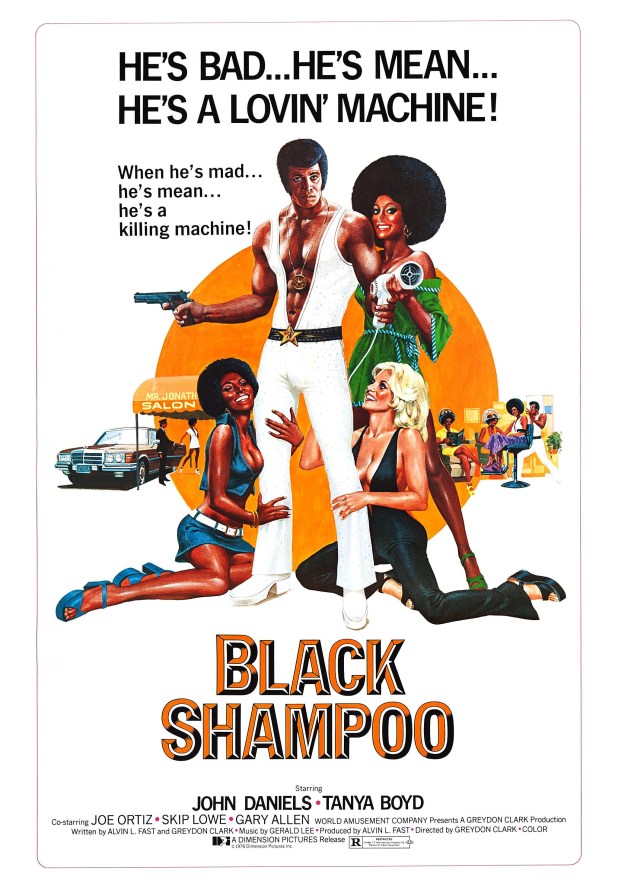
Director and writer Greydon Clark had $50,000 and the idea to take Shampoo and make a black version, subverting blacksploitation by having its hero — Jonathan (John Daniels) — be a business owner instead of the expected criminal. The director of photography had a car accident and still said he would show up. He didn’t and the film’s gaffer, Dean Cundey, took over.
Mr. Jonathan’s is the most successful hair salon for women on the Sunset Strip and that’s because, well, every old and rich white woman in town is coming to get dicked down by Mr. Jonathan. There’s no other polite way to say it. Backed up by hairdressers Artie (Skip E. Lowe, the inspiration for Jiminy Glick) and Richard (Gary Allen), he lives the kind of life that Machete would later imitate.
He soon falls in love with his receptionist, Brenda (Tanya Boyd), who breaks his heart when she disappears. That’s because she’s been kidnapped by her ex, a white mobster, and Jonathan loses his mind after they tear up his shop and even sexually abuse his hairdressers. So he does what any of us would. He gets a chainsaw and kills everyone.
This is the kind of movie where a white woman looks at a nude black man and says, “Oh my God! Mr. Jonathan, it IS bigger and better!” Perhaps you will not be surprised by just how bad the depiction of its gay characters is. This was made in 1976 and that’s in my lifetime. Also: nearly everyone used stage names as it was non-union, so William Bonner is billed as Jack Meoff. That’s kind of the name you’d expect from a porn, but this feels like an adult movie for the first section — there’s a scene in which two young women in a pool seduce Mr. Johnathan before their mother mounts him and makes them watch — and then it becomes a romance before someone is sodomized with a curling iron and revenge comes with a pool cue, an axe and finally, that chainsaw in a gory climax no one saw coming.
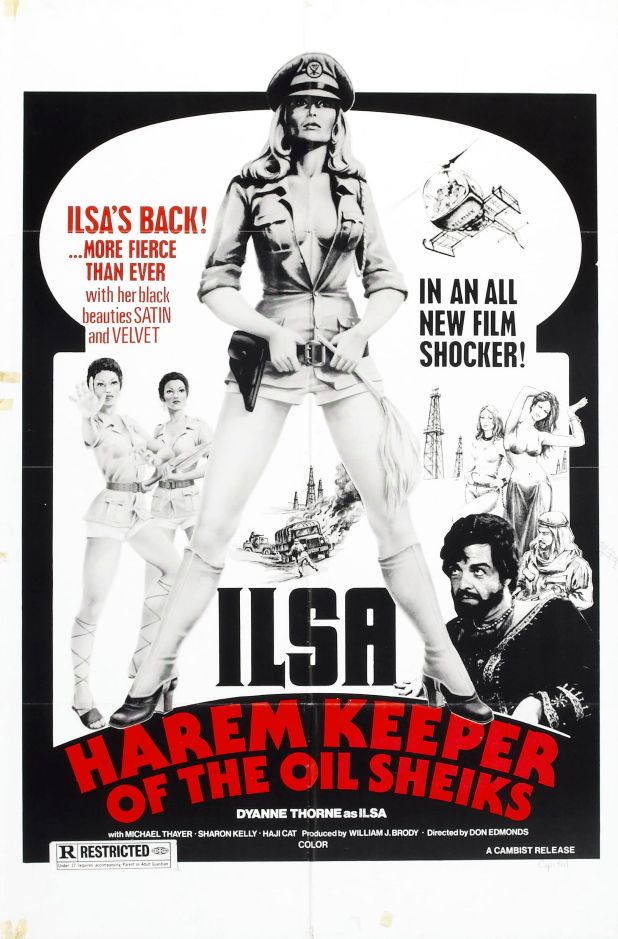
Yes, Ilsa died at the end of the first movie but when has that ever stopped a sequel?
Directed again by Don Edmonds, written by Langston Stafford and again featuring Dyanne Thorne as Ilsa, this film starts with three crates arriving for Ilsa to process. They three chastity belt-confined women. They are the sole heiress of a chain store king of the United States, an actress who is a Scandinavian love goddess and an Asian-European equestrian champion. Working for Sheikh El-Sharif (Jerry Delony), she is to prepare them for sale, which means forcing them to make love to her lesbian bodyguards and crush the body parts of spies who are working for the American commander (Max Thayer) who is spying on her.
This is a movie that has exploding diaphragms and belly button cameras, so it is much more Eurospy than the original. It is just as ridiculous. It also steals the theme from Blood from the Mummy’s Tomb.
It also has a formidable cast, including Russ Meyer supervixens Uschi Digard and Haji, Tanya Boyd, Colleen Brennan, Marilyn Joi, Su Ling and the returning George Buck Flower. There’s also a plot where the commander and Ilsa save the prince and she still gets condemned to starvation. Don’t worry. She’ll be back.
This is a much slicker looking movie with cardboard sets but somehow, it has more of a spirit of fun, even if it has dialogue like “Let’s see how she dances with no feet.”
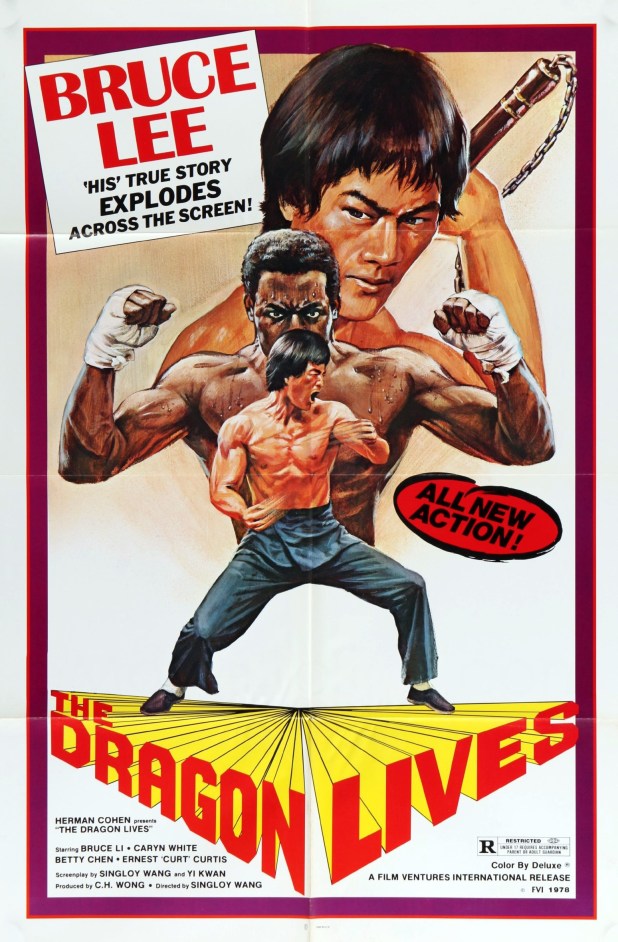
Also known as He’s a Legend, He’s a Hero, this Hong Kong film stars Bruce Li — note, this is not Bruce Lee: The Man, The Myth, which also stars Bruce Li AKA Ho Tsung-Tao — in a somewhat made-up story of the life of the recently deceased Bruce Lee.
Directed by Singloy Wan and written by Yi Kwan and Song Hsiang-yu, this starts as all martial arts movies should, with the star doing his moves while a disco song plays. More of this, people.
Bruce goes to Hollywood to become a star and finds racism waiting. He goes to Hong Kong and becomes a huge star, then gets married to Linda (Caryn White), fights with an American boxer — who even comes the whole way to Hong Kong to fight him in the set of Enter the Dragon — and then has sex with Betty Ting Pei (Su-Chen Chen) which has a lightning storm, a filling up coffee pot and ends with an earthquake and his death, but not before Bruce says, “Life is just so damn short. I always feel like I’m running behind – like time is running out on me.”
That said, nearly everyone says stuff like, “Life is short” and “It seems like Bruce isn’t going to live for long,” like all foreshadowing but is it foreshadowing if we already know the ending?
That said, I could watch every single Bruce Lee fake life story movie. And I feel like I have and then I find another.
From 1972 to 1978, William Girder directed nine feature films and would have probably never stopped, were it not for the helicopter crash that took his life while scouting the Philippines filming locations. From Asylum of Satan and Three on a Meathook to The Manitou, Sheba Baby and Project: Kill, his films may have been derivative but they made money.
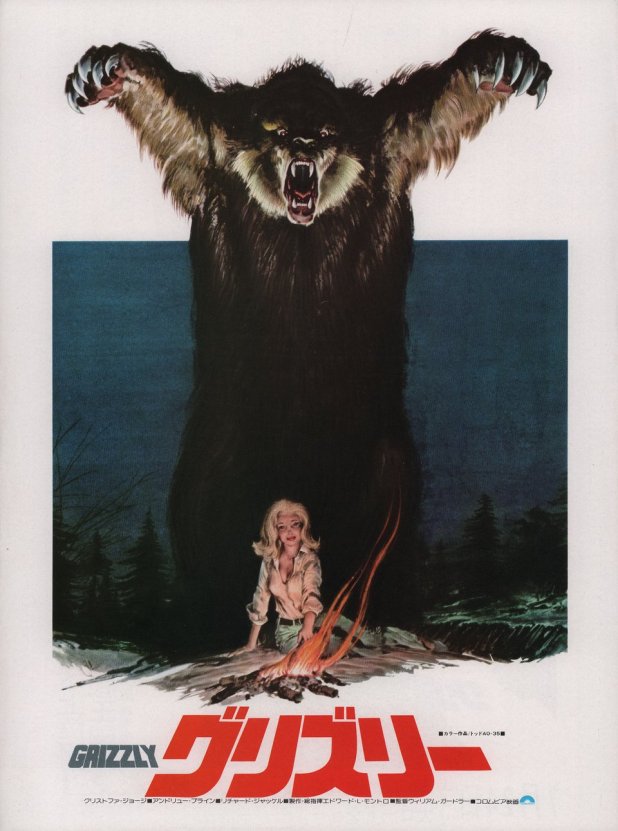
Here’s the best example. Around these parts, Girder is celebrated for Abby, a movie that was removed from theaters because of its similarity (let’s say total ripoff) of The Exorcist. That brings us to Grizzly, which is essentiallyJaws on dry land. With a bear. A grizzly bear.
Grizzly found its inspiration when its producer and writer, Harvey Flaxman, came face to face with a bear during a camping trip. Co-producer and co-writer David Sheldon thought about how they could make a bear version of Jaws and they wrote a script that Girdler discovered and offered to finance, as long as he could direct.
Grizzly begins with military vet and helicopter pilot Don Stober (Andrew Prine, The Town that Dreaded Sundown, The Eliminators, Amityville II: The Possession) flying over a national park and explaining how the woods remain untouched, much like they were in when Native Americans made their homes here.
The first two attacks happen quickly — in bear POV no less — when two female hikers are dismembered by the ursus arctos horribilis villain of this story. That brings in park ranger Michael Kelly (Christopher George, Gates of Hell/City of the Living Dead, Day of the Animals,Mortuary, Pieces) and photographer Allison Corwin (Joan McCall, who besides being in Devil Times Five is also married to the film’s writer, Sheldon) in on the case.
At the hospital, a doctor tells the park ranger that a bear killed the girls, but the park’s supervisor blames the ranger and naturalist Arthur Scott (Richard Jaeckel, The Dark, Mako: The Jaws of Death and TV’s Salvage 1) for the girls’ deaths. And guess what? Just like Jaws, there’s no way the park is getting closed before tourist season.
The rangers all decide to search the mountain for the grizzly, which isn’t accounted for in their census of animals in the park. One of the rangers — of course — decides to get nude in a waterfall because that’s what you do when you’re hunting a killer bear and gets murked for her stupidity.
Kelly and Stober think they have found the bear from the air, yet it’s just naturalist Scott wearing an animal pelt and tracking the bear himself. Scott tells them that this bear is actually a prehistoric version of the grizzly that stands 15 feet tall and weighs at least 2,000 pounds.
No matter how many people the grizzly kills, no one will close the park. So when the story becomes national news, the owners of the park — a national park can have owners? — allow amateur hunters to shoot the shark (this has nothing to do with the very same thing happening in Jaws, right?). Those hunters are pretty much the worst people ever, as they use a bear cub as bait, thinking the grizzly will protect its young. Nope — it eats that baby bear and keeps on coming.
The grizzly literally shreds his way through the park and nobody closes it down until it murders a young mother and mutilates her child. And get this — the grizzly is so smart, it knows how to bury the naturalist in the ground and then waits for him to wake up so it can kill him. Can a bear be a slasher killer? Well, we already know that Bigfoot can be, thanks to Night of the Demon.
The grizzly kills every hero in this movie other than Kelly the photographer, who magically finds a bazooka in the wrecked helicopter and remembers the end of every shark movie: you must blow this beast up real good. She does and that’s the end of Grizzly.
An interesting personal note: I was telling my dad about this movie and he remembered that it has played on a bus that took he and my mother on a casino trip. That’s right — at 1 AM, pitch blackness, the TV on their bus blared this gorefest as loudly as possible. “I couldn’t wait for that movie to end,” was my mother’s review. My father’s was a bit kinder.
Warner Brothers originally wanted to finance Grizzly, but were furious that Edward L. Montoro and Film Ventures International (FVI) had taken the project. That’s because a year before, the studio sued both of these companies for copyright infringement when they released Beyond the Doorin the US.
Sadly, while Grizzly was one of 1976’s best-performing films, earning $39 million worldwide (adjusted for inflation, that’s around $177 million in 2018 dollars), its distributor Edward L. Montoro and Film Ventures International kept all the profits. Girdler and Harvey Flaxman and David Sheldon (the film’s screenwriters/producers) had to sue to get their share.
Even after all that, Girdler still directed Day of the Animals, a spiritual sequel to Grizzly, for Montoro. While this film added Leslie Nielsen and Lynda Day George to the returning cast of Christopher George and Richard Jaeckel, it wasn’t as successful.
Grizzly just seems like a movie that’s buried in legal shenanigans. A sequel, Grizzly II: The Predator (also known as Grizzly II: The Concert, a title that would assuredly guarantee that I would buy this film) was made in 1983.
Filmed in Hungary by André Szöts and written by Sheldon, the co-producer and writer of the original, it was never released. The film had Louise Fletcher, John Rhys-Davies and unknowns but about to be big stars like Charlie Sheen (who took this movie over the lead in Karate Kid), George Clooney and Laura Dern in the cast, as well as live performances (hence Grizzly II: The Concert) by musicians like Toto Coelo (who had one song I can name, “I Eat Cannibals Part 1”) and Landscape III.
The movie was such a mess that the film’s caterer ended up rewriting it. And while the main filming was completed, special effects and all of the actual bear footage wasn’t. That’s because the film’s executive producer Joseph Proctor had disappeared with the money (and may have even been already jailed when filming began). While a mechanical bear was to be used, there was still footage shot of a live bear attacking concert-goers filmed (!). There’s a bootleg workprint, but the full film has ever emerged. This New York Post article has even more amazing info about Grizzly 2.
Finally, a trivia note for comic book fans. The amazing poster for this movie? Neal Adams did the art.
And in the universe of Tarantino, Don Stober was played by Rick Dalton, not Andrew Prine.
Here’s the recipe you can drink while you watch this movie.
Honey Bear
1 oz. bourbon
2 oz. apple cider
1/2 oz. Cointreau
1 oz. honey, orange and sage syrup
Sliced orange
Pre-work: To make the syrup use the following ingredients:
1 cup water
1/3 cup honey
3 tbsp. sugar
1 tsp. ground sage
2 orange slices
1 tsp. orange zest
Heat a small pan on high, then heat up all ingredients to boiling.
Simmer for 3 minutes and let cool. Store in refrigerator for up to a week.
To make the drink:
Pour bourbon and honey, orange and sage syrup in an ice-filled glass.
Top with apple cider.
You can watch this on Tubi or get it from Severin.
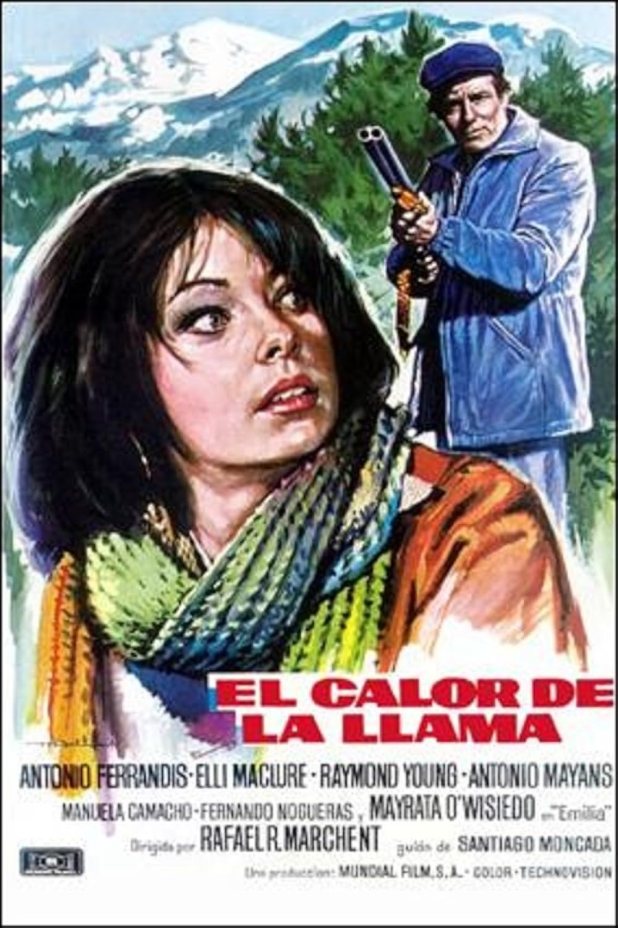
Heat of the Flame follows Gabriela (Christine McClure) who probably shouldn’t have married bank manager and mayoral hopeful Javier (Antonio Ferrandis). He’s kind of like Neil Wardh, an older man than his wife and someone who only cares about work. She has time on her hands, so she day drinks with a writer who goes by Carlos (Francsico Nieto) and remembering the affair that she had with Father Luis (Jess Franco regular Antonio Mayans).
As the marriage starts to fail, there’s also a giallo killer who uses a whistle while he stalks his prey. Gabriela is kidnapped and sexually assaulted by the killer, but lives to tell the tale. Also, as this is a Spanish exploitation movie, she also finds herself not afraid but actually turned on by the experience and wants more.
How bad is your marriage when you willingly walk back into the arms of someone who has been killing woman in your small village? I know that this comes shortly after the end of Franco ruling Spain and that divorce was probably not discussed, but what kind of a life does Gabriela want?
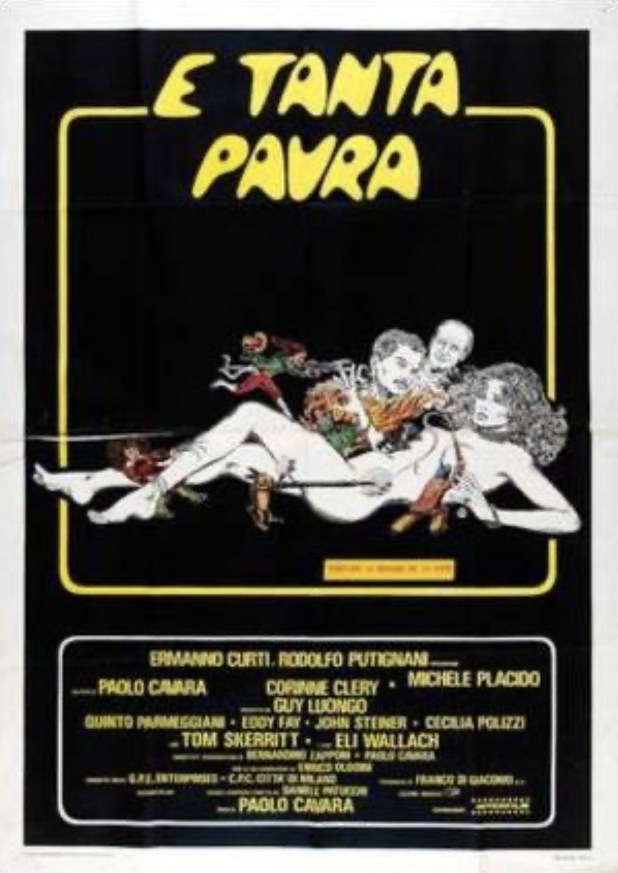
A man is strangled by a transvestite prostitute in his home.
A woman is killed on a bus by a man holding a wrench.
The only thing that ties these crimes together is an illustration from a children’s book by the name of Der Struwwelpete.
Inspector Gaspare Lomenzo (Michele Placido) is on the case, reporting to higher ups played by Tom Skerritt and Eli Wallach. By sheer luck, he meets Jeanna (Corinne Cléry), who witnessed the death of a sex worker that may be part of this case. She was also at a party being held by a group called Wildlife’s Friends — led by Hoffmann (John Steiner) — that hired a prostitute for one of their events and had to kill her after she learned that it was all a front for diamond smuggling. Now, one by one, members of this group — also a front for swinging, not just gems — are being killed off.
This also has a filthy cartoon by Gibba in the middle of all this, as well as the idea that perhaps Loemnzo shouldn’t trust anyone, as Jeanna is a total noir character and the remaining members of the club contact Wallace for protection. And hey — didn’t Heinrich Hoffmann write and draw Der Struwwelpete?
Director Paolo Cavara may be best-known for working with Gualtiero Jacopetti and Franco E. Prosperi to create Mondo Cane, but he’s not as celebrated as he should be for making two great giallo — this movie and one of the meanest in the entire genre, Black Belly of the Tarantula. He also wrote the script with Bernardino Zapponi (who wrote seven movies for Fellini and co-wrote Deep Red) and Enrico Oldoini.
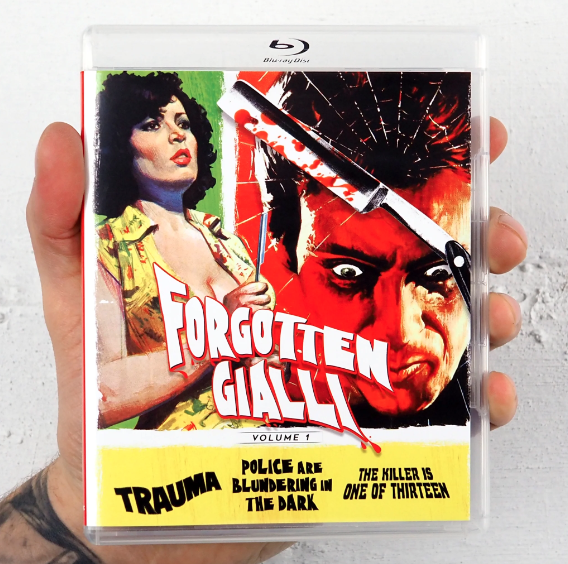
The first in a series from Vinegar Syndrome, these sets allow you to discover three giallo films that have been rare until this release.
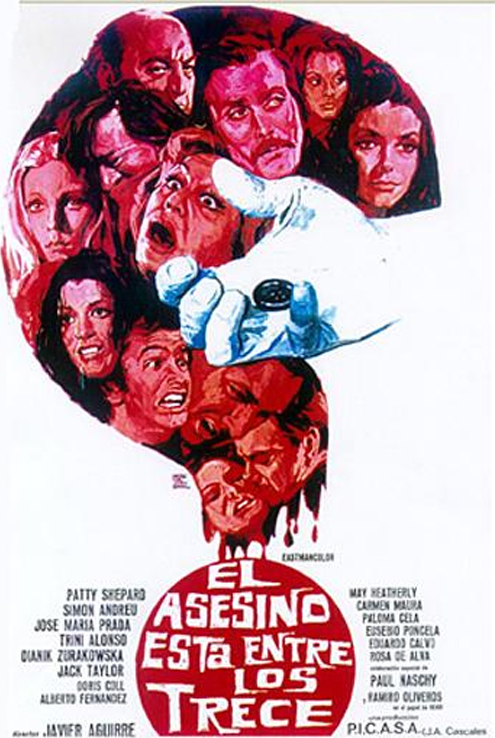
The Killer Is One of 13 (1976): Not a lot of nudity and little blood, this giallo is closer to Agatha Christie than Edward Wallace. That said, it does have Paul Naschy in it and it’s directed by Javier Aguirre, who made Count Dracula’s Great Love.
Patty Shepherd (Edge of the Axe) stars as Lisa, who has gathered twelve of her husband’s closest friends and informs them that she believes that one of them is the killer. That said, there are really seventeen suspects when you add in the butler, chauffeur, maid and gardener.
The Police Are Blundering In the Dark (1975): A young nude-model is stabbed to death with a pair of scissors, the third in a series of victims who had all had their photos taken by Parisi, a potentially mentally unhinged individual who claims that his camera can photograph people’s thoughts.
Director and writer Helia Colombo made one giallo and here it is, rarely seen outside of Italy until today. It really has the best title because if you think about it, the police never do a great job in these films.
Now, reporter Giorgio D’Amato meets his friend Enrichetta at the photographer’s villa, but when he arrives, he learns that she’s the model we watched die at the beginning of the movie.
She’d been begged by Parisi — who is in a wheelchair and looks quite frail — to come to speak to him about his magical camera. And just like Clue — you know, but with plenty of graphic murder and no short supply of nudity — we meet the suspects, ranging from Alberto the butler to the photographer’s lesbian wife Eleonora, his niece Sara and the sexed-up maid Lucia, who is the next to be killed.
I have no idea why that camera figures in, but maybe the filmmakers thought that Four Flies On Grey Velvet was going to force everyone to have science fiction photography as part of their plot, so they ripped it off. There’s also little police involvement, but it’s not like there’s an actual rule that giallo titles have to make sense. I prefer when they don’t.
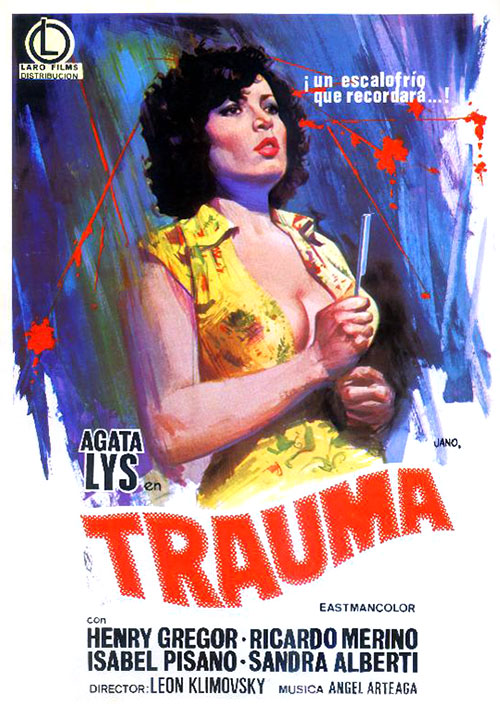
This is all about a gorgeous inn in the country that seems like the perfect place for Daniel (Heinrich Starhemberg, who was also the executive producer, which means that he gets to be the hero and have a love scene with Lys) to do some writing. However, from the moment he meets Veronica (Ágata Lys), nothing will be as it seems. She’s always taking care of her wheelchair-bound husband who is never seen and who lives in one small room.
All of the other guests are busy making love, which seems to be perfect for the film’s other character, a razor-slashing black-gloved killer. As he kills each couple, whoever they are also gets rid of the luggage of each person, as if they weren’t ever there. One of them is Antonio Mayans, which made me happy to see him.
You can get all three movies on blu ray in a great box set from Vinegar Syndrome.
This film begins with dancing women, native Brazilian drummers and an old man who chants over a coffin which opens to reveal…begins chanting over a closed coffin. The coffin opens and a man rises. Zé do Caixão! Coffin Joe!
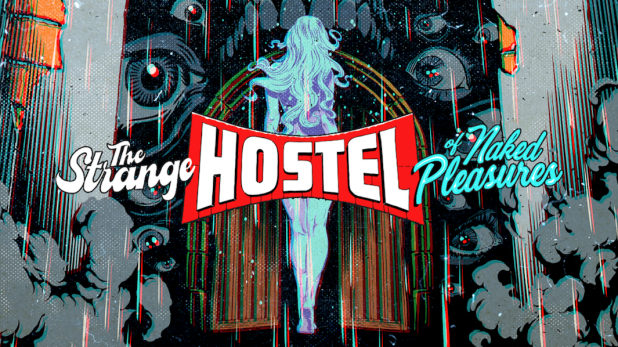
At an isolated inn — “Hospedaria dos Prazeres” (Hostel of Pleasures) — the owner (Jose Mojica Marins, who is also Coffin Joe) turns away some and allows others already in the guest book to stay. Those without a place to stay are enraged, as after all, there’s a storm outside. Yet he has room for hedonistic Hell’s Angels, a couple sneaking out on their respective partners, a man ready to kill himself, gamblers out to bankrupt someone and criminals escaping their last robbery.
When they wake up in the morning, all of the clocks and their watches are set to midnight. That’s because they’re all in Hell and the absence of time is one of the many things they must deal with, as well as having to watch their deaths again and again. The owner warns them all that they don’t want to see his evil side — Coffin Joe.
One of the rich men who argued about getting to stay the night before leads the police to the hotel. In its place is a graveyard, where we eventually see the owner. As the camera zooms in, his face is replaced by a skull with bleeding eye sockets.
This is a Cinema da Boca do Lixo (Mouth of Garbage films), called that because they were made in that downtown neighborhood of São Paulo, Brazil. These films — Killed the Family and Went to the Movies, The Red Light Bandit, Awakening of the Beast — are down and dirty exploitation films that are close to American exploitation of the 70s with sex and violence often in equal measure.
This is worth watching just for the opening speech from Coffin Joe: “Live to die or die to live? Is there an answer? No! Only doubts! Only deductions… Only the conviction of emptiness… of loneliness… the desperate search for the whole and the nothing in the vastness of the dark. The unveiling of this enigma would be the end of the mystery. The end of the secret of eternity. The apogee of happiness. The mission is accomplished! Men would be facing his biggest conquest… the awakening of his own origin.”
Arrow Video’s limited edition collection of Coffin Joe walks with you when it is night. The Strange Hostel of Naked Pleasures has a new interview with Dennison Ramalho (co-writer of Embodiment of Evil), footage of Marins at the 2001 Sundance Film Festival and A Blind Date for Coffin Joe, a short film by Raymond “Coffin Ray” Castile.
Here’s the review for that movie.
On Raymond Castile’s website, he posted some photos dressed up like Coffin Joe. They looked incredible.
In April of 2006, he learned that the real Coffin Joe — Jose Mojica Marins — had visited this page and loved it. Even better, in October of that year, Mojica and Dennison Ramalho, assistant director of the upcoming Encarnacao do Demonio asked Castile to be in the movie, playing the younger Ze do Caixao in a scene that would connect the final film in the trilogy with This Night I’ll Possess Your Corpse.
Check out Diary do Demonio, his diary about traveling to Sao Paulo, Brazil to play Coffin Joe.
After this, he made The Blind Date of Coffin Joe in which Coffin Joe moves to America and starts his own reality dating show. If you’ve never seen a Coffin Joe movie, you probably won’t get the jokes. If you have, it’s absolutely hilarious with Castile looking, sounding and acting exactly like Ze do Caixao as he faces modern dating, all in the hopes of finding a superior woman to give birth to his child.
In 1926, Randolph (Jeffrey Hurst) catches his wife (Ursula Austin) making love to his best friend (Terry Austin). He kills them, then himself, and remains trapped in the apartment, his spirit unable to move on.
Fifty years later, Abby (also Ursula Austin) moves into the apartment, a place where sex is always happening, mostly between her neighbors Patrick (Robert Kerman, who would go to Italy and make Cannibal Holocaust), his unnamed blonde lover (Nancy Dare) and Lola (Vanessa Del Rio), who is the one who told Abby to move here. There’s also Tess Albertino (Annie Sprinkle).
Abby can’t sleep and magically, sleeping pills show up. She takes them and we see the sky, the wind picks up and Randolph emerges from the wallpaper to make love to her, which we see as Abby being thrown around the bed with no one else there. The problem, well besides the lack of consent in this scene, is that every man who has sex with Abby gets killed from here on our. There’s even a radio thrown into a bathtub which I love to no end. Anny deals with this by wandering through a blizzard before coming home to discover that she has a wedding ring stuck on her hand.
The credits say that this was directed by Luigi Manicottale — when has an American taken on an Italian name, that’s the exact reverse of how this works — but that’s really Doris Wishman. The ghost effects of this movie, the strange snowy park walking scene, the murder after murder without stopping the nonstop lovemaking — this is one strange movie. I have no idea who would be turned on by it and I don’t think Doris cared at all.
Annie Sprinkle recently posted about this movie on Instagram, saying “I was just interviewed for a documentary film about cult filmmaker, Doris Wishman. Amazingly I was in two of her movies almost 50 years ago. Satan Was A Lady and Come With My Love. I had not had a single acting lesson. (Still haven’t. ) I didn’t like acting. I liked the sekx scenes. When I thought about it, Doris was the first woman director I worked with. She was in her 60s and when we shot the dirty bits she would leave the room! The films are partly on YouTube. I was 20 years young and had very bad hair! Most everyone else in the film is dead now. I’m still here! Dori’s would be amazed I’m now still making films and am a Guggenheim Fellow even. Doris is gone but not forgotten.”
The effect of the man emerging from the wallpaper scares me.
When I was young, my neighbor used to have her grandchildren visit over the holidays and we always had to play with them. One of them was very young and while sled riding, he lost his tiger. I thought that it was a stuffed one but after we walked the entire neighborhood, he told me it was invisible.
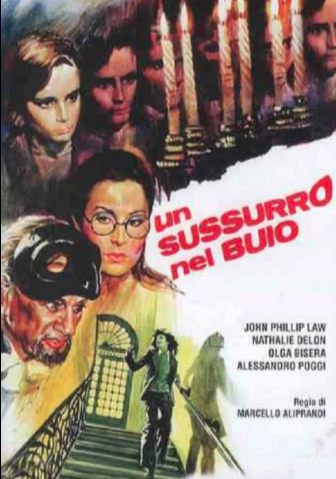
This is about a family who have fractured dynamics to say the least. Alex (John Phillip Law) is sleeping with everyone but his wife Camille (Nathalie Delon). The twins, Milena (Susanna Melandri) and Mathilde (Simona Patitucci) are horrible to their sensitive brother Martino (Alessandro Poggi). Alex’s mother (Zora Velcova) only makes everyone more on edge and the governess Françoise (Olga Bisera, The Spy Who Loved Me) trying to keep it all together. There’s also a visit from America, Susan (Lucretia Love, Enter the Devil) who is in the house seemingly only to be nude in a few moments.
There’s also Luca, who is either Martino’s imaginary friend or the ghost of Camila’s miscarriage. Only Martino can see him and a famous psychologist (Joseph Cotten) is determined to learn if this is a mental or supernatural problem.
This movie feels at times like it’s from another dimension, such as the scene where the children throw confetti in the air as a boat with a wicker man is set on fire in the lake. As snow and fog roll in, Camille is chased through their grounds by Luca and she decides that she must finally keep her family safe from her lost son. She can no longer keep him and she sends him away from her with the camera moving upward. Her husband finds her in tears and they finally come back together to make love.
The next day, everything has moved back into the routine of family as finally, all of the busy people run away from the breakfast table, leaving Camille alone.
I really enjoyed this, as it’s so different from what you expect, a slow and sad rumination over family life and loss that may or may not be fantastic in nature. You can watch it from either the thought that everyone is mad or that Luca exists.
The Pino Donaggio score is great, too. He also shows up as a singer at the children’s ball.


 B&S About Movies
You must be logged in to post a comment.