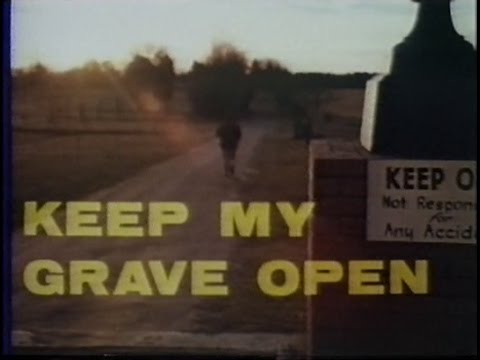
I’d love to have heard what people in the 1970’s felt like when they encountered a movie from S. F. Brownrigg at the drive-in. Something like Don’t Look in the Basement, Scum of the Earth or this truly inspiringly strange affair, a movie that riffs on Repulsion while presenting a woman who is in the grips of madness — or maybe not.
Leslie Fontaine (Camilla Carr) lives in a mansion with her husband Kevin — or maybe she doesn’t or maybe Kevin is her brother, this movie isn’t going to give you any easy answers — who is locked in their bedroom and doesn’t want to make love to her, no matter what she does. Finally, she allows herself to seduce a local teenager — a scene that is the Wikipedia definition of awkward — before “Kevin” emerges and kills the guy with a saber.
Everything proves that Leslie and Kevin are the same person, but at the end, after she consumes pills and broken glass in equal measure, we see her funeral. And Kevin’s there, ready to move into the mansion. There’s no explanation at all for this, but I’m not certain there’s one that will suffice.
I’ve often discussed that the difference between a film seen as art and one seen as exploitation really comes down to the theater that shows the film. This is a movie that aspires to the former while emerging from the muck of the grindhouse and drive-in, a burst of strangeness even amongst the other movies that it would play with.
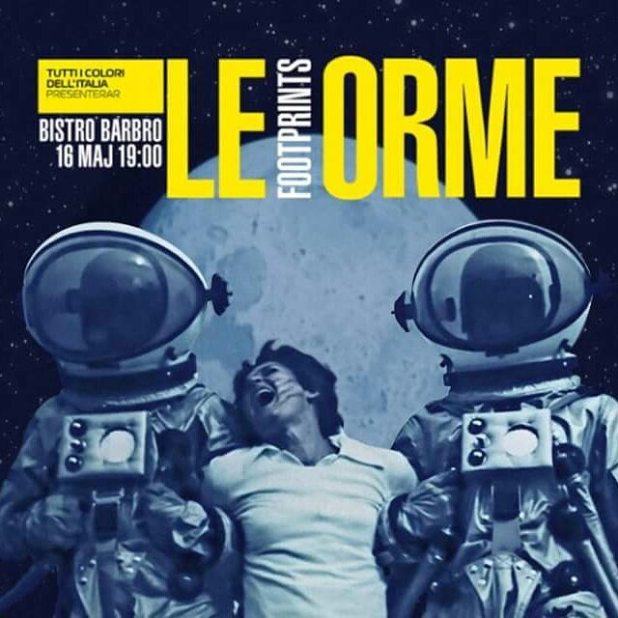
Alice Cespi (Florinda Bolkan, A Lizard in a Woman’s Skin) watched a strange film in her childhood called “Footprints on the Moon,” where astronauts were stranded on the moon’s surface. Now, as an adult, the only sleep she gets is from tranquilizers and she starts missing days of her life. Get ready for a giallo that skips the fashion and outlandish murders while going straight for pure weirdness.
After losing her job as a translator, Alice find a torn postcard for a resort area called Garma. That’s where she meets a little girl named Paula (Nicoletta Elmi, Demons, A Bay of Blood) who claims that Alice looks exactly like another woman she met named Nicole, who is also at the resort. Slowly but surely, our heroine starts to believe that a huge conspiracy is against her.
This is the last theatrical film of Luigi Bazzoni (he has directed some documentaries and wrote a few films since), who also directed The Fifth Cord. There are only two murders, but don’t let that hold you back. There are also abrupt shifts in color and a slow doomy mood to the entire proceedings. It’s unlike any other giallo I’ve seen and I mean that as a compliment.
Klaus Kinski also shows up as Blackman, the doctor who was behind the experiment that Alice saw as a child. He’s only in the film for a minute or so, but he makes the most of his time, chewing up the scenery as only he can. And cinematographer Vittorio Storaro, beyond working on The Bird with the Crystal Plumage, also was the DP on films like Apocalypse Now, Reds, Last Tango in Paris and Dick Tracy.
Shameless Films, who are the folks to order this from, referred to it as “the loneliest, most haunting and beautiful giallo you will ever see.” I have to agree — especially with its shocking ending. This isn’t like any of the films that came in the wake of The Bird with the Crystal Plumageand it’s a shame that its director didn’t make more films in the genre.
Sometimes the Chilling Classics rewards you with magic. Other times, it assaults you with a film like Sunburst, also known as Slashed Dreams.
Robert (Peter Hooten, the original Dr. Strange) and Jenny (Katharine Baumann, The Thing with Two Heads and now a handbag creator) are going up to the woods to find their friend, Michael (Robert Englund), who has left the world of capitalism behind for a simpler one in the woods.
Once they’re up there, they run into one of a store owner played by Rudy Vallee. In his era, Vallee was one of the biggest teen hearthrobs ever. Here, he’s singing and trying to sell our protagonists a knife. You can also see Vallee in The Phynx and Michael Winner’s strange family film, Won Ton Ton, the Dog Who Saved Hollywood. Seriously, if you’re a fan of old Hollywood, that movie has so many cameos that your head will spin.
Anyways, while skinny dipping, two hooligans (James Keach and David Pritchard, the writers of the film) attack Robert and rape Jenny. Michael saves them, then Robert has a mudwrestling fight with the two men, who run away. Jenny reads a poem from Khalil Gibran and…that’s the end of the movie.
To no surprise, this slice of 1970’s post-hippie weirdness comes from James Polakof, who was also behind the lost woman in the 1970’s trying to make sense of it all by having sex with the devil movie Satan’s Mistress.
To make matter worse — or better — the film features seven songs by Roberta Van Dere, including one titled “Animals Are Clumsy Too” and “Theme from Sunburst.” Actually, best of all, the version of this film on the Chilling Classics set has a video effect over the Sunburst title, replacing it with a keyed out box and the words Slashed Dreams.
Why a movie about Deliverance-esque hillbillies raping and attacking a couple ala Straw Dogs needs a legendary jazz crooner and numerous Carol King sounding songs is beyond me. I met James Keach once, as his son’s band (he was once married to Jane Seymour) was playing a benefit for the charity my agency did work for. If only I had seen Sunburst, because I would have driven him insane asking a million questions about this movie. Or maybe he would have loved the fact that someone had actually seen it.
You can get this in the set or pick up all on its lonesome from Cheesy Flix.
Deep Red is one of the few Argento movies that I’ve seen in a theater. I’m not sure what the audience expected, as it was on what was presented as a grindhouse night. I think they wanted something like the modern interpretation of the term, all fast moving action and laughs. I don’t think that many of them were happy with what they got from this film — a movie that started with a 500-page script that even Dario Argento’s family felt was too cryptic and continues with not just one, but two references to American painter Edward Hopper. This isn’t just a movie about murder. This is a movie that transforms murder into art.
The movie begins at Christmas, as two shadowy figures battle until one of them stabs the other. Screams ring out as a knife drops at the feer of a child.
Fast forward to Rome, as a medium named Helga Ulmann is conducting a lecture about her psychic powers. Within moments, she senses that one of the people in the theater is a killer. Later that night, that killer kicks in her front door and murders her with a meat cleaver (which is probably why this movie got the boring American title of The Hatchet Murders).
British musician Marcus Daly (David Hemmings, Barbarella, Blowup,Harlequin), who fits the giallo mold of the stranger in a strange land thrust into the middle of a series of murders that he must solve, is returning home from drinking with his gay best friend Carlo (Gabriele Lavia, Beyond the Door, Inferno) when he sees the murder that we’ve just witnessed from the street. He runs to save Helga, but she’s thrust through the window and her neck is pierced by the broken glass of her window in a kill that has become Argento’s trademark.
As he tells the police what has happened, he notices that a painting on Helga’s wall is gone. That’s when Gianna Brezzzi (Argento’s wife at the time, Dario Nicolodi, who met him during the filming of this movie) takes his photo, which ends up on the cover of the newspaper the very next day.
Unlike most giallo women, Gianna is presented as more competent and even stronger than our hero — she sits high above him in her Fiat 500 and continually bests Marcus every time they arm wrestle.
Marcus isn’t your typical hero, though. When the killer attacks him, he doesn’t stop them by daring or skill. He locks himself in his study to escape them. He does remember the song the killer played — we also have heard it when Helga is murdered — that psychiatrist (and Helga’s boyfriend) Professor Giordani believes is related to some trauma that motivates the killer.
Feeling guilty that she’s caused the killer to come after Marcus, Gianna relates an urban legend of a haunted house where the sounds of a singing child and screams of murder can be heard. The truth lies in House of the Screaming Child, a book written by Amanda Righetti, which tells the truth of the long-forgotten murder. Marcus and Gianna would learn even more, but the killer beats them to her house and drowns her in a bathtub of scalding hot water (directly influencing the murder of Karen Bailey in Halloween 2). As she dies, the writer leaves a message behind on the wall, which our heroes find. They’ve already assumed the investigation — again, in the giallo tradition — and think the police will assume that Marcus is the murderer, so they don’t report the crime.
Marcus follows the trail of the killer from a picture in the book to the real house, which has been abandoned since 1963. As he searches the home, he uncovers a child’s drawing of a murdered man and a Christmas tree, echoing the flashback that starts the film. Yet when he leaves the room, we see more plaster fall away, revealing a third figure.
Marcus tells his friend Carlos all that he’s learned, but his friend reacts in anger, telling him to stop questioning things and to just leave town with his new girlfriend. At this point, you can start to question Marcus’ ability as a hero — he misses vital clues, he hides instead of fighting and he can’t even tell that someone is in love with him.
Professor Giordani steams up the Righetti murder scene and sees part of the message that she left on the wall. That night, a mechanical doll is set loose in his office as the killer breaks in, smashing his teeth on the mantle and stabbing him in the neck.
Meanwhile, Marcus and Gianna realize that the house has a secret room, with Marcus using a pickaxe to knock down the walls, only to discover a skeleton and Christmas tree. An unseen person knocks our hero out and sets the house on fire, but Gianna is able to save him. As they wait for the police, Marcus sees that the caretaker’s daughter has drawn the little boy with the bloody knife. The little girl explains that she had seen this before at her school.
Marcus finds the painting at the young girl’s school and learns that Carlo painted it. Within moments, his friend turns up, stabs Gianna and holds him at gunpoint. The police arrive and Carlo flees, only to be dragged down the street and his head messily run over by a car.
With Gianna in the hospital and his best friend obviously the murder, Marcus then has the Argento-esque moment of remembering critical evidence: there’s no way Carlo could have killed the psychic, as they were together when they heard her screams. The portrait that he thought was missing from the apartment was a mirror and the image was the killer — who now appears in front of him.
The real killer is Martha (Clara Calamai, who came out of retirement for this role, an actress famous for her telefoni bianchi comedy roles), who killed Carlo’s father in the flashback we’ve seen numerous times after he tried to commit her. She chases Marcus with a meat cleaver, striking him in the shoulder, but he kicks her and her long necklace becomes caught in an elevator which beheads her. The film ends with the reflection of Marcus in the pool of the killer’s blood.
While this film feels long, it has moments of great shock and surprise, such as the two graphic murders that end the film and the clockwork doll. The original cut was even longer, as most US versions remove 22 minutes of footage, including the most graphic violence, any attempts at humor, any romantic scenes between David Hemmings and Daria Nicolodi, and some of the screaming child investigation.
This is also the first film where Argento would work with Goblin. After having scored Argento’s The Five Days — a rare comedy — Giorgio Gaslini was to provide music for the film. Argento didn’t like what he did and attempted to convince Pink Floyd to be part of the soundtrack. After failing to get them to be part of Deep Red, Goblin leader Claudio Simonetti impressed the director by producing two songs in one night. They’d go on to not only write the music for this film, but also for plenty of future Argento projects.
A trivia note: Argento’s horror film museum and gift shop, Profondo Rosso, is named after the Italian title to this movie.
Deep Red is the bridge between Argento’s animal-themed giallo and supernatural based films. While its pace may seem glacial to modern audiences, it still packs plenty of moments of mayhem that approaches high art.
Want to see it for yourself? Sure, it’s on the Chilling Classics set, but for the best possible home experience, get the Arrow Video blu ray. You can also stream Deep Red on Shudder and Amazon Prime for free with your membership.
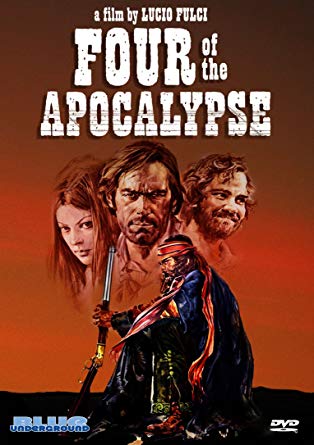
Day 14 of the Scarecrow Psychotronic Challenge is Westerns. Hats and boots are a must on this trail, y’all. Yeehaw! I chose Lucio Fulci’s Four of the Apocalypse…, which was made years before he became known as the Godfather of Gore.
Salt Flats, Utah. 1873. Professional gambler Stubby Preston (Fabio Testi, Contraband) is arrested the moment he steps off the stagecoach, thwarting his plans to win money from the town’s casino. It turns out that he’s actually lucky, because the town has become a vigilante mob that burns that den of iniquity to the ground, leaving only Stubby and three other criminals alive: Bunny (Lynne Frederick, Phase IV), a pregnant prostitute, a black man named Bud and the alcoholic Clem (Michael J. Pollard, Bonnie and Clyde).
The four are given safe passage out of town by the sheriff, who gives them a wagon and horses for all of their remaining money and possessions. Soon, they are traveling with a Mexican gunman named Chaco (Tomas Milian, Don’t Torture a Duckling) who saves the group from lawmen, only to torture one of the remaining lawmen in front of the group.
Nevertheless, everyone agrees to take peyote together. The four wake up tied up as Chaco (Milian claims he based his performance on Manson) taunts and beats them, shooting Clem and raping Bunny in front of the entire group.
There have been rumors for decades that Frederick and Testi were having an affair during this film. Testi was dating Ursula Andress at the time, who was incredibly jealous. Some evidence is that even when Frederick’s scenes were all wrapped, the two actors improvised scenes that would include the two of them, including a love scene that has been lost. During the aforementioned rape scene, Milian was so into character and so rough that Testi’s reaction in that scene is real.
The four manage to get the gravely injured Clem onto a makeshift stretcher and follow Chaco and his gang as they kill everything in their path. Finally, they find a ghost town where Clem dies, Bud loses his mind and Stubby and Bunny admit that they love one another — just in time for her to die in childbirth and Stubby to leave her son to a town made up of only men.
Stubby hunts down Chaco, learning that the sheriff set up the events of the entire movie. Enraged, he murders every single person there, leaving Cacho alive so that he can torture him. When Chaco reminds him that he raped Bunny, Stubby shoots him without a word, as he walks into the sunset with only a stray dog as a companion.
Four of the Apocalypse… is influenced by Easy Rider and attempts to offer up a journey of redemption, but you have to understand that Fulci is at the helm. That means that as soon as you have a tender, feel-good moment, you’re going to be given moments of pure gore, like people skinned alive or used for food. Yet there’s also art to be found, thanks to Fulci’s first of ten collaborations with cinematographer Sergio Salvati. It’s also the first time Fulci would work with Fabio Frizzi on the soundtrack. The result is unlike anything you’ve heard in a spaghetti western.
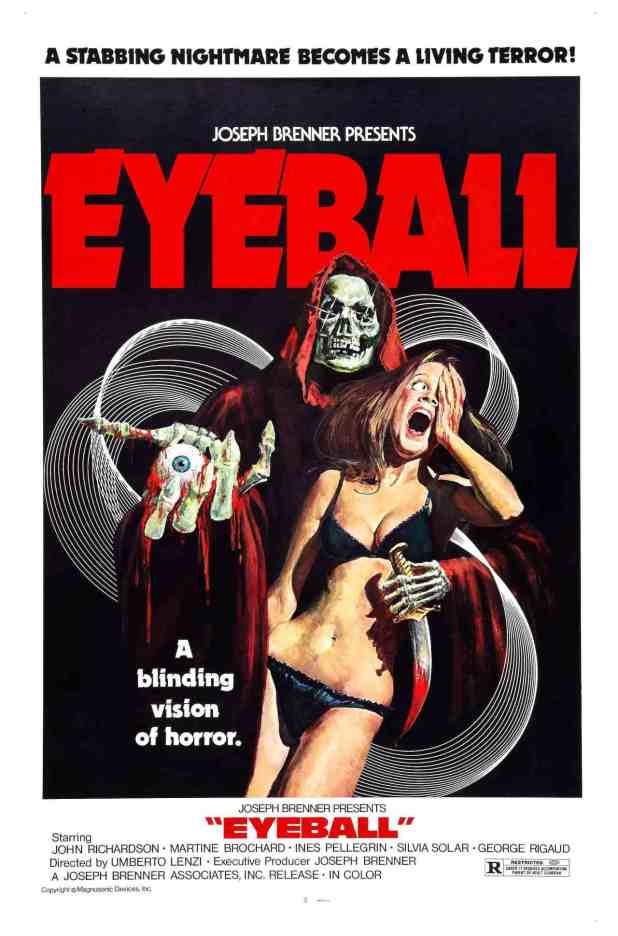
The Scarecrow Psychotronic Challenge for today is THE EYES HAVE IT. This pick must have an eye specific scene. I’ve already covered the granddaddy of all eye torture, Fulci’s Zombi, as well as his other paean to ocular decimation,The New York Ripper. There’s also Demonia, where nuns eat a dead baby’s eyeballs. And Cat in the Brain, with a whole plate of eyeballs. Oh, Fulci. You do love seeing the eyes get killed, as they have seen so much.
I already hit Dead and Buried, which has an eyeball impalement that upsets many. And Lamberto Bava’s Demonia, where a woman looks like a giant eyeball. So that leaves Umberto Lenzi’s Eyeball, where a killer in a red raincoat kills tourists in Barcelona.
Any of the main characters could be the killer, one with this amazing motive: “I was like you… before this friend of mine ripped out my eye playing doctor with me… leaving an empty socket!” That means with each kill, the killer keeps an eyeball.
Unlike most giallo, the killer is all in red, with red gloves, which is a rarity unless we’re considering The Red Queen Kills Seven Times. Like most giallo, it has the worst cops ever on the case. And for 1975. it’s pretty woke, considering one of the couples is an interracial lesbian duo.
Seeing as how this is a movie with an Italian director and a Spanish crew, you just know that the dubbing is going to be great. Witness this exchange:
“Spanish or Italian, it makes no difference to me. He made a terrible mistake. You don’t think America’s worth all that trouble do you?”
“Oh my God! You’re not a communist, are you?”
That said, I came off really enjoying this. There’s a lot of red highlights hidden in every scene, which for a Lenzi movie is as close as he’s going to get to art. Then again, I tend to love all of his films way more than most people.
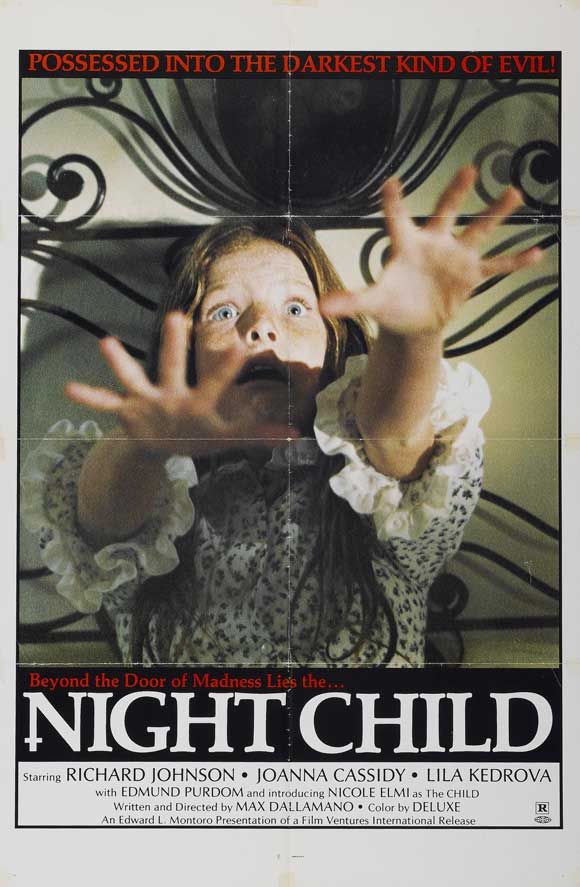
Also known as The Cursed Medallion, this Italian ripoff was directed by Massimo Dallamano (What Have You Done to Solange?).
Richard Johnson (The Hauntingand Dr. Menard from Zombi 2) is a BBC filmmaker working on a documentary about demonic images in paintings. His daughter Emily (Nicoletta Elmi, Who Saw Her Die?, Deep Red) is having nightmares about how her mother died in a fire.
Edmund Purdom (2019: After the Fall of New York) advises him to bring his daughter along to Italy for some bonding time, along with their governess Jill, who is love with her boss. But then so is Joanna (Joanna Cassidy, The Glove), the producer of his movie. It also seems like Emily is in love, like real love, with her dad too. Was everyone incestual in 1970’s horror?
Michael meets Contessa Cappelli, an expert on satanic paintings. She warns him not to use a painting in his work. It depicts a child — wearing a medallion just like the one his daughter has been wearing — watching her mother burn. Is it any wonder that demonic possession soon follows?
This movie looks gorgeous. You can see the difference when a real director takes on a ripoff and decides to make it his own movie instead of aping The Exorcist directly.
I’m shocked that more people don’t discuss this film. It really fits into the genre of 70’s occult film quite well. You should check it out for yourself on Amazon Prime or buy the Code Red version at Amazon or the Arrow Video reissue at Diabolik DVD.
According to The Weirdest Movie Ever Made, the book we reviewed at the start of the week, the Patterson-Gimlin film may have made Patterson rich, but Gimlin at first wanted nothing to do with it.
Yet according to author Phil Hall, “After Patterson’s death, Gimlin approached his former partner’s widow, Patricia Patterson, regarding the failure to provide him with the profits from the screenings of the Bluff Creek film. Unable to settle amicably with Mrs. Patterson, Gimlin filed a lawsuit against her…” with the end result being Gimlin was eventually “rewarded 100 percent of all past, present and future publication rights of the imagery connected to the film.”
After this victory, Gimlin was convinced that he should sue American National Enterprises, which is the company behind 1975’s Sasquatch: Legend of Bigfoot.
Turns out that while Bigfoot was difficult to find in the wild, he was easy to find in the courtroom. American National Enterprises was also suing our old friends Sunn Classic Pictures, claiming that they were illegally using the Patterson-Gimlin film for The Mysterious Monsters. American National Enterprises and Sunn Classic Pictures may have settled out of court, but René Dahinden, author of the book Sasquatch, was bankrolling Gimlin’s legal battles.
Gimlin was, at heart, a cowboy and had little interest in the stress of these battles. You’ll have to read the book to learn more — I don’t want to give away more of Hall’s fine work for free — because it’s time that we get to Ivan Marx.
Don’t get confused. This is the second 1975 entitled The Legend of Bigfoot. And this one is all about Ivan Marx, created by Ivan Marx and narrated by Ivan Marx. According to Wikipedia, the film receives “praise focused largely on the nature footage and the new information about cryptozoology, but criticism largely focused on Marx’s rambling voice-overs (seen by some as self-promotion) and the poor-quality Bigfoot footage, that most have accepted as a hoax. However, to this day, there are many supporters of Marx, who consider him a true explorer and pioneer in the field of cryptozoology.”
If you watch this movie and come away thinking that Ivan Marx and his wife Peggy, who would go on to also make In the Shadow of Bigfoot and Bigfoot: Alive and Well in ’82, are the Ed and Lorraine Warren of the Bigfoot world, then you’re not alone.
Get ready for 70 some odd minutes of rambling raconteur Ivan Marx telling some tall tales. He opens facing the camera, telling us that this movie is the result of ten years of research and he stands behind every word. Seeing as how I had no idea who Ivan Marx was before this movie began, I was inclined to listen.
After explaining to us his pedigree as a tracker, showing us his wife and the cougar pups that live on their ranch and talking about the first men who told him of Bigfoot, Marx learns about the land of petrified wood from his brother-in-law, a place where carvings tell the tale of giant hand and foot having monsters stealing children.
After a series of cow murders and a dead bear near some large tracks, he begins trying to hunt and study something he barely believes in. This takes him to the Oh-mah statues in the redwoods and all along the Oregon coast to no avail.
While on a job filming a cinnamon bear, he’s able to capture footage of the beast. Nobody believes him and he becomes being questioned by science. Then he takes us on a tour of b-roll footage of injured squirrels, goats in the dirt, glaciers melting, the Trans-Alaska pipeline, Bigfoot painters, the Northern Lights and more.
He even gets the promise that he’ll see Bigfoot from an Eskimo and while he gets the footage of some shining eyes, he doesn’t see the creature…because he disappeared behind a rainbow. You can’t make this stuff up. Well, you can.
We then watch more nature footage of salmon, geese, moose, caribou and more until we see a young Bigfoot in the stream. The other animals — all from other b-roll footage of course — aren’t afraid. “Bigfoot is a benevolent creature!” Yep, Marx also figures out that the creature is mostly a vegetarian with occasional fish meals. Yes, this movie taught me that Bigfoot is a pescetarian!
Luckily, Marx isn’t giving up here. He’s figured out Bigfoot’s migratory patterns and he’s on the search for the creature…all in the hopes of protecting him from mankind.
This film was directed by Harry Winer, who would go on to direct two of Becca’s favorite movies, the Jamie Lee Curtis starring House Arrest and SpaceCamp. It’s a shambling mess of a film and your ability to enjoy it will be solely determined by how much of Ivan Marx’s carny spirit you can stomach. As for me, I’ve spent more than half my life as a professional wrestler, so I was all in for this.
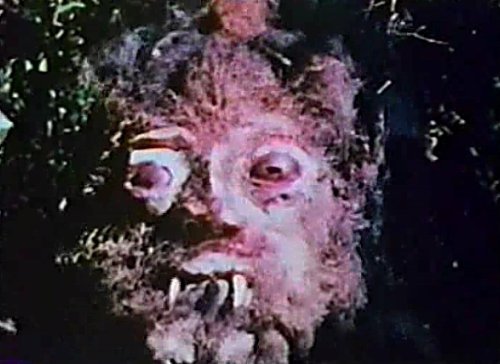
This movie lies to you from the very moment it begins. First off, it’s barely a movie, clicking in around 59 minutes. And when you get to the real heart of the movie, it’s not even about Bigfoot! It’s really about a mummy coming back from the dead.
A high school biology class — filled with stoners — spends much of the opening of the movie discussing cryptozoological creatures like the griffin. What school is this? Who approved this lesson plan? Nonetheless, this class is interrupted by a good friend of their teacher, who frighteningly warns that he took his class to search for Bigfoot 15 years ago, a field trip where parents bemoaned signing the permission slips, as nearly everyone involved ended up in mental institution.
That’s when we cut to footage of a completely different movie — a student film made in 1958 called Teenagers Battle the Thing — where that class travels to Native American burial ground where a mummy attacks the kids.
This is a movie that redefines the phrase bad movie. It has it all — B roll travelogue footage, amateurish acting from two different decades, day for night footage that’s explained away by the moon being so bright and a climax that explains that the only way to stop Bigfoot is to set him on fire. Even better, the print I watched was completely blobbed out and orange. This is not a movie that demands a blu ray or 4K transfer. It belongs beaten up and hard to watch.
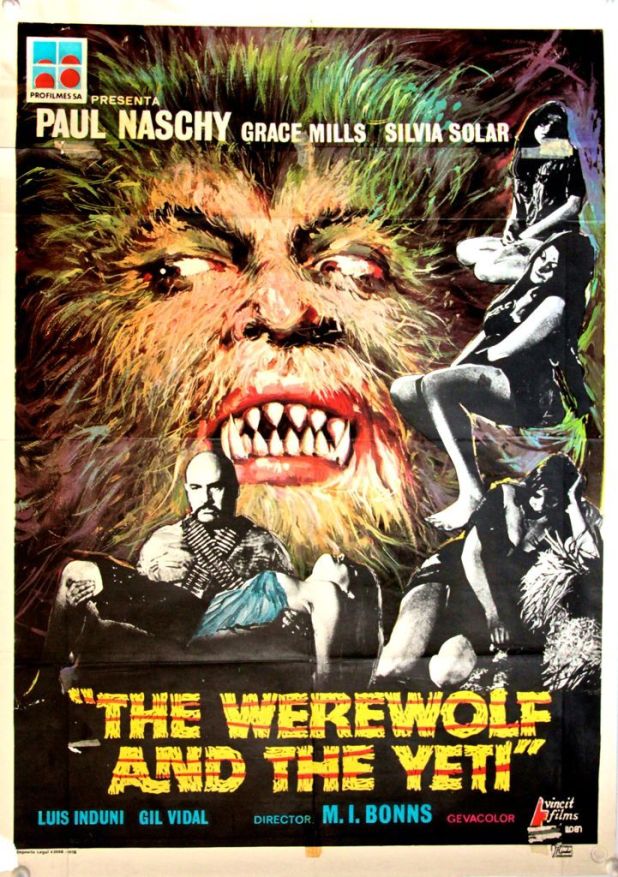
Let’s step away from Bigfoot to speak on werewolves. Specifically, a werewolf named Count Waldemar Daninsky. Over twelve movies, his origins have changed as many times as his films have alternate titles. Here, in the eighth film in the series (also known as The Curse of the Beast, Night of the Howling Beast and Hall of the Mountain King), Waldemar becomes a werewolf when he’s bitten by not only one, but two vampire woman.
Wait — a vampire can turn you into a werewolf? And how does a yeti get involved? Oh man, welcome to the fever dream that is a Paul Naschy film.
Waldemar Daninsky is in Tibet looking for the legendary yeti when those two vampire women we alluded to before capture him and keep him in their cave. While they’re having sex with him and biting him and making him a werewolf (which seems to be the best way to be transformed), his friends are being captured and tortured by Tibetan pirates.
With eight minutes left in the movie, Waldemar becomes a werewolf and battles a yeti one on one. By the time I got that far — keep in mind I was at a drive-in — I was so inebriated that I was in and out of consciousness. Or perhaps this film is that strange, seeing as how it’s filled with skin being ripped off people’s backs, neon glowing caves, nudity, rituals and stock footage. In short, it’s great.
You’ll find this movie — in way better quality than the night I saw it — in the Paul Naschy Collection volume 2 from Shout! Factory.


 B&S About Movies
You must be logged in to post a comment.