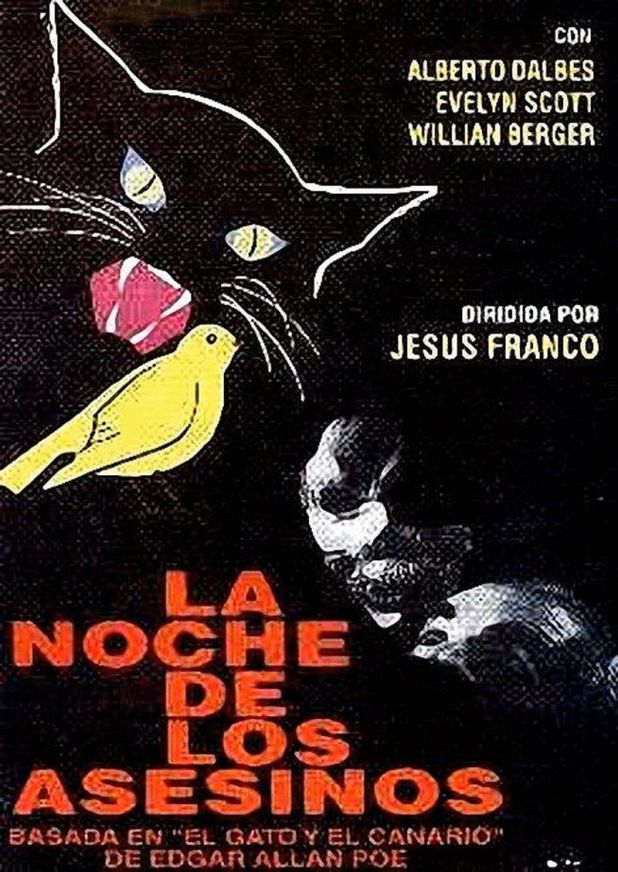
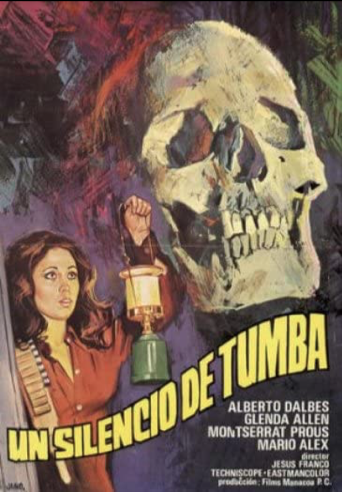
Inspired by Edgar Allan Poe* in the credits and Edgar Wallace in an interview Franco gave — well, we can say that for any krimi or giallo, hmm? — Night of the Skull has Jess Franco making a mystery movie that doesn’t go fully into his usual perverted take on, well, everything. But there’s still plenty of love in this.
No zooms, no wild moving camera, no plot that seems made up when the camera starts rolling, not even much nudity — but Lina Romay does get whipped and ends up dating someone who may be her brother, so yes, this is a Jess Franco movie.
Lord Marian (Angel Menendez) is reading from the Book of Apocalypse — again, not a real book, which is a Franco trademark as much as stolen diamonds and sex scenes — when he’s attacked by a hooded menace and buried alive in mud, only his hands emerging and reaching for the heavens. Everyone thinks that his secret daughter Rita (Romay), so has been used as a servant and the whipping target of his second wife Cecilia (Maribel Hidalgo, Santo vs. Doctor Death) before the will states that she gets everything.
There’s also another will and another family and everyone starts getting murdered by the masked killer, all in ways that reference the end of all things as well as the four elements. And hey — it’s set in Louisiana, which is crazy because Scotland Yard has jurisdiction there, which makes as much sense as anything Franco usually writes.
*The Cat and the Canary, which isn’t by Poe but is a play by John Willard that became a 1927 silent movie and a 1939 Bob Hope-starring remake.
EDITOR’S NOTE: Jess Franco is an acquired taste. As of January 19, 2018, when I wrote the original review of this film, I had not yet learned to love his movies. So here’s an experiment: the 2018 take on the film and the 2022 version. Let’s see if we learn anything.
2018 version
Anne (Lina Romay, muse of this film’s director, Jess Franco) is a performance artist who specializes in recreating Satanic rituals and spicing them up for old rich folks to savor. She also writes for a magazine, Garter and Dagger, that appeals to people who like this kind of dreck.
Turns out that Mathis, one of the writers at the magazine (yep, Franco himself), was a priest kicked out of the church for following Old Testament beliefs instead of Vatican 2. After overhearing Anne and her assistant planning a Black Mass (not an actual one, more like a sex party, which come to think of it, why is a man of the cloth working for a porn magazine? And wouldn’t an orgy be just as bad as a Black Mass?), Mathis kills each and every person involved.
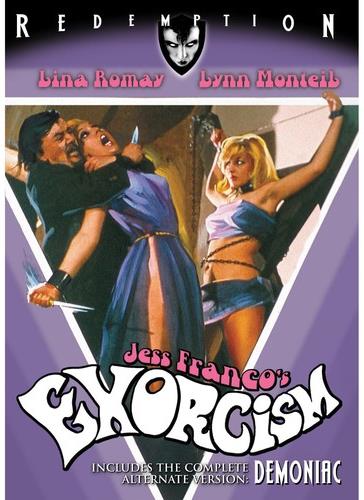
There’s another cut of the film, Demoniac, which is just death and gore with none of the sex. It’s 69 minutes long. And there’s another version called Sexorcismes that remakes this film with added hardcore footage, including Franco himself showing up for the party. And Franco remade it again as El Sádico de Notre-Dame.
Under any title, this movie is the absolute shits. It fails at horror. It fails at being sexy. It fails at being interesting. It even fails at being an Exorcist clone because it has nothing to do with exorcism!
Look — when I tell you a movie is bad, trust me. It’s bad. Real bad.
Seriously — I found a movie about Satanic sex crimes boring. If that’s not a recommendation to avoid, I don’t know what is!
2022 version
Consider this three movies in one: Sexorcisme is the hardcore version, which also has two versions, coming in at 71 and 82 minutes. And then there’s The Sadist of Notre Dame, a remade version that came out just a few years later, with Franco shooting new footage five years later to add greater character motivation. And there’s a really cut down version, Demoniacs, which ironically has a running time of 69 minutes.
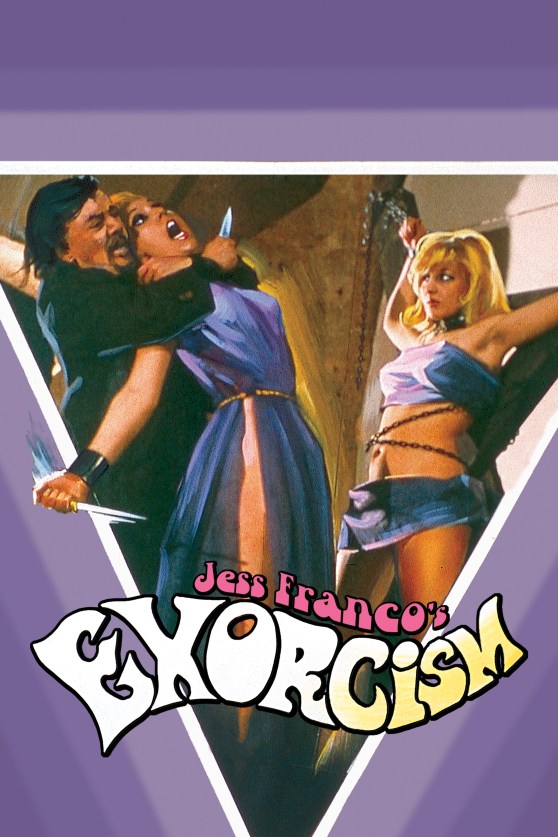
Then there’s the original, Exorcism AKA L’éventreur de Notre-Dame.
You could see this as confusing, but I like to think of the films of my favorite exploitation directors as grand puzzles that demand solutions.
Made during the height of the demon possession film cash-in cycle, this finds how Jess Franco would make one of those movies and of course, he runs hard and fast in the other direction, as this movie feels like the 70s I knew I’d never escape alive.
So when I look back at my old review, I realize that either back then I was judging Franco’s movies against normal films. Or perhaps I really have Stockholm Syndrome and have started to completely accept everything Franco makes as something better than it should be.
Instead of realizing that this is boring, if we concentrate on a normal film narrative, one must embrace the sheer wildness of it all, as Lina Romay plays Anne, a performance artist who makes great money staging fake Satanic rituals in the time when such things were considered transgressive art and not reasons to fear a dark Luciferian underground out to rule the world. But tell that to Mathias Vogal (Franco), a former priest who has lost his sanity and sees what they are doing as a true Black Mass that he must decimate by finding every woman involved and conducting a one-man Spanish Inquisition.
Of course, Franco brings the sleaze and has some fine instruments to conduct his symphony, including Monica Swain as a sadist who yells, “You’re as disgusting as a leper’s sores. You make me vomit!” and Catherine Lafferière as Martine.
Any movie where Franco plays a deranged priest who says things like “Yes I have a chapel in my house, what’s strange about that?” and obsesses over his sins while spying on women as they make love and then murdering them, I’m very much for. Also, the same dude writes Inquisition fiction ala Penthouse Forum for his real job, which is insane, but such is the universe of Franco. There’s aso a momebt wen he stares out into the early day outside his window and you can nearly see two shapes of him, his physical and shadow form and it truly shows us the divided nature of his character,
As for the Sexorcisme cut, how badly do you want to see Jess Franco’s fuck style? Because there he is at the end of the film, giving Lina a tongue bath and man, you’d expect doubles to be use for all of this reshot footage and nope. It’s all of the cast and you even get to see little Jess in footage that in no way matches up with the rest of the movie. The fact that that sex scene between Jess and Lina exists kind of breaks the movie, because in the original cut, he’s praying in Latin just as much to keep his lust from taking over his body as he’s trying to get Satan out of her.
This is what we call emotional maturity, friends, when you care about the story more than seeing Lina Romay in a non-simulated sex scene.
The Demoniac cut of this movie is also on the ARROW PLAYER. Head over to ARROW to start your 30-day free trial. Subscriptions are available for $4.99 monthly or $49.99 yearly. ARROW is available in the US, Canada, the UK and Ireland on the following Apps/devices: Roku (all Roku sticks, boxes, devices, etc), Apple TV & iOS devices, Android TV and mobile devices, Fire TV (all Amazon Fire TV Sticks, boxes, etc), and on all web browsers at https://www.arrow-player.com.
Patrick Mariel (Guy Delorme) decides to take his perfect family to the south of France on holiday, but before long, his wie Marianne (Jacqueline Laurent) and his on the cusp of womanhood daughter Linda (Lina Romay).
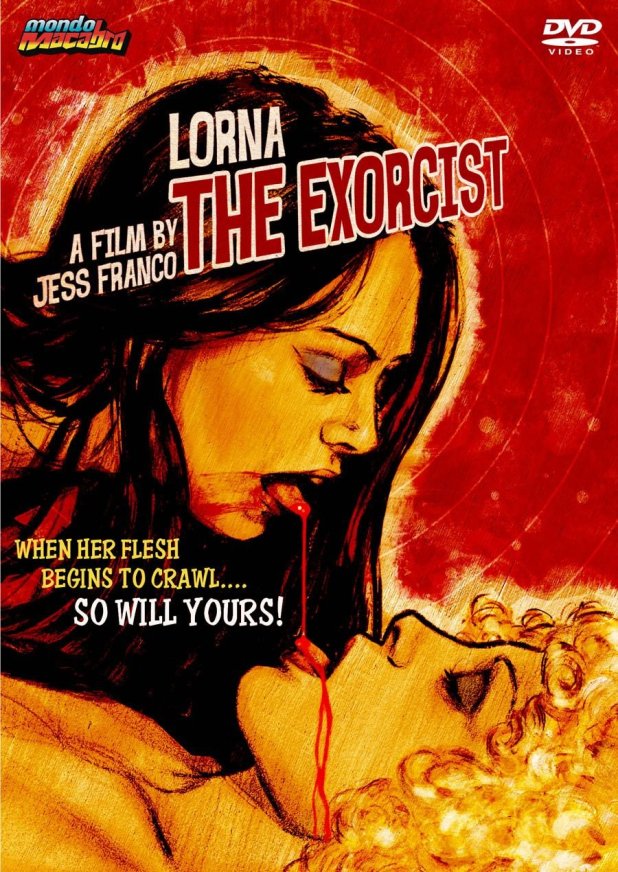
Yet before they even depart, threatening phone calls start coming in to their home from Lorna (Pamela Stanford), a woman from Patrick’s wild past who is either or noth the reason for his success and someone who has transcended mortality and become a demonic succubus, as a Jess Franco character often does. The deal that she made in blood with Patrick has come due and now, she’d rather take Linda than anything else.
Stanford was also in Franco’s Succubus, but here she’s coating her face in tons of makeup and unleashing small crabs on her victims and you know, you can’t say that Jess Franco doesn’t try to make it weird, you know?
Franco made this movie for producer Robert de Nesle, who put it out as a clone of The Exorcist, as happened often in the 70s, then re-released it with inserts and called it Luscious Linda, as if trying to figure out what Franco movie is what, as the director also made The Story of Linda, AKA Captive Women, as well as Who Raped Linda?
And because this is Jess Franco, he remade this movie in 2002 as the shot on video Incubus.
So what if Jess Franco made a giallo? Or a takeoff on Ten Little Indians for that matter? And what if it concerned an actress named Annette Lamark (Glenda Allen, Confessions of a Window Cleaner) who invites her friends to an island that she’s just bought — obviously her movies are doing well — that’s home to the secret child she had with director Jean-Paul (Francisco Acosta, Sinner: The Secret Diary of a Nymphomaniac) who is being raised by her sister — and the movie’s narrator — Valeria (Montserrat Prous, The Fish with the Eyes of Gold).
The kid gets kindnapped and anyone on the island could have done it. Well, anyone, that is, who isn’t murdered.
Based on a book by Enrique Jarnes, who also wrote multiple Spanish TV series, this might be the most restrained I’ve seen Franco, but there’s still something boiling under the surface. Made in the same location as The Sinister Eyes of Dr. Orloff, it may not be as good as that movie. That said, there are some reasons to watch this, if only to imagine that this could have been a soap opera directed by Jess that went on for several years and man, I would have to buy a gigantic box of it like that Dark Shadows set that has Barnabas Collins lying in a coffin on every slipcase.
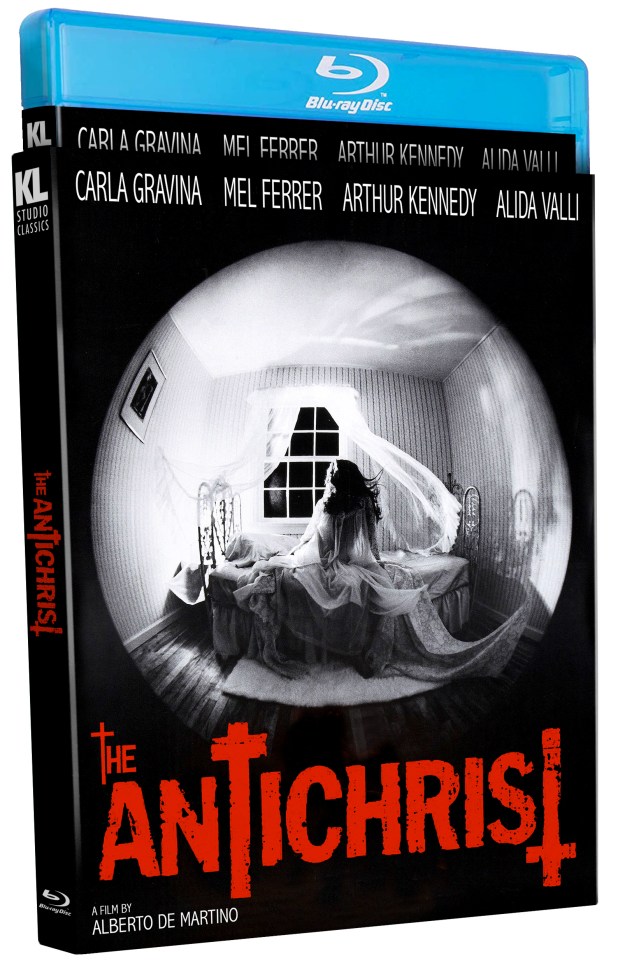
EDITOR’S NOTE: We originally watched this movie back on October 23, 2020 and we’re beyond excited that a new blu ray has been released by Kino Lorber, featuring a brand new 4K restoration by StudioCanal, Raising Hell, a featurette with director/co-writer Alberto De Martino and composer Ennio Morricone, new commentary by Lee Gambin and Sally Christie, a TV commercial, trailers, English and Italian audio and the alternate The Tempter credits. You can get it now from Kino Lorber.
The beauty of Morricone is that for every big budget or quality film that he did music for — The Hateful Eight, Days of Heaven, Once Upon a Time In America — you can find scores he did for movies that aren’t as well thought of, from giallo like What Have You Done to Solange? and A Lizard in a Woman’s Skin to outright ridiculous films like Butterfly and, well, this movie.
And I love it.
I love every single minute of it.
Ippolita (Carla Gravina rocking a Mia Farrow haircut) is a paralyzed young woman with major issues, all because her mother has died. So her shrink does what any psychologist would do in 1974: he sends her brains back in time to remember when she was a witch getting killed during the Inquisition. That ancestor takes over and before you know it, our heroine is screwing and destroying men. It’s time for this movie to stop ripping off Rosemary’s Baby and start being The Exorcist!
Also released as The Tempter, this was directed by Alberto De Martino, who also made the amazing poliziotteschi/giallo hybrid Strange Shadows In an Empty Roomand the downright weird superhero film The Pumaman, not to mention Miami Golem.
There’s way more nudity and sexuality than the majority of American The Exorcist clones, but this is Italy and Aristide Massaccessi is the director of photography. That’s Joe D’Amato, in case you didn’t know, so when Ippolita says cock numerous times and there’s a lengthy Satanic orgy, one of the few I can think of set to tunes by Morricone (that said, he did so many films* that I’m sure there’s at least one more key party for the First of the Fallen set to his music), you can just say, “Hell yeah, the Italians might be all repressed Catholics, but they sure know how to make a Satan movie.”
The scene in the ruins at the end? That’s the kind of stuff my dreams are made of. More movies should be this unabashedly out of control, you know? Another great example of this level of craziness is another De Martino ripoff that somehow has great Hollywood actors in it, 1977’s The Omen Xerox film, The Chosen, also known as Holocaust 2000.
EDITOR’S NOTE: As we wade through a month of all things Jess, here’s a sideways version of his work, as scenes from Count Dracula were used to complete this documentary on the life of Dracula. This originally ran on our site on March 13, 2021.
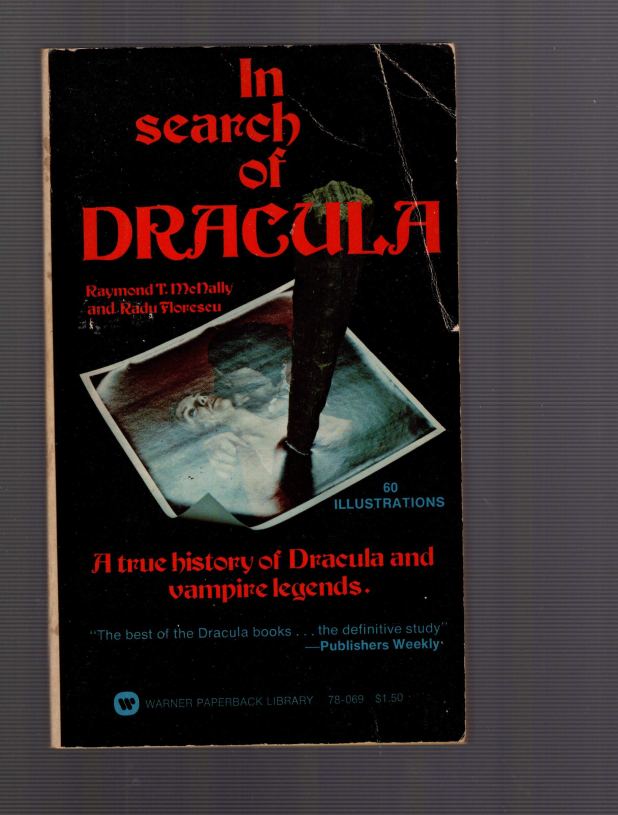
When I was a kid, my dad had a paperback shelf filled with paranormal books that I spied in fear. One of those books was Radu Florescu and Raymond McNally’s In Search of Dracula. Between that tome and the ad in Warren comics for a necklace filled with dirt from Dracula’s grave, I lived in mortal fear of vampires, as if I lived in Santa Carla instead of Southwestern Pennsylvania.
Now that I’m grown up, I’m obsessed with tracking down the early 70’s pop culture paranormal that often expresses itself in Schick Sunn Classic films and movies like this, directed by Calvin Floyd* (Terror of Frankenstein, The Sleep of Death).
To illustrate the history of Dracula, Christopher Lee shows up as Vlad Tepes, Count Dracula and himself** Plus, Swedish actors Tor Isedal and Solveig Andersson show up. They were both in Dagmar’s Hot Pants, Inc. and The Lustful Vicar together and she also played one of the prostitutes in They Call Her One Eye.
Thanks to the research of Florescu, Vlad Tepes is an accepted part of the Dracula mythos and his further research into Frankenstein’s Monster has led to the alchemist Konrad Dippe being associated with that legend. Yes, before he wrote that book, no one knew that Sir Arthur Conan Doyle was influenced by history.
*Floyd is pretty much an auteur, as he also produced this film and composed all of the music. He was also a pianist, author, composer, pianist and president of music-publisher Kalmar, Inc.
**Footage is also taken from the Hammer films and Jess Franco’s version, too.
Henrietta and Pete Robbins (Barbra Streisand and Michael Sarrazin) are a struggling couple who have to deal with the insults of their sister-in-law Helen, who tells them that an early marriage took away Pete’s chance at success. Yet when Pete gets an insider trading tip — this type of thing was somehow perfectly legal in 1974 — she borrows three grand from a Mafia loan shark and finds herself unable to quickly pay them back, which means that she’s sold to Mrs. Cherry and rented out as a call girl, but she fails again and again to satisfy any of her clients and starts adding up even more debt.
It was written by Stanley Shapiro (How to Save a Marriage and Ruin Your Life, Pillow Talk) and Maurice Richli (The Pink Panther) and directed by Peter Yates, whose career has movies like Breaking Away and Mother, Jugs and Speed as well as Bullitt, The Deep, The Dresser and Krull.
It’s a light farce and while Streisand didn’t like the movie, it was a success.
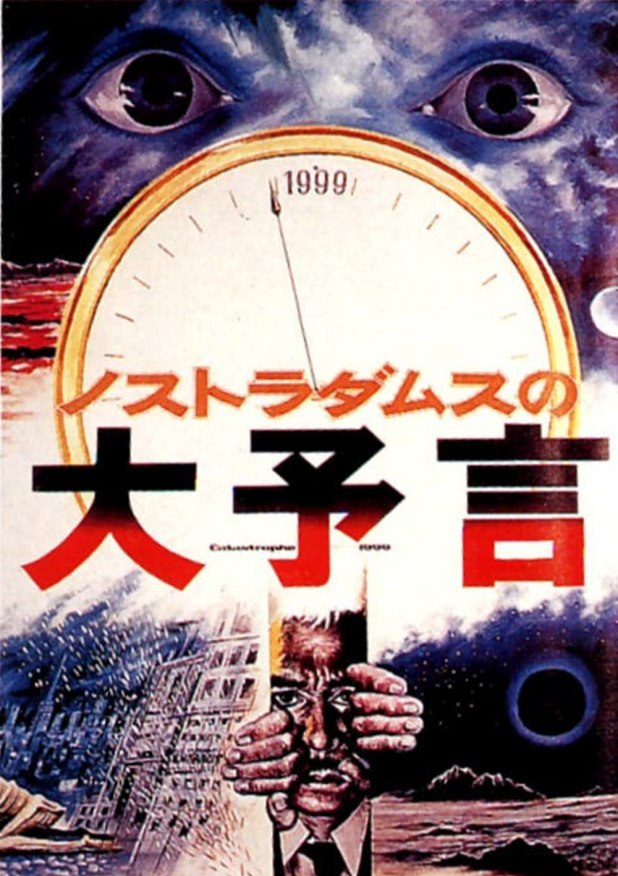
In 1969, Tsutomy “Ben” Goto was writing for women’s magazines and watching the moon landing. That’s when he remembered reading about man walking on the lunar surface in the quatrains of Nostradamus*.
Michel de Nostredame was a French astrologer and physician, but also a seer who wrote Les Prophéties, a collection of 942 quatrains — a poetic stanza made up of four lines with one having alternate rhymes — that allegedly predicting future events. Worrying about being arrested and tortured in the Inquisition, Nostradamus obscuring the meaning of his prophecies by using word games and a mixture of other languages such as Greek, Italian, Latin and Provençal.
At the time, people thought Nostradamus was either evil, fake or insane. After all, if he was so good at predicting the future, why didn’t he predict that he’d suffer from the gout? He did have one admirer. Queen Catherine believed in him so much that she made him Counselor and Physician-in-Ordinary to her son, King Charles IX.
The Japan of 1974 was gripped in pre-millennial tension that one has to assume was exacerbated that they alone had had two examples of nuclear fire dropped on their country in the past century and here we were, on the precipice of an even more frightening future. Goto’s books were perfect for the country’s insecurity and vulnerability.
This is also when the idea of 1999 started worrying people. After all, a major disaster was coming in the last year of the millennium, even though the millennium didn’t really end until 2000. The book said that Japan would suffer an oil crisis, a trade war with America, a devalued yen, the rise and fall of real estate in Tokyo, volcanos and earthquakes.
By Predictions of Nostradamus: Middle-East Chapter in 1991, Goto had written seven books on the subject (he eventually wrote ten), he had sold 5.4 million books, even if critics said that his work was “Nostre-damasu,” which uses the Japanese word damasu, which means to deceive**.
Meanwhile, Toho was nearing the end of Godzilla’s Heisei era and was looking for something new to get moviegoers into the theater. They’d already followed Hollywood’s disaster movie template to make Japan Sinks, which was the most popular movie in the country in 1973 and 1974, making double what its closest competitor did. It was so successful that Roger Corman and New World Pictures bought the rights, threw in Lorne Greene and released it as Tidal Wave.
For this movie, Toho took a glance at a book written by Shinya Nishimaru, general manager of the Food General Office within the Ministry of Agriculture and Forestry, and Goto that saw a dismal future, filled with no food and an environment that began to turn against humanity.
Written by Yoshimitsu Banno, who also made the apocalyptic Godzilla vs. Hedorah, and Toshio Masuda, who directed Tora! Tora! Tora! about Japanese and American naval conflict, as well as Be Forever Yamato, which is an anime that has a Japanese battleship rise into space, along with help from Toshio Yasumi (The Last War) in just ten days, this movie points to the dual scope and economy of Toho.
Scope: It’s the end of everything, so it was shot on all of Toho’s visual effects soundstages***.
Economy: It features footage from The Last War and Tokyo Sinks, while its destruction was recycled again as destructive scenes in The Return of Godzilla and Deathquake.
In the Japanese cut — oh man, there are six versions — the movie gets started in 1853, as Genta Nishiyama begins preaching the prophecies of Nostradamus before he begins to preach that Japan will end its isolation. Killed for heresy, his children hide the book and his family continues to tell of the prophecies, like a World War II descendant who is interrogated about the defeat of the Axis.
Let’s smash cut to 1999. Dr. Ryogen Nishiyama has been analyzing all manner of bio-phenomena, like large mutant bugs, kids getting psychic powers from drinking zinc-heavy water and ice showing up in Hawaii. Trust me, this movie is decades ahead of Don’t Look Up and a million trillion times more entertaining, as no one believes that natural disasters are about to be unleashed and things like nuclear clouds in New Guinea will create giant leeches, bats that feel like they came out of A Lizard In a Woman’s Skin and cannibalism.
There’s also an incredibly dark scene where a fisherman, realizing that the oceans will never sustain life again, realizes that his life has no purpose, so he walks into the waves to die as his sons fight to save him.
From catastrophe both large — SST jets exploding over Japan and unleashing the full power of a hole in the ozone layer and snow in the Middle East — to small — dying family members of the central cast making the end of the world personal, this movie takes a downbeat turn quickly, but somehow, this is all set to a score that can only be described as transcendent. Or paradoxical. Or great.
In between all of this death and destruction, we learn that the young people have decided to take their fates into their own hands. As they take tons of drugs, they draw lots and sacrifice themselves by climbing into the sails of boats, dressed in kabuki makeup, crashing into one another. They also line up on motorcycles and one after another jump into oblivion and the dead sea, all set to guitar-driven fuzz rock.
By the end, nuclear war has broken out and our planet is a desert where mutant humans still kill one another, learning nothing.
Then, as if Bobby Ewing had just finished his shower, we learn that this has all been a speech that Dr. Nishiyama was giving to the Japanese Diet. The film ends with this credit:
The story you have just seen was a work of fiction. The events it portrayed, however, may take place in our world. It’s up to you to take action to ensure these events do not come to pass…
A Japanese version of Prophecies of Nostradamus played Japanese-language theaters in the U.S. in 1979 and 1980, while UPA acquired the rights to distribute the film on home video and television. The American version, The Last Days of Planet Earth, was released on VHS and laserdisc in 1995 by Paramount.
There are a ton of differences, with much of the gorier moments taken out like the cannibals eating one of the scientists, the flesh falling off the arm of a zombified man, an American voice-over for the regatta of death, nuclear missiles being launched, the mutants and a human biting into a snake — amongst many other excised scenes and narration changes.
While available for release in the U.S., it’s doubtful that the full movie will ever be seen here outside of bootlegs (shh — I have one with six different cuts of the movie****). The cannibal scenes and the mutant battle were cut everywhere outside of Japan and as of 1980, those scenes don’t appear in Japan outside of a bootleg — released by a Toho employee — of a canceled VHS and laserdisc release in 1988.
The film was cut down from 114 to 90 minutes thanks to all of the edits.
Sadly, the sequel Prophecies of Nostradamus II: The Great King of Terrorwas never made, a movie in which Goto analog Tsutomu Goto would try to reach out to the spirit of Nostradamus to save the world. Toho did make Nosutoradamusu: Sen ritsu no keiji in 1994.
*Century 9, Quatrain 65: “He will come to go into the corner of Luna, where he will be captured and put in a strange land. The unripe fruits will be the subject of great scandal. Great blame, to one great praise.”
**Thanks to Japan Today for this fact. They also shared an amazing article about Ryo Tatsuki, a manga artist who published The future as I see it, in which she predicted that “around 2020, an unknown virus will appear, reaching its peak in April; it will then vanish but reappear 10 years late,” as well as the deaths of Freddie Mercury and Princess Diana. Obviously, Nostre-damasu will never die.
***During filming, a pyrotechnical accident caused a fire that burned down part of the main visual effects soundstage, an apocalyptic event all its own that destroyed many of the costumes and props from earlier Toho films, including the original Mogera costume from The Mysterians.
When I was a kid in the 70s, killer bees were all we heard of. They were obviously going to get us and a story on the news every night for years and then, well…nothing ever happened.
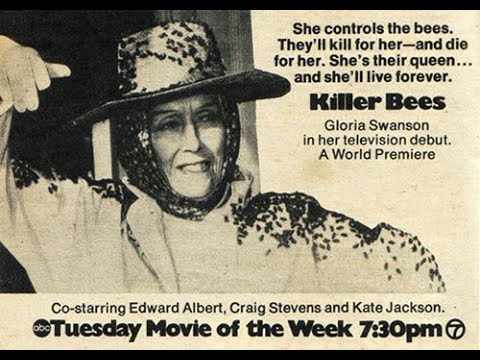
The ABC Movie of the Week on February 26, 1974, The Killer Bees, directed by Curtis Harrington and written by former lawyer John William Corrington and his wife Joyce Hooper, who teamed to write the scripts for Von Richthofen andBrown, The Omega Man, Boxcar Bertha, The Arena and Battle for the Planet of the Apes, as well as several soap operas and the syndicated show Superior Court.
Edward Van Bohlen (Edward Albert) has stayed away from his wine making family until his girlfriend Victoria Wells (Kate Jackson) asks him to go back home and try to reconnect. We all know that you can’t go home again and when your family uses African bees to make your wine better, well, you really should in no way go back home again.
Madame Van Bohlen (Gloria Swanson) not only runs the family and the winery, but the bees as well. She’s able to command them to kill everyone that she sees as a threat, but when she dies, who will the bees follow?
Bette Davis was originally going to be the star of the movie, but her doctor worried that she’d o into anaphylactic shock if she was stung by a bee. As for Gloria Swanson, she was so game for this movie that she agreed to have bees put all over her body. To create this moment, the bees were placed in a dry ice room to make them tired, then gradually warmed once they were put on Ms. Swanson’s costume.
The wine that got made by the Van Bohlen’s must have been good, because their home is now the place where noted winemaker — and yes, director — Francis Ford Coppola lives.
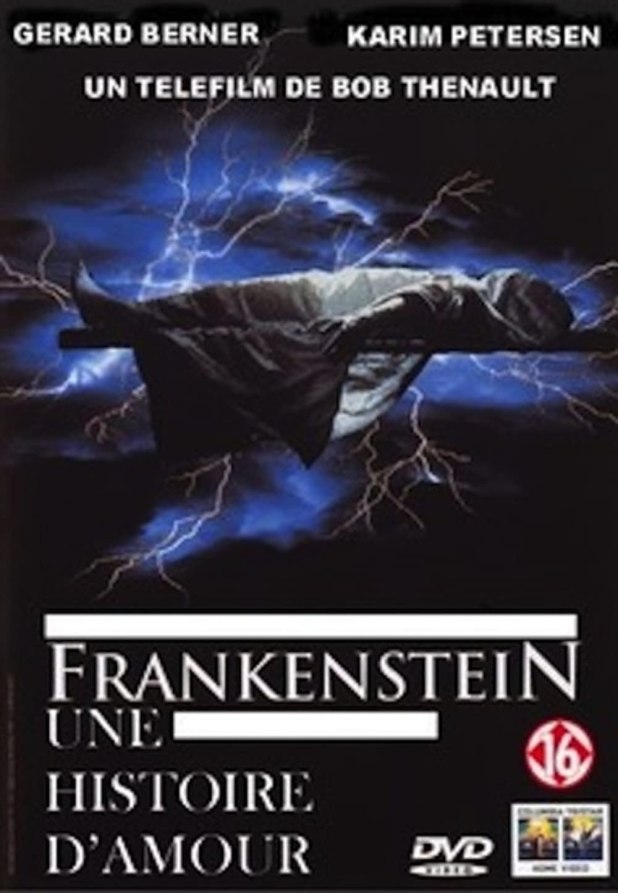
AKA Frankenstein 95 and why does Frankenstein have so many movies with years after its name?
Obsessed with creating life, Count Victor Frankenstein starts on animals, moves up to cadavers and freaks everyone out around him — his teachers, the lcoal government and even his own family — as he dreams of getting a real person to try out his experiments on.
Man, this movie is just plain weird and nobody is talking about it, but then I realize that it’s a made for TV French movie from 1974 so adjust your perceptions, Sam.
Also, besides morally disgusting everyone he meets, the other people that Victor knows — his foster sister, a village fool — want to have steamy, sweaty and probably chemically smelling sex with him. He’s also mentally bonded with the creature, giving everyone else in town psychic visions.




 B&S About Movies
You must be logged in to post a comment.