A wealthy industrialist named Johann Wallenberger has showed up dead outside a haunted house ride and is missing all of his money. His insurance company sends its top man, Chris Buyer (Robert Hoffman, Death Carries a Cane). He decides to go undercover by dating the dead man’s daughter Catherine, but before long, he’s in her family home as her mother loses her mind and her sister Barbara starts to seduce him. And oh yeah — more people start dying, which could be anyone from a blackmailer to a family member to even someone else from Chris’ company trying to ruin his good name.
Director Alfonso Brescia is well-known to us here — we did an entire breakdown of his five post-Star Wars science fiction films — and you can trust the man who made The Beast In Space and the underrated Iron Warrior to make something interesting.
I love that this movie has more than one ending and more than one killer. It plays with the form a bit and keeps you guessing. I’m also all for Adolfo Celli showing up in every movie that I watch.
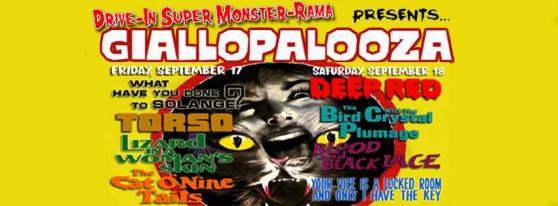
EDITOR’S NOTE: We originally posted this on March 26, 2018. To celebrate the Drive-In Super Monster-Rama Giallopalooza on September 17 and 18, we’re posting an article on each of the eight films that will play at this incredible event.
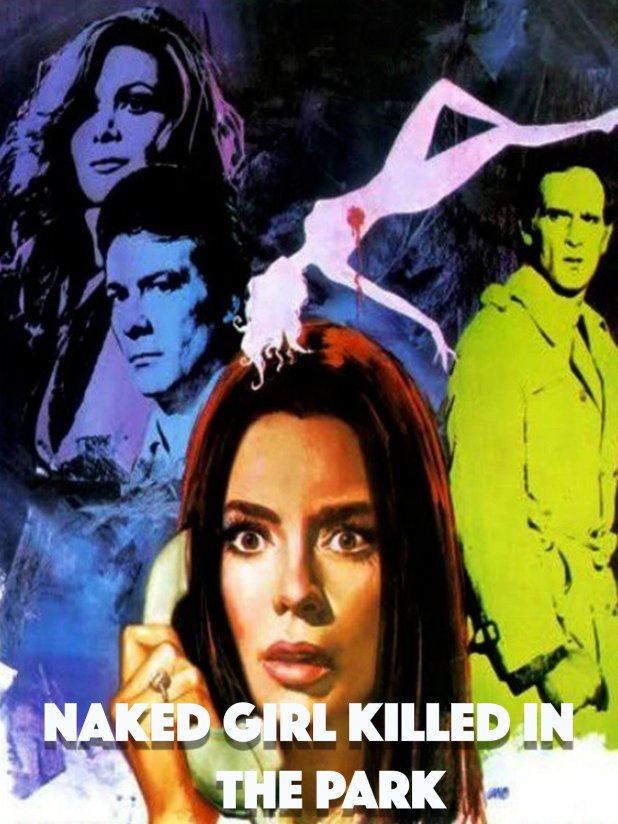
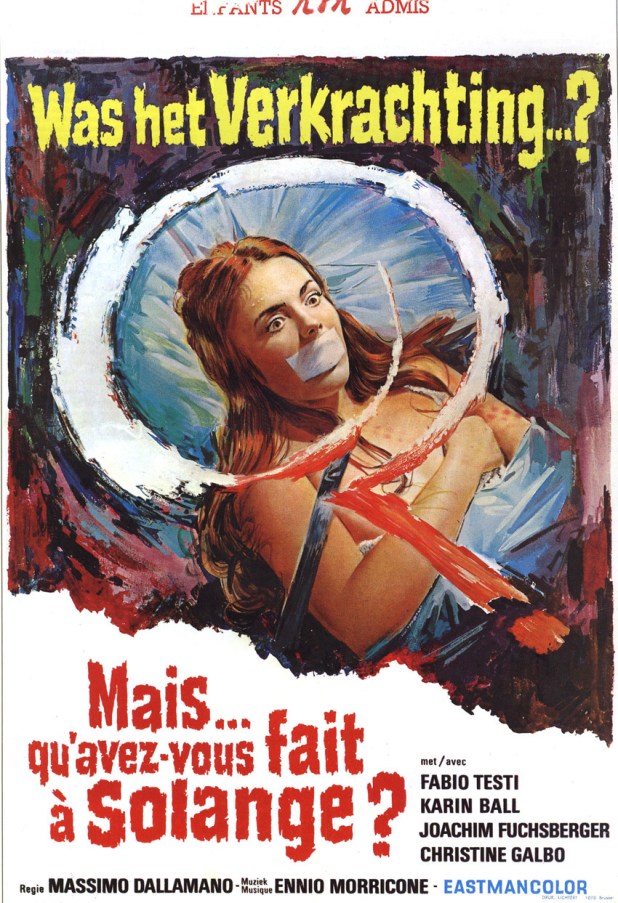
London. The 70’s. Professor of Italian Enrico Rosseni (Fabio Testi, The Four of the Apocalypse) is on his boat, making out with Elizabeth (Cristina Galbó, The Living Dead at Manchester Morgue, The House that Screamed) and trying to get her to go further than she has before. Right when it seems like he’s going to finally conquer her, she looks up to see a woman being stabbed on the shore.
After angrily rowing to the shore, Rosseni and Elizabeth find no evidence of a crime. He accuses her of being too religious, like all the girls at the school her uncle sent her to. The next morning, while he dresses and argues with his wife Helga, he hears about a horrid murder on the banks of the Thames river. He drives to where he and Elizabeth were and finds tons of cops. And there are even more at the school where he works!
The victim was one of Elizabeth’s friends, so she wants to tell the police what they know. However, he doesn’t want the affair exposed. However, his pen has been found near the body and he shows up in the crime scene photographs in the newspaper.
More murders. More clues in Elizabeth’s mind. More priests doing evil things. More anger from Helga. More of Rosseni trying to solve the crime. And all he has is one clue: Who is Solange and what was done to her?
The movie takes a turn when Elizabeth is killed inside the apartment that Rosseni has rented for the two of them to continue their affair. And at that point, Helga starts being much nicer to our hero. As their relationship improves, her makeup grows softer, her clothing gets more fashionable and her hair comes down. How strange to find a giallo about a relationship coming back together as the result of murder!
What happened to Solange (Camille Keaton, I Spit on Your Grave)? She was given an abortion that all of the murdered girls were there for. In a kitchen, no less. And all of those girls were involved in doing drugs and dating older men.
So what do the cops do? Oh, just set up a sting operation with all of the surviving girls. And of course, Solange just happens to show up, walking through the park. Here’s the second of course — the cops bungle everything and the killer takes Brenda, asking her the story of Solange, as he did every other victim.
This is one well-put-together film, thanks to Massimo Dallamano, who was the cameraman for Sergio Leone’s A Fistful of Dollars and For a Few Dollars More. Joe D’Amoto was the cinematographer and added plenty to the film. And you can’t deny the power of having an Ennio Morricone score!
This film is an interesting combination of the German krimi film and the Italian giallo and gave way to Dallamono’s Schoolgirls in Peril trilogy, which includes What Have They Done to Your Daughters?and Rings of Fear.
I always love seeing what titles films get released and re-released under. What Have You Done to Solange? has so many, including an attempt to sell it as a teen comedy entitled The Rah-Rah Girls! You can learn more at the amazing Temple of Schlock site. And for an awesome police report of the events of the film, head to The Giallo Files.
So who was the killer? No spoilers here.
Drive-In Super Monster-Rama is presenting “Giallopalooza”, two big nights of classic, fully restored giallo thrillers from such maestros as Dario Argento, Mario Bava, Lucio Fulci and Sergio Martino!
Special guest for the weekend will be actress Camille Keaton, Solange herself and also from movies like I Spit on Your Grave, Tragic Ceremony and Seven Blood Stained Orchids. Camille will be available for autographs and photo ops throughout the weekend.
Admission is $10 per person each night (children 12 and under FREE with adult guardian). Camping on the premises is available each night for an additional $10 a person, and that includes breakfast.
Advance tickets are available online at the Riverside Drive In’s webpage.
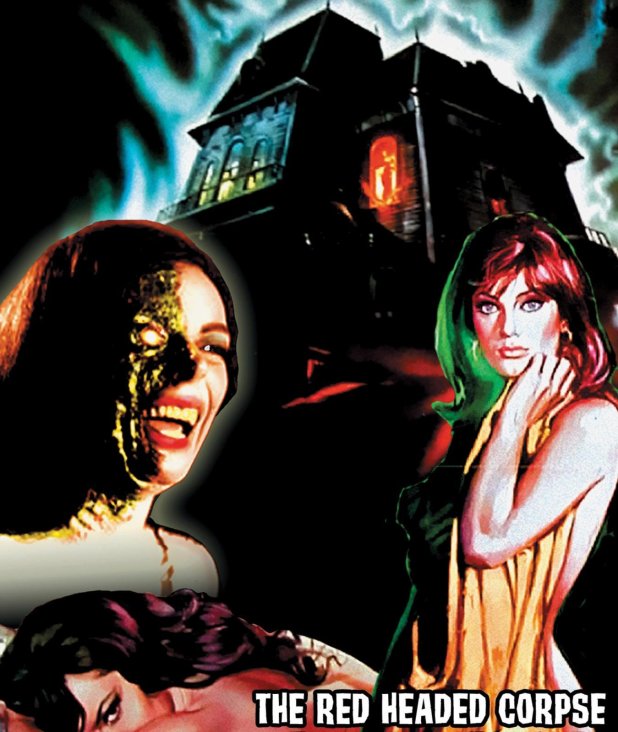
Also known as The Sensuous Doll and Sweet Spirits (or in Italy, La rossa dalla pelle che scotta AKA The Redhead with Hot Skin), this one is…well, I don’t even know if I’d call it a giallo. I’d actually say that it has to fit in there because what else would you call it? A mannequin movie?
Farley Granger is John Ward, a starving — and drunken — artist who transforms a faceless mannequin that he gets from a gaggle of hippies (is that the right word for a group of them?) into a work of art that eventually becomes a real living and breathing woman that he starts to abuse, so she starts sleeping around. Seeing as how that woman is Erika Blanc, you can see how much I hate our protagonist.
Of course, by the end, he’s offering up his soul for one more night in her bed. So is this a supernatural film? Whatever it is, it’s way darker than the 80s would make a mannequin film. Or two on the move.
Do you think Farley Granger muttered to director Renzo Russo (The Kinky Darlings), “You know, I deserve better than this. I was in two Hitchcock movies!”? I’m sure that Erika Bella was like, “Yeah? I was in The Devil’s Nightmare and A Man for Emmanuelle! So there!”
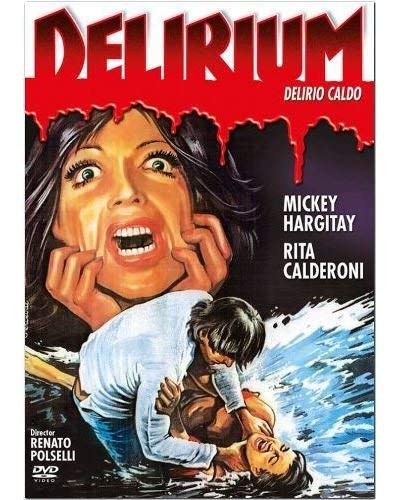
Translating as Hot Delusion or Hot Frenzy,this film was also released as Delirium and has nothing to do with the 1987 giallo DeliriumAKA Photos of Gioia. Instead, it stars one-time Mr. Universe and the former husband of Jayne Mansfield Mickey Hargitay as Dr. Herbert Lyutak, a man who is a psychological consultant to the police and the serial killer they’ve been chasing.
Just when he decides to let his wife Marcia (Rita Calderoni, who was in Nude for Satan and The Amazons) in on the secret, someone starts providing him with alibis and covering up for him, which is good, because Herbert can only perform in the bedroom when he’s beating his wife or murdering other women.
I mean, not good. Good for the story.
There’s also a dream sequence where Marcia and the maid engage in a sapphic encounter while Mickey remains in chains, flipping out and chewing chunks out of scenery that may nearly choke the entire cast. It’s awesome.
The American cut adds in a Vietnam subplot, where Herbert is now a PTSD-damaged ‘Nam vet and Calderoni the field nurse who fell in love with him. It also has two more murders, so there’s that.
Director Renato Polselli has the type of scuzzy credits that mark him as a talent to look into further, like The Vampire and the Ballerina, The Reincarnation of Isabel AKA Black Magic Rites (also starring Hargitay and Calderoni), Revelations of a Psychiatrist on the World of Sexual Perversion and Mania.
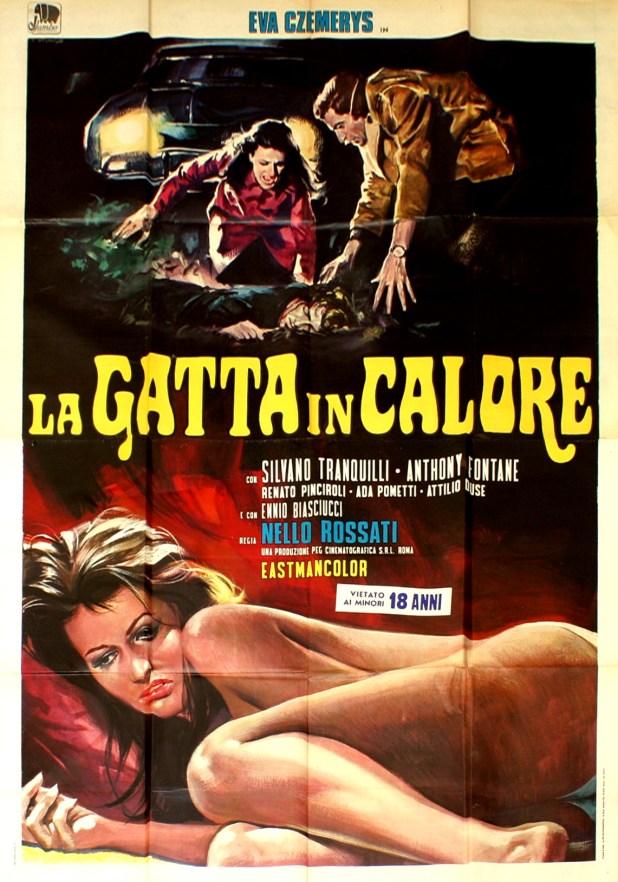
Writer/director Nello Rossati isn’t an Italian filmmaker that gets brought up all that often. He does have some interesting films in his resume, including 1987’s Django Strikes Again, the only official sequel to a western genre all on its own. He also made Bona parte di Paolina, one of the few Napoleon-sploitation films that I can think of, as well as Ursula Andress making a comeback by slumming it in a commedia sexy all’italiana called The Sensuous Nurse, a poliziotteschi with the wild name of Don’t Touch the Children!, a movie called Io zombo, tu zombi, lei zomba that I really need to track down as its a sex comedy horror movie about four zombies running a hotel, a giallo-adjacent called Le mani di una donna sola in which a lesbian countess seduces married women until insane asylum escapees chop her hands off, an I Spit On Your Grave-esque film called Fuga scabrosamente pericolosa that stars Andy Sidaris villain Rodrigo Obregón, the all over the place genre buffet that is Top Lineand this movie, which is a giallo from right in the middle of the golden era of the form.
Antonio (Silvano Tranquilli, who has been in plenty of giallo, like Black Belly of the Tarantula, The Bloodstained Butterfly andSo Sweet, So Dead) is the kind of workaholic husband that falls asleep on date night before fulfilling his duties as a husband. Is it any surprise then that he comes home, finds a dead body in his yard and his wife Anna (Eva Czemerys, The Weapon, The Hour, The Motive; The Killer Reserved Nine Seats; Women in Cell Block 7) has a gun on the dining room table?
As she tells the story of how she left her husband’s bed for their neighbor Massimo, who is always surrounded by other women, loud classical music and a Satanic air. After he abuses her for being rich and continually calls her a cat in heat, then starts abusing her and luring her into all manner of kinks.
The whole time that his wife is telling this story, Antonio is trying to hide the body from neighbors. Yet what if the body is still alive? And how would this couple make it all work after a night of revelations like this? More importantly, is it a giallo when no one really dies?
You may think to yourself while watching this that it looks way better than you’d think, particularly during the LSD orgy sequences. That would be because the director of photography was Aristide Massaccesi, who you may know by one of his many, many names. I often just use the name Joe D’Amato and soon enough, he’d be making movies that put the sex quotient of this movie to shame. You may also notice that the assistant director is someone of some renown: Lamberto Bava.
If you’re new to the giallo, maybe start somewhere else. If you’re starting to think you’ve seen it all, check this one out.
Editor’s Note: In addition to reviewing the films: at the end of the reviews, we’ll also explore the music in each.
In April 2023, Red Rocket Media bring Three on a Meathook to Tubi under their “First Time on Tubi” feature. While they have not yet uploaded a stream of Asylum of Satan, there are five other William Girdler films mentioned within this review to enjoy on the platform.Make a day of it!
Who is William Girdler?
Prior to his death in a helicopter crash in Manila, Philippines, in January 1978, while scouting locations for his next film project (a Star Wars response known as The Overlords), writer-director William Girdler was a driven, prolific filmmaker who shot nine features in six years between 1972 to 1978. His final film was the Tony Curtis-starring The Manitou (1978). His debut was the shot-in Louisville, Kentucky, Asylum of Satan — his response to Rosemary’s Baby (1968; we’ve reviewed the ’76 sequel). Asylum’s plot deals with the head of a mental hospital who sidelines as a Satanic priest. Then, with some trust fund cash in hand, Girdler created his most infamous, second film that earned its notoriety courtesy of its later ’80s VHS shelf life: Three on a Meathook. That film, a Halloween proto-slasher, deals with a character based on the infamous Ed Gein; Gein also served, if you’re keeping track of such things, as the inspiration for Alfred Hitchcock’s Psycho, Deranged, and The Texas Chainsaw Massacre .
Asylum and Meathook impressed producer Samuel Z. Arkoff, so he hired Girdler to direct pictures for American International Pictures. Those three projects were in the Blaxploitation genre: The Zebra Killer (1973) starring Austin Stoker (John Carpenter’s Assault onPrecinct13), the ever-amazing Abby (1974) with William H. Marshall (Blacula), and the Quentin Tarantino favorite, Sheba, Baby (1975).
Girdler’s next film, after his Blaxploitation cycle, was a ripoff of the major-studio and more successful James Caan-starrer, The Killer Elite (1975). Known as Project: Kill (1976), the film served as one of the few non-comedy films of Leslie Neilsen (The Patriot). Girdler then followed with his most financially successful film — which was another ripoff, this time, of Jaws — only with a man-eating bear, known as Grizzly (1976). Christopher George returned from that film for its loose, man-verses-nature sequel, Day of the Animals (1977) — which also starred Leslie Neilsen from Project: Kill. Girdler’s final film was his most expensive production — and the best-looking production of his career: a truly original piece based on a best-selling book, The Manitou, even though it was a cash-in on The Omen.
Asylum of Satan: The Review
Not so infamous . . . and forgotten.
Girdler produced Asylum of Satan for around $50,000 . . . yet, as a testament to his cinematic skills, it looks more expensive: the basement bowels of the Satanic chapel under the “hospital” is surely a wonder of costuming and lighting; so, yeah, we’ll forgive the papier-mâché head of the Devil when he appears.
Lucina Martin (San Francisco-born Carla Borelli, later of Billy Jack Goes to Washington and O.C. and Stiggs) is a nurse assigned to the titled abode where she soon learns she’ll be taking part in a Black Mass — which has Michael Aquino, the man who wrote the rituals in The Satanic Bible to ensure the accuracy of it all. Except that, well, you know: LaVey and Temple of Set Satanists do not kidnap and kill. But, hey, this is Hollywood. And it is the type of Satanic movie your less-informed, ignorant self — drunk on a wealth of UHF-TV era Hammer and Amicus films — would make: complete with naked, bound up girls on altars, which makes this movie such a fun, retro-watch.
You can watch Asylum of Satan on YouTube and here’s the trailer.
Three on a Meathook: The Review
The infamous ’80s rental . . . that wasn’t as graphic as we were lead to believe.
So, under budget and with film stock left over Asylum of Satan, William Girdler made his next film, Three on a Meathook. Once again filming in and the surrounding areas of Girdler’s home town, our faux Ed Gein slashing up the town is Billy Townsend (a not-too-bad James Carroll Pickett): he’s one of those “nice guys” who helps four girls on a country lake vacation when their car breaks down. Oh, yes: Billy has skeletons of the figurative and literal variety with a little Vietnam bad vibes piled on — along with a dedicated father (Charles Kissinger, also of Girdler’s Asylum of Satan, Abby, Sheba, Baby, Grizzly, and The Manitou) who will protect his son at any cost.
This is, of course, a Drive-In Asylum magazine’s Bill Van Ryn film: the kind of ’70s Drive-In’er where “nothing happens” (Norman J. Warren’s Prey, Lee Madden’s Night Creature, John Hayes’s End of the World, and Bill Rebane’s Invasion from Inner Earth, in no particular order, are oft mentioned) to the point where our slasher stops by a movie theater to watch Dustin Hoffman in The Graduate, then he’s off to a bar to have a suds and listen to live music. (Don’t stick your saliva fingers in the bar’s communal nuts bowl, Billy T. Dump ’em on a cocktail napkin.)
Girdler’s freshman and sophomore films proved he knew how to make movies on a budget: he also wrote and arranged the music for the songs in both films. The songs are performed by his hometown friend, Eddie “Eddie D” Dempley: his Blues Express are heard in Asylum; his later band, American Xpress, also appear in Meathook.
You can watch Three on Meathook on You Tube. Here’s the trailer. And here’s Eli Roth chiming in on the film’s “grindhouse” notoriety. Eli’s right: the bigger VHS box meant the movie would suck, but that made us want to watch it more!
Nick Jolley: The Music
The actor’s handwritten, autographed resume from the archive of Theatre World and Screen World, a comprehensive record of American stage and film since 1945/Image courtesy of History for Sale.
The song “Red Light Lady,” heard during the opening credits of Asylum of Satan, was written and arranged by William Girdler and sung by leading man Nick Jolley. The background musicians are unknown and may or may not be the Blues Express. A Broadway actor and singer, Jolley was born on February 17, 1948, in Hindsboro, Illinois. His lone film acting role was playing the plaid jacket and checkered pant hero of Chris Duncan in Asylum.
Jolley, most notably, worked as an understudy and onstage performer in the Broadway theater revivals of Oklahoma! (as Chord Elam, December 13, 1979 – August 24, 1980; New York Timesreview) and The Pirates of Penzance (January 8, 1981 – November 28, 1982). He also acted and sang in many TV commercials and traveling dinner theater productions. You can hear Jolley sing “The Farmer and The Cowman” on the Oklahoma! Cast Album issued by RCA Records. His other stage musical credits included Kiss Me, Kate (1974), A Little Night Music (1976), The Music Man (1978), The Brooklyn Bridge (1983; review), Up in Central Park (1984), and South Pacific (1985).
Nick Jolley died at the age of 48 on February 8, 1997 (Obituary).
Eddie Dempley: The Music
Edward “Eddie D” Dempley and the Blues Express do not appear in but performed the instrumental “The Satan Spectrum Theme” during the end credits of Asylum of Satan. The song was written and arranged by William Girdler (that’s Eddie, in the white tux holding the microphone, second from left in the video still, below).
Born on August 23, 1943, Dempley passed away on July 28, 2011, after a three-year cancer battle. Born in Oldham County, Kentucky, he excelled on the saxophone as a member of the Van Dells and Eddie D (Eddy Dee, Eddy D) and the Blues Express. The band, credited as the American Xpress, also recorded the vocal pieces “You Gotta Be Free,” “We’re All Insane,” and an untitled, end credit instrumental that we’ll call “Love Theme from Three on a Meathook,” for Three on a Meathook.
Even though the band changed monikers from the Blues Express to American Xpress between the two films, it’s the same line up of Bill Longale, Mikk Mastin, Dave Goode, Waldo Weathers, Don Powell (drummer), Maury Bechtel, and Edward “Eddie D” Dempley. (We’ve since heard from Don Powell, who left a kind message in February 2022 on our previous, October 2020 “Slasher Month” review of Meathook.)
Eddie started out with bassist Richard Basin in the Successions, as a singer, in 1964 in Middletown, Kentucky. The band secured the house gig at Bells Country Club off of Poplar Level Road from 1965 to 1967. Another popular club Eddie D played as a house band gig was the Doo Drop Inn on Story Avenue in Louisville in the mid 1980s. During this period he recorded and released on the regional Dunbar label, “Fanny Mae b/w The Same Old Guy (Who Still Loves You).” Another of Eddie’s lost recordings is the Dunbar Records’ 45-rpm Eddie Dee and the Blues Express with “Let´s Go Steady” b/w” Make It Happen.” During this period, the band was also known as Eddie D and the Country Connection. All of his bands also appeared numerous times at the beloved Colonial Gardens and Office Lounge.
Around 1979, Eddie played with Jim Wilson, along with Jim Baugher, David Marasco, George Ashmore, Rod Wurtle, and Rob Brown when the band was called Eddie D and Energy. That version of the band played at the Fern Valley Holiday Inn, Big Moes, and the Old Churchill Inn, and Harold’s Club; the last, which way out down yonder on the ol’ Dixie Hwy.
— Images of Nick Jolley and American Xpress capped from their respective William Girdler films.
— The black and white image of the Blues Express in the Meathook video are courtesy of the Dempley Family Archives. The Archive also provided this review’s biography materials. We also thank Paul Povesis, Caroline R, Richard Bolin, and Jim Wilson for their blog and video comment insights. Our thanks to each for allowing us to preserve their loved one’s career.
— Nick Jolley bio information courtesy of Woody Anders/IMDb, History for Sale, and Ovrtur. Thank you for allowing its use to honor Nick’s life and career.
— A special thanks to those who reached out in kindness to this writer, as we close out 2022, with their pleasure in reading this review, as well as sharing their additional memories of Eddie Dempley and Nick Jolley. Yes, sometimes social media can work in the positive, so it’s a feel-good day! The same happened just the other day with reviews for The Survivalist and about a month or so back with The Spirits of Jupiter.
About the Author: You can learn more about the writings of R.D Francis on Facebook.He also writes for B&S About Movies.
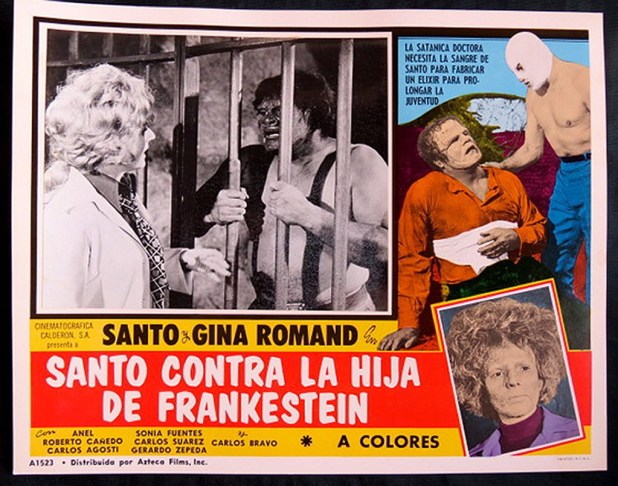
If you’re the daughter of Frankenstein and you need a serum to make you eternally young, there’s only one man’s whose blood will work. That would be Santo. And that’s all we really need to get this movie rolling, right? Also, to make things even more awesome, Dr. Freda Frankenstein has several monsters in her employ, including the half-human, half-ape Truxon and a very Universal Monsters looking version of her father’s creation that she has named Ursus*.
She also kidnaps Santo’s girlfriend Norma and hypnotizes her into cutting out his eyes with a knife because life is cheap in Mexico and our hero has already turned down the evil woman’s advances.
I have a weakness for the female side of the Frankenstein family tree — witness Jesse James Meets Frankenstein’s Daughter and Lady Frankenstein — and this film has that plus lucha libre and ends with Santo fighting Japanese wrestler Yamaguchi for the title.
After this, Santo would battle Dracula, a wolfman and Dr. Frankenstein himself. Gina Roman, who played Freda, was also in La Venganza de las Mujeres Vampiro as the dreaded Countess Mayra.
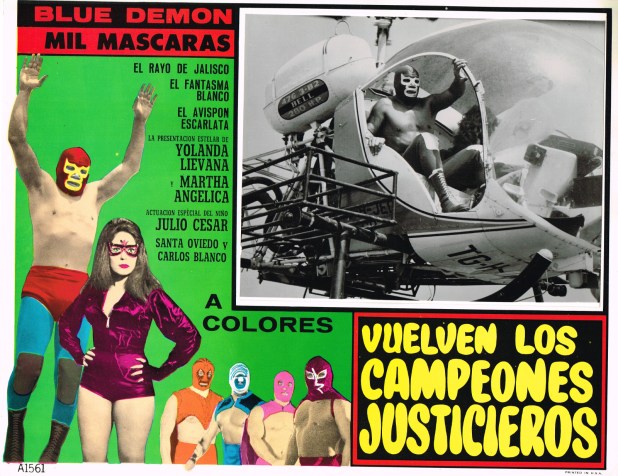
The five “Champions of Justice” in this film are Blue Demon, Mil Mascaras, Rayo de Jalisco, Fantasma Blanco and Avispon Escarlata. Sure, we’ve seen Blue and Mil before, but let’s get you up to speed on a few of the others.
Rayo de Jalisco started wrestling in 1950 but didn’t find success — and the gimmick that would get him said fame — until the early 60s. Once he put on the black mask, he quickly won both the NWA World Middleweight Championship and Occidente Welterweight Championship. He was named best wrestler of 1963, as well as forming a tag team with Blue Demon, the man who would take his hair 26 years later in Plaza de Toros Monumental (the same arena where Los Brazos lost their masks to Los Villanos).
Fantasma Blanco is actually Coloso Colosseti, who wrestled as El Internacional (he lost that match to Tinieblas), El Enterrador (that hood was lost in ring to The Tempest), Batman, Maskaraman and Tårzan.
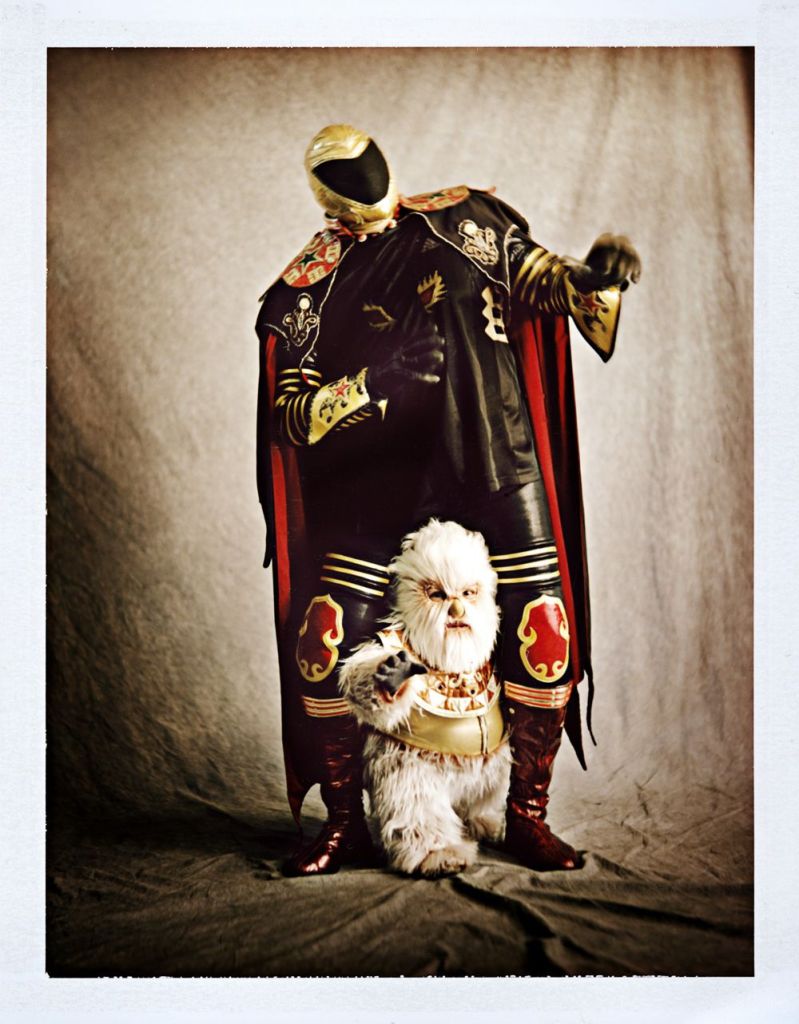
As for Avispon Escarlata — the Scarlet Hornet — he was created for this film and echoes the Green Hornet. He’s played by Manuel Leal, the man who is also Tinieblas. He was a bodybuilder who was scouted by Dory Dixon and the Black Shadow for wrestling, yet before that, he was already in movies, playing Frankenstein in Santo y Blue Demon contra los Monstruos and Satan in Las Momias de Guanajuato. As Tinieblas, he shows up in The Champions of Justice — why he was that role in the first in this series and switched in this one is beyond me — as well as The Castle of Mummies of Guanajuato, Macabre Legends of the Colony, El Puño de la Muerte, La Furia de los Karatecas, El Investigador Capulina and Las Momias de San Ángel. The character was originally intended to be the faceless enemy of the man of a thousand faces, Mil Mascaras! Instead, he became a comic book hero — he had his own book for years — and even has a mascot, the Ewok-like creature known as Alushe*.
One of his nicknames is El Gigante Sabio (The Wise Giant) and he even has a column called Pregúntale a Tinieblas (Ask Tinieblas) where people send him questions to answer. Perhaps that’s one of the many reasons why people thought that he and the respected Mexican commentator Dr. Alfonso Morales were the same person. On August 21, 1970 when Tinieblas made his debut, Dr. Morales was not there. They were both tall men, so the joke for years was that they were the same man.
The main story here is that a team of rat-men — yes, the same miniature henchmen from the original, but now looking like rodents — are trying to take over the world for a Mexican superscience villainess in hot pants named Gatussy. I’m not certain if these guys were men who became rats or rats who became men, yet most of the film is about them swarming all over our heroes.
If you have an issue with a movie about cool lucha dudes riding motorcycles and watching their women go-go dance in between fighting miniature rat men, you should really examine your life.
*Alushe was based on a Mayan mythical elf born in the year 1767 in the city of Anahuac in Xibalba, the Mayan version of hell. When he made his debut in 1988, he was already 221 years old. He was also bribed with candy, money and women by Pierroth Jr.’s group Los Boricuas and suddenly became a Puerto Rican rudo for some time before rejoining Tinieblas. A second Alushe debuted shortly afterward and the original became the blue monkey KeMonito entering into a threeway mascot feud with Mije and the dreaded evil dancing Zacarías el Perico. Man, how much better is lucha libre than pro wrestling?
You know, I can’t get enough of luchadors fighting mummies. I really can’t. They could have made hundreds of these movies and I’d watch every single one.
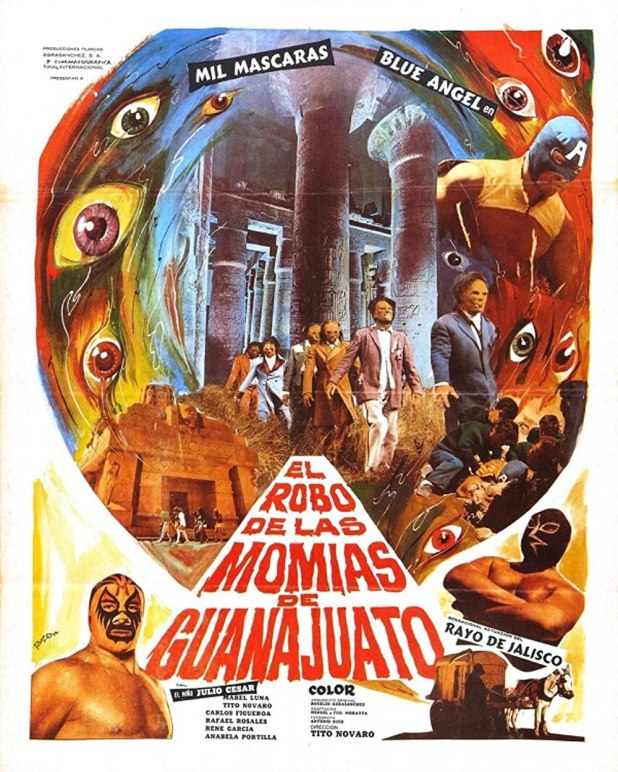
This time around, the evil Count Cagliostro (Tito Novaro, who also directed this movie) and a scientist have succeeded in bringing the mummies of Guanajuato — yes, the same ones from Las Momias de Guanajuato— back to life. Beyond wiring the undead with electronics that allow them to be controlled, they also have an army of karate-chopping little people.
Luckily, humanity has El Rayo de Jalisco (who didn’t appear all that often in movies), Mil Máscaras and Blue Angel* (who would team with Superzan and Tieneblas to fight a very similar set of bad guys in the following year’s El Castillo de las Momias de Guanajuato) are on our side.
Not only does Mil have a convertible, fight mummies in a cape and know tons of attractive women, he lives in the kind of space age seventies apartment that would not be out of place in a giallo. Well done, man of a thousand masks!
*According to Cool Ass Cinema, Blue Angel was bodybuilderOrlando Hernandez. The character was created by producer Rogelio Agrasánchez Sr. as a replacement for Blue Demon.
The Woman Hunter has an all-star cast, with Barbara Eden in the lead, alongside Stuart Whitman, Larry Storch and Robert Vaughn. Like I said — it’s what I say is an all-star cast.
Most Giallo heroines are characterized by their wealth and potential mental issues. However, in The Woman Hunter, when Dina Hunter (Eden) survives a car accident and plans a trip to Mexico with her husband (Vaughn), who would have thought that the artist she hired to paint her portrait (Whitman) could be a jewel thief and a murderer?
This was written by Brian Clemens (Captain Kronos, And Soon the Darkness) and Tony Williamson (Adam Adamant Lives!, The Avengers). It is Clemens’ first U.S. work and Williamson’s only script made over here. It’s directed by Bernard L. Kowalski, who stepped in for John Peyser (The Centerfold Girls). I assume that everyone enjoyed shooting this on location in Acapulco. Larry Storch even brought his wife Norma along.



 B&S About Movies
You must be logged in to post a comment.