Ghost Story Episode 11: “Touch of Madness”

Janet (Lynn Loring) has inherited her mother’s house after her death in a mental institution, a home that she must share with her aunt Hattie and uncle Jonathon (Geraldine Page and Rip Torn, who were married when this was filmed). She decides to move in and fix up the home so that her family can stay there. But of course, this is an episode of Circle of Fear/Ghost Story and that means that everything is going to wrong quickly.

After all, when Janet’s mother died, she told her, “You’re just like me.”

So when Janet sees the home, she sees what it was and perhaps what it could be instead of the shambling wreck that it has become. So when she’s cradling the family cat, perhaps she’s really giving love and attention to a rat. If you’ve read this site for any time, you may realize that I absolutely love any movie where women slowly go psychotic.

This episode was written by Richard Matheson and Halsted Welles, who also wrote 3:10 to Yuma and plenty of television, including episodes of Suspense and Night Gallery. It was directed by Robert Day, who you may know from his work on movies like the 1966 version of She, several Tarzan movies and The Initiation of Sarah.

You can watch this on YouTube.
Ghost Story Episode 10: “Elegy for a Vampire”

Coeds are being drained of their blood on a small college campus, the same place where the departed Professor Pendergast had been studying the hypothesis that vampires suffer from a blood disease. And since he’s been seen at two of the attacks…

David Wells and Frank Simmons (Hal Linden and Mike Farrell, great casting!) are conducting patrols of the campus, trying to protect the female students from whatever killer is on the loose. And yes, perhaps Wells could be that killer.

This episode is based on “Pendergast” by Elizabeth M. Walter, whose “Traveling Companion” was turned into an episode of this show, as well as “The New House” and “The Concrete Captain” also being based on her stories. She also had “The Spider” appear on Night Gallery. The screenplay comes from Mark Weingart and Richard Matheson, while the direction was by Don McDougall, who also made Riding With Death and the “At the Cradle Foot” episode of this series.

You can watch this on YouTube.
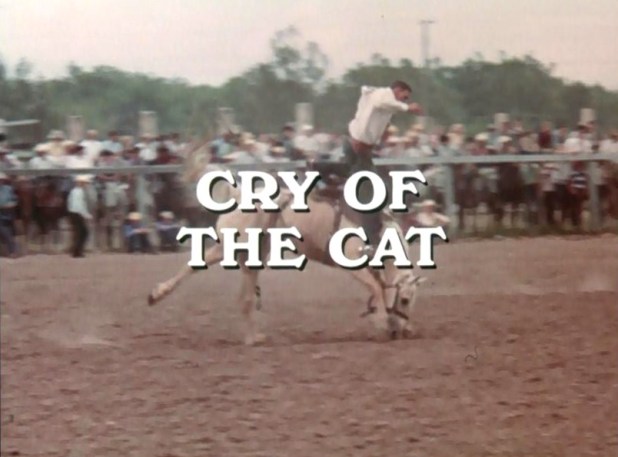
Ghost Story Episode 9: “Cry of the Cat”

Danny (Doug McClure, The Land That Time Forgot) is a rodeo star that falls for a young woman who pretty much casts a spell over him. But as time goes on, he starts to wonder if she’s a cougar that’s attacking the crew. Yes, Ghost Story/Circle of Fear goes for it sometimes and this would be one of those times.

Mariah (Lauri Peters) may be something other than human, a fact that only rodeo clown Dumpy (Jackie Cooper) knows to be true, as he once knew her mother. But no matter how much Danny loves her, she’s doomed, an animal trapped in the world of humans.

Mariette Hartley also appears as a past lover of our hero that helps him when things go too far, plus former Red Ryder Don Barry and Richard Benedict show up.

Director Arnold Laven also made two of the Planet of the Apes foreign release movies, taken from the TV series, Back to the Planet of the Apes and Life, Liberty and Pursuit on the Planet of the Apes, as well as multiple episodes of The RiflemanMannixThe A-Team and The Greatest American Hero. The script was written by Richard Matheson and William Bast, who wrote The Valley of Gwangi and one of the best TV movies ever, The Legend of Lizzie Borden.

This episode is a silly cowboy version of Cat People, but you know, I’m here for it.

You can watch this on YouTube.
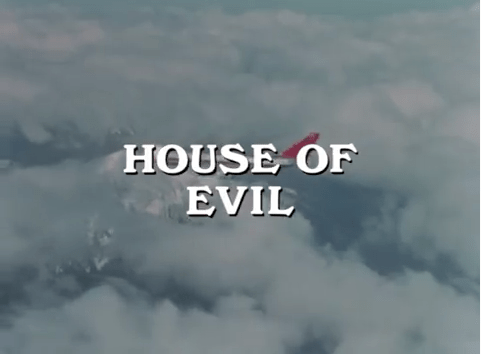
Ghost Story: Episode 8 “House of Evil”

For an episode that uses the Bewitched house, this Circle of Fear/Ghost Story episode just might be the most frightening of the entire series, casting a super young Jodie Foster as Judy, a girl in love with her grandfather, played by Melvyn Douglas. Judy is deaf/mute and her grandfather, well, he’s evil as it gets, giving her the ability to speak without speaking and gifting her with a dollhouse and the ability to make cookie voodoo dolls, all because his daughter — who he speaks with beyond the veil of death — died giving birth to Judy, her husband (Richard Mulligan) has remarried and no one seems to be grieving like he is.

Trust me — you’ve never seen cookies with raisin eyes treated in so sinister a way and for as silly as the subject is, this episode is filmed completely straight. It’s a sinister old man corrupting a child into using her latent mental powers to decimate her family.

The script is a double blast from two of the best writers in horror film and TV, Robert Bloch and Richard Matheson, and it was directed by Daryl Duke, who also made A Cry for HelpFatal Memories and The Silent Partner, as well as one of the most successful TV movies ever, The Thorn Birds.

If you’re looking for the perfect episode to get into this show, this would be it.

You can watch this on YouTube.

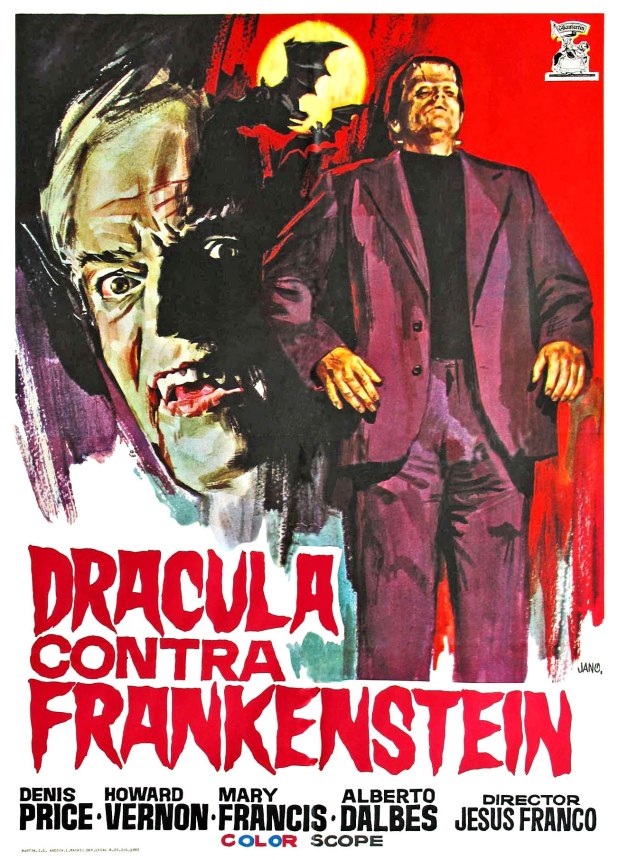
JESS FRANCO MONTH: Dracula, Prisoner of Frankenstein (1972)

The third movie released in the U.S. as Dracula vs. Frankenstein (after Naschy in Los Monstruos del Terror and Al Adamson’s memorable movie), Jess Franco’s Dracula, Prisoner of Frankenstein follows his Christopher Lee-starring Count Dracula, with Howard Vernon taking over the role and being controlled by Dr. Frankenstein (Dennis Price). Their mutual enemy ends up being Dr. Jonathan Seward (Alberto Dalbes), who has already staked Dracula in the heart once and turned him into a dried-up little bat that he pins up in a collection.

Luckily — or unluckily for everyone else — Frankenstein bathes that bat in the blood of a nighclub dancer, which in the world of Jess Franco is the most perfect blood of all. Somehow, this is also a movie where Dracula never speaks.

It isn’t until the end of the movie that a gypsy beckons a werewolf to come attack the caste, because when we’ve come this far, you know, why not. And the Luis Barboo-played monster looks like an Azrak Hamway rack toy World Famous Official Super Monster than anything that Jack Pierce created.

Starting with 15-plus minutes of absolute silences and featuring characters often given words via narration, this movie shows that Franco had the good sense to reuse Bruno Nicolai’s soundtrack score from Justine and use Museu Condes de Castro Guimarães as a set, the same place where Love Letters of a Portuguese Nun would be filmed.

Best of all, Britt Nichols (also known as Carmen Yazalde), who shows up in other Franco movies like Daughter of Dracula and The Demons, brings glamour to her role as a lady vampire.

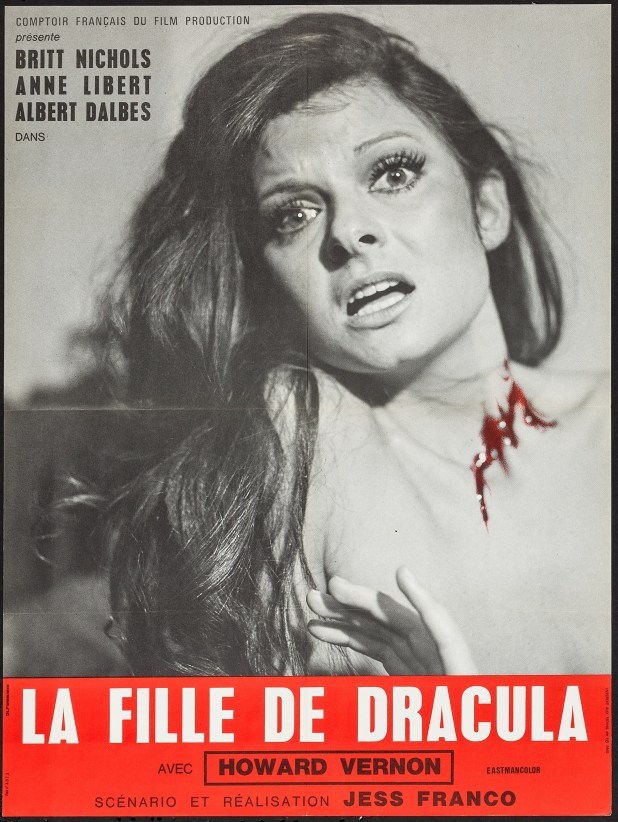
JESS FRANCO MONTH: Daughter of Dracula (1972)

Luisa (Carmen Yazalde, who is billed as Britt Nichols, and also shows up in Franco’s Jungfrauen-ReportA Virgin Among the Living Dead and Dracula, Prisoner of Frankenstein) learns from her dying mother that her family — the Karlsteins not the Karnsteins — are all vampires and their leader, Count Karlstein still lies in half-dead, half-alive stasis in the crypt of their castle.

This being a Jess Franco movie, Luisa is soon taking her cousin Karine (Anne Libert, Sins of the Flesh) as a lover with just as much gusto — in front of a holy cross — as she throws victims to the Count (Howard Vernon), who stays in his coffin all of the time.

Franco also shows up as vampire killer Cyril Jefferson, who takes over the movie as the two main characters suddenly are no longer the leads. It also becomes a giallo, so a movie that feels like two films at once was ironically shot at the same time that Franco was making two other movies.

You can watch this on KinoCult.

Ghost Story: Episode 7 “Half a Death”

Christina has always wanted to meet her twin sister Lisa (both are played by Pamela Franklin from And Soon the Darkness and The Legend of Hell House), but Lisa dies before that can happen. And now, she keeps seeing visions of her rising from an open grave to call out to her in the night.

Then her father dies and her mother (Eleanor Parker, The Sound of Music) takes up with a neighbor way too quickly. So Lisa’s haunting grows more horrifying, reminding her of the asylum-trapped other side of herself that she has never even seen in person before. And as twins share one soul, she begins to believe that Lisa is offering her an early death to take away her ennui, a half a death to make their souls whole once more.

This episode comes from Batman TV and Fathom director Leslie H. Martinson, with a script by Richard Matheson and Henry Slesar, whose career was mainly in TV anthologies like The Twilight ZoneAlfread Hitchcock Presents and Tales of the Unexpected. He also wrote Two On a Guillotine and The Man from U.N.C.L.E. movie One of Our Spies Is Missing.

It’s not the Ghost Story/Circle of Fear episode that I would choose to show the best of this series with someone that had never seen it before, but it’s not particularly bad. It has some moody graveyard scenes and eerie moments, but the series can and will have better stories to tell.

You can watch this on YouTube.

Ghost Story: Episode 6 “Alter-Ego”

When this show is good, it’s good. “Alter-Ego” was written by D.C. Fontana, who is mainly known for her Star Trek episodes, and Richard Matheson, who is the king of anthology horror. It’s based on a story by Stanley Ellin, a mystery writer who wrote several episodes of Alfred Hitchcock Presents and had six of his books made into movies: Dreadful Summit became The Big Night, Key to Nicholas Street was made as Claude Chabrol’s A Double Tour, The Best of Everything was made by Clive Donner as Nothing but the BestHouse of CardsThe Bind which was filmed as Sunburn and Stronghold was made into A Prayer in the Dark.

In the director’s chair? David Lowell Rich, whose mark was made in disaster movies like SST Death Flight and Airport ’79…The Concorde, horror such as The Horror at 37,000 FeetEye of the Cat and Satan’s School for Girls, as well as one of my favorite episodes of The Twilight Zone, “Of Late I Think of Cliffordville.”

Bobby is stuck at home from fifth grade, unable to go to the class of his beloved Miss Gilden (Helen Hayes), but he soon gains an alter ego who can go to school in his place. However, his other half is a child of pure malice and wow, what a star turn by Michael-James Wixted. As time goes on, everyone that the other half of Bobby meets must pay, from family animals to even the kindly teacher, all as a game of chess between the two takes on the highest of stakes.

This description won’t explain just how upset this episode made me at times, as the evil Bobby is just horrible. Gilden is dealt scorn for scorn throughout, abused by a child who surely can’t be pulling off all of the horrible things that she claims that he’s been doing in her class. The scene where he slowly teases eating potentially poisoned chocolates? Borderline Satanic.

If you were to pick one episode of this show to check out, this would be my pick.

You can watch this on YouTube.

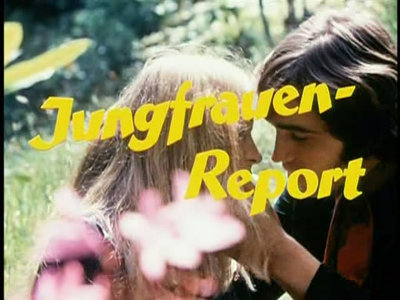
JESS FRANCO MONTH: Jungfrauen-Report (1972)

The Schoolgirl Report movies were big business in the early 70s and so were the mondo films, so here’s Jess Franco to make his own version in his own style. And we are here to watch.

Ingrid Steinbach and Eva Garden have been in a bunch of the originals like Schoolgirl Report Part 3: What Parents Find Unthinkable and Virgin Wives, plus Franco brought his regulars like Howard Vernon (Dr. Orloff, I presume), Britt Nichols AKA Carmen Yazalde (A Virgin Among the Living DeadThe Demons) and Christina von Blanc (A Bell from HellThe Dead Are Alive!).

This entire movie is dedicated to women losing their virginity, whether it’s through deflowering rituals of the past or the women of today doing everything they can to lose their innocence. There’s also Adam and Eve showing how they knew each other biblically and, following that, a priest and a nun giving one another confession, so to speak. And oh yeah — man on the street interviews.

Strangely enough, in the 1980s, Franco would make Faceless for the producer who created the Schulmädchen-Report series, Wolf C. Hartwig. Franco also made another mondo,  In 80 Betten um die Welt, which my obsession screams at me that I must now watch.

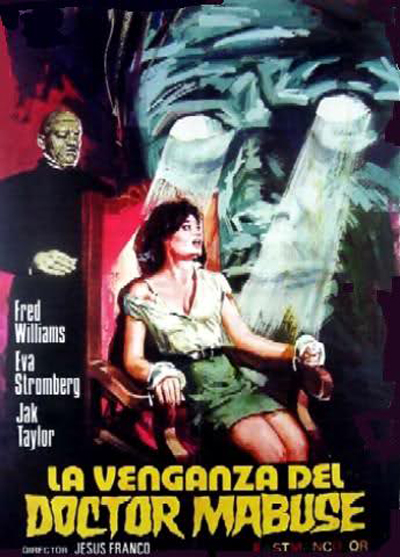
JESS FRANCO: The Vengeance of Doctor Mabuse (1972)

Dr. Mabuse! Master of disguise and telepathic hypnosis! A man able to switch bodies through possession, usually using televisions! The leader of a society of crime! The king of blackmail! A Jess Franco villain if I’ve seen one!

Mabuse first appeared in Norbert Jacques’ 1921 novel Dr. Mabuse the Gambler which became a movie directed by Fritz Lang. A four hour long movie, it was released in two parts that were both box office successes: The Great Gambler: An Image of the Time and Inferno: A Game for the People of Our Age. Rudolf Klein-Rogge came back to work with Lang again to make the sequel, The Testament of Dr. Mabuse (and Lang’s last movie would be The Thousand Eyes of Dr. Mabuse).

A series of German Mabuse films owed more to the Eurospy craze*, but now Jess is in the director’s chair and Mabuse wants to steal a moon rock, so let’s do this.

Mabuse and his accomplices also are stealing all sorts of things — and people — from the National Research Institute so that he can finally make his dream invention, a mind-control ray. So yeah, this is Dr. Orloff all over again or more to the point The Diabolical Dr. Z. Mabuse even mentions that he’s a rival of Dr. Orloff, so my dream of a Franco Cinematic Universe is closer to truth than fiction.

I love reading reviews of this, because those dosed by Franco love it and even enjoy its faults, while those flaws drive anyone non-Franco obsessed absolutely insane, upsetting them because this is a movie that has extended sunsets, nonsensical at best dialogue and heroes that are as inept as it gets.

*The Return of Doctor MabuseThe Invisible Dr. MabuseThe Testament of Dr. MabuseScotland Yard Hunts Dr. Mabuse and The Secret of Dr. Mabuse are the 60s Mabuse films that come before this. There were also other appearances of the character in The Image of Dorian Gray in the Yellow Press, Claude Chabrol’s Dr. M and three movies in the 2000s, Doctor MabuseDoctor Mabuse: Etiopomar and  The Thousand and One Lives of Doctor Mabuse.