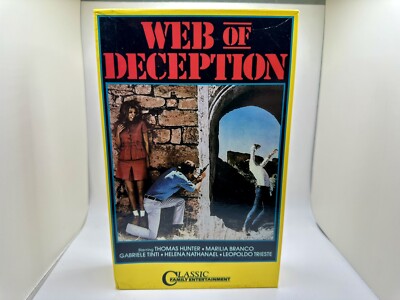
Web of Deception (1971)

Also known as Il Sorriso Del Ragno, The Spider’s Smile and Sweet Blue Sweat, this is the only movie directed by Massimo Castellani, who was assistant director on Bloody Pit of Horror and Perversion Story. It was released on VHS by Magnum Video back in the day.

Tony Driscoll (Thomas Hunter) is an insurance man investigating a $5 million jewelry robbery in which he becomes the main suspect. That’s because a woman he hooks up with slips some jewels into his luggage and then gets killed. It features Gabriele Tinti, and while you’d hope it was a full-on giallo, it’s closer to Eurocrime or even a travelogue of Greece.

Elena Nathanail is the femme fatale, and this was produced by Sergio’s brother Luciano. Writers are Italo Gasperini (ScalpsWrath of God) and Armando Morandi.

When all I have are facts, know that the movie won’t be memorable.

You can watch this on YouTube.

RADIANCE BLU RAY RELEASE: Malpertuis (1971)

Malpertuis was directed by Harry Kümel (Daughters of Darkness) and was based on the Jean Ray novel of the same name. It was released in the U.S. as The Legend of Doom House, which is not as classy a title, but you know me. I like the sleaze.

Jan (Mathieu Carrière) is a sailor who has decided to leave the sea and return to his childhood home. He’s abducted during his search and wakes up in a mansion called Malpertuis and surrounded by relatives like his sister Nancy (Susan Hampshire), a taxidermist named Lampernisse (Jean-Pierre Cassel) and his occultist uncle Cassavius (Orson Welles), who forces everyone to become Greek gods and never leave under penalty of death.

As for Malpertuis, it could fit into an Italian Gothic horror movie, as it’s a maze of secret rooms, long corridors, and cobwebbed staircases.

Kümel worshipped Welles, wrote the part of Cassius for him, and made sure to get him the money he asked for. As nervous as he was to meet his idol, he was greeted by a drunk and angry Welles on set. That said, they got along, even if no one else in the film did with the legendary director. People had a way of not getting along with Welles, like writer Charles Higham, whose book Orson Welles: The Rise and Fall of an American Genius used a photo of this to show the actor’s decline. Never mind that he was made up to look older than he really was, and on his deathbed.

The Radiance Blu-ray of Malpurtis has a new 4K restoration of the film overseen by director Harry Kümel, along with a new interview with the director. There’s also an archival commentary by Harry and assistant director Françoise Levie, an archival making of documentary, a featurette on Welles, an interview with author and gothic horror expert Jonathan Rigby, archival interviews with Susan Hampshire, Michel Bouquet, Harry Kümel, Jean Ray and John Flanders, Kümel revisiting locations from the film, the Cannes cut of the movie, The Warden of the Tomb (Kümel’s early film based on Franz Kafka’s play) and a trailer. It has a reversible sleeve featuring original and newly commissioned artwork by Time Tomorrow, a limited edition 80-page perfect bound booklet featuring new writing by Lucas Balbo, Maria J. Pérez Cuervo, David Flint, Willow Catelyn Maclay and Jonathan Owen and a limited edition of 3000 copies, presented in rigid box and full-height Scanavo packaging with removable OBI strip leaving packaging free of certificates and markings. You can get it from MVD.

Cinematic Void January Giallo 2026: A Bay of Blood (1971)

Editor’s note: Cinematic Void will be playing this movie tonight at 8:00 PM at The Frida Cinema in Santa Ana, CA. You can get tickets here. It’s also playing on January 31 at 7:00 PM at The Sie Film Center in Denver. You can get tickets here. For more information, visit Cinematic Void.

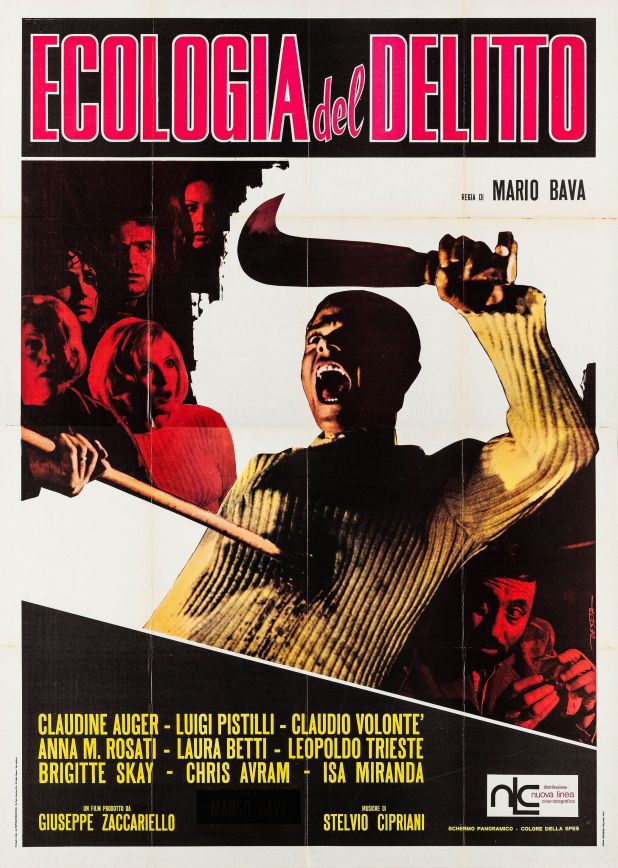
Also known as Ecology of CrimeChain ReactionCarnageTwitch of the Death Nerve and Blood Bath, Last House on the Left – Part II and New House on the Left, this is the most violent and nihilistic of all of Mario Bava’s films. It started as a story idea so that Bava could work with Laura Betti (Hatchet for the Honeymoon) again, with the original titles of Stench of Flesh and Thus We Do Live to Be Evil, but had a virtual litany of writers get involved, including producer Giuseppe Zaccariello, Filippo Ottoni, Sergio Canevari, Dardano Sacchetti (who co-wrote all of Fulci’s best films, like Zombi 2 and House by the Cemetery) and Franco Barberi.

Bava was devoted to the film, and its low budget meant he would also serve as his own cinematographer, often creating innovative tracking shots with a toy wagon and relying on in-camera tricks to make the location seem much more expansive than it was.

There are thirteen murders in the film — many of which are incredibly gory, thanks to the skill of Carlo Rambaldi — as several characters vie to inherit the titular bay. The film divides critics and fans: some see it as pure gore, while others see it as the nuanced films Bava is known for. For example, Christopher Lee went on record saying he found the movie revolting.

It also gave rise to the slasher genre, as every film that follows owes it a debt of gory gratitude. And some owe it plenty more, in particular Friday the 13th Part 2, which copies two of the kills in this film shot-for-shot.

The story is all over the place and has a mix of dark humor and pure meanness at its core, starting with Filippo Dontai strangling his wife, Countess Federica, before being stabbed and killed scant seconds later. His corpse is dragged to the bay, where his murder goes undiscovered as detectives begin their investigation into the death of the Countess.

That’s when we meet Frank (Chris Avram, Enter the Devil), a real estate agent, and his girlfriend Laura, who plot to take over the bay. They were working with Donati to kill his wife and now need his signature, but don’t realize that he is dead.

Meanwhile, four teenagers hear about the murders and break into the mansion. One of them, Brunhilda, skinny dips in the bay until the dead corpse of Donati surfaces and touches her. She screams and runs toward the mansion, only to be killed by an unseen murderer holding a billhook. That killer uses that same weapon to kill her boyfriend, Bobby, then he impales Duke and Denise together with a spear while they’re having sex. Here’s a good lesson that I constantly yell: don’t fuck in the woods, don’t fuck in a haunted house, don’t fuck when a killer is about.

The killer turns out to be the Countess’s illegitimate son, Simon, who is wiping out everyone under Frank’s orders. Renata (Claudine Auger, Thunderball) shows up to throw a wrench in the work, as she’s the Countess’ real daughter. Along with her husband, Albert, she begins to make plans to kill her half-brother.

What follows is a near Grand Guignol of back-and-forth murder: Frank attacks Renata, who turns the tables and stabs him with a knife. Paolo, the entomologist who lives on the estate grounds, sees the killing but is strangled by Albert before he can call the police, and his wife is decapitated with an axe. Laura shows up, but Simon strangles her to death before Albert kills him. Frank shows up again, but Albert takes him out, leaving Renata as the sole heir.

They return home to await being awarded the money, but as they get to the front door, their children shoot them with a shotgun, thinking they are playing with their parents. Bored with the game and how long their parents have been playing dead, the kids run out to play another game, an ending that can be viewed as pure comedy or a sad comment on humanity. Maybe both.

Bay of Blood isn’t the art of past Bava films, but it’s not trash. It’s also been claimed to have been Bava’s favorite film that he directed. And Dario Argento adores the movie so much that he literally stole a print of it from a theater!


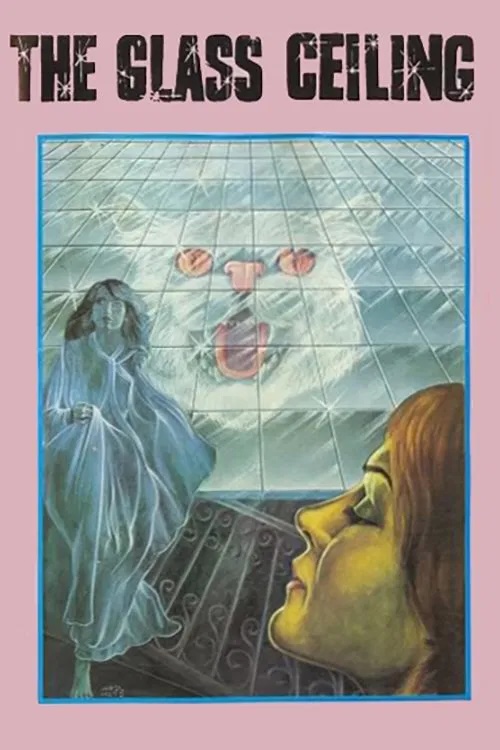
The Glass Ceiling (1971)

Directed by Eloy de la Iglesia, who co-wrote the story with Antonio Fons, this is all about lonely housewife Marta (Carmen Sevilla), left all alone once again when husband Carlos (Fernando Cebrián) goes on a business trip, leaving her with just her cat Fedra. One night, she’s sure that her neighbor, Julia (Patty Shepard), has murdered her husband. Oh, the intrirgue in this apartment building: landlord and artist Ricardo (Dean Selmier) is way into Marta, teenage milkmaid and farmer’s daughter — yes, really — Rosa (Emma Cohen) is into Ricardo, deliveryman Pete (Javier De Campos) is into Julia and Ricardo’s dog is in love with the mystery meat someone is feeding him at night. There’s also a pervert walking around and discreetly taking photos of the women.

Eloy de la Iglesia is a director who may have been known for Cannibal Man, but it was the Severin releases of his films that made him better known in the U.S. I love the tension he’s built with this, all inside a small town apartment building, a place overflowing with need, with secrets and with, well…you’ll see.

You can watch this movie on Tubi.

Cinematic Void January Giallo 2026: Marta (1971)

EDITOR’S NOTE: Cinematic Void will be playing this tomorrow at 7:00 p.m. at the Music Box Theater in Chicago (tickets here). I considered flying to Chicago just for the occasion, as this will be shown on an ultra-rare 16mm print. Never released to home video, this is one of my favorite movies. For more information, visit Cinematic Void

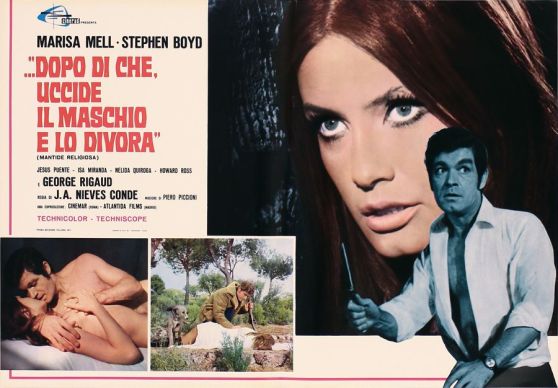
Marisa Mell is the female George Eastman. No, she doesn’t act like a wide-eyed gigantic maniac in every movie. It’s just that no matter what movie she appears in, just her name being in the credits guarantees that I will watch the film.

Also known as …dopo di che, uccide il maschio e lo divora (…After That, It Kills the Male and Devours It), which is one of the best titles ever.

A wealthy landowner named Don Miguel (Stephen Boyd, who was in Ben-Hur) is haunted by his dead mother and missing wife — who may have been murdered — when he meets a gorgeous runaway named Marta (Mell), who may have killed the man who she was running from.

I haven’t seen any of José Antonio Nieves Conde’s films before, but this movie makes me want to watch every single one of them.

The strange thing is that this movie pretty much became true in a way, as Boyd and Mell fell in love, as they made this and The Great Swindle one on top of the other*. Despite Boyd not wanting anything to do with Mell at first — was the man made of stone? — he eventually fell for her and they married in a gypsy ceremony near Madrid, cutting their wrists and sealing their blood. The couple was so possessed by the mystical and sexual desire they felt for one another that they even went to have it exorcized in another ritual.

Boyd had to run from her, as the relationship physically and mentally exhausted him. As for Mell, she’d tell the Akron Beacon Journal that “We both believe in reincarnation, and we realized we’ve already been lovers in three different lifetimes, and in each one I made him suffer terribly.”

In the same year that all this happened, Mell was also dating Pier Luigi Torri, an aristocratic nightclub owner who fled the country after a cocaine scandal. Arrested in London after it was discovered he had a $300 million dollar gold mine and had also scammed a bank, he somehow escaped his jail cell and ran from the police across rooftops, escaping to America for 18 months. Evidently, Mell dated Diabolik in art and in life.

So let’s talk about the Mell relationship in the film instead of reality. She has come to live with Miguel, who collects insects and has two servants who keep things tidy. She enters his life by claiming that she is on the run for a self-defense murder. Miguel decides to protect her from the police because she looks like his wife Pilar (also played by Mell) who has left him or was killed. He’s also tormented by the death of his sainted mother while she may not be who she says that she is.

Oh yeah — and now Marta is acting as Pillar to throw the police off the scent of the man whom she either wants to marry or destroy.

Marta is a gothic-style giallo but is also dreamlike throughout. There’s a continual obsession with placing Mell in front of mirrors. And for someone who was rarely used outside of her sex appeal in films, she absolutely haunting here. Somehow, Spain put this movie forward for Oscar consideration and if I ran those popcorn fart boring awards, I would have given this every single award.

Sure, this movie rips off Hitchcock, but it also wallows in sin, which is what I demand from the giallo that I come to adore. Somehow, someway, this aired on broadcast TV as part of Avco Embassy’s Nightmare Theater package, along with A Bell from Hell, Death Smiles on a Murderer, Maniac MansionNight of the SorcerersFury of the Wolfman, Hatchet for the HoneymoonHorror Rises from the TombDear Dead DelilahDoomwatchWitches MountainThe Mummy’s Revenge and The Witch. Man, how did any of those air on regular TV?

*Credit to the Stephen Boyd Fan Page and Marisa Mell: Her Life and Her Work for this information.

WEIRD WEDNESDAY: Ginger (1971)

In the book that inspired these Weird Wednesday posts, Warped & Faded: Weird Wednesday and the Birth of the American Genre Film Archive, Lars Nilsen writes, “This was promoted as ‘the female James Bond.” There’s some truth to that. Both have two legs and carry a gun. But if I had to choose between a James Bond movie and Ginger, this would win nine throws out of 10. Unlike 007, Ginger is a hard-faced, bleached blonde biker chick from New Jersey who goes undercover to expose a marijuana and white slavery ring. This is about the most mean-spirited, merciless, joyfully cruel example of rough sexploitation you’re ever likely to luck into. It has a casually nihilistic “we’re all scum, but only some of us admit it” attitude that’s, well… refreshing. And it’s hilarious, particularly if you have an irredeemably sick sense of humor. In Ginger’s world, all men are scum who deserve to be killed and worse. And Ginger does much, much worse. With piano wire in one case.”

This stars Cheri Caffaro, who, no offense to Nilsen, was born in Pasadena. At a very young age, she won a Life magazine Brigitte Bardot look-alike contest, beating Portland Mason, James’s daughter. Her husband, Don Schain, may have eventually produced High School Musical for Disney, but he made three scuzzy Ginger movies with his soon-to-be wife: this film, The Abductors and Girls Are for Loving.

Ginger McAllister takes on a job of infiltrating a gang of criminals. This often means sleeping with men and women, which can often mean using piano wire on a dude’s tallywhacker and threatening to cut it off. This feels like porn without penetration, the kind of porn that was playing the Avon and the rougher theaters, as Ginger is tied up and assaulted several times, yet always comes out on top, even when bad guy Rex Halsey (Duane Tucker) rapes her. After all, the cut to her face assures us that she likes this.

If you’re expecting a 1971 grindhouse movie to have any morality… just wait for the scene where Ginger relates how three black guys assaulted her when she was young and how much she hates African-American men, using all the language you would hope she wouldn’t.

That said, this is Tracey Walter’s first movie, playing Ginger’s brother. One day, he would be Bob the Goon.

This is the kind of sex movie that makes no one want to have sex ever again. Bodies just fall onto one another, nudity seems like an attack on you and at no moment does anything feel arousing. Ah, the 007 of 42nd Street. I want to watch her fight Olga.

Cinematic Void January Giallo 2026: Black Belly of the Tarantula (1971)

EDITOR’S NOTE: Cinematic Void will be playing this tonight at 7:00 p.m. at the American Cinematheque Los Feliz 3 in Los Angeles (tickets here). For more information, visit Cinematic Void

Paolo Cavara and Gualtiero Jacopetti (who took all the credit) directed the first shockumentary, Mondo Cane. Following that, they worked on Women of the World before Jacopetti moved on to make increasingly more insane films with Franco Prosperi. Cavara? He went on to make his own films, including this one, which some place amongst the best giallo ever.

A mysterious killer is killing women who were involved with a blackmail scheme, using a needle to paralyze them before he slices their stomachs open, the same way a tarantula kills a wasp. Even worse — the victims are awake and can feel the pain, but are unable to move or scream.

Cavara uses one of the queens of giallo for his first victim, Barbara Bouchet (The Red Queen Kills Seven TimesDon’t Torture a DucklingAmuck!). Soon, it’s up to Inspector Tellini to solve the case before he or his girlfriend is killed. He’s a totally likable character, rare for a giallo, who mainly argues with his wife, who buys too much furniture while worrying if he’s good enough at what he does. He hits a little too close to home.

There is plenty more eye candy in the film, with Claudine Auger (Domino from Thunderball) and Barbara Bach (The Spy Who Loved MeThe Humanoid) showing up. And there’s an excellent Ennio Morricone score.

For more info on Bond girls and giallo, read this.

EUREKA BOX SET: Furious Swords and Fantastic Warriors: King Eagle (1971)

King Eagle is Jin Fei (Ti Lung), and he’s a wandering swordsman who runs into the Tien Yi Tong clan, who are dealing with their leader being killed. Martial artists from around the world come to try out to be the new leader, but First Chief (Cheung Pooi-Saan) has the edge, seeing as how he killed the original leader. King Eagle learns this and just wants to be left alone, but keeps getting brought into politics and intrigue, like all the killers hired to keep him from revealing the secret.

The guy just wants to be left alone and has no problem throwing a sword through a tree or a person to make his point.

Directed by Chang Cheh, this was his eleventh movie for Shaw Brothers. This features a love interest for our hero in Yuk Lin (Li Ching, who plays a twin role, as she is also the evil sister who helped First Chief with his schemes). Ah, King Eagle, you’re a good dude, even if you drag people behind your horse and set them on fire. You do save a child from being crushed, so you’re like an Italian Western hero.

This Eureka release has a commentary track by action cinema experts Mike Leeder and Arne Venema. You can get it from MVD.

WEIRD WEDNESDAY: Fearless Fighters (1971)


Also known as Ninja Killers or A Real Man, this started as Tou tiao hao han. Directed by Min-Hsiung Wu and written by Yang Ho, it was remixed in the U.S. by William C.F. Lo and Richard S. Brummer, who edited New Year’s EvilSchizoidGodmonster of Indian Flatsand Alabama’s Ghost, and did sound editing and effects for plenty of Russ Meyer movies. He ran the boom mic on Faster, Pussycat! Kill! Kill! 

This was distributed by Ellman Film Enterprises, who also put the original The ToyScream Bloody MurderWill to DiePanorama BlueCoed DormDiabolic WeddingThe Loves of Liszt and The Gatling Gun into grindhouses and drive-ins.

To Pa (director Mo Man-hung) and his Eagle Claw Fighting Clan are trying to rob some gold but are stopped — at first — by Chen Chen Chow, the Lightning Whipper (Ma Kei). Yes, despite having a name like that, they are able to kill the hero, but Lei Peng (Yik Yuen) takes the gold back and plans on returning it to the government. To Pa reacts to this by killing his entire family, except for his son, who is saved by Lady Tieh (Mo Man-ha).

Chen (Chiang Ming) and Mu Lan (Chang Ching-ching), the children of the Lightning Whiper, are able to save Lei Peng from prison. This allows all of them to join up and take the fight back to To Pa.

This has kung-fu vampires, a dude called the One-Man Army because he can hypnotize people before hitting them with his wild double swords, the “Solar Ray of Death,” and a bad guy who loses his arms but gains the kind of martial-arts weapons you watch these movies for. 

You used to be able to buy this for a dollar, but now, someone will put it out on 4K UHD and ask for $70. At least you’ll get a slipcover.

You can watch this on YouTube.

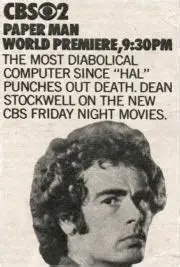
WEIRD WEDNESDAY: Evel Knievel (1971)

Robert Craig Knievel was the hero of my childhood. After all, who else was brave, insane or dumb enough to attempt more than 75 ramp-to-ramp motorcycle jumps in his life, a life that should have ended way shorter than the 69 hellacious years that he lived on this planet with?

How does one become a daredevil? For Evel — who was given that name by a jail guard — it all started with rodeos, ski jumping and pole vaulting. Upon returning from the army, he started a semi-pro hockey team, the Butte Bombers. In one of their games, where they played against the Czechoslovakian Olympic ice hockey team, Evel was ejected from the game minutes into the third period and left the stadium. When the Czechoslovakian officials went to collect the money for playing, they learned that it had been stolen.

After the birth of his son, Evel started the Sur-Kill Guide Service, which was really just a front for poaching in Yellowstone National Park. He was arrested for this and then hitchhiked with a 54-inch rack of antlers the whole way to Washington to plead his case.

It was around this time that Evel decided to stop committing crimes — don’t worry, he kept up with them — and get into motorcycle riding. A broken collarbone and reading Success Through a Positive Mental Attitude led to Evel working for the Combined Insurance Company of America, a job he held for a few months until they wouldn’t promote him to vice president after a few months. Whew Evel! And then a failed Honda dealership led him to work for Don Pomeroy at his motorcycle shop, where the owner’s son Jim taught him how to do a wheelie.

This led Evel to do his first stunt show that he promoted entirely on his own, even serving as his own MC. He did a few wheelies and then jumped a box filled with rattlesnakes and mountain lions. This is where you either say, “This is stupid” or become fascinated. Me? How awesome is it to have a box filled with dangerous wildlife and decide to jump a motorcycle over it? Yep, this is why I was obsessed with Evel as a child.

This led to an obsession with jumping more things — like cars — and the unfortunate side effect of getting hurt nearly every time. He crashed around twenty times — huge, incredibly violent crashes — and his Guinness Book of World Records entry states he suffered 433 bone fractures by the end of 1975.

In Evel’s 1999 autobiography, he published this photo, which showed his many, many broken bones and injuries. You can learn more at http://www.stevemandich.com/evelincarnate/knievelinjuries.htm

Evel crashed at Caesar’s Palace. He crashed jumping Pepsi trucks. He crashed outside the Cow Palace. And then he started dreaming big — he wanted to jump teh Grand Canyon. Why? Take it from the man himself: “I don’t care if they say, “Look, kid, you’re going to drive that thing off the edge of the Canyon and die,” I’m going to do it. I want to be the first. If they’d let me go to the moon, I’d crawl all the way to Cape Kennedy just to do it. I’d like to go to the moon, but I don’t want to be the second man to go there.”

The government would never allow Evel to do this. It’s even a big part of this movie — just look at the posters. Finally, he’d jump Snake River Canyon, an event whose close circuit telecast bombed, almost bankrupting a young Vince McMahon Jr. before he even bought his father’s WWF. He used the Skycycle and nearly drowned when again he failed to make the jump.

A year later, Evel would crash again jumping thirteen buses in front of Wembley Stadium. After the crash, despite breaking his pelvis, Knievel made it to his feet and talked to the crowd, announcing his retirement: “Ladies and gentlemen of this wonderful country, I’ve got to tell you that you are the last people in the world who will ever see me jump. Because I will never, ever, ever jump again. I’m through.” Frank Gifford begged him to go out on a stretcher, but Evel said “I came in walking, I went out walking!”

Of course, Evel was a carnie and kept on pulling off stunts until 1977, when a Jaws-inspired leap broke both his arms and nearly blinded a cameraman.

The life of Evel is a complicated story to tell. On one hand, he was an entertainer, out there in a jumpsuit covered with stars and a cape. On the other, he was a man who believed in keeping his word and battling the evils of drugs (a Hell’s Angel threw a tire iron on stage during one of his jumps as he had often battled against the group for being drug dealers and he ended up putting three of them in the hospital). And on another hand, he lost his Ideal Toy and Harley Davidson endorsements when he went wild on Shelly Saltsman, a sports promoter, Hollywood producer and author of the book Evel Knievel on Tour, which alleged that Evel used drugs and abused his family. To get back at him, despite having two broken arms, Evel cornered him on the 20th Century Fox backlot and beat him unmerciful with a baseball bat.

When the news of Knievel’s attack came up on the news, Saltman’s elderly mother had a heart attack and died three months later. Evel got a six month work furlough and was ordered to pay $12.75 million in damages, money he never paid. After the stunt icon’s 2007 death, Saltman decided to sue his estate for $100 million US dollars with interest, but he never got a dime before he died in 2019.

As for Evel, even his death was an event. His packed funeral was presided over by Pastor Dr. Robert H. Schuller — who baptized Evel in 2007 at his Crystal Cathedral, which led to an influx of new parishioners — with Matthew McConaughey giving the eulogy. But first — there were fireworks. Before he died, Evel said that he “beat the hell out of death.”

I told you all that to tell you about this movie.

The film begins with Evel — played by George Hamilton — giving a speech directly to us, the viewer: “Ladies and gentlemen, you have no idea how good it makes me feel to be here today. It is truly an honor to risk my life for you. An honor. Before I jump this motorcycle over these 19 cars — and I want you to know there’s not a Volkswagen or a Datsun in the row — before I sail cleanly over that last truck, I want to tell you that last night a kid came up to me and he said, “Mr Knievel, are you crazy? That jump you’re going to make is impossible, but I already have my tickets because I want to see you splatter.” That’s right, that’s what he said. And I told that boy last night that nothing is impossible. Now they told Columbus to sail across the ocean was impossible. They told the settlers to live in a wild land was impossible. They told the Wright Brothers to fly was impossible. And they probably told Neil Armstrong a walk on the moon was impossible. They tell Evel Knievel to jump a motorcycle across the Grand Canyon is impossible, and they say that every day. A Roman General in the time of Caesar had the motto: “If it is possible, it is done. If it is impossible, it will be done.” And that, ladies and gentlemen, is what I live by.”

Then we get a movie version of Evel’s life. It was originally written by Alan Caillou, who played King Sancho in The Sword and the Sorcerer. Hamilton wanted John Milius to rewrite it. Upon reading the original script, he launched it into Hamilton’s pool and beat it with an oar. That meant that he was the new writer.

Milius would go on to say that he preferred the final product to many of the other films shot from his scripts. “They didn’t restrain it or tone it down, they shot the script. The guy is just as obnoxious and full of hot air as he was in the script. Just as full of life and vitality too. He’s Evel Knievel! He wouldn’t take a dime off of anybody.”

Hamilton would later tell Pop Entertainment, when asked about the film, “The thing about it is at that time Evel was not famous. When we made that movie he took a jump over the fountains and splattered. He had not become a Mattel toy at that time. I put a writer on it named John Milius – who later wrote Apocalypse Now. He was the best of the writers of that era. I got him to write the script for me. Then Milius made me read the script to Evel. I realized he was kind of a sociopath and was totally messed. Then all of sudden Evel started to adopt lines out of the movie for himself. So his persona in the movie became more of his persona in real life. He would have been every kid’s hero on one hand, but then he went and took that baseball bat and broke that guy’s legs and that finished his career in the toy business. Evel was very, very difficult and he was jealous of anybody that was gonna play him. He wanted to portray himself and he did go and make his own movie later on. He had a great perception of this warrior that he thought he was and that was good. Then he had this other side of himself where he’d turn on you in a minute. Success is something that you have earn. You have to have a humility for it, because it can leave you in a second. It may remember you but it can sure leave you. I think if you don’t get that and you don’t have gratitude for what you are and where you are it doesn’t come back and it goes away forever.”

Evel Knievel ends with our hero successfully making a jump at the Ontario Motor Speedway and driving to a dirt road that leads to the Grand Canyon — which is about 456 miles if you take I-40. Again, he looks right at the camera and says, “Important people in this country, celebrities like myself — Elvis, Frank Sinatra, John Wayne — we have a responsibility. There are millions of people that look at our lives and it gives theirs some meaning. People come out from their jobs, most of which are meaningless to them, and they watch me jump 20 cars, maybe get splattered. It means something to them. They jump right alongside of me — they take the bars in their hands, and for one split second, they’re all daredevils. I am the last gladiator in the new Rome. I go into the arena and I compete against destruction and I win. And next week, I go out there and I do it again. And this time — civilization being what it is and all — we have very little choice about our life. The only thing really left to us is a choice about our death. And mine will be — glorious.”

Sue Lyon, who debuted as Lolita in the film of the same name, plays Evel’s woman. She’d go on to be in all manner of movies that I could go on for hours about like End of the World and Alligator.

George Hamilton seems as far from the real Evel as you can get. But he was a carnie too, as Milius related that Hamilton was “A great con-man, that’s what he really is. He always said, “I’ll be remembered as a third-rate actor when in fact, I’m a first-rate con man.””

Evel made one more movie. You should watch it: Viva Knievel!

You can watch this on Tubi or download it on the Internet Archive.