The film Jaromil Jires, directed before this one, 1969’s The Joke, has been described as “possibly the most shattering indictment of totalitarianism to come out of a Communist country.” As a result, it was banned for nearly twenty years.
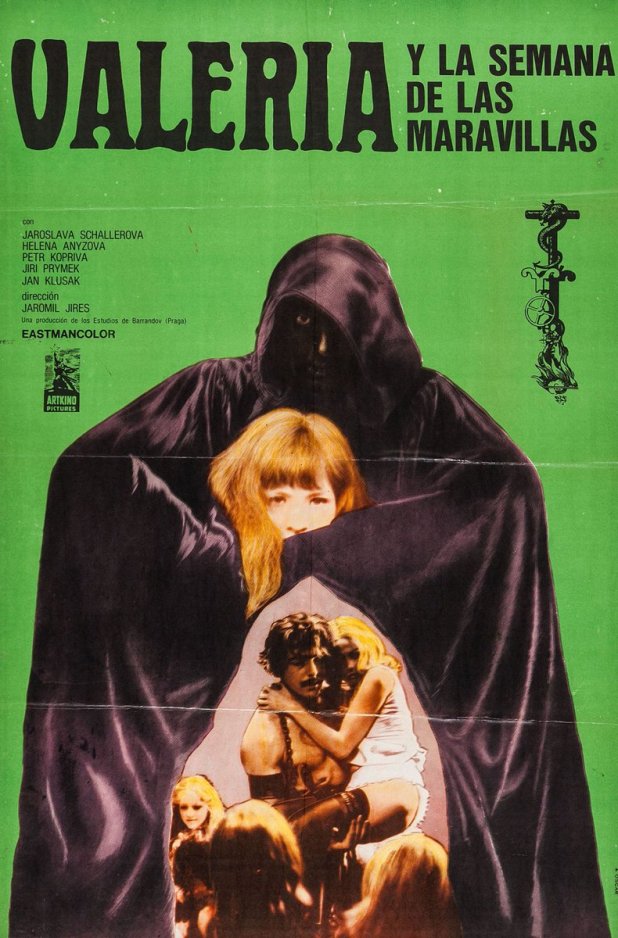
Valerie and Her Week of Wonders is based on the 1935 Vítezslav Nezval novel. Much like that work, this movie is a work of surrealism and one of the films that I can best point to being part of a genre I’ve been referring to as ‘dark childhood’ films. This genre, which I’ve come to represent as movies that use the supernatural to explain the pains of oncoming adulthood, often features dreamlike sequences, allegorical storytelling, and a focus on the psychological aspects of growing up.
Valerie is asleep when a thief steals her earrings. She’s frightened by the masked Constable, who grows angry when the thief returns what he has stolen to her. That’s when she learns that the earrings were a last gift from her mother before she entered a convent, but they once belonged to the Constable.
The Thief and the Constable remain at odds over the earrings and Valerie. That night, she meets the masked man in the street, where he leads her to a chamber where her grandmother ritualistically whips herself all in the name of a past lover. Oh yeah — there’s also a woman named Elsa who was once the Constable’s lover and grows young again when she tastes blood.
The earrings pass through multiple owners, and Valerie’s blood is the key to nearly everyone’s survival. People transform into monsters and cats, and if you didn’t guess already, the movie has descended into a dream that only Valerie can wake up from.
Honestly, it’s hard to rationally write about this film. The film is a visual masterpiece, with magic infused in every frame. You’re either going to be captivated by its artistic brilliance, or you’re going to find it too arty or strange. Obviously, I belong to the former camp.
Members of the bands Espers, Fern Knight, Fursaxa and other musicians formed the Valerie Project in 2006, performing original songs while the film plays.
If you’ve ever read Angela Carter’s works or seen the film The Company of Wolves, which she wrote for director Neil Jordan, you’ve seen work directly influenced by Valerie.
Grab the Criterion blu of this and do yourself a favor. It’s a perfect film.
Alan Gibson may have been born in Canada, but he’s more known for his British horror films, which include Dracula A.D. 1972 and The Satanic Rites of Dracula.
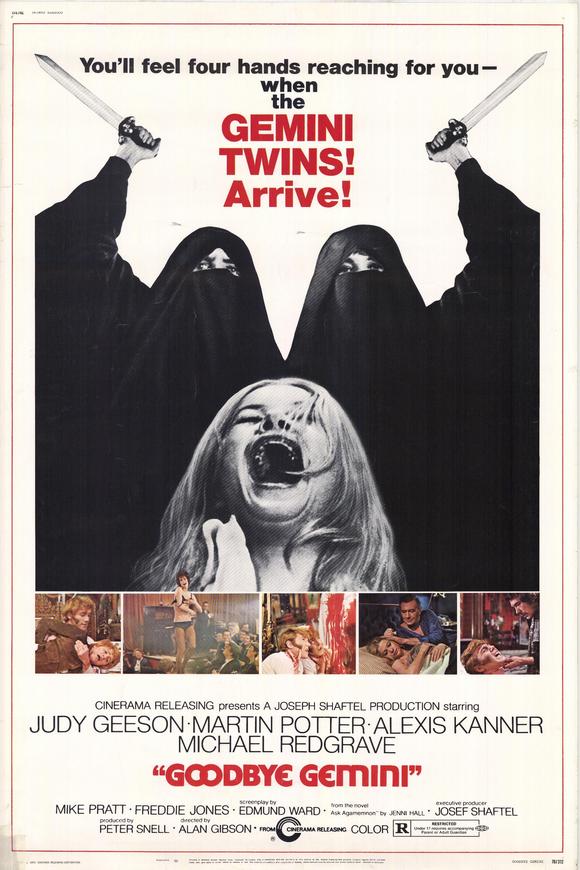
Goodbye Gemini was based on the book Ask Agamemnon by Jenni Hall. The book differs in that it is written in the style of a Greek tragedy, with Agmemnon coming to life and interacting with Jacki, who has amnesia and sees the story unfold in less linear fashion.
The film is way more about the incestuous relationship between Jacki and Julian, which angered conservative groups who were already enraged about the excesses of pop culture at the end of the 1960’s.
This film and Freddie Francis’ Mumsy, Nanny, Sonny and Girly were targeted by the conservative press, which resulting in protests and theaters that refused to show either film. While they weren’t on the list of video nasties, the scandal that came in the wake of these two films was definitely a precusor to their era.
Jacki (Judy Geeson, fresh off To Sir, With Love) and Julian (Martin Potter, fresh off Fellini’s Satyricon) are twins on break from university who have entered London’s party scene, accompanied by Jacki’s teddy bear Agamemnon. The twins see the stuffed toy as a father figure and often speak to him as if he were a real person.
The twosome eventually connect with Clive (Alexis Kanner, The Prisoner), a pimp who knows the wealthy and well-connected. He’s on teh make for Jacki with his kind of, sort of girlfriend Denise wants Julian. However, Julian sees he and his sister as two sides of one hive mind and believes that incest is the natural next stage in their closeness.
Clive, on the other hand, is hiding from a huge debt within the house of the twins. In order to get the money, Clive drugs Julian and has two of his transgender prostitutes molest the twin while the pimp takes photos for blackmail. Denise confesses this plan to Jacki, telling her that Clive has done this in the past and has gone so far as to sell men into sexual slavery.
Jacki soon comforts Julian, telling him that their relationship has not changed. She helps him escape this issue by tricking Clive. It starts when they bet him that he can’t tell them apart. They dress their room into an altar for their bear and dress in ceremonial robes. As the pimp awakens, they repeatedly stab him, which leads to Agamemnon being cut in half. This causes her to have a nervous breakdown.
As an amnesiac Jacki recovers at the home of parliament member James Harrington-Smith (Sir Michael Redgrave, father of Vanessa and Lynn, in one of his last roles), the police go on a manhunt for the twins. Between James not wanting to be connected to the scandal and the twins increasingly fragile grasp on reality, there’s no way that this story can end happily.
You should check this movie out for yourself. You can get it from Ronin Flix.
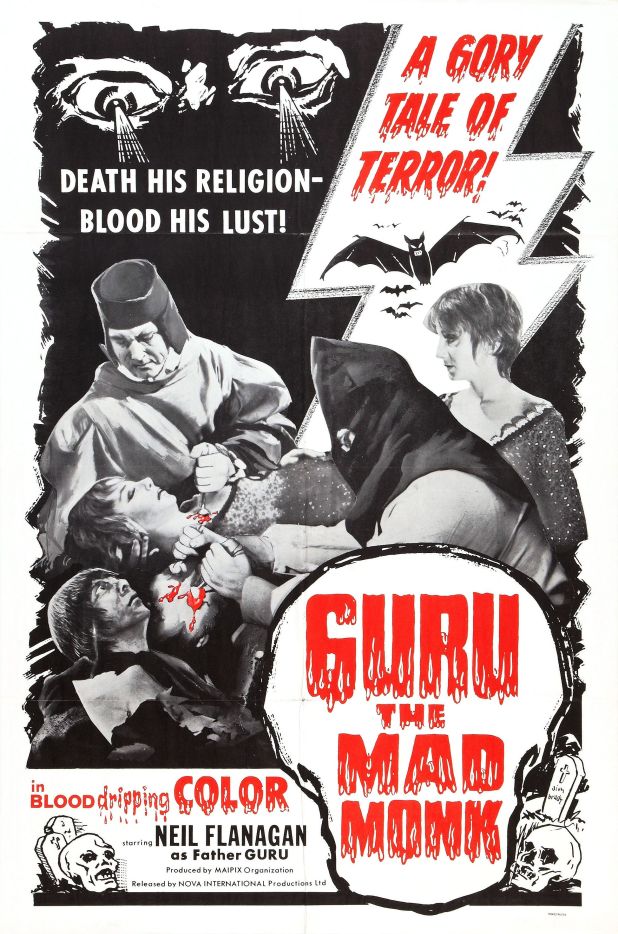
The Church of Mortavia needs cash, so Father Guru does what he can, which means getting dead bodies for medical students to experiment on. This may mean stabbing churchgoers in the eyeball or working with vampires and hunchbacks. And while this is all supposedly set in the Middle Ages, it was really shot in New York City’s St. Peter’s Church, which means that you just may hear the sounds of modern traffic.
Shot for $11,000, this is yet another Milligan film where the director Milligan wrote, directed, built sets and sewed costumes for a film made up of mainly off-off Broadway actors and Staten Island locals. How else would you populate a prison colony of Catholic sinners who were all waiting to be served sentences that are all being wiped out by an insane priest?
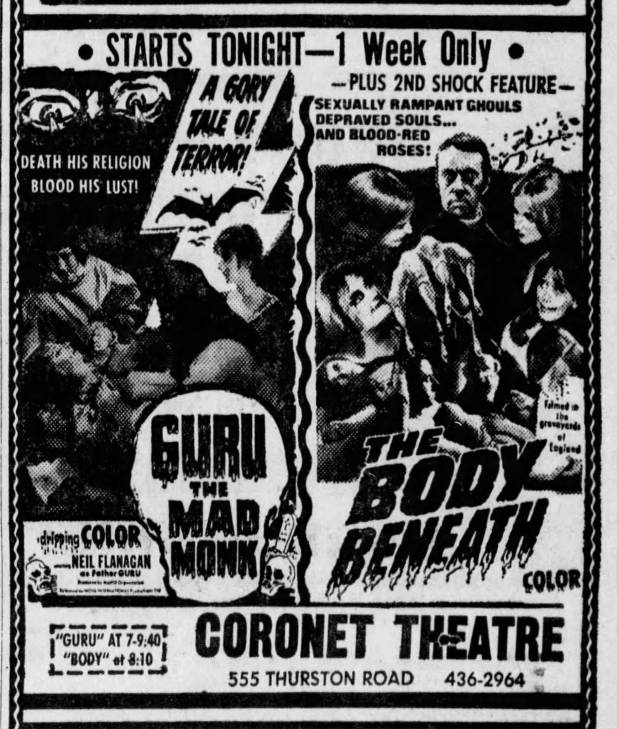
This was made as part of a double bill with another of Milligan’s movies, The Body Beneath. It’s around 55 minutes long and has some gore, but in no way does it have as inventive of a title as Milligan’s best-named film, The Rats are Coming! The Werewolves are Here!
Milligan is a fascinating character study, probably moreso than his films to be perfectly honest. He was considered one of the worst directors of all time until his movie Fleshpot on 42nd Street was rediscovered by Something Weird Video and his theatrical efforts were unearthed. In some strange universe, his work as a queer filmmaker found a better audience than maniacs like me who watched his movies like The Ghastly Ones.
Frantic Friar
1.5 oz. Frangelico
.75 oz. lemon juice
.75 oz. lime juice
Maraschino cherry
Pour Frangelico and juices into a shaker with ice.
Scream at it like you’re in an Andy Milligan movie while shaking, then pour in a glass and top with a cherry.
The Middle Ages were hard times for mad monks. Father Guru (Neal Flanagan) is a corrupt chaplain in the 15th Century, employed in a bizarre prison complex. Assigned to deliver the last rites to condemned prisoners, Guru also carries out punishments like heating up an iron cross and then searing the flesh of sinners while they kneel before him. When prison guard Carl’s girlfriend Nadja (Judith Israel) is locked up, accused of murdering her newborn baby, Carl (Paul Lieber) appeals to Guru to save his girlfriend from execution. In return, Guru enlists Carl’s help to acquire corpses to sell to medical schools for profit. Carl also finds himself indebted to Guru’s secret mistress, Olga (Jacquelin Webb), who gives him the drugs necessary to fake Nadja’s death. Olga demands that Carl allow her some alone time with all the recently deceased corpses at the prison so that she may drain their blood for use in her ‘experiments’. What she really meant to say was “meals”, since she is a vampire.
Are you still following this?
Guru, who not only likes to date vampires but also has two-person conversations with himself in the mirror, is resentful over the fact that the mother church refuses to send more money to his parish. When Nadja is revived, they hide her in a tower chamber, where she spends her days looking out the window and noticing that people keep coming to the church and never leaving. Sometimes Guru kills them for Olga, and sometimes Olga kills them herself, but Guru has a knack for picking the right ones, especially when they say things like “Nobody knows I came here.” Nadja can’t wait to tell someone about it, bored in her tower chamber while Carl is on a long body-collecting journey for Guru. She also befriends Guru’s hunchback assistant, Igor, who is clearly so in love that he can hardly speak around her. He has a memorable freakout moment when she shows him the slightest bit of interest and cheerfully asks him questions about himself.
I’ve always thought of Andy Milligan as the John Waters of horror movies. Although he lacked recurring stars as outrageous as Divine, Edith Massey and Jean Hill, his films are driven by a similar manic energy. Not as earnest as Ed Wood’s cinematic output, Milligan movies usually don’t aspire to be better than they are, they just want to wallow in despicable behavior for an hour and then move on to the next feature.
Guru the Mad Monk is one of the better examples of the way Milligan’s films take the more ridiculous aspects of the plot for granted. The plot goes on and on with daytime drama involving true love, religious convictions, and the abuse of power, with very little regard given to the fact that one of the characters is a fucking vampire. We are just supposed to accept that she’s a vampire, with no explanation given other than a throwaway line when Guru makes reference to when she was “bitten by that animal!” I kinda want the movie to be about that, ya know? But instead, you just have to go with it, because the movie charges full speed ahead right past it. Don’t worry, it runs just short of a full hour, so it won’t waste too much of your time.
Like Waters, Milligan has a way with dialogue that has to be heard to be believed. I won’t accuse the actors of delivering bad performances with stilted delivery, because actually they are rather convincing in these hopelessly bullshit roles. There’s nothing at all going for this movie without the performances, and I was not disappointed by these actors. Judith Israel is particularly good, channeling Mia Farrow from her hairstyle right down to her crisp, accented diction.
A period picture is an ambitious concept for an ultra low budget film, and “Guru” has Milligan’s usual Halloween costume look to it. It’s supposed to be the Middle Ages, yet the women all wear modern cosmetics and the lead actress has lovely hair that probably took her Middle Ages hairdresser about an hour to shape for her. I wonder if they came to her tower to do her hair right there. Don’t let your guard down or you may catch yourself thinking this is one of the best ways to spend an hour of your life.
DAY 17. EVIL IN BROAD DAYLIGHT: Scary stories aren’t just for the night time.
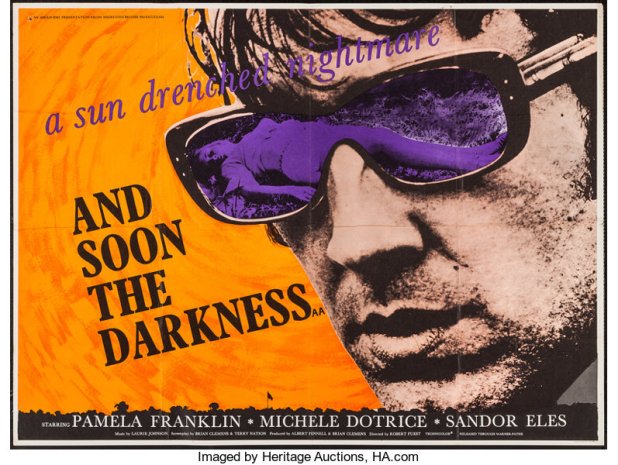
A movie that’s referred to as “a sun-drenched nightmare” on its poster, Robert Fuest’s And Soon the Darkness is nearly forgotten today, which is a real shame. Fuest is probably better remembered for The Abominable Dr. Phibes and Dr. Phibes Rises Again than he is for any other movie, but he also made plenty more, like The Final Programme, The Devil’s Rain! and Revenge of the Stepford Wives to name but a few.
And Soon the Darkness is about a day gone wrong, about being a tourist in a strange land and about how trust isn’t an easy thing to come by. It’s also an incredible film worthy of rediscovery.
Jane (Pamela Franklin, Necromancy, The Legend of Hell House) and Cathy (Michele Dotrice, the wife of The Wicker Man star Edward Woodward who was also in The Blood on Satan’s Claw) are two young nurses from Nottingham. They’ve decided to take a cycling holiday in France.
Jane’s been planning each and every stop on the route while Cathy is more interested in letting life happen. Life ends up being Paul (Sandor Else, Countess Dracula), a handsome man riding a scooter who catches her eye. The girls soon come to an argument and go their separate ways, with Cathy staying behind to sunbathe and perhaps catch up with Paul.
As Jane moves on to the next town, a cafe owner struggles to tell her that she’s in a dangerous area where young girls are often murdered. She decides to go back and find her friend, but she’s gone. A policeman is on the case, but Jane instantly believes that Paul is the murderer, despite him saying that he’s a plain-clothes detective who has taken an interest in the missing girls from this region.
What follows is the sun slowing setting on Jane’s hopes of ever finding her friend again, as she believes that Paul is closing in on her, ready to add her to his list of victims. But was there even a murder? Or is this all in her head?
There are no easy answers in And Soon the Darkness. It was written by Brian Clemens (who wrote See No Evil and Dr. Jekyll and Sister Hyde, as well as writing and directing Captain Kronos – Vampire Hunter) and Terry Nation (The House in Nightmare Park as well as the creator of Dr. Who’s Daleks), who had worked with Fuest on the game-changing British crime show The Avengers.
This was remade in 2010 as And Soon the Darkness with Karl Urban, Amber Heard and Odette Annable. I’ve never seen it, but talk about a lot to live up to. Just the end shot of this movie, cast in a rain that isn’t about to wash away anyone’s pain, is brutal in its quiet intensity.
. . . Cue the obligatory, budget-conscious voice over-photo montage (bellowing smokestacks, animal carcasses, muddy water, etc.) of a ravaged Earth (in the “future” of 1972; again “budget”) as we learn about a disease that devours the Asian continent and lays waste to all members of the grass-grains family, such as corn, rice, wheat, and oats. (Yep, it’s more sterile sci-fi cereal grasses, à la the 2001-inspired Interstellar.) As starvation and cannibalism rip across Africa, Europe, and South America, and encroaches China, the Chinese gas-murder 300 thousand of their citizens in a twisted effort to assure their survival.
A year later . . .
The philosophical-talk action begins as we meet John Custance (Nigel Davenport; snooty film critics will cite the award-winners A Man for All Season and Chariots of Fire . . . we at B&S Movies prefer the serial-killer romp Peeping Tom, the crazy-ass ant movie Phase IV, A.I.P’s H.G Wells frolic The Island of Dr. Moreau, and Stallone’s Nighthawks) who flees with his family from a devastated London into the mossy-countryside on a quest to an “easily protected valley” that shelters his brother’s farmstead in northern England on the Scottish border. Along the way they battle rogue army officers, his teenaged daughter (as is the case with post-apoc films) is raped by the ubiquitous slobbering idiots who, in the face of an apocalypse, always believe the key to survival is raping women. (Lynn Frederick, star of Hammer Studios’ classic, Vampire Circus (1972), the aforementioned Phase IV, and Pete Walker’s Schizo (1976), stars in her acting debut as the daughter.)
So now, while John is on a spaghetti western quest to avenge the rape of his daughter (like Richard Harris in Ravagers), he becomes a defacto Moses as the leader of the ragamuffins they meet along the way (like Richard Harris in Ravagers). Of course, no apocalypse landscape is complete without some Toecutter-pillaging (Mad Max) mayhem courtesy of a chain-wielding motorcycle gang — complete with red-racing striped, cow-horned helmets. (Piffle. Roger Corman’s laser-blasting Death Machine and Fulci’s Kill Bike hoards would kick their grassy-asses across The English Channel and all the way into Italy for a pasta-zombie barbeque.)
Finally, this sci-fi take on the biblical story of the Exodus reaches “utopia” . . .
That is until John’s brother, David, declares John’s little Red Sea gang is too large to be supported by the valley’s riches. So John declares war on David and mounts a daring night attack to take control of the valley and rebuild . . . a society without grass.
Released early on in the ‘70s post-apocalypse riot-races, beating Charlton Heston’s The Omega Man to the big screen — and most likely put into production by MGM when news hit the trades that Warner Bros. was going into production with their Richard Matheson adaptation — No Blade of Grass, as with most apoc-films of the era (Soylent Green, Damnation Alley, Ravagers, etc.) was based on a successful novel, The Death of Grass, published by British novelist John Christopher in 1956.
The film was directed by Hungarian-born bad-ass Cornell Wilde (Gargoyles, Sharks’ Treasure) who walked away from a career in medicine after aceing his pre-med studies and earning a scholarship to Columbia University — to qualify for a spot on the 1936 Olympic Fencing Team. The dude taught Sir Laurence Olivier to fence for a Broadway production of Romeo and Juliet and, as result; he scored a film contract with Warner Bros. (I wish my life took those shocking, out-of-left-field luck turns.) Forming his own production company, Theodora, Wilde came to produce, write, and direct his pet-project adaptation of Christopher’s novel, a dream that goes back to the days of his first production: the film noir The Big Combo (1955).
“Cornell who?” the younger B&S Movies reader might be saying.
Surely you have seen Cornell Wilde in TV reruns with his notable appearances as a surgeon in the U.S television anthology series Night Gallery (“Deliveries in the Rear”) and, in the highly-rated TV horror film, Gargoyles (1972). Trash cinema lovers of the ‘80s video fringe definitely remember Wilde with his contribution to the ‘70s sharksplotation cycle inspired by Jaws (see our “Bastard Pups of Jaws” week)—Shark’s Treasure (1975) — the first of the genre’s rip-offs, which Wilde produced, wrote, directed, and starred. Film buffs of old will fondly remember Wilde from The Naked Prey (1965; another Wilde produce-direct-star effort that we’ll call a pseudo “human death sport” precursor).
Shot for a paltry — well, back then it was a “big budget” — 1.5 million dollars, once again the grassless “future” looks exactly like our present, only with anarchy as the rule of the day . . . with the same ol’ cars, architecture, and weapons. And as with most — well, all — of the novel-to-film adaptations of the apoc-‘70s, the film widely deviates from its source material, in this case, excising the book’s cautionary Communism tale about awry biological warfare experiments in Red China . . . and replacing it with a yawn-inducing environmental message. At least the studio kept the “dying grass” part of the story (and that’s about all they kept).
You can watch No Blade of Grass on YouTube, Amazon Prime, and Google Play. And if it all seems a bit familiar — like Panic in the Year Zero (1962) familiar — that’s because director-actor Ray Milland’s film “borrowed” it’s overall premise and some incidents from John Christopher’s novel.
Not surprising: The uptight British shuddered at the film’s double rape scene (which, I admit, is pretty brutal; what were you thinking, Cornell?), and a rather dark, nasty birth of a stillborn baby, punctuated by lots of shootings and deaths. Thus, in order to receive an “AA” certificate for a UK release, the BBFC cut the sex and violence by 15 minutes — which was restored for us bloody, liberal Americans, sans one and a half minutes of the rape scenes. (How uptight are the Brits? Check out our “Video Nasties” explorations for the UK’s Section 1, Section, 2, and Section 3 “red flag” films. Come take my VHS nasties. I dare ya.)
As is the case with The Ultimate Warrior, Damnation Alley, and Ravagers,No Blade of Grass has wonderful production values and isn’t a total waste of time . . . it’s just that it could be so much better, as it suffers from too much of the “why we’re here and what are we gonna do now” yakity-yak. You won’t be seeing any The Simpsons’ Tree House of Horror tributes to No Blade of Grass, like you did with The Omega Man (Part 1/Part 2), anytime soon. In the end: Where’s Chuck Heston in a silver-football helmet going up against Matthias and his albino-mutants minions when you need ‘em?
And with that: I’ll let my ol’ buddies from North Carolina’s Animal Bag take us out with their grungy tribute to the “Spirits of Grass.”
Smoke ‘em if you got ‘em: we might lose our weed in the next apocalypse.
About the Author: You can read the music and film reviews of R.D Francis on Medium and learn more about his work on Facebook.
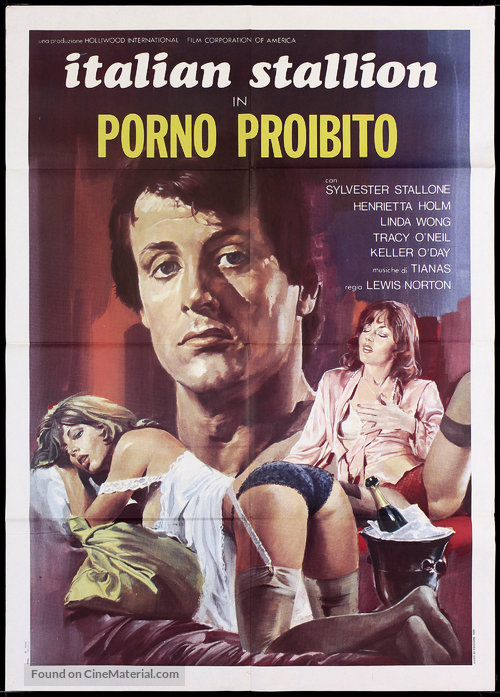
Otherwise known as The Italian Stallion, this movie was a big deal in the mid-1970’s, with its urban legend stretching well into the 1980’s. Basically, it’s a soft core movie with a pre-Rocky Sylvester Stallone in the lead, but there were rumors that it originally had hardcore penetration scenes. That’s since been debunked.
Stallone made this film his debut, but did so out of desperation. He’d been homeless for several days and was sleeping in a New York City bus station in the dead of winter. In the September 1978 issue of Playboy, he said “It was either do that movie or rob someone because I was at the end — at the very end — of my rope. Instead of doing something desperate, I worked two days for $200 and got myself out of the bus station.”
It was directed by Morton Lewis, who was also behind It’s Getting Harder All the Time and the producer of several movies I’ll soon be searching for, like The Girl From Starship Venus and Secret Rites, which rips the lid off British black magic, complete with a rare on-camera appearance by Alex Sanders.
After Stallone made his money, the film, by all accounts, was never shown. Then Rockyhappened. The now hot was extorted for $100,000 to make the film go away, but he refused to pay. And then our old friends the Bryanston Distributing Company got the rights.
I could tell you that this company put out movies like Return of the Dragon, Andy Warhol’s Frankenstein, Coonskin, The Devil’s Rain! and Dark Star. But what they’re really known for is basically stealing The Texas Chainsaw Massacre.
That’s because Bryanstone was owned by the Columbo crime family and run by Anthony “Big Tony” Peraino. And they’re the ones that made all the money on Deep Throat.
The 1976 release of this film, now called Italian Stallion, starts with a prologue with pornography director Gail Palmer, which further fueled the flames of the adult scenes that were supposedly cut from the film.
What is in the film is pretty boring, unless you’ve always yearned to see Stallone’s yam bag. He plays Stud, who lives with Kitty in New York City. If you didn’t guess that from the title…
Stud is pretty much a brutal thug, but he’s good in bed and Kitty likes how he whips her with a belt. Later, they have a party and there’s a big group scene that ends with Stud taking care of every girl without breaking a sweat. “Yo! I didn’t hear no bell,” you may say.
An uncredited Janet Bazet also shows upon here and if you’ve seen enough Michael Findlay and Joe Sarno movies, you’ll know who he is. You’re also a pervert if you perked up at those two names. It’s OK. I understand.
After being released on DVD in the early 2000’s, this movie resurfaced in 2007 when the long-rumored hardcore version showed up. Adult Video News debunked this, however, as what was edited in appeared to be older loops and nothing to do with Stallone.
Bryanston — who resurfaced as a film distribution company — and Metro-Goldwyn-Mayer were in negotiations for the rights to this film, but the worldwide rights ended up being sold on eBay in November of 2010 for around $327,000.
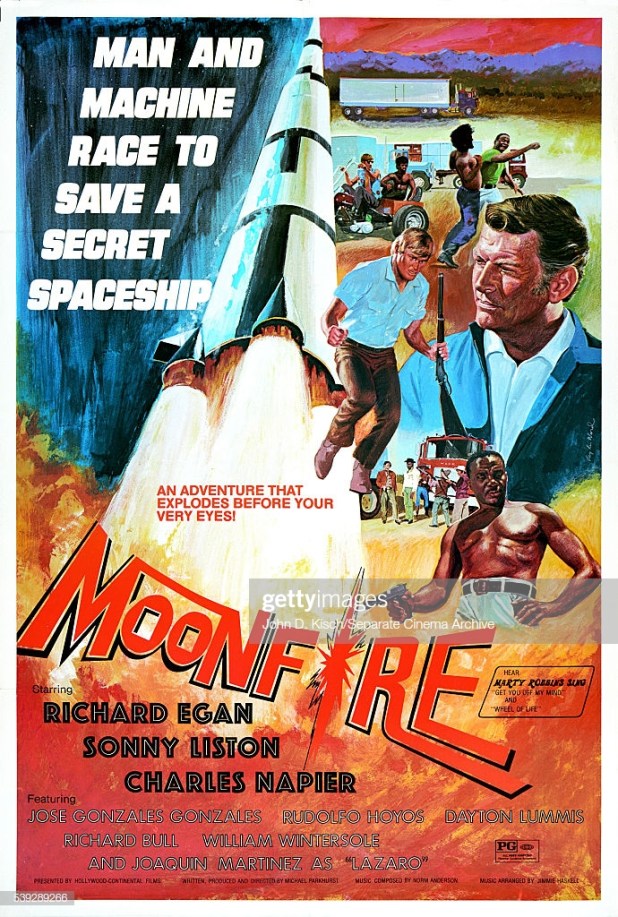
Michael Parkhurst directed exactly one movie, this 1970 effort about truckers battling Nazis in Mexico to rescue a pilot. There’s also a millionaire gone missing, a fortune hidden inside a haul of lettuce and a lost space capsule. Yes, really.
Parkhurst also appeared in the 1992 film Hot Under the Collar. Everything else on his IMDB page lists him as equipment supplier and technical consultant, so I did some research of my own. Parkhurt was a big supporter of truckers for nearly fifty decades, starting Overdrive magazine and producing the documentary Big Rig before building that aforementioned IMDB resume that includes Duel, Convoy, Movin’ On, Citizens Band, Smokey & The Bandit, B.J. and the Bandit, Big Trouble In Little China, Near Dark and many, many more.
Starting with the Marty Robbins song, “The Wheel of Life,” we get ready to enter the world of truckers, hauling their loads across the highways and byways of our great nation. Richard Egan has top billing, but he’s not really the star of this. He was, however, Rod Serling’s original choice to host The Twilight Zone before contractural issues got in the way.
The real star is Charles Napier. After a stint in the army, Napier got into Hollywood by accident, as a girlfriend took the square jawed Napier along when she went to audition for Russ Meyer, who him as the male lead in Cherry, Harry & Raquel! In addition to acting and doing a full-frontal nude scene, he also helped film the movie, do make-up, drive and do stunts for the movie. After Moonfire, he actually became a writer and photographer for Overdrive, as well as appearing in Jonathan Demme’s Citizen Band (he also appeared in several more films for the director, including Silence of the Lambs) and as Tucker McElroy in The Blues Brothers.
Sonny Liston — the heavyweight champion of the world who lost his title to Cassius Clay in 1964 — also appears as The Farmer, another trucker. Liston also lost the rematch to the future Muhammad Ali in the first round. He died before this movie was released in 1970 of a heroin overdose, but the truth is he was probably murdered and that was covered up. He also appears in the movies Harlow and the Monkees’ film Head.
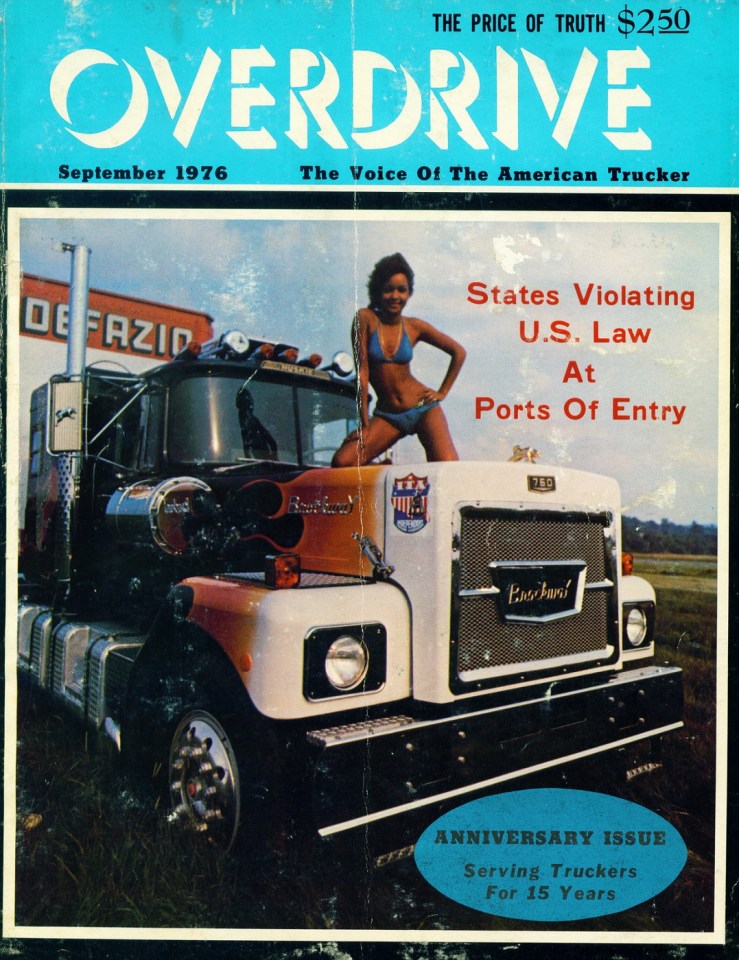
The bad guys are played by Jose Gonzales Gonzales and Joaquin Martinez, who often played stereotypical Mexican bad guys in films in the days before political correctness. Speaking of a lack of PC, this article from Overdrive takes note of the fact that the magazine “was known not only for strident advocacy on behalf of the independent trucker but for cheesecake photos of attractive women posing in, on and around big rigs.” At least one of those models ends up in the film.
Some Overdrive magazine evidence
The real plot revolves around a Howard Hughes-like figure’s satellite — intended to pretty much be something like Ted Turner’s Superstation satellite or the one that SCTV launched into space from Mellonville — and the truckers taking a few million hidden amongst their load to Mexico, where the evil Nazi tries to take them out. There’s also a brawl with a motorcycle gang, because as well as all know, two wheelers hate eighteen wheelers. It’s a proven fact.
If you love trucking, there’s plenty of real truckers and truckstop owners in the film, as well as the actual Tucson Truck Terminal, a popular spot. Sadly, it’s about as exciting as driving across Kansas hauling lettuce for 12 straight hours.
That said, Parkhurt himself wrote of the film on IMDB, which overjoys me to no end: “My review cannot be taken objectively inasmuch as I wrote and produced it and directed 95% of it. This was a low budget movie first released in theatres in 1972, but it has excellent photography, a good and original musical score with country legend Marty Robbins singing two songs (offscreen). The film was shot entirely on location in California, Arizona, New Mexico, Texas and Mexico for less than $300,000, still, “low budget” even in 1970. Even though it was a low budget film, several years later, ORION pictures distributed it for many years on TV, and it got good audience reaction when first released in theatres. The production sound mixer went on to gain five Oscar nominations, and an assistant cameraman, Ed Begley Jr., said he never wanted to act. In spite of a good cast,I would rate this film as “fair,” but not bad, especially considering the low budget. It was even a union crew. Leonard Maltin calls this film a “bomb” and describes the plot as a blackmail plot but there was no blackmail plot at all, so we know Maltin never saw it and probably relied on the inaccurate summary of some high school dropout to provide the description. It was never released on video until early 1998 and then only in truck stops where it outsold all other recent hits by far, wherever it was displayed, partly due to the fact that all the trucker scenes were technically accurate, and co-star Charles Napier, in his first PG film, actually learned to drive a tractor trailer for his role. Sorry, folks, no gratuitous violence or sex scenes except a little teaser in the beginning, and no cursing. If I had known that Maltin would provide a completely inaccurate plot summary I would have put in filthy words and stupid violence in order to elevate Moonfire to the level of all the really inane so-called trucker movies with unbelievable plots.”
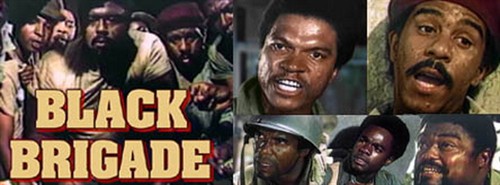
Originally entitled Carter’s Army, this made for TV movie debuted on ABC on January 27, 1970. It was written by David Kidd, who would also write The Swinging Cheerleaders, and Aaron Spelling, who would go on to dominate 1970’s TV with Mod Squad, The Rookies, S.W.A.T., Starsky and Hutch, Family, Vega$, Charlie’s Angels, Fantasy Island, Hart to Hart and many more.
Captain Beau Carter (Stephen Boyd, who was the main bad guy in Ben-Hur as well as appearing in The Devil Has Seven Faces/Bloody Mary) is placed in charge of a unit of African American soldiers, including comedian Richard Pryor, football player/needlepoint enthusiast/apprehender of Sirhan Sirhan Rosey Grier, Trouble Man Robert Hooks, Glynn Turman from Cooley High, Billy Dee Williams (do I need to tell you who he is?) and Moses Gunn, who is Detective Turner in Amityville II: The Possession.
These soldiers have been relegated to cleaning latrines and removed from the front lines, but now they must secure an important dam or the Allied advance will be delayed. Carter must get past his racism to lead the men to victory.
Susan Oliver — whose life may be more interesting than any movie, is also in this film. After a near-disaster on a plane the day Buddy Holly died, she got hypnotized to get around her fear of flying. She became an incredibly competitive pilot, finally the 2760-mile transcontinental race known as the “Powder Puff Derby” and becoming 1970’s Pilot of the Year. She also was one of the original 19 women admitted to the American Film Institute’s Directing Workshop for Women and left most of her estate to that organization.
Black Brigade is an intriguing film to include on a blaxploitation box set, as it does anything but glorify violence or combat. It was a real surprise to me and it’s definitely worth your time.
You can get Black Brigade on Mill Creek’s new Soul Team Six DVD collection, along with five other films.
DISCLAIMER: Mill Creek sent us this set, but we were planning on buying it anyway. It has no bearing on this review.
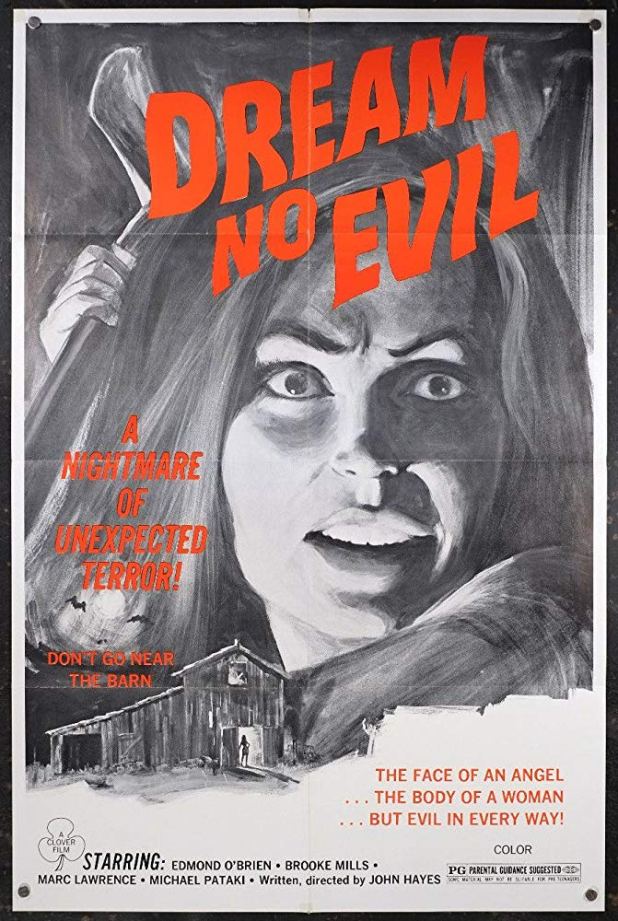
Arrow Video’s American Horror Project is dedicated to “its mission to unearth the very best in weird and wonderful horror obscura from the golden age of US independent genre moviemaking.” The second volume — the first had Malatesta’s Carnival of Blood, The Witch Who Came from the Sea and The Premonition — lives up to that bold challenge.
John Hayes began his career producing and directing short subjects, even getting nominated for an Academy Award for 1959’s The Kiss. In addition to those roles, he often wrote his own films and occasionally appeared as an actor in movies like The Shaggy D.A. and his own End of the World.
After his initial full-length movie, The Grass Eater, he made Five Minutes to Love, a Rue McClanahan (yes, from The Golden Girls) starring film all about Poochie, a woman who lives in a junkyard. Also known as Hollywood After Dark, it was picked up by exploitation godfather Kroger Babb. He also directed Jailbait Babysitter and several adult films, such as Pleasure Zone and Hot Lunch.
Hayes is probably best known for two movies he made in 1974: Grave of the Vampire and Garden of the Dead. Hopefully, people will soon add this film to that list, as I absolutely loved it.
Grace (Brooke Mills, The Big Doll House, The Student Teachers) grew up in an orphanage where she dreamed of the day her father would return, forever living outside the other children around her. When she grows up, she goes to work with her adopted foster brother Rev. Paul Jessie Bundy (Michael Pataki, amazing as always), who has turned his father’s church into a circus. For her part, she wears a sexy costume before jumping off a high platform into water to symbolize Satan falling into Hell. He also uses her to faith heal others — indeed, the movie was made as The Faith Healer — while hiding his lust for her.
She’s already dating their other foster brother, Dr. Patrick Bundy, yet refuses to have sex with him. He gives up and starts dating another medical student. If this seems strange that brothers are at war over their sister, well, stay tuned.
The church makes it to a town where she hears word of her father (Edmond O’Brien, who started his career as a magician trained by next door neighbor Houdini before appearing in plays at Orson Welles’ Mercury Theater and films like The Man Who Shot Liberty Valance, Seven Days In May and The Wild Bunch). This brings her to the combination funeral home/brothel of an undertaker (Marc Lawrence, who was in a ton of movies, but I’ll always think of him as being in Night Train to Terror) who has her father dead on his mortuary slab. She wishes him back to life and he rises to murder the undertaker in a completely frightening scene that creates one of several breaks in the film with reality.
The one issue I have with the film is that its narrator reveals the big twist early. The destroyed house on the edge of town that Grace lives in isn’t the comfortable home that’s in her mind and her father doesn’t exist. Who knows what the people who came there to see her dance to his squeezebox songs really saw.
This movie is the kind of crazy film that I text people about in the middle of the night because I don’t believe that it can be real. But it is — it gloriously is — and now I’m here exclaiming that you should go out of your way to see it.
In 1976, Hayes directed Baby Rosemary, which is an adult remake of this film. That’s probably one of the few — if only — times I can think of when the same director created a XXX and mainstream version of the same film, albeit six years apart.
The blu ray of this film is packed with extras, including an appreciation by Stephen Thrower and brand new audio commentary with Kat Ellinger and Samm Deighan. There’s also a video essay by Thrower concerning Hayes’ films from 1959 to 1971, an exploration of Edmond O’Brien’s career by writer Chris Poggiali on the prodigious career of celebrated character actor Edmond O’Brien and excerpts from an audio interview with Rue McClanahan about how Hayes started her career.
You can learn more about the American Horror Project vol. 2 box set on Arrow Video‘s web site. This is one block of blu rays worth owning, trust me.
DISCLAIMER: Arrow sent us this set for review, but we were already planning on buying it. That had no bearing on our review.





 B&S About Movies
You must be logged in to post a comment.