DAY 17. EVIL IN BROAD DAYLIGHT: Scary stories aren’t just for the night time.
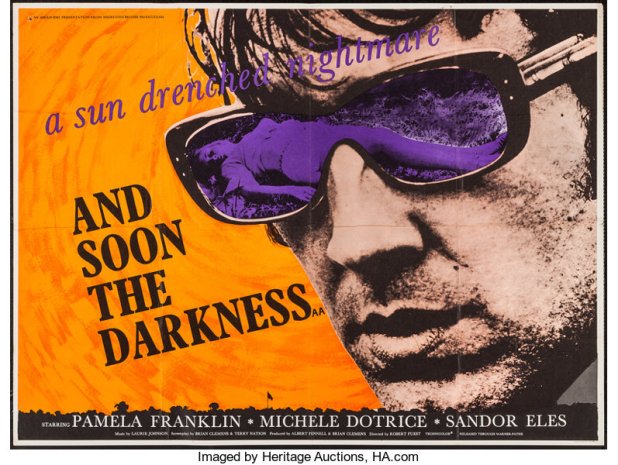
A movie that’s referred to as “a sun-drenched nightmare” on its poster, Robert Fuest’s And Soon the Darkness is nearly forgotten today, which is a real shame. Fuest is probably better remembered for The Abominable Dr. Phibes and Dr. Phibes Rises Again than he is for any other movie, but he also made plenty more, like The Final Programme, The Devil’s Rain! and Revenge of the Stepford Wives to name but a few.
And Soon the Darkness is about a day gone wrong, about being a tourist in a strange land and about how trust isn’t an easy thing to come by. It’s also an incredible film worthy of rediscovery.
Jane (Pamela Franklin, Necromancy, The Legend of Hell House) and Cathy (Michele Dotrice, the wife of The Wicker Man star Edward Woodward who was also in The Blood on Satan’s Claw) are two young nurses from Nottingham. They’ve decided to take a cycling holiday in France.
Jane’s been planning each and every stop on the route while Cathy is more interested in letting life happen. Life ends up being Paul (Sandor Else, Countess Dracula), a handsome man riding a scooter who catches her eye. The girls soon come to an argument and go their separate ways, with Cathy staying behind to sunbathe and perhaps catch up with Paul.
As Jane moves on to the next town, a cafe owner struggles to tell her that she’s in a dangerous area where young girls are often murdered. She decides to go back and find her friend, but she’s gone. A policeman is on the case, but Jane instantly believes that Paul is the murderer, despite him saying that he’s a plain-clothes detective who has taken an interest in the missing girls from this region.
What follows is the sun slowing setting on Jane’s hopes of ever finding her friend again, as she believes that Paul is closing in on her, ready to add her to his list of victims. But was there even a murder? Or is this all in her head?
There are no easy answers in And Soon the Darkness. It was written by Brian Clemens (who wrote See No Evil and Dr. Jekyll and Sister Hyde, as well as writing and directing Captain Kronos – Vampire Hunter) and Terry Nation (The House in Nightmare Park as well as the creator of Dr. Who’s Daleks), who had worked with Fuest on the game-changing British crime show The Avengers.
This was remade in 2010 as And Soon the Darkness with Karl Urban, Amber Heard and Odette Annable. I’ve never seen it, but talk about a lot to live up to. Just the end shot of this movie, cast in a rain that isn’t about to wash away anyone’s pain, is brutal in its quiet intensity.
. . . Cue the obligatory, budget-conscious voice over-photo montage (bellowing smokestacks, animal carcasses, muddy water, etc.) of a ravaged Earth (in the “future” of 1972; again “budget”) as we learn about a disease that devours the Asian continent and lays waste to all members of the grass-grains family, such as corn, rice, wheat, and oats. (Yep, it’s more sterile sci-fi cereal grasses, à la the 2001-inspired Interstellar.) As starvation and cannibalism rip across Africa, Europe, and South America, and encroaches China, the Chinese gas-murder 300 thousand of their citizens in a twisted effort to assure their survival.
A year later . . .
The philosophical-talk action begins as we meet John Custance (Nigel Davenport; snooty film critics will cite the award-winners A Man for All Season and Chariots of Fire . . . we at B&S Movies prefer the serial-killer romp Peeping Tom, the crazy-ass ant movie Phase IV, A.I.P’s H.G Wells frolic The Island of Dr. Moreau, and Stallone’s Nighthawks) who flees with his family from a devastated London into the mossy-countryside on a quest to an “easily protected valley” that shelters his brother’s farmstead in northern England on the Scottish border. Along the way they battle rogue army officers, his teenaged daughter (as is the case with post-apoc films) is raped by the ubiquitous slobbering idiots who, in the face of an apocalypse, always believe the key to survival is raping women. (Lynn Frederick, star of Hammer Studios’ classic, Vampire Circus (1972), the aforementioned Phase IV, and Pete Walker’s Schizo (1976), stars in her acting debut as the daughter.)
So now, while John is on a spaghetti western quest to avenge the rape of his daughter (like Richard Harris in Ravagers), he becomes a defacto Moses as the leader of the ragamuffins they meet along the way (like Richard Harris in Ravagers). Of course, no apocalypse landscape is complete without some Toecutter-pillaging (Mad Max) mayhem courtesy of a chain-wielding motorcycle gang — complete with red-racing striped, cow-horned helmets. (Piffle. Roger Corman’s laser-blasting Death Machine and Fulci’s Kill Bike hoards would kick their grassy-asses across The English Channel and all the way into Italy for a pasta-zombie barbeque.)
Finally, this sci-fi take on the biblical story of the Exodus reaches “utopia” . . .
That is until John’s brother, David, declares John’s little Red Sea gang is too large to be supported by the valley’s riches. So John declares war on David and mounts a daring night attack to take control of the valley and rebuild . . . a society without grass.
Released early on in the ‘70s post-apocalypse riot-races, beating Charlton Heston’s The Omega Man to the big screen — and most likely put into production by MGM when news hit the trades that Warner Bros. was going into production with their Richard Matheson adaptation — No Blade of Grass, as with most apoc-films of the era (Soylent Green, Damnation Alley, Ravagers, etc.) was based on a successful novel, The Death of Grass, published by British novelist John Christopher in 1956.
The film was directed by Hungarian-born bad-ass Cornell Wilde (Gargoyles, Sharks’ Treasure) who walked away from a career in medicine after aceing his pre-med studies and earning a scholarship to Columbia University — to qualify for a spot on the 1936 Olympic Fencing Team. The dude taught Sir Laurence Olivier to fence for a Broadway production of Romeo and Juliet and, as result; he scored a film contract with Warner Bros. (I wish my life took those shocking, out-of-left-field luck turns.) Forming his own production company, Theodora, Wilde came to produce, write, and direct his pet-project adaptation of Christopher’s novel, a dream that goes back to the days of his first production: the film noir The Big Combo (1955).
“Cornell who?” the younger B&S Movies reader might be saying.
Surely you have seen Cornell Wilde in TV reruns with his notable appearances as a surgeon in the U.S television anthology series Night Gallery (“Deliveries in the Rear”) and, in the highly-rated TV horror film, Gargoyles (1972). Trash cinema lovers of the ‘80s video fringe definitely remember Wilde with his contribution to the ‘70s sharksplotation cycle inspired by Jaws (see our “Bastard Pups of Jaws” week)—Shark’s Treasure (1975) — the first of the genre’s rip-offs, which Wilde produced, wrote, directed, and starred. Film buffs of old will fondly remember Wilde from The Naked Prey (1965; another Wilde produce-direct-star effort that we’ll call a pseudo “human death sport” precursor).
Shot for a paltry — well, back then it was a “big budget” — 1.5 million dollars, once again the grassless “future” looks exactly like our present, only with anarchy as the rule of the day . . . with the same ol’ cars, architecture, and weapons. And as with most — well, all — of the novel-to-film adaptations of the apoc-‘70s, the film widely deviates from its source material, in this case, excising the book’s cautionary Communism tale about awry biological warfare experiments in Red China . . . and replacing it with a yawn-inducing environmental message. At least the studio kept the “dying grass” part of the story (and that’s about all they kept).
You can watch No Blade of Grass on YouTube, Amazon Prime, and Google Play. And if it all seems a bit familiar — like Panic in the Year Zero (1962) familiar — that’s because director-actor Ray Milland’s film “borrowed” it’s overall premise and some incidents from John Christopher’s novel.
Not surprising: The uptight British shuddered at the film’s double rape scene (which, I admit, is pretty brutal; what were you thinking, Cornell?), and a rather dark, nasty birth of a stillborn baby, punctuated by lots of shootings and deaths. Thus, in order to receive an “AA” certificate for a UK release, the BBFC cut the sex and violence by 15 minutes — which was restored for us bloody, liberal Americans, sans one and a half minutes of the rape scenes. (How uptight are the Brits? Check out our “Video Nasties” explorations for the UK’s Section 1, Section, 2, and Section 3 “red flag” films. Come take my VHS nasties. I dare ya.)
As is the case with The Ultimate Warrior, Damnation Alley, and Ravagers,No Blade of Grass has wonderful production values and isn’t a total waste of time . . . it’s just that it could be so much better, as it suffers from too much of the “why we’re here and what are we gonna do now” yakity-yak. You won’t be seeing any The Simpsons’ Tree House of Horror tributes to No Blade of Grass, like you did with The Omega Man (Part 1/Part 2), anytime soon. In the end: Where’s Chuck Heston in a silver-football helmet going up against Matthias and his albino-mutants minions when you need ‘em?
And with that: I’ll let my ol’ buddies from North Carolina’s Animal Bag take us out with their grungy tribute to the “Spirits of Grass.”
Smoke ‘em if you got ‘em: we might lose our weed in the next apocalypse.
About the Author: You can read the music and film reviews of R.D Francis on Medium and learn more about his work on Facebook.
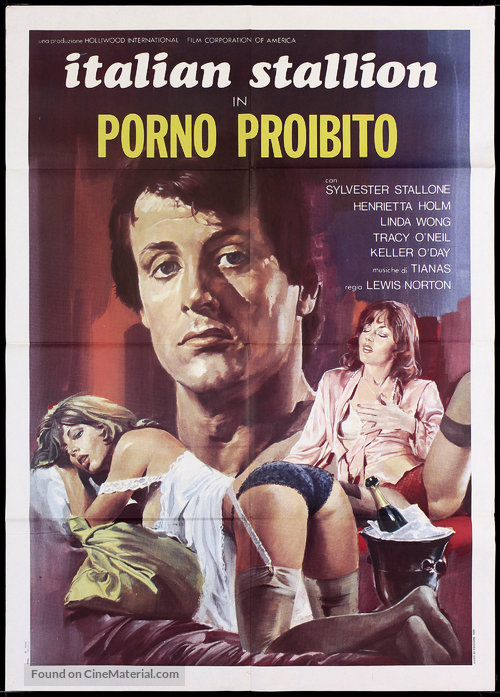
Otherwise known as The Italian Stallion, this movie was a big deal in the mid-1970’s, with its urban legend stretching well into the 1980’s. Basically, it’s a soft core movie with a pre-Rocky Sylvester Stallone in the lead, but there were rumors that it originally had hardcore penetration scenes. That’s since been debunked.
Stallone made this film his debut, but did so out of desperation. He’d been homeless for several days and was sleeping in a New York City bus station in the dead of winter. In the September 1978 issue of Playboy, he said “It was either do that movie or rob someone because I was at the end — at the very end — of my rope. Instead of doing something desperate, I worked two days for $200 and got myself out of the bus station.”
It was directed by Morton Lewis, who was also behind It’s Getting Harder All the Time and the producer of several movies I’ll soon be searching for, like The Girl From Starship Venus and Secret Rites, which rips the lid off British black magic, complete with a rare on-camera appearance by Alex Sanders.
After Stallone made his money, the film, by all accounts, was never shown. Then Rockyhappened. The now hot was extorted for $100,000 to make the film go away, but he refused to pay. And then our old friends the Bryanston Distributing Company got the rights.
I could tell you that this company put out movies like Return of the Dragon, Andy Warhol’s Frankenstein, Coonskin, The Devil’s Rain! and Dark Star. But what they’re really known for is basically stealing The Texas Chainsaw Massacre.
That’s because Bryanstone was owned by the Columbo crime family and run by Anthony “Big Tony” Peraino. And they’re the ones that made all the money on Deep Throat.
The 1976 release of this film, now called Italian Stallion, starts with a prologue with pornography director Gail Palmer, which further fueled the flames of the adult scenes that were supposedly cut from the film.
What is in the film is pretty boring, unless you’ve always yearned to see Stallone’s yam bag. He plays Stud, who lives with Kitty in New York City. If you didn’t guess that from the title…
Stud is pretty much a brutal thug, but he’s good in bed and Kitty likes how he whips her with a belt. Later, they have a party and there’s a big group scene that ends with Stud taking care of every girl without breaking a sweat. “Yo! I didn’t hear no bell,” you may say.
An uncredited Janet Bazet also shows upon here and if you’ve seen enough Michael Findlay and Joe Sarno movies, you’ll know who he is. You’re also a pervert if you perked up at those two names. It’s OK. I understand.
After being released on DVD in the early 2000’s, this movie resurfaced in 2007 when the long-rumored hardcore version showed up. Adult Video News debunked this, however, as what was edited in appeared to be older loops and nothing to do with Stallone.
Bryanston — who resurfaced as a film distribution company — and Metro-Goldwyn-Mayer were in negotiations for the rights to this film, but the worldwide rights ended up being sold on eBay in November of 2010 for around $327,000.
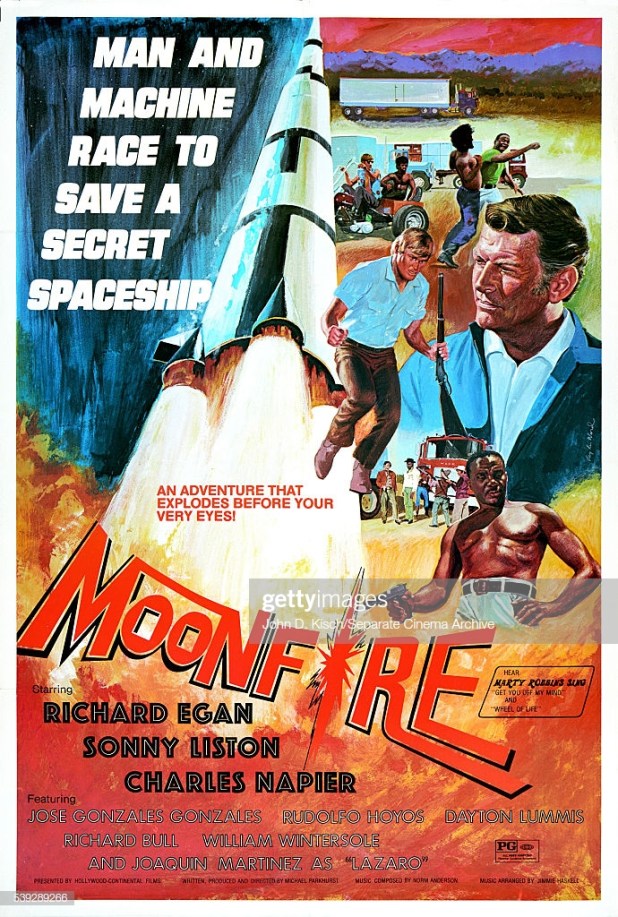
Michael Parkhurst directed exactly one movie, this 1970 effort about truckers battling Nazis in Mexico to rescue a pilot. There’s also a millionaire gone missing, a fortune hidden inside a haul of lettuce and a lost space capsule. Yes, really.
Parkhurst also appeared in the 1992 film Hot Under the Collar. Everything else on his IMDB page lists him as equipment supplier and technical consultant, so I did some research of my own. Parkhurt was a big supporter of truckers for nearly fifty decades, starting Overdrive magazine and producing the documentary Big Rig before building that aforementioned IMDB resume that includes Duel, Convoy, Movin’ On, Citizens Band, Smokey & The Bandit, B.J. and the Bandit, Big Trouble In Little China, Near Dark and many, many more.
Starting with the Marty Robbins song, “The Wheel of Life,” we get ready to enter the world of truckers, hauling their loads across the highways and byways of our great nation. Richard Egan has top billing, but he’s not really the star of this. He was, however, Rod Serling’s original choice to host The Twilight Zone before contractural issues got in the way.
The real star is Charles Napier. After a stint in the army, Napier got into Hollywood by accident, as a girlfriend took the square jawed Napier along when she went to audition for Russ Meyer, who him as the male lead in Cherry, Harry & Raquel! In addition to acting and doing a full-frontal nude scene, he also helped film the movie, do make-up, drive and do stunts for the movie. After Moonfire, he actually became a writer and photographer for Overdrive, as well as appearing in Jonathan Demme’s Citizen Band (he also appeared in several more films for the director, including Silence of the Lambs) and as Tucker McElroy in The Blues Brothers.
Sonny Liston — the heavyweight champion of the world who lost his title to Cassius Clay in 1964 — also appears as The Farmer, another trucker. Liston also lost the rematch to the future Muhammad Ali in the first round. He died before this movie was released in 1970 of a heroin overdose, but the truth is he was probably murdered and that was covered up. He also appears in the movies Harlow and the Monkees’ film Head.
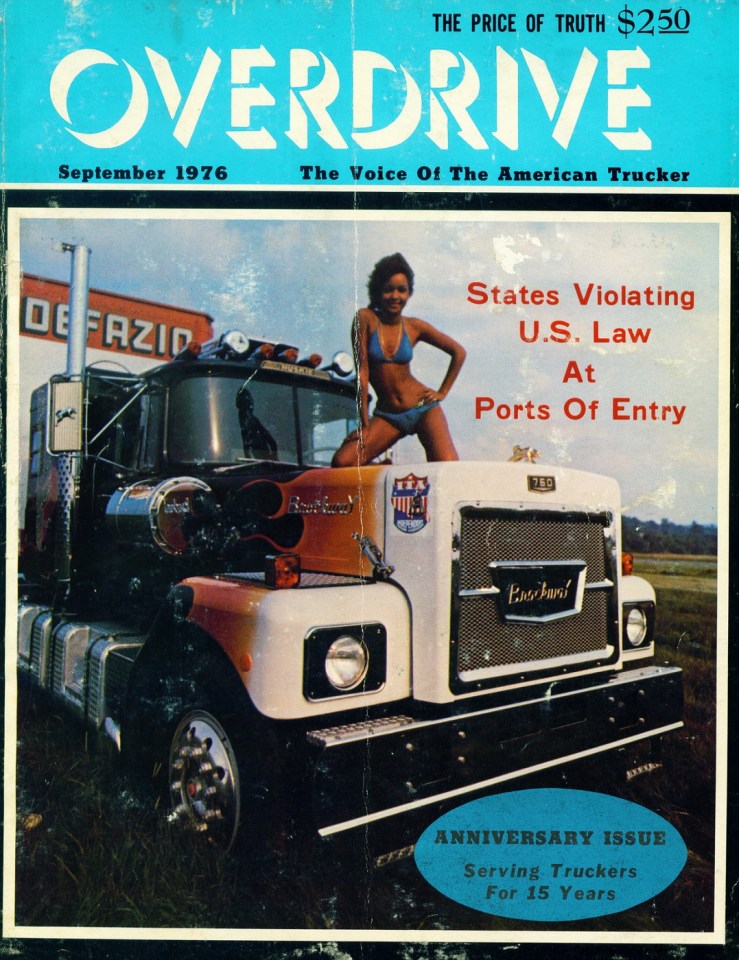
The bad guys are played by Jose Gonzales Gonzales and Joaquin Martinez, who often played stereotypical Mexican bad guys in films in the days before political correctness. Speaking of a lack of PC, this article from Overdrive takes note of the fact that the magazine “was known not only for strident advocacy on behalf of the independent trucker but for cheesecake photos of attractive women posing in, on and around big rigs.” At least one of those models ends up in the film.
Some Overdrive magazine evidence
The real plot revolves around a Howard Hughes-like figure’s satellite — intended to pretty much be something like Ted Turner’s Superstation satellite or the one that SCTV launched into space from Mellonville — and the truckers taking a few million hidden amongst their load to Mexico, where the evil Nazi tries to take them out. There’s also a brawl with a motorcycle gang, because as well as all know, two wheelers hate eighteen wheelers. It’s a proven fact.
If you love trucking, there’s plenty of real truckers and truckstop owners in the film, as well as the actual Tucson Truck Terminal, a popular spot. Sadly, it’s about as exciting as driving across Kansas hauling lettuce for 12 straight hours.
That said, Parkhurt himself wrote of the film on IMDB, which overjoys me to no end: “My review cannot be taken objectively inasmuch as I wrote and produced it and directed 95% of it. This was a low budget movie first released in theatres in 1972, but it has excellent photography, a good and original musical score with country legend Marty Robbins singing two songs (offscreen). The film was shot entirely on location in California, Arizona, New Mexico, Texas and Mexico for less than $300,000, still, “low budget” even in 1970. Even though it was a low budget film, several years later, ORION pictures distributed it for many years on TV, and it got good audience reaction when first released in theatres. The production sound mixer went on to gain five Oscar nominations, and an assistant cameraman, Ed Begley Jr., said he never wanted to act. In spite of a good cast,I would rate this film as “fair,” but not bad, especially considering the low budget. It was even a union crew. Leonard Maltin calls this film a “bomb” and describes the plot as a blackmail plot but there was no blackmail plot at all, so we know Maltin never saw it and probably relied on the inaccurate summary of some high school dropout to provide the description. It was never released on video until early 1998 and then only in truck stops where it outsold all other recent hits by far, wherever it was displayed, partly due to the fact that all the trucker scenes were technically accurate, and co-star Charles Napier, in his first PG film, actually learned to drive a tractor trailer for his role. Sorry, folks, no gratuitous violence or sex scenes except a little teaser in the beginning, and no cursing. If I had known that Maltin would provide a completely inaccurate plot summary I would have put in filthy words and stupid violence in order to elevate Moonfire to the level of all the really inane so-called trucker movies with unbelievable plots.”
Originally entitled Carter’s Army, this made for TV movie debuted on ABC on January 27, 1970. It was written by David Kidd, who would also write The Swinging Cheerleaders, and Aaron Spelling, who would go on to dominate 1970’s TV with Mod Squad, The Rookies, S.W.A.T., Starsky and Hutch, Family, Vega$, Charlie’s Angels, Fantasy Island, Hart to Hart and many more.
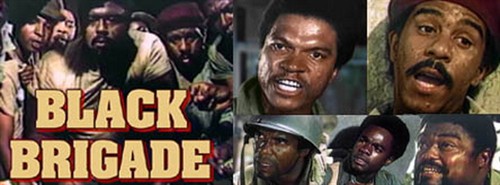
Captain Beau Carter (Stephen Boyd, who was the main bad guy in Ben-Hur as well as appearing in The Devil Has Seven Faces/Bloody Mary) is placed in charge of a unit of African American soldiers, including comedian Richard Pryor, football player/needlepoint enthusiast/apprehender of Sirhan Sirhan Rosey Grier, Trouble Man Robert Hooks, Glynn Turman from Cooley High, Billy Dee Williams (do I need to tell you who he is?) and Moses Gunn, who is Detective Turner in Amityville II: The Possession.
These soldiers have been relegated to cleaning latrines and removed from the front lines, but now they must secure an important dam or the Allied advance will be delayed. Carter must get past his racism to lead the men to victory.
Susan Oliver — whose life may be more interesting than any movie, is also in this film. After a near-disaster on a plane the day Buddy Holly died, she got hypnotized to get around her fear of flying. She became an incredibly competitive pilot, finally the 2760-mile transcontinental race known as the “Powder Puff Derby” and becoming 1970’s Pilot of the Year. She also was one of the original 19 women admitted to the American Film Institute’s Directing Workshop for Women and left most of her estate to that organization.
Black Brigade is an intriguing film to include on a blaxploitation box set, as it does anything but glorify violence or combat. It was a real surprise to me and it’s definitely worth your time.
You can get Black Brigade on Mill Creek’s new Soul Team Six DVD collection, along with five other films.
DISCLAIMER: Mill Creek sent us this set, but we were planning on buying it anyway. It has no bearing on this review.
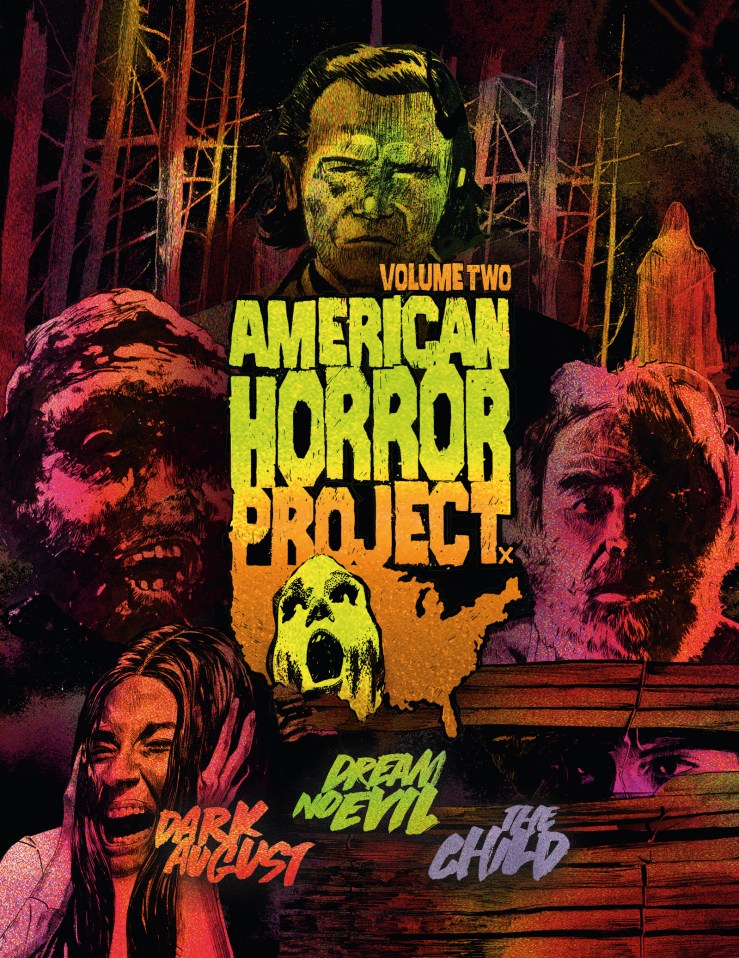
Arrow Video’s American Horror Project is dedicated to “its mission to unearth the very best in weird and wonderful horror obscura from the golden age of US independent genre moviemaking.” The second volume — the first had Malatesta’s Carnival of Blood, The Witch Who Came from the Sea and The Premonition — lives up to that bold challenge.
John Hayes began his career producing and directing short subjects, even getting nominated for an Academy Award for 1959’s The Kiss. In addition to those roles, he often wrote his own films and occasionally appeared as an actor in movies like The Shaggy D.A. and his own End of the World.
After his initial full-length movie, The Grass Eater, he made Five Minutes to Love, a Rue McClanahan (yes, from The Golden Girls) starring film all about Poochie, a woman who lives in a junkyard. Also known as Hollywood After Dark, it was picked up by exploitation godfather Kroger Babb. He also directed Jailbait Babysitter and several adult films, such as Pleasure Zone and Hot Lunch.
Hayes is probably best known for two movies he made in 1974: Grave of the Vampire and Garden of the Dead. Hopefully, people will soon add this film to that list, as I absolutely loved it.
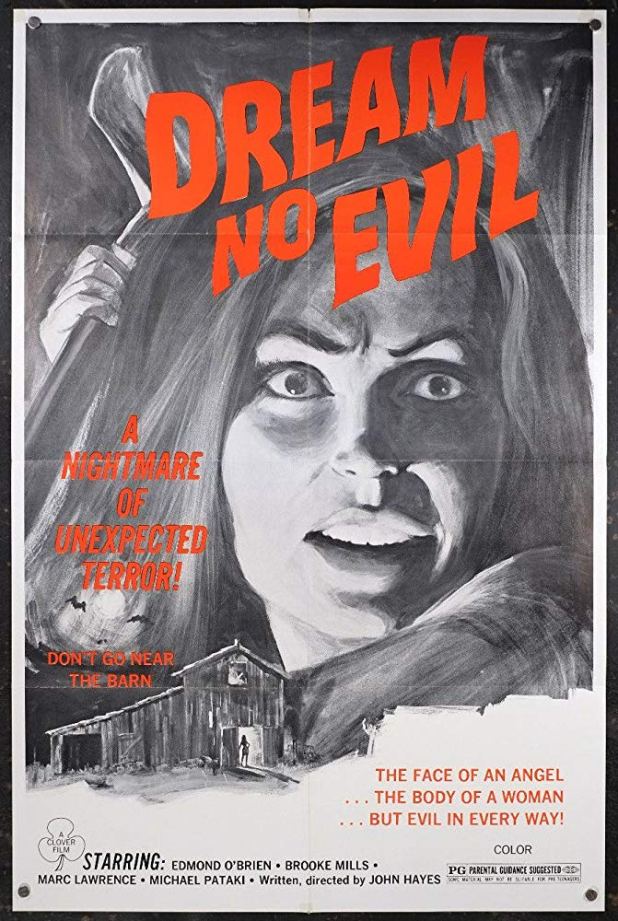
Grace (Brooke Mills, The Big Doll House, The Student Teachers) grew up in an orphanage where she dreamed of the day her father would return, forever living outside the other children around her. When she grows up, she goes to work with her adopted foster brother Rev. Paul Jessie Bundy (Michael Pataki, amazing as always), who has turned his father’s church into a circus. For her part, she wears a sexy costume before jumping off a high platform into water to symbolize Satan falling into Hell. He also uses her to faith heal others — indeed, the movie was made as The Faith Healer — while hiding his lust for her.
She’s already dating their other foster brother, Dr. Patrick Bundy, yet refuses to have sex with him. He gives up and starts dating another medical student. If this seems strange that brothers are at war over their sister, well, stay tuned.
The church makes it to a town where she hears word of her father (Edmond O’Brien, who started his career as a magician trained by next door neighbor Houdini before appearing in plays at Orson Welles’ Mercury Theater and films like The Man Who Shot Liberty Valance, Seven Days In May and The Wild Bunch). This brings her to the combination funeral home/brothel of an undertaker (Marc Lawrence, who was in a ton of movies, but I’ll always think of him as being in Night Train to Terror) who has her father dead on his mortuary slab. She wishes him back to life and he rises to murder the undertaker in a completely frightening scene that creates one of several breaks in the film with reality.
The one issue I have with the film is that its narrator reveals the big twist early. The destroyed house on the edge of town that Grace lives in isn’t the comfortable home that’s in her mind and her father doesn’t exist. Who knows what the people who came there to see her dance to his squeezebox songs really saw.
This movie is the kind of crazy film that I text people about in the middle of the night because I don’t believe that it can be real. But it is — it gloriously is — and now I’m here exclaiming that you should go out of your way to see it.
In 1976, Hayes directed Baby Rosemary, which is an adult remake of this film. That’s probably one of the few — if only — times I can think of when the same director created a XXX and mainstream version of the same film, albeit six years apart.
The blu ray of this film is packed with extras, including an appreciation by Stephen Thrower and brand new audio commentary with Kat Ellinger and Samm Deighan. There’s also a video essay by Thrower concerning Hayes’ films from 1959 to 1971, an exploration of Edmond O’Brien’s career by writer Chris Poggiali on the prodigious career of celebrated character actor Edmond O’Brien and excerpts from an audio interview with Rue McClanahan about how Hayes started her career.
You can learn more about the American Horror Project vol. 2 box set on Arrow Video‘s web site. This is one block of blu rays worth owning, trust me.
DISCLAIMER: Arrow sent us this set for review, but we were already planning on buying it. That had no bearing on our review.
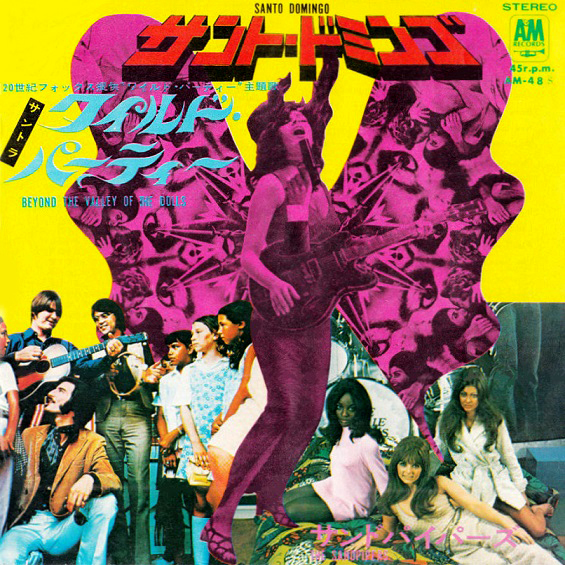
That it was intended as a sequel to 1967’s Valley of the Dolls, a veritable smorgasbord of sleaze and stupidity that I adore with all my heart, but which was a sizeable mainstream success.
That 20th Century Fox would hire Russ Meyer and Roger Ebert to make it. Ebert himself says that it wasn’t until after making the film that he realized how unusual it all was: “…in hindsight, I can recognize that the conditions of its making were almost miraculous. An independent X-rated filmmaker and an inexperienced screenwriter were brought into a major studio and given carte blanche to turn out a satire of one of the studio’s own hits.” When Fox producer Richard Zanuck greenlit the script, Meyer said, “I felt like I had pulled off the biggest caper in the world.”
That anybody has ever made a movie afterward, because this is the literal ultimate film of all ultimate films, a movie awash in overwrought pathos, exploitation and you can’t believe they went there insanity, blows my mind.
Neither Meyer nor Ebert read the novel Valley of the Dolls, but they knew what the film was all about — young innocent girls get chewed up and spit out by the hard and violent world of Hollywood and not all of them find redemption.
Ebert said that the duo wanted to take that ever further: “We would include some of the sensational elements of the original story- homosexuality, crippling diseases, characters based on “real” people, events out of recent headlines…heavily overlaid with such shocking violence that some critics didn’t know whether the movie knew it was a comedy.”
Meyer wanted to appeal to all audiences under thirty with something for everyone: mod fashion, hip music, soap opera romance, amazing set design, lesbians, orgies, drugs, transgender characters, Nazis, comedy, serious drama, plenty of skin, violent exploitation and an ending that had a moral — the so-called square-up reel.
They changed some characters — Susan Lake and Baxter Wolfe are really Anne Welles and Lyon Burke from Valley of the Dolls — but some are real people, like Ronnie “Z-Man” Barzell being based on Phil Spector decades before he became a killer. Randy Black is Muhammed Ali. And the end of the movie was based on the Tate-LaBianca Murders, claiming the life of Valley star Sharon Tate at the hands of the Manson Family.
Complicating the movie — for the actors — is that Meyer wouldn’t let on if the movie was really serious or comedic. Some decisions — SPOILER WARNING like Z-Man being Z-Woman SPOILER WARNING — were made on the spot, despite it having nothing to do with the rest of the film.
Roger Ebert said, “It’s an anthology of stock situations, characters, dialogue, clichés and stereotypes, set to music and manipulated to work as exposition and satire at the same time; it’s cause and effect, a wind-up machine to generate emotions, pure movie without message.”
While Zanuck had asked for an R rated to pushed the boundaries toward X, the film did receive an X rating. So Meyer responded by deciding that he wanted to insert even more sex and nudity into the film.
So what’s it all about? Glad you asked.
Kelly MacNamara (Dolly Martin, Playboy Playmate of the Month for May 1966), Casey Anderson (Cynthia Myers, Playboy Playmate of the Month for December 1968, and a woman whose nude photo was taken to the moon by the crew of Apollo 12) and Petronella “Pet” Danforth are The Kelly Affair. Kelly’s man, Harris Allsworth manages them and they decide to travel to Hollywood to meet up with Kelly’s aunt Susan Lake, who stands to inherit a big fortune.
Her financial advisor Porter Hall thinks they’re just hippies out to get her money, but she doesn’t care what that old man thinks. Instead, she introduces them to Ronnie “Z-Man” Barzell. He’s played by John LaZar, who is also in Deathstalker II, so it’s kind of ironic that he’s in the sequel to a movie that stars Lana Clarkson, the woman killed by the person he’s really playing here, Phil Spector. Woah.
To top it off, Kelly is wearing one of Sharon Tate’s outfits from the original in this scene. Dolly Read nearly couldn’t do the scene as she was in tears when she learned that the outfit had belonged to the dead actress. The publicity for the film — the famous three on a bed shot of the band — also has them wearing clothes from that movie.
He becomes their manager, enraging Harris, and renames them The Carrie Nations. Kelly soon falls for Lance Rocke (Michael Blodgett, who after acting in movies like Disco Fever and The Velvet Vampire, would write Rent-A-Cop and Hero and the Terror) while her ex-boyfriend ends up in bed with pornstar Ashley St. Ives (Meyer’s wife, Edy Williams). But soon, Harris can’t perform because he’s all tied into the booze and the dolls, baby. The dolls! The one time he can get it up, he knocks up Casey, his ex-girl’s best girlfriend who then has a lesbian affair with Roxanne (Erica Gavin, the star of Meyer’s Vixen), who asks her to get an abortion. Whew! So much happens so fast in this movie you really gotta keep up.
Meanwhile, Petronella has a storybook romance with Emerson Thorne (Harrison Page, Carnosaur) that ends in a brutal fistfight and near vehicular homicide when he catches her in bed with champion boxer Randy Black (James Iglehart, Angels Hard As They Come). Susan gets back with her old fiancee Baxter Wolfe (Charles Napier!) while drugs and touring beat up The Carrie Nations, until one show Harris leaps to his, well, not death, but he loses the use of his legs. Kelly falls back in love for him after his stupid fall. Emerson and Petronella get back together. Casey and Roxanne have lots of sex. If it seems like it’s all going to end up fine, Meyer is here to play with your mind.
Z-Man invites Lance, Casey and Roxanne (the latter two wearing real outfits from the 1960’s Batman TV show) to another of his drug-fuelled parties. After Lance turns him down, he reveals that he’s been a woman all along before going off — beheading Lance to the 20th Century Fox theme before stabbing his servant and getting Casey to fellate his gun before murdering her and her lover (this is teased in the film’s opening). Kelly, Harris, Pet, and Emerson arrive too late to save them, but they kill Z-Man and Harris starts to move his feet again.
While an overly preachy voiceover squares us all up, like we’re watching Mom and Dad or something, we watch Kelly and Harris, who is limping on crutches, enjoy nature before all three surviving couples get married at the courthouse.
Between this movie and Myra Breckenridge, Zanuck lost his job at Fox. That said — despite an X rating and a meager $900,000 budget (Meyer came in $100,000 under) — it ended up earning more than $40 million dollars. Of course, they also had to pay out Valley author Jacqueline Susann’s estate for damages, which meant that the movie starts with this disclaimer:
THE FILM YOU ARE ABOUT TO SEE IS NOT A SEQUEL TO “VALLEY OF THE DOLLS.” IT IS WHOLLY ORIGINAL AND BEARS NO RELATIONSHIP TO REAL PERSONS, LIVING OR DEAD. IT DOES, LIKE “VALLEY OF THE DOLLS” DEAL WITH THE OFT-TIMES NIGHTMARE WORLD OF SHOW BUSINESS BUT IN A DIFFERENT TIME AND CONTEXT.
Needless to say, this is in my top films ever. If you ever visit and you’d like to watch while I scream the songs at the screen and jump up and down, you’re invited.
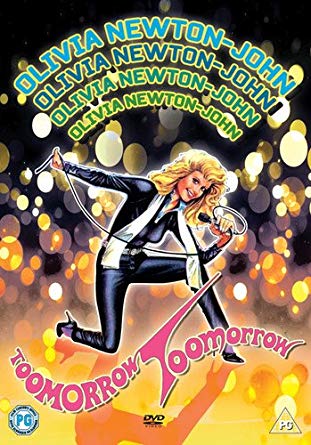
Harry Saltzman had produced James Bond and Harry Palmer films, but he wanted to work with Don Kirshner, who had just had a big success as the producer of The Monkees. They had a three-picture deal, but it barely made it through this movie.
Saltzman had originally brought on David Benedictus to write the film, but didn’t like the script and kept him writing it while he asked director Val Guest (The Quatermass Xperiment) to write his own script. Once the film started shooting, the writer did eventually learn that a new script had been completed.
Guest also had no idea that Benedictus hadn’t been informed. And it got worse for Guest, who would go six months over schedule on the making of the film and was never paid. He was smart, though. He waited until after the film’s premiere to obtain an injunction that stated that Toomorrow couldn’t be shown until everyone was paid. As of 1994, that hadn’t happened.
This meant that this movie was shown in one theater for one week, then on some British military bases in 1971 and 1972, then sat on the shelf until it played a special LA Film Festival in 2000. When Kirshner died in January 2011, Pickwick licensed the film from the estate of Guest and released the film on DVD. (Much of Kirshner’s catalog is under the tutelage of SOFA Entertainment & Historical Films.)
So how is it? It’s a hippie musical from 1970 about aliens, man. How do you think it is? It even has Roy Doltrice* (who was in Eliminators) as an alien that falls in love with humanity. Then again, if humanity includes Olivia Newton-John, here all of twenty-two years old, well, you can totally get his point. She is seriously angelic here. The production team told her that she would have to strip to her underwear for a scene in the film, which caused her to burst into tears. I wish I could punch every one of them in the taint to protect her modesty.
So why Kirschner? The goal was to transform the band Toomorrow from this film into its own band. But with no film — no band. Every member was paid for two years of the film’s production and had a three-picture contract, too.
It’s a movie of its time. That said, it’s silly and fun in all of the best ways. How can you even think a campy n’ trashy, sci-fi-bubblegum-pop blowout produced by James Bond’s Harry Saltzman and The Monkees’ Don Kirshner starring Olivia Newton-John could be anything but fun?
The maniacs at Deranged Visions had a video tribute posted on You Tube, which we posted. But that account has since left the platform. But no worries, since Pickwick’s 2011 release of the film, fans have ripped many clips of scenes and tunes from the film. Fans have also recently uploaded the full film — it comes and goes from You Tube, so watch it while you can.
For more clips and songs, just You Tube “Toomorrow” and enjoy the fun!
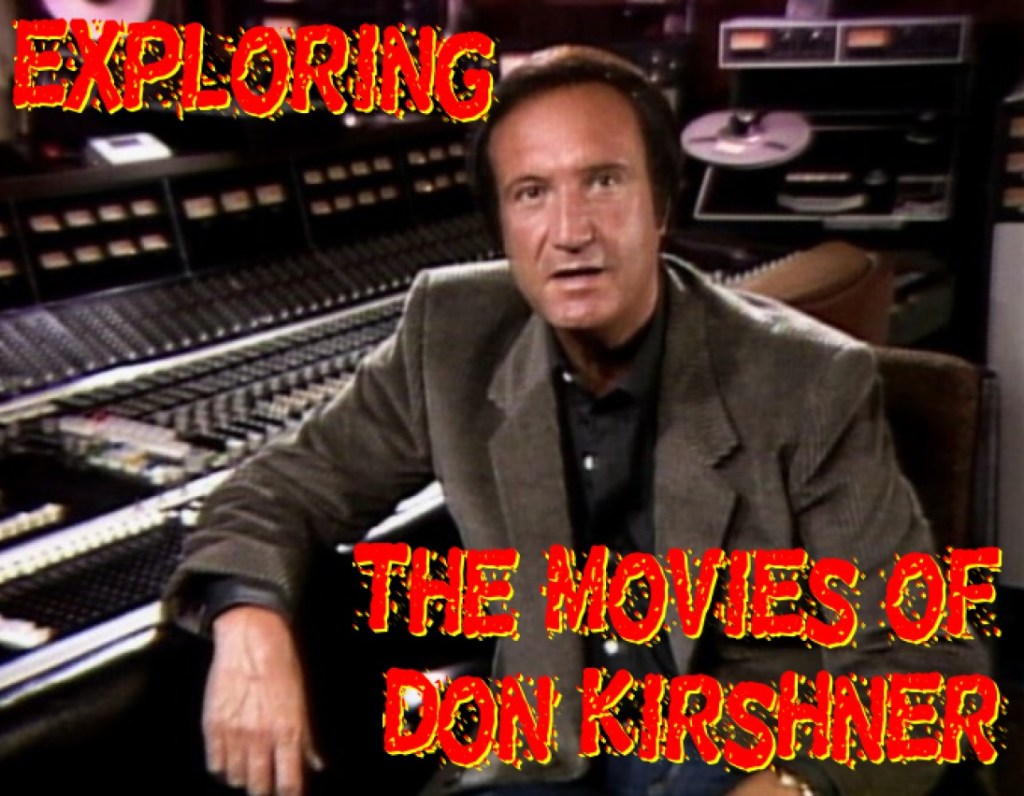
As for Don Kirshner: His lone screenwriting credit was on the hippie-western parody The Kowboys (1970) made with the same production team behind The Monkees. As with Toomorrow, that TV movie served as a pilot for a failed U.S. Monkees-inspired music series. After his failures to transform The Kowboys and Toomorrow into the next Monkees, Kirshner set his sights on Kim Milford (of Corvette Summer and Laserblast fame) and his post-Jeff Beck Group endeavor, Moon. The band starred in two ABC-TV movies: Song of the Succubus and Rock-a-Die Baby. While Kirshner produced and music consulted a wealth of even more TV series and specials for the networks (such as creating The Archies, music for The Flintstones, working with Sid and Marty Kroffts, The Harlem Globe Trotters, the Hudson Brothers, and producing the Greg Evigan-Paul Schaffer starring series A Year at the Top (yep, B.J and Artie Fufkin!)), Kirshner produced his first dramatic movie proper with the Michael Parks-starring The Savage Bees (1976). He quickly followed up with the TV movies The Night the Took Miss Beautiful (1977), Terror Out of the Sky (1978), and The Triangle Factory Fire Scandal (1979).
Learn more about the movies of Don Kirshner with our “Exploring” featurette.
* The crazy career of Roy Dotrice lead him from Kirshner, to dubbing Harvey Keitel’s “Brooklyn accent” for his character Benson in Saturn 3, as well as serving as Commissioner Simmonds in Space: 1999 (which appears in the series’ theatrical films Destination: Moonbase Alpha and Alien Attack), Cheech & Chong’s The Corsican Brothers, Milos Forman’s 1984 multiple Oscar Winner, Amadeus, and King Baylor in Hellboy II: The Golden Army. Like we said: crazy!
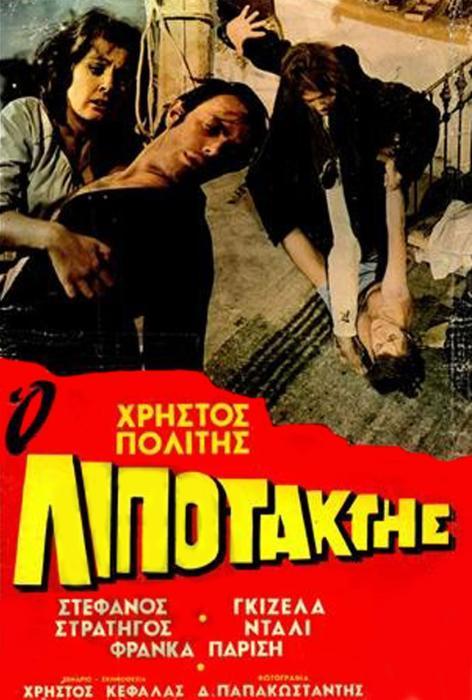
A young soldier escapes a seemingly endless war and winds up in the middle of an entirely different battle. Now he’s trapped between the desires of two desperate women. It’s another lost Greek film found by the folks at Mondo Macabro, who seem to specialize in discovering movies that you never knew about that you suddenly find out you need to own.
Ermina (Franca Parisi, Atom Age Vampire) is trapped in a loveless marriage to a farmer who only cares about getting rich selling moonshine to soldiers. And the other woman (Greek singing star Alexandra Kyriakaki) is much younger and lives in a world of fantasy. They’re both in love with the soldier who has been hiding in a barn and falling for both of them.
I was really struck by how rapid the cuts are in some of these scenes, almost a strobing effect as the emotional anguish increases. This movie has the kind of insane love in it that causes women to pull knives and fight one another in the mud. There’s also a great scene in here when the younger girl casts a love spell to try and keep the soldier all to herself. Gisela Dali — the Greek Bardot — has a brief role here as the witch who aids her.
This film was edited — and perhaps directed — by Bruno Mattei, who remade it in Italy as Armida, a Wife’s Story with Parisi returning to star in the remake.
You can get this on a double blu ray disc along with The Wild Pussycat from Mondo Macabro.
NOTE: This film was sent to us by Mondo Macabro, but that has no bearing on this review.
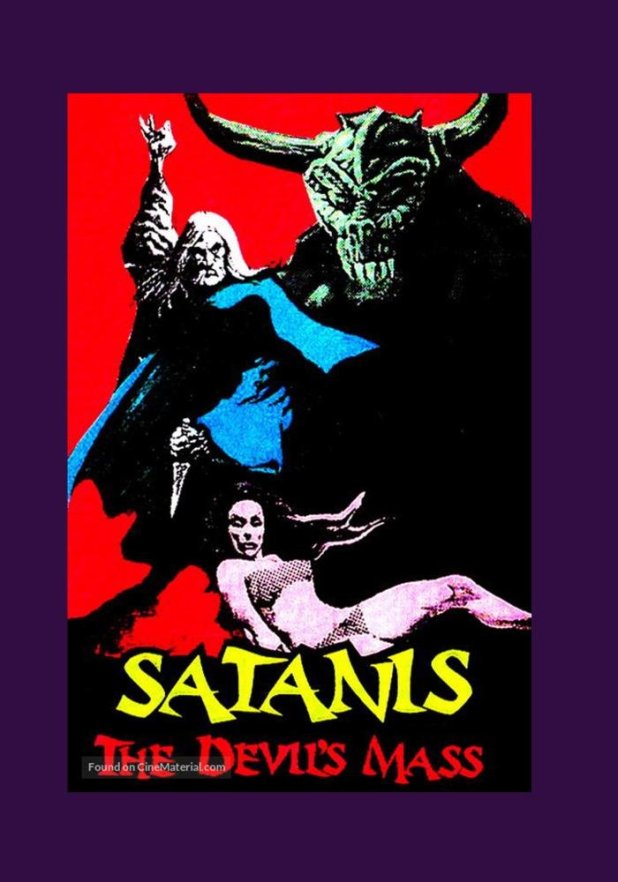
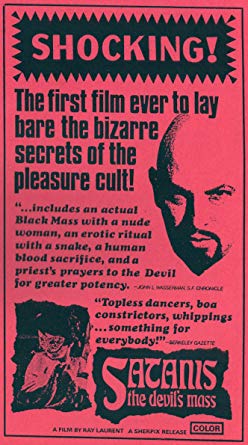
This 1970 documentary about Anton LaVey and the Church of Satan that was directed and produced by Ray Laurent, whose only other credits involve editing some films, including one of the Lemon Grove Kids films that Ray Dennis Steckler directed. Within this movie, there’s plenty of ritual footage, as well as interviews with LaVey, his family, church members and then his somewhat annoying neighbors and some priests and Mormon missionaries.
It’s really interesting to see how the people living next to LaVey saw things, less concerned about the people coming in and out than the upkeep and shingles of the Black House. This is a rare opportunity to see actual rituals of the early Church and hear from its members.
Also, the Church is very ahead of the cultural mores of the time — and even today — commenting on how they don’t tolerate homosexuality in the Church of Satan. Instead, they go further: “To tolerate is to infer they are different or less than, we just accept them as normal people because that’s exactly what they are.” Keep in mind this was made in 1970.



 B&S About Movies
You must be logged in to post a comment.