Ted V. Mikels had the body of a Greek god with a giant handlebar mustache, lived in a castle in the Nevada desert populated with live-in women (his Castle wives) and made astoundingly crazy movies. He was a magician, acrobat and fire eater before he started making movies and once he began filming them, he left this planet with pieces of insanity such as Girl In Gold Boots, The Black Klansman, The Corpse Grinders, Blood Orgy of the She-Devils, The Doll Squad and many, many more.
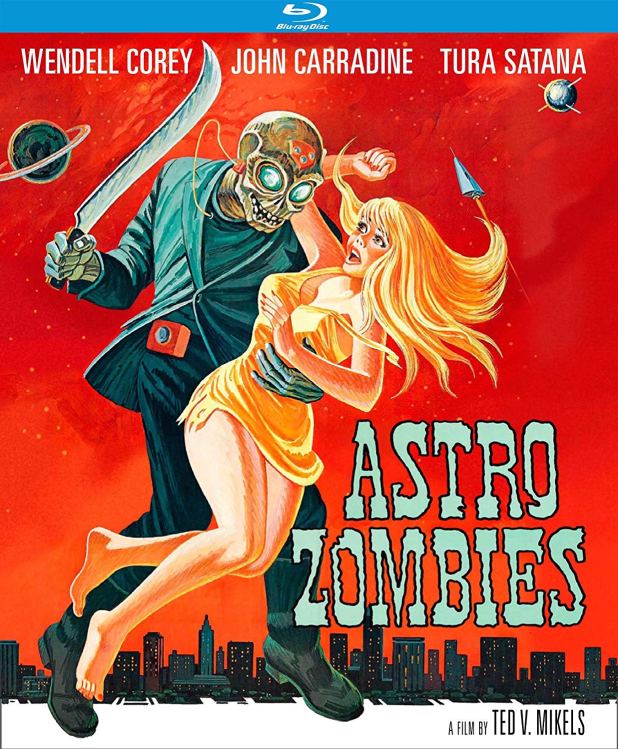
Dr. DeMarco (the ever-job hungry John Carradine) gets fired by the space agency. Not NASA. The space agency. So he does what any of us do when we get downsized. No, he doesn’t develop a case of the shakes and contemplate how to kill himself so his wife can take advantage of his life insurance because he’s failed yet again.
He makes superhuman monsters from the body parts of innocent murder victims that can be controlled by flashlights to the side of the head.
That said, those undead, well, astro zombies get loose and the CIA and an international gang of spies all get mixed up.
This is Wendell Corey’s last film, an ignominious close if I ever saw one.
Wayne Rodgers, who would become a star on M*A*S*H* co-wrote and co-produced this movie, the last time he’d work with Mikels.
But come on. You’re watching this for Tura Satana. Seriously, of all the women to walk the millions of years on this Earth, there could be only one Tura, the women who studied martial arts so that she could go back and get revenge on the men who assaulted her as a child, like a living and breathing version of They Call Her One Eye.
“I made a vow to myself that I would someday, somehow get even with all of them. They never knew who I was until I told them,” said the goddess herself.
She also survived being shot, breaking her back in a car wreck and a wedding proposal from Elvis Presley. Seriously, my love for Tura Satana knows no boundaries.
She’s why I watched this movie.
As Glenn Danzig once sang in the song “Astro Zombies” — which more people know than probably this movie — “With just a touch of my burning hand, I’m gonna live my life to destroy your world. Prime directive, exterminate the whole fuckin’ race!” The Misfits were the perfect band to convey the junky charms of this film.
You can watch this on Amazon Prime. The Rifftrax version is available on Tubi.
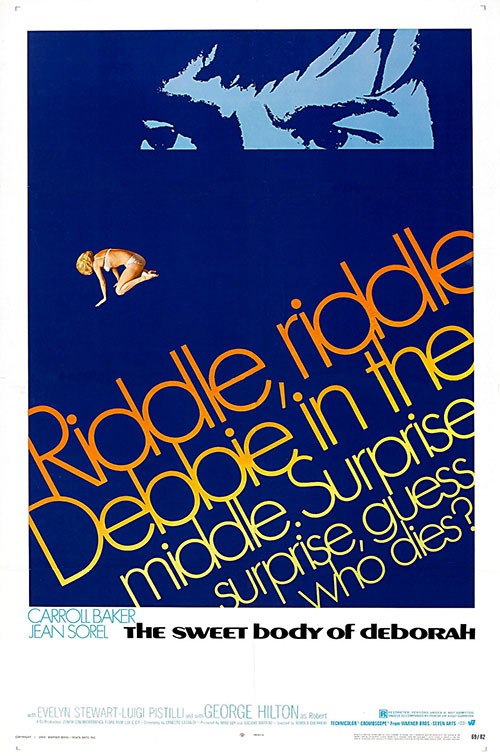
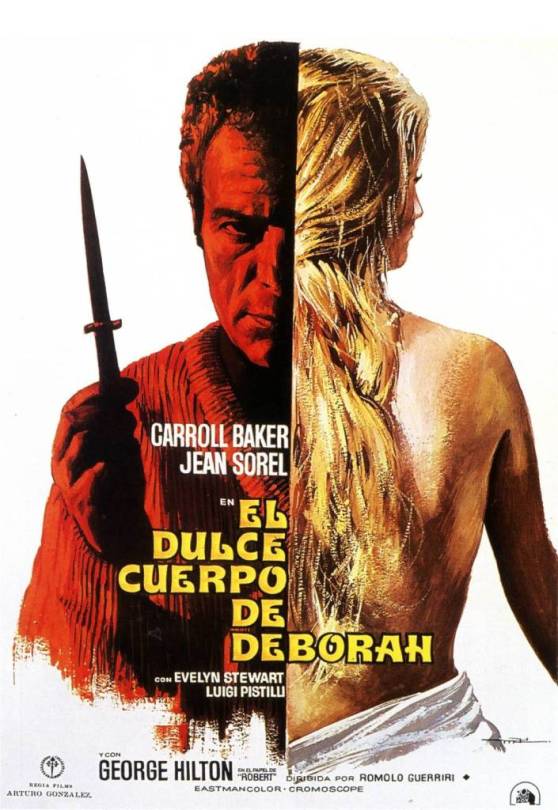
Il Dolce Corpo di Deborah, or The Sweet Body of Deborah, is a gorgeous film that embodies the fashionable side of the giallo. It’s directed by Romolo Guerrieri (Johnny Yuma) from a script by Ernesto Gastaldi (Hands of Steel, 2019: After the Fall of New York, The Case of the Bloody Iris, The Strange Vice of Mrs. Wardh — obviously this man knew what he was doing with a resume like that) and producer Luciano Martino (who, in addition to helping write The Whip and the Body and Delirium, was engaged to Edwige Fenech at one point).
Adding to this pedigree — the cast. Carroll Baker is a giallo queen if there ever was one, thanks to appearances in So Sweet…So Peverse, Orgasmo, A Quiet Place to Kill and Baba Yaga (a comic book adaption with George Eastman in it, so it’s amazing that I’ve never written about it here). And Jean Sorel, who was in the proto-giallo Perversion Story for Fulci, appears here as well. Finally, to make every fan of the black-gloved psychosexual realm pleased, George Hilton (who once played Sartana, as well as appearing in Luciano’s brother Sergio’s films, such as All the Colors of the Dark and The Case of the Scorpion’s Tail) is here as a voyeur.
Oh yes. We have a winner, dear reader.
Deborah (Baker) and Marcel (Sorel) have returned home from their honeymoon, just in time for them to learn that Marcel’s past lover, Susan, has killed herself. The mood transforms from frolic and fun to fright, as a man from the past named Phillip (Luigi Pistilli, Iguana With the Tongue of Fire, A Bay of Blood).
Marcel — and Deborah — both start to receive threats related to Susan’s death. But is she really dead? And who is Robert (Hilton) and why is he perving all over our girl?
While this isn’t the best giallo you’ve ever seen, you get to see Baker in — and out — of some insane fashions. There’s a bonkers outdoor twister scene set to some cool jazz and a nightclub with pop art all over the walls, including Batman and several sculptures of Cybermen from Dr. Who. The whole mood and tone are totally perfect.
Ah man. If only all films were this sumptuous. And sounded this great, thanks to a score by Nora Orlandi. You may know her from the song “Dies Irae”, which was in The Strange Vice of Mrs. Wardh and Quentin Tarantino’s Kill Bill: Volume 2.
There’s also an amazing knife fight scene in the dark and a great ending. What else do you want?
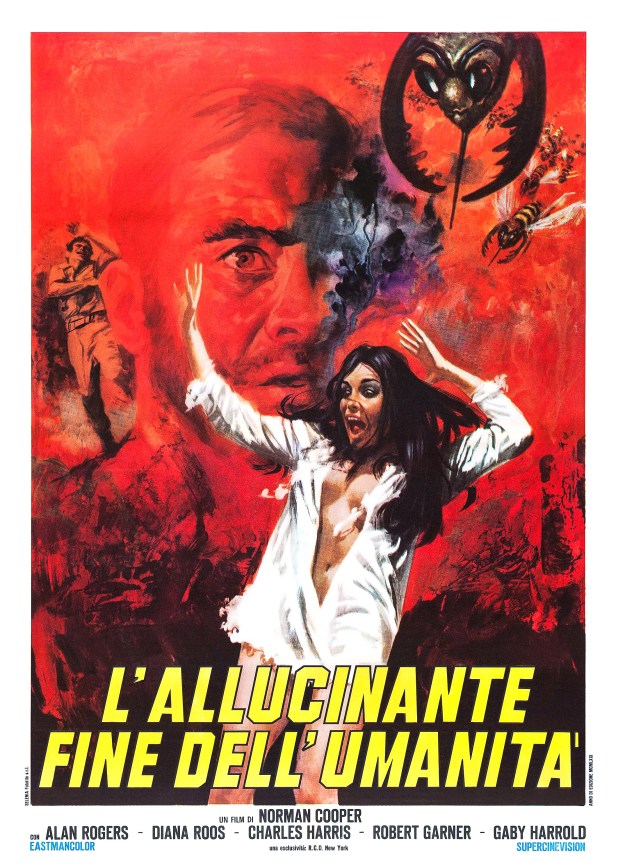
Also known as Konchu Daisenso (which translates to Insect War), this Japanese apocalyptic film was directed by Kazui Nihonmatsu, who often found himself as an assistant director to Akira Kurosawa (on 1952’s The Idiot), Keisuke Kinoshita (Carmen Come Home) and Masaki Kobayashi (1956’s The Thick-Walled Room). He would use the name Norman Cooper here.
It’s written by Susumu Takaku, who would later write 92 episodes of the anime Mazinger Z, the Fist of the North Star anime movie and numerous Sentai shows.
The Shochiku Company was considered a prestige studio, not one that was part of the kaiju and science fiction crazes of the 50’s and 60’s in Japan. But here we are, with one of the few films that the studio made within these genres.
Somewhere in the Anan Archipelago, Akiyama Joji is making time with Annabelle, who is not his full-time woman, when an American jet carrying a nuke goes horribly off-course above. Charly, one of the crew, has a flashback to World War II thanks to an insect. He begs for drugs as a release from his pain, begging not to go back into the war. This is 1968, not today when PTSD is common knowledge. Suddenly, the plane flies into a swarm of insects and explodes, with several parachutes escaping the wreckage.
Charly is played by Arthur “Chico” Lourant, who made his way to Japan via the Korean War before staying there as an actor, with roles in Gamera vs. Jiger and Prophecies of Nostradamus, which was released in the U.S. as The Last Days of Planet Earth.
The hydrogen bomb on board is missing and now Lieutenant-Colonel Gordon must find it. At the same time, Joji’s wife Akiyama must deal with her adulterous husband and the unwanted attentions of her boss Kudo. And hey — there’s Charly, who seems to be the only survivor. The rest? Dead in a cave and covered with insect bites.
Joji has found a watch whole looking for insects for Dr. Nagumo. This is the only fact that the military needs to put the blame for the two deaths on him, as the watch is government issue. Yukari begs the doctor to speak for her husband, just as we learn that insects are destroying India.
Meanwhile, Dr. Nagumo meets the only other witness to the accident, Joji’s lover Annabelle, who knows way more about the insects on the island than maybe even this scientist. That’s because she’s at once a scarlet woman, a lover of nature, an enemy to capitalism and, yes, a mad scientist.
This is a film with no real heroes and constant inhumanity to man, so you take the good where you can get it, you know?
“I don’t care whether I live in a free society of a Communist one. I just want to breed vast numbers of insects that drive people mad and scatter them all over the world.” Oh Annabelle!
Kathy Horan, who plays this role, shows up as a stock American in plenty of Japanese films of this era, including The Green Slime and the astoundingly great King Kong Escapes.
Meanwhile, Charly dies and it’s revealed that the insects have laid their eggs inside him. As he expires, they all chant “Genocide! Genocide!” This movie has become pure drug-filled post-nuke madness. What follows is even more buggy, as they say: the good doctor allows himself to be injected with insect venom so he can connect with their hive mind and learn their plan for dominating the world. Seriously, do not dose yourself before this scene.
Nobody really gets out of this alive and if you think Japanese directors are going to allow the Americans to not look like amoral scientists who will quickly nuke their small island from orbit, perhaps you don’t understand that, well, we already did that twice to them.
Seriously, this is one demented film.:
You can watch the Cinematic Titanic version of this movie on Tubi. The Criterion Collection released this film on a compilation set titled When Horror Came to Shochiku along with Goku Bodysnatcher from Hell, The Living Skeleton (which it played double features with in the U.S.) and The X From Outerspace. You can buy it on their site.
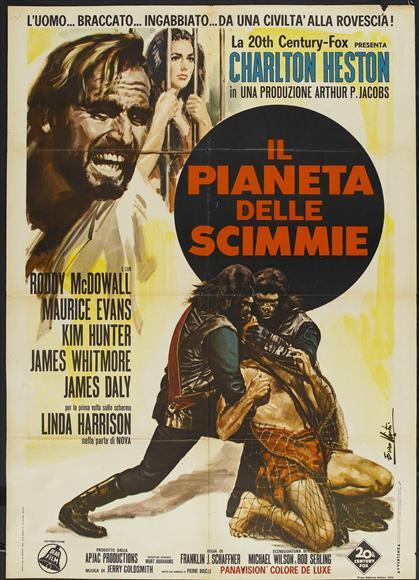
La Planete des Singes is where Planet of the Apes gets its start. It’s the story of three humans who travel from Earth to the star Betelgeuse, where apes are the dominant species. So many of the ideas that appear in the movies come from this book, save the shock ending that all surprise endings yearn to emulate.
Let me tell you — Planet of the Apes is beyond Star Wars for some folks. How many other franchises have had so many sequels, two reboots, a TV series and a cartoon?
Boulle’s literary agent, Allain Bernheim, sold the novel to film producer Arthur P. Jacobs, who once said, “I wish King Kong hadn’t been made so I could make it.” Luckily, he had just the ape project to sell him.
Jacobs spent over three years trying to convince someone to make the movie. The screenplay, from Twilight Zone creator Rod Serling, went a long way toward making that happen. He added themes from the Cold War and added the aforementioned twist ending. But with production costs at $10 million — $70 million today — no studio wanted to make it.
Jacobs and associate producer Mort Abrahams kept at it and once they got Charlton Heston on board, things started to get rolling. Heston brought director Franklin J. Schaffner (Patton, The Boys From Brazil) on board and for a screen test.
This screen test featured Heston, Edward G. Robinson appeared as Dr. Zaius and two then-unknown Fox contract actors — James Brolin and Linda Harrison — who played Cornelius and Zira.
It worked and convinced 20th Century Fox to make the film for $5.8 million, which paid off — the film made $22 million.
Astronauts Taylor (Heston), Landon and Dodge awake from hypersleep as their ship crashes into an unknown planet. A malfunction has already claimed the life of their crewmate Stewart. As they leave their spacecraft, Taylor notices that they are 2,000 years in the future and on a planet that appears to be a wasteland.
Soon, they’ve been attacked by not only primitive humans but militant apes. Dodge is killed, Taylor is injured and Landon is knocked out. Animal psychologist Zira (Kim Hunter) and surgeon Galen (Wright King, Invasion of the Bee Girls) save Taylor and place him with Nova (Linda Harrison, who for some time renamed herself Augusta Summerland thanks to her spiritual advisor), a gorgeous primitive human.
The apes live in a caste system, with gorillas serving as the muscle, orangutans handling religion and government and chimpanzees being involved in medicine and science. Humans are seen as nothing more than animals to be herded and hunted.
This all changes for Cornelius (Roddy McDowall) and Zira when they learn that Taylor can speak. After all, how else would we get such classic lines like “Take your stinking paws off me, you damn dirty ape!”
Of course, a visit to the Forbidden Zone — a trope that would come back in nearly every post-apocalyptic film ever — we learn that this isn’t another planet. It’s Earth. It’s also the best ending to probably any movie ever made.
Two months after this came out, they were already talking sequel. Stay tuned all week — we’ll be covering every single film in the series.
ABOUT THE AUTHOR: This is the second film in Raven Mack’s series. You can learn more about this work of art here or support the work of the artist at his Patreon.
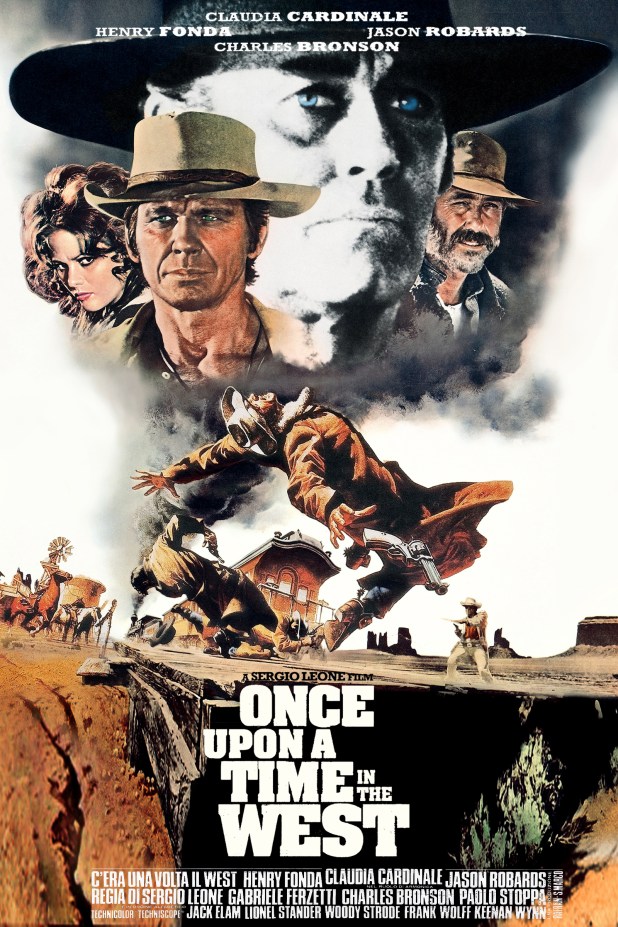
Once Upon a Time in the West is a spaghetti western epic, the first big film done by Sergio Leone after his trilogy with Clint Eastwood featuring the man with no name, each of which ended up being a bigger box office success than the one before it. The film was a big budget Paramount Pictures fever dream about the American mythology of the west, and is an absolute beauty from a cinematographic perspective. It got released in December of 1968, a month after Richard Nixon got elected in a somewhat unsettled Presidential election cycle.
1968 was a time of plenty unrest in America, with both Martin Luther King Jr. and Robert F. Kennedy getting assassinated that year, and riots spawning multiple times, both in African-American communities as well as among liberal college campus set. The Democratic Convention in Chicago was a huge mess, where thousands of activists showed up to disrupt the proceedings of status quo with antiwar protests. Police ran roughshod with tear gas and clubs, all of it on TV for the whole nation to see. Incumbent Lyndon Johnson had already pulled out of running after losing early primaries and with RFK in the race, long before it got to the convention. Hubert Humphrey came out of the convention as the nominee.
Richard Nixon’s launch into political success (he lost to JFK in 1960, so this was his second run at the big seat) was not without its own opposition, as the more racist South, who around this time were being rejected by the Democratic Party that had previously housed Southern Dixiecrats after the Civil War, wanted a pro-segregationist politician. The American Independent Party was founded via funding by Bill and Eileen Shearer, who positioned former Alabama governor George Wallace as an unflinching voice for law and order segregation. The whole thing has snippets and tinges of 2016-2020 politics, but even worse, which is a good reminder for this constant End Times vision we all seem to be instilled with in this great digital age of fear and self-loathing. Wallace actually won five deep south states in the election, with Nixon taking most everywhere else in the south and west, with Humphrey getting most of the northeast and notably Texas. Obviously, as history showed us in the years that followed, Nixon was absolutely not a unifying force with a grand vision for a better America, but instead a political bully who ended up being his own worst enemy. But when you have an outright racist like Wallace, and a status quo baby steps towards progressive visions establishment candidate like Humphrey, Richard Milhouse Nixon was the centrist, by default.
It’s also really strange to think about what’s historically painted as such a cataclysmic time in American history, with people literally setting shit on fire in the street demanding a better country. And the Democratic Party could only trot out a tired “old politics” safe bet (which sounds awfully familiar), and the Republicans brought out a longtime political snake who pretty much ran on blaming LBJ for Vietnam and civil unrest and everything else. That, combined with Wallace siphoning off the outright racists, allowed Nixon to win in an election more like that Three Stooges bit where two of them step backwards leaving Curly up front than any other.
In terms of my family, when this film dropped, my mom would’ve been 12, and my dad would’ve just turned 13 a couple days before. It was just his birthday this past Thanksgiving, and I miss him more now than ever, likely because familial relations are all fucked up, and I’m very alone in this world in terms of family, so I can romanticize my father (who died at 46, but would’ve turned 64 if he was still alive) and pretend he would’ve been a wonderful part of my life, instead of likely having fallen down all the wrong rabbitholes on a secondhand iPhone 6, and texting me links to youtube videos that were gonna wake me up to the reality going on. I am thankful for strained family relations so that I don’t have to tolerate proud pro-Trump voices who think they are incredibly smart for seeing through the Democrat’s bullshit. I also don’t understand that binary, because I could give a fuck less about the Democrats. Yeah, they’re hypocrites and the established portions of that party are likely corrupt as fuck. But you take that counter example away and have Trump standing there by himself without the comparison, and what you have is corrupt as fuck hypocrite.
Anyways, it’s good to look back briefly at a previous election and realize it’s always been fucked to one extent or another. The things we are experiencing in today’s America really aren’t that much of an anomaly. And it makes sense to go back to a western from that tumultuous 1968 year, because the American Dream, which has always been a myth and mythologized to a certain extent, was definitely kept alive by how we collectively imagined the old west. Early America was English colonies, where the fine English carved out the beginnings of a new world, and sent poor non-English people out into the Appalachian wilderness to settle and further colonize this already inhabited land. Once Thomas Jefferson (who lived in a nice house on the mountain overlooking my basement apartment I can barely afford) completed the Louisiana Purchase from Napoleon, doubling America’s claims to land in size, and the concept of Manifest Destiny was ingrained in our consciousness, the settler-colonist mindset spread further west until it hit the Pacific, with the notion that America was creating a New World, better than the old one, like a chance to redo what Europe had done, but bigger and better, acting as if it was all new and people didn’t already live here. “Go west, young man,” was the phrase attributed to newspaperman Horace Greeley, about how you could build a new life for yourself, even if you didn’t have a great one yet, because there was unlimited wealth to be found. Gold rushes, and speculation, and the expansion of the U.S. railroad system all fed this, sending poorer eastern whites west, in the hopes of becoming rich as fuck.
That is the foundational essence of the western genre, which reflects this mythologization of the American west during this period, and it’s the underlying theme of this particular Sergio Leone written and directed film as well. This Irish dude, McBain, has landed just outside a place called Flagstone, on a chunk of land he bought and named Sweetwater, as it was the only source of water in the area. McBain had secretly been planning on building a station, and making a brand new town out here in the desert, just by having the foresight to get the land and figure out where the railroad was gonna get built.
The film opens with magical imagery, as three dudes have congregated at a station, presumably to do some dastardly shit, as they’re bullying the station manager. One of those three is that crooked eyeball dude Jack Elam who played in a ton of old movies, and was an amazing character actor. He’s even in the credits in the opening of Once Upon a Time in the West, but very little time passes before our antihero, the ghostly harmonica playing Charles Bronson, simply called “Harmonica”, shoots Elam and his compadres dead. That establishes our first character in the drama triangle.
The second is quickly established in elder Henry Fonda, who is part of a bad crew of dudes (some real bad hombres, as Trump would say) who end up murdering not only McBain and his teen children, not only the sweet teen daughter softly singing “Danny Boy” a few moments earlier, but even the young maybe 8-year-old child who was far too young to be murdered openly, even by old west standards where you lived by the gun for the most part. But Fonda’s character, called Frank, was named out loud by one of his fellow gunmen, so he had to shoot the boy so the boy didn’t talk about who killed his family. This obviously establishes Fonda as the hard evil on our drama triangle.
And finally Jason Robards wanders into a saloon, recruiting some sucker to shoot his hand shackles loose, and has a tense interaction with both Harmonica as well as McBain’s whore wife from New Orleans (she really is a sex worker, so I’m not projecting here), before wandering off as the third part of our drama triangle, all of which get involved with the widow McBain to one extent or another, with varying levels of mutual consent.
It should be made abundantly clear that the pacing of a Sergio Leone movie is absolutely amazing – a morphine dream of a slow boil, so unlike today’s marathon explosions and CGI-induced sensory shock and awes. So many close-ups on various white faces that have become dirt and sand and sweat and blood-stained to various degrees of non-whitening. There’s a long sequence of a sweaty ass Elam sitting in a squeaky chair fiddling with a fly on his face, slow thick drama like southern humidity.
The unwhitening is both an actual phenomenon and digital cultural posturing seen in actual life. I remember on a Greyhound layover one time, getting drunk with two dudes from California outside the Oklahoma City bus station, from a bottle of vodka stashed in the trash can, and both dudes were belligerently white, but their faces were that deep brown leathered, crackled broke ass for two generations, half that time stuck outside white faces. That same shade as seen on the face of the mother in that famous Dorothea Lange photo, of dust bowl family fleeing west. I think about those types of whitefaces a lot when I contemplate my internal philosophies of dirtgods juxtaposed with shinefaces. Shinefaces are always clean, perfectly manicured, no scars or cracks or deep brown effects of public poverty on their faces. Smooth silky handshakes, smooth silky clothes, and smooth silky faces. The wretched of the Earth white are not the equals to the fine whites, which is also why I get tripped out by poor people supporting Trump so nihilistically. I used to live across the road from a dude who was a shitty HVAC repair dude who worked on farms both days in the weekend, often times driving animals to the slaughterhouse at night too. He worked seven days a week, every week, and still ain’t have shit, yet had a Trump sign out front of his house. How does a guy like that, who can’t get ahead no matter how much he works, get behind a guy that literally had a gold-plated home? I don’t get it.
And then the other side of that unwhitening is what we see as a response to white fragility and guilt in digital culture, where every white person tries to distance themselves from the most oppressive versions of American whiteness, by being part Jewish or from a poor rural family, fetishizing Appalachian identity, even though that was the settler-colonizers who pushed the American Dream deeper into this continent, albeit less silky, less smooth handshakes and outfits. But just like Jason Robards or Henry Fonda, flashing blazing blue eyes behind that dirt-crusted face, it’s easy to still see what’s up.
As Harmonica and Jason Robards (called Cheyenne) are linked up as allies finally in this drama triangle, and realize McBain’s plans, and that Frank is a hired gun who’s come around to help some shithead on his own Trump-like train, complete with gaudy garnish galore, get ahold of McBain’s land and build the town at Sweetwater, they decide to work together to foil the plans, basically just to be dicks to be honest, but being dicks to the biggest dicks, so good, in relation, I guess using the same binary I said was stupid before with regards to two-party politics. The drama triangle at least gives us the illusion of more than one alternative, that sometimes even work together against the worst evil. We could use a drama triangle in American politics more, although I guess that’s also what George Wallace was in 1968. Fuck, are we just entirely doomed always?
But as Harmonica and Cheyenne talk, Cheyenne says the potential Sweetwater train town could be worth “thousands of thousands”. Harmonica answers, “They call that millions.” An unimaginable wealth, just there for the cultivating, if you’re willing to do the dirty work to make it happen. That old west mythology, of manifest destiny, which is also still the American Dream as it is written in the brochures, but not seen as often as maybe it once was.
I’d like to tangent here about the rich dude who had his own train, because THIS MOTHERFUCKER HAD HIS OWN TRAIN! Like, he was just riding around out west in this gilded ass fancy car, walking on crutches because he had polio or something, hiring these evil bastards to kill whoever he needed killed in order to make his destiny manifest, namely increasing his already exorbitant wealth even more. He was Trump, or Jeff Bezos, or Bloomberg, or whoever you feel best putting that role with your own personal biases, as the already wealthy asshole who is using his powerful wealth to make it even larger and more powerful. Of course, those who live by hired guns often die when they get turned on, and that’s exactly what happens to rich polio dude with his own fucking train, left to die in a mud puddle, ironically in a rare desert water source. Frank killed him.
This all leads up to the final showdown (as all westerns do), as the railroad is getting built closer and closer, and Cheyenne’s men are building the station to seal in McBain’s vision before the other bastards can steal the plan, and Harmonica Charles Bronson is just sitting there whittling a piece of wood. All this shit going on, and he’s just whittling with a knife. I briefly tried woodcarving, and found it highly enjoyable, but my 21st century mind is too ingrained with productivity and there being an end result to any effort made. I mean, fuck, this long ass pontification of a 1968 western is perfect example – I couldn’t just watch a bunch of old ass movies, one per year. I had to make a project of it, to share, and feel like I’ve produced something worthwhile instead of just slothing about on my secondhand Ikea futon couch in the purple Christmas lights watching an old Bronson flick. So woodcarving didn’t work out long term because I didn’t accomplish anything with it, other than whittling on some chunks of wood. Maybe I should give up all these stupid projects and just carve on some chunks of wood more. WHAT’S THE POINT OF ANY OF THIS SHIT?
Frank shows up finally, and Cheyenne is in the house with McBain’s widow (who I think would’ve slept with all three men in our triangle, except Harmonica was the hard good in the triangle, so didn’t reciprocate the advances). Harmonica lines up against Frank, and we get the flashbacks that show the childhood Harmonica being forced to stand with I guess his brother or father on his shoulders, in a noose, and a younger Frank (along with his bully buddies) is there, tormenting the young Harmonica, by putting a harmonica in his mouth as he struggled to stand upright to save his family member’s life for another few moments, before inevitably falling to the ground, thus being complicit in the death of his loved one. Frank’s just laughing in the flashback, but as we come back to current time, with bastardly Frank slumped to the ground, Harmonica pulls his namesake instrument out of his pocket and stuffs it into Frank’s mouth, coming full circle.
After that, Frank is dead, and Bronson splits, with no real point in life any more. Not everybody is bound to achieve great dreams of wealth and a wonderful destiny being manifested. Some of us are controlled by vengeance, and after he got his, he ain’t even need his harmonica no more. He just grabbed his satchel, and split. Cheyenne did too, catching up briefly to Harmonica, but he got clipped in the earlier shootout, so was dying too. Hard evil was shot dead, and indeterminate kinda evil but kinda good also got shot but bled slow. And hard good just disappeared into the distance, while the town got built and other people got rich and progress happened.
We ran out of land to head west on, but there’s still speculation galore. Our entire stock market is built on that. The rise of cryptocurrency is essentially that old west speculation, just in an even larger abstract realm, but it’s same damn shit as always. These imaginary entities get built, and fortunes get made, and a lot of people get fucked, and the only thing that undoes one of these super-evil super-wealthy assholes is them crossing the wrong person, who doesn’t give a fuck to be bought out, and just wants to gain revenge somehow, and plays that out slowly and quietly and with great attention to every nefarious detail. Within the grand abstraction of whiteness, the hardest evil point of that triangle always hopefully get undone by a vengeful spirit somewhere else on that confusing non-binary triangle. That’s our infamous antihero – too fucked up to actually succeed according to civilized standards, but amazingly beautiful in their ability to briefly light a better path for us all with their bridge arsonry.n
This movie, originally known as Island of Living Horror, was rereleased with Count Dracula’s Great Love. The former was retitled Cemetery Girls, and the latter was renamed Grave Desires.
Much like all of these Filipino horror films, it’s completely bonkers.
The tropics are the place for three Americans to find, well, complete insanity.
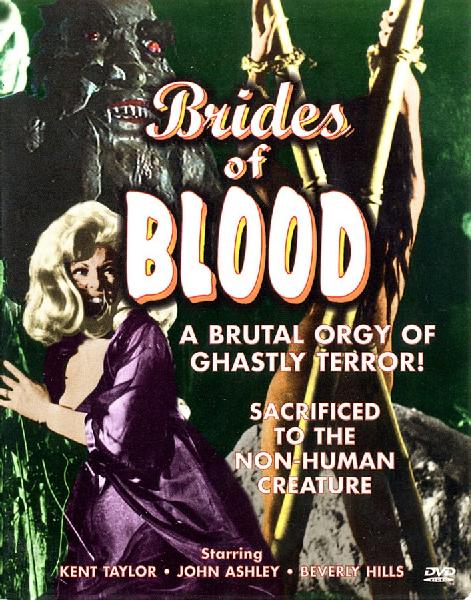
Dr. Paul Henderson, a nuclear scientist investigating nuclear bomb tests, is played by Kent Taylor. He was once a major star, playing the title role in fifty-eight Boston Blackie movies. His name is also half the inspiration for Superman’s alter ego (the other star is Clark Gable).
He’s married to the gorgeous but always ready-to-cuckold Carla, Beverly Powers. Beverly was once the highest-paid exotic dancer in the world before becoming an actress and starring with Elvis in Speedway, Kissin’ Cousins and Viva Las Vegas. She also pretty much played herself in Breakfast at Tiffany’s. After all that acting, she became a minister with The Living Ministry in Maui, Hawaii.
Then there’s Jim Farrell, a young Peace Corps member played by John Ashley. Ashley was an AIP star who appeared in Dragstrip Girl and sang his song “Let Yourself Go Go Go” in Zero Hour! He was also a regular in their beach movies, appearing at Beach Party, Muscle Beach Party, Bikini Beach, Beach Blanket Bingo, and How to Stuff a Wild Bikini.
After living in Oklahoma for a while, Ashley produced these movies with Hemisphere Pictures, living in the Philippines for part of the year and helping to create these little bits of madness.
Our protagonists soon learn that Blood Island is cursed. It’s now a place that has been irradiated by nuclear fallout from those bomb tests, with vines that attack people and butterflies that bite. There’s also a beast in the jungle that tears women apart to get off because, hey, why not?
Carla learns that the beast is one of the villagers, Esteban, but it comes at the price of her own life. She’s an early “sex and people who want sex must be destroyed” casualty decades before this type of destruction de rigeur.
Between carnivorous trees eating Carla’s remains and the movie ending in a vast orgy, this is probably unlike any other film you’ve seen before. You can say that about every single film from this studio.
The press book for the movie suggested that all female theatergoers would get the chance to become Brides of Blood and receive a free engagement ring. There was even the idea of giving away fake marriage certificates, but legal concerns prevented that.
I kind of wish that I was alive in 1968 just so I could have been part of this movie. Seriously, I’ve never seen a film that so quicky changes its tone and central theme so quickly, abandoning characters that its taken time to set up for an entirely new situation. And then we get the airplane, with swinging bands playing on it and people going bonkers before it crashes? I want to live in this insane world.
After we meet all these folks — bound for Rio — we better not get too used to them. Except for little Henry Clayton Jr., who is taking his stuffed lion to live with his mother after his parents split up. There’s also Mrs. Sherman, who may or may not have killed her husband, but has a suitcase full of money and is given to insane crying jags. And there’s an exotic dancer on board as well! And some nuns, traveling with one of their dead sisters in a coffin! And then there’s a band! And a rich dude that talks about cannibals!
Everybody is having so much fun that the band plays their big hit and Marian, the exotic dancer, shows off and even the nuns enjoy it.
However, the movie soon turns into sheer insanity, as the plane begins to crash. Money spills all over the plane, a nun gets pulled out of an open door and half the cast abruptly dies. Seriously, somehow this went from “Soft Lips” to dudes getting their foreheads split in half and a gory death with a birdcage. I have no idea what brought on this narrative shift.
Then, to top all this off, every single other person we met is eaten by alligators.
You read that right.
The entire cast is dead.
Everyone except Henry, who is now floating down a reptile filled river in the coffin of a dead nun.
What the actual hell is going on here?
The natives — yes, the cannibals that were discussed on the plane that call themselves the Jivaros — find Henry and thanks to his blonde hair and the magic of 1968’s worst special effects, he has a halo. The leader of the tribe declares that he is a god, except that one of them thinks he has to die. So he chases Henry into the jungle and the kid’s stuffed lion transforms into a real lion and eats the dude.
So wait — is Henry really a god?
This is a movie that starts with the declaration that “This pictur was filme don location in the Jivaros Regions of the Amazon Jungle. Without the assistance and encouragement of the Government of Peru it would not have been possible.”
It’s also the kind of movie that randomly has Fawn Silver be Marian, the exotic dancer. If you don’t know who she is, she’s Criswell’s assistant in Ed Wood’s Orgy of the Dead.
It also has three directors — Tom De’Simone directed the plane sequence, Andrew Janzack the jungle parts and the temple close was directed by Alex Graton. That may explain the strange narrative leaps that this makes.
Let’s break down each director.
Tom De’Simone went on to become adult film director Lancer Brooks, as well as creating some of my favorite films, like Hell Night, Reform School Girls and Chatterbox.
Alex Graton would finally direct another movie eleven years later, a romantic comedy entitled Only Once In a Lifetime that has Claudio Brook — yes, the same Claudio Brook who was in Luis Buneul’s The Exterminating Angel — in it.
I love IMDB because it has comments directly from De’Simone in the review. I’ll share it below for your enjoyment:
“OK, now it’s my turn to weigh in on this disaster. I’m the director who’s credited with this fiasco but in my defense I have to explain that there were three directors on this film and we all suffered under a producer with no experience, no taste, no sense and worst of all, NO MONEY.
I was fresh out of film school working as an editor when I was introduced to him when he was looking for a director. I convinced him I could handle a feature having already won two awards at film festivals for two shorts I had done. This was the biggest mistake in my life. Once on, for a mere $50 a day, I realized what I had gotten into. He hired a bunch of non-SAG actors who actually PAID HIM to be in his movie. None had any experience in front of a camera and all the characters were his creation. I was stuck in that plane mock-up for two weeks with these desperate souls trying to create something from nothing. The script was only half written when we started and he said he would finish it when we got to the jungle. When we completed the plane interiors, including the now famous “crash” scene, the rough cut was 83 minutes long and we hadn’t even reached the jungle part of the story.
I told him we had to make some serious trims, both for time and for performances. He refused to cut anything. He was so in love with the crap we had he actually once said he believed that the actress playing the stewardess would win an Oscar for her scream scene in the fire. I knew I was doomed. We argued over and over about what I felt should be dropped, trimmed and eliminated until I had it. I walked from the production and that wonderful salary. Undaunted, he went to Peru and used the cameraman as the replacement director. Down there they wrote the second half of the script and shot it as he wrote it.
Back in LA they now had a bigger disaster, naturally. The film was way too long, badly shot, badly acted and unwatchable. He and this second director fought, as did I, and he then walked away as well. Now the producer was over a barrel. He had sunk what little money he borrowed and still believed he had a hit on his hands if he could just get it finished. He hired a third guy to come in and fix the problem. This genius hired a bunch of extras, put bad wigs on them and went to Griffith Park in LA and shot more crap that was even more laughable than what they got in Peru. After that the producer shopped around for stock footage of native ceremonies and came up with some god-awful crap from a 40’s schlock film and cut it in… the final disaster is what’s on screen. I’ve lived in shame my entire career because for some reason I always get the credit for making this turkey. I was one of three victims! The entire debacle was the brain child of the producer and none of us had a chance in hell to make it any better than it was doomed to be from the start.
And that’s the truth.”
In case you haven’t realized it yet, I love this movie. Like, beyond love. I’m going to bother everyone I know to tell them just how great it is and then laugh when they look at me and wonder why I enjoy this blast of craziness so much. Beware!
Update: You can also find Terror in the Jungle on Mill Creek’s “Explosive Cinema” 12-pack box set, which we reviewed in full during the second week of March 2020.
Thanks to Dustin Fallon from Horror and Sons for this entry. He’s always been a big promoter of our site and has been instrumental when it comes to getting writers for this project. Plus, he’s one hell of a nice guy.
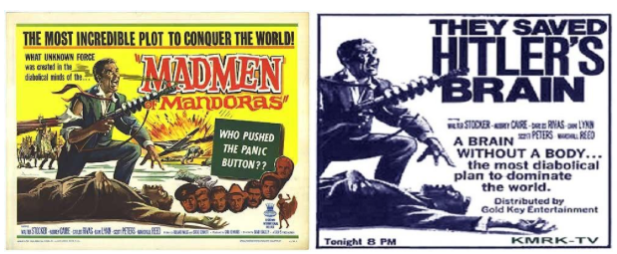
They Saved Hitler’s Brain is a 1968 film directed by David Bradley, who also directed 2 well-known films starring Burt Lancaster, “Peer Gynt” and “Julius Caesar”.
You know what? Strike that last sentence.
The Madmen of Mandoras is a 1963 film from director David Bradley, who also directed 2 well-known films starring Burt Lancaster, “Peer Gynt” and “Julius Caesar”. They Saved Hitler’s Brain is really just the same damned movie, re-titled for television distribution in 1968 and featuring new footage shot specifically for its broadcast re-release.
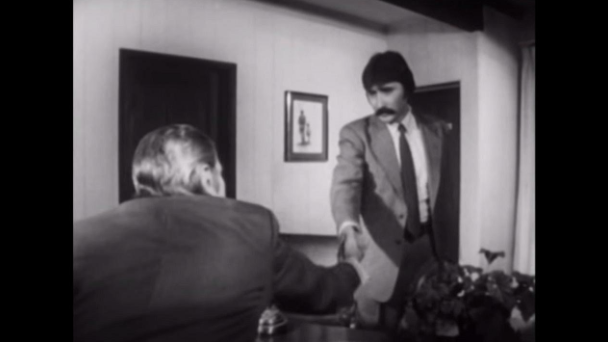
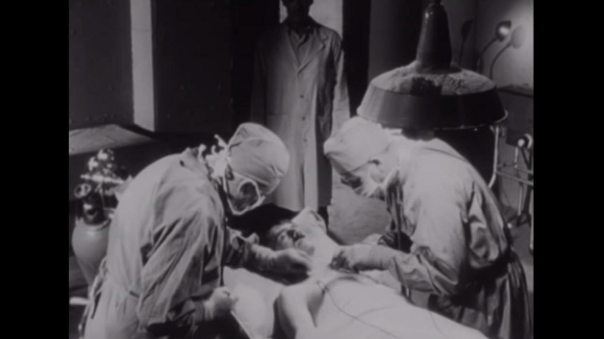
The new footage, which is essentially an entirely new opening for the film, is a bunch of muddled nonsense that attempts to expand upon the original film’s plot, but in truth adds nothing of value or importance to the film, and actually slows down the film’s pacing. The film opens with a scientist who has been working on a secret government project to create a serum for the deadly chemical weapon known as “G-gas” (which the government fears may be used as a weapon by hostile countries) being blown to bits when he triggers a bomb connected to his car. A government agent, who looks suspiciously like Hall of Fame closer Dennis Eckersley, is assigned to the case.
The opening moments of The Madmen of Mandoras are edited into this new footage through the use of some rather abrupt and jarring transitions, with the difference in film quality immediately apparent. These scenes highlight a military briefing on the lethal “G-Gas”, where it is stated that the antidote must remain well guarded, as its falling into the wrong hands could have dire consequences for the entire world. Of course, this just means that a scientist working on the antidote is soon captured by agents of the surviving Third Reich!
They Saved Hitler’s Brain attempts to add some additional action to its runtime by meshing footage from the original film with the newly created scenes so that it appears that Eckersley and his new female partner are trying to thwart the abduction. However, both agents fail to do so and are killed for their efforts, saving viewers the nightmare of dealing with them any longer. This, in essence, wraps up the “Hilter’s Brain” portion of this review, as well as the newly created portions of the film. Now, forget they ever happened because they are total shit!
As for the real film, The Madmen of Mandoras….
Near the end of WWII, Nazi scientists discover a means of preserving the life of Adolph Hitler into perpetuity, allowing the man to continue his plans for world domination for years to come. Well, at least his severed head is preserved, severed from his body and placed into a small glass tank filled with various “life-sustaining” fluids. A decoy of the Fuhrer is left behind to deceive the Allied forces into believing that the madman had been killed and his plans for domination thwarted. The surviving officers of the Reich, with Hitler’s head in tow, flee to the fictional South American island nation of Mandoras, where they secretly plan their next steps.
Years pass and with the creation of the G-gas weapon, the Nazis have found the key to their resurgence. The only thing standing in their way is the antidote, which counters the gas’s effects, should it ever be released. As such, Nazi agents are sent to America with orders to abduct a certain Professor John Coleman, one of the scientists working on the serum. However, the government of Mandoras is not without knowledge of the Nazi’s schemes and have sent their own agent to prevent the plan from succeeding.
The Mandorian (Is that the correct terminology for the natives of this tiny fictional country?) agent fails and Coleman is taken despite his interference. Also captured are Coleman’s youngest daughter, Suzanne, and her boyfriend, David. The next intended target is Coleman’s son-in-law, Phil Day, who works for US intelligence. Granted, they weren’t intelligent enough to predict an incident such as this, or Coleman would have had some sort of security detail. The Mandorian agent prevents Phil and his wife’s abduction, but is shot and killed in the process. However, as this is a movie, the man is able to disclose the entire elaborate conspiracy to Phil before he expires.
Phil and his wife, Kathy, soon board a flight to Mandoras. Upon landing, the couple are “greeted” by the island nation’s police force, which in this case is just Creature From the Black Lagoon co-star Nestor Paiva and his seemingly slow-witted assistant. The couple are treated as “special guests” of the nation, even though no one should have known that they were visiting, and are shown to the island’s finest hotel. Okay, so it’s the only hotel.
Not long after settling into the hotel room, the Days’ are shocked to find a man sneaking into their room, despite their still being in it at the time. After a brief scuffle, the man is introduced as “Camino”, the twin brother of the Mandorian agent killed in America. Camino discloses that he, like his late brother, are working to stop the Nazi resurgence. He warns the couple that many nefarious eyes are now watching them and that danger can wait around any corner.
Essentially ignoring this warning, Phil and Kathy head out to a small local bar. There, they find Suzanne dancing away to the brass band that is playing. Suzanne informs her sister that the men that kidnapped her were quite friendly, which really doesn’t seem like the actions and behavior of a group known for their acts of genocide. Suzanne is also not aware of David’s whereabouts, but she also doesn’t seem overly concerned either. The good nature of the Nazis is proven untrue when a failed attempt on Phil’s life leaves another man dead and a dancer with a bullet in her side. After the dust has settled, Phil notices that Kathy and Suzanne are no longer in the bar. Making matters worse, Phil is arrested before he can even begin to search for the women.
Phil is escorted to the Mandoras’ presidential palace, which the Nazis have overtaken to use as their new base of operations. Phil is placed into a jail cell, where not only Kathy and Suzanne await, but Professor Coleman as well. David resurfaces, revealing himself to be a Nazi officer who has been involved in the plot for quite some time, brutally bitch-slapping Suzanne when she confronts him. However, the incarceration proves to be brief when Paiva and the nation’s president appear to release the captives, disclosing that they’ve secretly been fighting against the Nazi insurgence.
Hitler’s severed head finally makes its grand entrance, leading his forces as they prepare their bombers for a worldwide G-gas attack. This plan doesn’t get very far though, as Phil, Camino, and the rest of the men launch an all-out assault on the small, single-engine plane that is actually shown. I did mention that this was a low-budget film, right? You won’t be seeing much more than stock footage of bombers. Here, you’ll just get a Cessna.
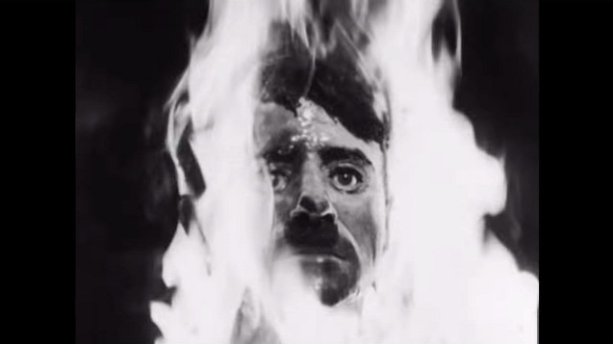
As one might expect, the heroes win, preventing the world from falling into the hands of the Third Reich. What you might not expect, especially from a film of this age, is the grisly closing image of Hitler’s disembodied head, here portrayed by a wax mold, gruesomely melted away by flames. While it is quite evident that the head is indeed wax, it’s still fairly gnarly watching the wax melt away like layers of skin and flesh from the skull-shaped creation. In fact, the scene was deemed disturbing enough to viewers that it had to be (marginally) edited down for the television re-issue.
The Madmen of Mandoras, or They Saved Hitler’s Brain, or whatever you choose to call it is a fun slice of pro-American/anti-Nazi propaganda layered in a healthy dose of 1940’s/50’s era comics “pulp”, and sprinkled with a pinch of early 60’s pop culture sensibility. It doesn’t require a lot of thought and generally moves at a steady pace, although the footage added to the television re-release does make the first half of the film drag noticeably. The film feels more than a little dated by today’s standards, but still provides some solid entertainment for a rainy weekend afternoon or one of those nights when you’re just not sure why you are even still awake.
DAY 15. PICK YOUR POISON: One with some drugs in it. Turn on, tune in…and freak out!
Otto Preminger was the king of the issue movie. To wit: The Man With the Golden Arm (drug addiction), Advise & Consent (homosexuality), Anatomy of a Murder (rape), Hurry Sundown (racial and sexual taboos) and The Cardinal (which touches on everything from interfaith marriage, pre-marital sex, abortion, racial bigotry, the rise of fascism and war, all heady subjects for many movies much less just one). And with 1960’s Exodus, Preminger struck back against the Hollywood blacklist by acknowledging banned screenwriter Dalton Trumbo.
However, as his career went on, he was criticized for two things: his heavy-handed nature and his reputation for bullying actors.
This may have started when Laurence Oliver stated that notion about Preminger in his autobiography Confessions of an Actor. Joan Crawford, who was a fan of his work, said that he was “Sort of a Jewish Nazi.” On the set of Angel Face, Angel Face” (1952), he demanded so many versions of a scene where Robert Mitchum slapped Jean Simmons across the face that Mitchum finally turned around and cuffed Preminger.
“I do not welcome advice from actors,” said Preminger, once said. “They are here to act.” The set was his dictatorship and he was given to violent outbursts. Supposedly, the great director once directed a group of child actors during Exodus by shouting, “Cry, you little monsters! You see, your mothers have been taken away! You are never going to see them again – never!” as assistants led their stage mothers from their sight.
Preminger’s treatment of a young Tom Tryon — who would leave acting to instead write the books that would become The Other and The Dark Secret of Harvest Home — and Jean Sebring led to them suffering nervous breakdowns. He’d harangue them to the point of tears on the set. Once, he abused Tryon so badly in front of his family that he nearly quit The Cardinal, a movie that he would earn a Golden Globe nomination for. That night, after a workday filled with hatred, Preminger would follow classic abuser behavior by taking them to the finest dinners and treating them like human beings. The next day? The cycle would continue. For his part, Tryon sought to always be in the position to fire the director for the rest of his career.
He was an iconoclast, fighting against the world — studio heads, producers, actors, censors. It’d take an entire website for me to share the stories of Preminger’s life, from him guesting on the Batman TV show as Mr. Freeze to his secret son with dancer Gypsy Rose Lee, his fight with Darryl F. Zanuck that led to him being told ”you’ll never work in Hollywood again” before doing just that and making the classic film Laura and the fact that he was primarily known as an actor for playing Nazis, despite working with Tallulah Bankhead to held them escape Germany during the war, in movies like The Pied Piper, Margin for Error, They Got Me Covered Stalag 17.
So how did Otto Preminger come to direct a movie about LSD?
Because Hollywood in 1968 was a mess.
The counter-culture had taken full root. Hollywood was on the cusp of becoming what Quentin Tarantino’s Once Upon a Time…In Hollywood essayed this year: out was the clean-cut man’s man who had a firm resolve. In was the sensitive bearded unsure of his place in the world.
Preminger was aware of this. That’s why he sought out Timothy Leary, the guru of LSD, and took the drug under his supervision. While Leary would say, “I consider Otto Preminger one of our failures,” he would also divulge “I was fooled by Otto Preminger. He was much hipper than I was.”
For his part, the director yearned to understand the youth culture that was revolutionizing the world. He went from the film being an anti-LSD movie to whatever it ended up becoming. And as he took acid himself, he said, “I saw things; I did not see myself.” What he did see was his wife in miniature form, which ended up in the movie. And his mindset changed after spending time with Tom and John Phillip Law, whose home The Castle was a legendary 1960’s mecca. Seriously, if you can name your home, you know that it’s going to be awesome. Rooms there were rented to young artists and musicians, among them the Velvet Underground and Bob Dylan. A young Harrison Ford was the carpenter. It was a totally different world for the Old Hollywood director to inhabit.
I first discover Skidoo in the Medved Brothers’ Golden Turkey Awards books. For years, it had been a cultural touchstone for what made a bad movie. I’ve learned over the years that what many see as trash, I discover as treasure. And when I watched the trailer for the film, I was astounded: this was a movie I wanted to see.
So why did I wait so long to see it?
Two reasons. One an excuse and the other reality.
The excuse? The film was incredibly difficult to find for years. But now, thanks to the cloud, we can call down any movie virtually at any time.
The real reason? The film that I built up inside my head had to be better than the actual reality. There’s no way any movie could live up to that insane trailer, where Old Hollywood mixes with Dr. Timothy Leary and a cliche-spouting Sammy Davis Jr. to cajole you into not only seeing Skidoo with mom and dad, but potentially dosing their Sprite before they view it in their local cinema.
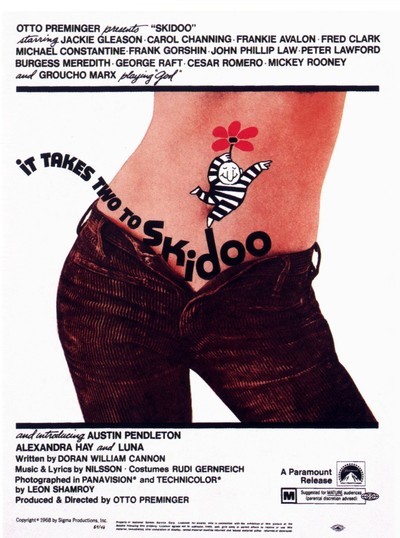
The film begins with a cartoon Jackie Gleason dancing as a peace-logo flower descends and the logo of the movie fills the screen. Nilsson’s theme plays — he would also appear in the film in a minor role and sing the astounding end credits, covering every person down to the copyright info — as we pill back to a TV screen flashing through channels.
We hear the voices of stars Carol Channing and Arnold Stang over images from space, then Peter Lawford in a mock U.S. Senate hearing about organized crime, then scenes of Preminger’s In Harm’s Way in between each story beat and mock ad. Of note, Channing says that she hates how they chop up movies for TV. At one point, Preminger sued ABC for editing his film, after all.
More commercials follow, including one where an attractive woman promises you the viewer that “Now, you too can be beautiful and sexually desirable like me, instead of being that fat, disgusting, foul-breathed, slimy, wallowing sow that you are!” before another ad with an even more attractive blonde and then a man drinks beer while belching and being intercut with images of a swine in mud as an announcer happily intones, “Feel big! Drink Pig!”
This strange blend of footage — feeling like cut and paste Burroughs technique — continues with the jingle for Fat Cola (“You’ll never lose your man if you drink Fat Cola!”), kids made up like Our Gang complete with Pete the Pup all smoking cigarettes and then more kids being given guns as gifts and then an ad for New Daisy Chain Deodorant, which battles “dandruff, athlete’s foot and the common cold, cancer, birth defects, mental illness, ringworm, poison ivy, tooth decay, acne, measles, brain tumor, smallpox, syphilis, plague, influenza, hepatitis and St. Vitus Dance.”
We move back from the TV to reveal the cause of all this flipping: Gleason and Channing each have a gigantic remote control. One of them wants to see the Senate hearing; the other anything but. We then see Joe Pyne, a TV host who pioneered the confrontational style of today’s TV journalism, launch into a diatribe.
Welcome to Skidoo, chum.
Gleason is Tony Banks, a retired hitman who has settled down with Flo (Channing) and the girl who may or may not be his daughter — one wonders if any of Preminger’s relationship with Gypsy Rose Lee and the son he had to avoid claiming Erik figures into this — Darlene (Alexandra Hay, who is stunning and sadly died at the age of 46 from heart disease).
There are two big issues: Darlene has fallen for a hippy named Stash (John Phillip Law, forever Diabolik in my heart) and that the mob wants Tony back. Hechy (Cesar Romero!) and Angie (Frankie Avalon!) — a father and son duo in matching Halloween-tone suits — want him to rub out “Blud Chips” Packard (Mickey Rooney) before he can rat them all out to the U.S. Senate. Tony refuses the word of God, the top mobster, and pays for it when his best friend Harry (Arnold Stang, who is really the god of movies people decry as bad, appearing in this film as well as Dondi and Hercules In New York) shows up dead. Tony’s fingered for the crime and goes up the river, exactly as God intended.
We move to Alcatraz, a high-tech prison where Packard is being protected before he can testify. One of Tony’s cellmates is draft dodger Fred the Professor (Firesign Theater co-founder Austin Pendleton), who is a wizard with technology but refuses to use it. Of course, Tony talks him into creating a way of communicating with Packard. They renew their friendship and our protagonist — well, if this movie even has a hero — decides not to kill the man.
Meanwhile, Stash and his friends have moved into Tony’s house (their dialogue was written by Rob Reiner) while Flo does a striptease for Angie — she’s dressed in neon hues throughout the film and at times, appears as if she’s a real-life Big Bird — in the hopes of finding her husband. Darlene also shows up and nearly leaves Stash for the suave killer. He agrees to take her to see God and Stash hitches a ride.
When they arrive, we learn that God is Groucho Marx and has been trapped on his yacht for years, afraid that he could be killed at any time. Intriguingly, the ship used for this movie is John Wayne’s yacht the Wild Goose, which was once a U.S. Navy minesweeper named USS YMS-328. Given Wayne’s feelings about the counter-culture, I kind of adore that his ship became the setting for what follows.
God and his mistress (Luna, who somehow connects all the worlds of film, from Warhol’s Factory to Fellini Satyricon and dating Klaus Kinski, who worried that they did so many drugs together that they could ruin his career; the fact that the famous madman was worried about Luna’s behavior speaks volumes) fall for Darlene and Stash, who go on the run from them.
Tony realizes that because he can’t kill Packard, so he’ll never leave the prison. He writes to her on some of Fred’s stationery, licks the envelope when he shouldn’t and we now enter into a seven-minute sequence of Jackie Gleason tripping balls. “I see mathematics!” shouts Tony, as he begins sweating profusely as the world becomes packed with color and he learns that his dead friend Harry was the father of his daughter, but none of that matters anymore. All is one and all is love and acid conquers all, setting a conflicted mobster’s life right.
Real life did not imitate art, as Gleason would go on to endorse Nixon. Then again, maybe he just did that because he was obsessed with seeing an alien first-hand. No, really.
Cellmate Leach (Michael Constantine, yes the very same Portokalos paterfamilias of the My Big Fat Greek Wedding films) watches all this and says, “Hey, maybe if I take some of that stuff, I wouldn’t have to rape anybody anymore.”
The hippies mount a rescue attempt as Tony and Fred dose everyone in the prison, leading to the guards seeing a football game with the Green Bay Packers (played by the Orange County Ramblers) discard their clothes and play naked. The twosome fly away from the prison and end up on God’s yacht, where Channing warbles the theme song as Tony and Flo consummate their love, God reads Gabriel Vahanian’s The Death of God and then Angie and God’s mistress get married before the new bride makes out with her father-in-law. As all this happens, Geronimo (Tom Law) marries Stash and Darlene.
To top all that off, God and Fred — now with shaved heads and Hare Krishna robes — sail off in a sailboat and smoke a joint. Groucho laughs and surprisingly says, “Mmm…pumpkin!”
An ordinary extraordinary movie would stop here.
But not Skidoo.
Preminger’s voice intrudes, as the voice of God almost, saying “Stop!, we are not through yet, and before you skidoo, we’d like to introduce our cast and crew…”
As stated earlier Nilsson sings everything along with asides, like “Luna as God’s Mistress, well you know-oh what I mean” and asking how your popcorn tastes.
Skidoo is awash with cameos, from character actors Fred Clark and Phil Arnold; Batman villains Frank Gorshin and Burgess Meredith; gangster star George Raft as the skipper; Doro Merande (who somehow survived working with Preminger multiple times); Slim Pickens and Robert Donner (Exidor from Mork & Mindy) as switchboard operators; Richard “Jaws” Kiel as a prisoner, Roman Gabriel (the first NFL quarterback of Filipino descent) as a prison guard.
Did the kids get it? Well, no. The film was not only a critical flop, it died in theaters too. It’s hard to say who the movie is for, as its themes are rooted in the counter-culture while the stars are firmly bound to the chains of Old Hollywood. You practically expect them to feed you tannis root and steal your baby, not turn you on and help drop you out.
Maybe Preminger was trying to connect with his aforementioned hidden progeny, who at the time of filming was living as a hippy in New York’s Greenwich Village. Or maybe he was making the kind of movie that would take a half-century to be appreciated.
That said, I love that Groucho did this movie, which was his last film. He also tripped on LSD with Paul Krassner to get ready for the film. Preminger browbeat the 78-year-old Marx Brother into bringing back his old greasepaint-mustache for this role and continually treated him like you’d expect Otto Preminger to treat an actor on set. This led to Jackie Gleason physically threatening Preminger’s life if he tried the same antics with him.
I spent more time writing about this film than I did watching it, but if my efforts lead to you watching it for yourself, I feel that I’ve properly done my job. You can get this movie for yourself from Olive FIlms.
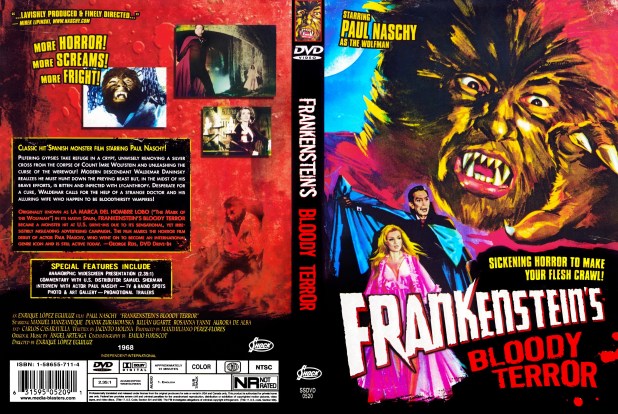
Paul Naschy’s real name was Jacinto Molina, but when German film distributors demanded he have a name that sounded like something native to their country, he took the name Paul from Pope Paul IV and Naschy from a Hungarian athlete.
Naschy had been inspired to make a horror movie since working on the movie Agonizing In Crime a year earlier. Despite several filmmakers trying to dissuade him from making such a film, he persevered and this film would become the first in a long line of werewolf films that would make Naschy famous all over the world.
Originally known as La Marca del Hombre Lobo (The Mark of the Wolfman), this movie is also known as Hell’s Creatures: Dracula and the Werewolf, The Nights of Satan and as the title I saw it run as at the Drive-In Super Monster Rama, Frankenstein’s Bloody Terror. But wait…isn’t this a werewolf movie? Read on, friends. Read on.
The film’s American distributor, Independent-International Pictures, had a big problem on their hands. While they also distributed films like All the Colors of the Dark (renamed They’re Coming to Get You! in an attempt to get audiences to think it had something to do with Night of the Living Dead), Satan’s Sadists, Blue Eyes of the Broken Doll and others, now they needed a second Frankenstein movie and they needed it in a hurry.
That’s because producer Sam Sherman already had 400 theaters lined up for the Al Adamson film Dracula vs. Frankenstein and had promised those grindhouses and drive-ins a Frank-centric double feature.
That’s why this movie begins with an animated opening sequence that explains that the cursed Frankenstein family has had all manner of issues in their history, but this film will discuss one branch of the family tree that has been cursed with lycanthropy and changed their surname to Wolfstein.
La Marca del Hombre Lobo was originally filmed in Jan Jacobsen’s Hi-Fi Stereo 70 3-D format. This led Sherman to hire Linwood Dunn to craft what were reportedly gorgeous 35mm prints that needed to be projected through high-end lenses. The producer even set up a star-studded Hollywood premiere that went to pieces when inferior acrylic lenses were used to show the film. This story feels apocryphal, as I can’t see A-listers showing up to celebrate a Paul Naschy movie. But man — if it did happen, how amazing is life?
The hijinks begin when a gypsy couple gets trashed and spends the night in the Wolfstein castle. Their shenanigans lead to the silver cross being removed from the body of Imre Wolfstein, who rises from the dead to kill them and go wild in a nearby village (by going wild, he attacks a few people).
When a hunting party goes to stop what they believe are wolf attacks, Count Waldemar Daninsky (Naschy) is attacked and receives the titular mark of the werewolf. Prayer and friendship aren’t enough to stop his curse, so he turns to two experts, Dr. Janos and Wandessa de Mikhelov.
They turn out to be Satanic vampires and revive Imre, then hold Waldemar’s lover Janice and best friend Rudolph in thrall. They seem to be more swingers than vampires, mutually supporting one another’s open marriage and need to dominate more docile partners. I’m kidding — they’re totally vampires. But really, come on. They’re swingers.
At the end, the two werewolves battle, with Waldemar winning, leading to him killing the vampires and being shot by a silver bullet fired by Janice. It really doesn’t pay to be a werewolf, you know?
Naschy would follow this film with 1968’s film Las Noches del Hombre Lobo. That movie is even stranger than this one because even today, no one is sure that it even exists. Wait…what?
It’s true. Even though many refer to it as the second of Naschy’s twelve Waldemar Daninsky movies, no one has ever seen this movie. Not even Naschy himself, although he claims that his script was filmed in Paris by director Rene Govar — who has no other known credits. Govar died in a career accident a week after the film was sent to the lab, where it was never paid for and destroyed. Naschy also claimed that he worked with actors Peter Beaumont and Monique Brainville, but no one knows if they existed either.
Supposedly, the film was about a professor who learns that one of his students suffers from lycanthropy, so he uses that student as a method of revenge on his enemies. That also sounds a lot like a later Naschy film, 1970’s La Furia del Hombre Lobo (The Fury of the Wolfman).
Most Naschy experts feel like he brought up this film early in his career to pad his resume and make it seem like he was working in foreign markets so that he could appear to be a bigger actor than he was. Nevertheless, it’s a strange footnote in his career.



 B&S About Movies
You must be logged in to post a comment.