2019 Scarecrow Psychotronic Challenge Day 15: Skidoo (1968)

DAY 15. PICK YOUR POISON: One with some drugs in it. Turn on, tune in…and freak out!

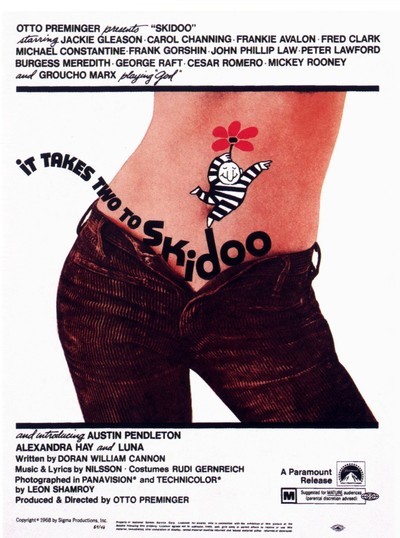
Otto Preminger was the king of the issue movie. To wit: The Man With the Golden Arm (drug addiction), Advise & Consent (homosexuality), Anatomy of a Murder (rape), Hurry Sundown (racial and sexual taboos) and The Cardinal (which touches on everything from interfaith marriage, pre-marital sex, abortion, racial bigotry, the rise of fascism and war, all heady subjects for many movies much less just one). And with 1960’s Exodus, Preminger struck back against the Hollywood blacklist by acknowledging banned screenwriter Dalton Trumbo.

However, as his career went on, he was criticized for two things: his heavy-handed nature and his reputation for bullying actors.

This may have started when Laurence Oliver stated that notion about Preminger in his autobiography Confessions of an Actor. Joan Crawford, who was a fan of his work, said that he was “Sort of a Jewish Nazi.” On the set of Angel Face, Angel Face” (1952), he demanded so many versions of a scene where Robert Mitchum slapped Jean Simmons across the face that Mitchum finally turned around and cuffed Preminger.

“I do not welcome advice from actors,” said Preminger, once said. “They are here to act.” The set was his dictatorship and he was given to violent outbursts. Supposedly, the great director once directed a group of child actors during Exodus by shouting,  “Cry, you little monsters! You see, your mothers have been taken away! You are never going to see them again – never!” as assistants led their stage mothers from their sight.

Preminger’s treatment of a young Tom Tryon — who would leave acting to instead write the books that would become The Other and The Dark Secret of Harvest Home — and Jean Sebring led to them suffering nervous breakdowns. He’d harangue them to the point of tears on the set. Once, he abused Tryon so badly in front of his family that he nearly quit The Cardinal, a movie that he would earn a Golden Globe nomination for. That night, after a workday filled with hatred, Preminger would follow classic abuser behavior by taking them to the finest dinners and treating them like human beings. The next day? The cycle would continue. For his part, Tryon sought to always be in the position to fire the director for the rest of his career.

He was an iconoclast, fighting against the world — studio heads, producers, actors, censors. It’d take an entire website for me to share the stories of Preminger’s life, from him guesting on the Batman TV show as Mr. Freeze to his secret son with dancer Gypsy Rose Lee, his fight with Darryl F. Zanuck that led to him being told ”you’ll never work in Hollywood again” before doing just that and making the classic film Laura and the fact that he was primarily known as an actor for playing Nazis, despite working with Tallulah Bankhead to held them escape Germany during the war, in movies like The Pied Piper, Margin for ErrorThey Got Me Covered Stalag 17.

So how did Otto Preminger come to direct a movie about LSD?

Because Hollywood in 1968 was a mess.

The counter-culture had taken full root. Hollywood was on the cusp of becoming what Quentin Tarantino’s Once Upon a Time…In Hollywood essayed this year: out was the clean-cut man’s man who had a firm resolve. In was the sensitive bearded unsure of his place in the world.

Preminger was aware of this. That’s why he sought out Timothy Leary, the guru of LSD, and took the drug under his supervision. While Leary would say, “I consider Otto Preminger one of our failures,” he would also divulge “I was fooled by Otto Preminger. He was much hipper than I was.”

For his part, the director yearned to understand the youth culture that was revolutionizing the world. He went from the film being an anti-LSD movie to whatever it ended up becoming. And as he took acid himself, he said, “I saw things; I did not see myself.” What he did see was his wife in miniature form, which ended up in the movie. And his mindset changed after spending time with Tom and John Phillip Law, whose home The Castle was a legendary 1960’s mecca. Seriously, if you can name your home, you know that it’s going to be awesome. Rooms there were rented to young artists and musicians, among them the Velvet Underground and Bob Dylan. A young Harrison Ford was the carpenter. It was a totally different world for the Old Hollywood director to inhabit.

I first discover Skidoo in the Medved Brothers’ Golden Turkey Awards books. For years, it had been a cultural touchstone for what made a bad movie. I’ve learned over the years that what many see as trash, I discover as treasure. And when I watched the trailer for the film, I was astounded: this was a movie I wanted to see.

So why did I wait so long to see it?

Two reasons. One an excuse and the other reality.

The excuse? The film was incredibly difficult to find for years. But now, thanks to the cloud, we can call down any movie virtually at any time.

The real reason? The film that I built up inside my head had to be better than the actual reality. There’s no way any movie could live up to that insane trailer, where Old Hollywood mixes with Dr. Timothy Leary and a cliche-spouting Sammy Davis Jr. to cajole you into not only seeing Skidoo with mom and dad, but potentially dosing their Sprite before they view it in their local cinema.

The film begins with a cartoon Jackie Gleason dancing as a peace-logo flower descends and the logo of the movie fills the screen. Nilsson’s theme plays — he would also appear in the film in a minor role and sing the astounding end credits, covering every person down to the copyright info — as we pill back to a TV screen flashing through channels.

We hear the voices of stars Carol Channing and Arnold Stang over images from space, then Peter Lawford in a mock U.S. Senate hearing about organized crime, then scenes of Preminger’s In Harm’s Way in between each story beat and mock ad. Of note, Channing says that she hates how they chop up movies for TV. At one point, Preminger sued ABC for editing his film, after all.

More commercials follow, including one where an attractive woman promises you the viewer that “Now, you too can be beautiful and sexually desirable like me, instead of being that fat, disgusting, foul-breathed, slimy, wallowing sow that you are!” before another ad with an even more attractive blonde and then a man drinks beer while belching and being intercut with images of a swine in mud as an announcer happily intones, “Feel big! Drink Pig!”

This strange blend of footage — feeling like cut and paste Burroughs technique — continues with the jingle for Fat Cola (“You’ll never lose your man if you drink Fat Cola!”), kids made up like Our Gang complete with Pete the Pup all smoking cigarettes and then more kids being given guns as gifts and then an ad for New Daisy Chain Deodorant, which battles “dandruff, athlete’s foot and the common cold, cancer, birth defects, mental illness, ringworm, poison ivy, tooth decay, acne, measles, brain tumor, smallpox, syphilis, plague, influenza, hepatitis and St. Vitus Dance.”

We move back from the TV to reveal the cause of all this flipping: Gleason and Channing each have a gigantic remote control. One of them wants to see the Senate hearing; the other anything but. We then see Joe Pyne, a TV host who pioneered the confrontational style of today’s TV journalism, launch into a diatribe.

Welcome to Skidoo, chum.

Gleason is Tony Banks, a retired hitman who has settled down with Flo (Channing) and the girl who may or may not be his daughter — one wonders if any of Preminger’s relationship with Gypsy Rose Lee and the son he had to avoid claiming Erik figures into this — Darlene (Alexandra Hay, who is stunning and sadly died at the age of 46 from heart disease).

There are two big issues: Darlene has fallen for a hippy named Stash (John Phillip Law, forever Diabolik in my heart) and that the mob wants Tony back. Hechy (Cesar Romero!) and Angie (Frankie Avalon!) — a father and son duo in matching Halloween-tone suits — want him to rub out “Blud Chips” Packard (Mickey Rooney) before he can rat them all out to the U.S. Senate. Tony refuses the word of God, the top mobster, and pays for it when his best friend Harry (Arnold Stang, who is really the god of movies people decry as bad, appearing in this film as well as Dondi and Hercules In New York) shows up dead. Tony’s fingered for the crime and goes up the river, exactly as God intended.

We move to Alcatraz, a high-tech prison where Packard is being protected before he can testify. One of Tony’s cellmates is draft dodger Fred the Professor (Firesign Theater co-founder Austin Pendleton), who is a wizard with technology but refuses to use it. Of course, Tony talks him into creating a way of communicating with Packard. They renew their friendship and our protagonist — well, if this movie even has a hero — decides not to kill the man.

Meanwhile, Stash and his friends have moved into Tony’s house (their dialogue was written by Rob Reiner) while Flo does a striptease for Angie — she’s dressed in neon hues throughout the film and at times, appears as if she’s a real-life Big Bird — in the hopes of finding her husband. Darlene also shows up and nearly leaves Stash for the suave killer. He agrees to take her to see God and Stash hitches a ride.

When they arrive, we learn that God is Groucho Marx and has been trapped on his yacht for years, afraid that he could be killed at any time. Intriguingly, the ship used for this movie is John Wayne’s yacht the Wild Goose, which was once a U.S. Navy minesweeper named USS YMS-328. Given Wayne’s feelings about the counter-culture, I kind of adore that his ship became the setting for what follows.

God and his mistress (Luna, who somehow connects all the worlds of film, from Warhol’s Factory to Fellini Satyricon and dating Klaus Kinski, who worried that they did so many drugs together that they could ruin his career; the fact that the famous madman was worried about Luna’s behavior speaks volumes) fall for Darlene and Stash, who go on the run from them.

Tony realizes that because he can’t kill Packard, so he’ll never leave the prison. He writes to her on some of Fred’s stationery, licks the envelope when he shouldn’t and we now enter into a seven-minute sequence of Jackie Gleason tripping balls. “I see mathematics!” shouts Tony, as he begins sweating profusely as the world becomes packed with color and he learns that his dead friend Harry was the father of his daughter, but none of that matters anymore. All is one and all is love and acid conquers all, setting a conflicted mobster’s life right.

Real life did not imitate art, as Gleason would go on to endorse Nixon. Then again, maybe he just did that because he was obsessed with seeing an alien first-hand. No, really.

Cellmate Leach (Michael Constantine, yes the very same Portokalos paterfamilias of the My Big Fat Greek Wedding films) watches all this and says, “Hey, maybe if I take some of that stuff, I wouldn’t have to rape anybody anymore.”

The hippies mount a rescue attempt as Tony and Fred dose everyone in the prison, leading to the guards seeing a football game with the Green Bay Packers (played by the Orange County Ramblers) discard their clothes and play naked. The twosome fly away from the prison and end up on God’s yacht, where Channing warbles the theme song as Tony and Flo consummate their love, God reads Gabriel Vahanian’s The Death of God and then Angie and God’s mistress get married before the new bride makes out with her father-in-law. As all this happens, Geronimo (Tom Law) marries Stash and Darlene. 

To top all that off, God and Fred — now with shaved heads and Hare Krishna robes — sail off in a sailboat and smoke a joint. Groucho laughs and surprisingly says, “Mmm…pumpkin!”

An ordinary extraordinary movie would stop here.

But not Skidoo.

Preminger’s voice intrudes, as the voice of God almost, saying “Stop!, we are not through yet, and before you skidoo, we’d like to introduce our cast and crew…”

As stated earlier Nilsson sings everything along with asides, like “Luna as God’s Mistress, well you know-oh what I mean” and asking how your popcorn tastes.

Skidoo is awash with cameos, from character actors Fred Clark and Phil Arnold; Batman villains Frank Gorshin and Burgess Meredith; gangster star George Raft as the skipper; Doro Merande (who somehow survived working with Preminger multiple times); Slim Pickens and Robert Donner (Exidor from Mork & Mindy) as switchboard operators; Richard “Jaws” Kiel as a prisoner, Roman Gabriel (the first NFL quarterback of Filipino descent) as a prison guard.

Did the kids get it? Well, no. The film was not only a critical flop, it died in theaters too. It’s hard to say who the movie is for, as its themes are rooted in the counter-culture while the stars are firmly bound to the chains of Old Hollywood. You practically expect them to feed you tannis root and steal your baby, not turn you on and help drop you out.

Maybe Preminger was trying to connect with his aforementioned hidden progeny, who at the time of filming was living as a hippy in New York’s Greenwich Village. Or maybe he was making the kind of movie that would take a half-century to be appreciated.

That said, I love that Groucho did this movie, which was his last film. He also tripped on LSD with Paul Krassner to get ready for the film. Preminger browbeat the 78-year-old Marx Brother into bringing back his old greasepaint-mustache for this role and continually treated him like you’d expect Otto Preminger to treat an actor on set. This led to Jackie Gleason physically threatening Preminger’s life if he tried the same antics with him.

I spent more time writing about this film than I did watching it, but if my efforts lead to you watching it for yourself, I feel that I’ve properly done my job. You can get this movie for yourself from Olive FIlms.

NOTE: The New York Times obituary of Preminger, a Paul Krassner article about tripping with Groucho Marx and the New Yorker article “Balance of Terror” were used as references for this article. 
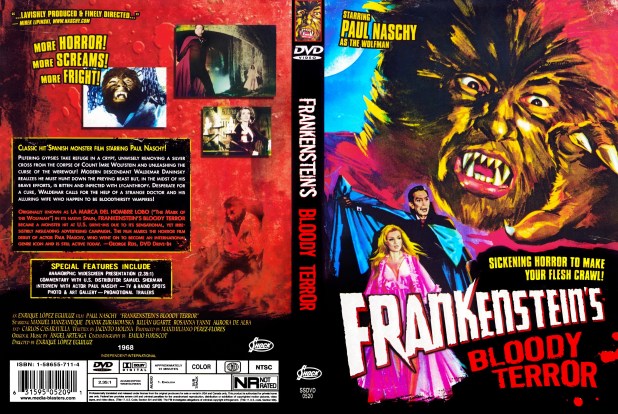
Frankenstein’s Bloody Terror (1968)

Paul Naschy’s real name was Jacinto Molina, but when German film distributors demanded he have a name that sounded like something native to their country, he took the name Paul from Pope Paul IV and Naschy from a Hungarian athlete.

Naschy had been inspired to make a horror movie since working on the movie Agonizing In Crime a year earlier. Despite several filmmakers trying to dissuade him from making such a film, he persevered and this film would become the first in a long line of werewolf films that would make Naschy famous all over the world.

Originally known as La Marca del Hombre Lobo (The Mark of the Wolfman), this movie is also known as Hell’s Creatures: Dracula and the Werewolf, The Nights of Satan and as the title I saw it run as at the Drive-In Super Monster Rama, Frankenstein’s Bloody Terror. But wait…isn’t this a werewolf movie? Read on, friends. Read on.

The film’s American distributor, Independent-International Pictures, had a big problem on their hands. While they also distributed films like All the Colors of the Dark (renamed They’re Coming to Get You! in an attempt to get audiences to think it had something to do with Night of the Living Dead), Satan’s SadistsBlue Eyes of the Broken Doll and others, now they needed a second Frankenstein movie and they needed it in a hurry.

That’s because producer Sam Sherman already had 400 theaters lined up for the Al Adamson film Dracula vs. Frankenstein and had promised those grindhouses and drive-ins a Frank-centric double feature.

That’s why this movie begins with an animated opening sequence that explains that the cursed Frankenstein family has had all manner of issues in their history, but this film will discuss one branch of the family tree that has been cursed with lycanthropy and changed their surname to Wolfstein.

La Marca del Hombre Lobo was originally filmed in Jan Jacobsen’s Hi-Fi Stereo 70 3-D format. This led Sherman to hire Linwood Dunn to craft what were reportedly gorgeous 35mm prints that needed to be projected through high-end lenses. The producer even set up a star-studded Hollywood premiere that went to pieces when inferior acrylic lenses were used to show the film. This story feels apocryphal, as I can’t see A-listers showing up to celebrate a Paul Naschy movie. But man — if it did happen, how amazing is life?

The hijinks begin when a gypsy couple gets trashed and spends the night in the Wolfstein castle. Their shenanigans lead to the silver cross being removed from the body of Imre Wolfstein, who rises from the dead to kill them and go wild in a nearby village (by going wild, he attacks a few people).

When a hunting party goes to stop what they believe are wolf attacks, Count Waldemar Daninsky (Naschy) is attacked and receives the titular mark of the werewolf. Prayer and friendship aren’t enough to stop his curse, so he turns to two experts, Dr. Janos and Wandessa de Mikhelov.

They turn out to be Satanic vampires and revive Imre, then hold Waldemar’s lover Janice and best friend Rudolph in thrall. They seem to be more swingers than vampires, mutually supporting one another’s open marriage and need to dominate more docile partners. I’m kidding — they’re totally vampires. But really, come on. They’re swingers.

At the end, the two werewolves battle, with Waldemar winning, leading to him killing the vampires and being shot by a silver bullet fired by Janice. It really doesn’t pay to be a werewolf, you know?

Naschy would follow this film with 1968’s film Las Noches del Hombre Lobo. That movie is even stranger than this one because even today, no one is sure that it even exists. Wait…what?

It’s true. Even though many refer to it as the second of Naschy’s twelve Waldemar Daninsky movies, no one has ever seen this movie. Not even Naschy himself, although he claims that his script was filmed in Paris by director Rene Govar — who has no other known credits. Govar died in a career accident a week after the film was sent to the lab, where it was never paid for and destroyed. Naschy also claimed that he worked with actors Peter Beaumont and Monique Brainville, but no one knows if they existed either.

Supposedly, the film was about a professor who learns that one of his students suffers from lycanthropy, so he uses that student as a method of revenge on his enemies. That also sounds a lot like a later Naschy film, 1970’s La Furia del Hombre Lobo (The Fury of the Wolfman).

Most Naschy experts feel like he brought up this film early in his career to pad his resume and make it seem like he was working in foreign markets so that he could appear to be a bigger actor than he was. Nevertheless, it’s a strange footnote in his career.

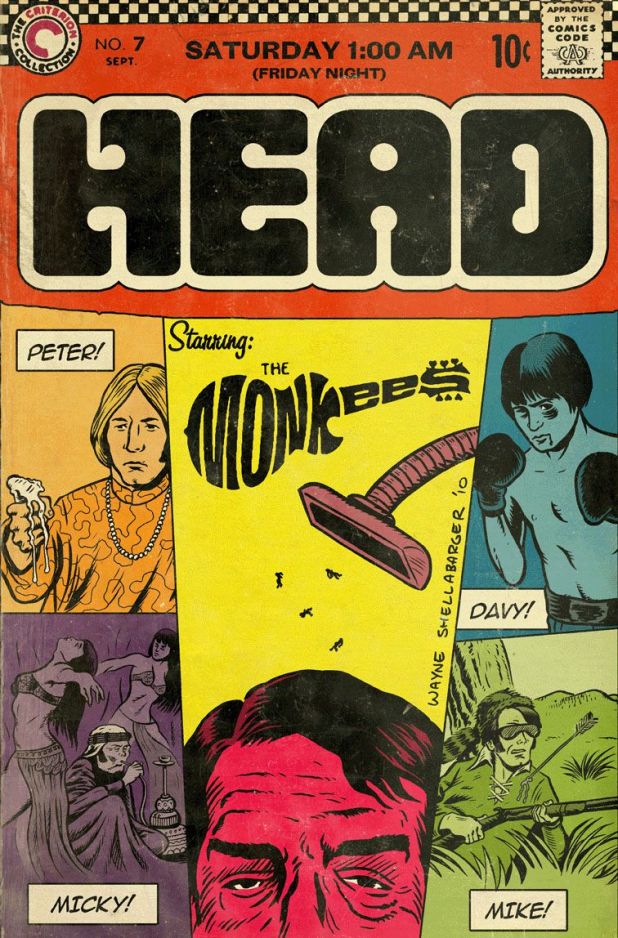
Head (1968)

Despite breaking up in 1971, The Monkees remained in syndication throughout the decade, and that’s when I discovered them. Despite being a band created for a TV show—a burst of comedy, silliness and catchy songs—The Monkees instantly appealed to me.

Initially formed in Los Angeles in 1965 by Bob Rafelson and Bert Schneider, the band was Micky Dolenz, Michael Nesmith, Peter Tork and Davy Jones. Producer Don Kirshner initially supervised the band’s music, with songs written by the songwriting duo of Tommy Boyce and Bobby Hart. The four band members were on set filming for nearly twelve hours a day, so session musicians originally played most of their tunes (that said, Nesmith did compose and produce some songs, with Tork playing guitar and all four contributing vocals).

By the TV show’s second season, The Monkees had won the right to create their own music, marking a significant shift in their artistic journey. They effectively became musicians, singers, songwriters, and producers. This growth was further evident in their fourth album, Pisces, Aquarius, Capricorn & Jones Ltd., where the band collaborated with respected session and star talents like the Wrecking Crew, Glen Campbell, members of the Byrds and the Association, drummer ‘Fast’ Eddie Hoh, Stephen Stills and Neil Young. This artistic growth is a testament to their determination and talent.

However, the Monkees continually battled against the notion that they were a manufactured band. Sure, that’s how things started, but they weren’t that way anymore. While their TV show remained successful, they were bored with its conventional format. They proposed making the show a variety program, a format that would allow them to showcase their musical talents and experiment with different styles and genres. But NBC objected, and by then, most of the band wasn’t getting along anyway.

The film’s title, Head, is a nod to the band’s desire to break free from their manufactured image and the constraints of their success. It’s a reference to the phrase ‘to get your head ‘, meaning to understand or grasp something, which reflects the band’s journey of self-discovery and artistic expression. After The Monkees was canceled in February 1968, Rafelson co-wrote and directed this film with Schneider as executive producer. Jack Nicholson, the other writer — a virtual unknown at the time — worked with the band and Rafelson in a jam session weekend with plenty of weed on hand. Later, under the influence of LSD, Nicholson would rewrite the stream-of-consciousness tapes into the script.

When the band learned they would not be allowed to direct themselves or receive screenwriting credit, every Monkee except Peter Tork had a one-day walkout. The studio agreed to a larger share of the film’s profits if the band returned, which ended the professional relationship between the band and their creators.

The filming of Head resulted in a movie that completely alienated their fanbase. Both Nesmith and Tork felt that this movie was a betrayal, a murder of the band by its creators, who seemed to have their eyes on bigger goals. This sense of disillusionment is palpable in their reactions, adding a layer of disappointment to the narrative.

At the dedication of the Gerald Desmond Bridge, an old man politician struggles with his speech. Suddenly, The Monkees appear, racing through the officials and creating chaos. Micky jumps off the bridge to the water below as we hear the words of “Porpoise Song. ” The lyrics intone, “A face, a voice, an overdub has no choice, an image cannot rejoice.” He floats under the waves until mermaids find him and bring him back to life.

After a kissing contest with all four Monkees being called “even” by Lady Pleasure (Mireille Machu, Nicholson’s girlfriend at the time), they launch into a distorted version of the TV show’s theme song:

“Hey, hey, we are The Monkees

You know we love to please

A manufactured image

With no philosophies.

You say we’re manufactured.

To that, we all agree.

So make your choice, and we’ll rejoice

in never being free!

Hey, hey, we are The Monkees

We’ve said it all before

The money’s in, we’re made of tin

We’re here to give you more!

The money’s in, we’re made of tin

We’re here to give you…”

BAM! A gunshot interrupts the proceedings, with the famous footage of the execution of Viet Cong operative Nguyen Van Lem by Chief of National Police Nguyen Ngoc Loan being shown. Head has no interest in being subtle.

From here, the movie becomes a kaleidoscope of ideas and pastiches as each Monkee gains a moment in the spotlight, yet none of them are thrilled with their situation, and each feels trapped. Any escape attempt — whether it’s through dance (Davy has a great scene with Toni Basil, who choreographed Head more than a decade before her hit song “Mickey”), punching waitresses, blowing up Coke machines with tanks, attending a strange birthday party (shot on one of the sets of Rosemary’s Baby, which was under production at the same time), a swami who claims to have the answer and even a rampage through the movie set itself, the boys can’t escape their prison, which is a large black box.

That box could symbolize the lounge area built for the band during the filming of their television show. When they first started filming, the band would wander the set between takes, bored by the filming speed. They’d often get lost, so Screen Gems built a special room where they were forced to remain, smoking cigarettes, playing music and studying their scripts. Whenever a band member was needed on the stage, a colored light corresponding to that member would inform them.

Throughout the film, the band runs into a massive cast of characters, with everyone from Mickey Mouse Club star Annette Funicello, Carol Doda (considered the first public topless dancer), Sonny Liston, Frank Zappa, Teri Garr, Victor Mature and Dennis Hopper.

After evading the box and all of their enemies in the desert, The Monkees run back to the film’s beginning and all leap from the bridge, this time to the triumphant return of “Porpoise Song.” But it’s all another sham: as they swim away, we see that they’re stuck in an aquarium, another big box, and taken away on a truck.

Unyielding sadness. It seems a far cry from “Hey, hey we’re The Monkees and people say we monkey around.”

Head bombed hard on release, bringing back only $16,000 on its $750,000 budget. It may be the ad campaign. While trailers say the “most extraordinary adventure, western, comedy, love story, mystery, drama, musical, documentary satire ever made (And that’s putting it mildly),” none of the band would appear in the ads.

The Monkees were trapped by another fact: younger and more mainstream audiences rejected the more serious side of the band, along with their new sound. While critics agreed that this was the band’s best music ever recorded — Carole King and Harry Nilsson co-wrote much of the music — serious hippies wanted nothing to do with a band they perceived as plastic and pre-manufactured.

Nesmith said, “By the time Head came out, The Monkees were a pariah. There was no confusion about this. We were on the cosine of the line of approbation, from acceptance to rejection…and it was over. Head was a swan song.”

At the end of the film, a still shot of a stylized Columbia Pictures logo appears before the movie skips frames, gets tangled and melts as we hear the soundtrack continue and the laugh of Lady Pleasure. Maybe some joy has escaped the box that The Monkees are trapped in. I want to think so, as Head may have been a failure upon release, but when viewed more than fifty years later, it transcends the divide between real and fake, manufactured and created, commerce and art.

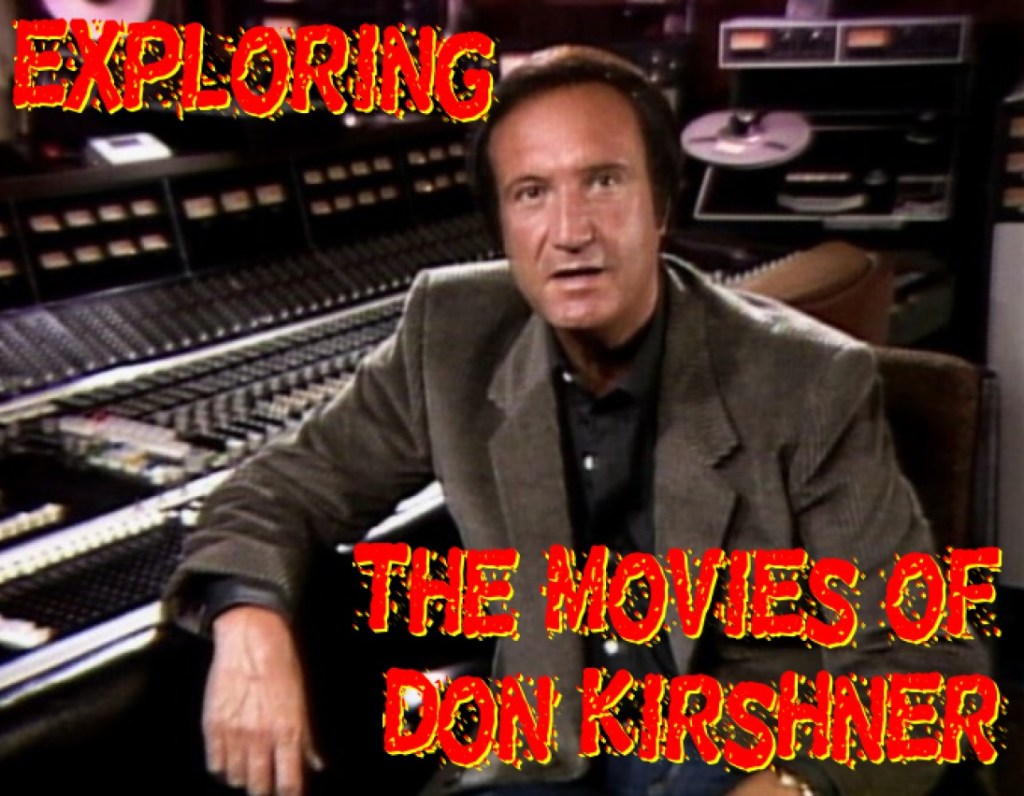
Learn more about the movies of Don Kirshner with our “Exploring” featurette.

She-Devils on Wheels (1968) take two

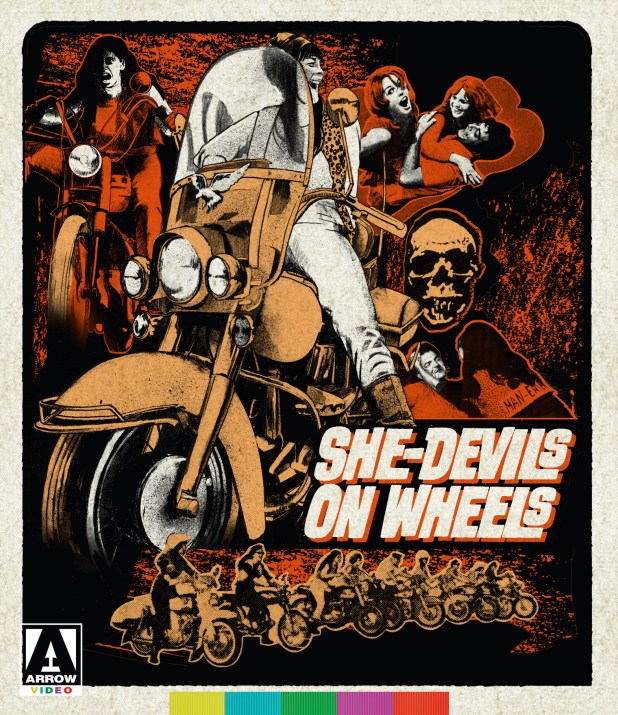
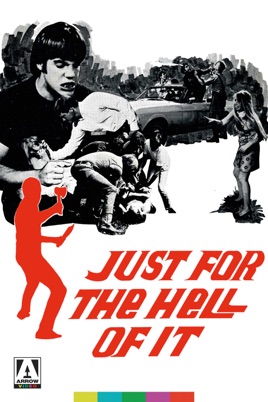
We covered this movie in July of last year, referring to it as “filthy, grimy, messy and completely wonderful.” It’s also one of Joe Bob Briggs’ Sleaziest Movies in the History of the World (keep in mind, ten our of the fourteen movies on that list came from Herschell Gordon Lewis). Now, Arrow Video has released it along with Just for the Hell of It on one blu ray, so you don’t have to shell out the big bucks for the Herschell Gordon Lewis Feast Box (but you totally should).

Arrow Video has lent their typical master’s touch to this release, with both movies presented in high def 1080p and filmed introductions from Lewis for both films. As the Godfather of Gore states in that intro, this is the one movie that rivals Blood Feast for box office and was his answer to the question, “Why don’t you stop cutting up all those girls and kill some men?”

This time through, I watched the film with commentary by H.G. Lewis and Something Weird’s Mike Vraney. This commentary track is a real joy, with Lewis quite honest about his faults as a filmmaker while giving tips for would be exploitation creations for how to film things properly. I wasn’t sure how much more I could love this movie, but this release exponentially increased my ardor.

Filmed with a legitimate cast of biker riding women, this movie is years ahead of its time. Heck, it’s years ahead of its time now. These women outride, outfight and dominate every man they meet with no apologies whatsoever. Even Karen, our would-be protagonist, after being forced to kill a lover by dragging him behind her hog, still stays with the Maneaters. They terrorize Florida and every human being they meet because they’re outside of the scope of humanity. They’re superheroes — well, supervillains — who can’t be stopped.

I love that Lewis realizes that adding on a post-credits scene in 1968 was a mistake. It was often trimmed or audiences left before they saw it. The film can’t end with the Maneaters in jail. They speak almost directly to the camera, promising more chaos. It’s as if they’re the biker gang Avengers years before anyone would think to film such a sequence.

I also love that Karen rejects the straight world and her ex-boyfriend Joe, who wants things to be the way they always were. The women in this movie reject the roles their gender has enforced upon them and instead have no issues slicing, dicing, tearing and maiming their way through their rival gang, led by Joe Boy. The fact that he’s a slice of mom and pop Americana, with bleached blonde good looks and it’s astounding — not to be a broken record — that the film ends with her rejecting white picket fences and a certain future.

H.G. Lewis made 33 films between 1962 and 1972. Those films would run in drive-ins for years before the adventure of the VCR and Something Weird would bring them back to viewers. Most of these movies had lower budgets than this and less time ($60,000 spent over two weeks), but they all exhibit a zeal and love for shock and showing you something different than you’ve ever seen before. Lewis remains affable and happy throughout the commentary, the kind of uncle you wish you had who’d done some crazy things in his past and wasn’t shy about sharing them with you. The loss of both he and Mike Vraney are palpable.

Needless to say, this movie has my highest possible recommendation. Don’t wait. Go to Arrow Video and buy She-Devils on Wheels NOW.

Disclaimer: We were sent this by Arrow, but we would have bought it anyway.

Just For the Hell of It (1968)

All hail Herschell Gordon Lewis. This movie — his attempt at a whole new genre that was the pornography of destruction — is completely unhinged and out of control, even a half-century after it was made.

Just watch the opening, where a gang of teens go from partying to suddenly decimating everything in their path, trashing an apartment in a moment of joyous destruction. As Lewis says on the intro to the film on its new Arrow Video release, “Watch this and think about how much fun everyone had making it.”

The gang Destruction Incorporated are here to terrorize small towns in Florida just for the hell of it, according to their insane leader Dexter, who has brought together Denny, Bitsy and Lummox as his crew. They beat up a bartender, splash a man with paint and set a woman’s newspaper on fire. Cops? They just make fun of the cops. These kids aren’t square. They just like messing things up for everyone else.

Not even cozy little coffee shops are safe. They just provide an arena for fist fights and grabbing store owners and burning their hands on the very stove that they make java on. The police try again to stop the gang, but no witnesses want to come forward. The violence only stops for a moment before the gang goes wild all over again, beating blind people, attacking men with their own crutches, throwing a baby into a garbage can and then destroying its stroller. They don’t care about anything or anyone, only the feeling of breaking things and the thrill of getting away with it.

Then, the gang invades a little league baseball game and starts attacking the children before Doug gets involved. Sadly, when a senile old woman calls the cop, he gets blamed. While he’s in jail, the gang beats a man on a beach blanket and assaults his girlfriend before they’re murdered.

If the police aren’t going to stop things, Doug and his girl Jeanne will. Bitsy, the mascot of the gang, lures Doug out of his house in the hopes she’ll testify against the Destruction boys, but it’s just a trap. His girlfriend is brutally attacked and left for dead with a drawing of a rat carved into her stomach. You know, for as kind of a man as Lewis seems while introducing this film, he’s an absolute maniac behind the camera.

Doug chases Denny and Bitsy, which leads their motorcycle into an explosive accident and our hero, such as it is, gets arrested. However, Dexter and Lummox have escaped and when told that two of the gang are dead, he answers, “Why cars, man?”

The movie ends with blood written on glass that says, “THE END… of this movie, but not the violence.”

This is a movie that doesn’t care that you find it worrisome or troublesome or problematic. If it could sneak into your parents’ house and beat them up with pool cues, it would do it right now. In fact, it just might be.

You can get Just For the Hell of It as a bonus movie on Arrow Video’s new blu ray release of She-Devils on Wheels.

NOTE: Arrow sent is this video, but we would have bought it anyway.

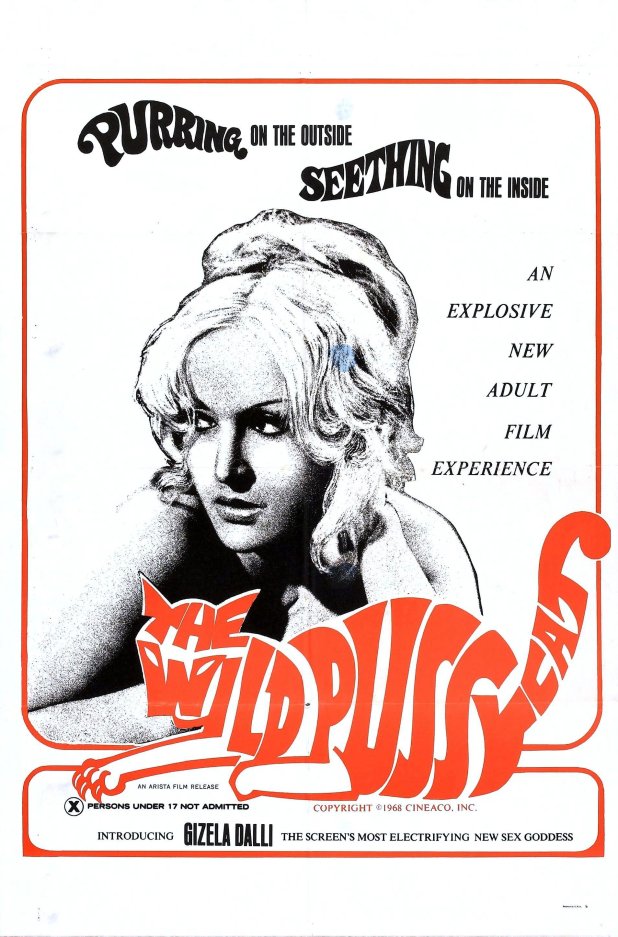
The Wild Pussycat (1968)

The Wild Pussycat is an unsung classic of exploitation cinema. Originally made in 1968, it wasn’t released for four years and then only in a censored version.

It’s a simple story: Good girl Nadia investigates the death of her sister, who was exploited and driven to suicide by her pimp. Now, she seduces the man, drugs him, then imprisons him in a hidden room that has a one-way mirror. On the other side, she continues her seduction by dancing for him and having affairs with other men and women while he can only look on.

Sure, The Wild Pussycat has rough subject matter, but it wasn’t a porno throwaway. Its director, Dimi Dadiras, directed more than fifty other films and its star Gisela Dali was known as the Greek Bardot.

This is another example of Mondo Macabro stretching out and grabbing films that most people would never know of. This film has never been released anywhere in the world on home video before now. This release includes both the 1972 Greek version (with much of the sex removed and a drug-dealing subplot inserted) uncut export version.

Joe D’Amato and Bruno Mattei would remake this movie in 1975 as Emanuelle’s Revenge, with George Eastman playing the role of the pimp.

As always, Mondo Macabro has put together an amazing release, finding something I didn’t even know was out there, making it look better than it ever has before and adding bonus features on top of all that. They’re putting out some astounding releases and deserve your full support.

You can get this on a double blu ray disc along with The Deserter from Mondo Macabro.

NOTE: This film was sent to us by Mondo Macabro, but that has no bearing on this review.

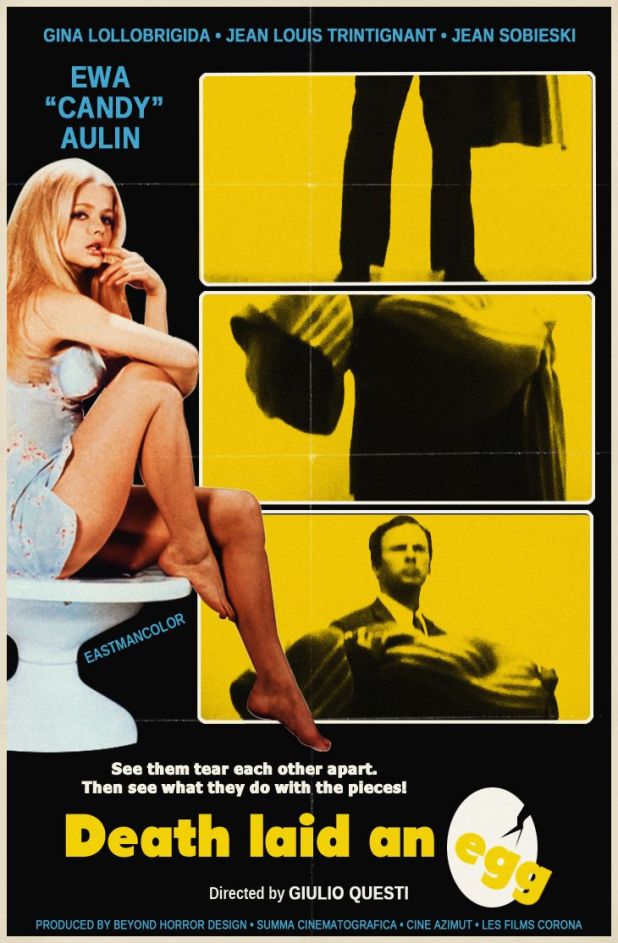
Death Laid an Egg (1968)

Let me put it out there right now: This movie is completely insane.

Let me see if I can summarize it.

A high tech chicken farm is trying to create birds that have no heads or bones. A love triangle develops between the three people who run it: Anna (international sex symbol and the photojournalist who was one of the first to interview Fidel Castro, Gina Lollobrigida), her prostitute killing husband Marco and their secretary Gabriella (Ewa Aulin, the near goddess who appeared in films like Candy and Death Smiles on a Murderer).

Yes. Headless and boneless chickens, all inside a fashionable proto giallo filled with sex and murder. You better believe I’m all over this movie.

Director Giulio Questi was also behind Django Kill… If You Live, Shoot! and Arcana, two movies that I must investigate immediately if this movie is any indication. I’ve seen this movie explained as a “socio-politically sophisticated avant-garde giallo,” which is pretty much the best way I can think of telling you what it’s all about. It’s also around 40 years ahead of its time yet blissfully stuck in 1968.

Despite being Anna’s cousin, Gabri hooks up with her husband and they debate running away together. However, Gabri is already married to Mondaini and their plan is to kill Anna and frame  Marco. There’s also the issue of Anna wanting to have something special and strange with Marco, which instead of being a child, ends up being these Eraserhead-ish chicken balls that scream and bleed worms when he kills them.

When Marco discovers his wife’s body in a hotel room, he cleans the scene up and brings her body to the farm to turn it into chicken feed. That’s when we learn his big secret: he doesn’t really kill prostitutes, but instead role plays the murder and sends them away with plenty of cash. But then, as he tries to feed his wife into the machine, he falls in just as the police arrive to catch him disposing of the body. Gabri and Mondaini are eventually caught as we watch the chickens chow down on human food. Nothing good is gonna come out of that. I mean, poultry that feeds on human flesh seems like way worse than any steroids or hormones.

I’ve never seen a movie that straddles being an art film, a drug film, a murder mystery story and science fiction examination of man trying to change nature along with psychedelic film techniques and non-linear editing techniques. It’s also a satire of the highest order. I have no idea why people aren’t constantly discussing this movie and I’m going to do my best to drive people nuts talking about it over and over again.

Cult Epics just released this film, which you can get on their site or on Diabolik DVD.

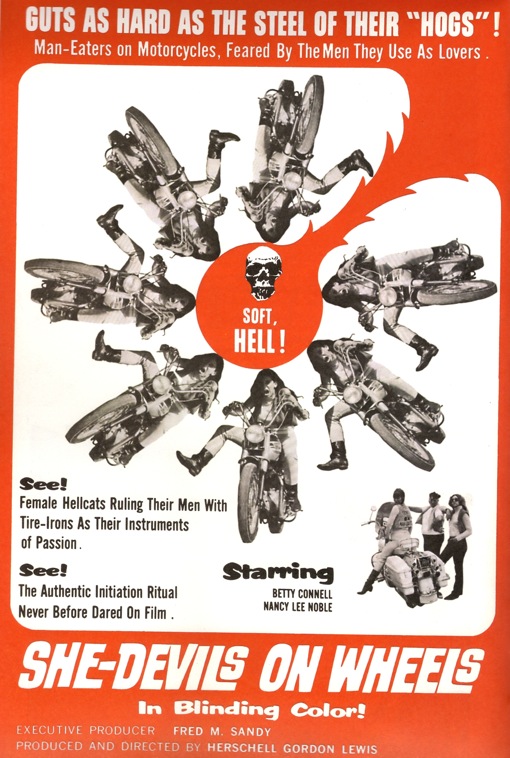
BIKER WEEK: She-Devils on Wheels (1968)

Herschell Gordon Lewis pretty much invented gore. But with this movie, he showed us all how to make a biker movie that takes it to the limit and way beyond.

The Maneaters are the secret that Karen keeps from her family. They’re a rough, tough and ready to rumble group of female motorcyclists who hold weekly races to determine who gets to pick first from their many male suitors, or as they call it, the stud line.

Karen wins this week’s race against the gang’s boss, Queen. And even though Karen wins that first pick, she chooses Bill for the fourth week in a row. That’s against the code of the Maneaters, who demand that no one can be attached to anything or anyone save the gang. “All men are mothers!” they shout. “No Manhunter falls in love!” they scream.

Honey Pot (Nancy Noble, Jackson County Jail, Chesty Anderson U.S. Navy) is the teenage mascot of the gang. She’s also following Karen and informs the gang that she’s fallen in love. They demand that she come to the runway that evening, where she must join them in beating the shit out of Bill, then dragging him behind her bike until he dies. She does it. She’s a Maneater.

This also makes Honey Pot an official Maneater. Her left hand is cut open and each girl licks the blood and kisses her, then she strips and is covered in honey and chocolate syrup before she entertains every man on the stud line. Finally, she is cleaned off and given her jacket, proclaiming that she is a member.

This movie presents episodes in the life of the gang, like them going to Medley, Florida and driving their bikes through lawns, in front of and right through businesses and up and down the streets. They’re so mean and nasty that the townsfolk refuse to press charges.

There’s another stud line race, but an all-male gang comes out for a race. It starts fun, but Queen and Joe Boy end up having a knife fight and the Maneaters end up beating the shit out of the guys.

Meanwhile, Karen’s old boyfriend Ted tries to get her to leave, because the male gang is coming back and they want blood. He even infiltrates the stud line to get to her. During a huge orgy, he takes her to another room to try and save her, but she keeps telling him that she’s in too deep to ever go back to a normal life. While this is going on, the gang kidnaps Honey Pot. When she’s dropped off in the morning, she’s bruised, beaten, covered in blood and even has had a ring nailed through her nose. Joe Boy threatens that the Maneaters should stop now.

This movie is in an alternate universe, one where women bike gangs pretty much rule the world. That means that instead of quit, they go even crazier, leaving broken bodies in their wake as they hunt for Joe Boy. Whitey and Terry find him, provoke him and leave a motorcycle so he can follow them. Queen and her gang — Karen, Delta, Supergirl, Ginger and more — wait as a wire decapitates their most hated enemy. Queen leaves her belt as a signature.

Ted tries one more time to take Karen away, but she tells him that she belongs to the Maneaters. The police arrest them all for Joe Boy’s murder, but after the credits, we learn that they don’t have enough evidence.  How could they? The Maneaters are just too powerful. Just stare at them as they ride off into the sunset.

Shot in two weeks, this movie was picked as one of Joe Bob Briggs’ Sleaziest Movies in the History of the World. Of that list of films, it’s worth noting that ten of the fourteen came from Lewis.

This movie is filthy, grimy, messy and completely wonderful. It’s what I want every biker movie to be. It’s also filled with Lewis’ trademark lack of worry for amateurish performances. After all, the majority of the women in this film were actual bikers, picked as much for the bikes they owned and could ride as they were for their looks.

Every single one of them lives up to the Maneaters code: We don’t owe nobody nothin,’ and we don’t make no deals; We’re swingin’ chicks on motors, we’re man-eaters on wheels.

I can’t even put into words — I’ve tried — how much I love this movie.

Something Weird put this out on DVD a while ago. It’s in their Herschell Gordon Lewis collection and on a single DVD, too. You can grab that on Amazon. If you really into his films — and you should be — the giant box set from Arrow is also available here.

Destroy All Monsters (1968)

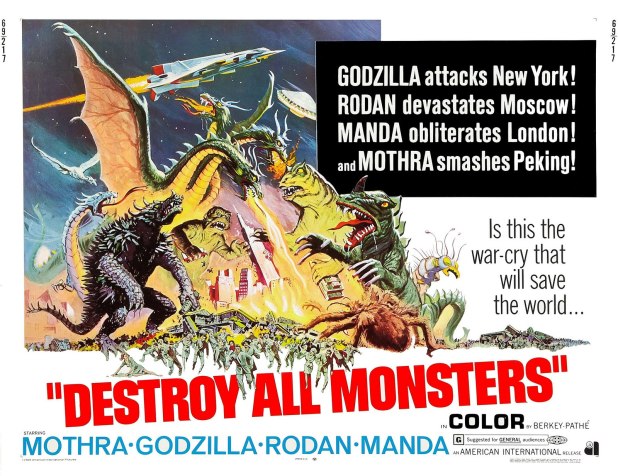
Has there ever been a better movie than Destroy All Monsters? It is everything that is magical about film: giant monsters smashing cities and fighting one another while people run and scream in terror. It is cinematic junk food, a treat for the mind that returns me to watching Action Movie on Youngstown’s WKBN 27 as a little kid, jumping around the room in pure glee.

Every giant monster on Earth has been captured and sent to Monster Island, where they are kept secure and studied — until all communication is mysteriously cut off.

Turns out that the scientists on the island are being mind-controlled by the Kilaaks, who demand the human race surrender or face total destruction. They control the monsters to attack famous cities all over the world: Godzilla decimates New York City, Rodan smashes Moscow, Mothra takes out Beijing, Gorosaurus crushes Paris and Manda, a giant Japanese dragon, goes shithouse on London. All of these attacks are to keep the UNSC forces from finding out that Tokyo is the real target. 

Luckily, the humans are able to take out the control signals and the good guy monsters take on King Ghidorah, who is overcome and killed (Minilla, Varan, Anguirus and Kumonga show up, too). The Kilaaks also have a Fire Dragon, a monster that starts setting cities on fire. Godzilla takes out their base and the forces of good triumph.

This was meant to be the final Godzilla film, as the popularity of the series was waning. However, the success of Destroy All Monsters led to even more Godzilla films.

When I was a kid, I was impatient for the human scenes to end and for the monsters to show up. I’ve never changed. All I want to do is watch giant monsters destroy cities and fight one another. This movie delivers all of that and more. It’s not high art, but does it have to be?

LEAGUE OF FORGOTTEN HEROES: Satanik (1968)

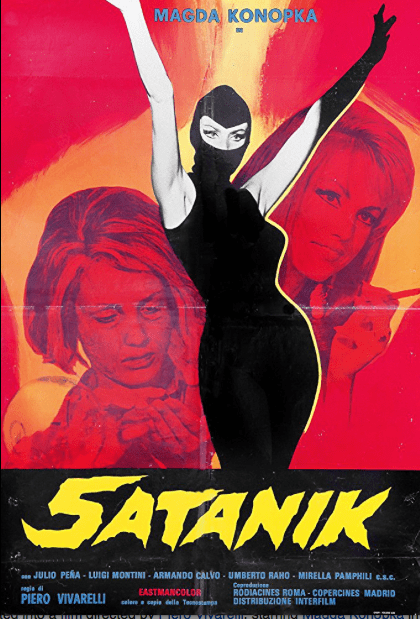
Satanik isn’t a hero, but it is based on an Italian comic book which was part of the fumetti neri (black comics) phase that Danger: Diabolik inspired (which is why Satanik is spelled that way).

Marnie Bannister is a biologist and chemist who earned her Ph.D. at a young age. While a technically brilliant scientist, she is ridiculed by her peers because of her poor background the fact that her face is marked by tumors. She still lives at home, Cinderella-style, with two beautiful sisters, an alcoholic father and closed-minded mother — all of whom make fun of her appearance. Working along with the alchemist Masopust, she develops a drug that makes her beautiful. The side effect? It also makes her into a murderous criminal named Satanik, who uses her beauty and sex appeal to take advantage of men. The comic features plenty of horror characters, such as evil ghosts and a vampire named Baron Wurdalak.

The movie, however, only concerns itself with Satanik’s transformation from old woman to beautiful young woman, playing by Polish model Magda Konopka.

If you’re looking for this film to live up to Bava’s Danger: Diabolik, I have bad news for you. There’s no way that can happen. Sure, there are murders and jet-setting and fun music, but this movie crawls while Bava’s runs, tumbles and pirouettes.

Its director, Piero Vivarelli, is better known for the original Django. With the great poster art and source material, I guess I was just expecting more.

If you want to see it for yourself, you can rent it on Amazon Prime.