The Mill Creek B-Movie Blast set is even more all over the place than your normal Mill Creek set, which usually at least has a horror or science fiction theme. Honestly, they could have just called this Mill Creek presents Nearly Everything Crown International Pictures Released. Actually, they totally should have, because I would have bought it even sooner.
Yes, not everyone has a Crown International Letterboxd list. But I sure do and one of my life’s goals — look, it’s my grail, not yours — is to see every single movie they ever released.
To get there, I’m going to have to make it through Indian Paint, a 1965 western with Johnny Crawford (Mark McCain from TV’s The Rifleman), Jay Silverheels (Tonto from TV’s The Lone Ranger) and Crawford’s brother-in-law Pat Hogan, a Native American actor who showed up in plenty of films before his untimely death at the age of 46. Hogan seems pretty awesome, as in his spare time he wrote for men’s magazines and was such a good writer that John Steinbeck sent him a note praising his writing. Know what’s even more amazing? His dog’s name was White Man.
This being a 1965 Western, Crawford ends up playing Nishko, the chief’s son who must tame a painted pony. Nobody told him anything about the rattlesnakes,cougars, wolves and enemy tribes that he’d have to handle along the way.
This was directed by Norman Foster, who made a pretty great film noir called Kiss the Blood Off My Hands, as well as several of the Mr. Moto, Charlie Chan and Davey Crockett movies. He wrote the film as well, which isn’t as problematic as most westerns from this time. So there’s that.
The quest to complete the Crown International library continues.
Why is this movie only 59 minutes long? That’s because it was a failed pilot for a TV series that would have been called The Black Cloak. The series would have been produced by Alfred Hitchcock’s television company, Shamley Productions, but it was considered too scary and violent for TV.
NBC sold it to Universal Pictures, where Hitchcock was under contract, and it played on double bills with William Castle’s I Saw What You Did.
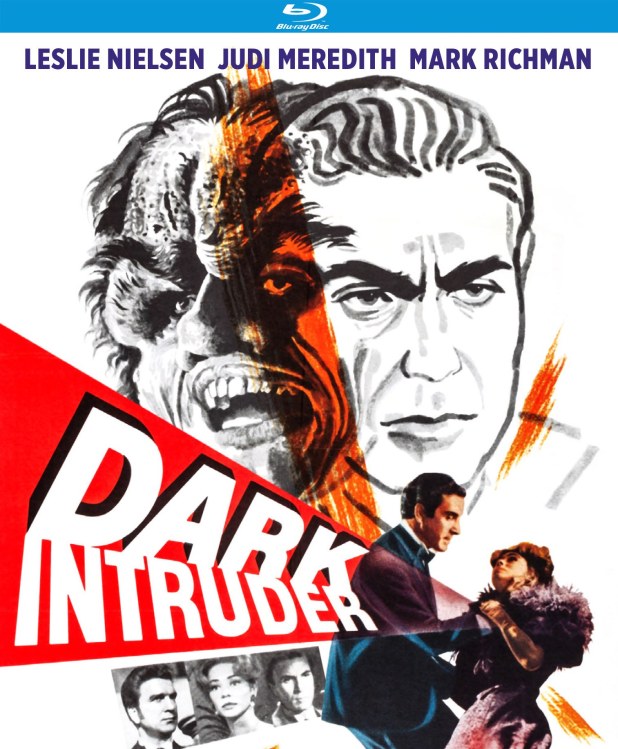
Written by Barré Lyndon (The Lodger, George Pal’s The War of the Worlds) and directed by Harvey Hart (The Pyx), this opens with a caped killer — I love that Wikipedia refers to him as a “hump-backed, long-fingernailed, black hat-wearing, caped and demonically-growling figure” — murdering a woman before introducing us to Brett Kingsford (Leslie Nielsen!). He’s a supernatural detective with a dwarf sidekick named Nikola who is on the trail of a Summarian demon that wants a body of its own.
That sentence alone should make you want to watch this.
That Summarian demon is using a series of Jack the Ripper inspired murders in San Francisco to enter our world. At each murder scene, police find an ivory statue that has a demon coming out of a man. With each new killing, the statue changes more and more.
As if things can’t get any stranger, an antique dealer just happens to have a mummified creature with a seven-spoked wheel, with each of the parts of the wheel representing a different murder that will happen. And before long, that killer is going to be coming for our hero.
Look for Peter Mark Richman (the annoying heel Charles McCulloch from that time Jason went to New York City), Judi Meredith (Jack the Giant Killer), Werner Klemperer (forever Colonel Klink), Bill Quinn (Dead and Buried), Vaughn Taylor (Psycho) and Peter Brocco (What’s the Matter with Helen?).
Jack Laird, who produced this, would go on to create Night Gallery with Rod Serling. Any of the silly parts of that show — like the ones starring Nielsen — can be blamed on him.
You can get this on blu ray from Kino Lorber, who continue to put out some really interesting movies.
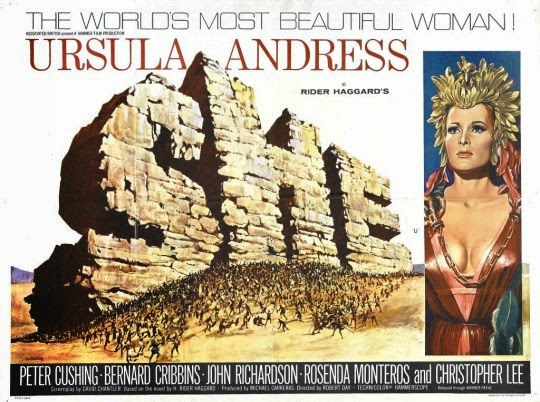
Based on the H. Rider Haggard novel, this Hammer feature — directed by Robert Day (The Initiation of Sarah) — takes Ursula Andress to the only logical place she can go after blowing minds as she rose from the beach in Dr. No. Now, she is a goddess.
Professor Holly (Peter Cushing), Leo Vincey (John Richardson, Torso, Black Sunday) and Job (Bernard Cribbins) have left the war behind and are their way to Africa when they discover a map of a secret land that is only rumored to exist. There, “She-Who-Waits” and “She-Who-Must-Be-Obeyed ” Ayesha (Andress) rules eternally.
She believes that Leo is the reincarnation of the lover she killed 2,000 years ago for cheating on her and wants him to walk through the blue fire to become immortal by her side.
In the midst of that drama, Leo has fallen in love with Ustane (Rosenda Monteros, The Magnificent Seven) and Ayesha decides to kill her for such impudence. Her tribe, the Amahagger, attack Ayesha’s army, all while her most fanatical follower, Billali (Christopher Lee) attempts to walk through the blue flames himself.
Despite Ayesha dying at the end of this film, the character would return in Hammer’s The Vengeance of She, with Olga Schoberová taking over the role.
The first Hammer movie to be built around a female character — in spite of them hating the sound of Andress’ accent and having her dubbed by Nikki van der Zyl* — this is an intriguing while dated look at a female ruler subjugating her subjects while remaining eternally in love.
She has been made so many times, starting in 1899 with Georges Méliès’ The Pillar of Fire. It was remade in 1908, 1911, 1916, 1917, 1925 (with Haggard writing the cards that appeared between the silent action) and 1935 before this movie and in 2011. I guess you can consider the Sandahl Bergman film She is somewhat inspired by this, even if it’s just the title.
Alejandro Muñoz Moreno became better known as Blue Demon, a Mexican luchador and film actor who was the contemporary, teammate and often rival of El Santo. From 1948 to 1989, he never lost his trademark mask in a series of mask vs. mask and mask vs. hair challenges, winning the hoods of Espectro II, Matemático, Rayo de Jalisco and Moloch and shaved the heads of Baby Olson, Tony Borne and Cavernario Galindo. He held the NWA World Welterweight Championship twice, the Mexican National Welterweight Championship three times and the Mexican National Tag Team Championship. He was such a big deal that each year or so, CMLL holds the Leyenda de Azul tournament in his name and he was buried in his trademark outfit.
Along the way, he found the time and energy to appear in 28 movies.
After La Furia del Ringand Asesinos de la Lucha Libre, this was the third film that Blue Demon would appear in. Directed by Chano Urueta, this is a great introduction to the hero, who battles werewolves and mad scientists. Whereas El Santo at least had a silver mask that you’d figure would give him the edge against el hombre lobos, Demon has no such extra advantage. Instead, he’s going to battle them with just the gifts that God gave him, which is mostly body slams, which somehow do end up curing the world of lycanthropes in this entry.
One of the wrestlers that Blue Demon is in the ring with in this, Ray Mendoza, may not be known as much to American audiences, but his sons became Los Villanos and two of them — Villano 4 and Villano 5 — wrestled for WCW.
Plus, the man who played El Sanguinario in this — Fernando Osés — would go on to write ten of the Santo films and nearly all of Blue Demon’s movies, including this one. He even directed three movies — El Chicano Justiciero, La Hija del Contrabando and Gente Violenta.
You know, for two genres that have so many movies, westerns and horror don’t cross over nearly as much as they should.
Director Alfredo B. Crevenna (Aventura Al Centro de la Tierra , El Planeta de Las Mujeres Invasoras) and writer Alfredo Ruanova (Blud Demon: Destructor de Espias, the Neutron movies) team up to tell the story of the two centuries old Rio Kid, who has taken up residence in a western town to draw out other gunfighters, murder them in cold blood — or duels, really — and then drink their, well, blood to gain their gunfighting skills. It’s a pretty great scam he has going and the townspeople all love him because he’s saved a few of the women from some of the rougher men out there.
Meanwhile, a guy named Texan, who is el hijo of a pretty well-known bandito, joins up with an old man named Nestor who was in jail because of the villainous Rio Kid, and the Rivero brothers all head to San Jose to see if they can take out the bad guy.
With a title that translates as Ghost Town, you know what you’re getting into. The townspeople have a song that drives Nestor to violence, the vampire has the longest fangs you’ve ever seen and it seems like Gunsmoke meets a Universal monster, which really is the episode of that venerable TV series that I always longed to see.
Roberto Mauri started as an actor before directing became his main calling card. You may have seen some of his Italian Westerns, like Sartana in the Valley of Death and He Was Called Holy Ghost or his oddball jungle film King of Kong Island or Slaughter of the Vampires. Oh yeah — he also wrote the giallo Clap, You’re Dead and came back in 1980 to make The Porno Killers.
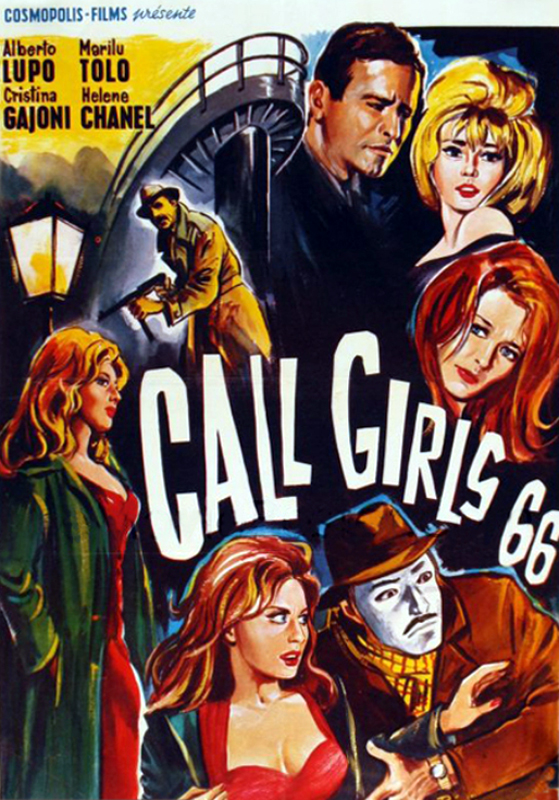
Prefiguring the giallo craze that would happen in around five years, thanks to Argento, this movie has a masked killer who preys only on prostitutes, hence its alt title Call Girls 66.
When a prostitute is killed and several others are nearly snuffed out, that girl’s sister decides to investigate on her own, learning that not just one, but several famous actors seem to be behind the killers.
This movie has such a great payoff that I’m shocked that more giallo didn’t steal it. The killer is a man whose features were destroyed in the Hiroshima bomb blast and no woman will go near him, much less have sex with him. So he makes masks of famous actors and uses them to get close to the women, who he soon kills. Crazy, right?
Margaret Rutherford may have ben in more than 40 films, but she is best known for playing Agatha Christie’s Miss Jane Marple in four movies and Madame Arcati in Blithe Spirit. She also dealt with some family craziness, as before she was even born, her father killed his father by beating him to death with a chamber pot. After seven years in a mental ward, he was released. After starting his new family, changing his name and moving to India, his wife killed herself, leading Margaret to be raised by her aunt. She was told her father was dead, despite him trying to reach her for years.
Once she began acting, she was pretty much protected from the world by her husband — and frequent acting partner — Stringer Davis. There have been rumors that the two never consummated their relationship, but they did adopt a child of sorts by taking in a young man named Gordon Langley Hall who eventually had gender reassignment surgery and became known as Dawn Langley Hall, the name she used when she wrote the biography of Rutherford, Margaret Rutherford: A Blithe Spirit.
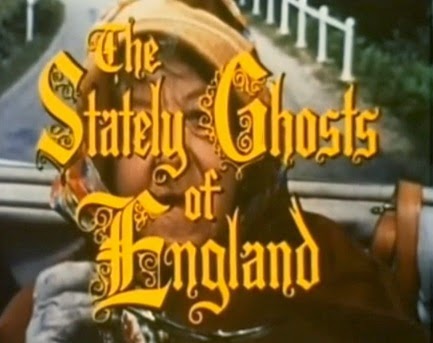
In 1965, Margaret — who suffered bad spells and electroshock therapies in her life in an effort to stay away from the madness she thought infected her family — Stringer Davis and Tom Corbett visited the haunted homes Longleat, Salisbury Hall and Beaulieu for an NBC special based on Diana Norman’s book The Stately Ghosts of England.
Honestly, it’s one of the best things I’ve ever seen, an absolute delight of old English manners, famous British actors and just plain goofball haunting silliness.
NBC promoted this show with articles in the New York Times and Show Magazine. There was plenty of William Castle-level BS in these, including all manner of ghost antics like slamming doors, ruined footage and broken cameras writer, producer and director Frank De Felitta asked for the ghosts to give him permission to film them.
Great story, right? Well sure, but De Felitta also wrote the novels Audrey Rose and The Entity. So he knew a great ghost story when he heard one.
Don “The Snake” Prudhomme and Tom “The Mongoose” McEwen were gods to us kids in the ’70. We bought the racing magazines and ripped out the glossy spreads of their cars and persons and Scotch Taped ’em to our bedroom doors and walls — right next to our Runaways (duBeat-e-o) and Suzi Quatro (Suzi Q) posters, and Roger Decoster’s mag-rips of his daring motocross jumps.
When the ABC Wild World of Sports held one of Prudhomme and McEwen’s drag or funny car races on a Saturday afternoon, the neighborhood streets cleared and everyone sat in front of the TV. The Snake and Mongoose were matched only by Richard Petty and Evel Knievel. They were the “Muhammad Ali” of racing. Everyone loved them.
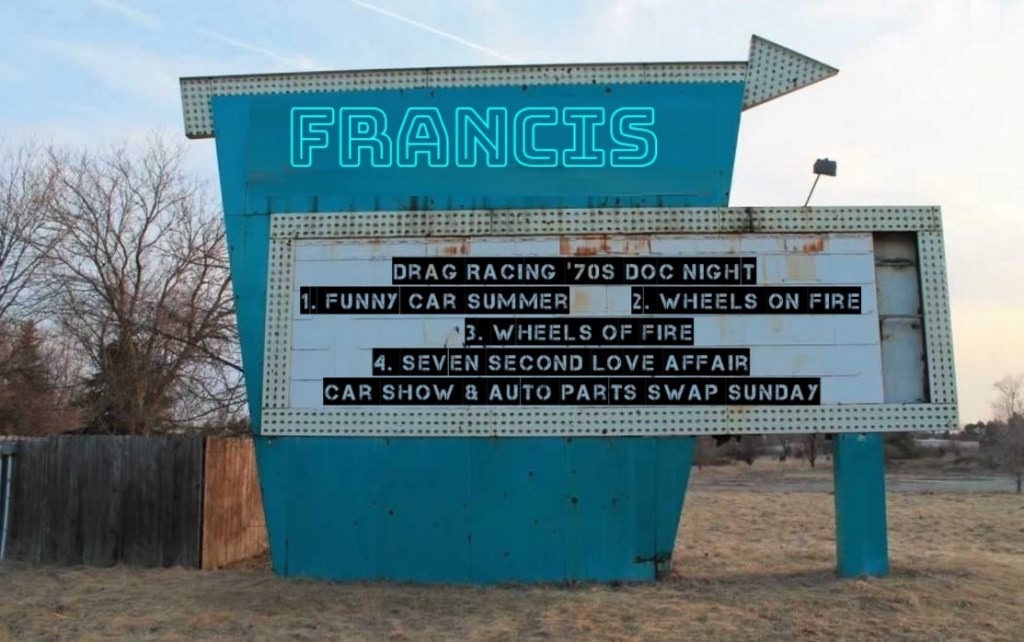
So, to commemorate those “Funny Car Summers” of those youthful days of yore, let’s fire up that silver screen under the stars!
Man, when this commercial came on TV . . . EVERYBODY went to see this documentary that chronicles a summer in the life of “Funny Car” racer Jim Dunn and his family.
The most popular, best known, and best-distributed film of the night — it is also the most disappointing (to those wee eyes of long ago) of the films of the night. You know how great Pawn Stars and American Chopper were when they first went on the air — then they turned into a Kardashians-styled sit(shite)com that’s all about Chum Lee and Corey Harrison bumblin’ about the shop and Junior and Senior fighting? Where’s the neat junk? Where’s the bikes? Where’s Frank and Mike? Who in the hell let Danielle, this Memphis blond chick, and Mike’s bumblin’ brother on the set? Where did the pickin’ go? This is American Pickers, right?
Well, that’s what watching this movie is like: all family drama and little vroom-vroom. Way to go marketing department and Mr. Distributor. You broke our little-tyke hearts — and pissed off our parents, who paid the drive-in fare, because we bitched from the backseat that we were bored — and watched 99 and 44/100% Dead (or was it The Exorcist) through the rear window, instead.
You can watch Funny Car Summer on You Tube HERE and HERE.
Wheels On Fire is a classic motor sports documentary — and also one of the most obscure and hard-to-find (as you can see, it’s even impossible to find a decent image of the theatrical one-sheet). But not in the land of Oz, since this was filmed in Liverpool, Sydney. This one kicks ass because of — before there were web-cam and fiber optics — has the first ever “race cam” strapped onto the drag car, which takes you behind the wheel at speeds above 300 kilometers (miles in the States) per hour.
Again, this one is near impossible to track down on VHS and DVD — and the DVDs are grey market VHS-rips. And there’s no trailer or clips . . . denied.
Intermission! The Snack Bar is Open! Check out our classic drag racing poster art gallery while you wait in line!
Not to be confused (and it is) with the “on” movie above, Wheels of Fire focuses on the lives of five major drag racers of the era: Don Garlits, Don Prudhomme, Shirley Muldowney, Richard Tharp and Billy Meyer, as they are each followed through a complete drag racing season. Yep. This is reality TV before Robert Kardashian had his first kid (I think; too lazy to check K-Dash B-Days), the very same kids who unleashed the ubiquitously-hated broadcasting format.
As with the oft-confused Wheels on Fire, there’s no online streams of this lost, classic drag racing film. It was on You Tube in several parts, but was removed. Only this 10:00 minute clip is available, which we’re posting in lieu of an official trailer (. . . and don’t be surprised if it also vanishes to grey screen; yep, it’s gone). The now out-of-print DVDs are available in the online marketplace from time to time (and, as you can see, it’s impossible to find a decent theatrical one-sheet). The NHRA web platform and their upper-tier cable channel rerun it from time to time.
Documentarian Les Blank of Burden of Dreams fame, which chronicled the making of Werner Herzog’s and Klaus Kinski’s Fitzcarraldo, made his docu-debut with this drag chronicle — its seeds (A Rubber Tree plant, ha-ha! ugh.) planted courtesy of his first behind-the-camera gig shooting drag racers in Long Beach, California.
This one has it all: Souped-up “Blower” Mercurys and Chevys (like in Two-Lane Blacktop), rails, and funny cars. While it chronicles other racers, this one is a showcase for Rick “The Iceman” Stewart as he attempts to grab the world’s record — as Los Angeles’ Canned Heat Blues Band provides the musical backing.
Les Blank has made this easily accessible as an Amazon Prime and Vimeo VOD that’s also available for purchase at Les Blanks.com and on eBay.
And so goes our “Fast and Furious Week: Part Deux.” Can you smell the rubber Big Daddy is cookin’, Dwayne? And, do you have a hankering for even MORE drag racing films? Then check out our first “Fast and Furious Week” reviews of Burnout and Fast Company.
Poster by Dennis Preston for “The Great Bed Race” in Lansing, Michigan on August 11, 1979/courtesy of Splatt Gallery Facebook.
Update: In May 2021, we went drag racing crazy and reviewed several more drag flicks as part of our “Drag Racing Week” theme-feature of the month. Image Courtesy of Vectezzy.
Another drag racing doc? You bet. During out two month “Cannon Month” blow out in July and August 2022, we discovered this Cannon-distributed ditty. Who knew?
In August and December of 2020, we had two “Fast and Furious” tribute weeks filled with the aromas of burning rubberand bubbling oil.
Mill Creek’s “Savage Cinema” 12-pack got us started as we reviewed over 40 filmsin August 2020.
Yeah, we did another week with another 40-plus films.
You say you need more racing films? You mean we haven’t covered enough? Well, then head on over to Demaras Racing under their “Fast Films” section for their reviews on car flicks. From Mickey Rooney in The Big Wheel to a discussion of Dustin Hoffman’s ride in The Graduate to the cars in THX 1138 — so many that we missed or never got around to reviewing — they’ve got you covered.
About the Author: You can learn more about the writings of R.D Francis on Facebook.He also writes forB&S About Movies.
About the Author: Paul Andolina is one of my favorite people to talk movies with. If you like his stuff, check out his site Wrestling with Film.
Evil Brain from Outer Space is a science fiction film from 1965. It happens to be a couple of the Japanese Super Giant films that have been hacked up and spliced together to make one English dubbed film. It’s an odd movie about a group of aliens who send one of their own to earth to stop the brain of the evil mutant Balazar from destroying humanity.
Special effects films and television shows are big in Japan and they have been since Godzilla roared onto screens. The Super Giant series from the late 50’s is a bunch of stand-alone films that are about the deeds of a man named Giant of Steel or as he is known in EBfOS Star Man. Star Man is a superhero basically and he wears some pretty nifty lycra outfits, he looks like a luchador that forgot his mask at home.
Evil Brain sees Star Man coming to earth to stop a few evil doctor/scientists who are in league with the evil extraterrestrial brain of Balazar. There is a hawk that hangs out with one of these doctors and a one-legged man who serves the other. There are some pretty awesome mutants who fight Star Man in this film as well. One looks like a chupacabra from the black lagoon and has strange tendril-like fingers and makes some weird noises, if I had seen this a child I would have been scared of him immediately. I actually said out loud, “WTF is that?” while watching the movie. He is by far my favorite part of the film. The other mutant is a long-haired demon lady who doesn’t quite know how to put on her lipstick. She jumps around and scratches the air while making demonic cat noises. There are also some generic henchmen mutants as well.
I would love to see the Super Giant serials in Japanese with English subtitles but I’m not sure they can live up to the insanity that is this film. It seems longer than it is because there is too much jibber-jabber. Honestly would love to see Star Man just mess up some mutants and forgo the plot altogether. If you like psychotronic films this is definitely the one for you. I have no idea what they were thinking when they pieced this bad boy together. I’d like to believe there was some acid involved and a whole lotta pot. It is in black and white but it still is a lot of fun.
If you have any interest in the Tokasatsu trend in Japan and want to see an earlier effort you can’t get much better than Evil Brain from Outer Space.
A bunch of salamander men from the planet Kulimon in the Moffit Galaxy plan on taking over Earth by unleashing a lethal plague on mankind (maybe not what you want to watch right now). It’s up to Starman from the Emerald Planet to save the human race.
I always wondered why these movies didn’t make any sense when I was a kid.
That’s because they were all part of a much larger story that we had no idea about. We’re coming into the middle of a movie serial called Kōtetsu no Kyojin (Giant of Steel). To be more exact, we’re watching episodes 3 and 4, which were called The Mysterious Spacemen’s Demonic Castleand Earth on the Verge of Destruction.
That’s because Walter Manley Enterprises and Medallion Films bought these movies from Japan and then did pretty much whatever they wanted with them. While the original films are 48 and 39 minutes long, they jammed them together, took out 9 minutes and used library music and dubbed dialogue.
While the American version refers to the bad guys as salamanders, those that love Japanese crytozology will recognize them as kappas, the dreaded frog-like beasts that haunt rivers and lakes. They also have a doctor who can hypnotize people, a witch and their leader, who is able to change the rotation of the planet.
Starman predates both Ultraman and the sendai ranger shows, but he’s very similar. He tends yo leap off things and do tons of backflips. A lesser hero would get dizzy and puke from the acrobatics that he does, but that’s why he’s such a winner, I guess.
Walter Manley Enterprises also brought the Jayne Mansfield-starring The Loves of Hercules, Invasion of the Neptune Men, Curse of the Blood Ghouls, Giants of Rome, Cavalier in Devil’s Castle and Revenge of the Black Eagle to America, amongst other films.
They also made three more Starman movies. It all begins in Atomic Rulers of the World, which is Super Giant and Super Giant Continues; Attack from Space which is The Artificial Satellite and the Destruction of Humanityand The Spaceship and the Clash of the Artificial Satellite; and finally Evil Brain from Outer Space, which took the full color films The Space Mutant Appears, The Devil’s Incarnation and Kingdom of the Poison Moth and made them black and white. Why? Your guess is as good as mine.
Director Teruo Ishii, known as “The King of Cult,” made tons of movies. He directed 10 of the 18 A Man from Abashiri Prison films, all eight of the Joys of Torture series, Horrors of Malformed Men, Sonny Chiba’s The Street Fighter’s Last Revenge, some Pinky violence films, a few biker movies, two Yoshiharu Tsuge manga adaptions (Master of the Gensenkan Inn and Wind-Up Type) and so many more. In all, he made 83 films and numerous shows for TV.
Ishii left the series after the sixth movie, as he learned that a child had imitated Super Giant, dressing up like the hero and jumping out of a window to the street below. This is why Japanese superhero shows began airing a disclaimer before every show, warning kids to not imitate the things they saw on screen.
I would hope that no one copied any of the Yakuza and erotic torture that he’d be in charge of in his later films.
Seriously, I love this movie. It’s kind of goofy looking compared to the CGI superheroics that we have today, but it has a charm that none of them do.
You can watch this on YouTube and download it for free on the Internet Archive.








 B&S About Movies
You must be logged in to post a comment.