The House By the Edge of the Lake (1979)

Enzo G. Castellari wasn’t too happy with how this movie was made or how it ended up.

According to Robert Curti’s Italian Gothic Horror Films, 1970-1979, he had become friends with a young writer named Jose Sanchez, who he was mentoring and had hired as an assistant. The script for this film was being produced in Spain and if they used Castellari’s name, there was a better chance the film would be made. However, in the credits, Jose Maria Nunes is the credited writer and Sanchez is an actor. But who are we to test the memory of the man who made Great White?

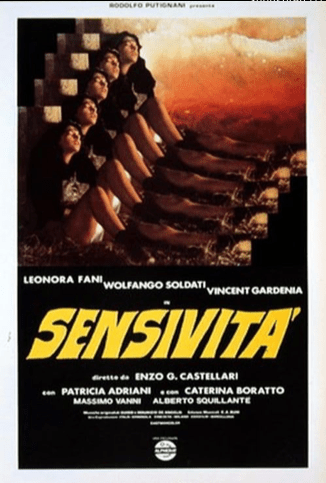
Castellari said, “Distributor Rodolfo Putignani and his associate Curti finished it their own way. But my name as director stayed.” They changed the name to Sensivita and it was released as Diabla in Spain. But they weren’t done. Seven years later, Alfonso Brescia was brought in to shoot new scenes, which Castellari saw years later at a horror convention. He laughed it off, saying, “After six minutes I walked out of the theater, horrified.” That new edit was released under the title Kyra – The Lady of the Lake.

Whatever the end result is, you know that I’m going to get excited by a movie that starts with a bloody hand that rises from a lake and drowns a woman, much less one about the occult secrets of a home being investigated by Lilian (Leonora Fani, Hotel Fear) who wanders the lake where her mother drowned and then finds a toad in her bed.

There’s also her sister — well, spoiler warning, sorry — Lilith (Patricia Adriani) who is a witch who lives in a cave that is constantly studying all of the symbols all over the area. She’s also connected to her sister in the way that all Italian exploitation films connect people. Yes, it’s sex. As Lillian makes love to a man, Lilith feels what she feels. They both pass out from a movie orgasm while the man drives off and immediately dies in a car crash. This is cinema.

Lilith can also speak to the woman inside the lake, who is named Kyra. There’s also a little blind girl who has more headless dolls than she knows what to do with, an axe murderer, Vincent Gardenia as a painter, a village filled with people in giant masks and Antonio Mayans shows up in a non-Jess Franco movie. I was beside myself with sheer happiness and that’s before the ending where the two leads have a clothes-destroying girl-on-girl fight to the death.

Why has this not yet been placed on blu ray and upgraded and presented with scholarly commentary tracks that pretend that it’s art instead of lurid Italian exploitation filmmaking — which is art, so this is a double positive and hey, physical media companies, I will totally record that commentary track — and man, I’ve been super down as of late and then a movie like this crosses my path and I have to think, “I live in a world where the cosmic coincidences or simulation that created my reality eventually led to thousands of years of evolution which eventually produced this, a film of staggering achievement that literally ones of people are obsessed over.”
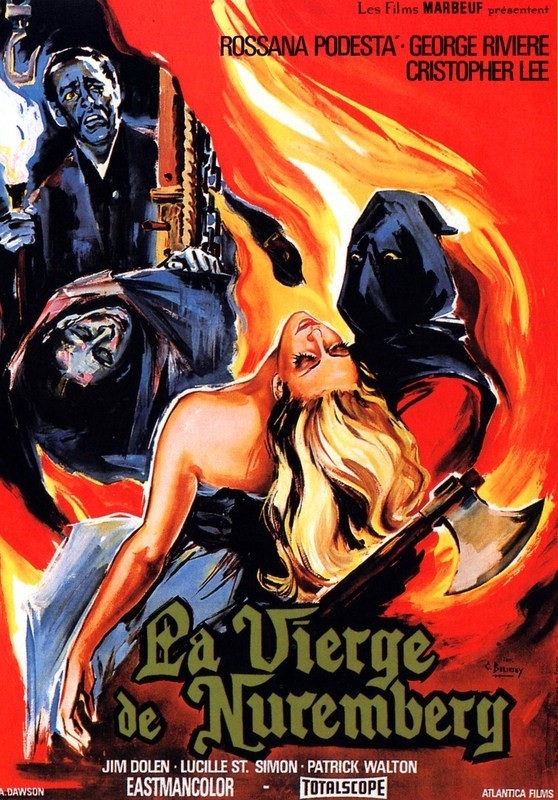
The Virgin of Nuremberg (1963)

The Virgin of Nuremberg — released in the U.S. as Horror Castle — was based on the Italian paperback La vergine di Normberga by Maddalena Gui. They were published by G.U.I., who sold these Gothic erotic horror slices of sleaze as British books translated into Italian, claiming that their real writers were just the translators.  Produced by G.U.I.’s owner Marco Vicario, this was directed by Antonio Margheriti, who wrote the story — well, rewrote it to add the surgical terror and World War II ideas — with Renato Vicario and Edmond T. Gréville, who directed The Hands of Orlac. The other name listed as a writer is Gastad Green, who may either be Vicario’s brother Renato or Ernesto Gastaldi.

Shot on the set of Castle of Blood in just three weeks, this finds Mary Hunter (Rossana Podestà, Seven Golden Men) newly married to Max (Georges Rivière) and living inside his large castle. One night, she wakes up and finds herself walking down to the dungeons below the ancient structure and finding an eyeless woman inside an iron maiden. Everyone believes that she’s making these things that she’s seen up and that they are just dreams. Cared for by the sinister servants Marta (Laura Nucci) and Erik (Christopher Lee), she soon discovers that the castle once was the home of The Punisher, an evil monster of a human being who loved to torture women.

Well, he’s definitely at it again, engaging in all manner of deranged tortures, including a rat cage face mask — complete with hungry little rats — being placed over a girl’s pretty face in a scene that predates torture porn. Yet this isn’t all shock for the sake of cheap jump scares. This has a dark and twisting story that takes us into how war can destroy people who end up destroying others.

It looks beyond impeccable and over this past year, I’ve become such a fan of Margheriti. Yes, Bava may be the master of Italian horror, but you can make the case for Anthony Dawson to having a space quite near the crown.

You can watch this on YouTube.

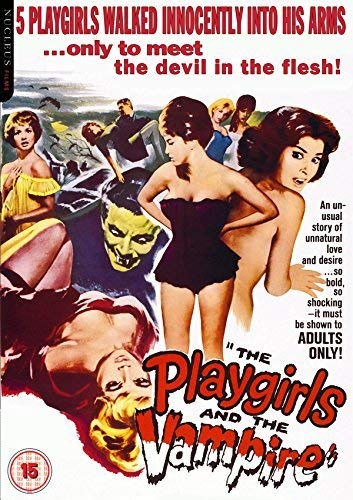
The Playgirls and the Vampire (1960)

Count Gabor Kernassy (Walter Brandi) lives in a castle surrounded by darkness and a forest, so when an entire group of exotic dancers, their piano player and their manager ends up on his doorstep, it all seems like a buffet. Yet one of those dancers, Vera (Lyla Rocco), is the reincarnation of his long lost wife Margherita Kernassy. How does this keep happening to these vampires? Well, maybe he isn’t the undead one. Ever think of that?

Directed by Piero Regnoli, who was one of the writers of I Vampiri as well as Patrick Still LivesBurial GroundDemoniaNightmare City and so many great films, has made a movie that seemingly shares so much with The Vampire and the Ballerina. This film, however, has more of a lost romanticism and had the original title L’ultima preda del vampiro (The Vampire’s Last Prey). It was released in the U.S. as an adult movie and then edited for TV as Curse of the Vampire.

Regnoli co-wrote this with cinematographer Aldo Greci, who shot this and so many other movies including Play Motel.

This has a good vampire and a bad one, so to speak, as well as a housekeeper Miss Balasz (Tilde Damiani) and groundsman Zoltan (Antonio Nicos) who are on the side of good. But still, this is a movie where Katia (Maria Giovannini) can die and get buried and everyone keeps on dancing because, I mean, why stop dancing? It’s also the kind of early exploitation that has her get a stake to the heart and blood pours all over her shapely legs. Didn’t Russ Meyer say it best? “While violence cloaks itself in a plethora of disguises, its favorite mantle still remains… sex.”

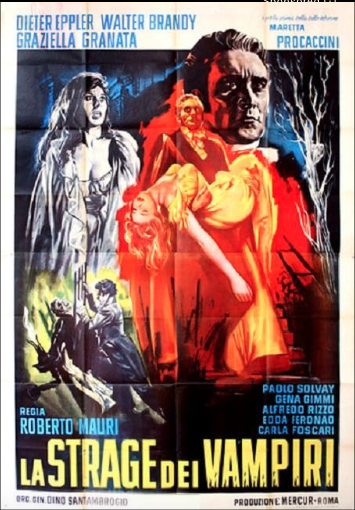
Slaughter of the Vampires (1962)

Roberto Mauri isn’t talked about as often as he should be. There’s his oddball King of Kong Island, his Westerns like He Was Called Holy Ghost and his masterful Madeleine: Anatomy of a NightmareNow, after this, I need to look up more of his movies.

Released in America on TV as Slaughter of the Vampires and then as a double feature with The Blood Beast Terror — renamed as The Vampire Beast Craves Blood — as Curse of the Blood Ghouls, this has the kind of tagline that definitely made me want to watch it: “Satan’s Horror Henchmen enslave beautiful women through weird ways of love transforming them into Blood Ghoul Vampires to satisfy an insatiable LUST.”

This stars Walter Brandi, who was also in The Vampire and the Ballerina and The Playgirls and the Vampire. He plays Wolfgang, who has just become married to Louise (Graziella Granata), and they are unaware that a vampire (Dieter Eppler) has entered the party they’re having. He soon seduces Louise and bites her, which means that Wolfgang must look for a cure, finally meeting Dr. Nietzche (Luigi Batzella).

Where Hammer has rich color, this is shot in black and white, but it’s a whole different type of beautiful filmmaking. The real castle adds quite the scenery and if this movie can’t have crimson blood, it can have bosoms barely held back by their costumes and that is always enough.

You can watch this on Tubi.

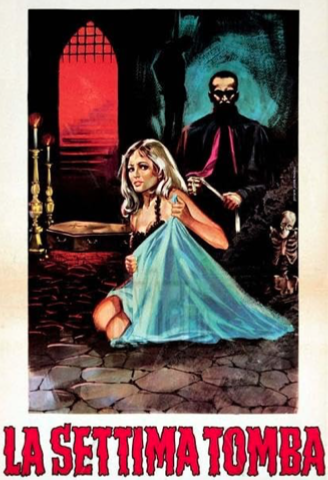
The Seventh Grave (1965)

The only movie directed by Garibaldi Serra Caracciolo, who used the name Finney Cliff, The Seventh Grave is one wild movie.

Written by Caracciolo, Antonio Casale (who plays Jenkins in this movie as the Americanized name John Anderson; he was also assistant director using the name Paul Sciamann) and Alessandro Santini (using the name Edmond W. Carloff; he also directed and wrote La pelle sotto gli artigli and Questa libertà di avere… le ali bagnate, which was co-written by Renato Polselli). this all takes place in Scotland after Sir Reginald Thorne dies from leprosy. As happens in these movies, the family comes to his estate for the last will and testament to be read.

Attorney Bill Elliot (Nando Angelini) and his assistant, a waitress named Betty (Germana Dominici), prepare to tell who gets what to the assembled friends and family, who include Jenkins (Antonio Casale) and his mistress Mary (Bruna Baini); his brother Fred (Gianni Dei, Patrick Still Lives); Sir Reginald’s assistant Patrick (Calogero Reale); Reverend Crabbe (Ferruccio Viotti) and Colonel Percival (Umberto Borsato) and his psychic daughter Katy (Stefania Nelli).

According to Sir Reginald’s request, everyone must stay together for 48 hours and explore the mansion, as the treasure of Sir Francis Drake is hidden there. Huh? Well, soon Patrick is dead, the coffin with Sir Reginald’s body is empty and Inspector Wright (Armando Guarnieri) is on the case.

This feels like The Cat and the Canary meets an Italian Gothic with a seance and a masked killer and oh, maybe we should add some psychic powers. I mean, that’s exactly what it is. And I loved it. It’s such a baffling movie, made with so many people who didn’t do much else and I’m kind of obsessed with learning more about it.

You can get this as part of Severin’s Danza Macabra Vol. 1 box set or watch it on Tubi.

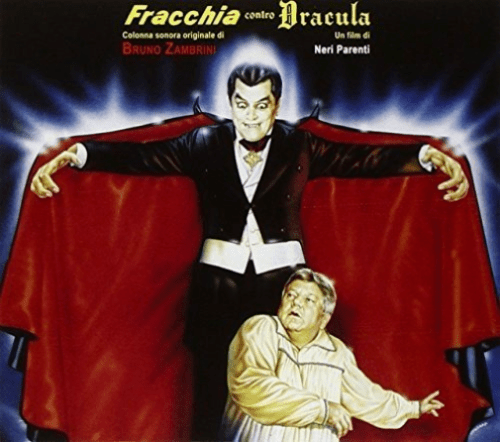
Fracchia contro Dracula (1985)

Giandomenico Fracchia (one of the many characters of comedic actor Paolo Villaggio) is given a challenge that he must succeed at or lose his job: sell a castle in Transylvania to nearsighted Arturo Filini (Gigi Reder), who doesn’t realize that he is buying Castle Dracula.

The duo get involved in the family drama of Count Vlad (Edmund Purdom!) and his sister Countess Oniria (Ania Pieroni, Mater Lachrymarum!), who is about to be married in an arranged ceremony to Frankenstein’s Monster (Romano Puppo, Lee Van Cleef’s stuntman and one of the pallbearers at his funeral). There’s also a beautiful vampire slayer named Luna (Isabella Ferrari) waiting to take out all of the undead.

Director Neri Parenti is known for his comedy films with Villaggio, as well as cinepanettoni, or comedy movies intended to be watched over the holidays. He also made The Face with Two Left Feet, a parody of Saturday Night Fever.

There’s a scene where Fracchia takes his girlfriend to the movies. They’re watching Return of the Living Dead. It scares the character so much that he nearly decimates the theater. By the end of the movie, this has all been a dream and our hero is back in the same theater except that Dracula is sitting behind him.

This looks way better than you’d expect but that’s because the cinematographer was Luciano Tovoli, who shot SuspiriaThe PassengerTenebraeThe Sunday Woman and many of Barbet Schroeder’s films. I won’t mention that he also lensed Dracula 3D.

You can watch this on YouTube.

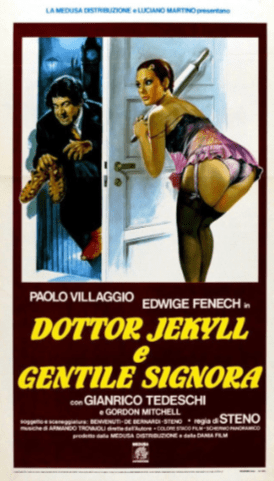
Dr. Jekyll Likes Them Hot (1979)

Dr. Jekyll (Paolo Villaggio) is the director of the powerful multinational food company PANTAC. He’s unleashed so many harmful products on the world, but when he drinks the serum of good, he becomes the much nicer Mr. Hyde.

Directed by noted Italian comedy director Steno, who wrote the script with Leonardo Benvenuti, Piero De Bernardi, Giovanni Manganelli, Franco Castellano and Giuseppe Moccia, this finds the doctor telling his servant Pretorius (Gordon Mitchell) that he secretly wants to be good. Well, it just so turns out that the real Dr. Jekyll lives in the basement and can turn him into a good version of himself, the one that his secretary Barbara (Edwige Fenech) falls for.

The commedia sexy all’italiana movies seem strange and maybe not funny to American audiences, but you know, Edwige Fenech is in it and isn’t that good enough? It’s good enough.

As for the film, well, it never really gets going past that major twist of having Hyde become good.

You can watch this on YouTube.

An Angel for Satan (1966)

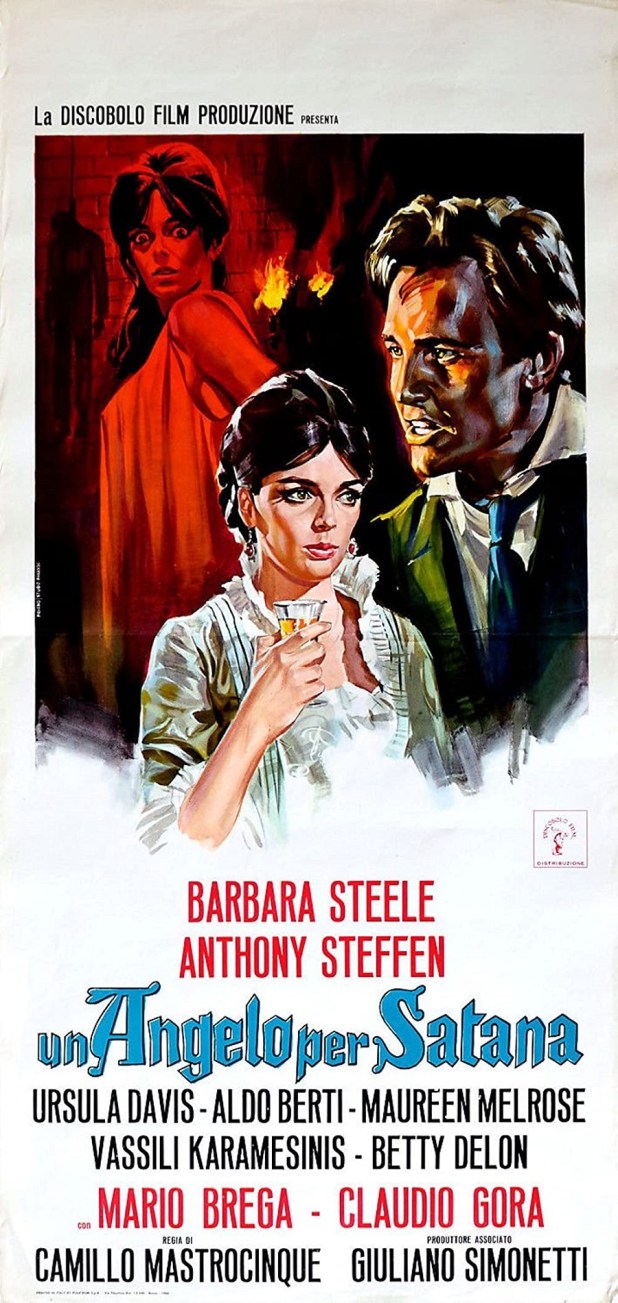
The Count of Montebruno (Claudio Gora) was just trying to clean up his gigantic mansion in time for his niece Harriet (Barbara Steele) to visit.  As part of this, a statue is found at the bottom of the lake and brought back to its original splendor by artist Roberto Morigi (Anthony Steffen). Of course, it turns out that the status looks exactly like Harriet but is truly one of Belinda, an ancestor who was a witch who held the entire village in her grip.

Now, Harriet has become Belinda and uses her beauty to destroy men — and a woman — in scene after scene of twisted sexual frisson. In one, she makes the gardener enflamed with desire by alternately asking him to watch her disrobe and attacking him with a riding crop. There’s no nudity, but somehow by being not in your face explicit it all seems somehow more perverted. The man becomes so overwhelmed that he attacks every woman in the village and he’s not the last man to feel her ways, as a teacher hangs himself, a woodsman kills his entire family and even the maid is forced into evil because of the womanly power that is Belinda.

Camillo Mastrocinque also made another Italian gothic, Terror In the Crypt.

I can’t even put into words — I’ve tried, you just read it all — how much I love this movie.

You can watch this on Tubi.

Don’t Look In the Attic (1982)

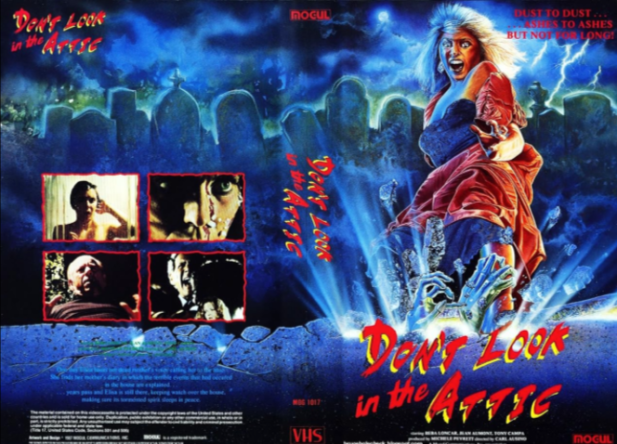
Carlo Ausino — Charles Austin — started his directing and writing career with La città dell’ultima paura, which he followed with Double Game, which also has Annarita Grapputo in the cast. As you can guess, it got this title when released in other countries, as it’s called La Villa Delle Anime Maledette (The Villa of the Cursed Souls) in Italy.

In 1955, two men are fighting. One kills the other with a knife, then a woman grabs the knife and stabs the killer. She runs into a cemetery where she’s dragged into a grave by a demon’s hand. This is called how to start a movie in a great way.

Years later, her daughter Elisa (Grapputo, who is also in Magnum Cop and Like Rabid Dogs) is at a seance when she hears her dead mother warn her to never go to the villa.

So she goes to the villa.

That’s because she and her cousins Bruno (Fausto Lombardi) and Tony (Antonio Campa) inherit the place and are told they can never sell it or rent it. They have to keep on the caretaker (Paul Teitcheid), and all move in. Bruno even brings his wife Sonia (Ileana Fraia, The Killer Nun), who is the first to die when she’s hit by a car. At this point, both Bruno and Tony realize that they’re in an Italian exploitation movie and decide to have sex with their cousin, who is a virgin. Not at the same time. I mean, they may be incestual, but they have some morality. Well, not Bruno, who has to have a heir and who always believed it was his wife’s fault he didn’t have a child, so he tries to assault Elisa, who has learned that she’s of the seventh generation cursed by the house, thanks to a diary.

While all that’s happening, the lawyer who read the will has a secretary who used to be his lover named Martha (Beba Loncar, Interrabang) who is also a student of the occult. When her lover Ugo (Jean-Pierre Aumont, Cauldron of Blood) dies, she also comes to the villa.

There’s also a giallo killer wandering outside, as well as lots of fog inside. I have no idea what the curse on Elisa was other than she’s in a haunted house. Then again, this has a great tagline, “Ashes to ashes, dust to dust — but not for long!” As you can see, that also sounds good and makes no sense. Maybe that’s why I like this movie. It’s an Italian Gothic, which means it’s probably not going to be logical and this movie just totally overachieves on that.

I love this movie but you’re probably going to hate it.

You can watch this on Tubi.

I Vampiri (1957)

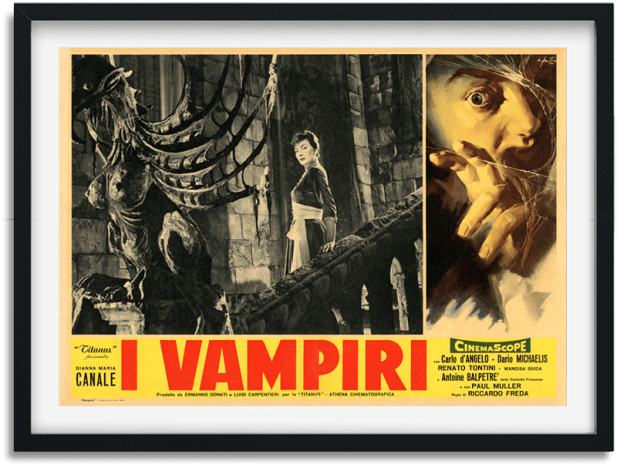
Goffredo Lombardo of Titanus wanted Italian films to not just be seen in Italy but around the world.

Director Riccardo Freda and cinematographer Mario Bava wanted to make a horror movie. Freda believed that until now, only Americans and German expressionists could make a movie like he had in mind.

Lombardo did not care for horror but gave the team a low budget.

They made magic.

On the 12th day of production, Freda left the set. After an argument with producers, Bava took over, changing parts of the story and the ending.

Again, magic was being made.

A series of mysterious killings are being investigated in Paris, as women of the same blood type are being drained by someone the press calls The Vampire. Journalist Pierre Lantin investigates and becomes even more involved when his dancer fiancee Nora Duval is kidnapped, possibly by The Vampire.

There’s also a man named Joseph addicted to something and is told that he must follow orders to get his next dose. He’s also blackmailing Professor Julian Du Grand, who soon meets with a woman shrouded in darkness named Marguerite who threatens the scholar. We learn that he has died unexpectedly, possibly by suicide, soon after.

Another woman named Lorette is kidnapped and kept in a room filled with the skeletons of past victims. And the truth is the Professor’s death has been faked so that he can work for the woman behind all of this, Gisele, a female vampire who ages each night. She and Marguerite are the same person, a woman who will use anyone and do anything she can to remain eternally young.

Released in the U.S. as The Devil’s Commandment and also as Lust of the Vampire, which has new scenes added with “Grandpa” Al Lewis added. This was the first Italian horror film of the speaking film era.

Mario Bava and Piero Regnoli’s last-minute rewrites — they were running out of time to make this movie — made Pierre the lead instead of a supporting character. This was needed as all of the other actors had only signed up for ten days.

Much like an other Italian vampire movie, Atom Age Vampire, there are no vampires in this movie. There are some amazing dungeons and the start of what Bava would bring to his movies.

You can watch this on YouTube.