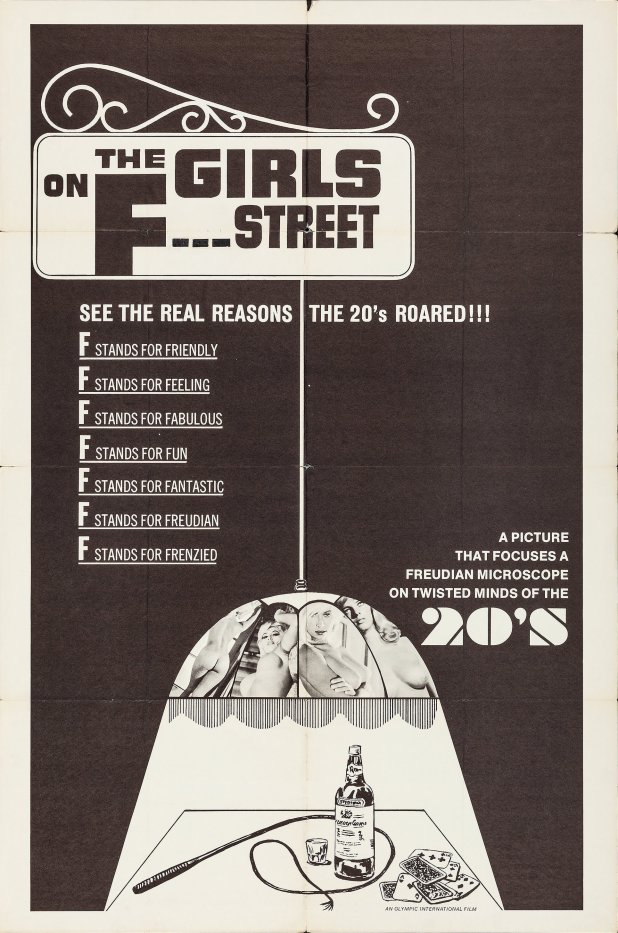
WEIRD WEDNESDAY: The Girls On F Street (1966)

Saul Resnick only directed this movie, but he was part of the late 60s sexploitation film scene, serving as cinematographer on Broadway Jungle and shooting Mondo Bizarro and Everybody Loves It

Also known as Maidens of Fetish Street, this is about Nick (Ken McCormick), who goes to a club to watch girls dance, which causes him to meditate on people’s sex lives. This is less a nudie or roughie and more softcore noir; it feels gross in the best way, sleazy and leering, dirty without penetration, just the way it’s made.

Every man in this, including Nick, is a loser. Women obsess over them and are upset and confused by them. All is, well, lost. Sometimes, like when one guy gets what he wants, they just cry. And this is way ahead of other films of the era, as women of every size and shape are included, as long as they have the most enormous breasts you’ve ever seen.

Speaking of that crying guy, he’s in love with a sex worker. He’s been in love with her for years. He tells her a few stories, and she barely listens; time is money, and she’s already got his cash. She then tells him every filthy tale about her life, all the men she has on a daily basis, and all he can do is weep as he sprawls on top of her, just another number and not the white knight he was hoping to be. 

Then, a nude model is the fantasy object for a female sculptor. This sequence feels like raw eroticism compared to the first, as the black and white film makes the clay look like flesh. Is this art?

Imagine: a movie set in 20s Los Angeles, shot like a film noir with distorted sound and non-synched voiced, like Carnival of Souls (copyright to Sakana1 on Letterboxd for that amazing connect the dots) but if Candace Hilligoss pulled her car over in the salt flats and suddenly decided that she wanted to give you the kind of lap dance that gives you blue balls for the rest of all eternity. Supposedly, this was based on a play called The Degenerates. Gentry Austin, also on Letterboxd, reminds us that Andy Milligan had a lost film of the same name; one can hope it had the same inspiration (and that Severin gets it out on Blu-ray ASAP).

It ends with Nick giving a black woman a bath alongside his much older wife, then falling for a gorgeous blonde, only to wake up to his wife whipping them both before he’s locked inside an adult bookstore as the night goes on without him.

The cast includes Althea Currier (Mr. Tease and His PlaythingsLorna, Surfside 77, the writer of the Ask Althea column in Adam magazine), Barbara Nordin (Orgy of the Dead), Kellie Everts (whose adult career goes from this movie all the way to Full Service Butler in 1989, a film she also directed; her stage dancing career lasted from March 1966 to August 1987. She then quit to become a producer of dancing and female domination videos, making enough money to purchase a large property with an island in Upstate New York in 1989, where she has lived ever since. Interestingly enough, she was known as a “stripper for God,” often preaching before she took her clothes off, starting her first spiritual talk at the Melody Theater in Times Square. If that’s not enough, she was also one of teh first female bodybuilders, which led to her winning Miss Nude Universe in July 1967, second place in Miss Americana nd Best Body in 1972, second place for Miss Body Beautiful in 1973, Miss Body Beautiful U.S.A. first place in 1974, and second place for Miss Americana and Best Body in 1974, which found her on the same stage as Arnold Schwarzenegger. Now, she has her own religion and her followers believe that she’s an “incarnation of God, much like Ramakrishna.” Wow.) and Margo Lynn Sweet (who is also in The Beach Girls and the Monster).
You can watch this on Mubi and ByNWR.

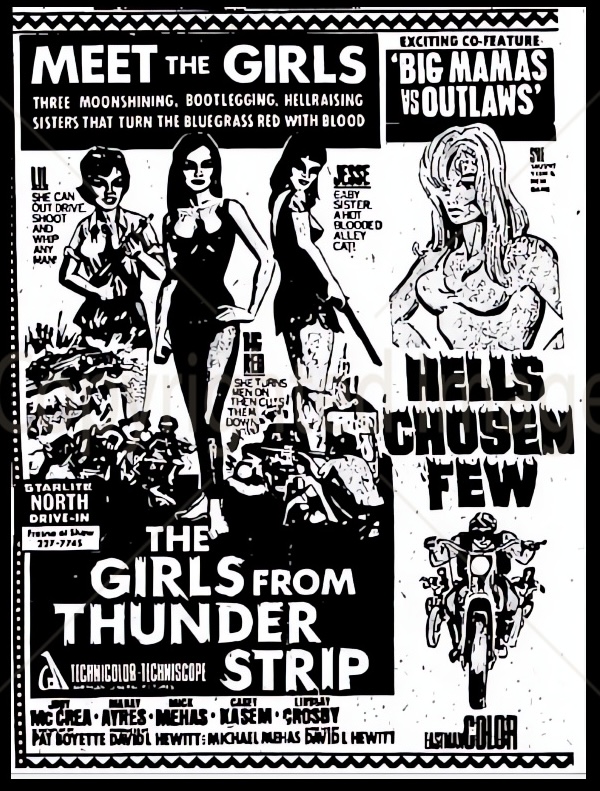
WEIRD WEDNESDAY: The Girls from Thunder Strip (1966)

David Hewitt started his career as an illusionist for a traveling spook show called Dr. Jekyll’s Strange Show before Forrest J. Ackerman helped him get into movies by having his script Journey Into the Unknown made into The Time Travellers. His directing debut was 1965’s Monsters Crash the Pajama Party, a movie in which actors ran into the audience to enhance the film’s antics.

He also directed Dr. Terror’s Gallery of Horrors, which had a title way too close to Amicus’ Dr. Terror’s House of Horrors, so it also ran as Return from the Past, The Blood Suckers, Alien MassacreThe Witch’s Clock and Gallery of Horror. He also directed Hell’s Chosen FewThe Mighty Gorga (he’s also Gorga, the giant ape) and The Tormentors. Later in his career, he moved into optical effects, working on films as varied as Inspector Gadget 2Willow and The Quiet American.

Today, we’re here to talk about bikers vs. moonshiners vs. the syndicate vs. the government in the exploitation film The Girls From Sunset Strip.

The screenplay for this film came from Pat Boyette, a news anchor in San Antonio, Texas, who went on to become the producer of a daytime talk show, a puppet show and TV commercials. Turning to comics, Boyette worked mainly for Charlton Comics, where his character the Peacemaker — he loves peace so much he’ll kill for it — became the inspiration for the Comedian in Watchmen. He wrote and drew hundreds of comics for Charlton, including Ghost Manor, Ghostly Tales, Space Adventures, The Many Ghosts of Doctor Graves, Cheyenne Kid, Korg: 70,000 B.C.Flash Gordon, Peter Cannon: ThunderboltThe Phantom and The Six Million Dollar Man. He was also responsible for writing and directing films such as No Man’s LandThe Dungeon of Harrow and The Weird Ones.

Three hillbilly girls — Red, Jessie and Lil — take on three bikers, led by Teach (Gary Kent, The Black Klansman) and aided by Animal and Todd. Of all people, Casey Kasem plays the government man, Conrad, while Jack Starrett (Race with the Devil, Cleopatra Jones) is the sheriff. The hero is Pike, who is played by Jody McCrea. He was in a ton of beach movies, including Operation BikiniBeach Blanket Bingo and How to Stuff a Wild Bikini. Interestingly, he was the only American International Pictures actor who could surf. And oh yeah — Bing Crosby’s son Lindsay is in this.

But we’re here to talk about the girls, because this movie isn’t called The Boys From Thunder Strip. Red is played by Maray Ayres, who is also in The Cycle Savages and looks a lot like Mary Woronov. Jessie is Megan Timothy, who appeared in three of Hewitt’s films, as well as in Al Damanson and Bud Cardos’ The Female Bunch, and in Russ Meyer’s Good Morning… and Goodbye! Lil is Melinda MacHarg, who really didn’t do much other than this film.

The film starts with one of the girls being assaulted by one of the boys, but honestly, stuff just happens after that. I mean it — sides are constantly switched, cops are brought in and turned on in moments, and Pike keeps getting beaten up.

It was shot on Spahn Ranch, a 500-acre property located in Chatsworth, California. Perhaps you’ve heard of it.  In Brian Albright’s Wild Beyond Belief!: Interviews with Exploitation Filmmakers of the 1960s, Gary Kent said that members of Manson’s Family would often visit craft services and beg for food.

The Girls From Thunder Strip was shot by cinematographer Gary Graver, who was, of course, Orson Welles’s preferred cameraman. Honestly, the behind-the-scenes stories of this movie are probably way more interesting than what was filmed.

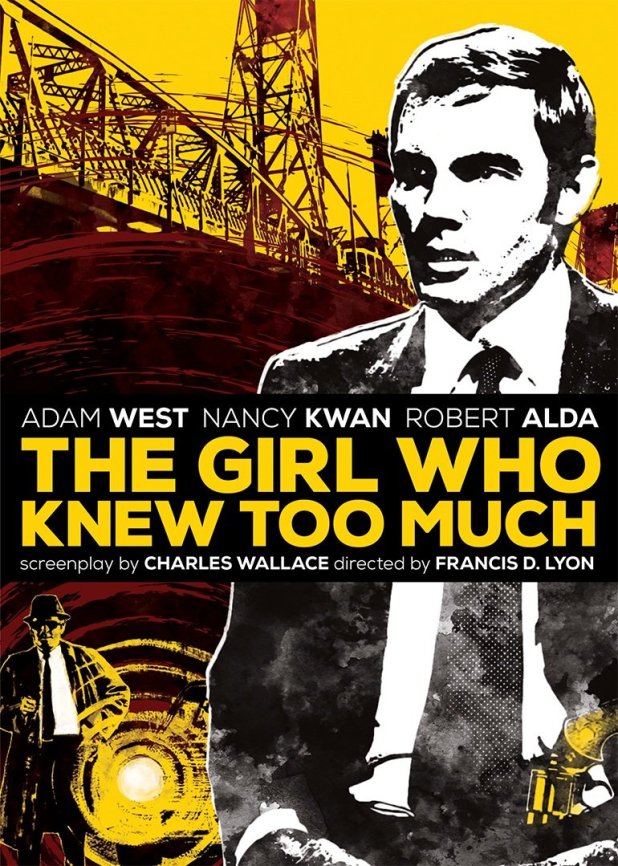
WEIRD WEDNESDAY: The Girl Who Knew Too Much (1969)

No, not Evil Eye

That said, Letícia Román, Dante DiPaolo and Roberto Calvi are in both movies.

This The Girl Who Knew Too Much stars Adam West as Johnny Cain, nightclub owner and adventurer. Directed by Francis D. Lyon, this was his chance to escape the typecasting of Batman, and no, that didn’t go down. But what does is murder, baby, the murder of Tony Grinaldi (Steve Peck) in Johnny Cain’s joint that brings him back into dealing with the Syndicate.

Working with his piano player, Lucky (Buddy Greco), Cain helps the CIA to defeat the Communists and the underworld at the same time. Maybe he picked the wrong side, who can say? Then, he gets all messed up with his old love, Revel Drue (Nancy Kwan). 

Revel Drue!

There’s some plot about a dead gangster who was after some priceless art and blackmail against Cain, but really, this is all about watching Adam West — or his obvious stunt double — get beaten up for nearly the entire running time, then tossed through a glass window. Meanwhile, he’s all laconic whenever he speaks, like the coolest guy in the room, if the coolest guy in the room got his ass kicked every two minutes.

You can watch this on YouTube

Cinematic Void January Giallo 2026: Deep Red (1975)

Editor’s note: Cinematic Void will be playing this movie on January 14 at 7:00 PM at Regal Mira Mesa in San Diego. You can get tickets here. There’s also an event the next day at the Whistle Stop Bar on Thursday, January 15th at 9 PM. It’s a night of drinks, socializing with the film community, and…of course, all things GIALLO. This edition of THE DIVE IN, presented by Popcorn Reef and Morricone Youth, will take you on a journey through shocking Italian cinema. More info here. For more information, visit Cinematic Void.

Deep Red is one of the few Argento movies that I’ve seen in a theater and the drive-in. It’s not the best film for the fast-moving grindhouse or drive-in, but it is a great film. After all, it started with a 500-page script that even Dario Argento’s family felt was too cryptic and continues with not just one, but two references to American painter Edward Hopper. This isn’t just a movie about murder. This is a movie that transforms murder into art.

We begin at Christmas, as two shadowy figures battle until one of them stabs the other. Screams ring out as a knife drops at the feet of a child.

Fast forward to Rome, as a medium named Helga Ulmann is conducting a lecture about her psychic powers. Within moments, she senses that one of the people in the theater is a killer. Later that night, that killer kicks in her front door and murders her with a meat cleaver (which is probably why this movie got the boring American title of The Hatchet Murders).

British musician Marcus Daly (David Hemmings, BarbarellaBlowup, Harlequin), who fits the giallo mold of the stranger in a strange land thrust into the middle of a series of murders that he must solve, is returning home from drinking with his gay best friend Carlo (Gabriele Lavia, Beyond the DoorInferno) when he sees the murder that we’ve just witnessed from the street. He runs to save Helga, but she’s thrust through the window and her neck is pierced by the broken glass of her window in a kill that has become Argento’s trademark.

As he tells the police what has happened, he notices that a painting on Helga’s wall is gone. That’s when Gianna Brezzzi (Argento’s soon-to-be wife, Dario Nicolodi, who met him during the filming of this movie) takes his photo, which ends up on the cover of the newspaper the very next day.

Unlike most giallo women, Gianna is presented as more competent and even stronger than our hero — she sits high above him in her Fiat 500 and continually bests Marcus every time they arm wrestle. Nicolodi is so perfect in this film that she both breaks and warms your heart at every turn.

Marcus isn’t your typical hero, though. When the killer attacks him, he doesn’t stop them by daring or skill. He locks himself in his study to escape them. He does remember the song the killer played — we also have heard it when Helga is murdered — that psychiatrist (and Helga’s boyfriend) Professor Giordani believes is related to some trauma that motivates the killer.

Feeling guilty that she’s caused the killer to come after Marcus, Gianna relates an urban legend of a haunted house where the sounds of a singing child and screams of murder can be heard. The truth lies in House of the Screaming Child, a book written by Amanda Righetti, which tells the truth of the long-forgotten murder. Marcus and Gianna would learn even more, but the killer beats them to her house and drowns her in a bathtub of scalding hot water (directly influencing the murder of Karen Bailey in Halloween 2). As she dies, the writer leaves a message behind on the wall, which our heroes find. They’ve already assumed the investigation — again, in the giallo tradition — and think the police will assume that Marcus is the murderer, so they don’t report the crime.

Marcus follows the trail of the killer from a picture in the book to the real house, which has been abandoned since 1963. As he searches the home, he uncovers a child’s drawing of a murdered man and a Christmas tree, echoing the flashback that starts the film. Yet when he leaves the room, we see more plaster fall away, revealing a third figure.

Marcus tells his friend Carlos all that he’s learned, but his friend reacts in anger, telling him to stop questioning things and to just leave town with his new girlfriend. At this point, you can start to question Marcus’ ability as a hero — he misses vital clues, he hides instead of fighting and he can’t even tell that someone is in love with him.

Professor Giordani steams up the Righetti murder scene and sees part of the message that she left on the wall. That night, a mechanical doll is set loose in his office as the killer breaks in, smashing his teeth on the mantle and stabbing him in the neck.

Meanwhile, Marcus and Gianna realize that the house has a secret room, with Marcus using a pickaxe to knock down the walls, only to discover a skeleton and Christmas tree. An unseen person knocks our hero out and sets the house on fire, but Gianna is able to save him. As they wait for the police, Marcus sees that the caretaker’s daughter has drawn the little boy with the bloody knife. The little girl explains that she had seen this before at her school.

Marcus finds the painting at the young girl’s school and learns that Carlo painted it. Within moments, his friend turns up, stabs Gianna and holds him at gunpoint. The police arrive and Carlo flees, only to be dragged down the street and his head messily run over by a car.

With Gianna in the hospital and his best friend obviously the murder, Marcus then has the Argento-esque moment of remembering critical evidence: there’s no way Carlo could have killed the psychic, as they were together when they heard her screams. The portrait that he thought was missing from the apartment was a mirror and the image was the killer — who now appears in front of him.

The real killer is Martha (Clara Calamai, who came out of retirement for this role, an actress famous for her telefoni bianchi comedy roles), who killed Carlo’s father in the flashback we’ve seen numerous times after he tried to commit her. She chases Marcus with a meat cleaver, striking him in the shoulder, but he kicks her and her long necklace becomes caught in an elevator which beheads her. The film ends with the reflection of Marcus in the pool of the killer’s blood.

While this film feels long, it has moments of great shock and surprise, such as the two graphic murders that end the film and the clockwork doll. The original cut was even longer, as most US versions remove 22 minutes of footage, including the most graphic violence, any attempts at humor, any romantic scenes between David Hemmings and Daria Nicolodi, and some of the screaming child investigation.

This is also the first film where Argento would work with Goblin. After having scored Argento’s The Five Days — a rare comedy —  Giorgio Gaslini was to provide music for the film. Argento didn’t like what he did and attempted to convince Pink Floyd to be part of the soundtrack. After failing to get them to be part of Deep Red, Goblin leader Claudio Simonetti impressed the director by producing two songs in one night. They’d go on to not only write the music for this film, but also for plenty of future Argento projects.

A trivia note: Argento’s horror film museum and gift shop, Profondo Rosso, is named after the Italian title to this movie.

Deep Red is the bridge between Argento’s animal-themed giallo and supernatural based films. While its pace may seem glacial to modern audiences, it still packs plenty of moments of mayhem that approaches high art.

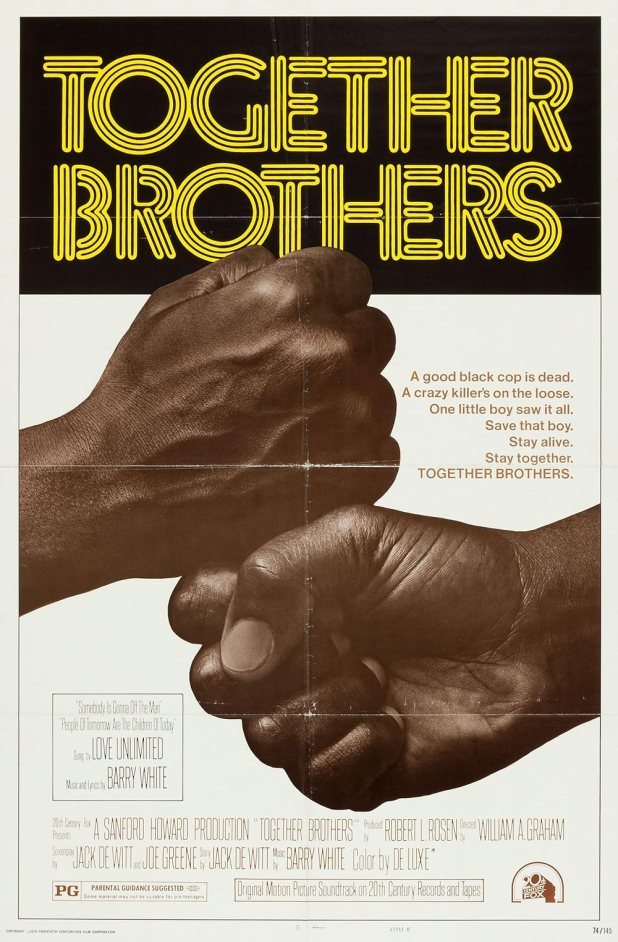
Together Brothers (1974)


I don’t know of any other giallo or giallo adjacent movies with a Barry White soundtrack.

Mr. Kool (Ed Bernard) is a black policeman who patrols the worst parts of the hood, but has the respect of nearly everyone, including The Dudes, a kid gang that includes H.J. (Ahmad Nurradin), his borther Tommy (Anthony Wilson), Monk (Owen Pace ), A.P. (Nelson Sims), Mau-Mau (Kenneth Bell) and Gri-Gri (Kim Dorsey).

One night, Tommy is following Mr. Kool when the cop is shot and killed. While the killer starts to slice up the body, Tommy screams, which causes the assassin to try to shoot him. Tommy loses his speech because he’s so frightened, and The Dudes promise to find out who the killer is. Before that, Tommy gets kidnapped by Billy Most (Lincoln Kilpatrick) and Maria (Craig Campfield) and H.J.’s girlfriend Francine (Angela Gibbs) is killed. They have to save Tommy, find the real killer and do it all without the cops.

Director William Graham also made The Hunt for the Unicorn KillerCalendar Girl MurdersBeyond the Bermuda TriangleReturn to the Blue Lagoon and Birds of Prey. This is written by Jack DeWitt (A Man Called Horse) and Joe Greene.

The downer is that the bad guy is a mincing gay stereotype. Otherwise, the film is an interesting idea: a blaxploitation film that doesn’t glorify crime and that has the detective element of the giallo.

You can watch this on YouTube.

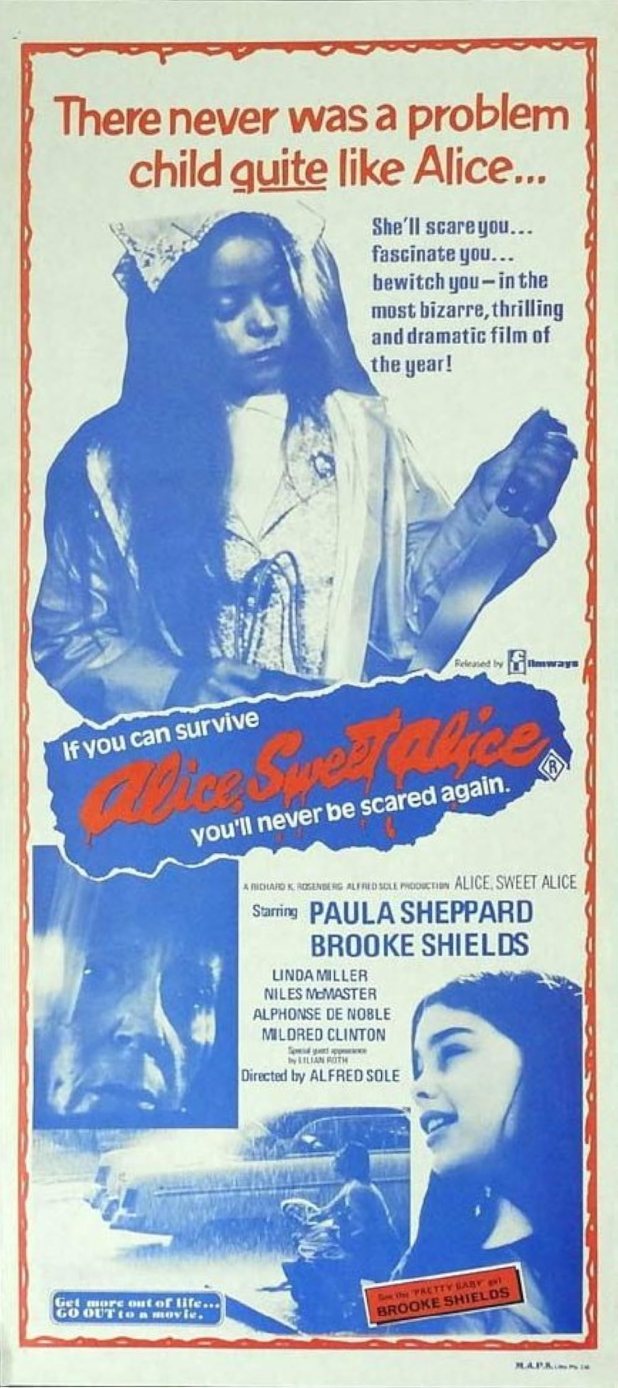
Cinematic Void January Giallo 2026: Alice, Sweet Alice (1976)

EDITOR’S NOTE: Cinematic Void will be playing at the Little Theater in Rochester, NY on Thursday, Jan. 15 at 7:30 PM (tickets here). For more information, visit Cinematic Void

Alfred Sole was an architect who dreamed of making movies. His first film, 1972’s Deep Sleep, which starred Deep Throat‘s Harry Reems and The Devil In Ms. Jones‘ Georgina Spelvin, was made for only $25,000. However, it was ruled obscene and pulled from theaters. His second film — the one we’re about to cover — may not have done well at first thanks to spotty distribution, but thanks to Brooke Shields’ popularity and multiple re-releases under multiple titles, like Holy TerrorCommunion and The Mask Murders.

Sole wrote the film with his neighbor Rosemary Ritvo, an English professor with whom he often discussed films. A Catholic herself, they would talk at length about the church in between discussing theater and horror films. Nicolas Roeg’s Don’t Look Now was a huge influence, as is evident by the yellow raincoat worn by the film’s villain.

The film is set in 1961 in Paterson, New Jersey, the director’s hometown; as such, much of it was based on his childhood. In fact, Mrs. Tredoni is directly based on a woman who lived next door to his grandmother, who would look after the priests.

While Sole claims he had never seen any Giallo before he made this, Alice, Sweet Alice is perhaps the most giallo of all American films before DePalma would make Dressed to Kill.

The film begins with Catherine Spages (Linda Miller, the daughter of Jackie Gleason and the mother of Jason Patric) visiting Father Tom with her two daughters, nine-year-old Karen (Shields) and twelve-year-old Alice (the astounding Paula Sheppard), who are students of St. Michael’s Parish Girls’ School. Father Tom gives Karen his mother’s crucifix as a gift for her first communion, making Alice jealous.

Alice is a wild child, her hair barely tied back, constantly in trouble for all manner of mischief. Is she a bad girl or just a misunderstood little girl dealing with the specter of her parent’s divorce in 1961, a time when this rarely happened and in a heavily Catholic neighborhood where this would indeed be judged? Her antics include wearing a clear mask and repeatedly frightening and threatening her sister.

This all ends on the day of Karen’s first communion, when someone in the same school raincoat and mask as Alice kidnaps the young girl, strangles her, rips the crucifix from her neck and then sets her body on fire inside a church pew. This is insanely brutal and lets the viewer know that this movie is unprepared to take it easy on you.

At the same time, Alice enters the room and attempts to receive communion while wearing her sister’s veil. It’s never really established where she found it or whether or not she knew it belonged to her sister. There are no easy answers here.

Catherine’s ex-husband Dominick (Niles McMaster, Bloodsucking Freaks) returns for the funeral and fulfills the Giallo role of a stranger pushed into becoming the detective. Furthering the giallo narrative, the ineffective Detective Spina takes over the case, pursuing the lead that Alice is the killer thanks to Catherine’s sister Annie’s suspicions. This lead seems even more apparent after the killer attacks Annie, and Alice is found at the scene, wearing the same clothes.

Alice is sent to a psychiatric institution where it’s revealed that she’s been in trouble numerous times in school, a fact that Father Tom has concealed as he believed he could solve her problems.

The killer tightens her noose around Alice’s neck by luring her father to an abandoned building,g where she gets the jump on him, beating him with a brick, binding his body and pushing him off a ledge. Before he dies, he’s able to swallow the crucifix that the killer had stolen from his daughter. That’s also when we learn who the killer is, way before the film is over: it’s Tredoni, who sees Dominick and Catherine — and by extension, their children — as sinners due to their premarital sex and divorce.

Alice may have been eliminated as a person of interest, but the danger remains. On a visit to Father Tom, Catherine learns that Tredoni lost a daughter on the day of her first communion, which taught her that children pay for the sins of their parents. In her grief, she gives herself over to the church. Her feelings about her calling are confirmed when Father Tom misunderstands her confession.

Finally, Alice’s scheme to leave cockroaches all over, frightening landlord Mr. Alphons,o neatly ties into Tredoni sneaking in to kill either her, Catherine or both of them. Alphonso is stabbed, and the mad older woman runs to the church. Father Todd assures the police he can handle her, but even his mercy and the church’s teachings fail in the face of mania.

The end of this movie shocked me out of my theater seat. It’s visceral in its intensity, and the ending—where Alice walks away—is even more harrowing.

It’s rare to find a movie that completely destroys an audience. Alice, Sweet Alice did that when it played here to a packed house as part of a Drive-In Asylum night of film.

In these modern times, Alice takes on a whole new light. Nearly every male in the movie treats her blossoming womanhood as an invitation, from the lie detector operator who says that when he bound her breasts with the machine, it looked like she wanted it to the guard at the children’s home who silently watches her as she meets with her parents. Perhaps even more disquieting is that Sheppard was 19 when this was made. Her only other film appearance is in the equally bizarre Liquid Sky, which is a shame, as she was incredible in both of these equally strange movies.

Alphonso DeNoble, who plays the grotesque Mr. Alphonso, also appeared in Bloodsucking Freaks. While his main career was as a bouncer at a gay bar, as his side hustle, Alphonso would dress up as a priest and hang around cemeteries, where widows would ask for a blessing, and he’d indulge them for a monetary donation.

This film truly lives up to the ninth Satanic Statement: Satan has been the best friend the church has ever had, as He has kept it in business all these years! And the Satanic Sin of Herd Mentality is obvious. From the actual church, “…only fools follow along with the herd, letting an impersonal entity dictate to you.”

Also, Alice posits that even the pre-Vatican II Catholic Church of 1961 was finding itself ill-equipped to understand the modern world and that people—from the old like Tredoni to the young like Alice—would suffer. It’s women who do most of that suffering, constantly propping up the male members yet never able to ascend to the power of the clergy unless they want to be second-best sisters.

Even 43 years after its debut, Alice Sweet Alice has the power to destroy. It’s a near-perfect film that demands introspection and multiple viewings.

BONUS CONTENT:

This article by Bill Van Ryn of Groovy Doom and the horror and exploitation fanzine Drive-In Asylum provides an even better look at this film.

I also had the opportunity to discuss this film with Alfred Sole’s cousin, Dante Tomaselli, the maker of the astounding Desecration.

B & S About Movies podcast special episode 18: Horror Gives Back 2025 part 3

Each October, the Unsung Horrors podcast does a month of themed movies. This year, this event benefits Best Friends, which is working to save the lives of cats and dogs all across America, giving pets second chances and happy homes.

If you enjoyed reading anything I posted, please consider donating and letting me know.

Here are the movies that I watched. You can also check out the Letterboxd list.

Thanks to Adam Hursey, Parker Simpson and John Connelly for being part of this!

This episode has these movies:

21. 1960s: Mars Needs Women
22. South America: History of the Occult
23. Series Episode: Guardian of the AbyssCHiPS
24. Ingrid PittChimes at Midnight
25. Haunted HouseThir13en GhostsSweet Home
26. MexicoThe Incredible Professor Zovek
27. Witches or Warlocks: Midnight Offerings, Queen of Black Magic
28. In Memoriam: Siegfried and Roy: Masters of the Impossible
29. Hammer or BritishFear In the Night
30. 1980s: Society, The Seventh SignThe Beast In Space
31. Viewer’s Choice: I, Madman, Black Eyed Susan

Listen to this episode on Spotify.

The show is also available on Apple Podcasts, iHeartRadio, Amazon Podcasts, Podchaser and Google Podcasts

Important links:

Theme song: Strip Search by Neal Gardner.

Donate to our ⁠⁠⁠⁠⁠⁠⁠⁠⁠⁠⁠⁠⁠⁠⁠⁠⁠⁠⁠⁠⁠⁠⁠⁠ko-fi page⁠⁠⁠⁠⁠⁠⁠⁠⁠⁠⁠⁠⁠⁠⁠⁠⁠⁠⁠⁠⁠⁠⁠.

Science fiction becomes science fact on the DIA!

This week, Bill and I are going into the final frontier at 8 PM EDT this Saturday on the Groovy Doom Facebook and YouTube channels.

Want to know what we’ve shown before? Check out this list.

Have a request? Make it here.

Want to see one of the drink recipes from a past show? We have you covered.

Up first: Forbidden World which you can find on Tubi.

Here’s this week’s first drink:

Subject 20

  • 2 oz. peach brandy
  • 6 oz. Calypso Southern Peach lemonade
  • .5 oz. lemon juice
  • Club soda
  1. Pour vodka, lemonade and lemon juice over ice, stir and then top with club soda.
  2. That’s it. Simple, you know?

Up next is Foes which is on YouTube.

Here’s the second cocktail:

UFOes

  • 1.5 oz. vodka
  • .5 oz. blue curaçao
  • .5 oz. Southern Comfort Peach
  • .5 oz. ounce lime juice
  • .5 oz. ounce simple syrup
  • 3 oz. pineapple juice
  1. Put it all in a shaker except pineapple juice.
  2. Shake it up, then top with pineapple juice.

See you Saturday!

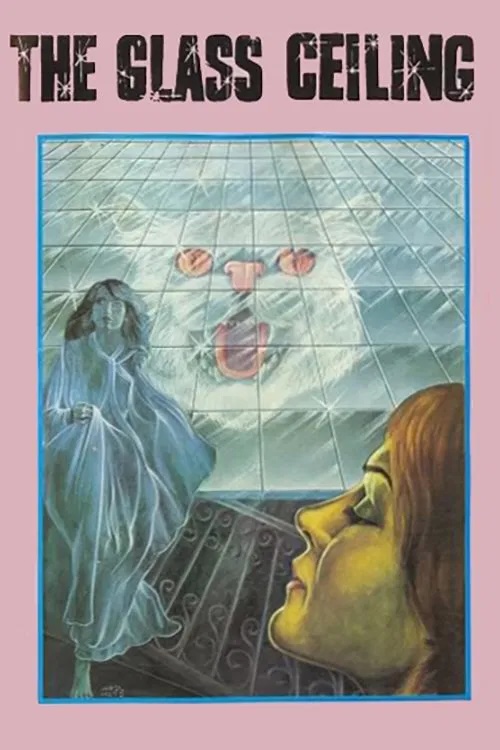
The Glass Ceiling (1971)

Directed by Eloy de la Iglesia, who co-wrote the story with Antonio Fons, this is all about lonely housewife Marta (Carmen Sevilla), left all alone once again when husband Carlos (Fernando Cebrián) goes on a business trip, leaving her with just her cat Fedra. One night, she’s sure that her neighbor, Julia (Patty Shepard), has murdered her husband. Oh, the intrirgue in this apartment building: landlord and artist Ricardo (Dean Selmier) is way into Marta, teenage milkmaid and farmer’s daughter — yes, really — Rosa (Emma Cohen) is into Ricardo, deliveryman Pete (Javier De Campos) is into Julia and Ricardo’s dog is in love with the mystery meat someone is feeding him at night. There’s also a pervert walking around and discreetly taking photos of the women.

Eloy de la Iglesia is a director who may have been known for Cannibal Man, but it was the Severin releases of his films that made him better known in the U.S. I love the tension he’s built with this, all inside a small town apartment building, a place overflowing with need, with secrets and with, well…you’ll see.

You can watch this movie on Tubi.