Thanks to the British Film Institute, there’s a list of films that played Scala. To celebrate the release of Severin’s new documentary, I’ll share a few of these movies every day. You can see the whole list on Letterboxd.
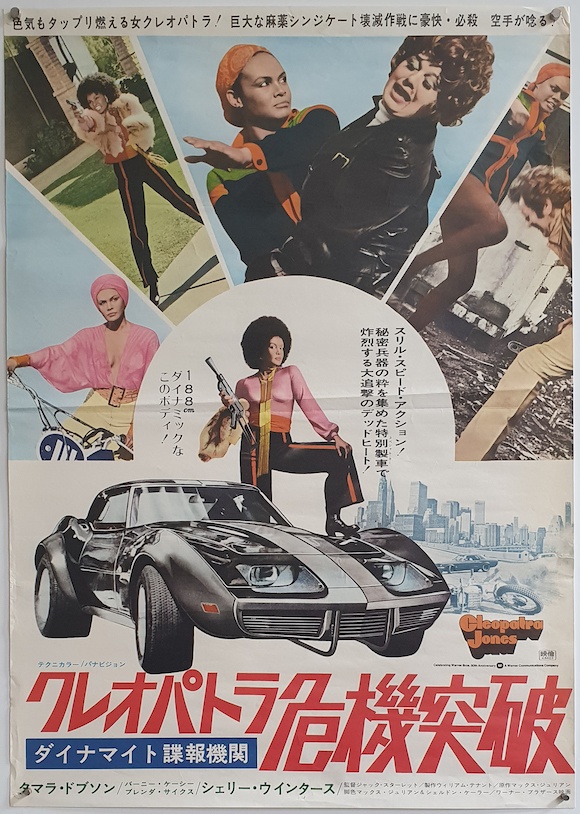
Cleopatra “Cleo” Jones (Tamara Dobson) is the coolest. She’s an international supermodel who drives a ’73 Corvette Stingray, volunteers for the B&S House — love that name — which is a street help group run by her lover Reuben Masters (Bernie Casey) and, oh yeah, she’s also a secret agent.
Her goal is to stop drugs from destroying her community and she starts by burning the poppy fields owned by drug lord Mommy (Shelley Winters). Mommy might run the cops and have drug dealers like “Doodlebug” Simpkins (Antonio Fargas) on her side, but she can’t even match up to Cleopatra.
Unlike so many blacksploitation films, Cleopatra never gets naked. There’s a lot of equality in her relationship with Reuben, but there is an evil lesbian obsessed with sex role for Mommy, so it’s not all forward thinking.
The cops in this are at war with the black community, while Cleopatra, working as a Special Agent to the President, seeks to lift people up and help them to improve their station in life. She’s the authority figure we wish we had. Plus, she wears ten different Giorgio di Sant’Angelo outfits, so she’s always at the front of fashion.
Thanks to the British Film Institute, there’s a list of films that played Scala. To celebrate the release of Severin’s new documentary, I’ll share a few of these movies every day. You can see the whole list on Letterboxd.
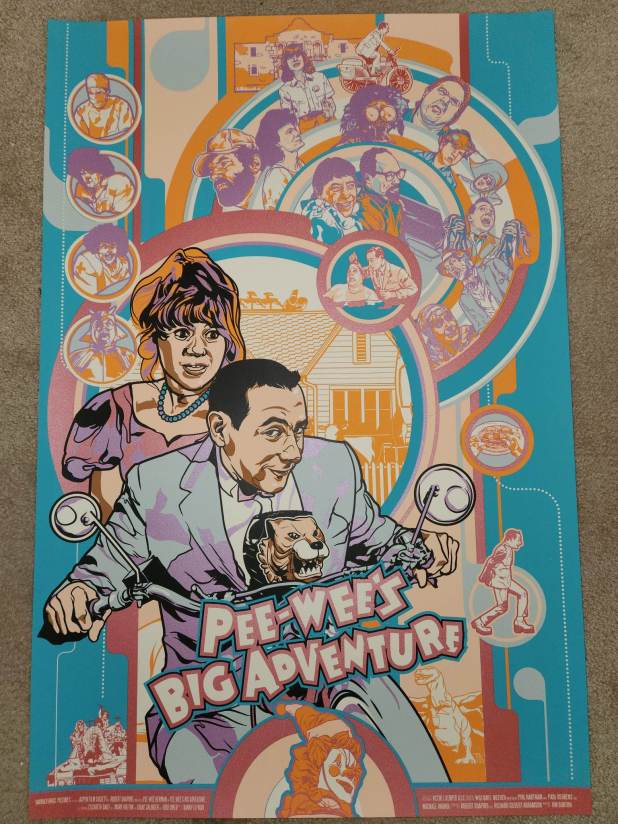
In the days before the internet, we could build our own cults. Amongst my family, we were obsessed with Pee-Wee Herman. Just imagine, in a time that could only be predicted by TV Guide, Pee-Wee would randomly show up in movies like Cheech & Chong’s Next Movieand Nice Dreams, here he was only known as “The Hamburger Guy.” As the 80’s began, Pee-Wee started by performing five months of the live The Pee-wee Herman Show at the Roxy Theater in LA and getting a taped special on HBO.
That special dominated my eight-year-old mind, presenting a world that at once childlike and at the other end, strangely sinister and adult. I watched it so many times that I could recite every single word and still can. The end, where Pee-Wee finally learns to fly, can often reduce me to tears.
In the five years between that special and this movie, Paul Reubens pretty much became Pee-Wee, even asking his parents to go by the names Honey and Herman Herman. His David Letterman appearances — major surprises, as we stated before — were riotous bursts of anarchy on a show that was already breaking nearly every rule of television. So when a Pee-Wee movie was announced, we lost our collective minds.
Somehow, Pee-Wee Herman is the rarest of cases of someone who became famous without losing a single ounce of his weirdness. And much like the HBO show that came before, I can still recite every word of this movie, quote it at will throughout the day and get misty-eyed just thinking of moments within it.
The story is incredibly simple: Pee-Wee’s most prized possession — his bike — has been taken by Francis. Now, he must get it back. A psychic tells our hero that his bike is in the basement of the Alamo, so we’re off to adventure.
That’s it. It’s that easy.
From wrestler Silo Sam chasing Pee-Wee around dinosaurs to his speech to Dottie (I actually gave this exact same “I’m a rebel, a loner” speech to a date once and was convinced she was going to slap me; she cried and told me it was the saddest thing she’d ever heard, somehow never seeing this movie before), dancing to “Tequilla” at a biker bar while Satan’s Helpers (look for Elvira) look on and so much more, there are so many moments in this film that simply listing them would take on the feel of Chris Farley talking to Paul McCartney.
I mean, without this film, you may not have Danny Elfman and Tim Burton making big budget movies.
To write the film, Reubens, Phil Hartman and Michael Varhol purchased the book Syd Field’s Screenplay and were as literal as possible. “It’s a 90-minute film, it’s a 90-page script,” said Ruebens. “On page 30 I lose my bike, on page 60 I find it. It’s literally exactly what they said to do in the book.” In my crazed mind, I also wish that Ruebens had followed through with his plan to remake Pollyanna with Pee-Wee in the lead.
There are so many easter eggs in this film, like the magic shop owned being named after Mario Bava, the Chiodo Brothers animating Large Marge, the Aleister Crowley head in the aforementioned magic shop, James Brolin playing Pee-Wee, the start of my crush on E.G. Daily, Professor Toru Tanaka as Francis’ butler and even the first acting role for Darla the dog, who was Queenie in The ‘Burbs and Precious in Silence of the Lambs.
There are so many lines in this, too. I leave you with my favorite:
Simone: Do you have any dreams?
Pee-Wee Herman: Yeah, I’m all alone. I’m rolling a big doughnut and this snake wearing a vest…
PS: I have just one more ridiculous Pee-Wee story to tell. In 1989, Pee-Wee exchanged fake marriage vows with Chandi Heffner — the adopted daughter of Doris Duke, the richest little girl in the world. Chandi was a Hare Krishna devotee and sister of the third wife of billionaire Nelson Peltz and all of 35-years-old when she was adopted, as Duke believed that she was the reincarnation of her only biological child Arden, who died days after being born. Chandra and Pee-Wee were “married” by Imelda Marcos at Duke’s Honolulu mansion Shangri-La. If you think the world is not amazing and special, you’re a fool.
Thanks to the British Film Institute, there’s a list of films that played Scala. To celebrate the release of Severin’s new documentary, I’ll share a few of these movies every day. You can see the whole list on Letterboxd.
I think I quote The Jerk and say lines from it more than any other movie, nearly having absorbed it into the ways that I think and do and act and live since I first saw it in my single digit years. It’s absolutely my junk food warm blanket movie, a reminder of a time when the only responsibility I had was to watch movies over and over again, unlike now, when aI face a mountain of multiple responsibilities but you know, still watch movies over and over again.
Imagine, Steve Martin was probably the biggest deal in comedy in 1979, selling out arenas, having best selling albums, being a cultural force with his appearances on Saturday Night Live and now, he’s about to step into another media and take a chance at failure and somehow takes a movie about failure and becomes a success.
Instead of me telling you the whole story of how Navin R. Johnson was born a poor black child, found his special purpose and found his fortune and lost it through the invention of the Optigrab, I will just tell you I love when I discover that the beliefs I have about this movie were true. In his book Born Standing Up: A Comic’s Life, Martin said that the set was joyous, with cast and crew eating together every day and you can feel the joy he had when they filmed the scene where he and Bernadette Peters sing “Tonight You Belong to Me” together.
I remember watching this at the age of eight and finally understanding why people did crazy things for love. If everyone was as wonderful and perfect and magical as Bernadette Peters, it had to make sense.
As I’ve learned and grown and loved and lost, The Jerk remains there for me, a movie I’ve watched hundreds of times and can turn down the volume and word for word recite the dialogue. I always find something new to laugh at, like the moment where Navin sees his name in print for the first time or the disco in his house that everyone leaves behind after it all falls apart.
If life is treating you like life treats you, I invite you to watch this movie. Allow it to wash over you. I think you’ll smile at least once and that’s better than staring into the void and screaming.
“Oh, this is the best pizza in a cup ever. This guy is unbelievable. He ran the old Cup ‘o Pizza guy out of business. People come from all over to eat this.”
Thanks to the British Film Institute, there’s a list of films that played Scala. To celebrate the release of Severin’s new documentary, I’ll share a few of these movies every day. You can see the whole list on Letterboxd.
The first English language movie by Michelangelo Antonioni, who wrote the story with Tonino Guerra and Edward Bond, this was based on Julio Cortázar’s 1959 short story “Las babas del diablo.” It would go on to inspire The Conversation and Blow Out.
Thomas (David Hemmings) is bored with shooting models — Veruschka von Lehndorff appears as herself — and has been taking photos in hostels and parks — one of the people whose photos he takes is author Cortázar — trying to capture humanity. One of the people whose photos he has taken is Jane (Vanessa Redgrave), who demands that he stop shooting her. He feels like he’s being followed afterward and she asks that he give her the film. He gives her the wrong roll; she gives him a fake phone number. That’s when he blows up the film and discovers a dead body. He begins to have his life turned upside down, but this isn’t a film about the mystery of who is killed and why. As Antonioni said, Blow-Up isn’t about “man’s relationship with man, it is about man’s relationship with reality.”
That all sounds quite intelligent and raises the idea that this movie is about Thomas’ feelings that he is out of step with life and he’s given up on art for material gain, which causes him to fade away from the world, as even the tools he knows so well fail to ground him and prove the truth of whether or not he saw a murder. Even his mastery of the camera is now in question.
Or maybe the truth is they ran out of money.
Director Ronan O’Casey wrote to Roger Ebert and informed him that scenes that would have shown “the planning of the murder and its aftermath – scenes with Vanessa, Sarah Miles, and Jeremy Glover, Vanessa’s new young lover who plots with her to murder me – were never shot because the film went seriously over budget.”
This had to be incendiary when it was made — it still feels that way — with scenes of the Yardbirds performing live and Jeff Beck destroying an amp and a guitar and an open depiction of sexuality, including a threeway between Hemmings, Jane Birkin (who recorded the duet “Je t’aime… moi non plus” with Serge Gainsbourg) and Gillian Hills.
Antonioni didn’t want to explain the movie to anyone. He did say, “By developing with enlargers…things emerge that we probably don’t see with the naked eye. The photographer in Blow-Up, who is not a philosopher, wants to see things closer up. But it so happens that, by enlarging too far, the object itself decomposes and disappears. Hence there’s a moment in which we grasp reality, but then the moment passes. This was in part the meaning of Blow-Up.”
I love this thought that Hemmings had of the director, who was twice his age when this movie was made. “For a man of his age, he was impressively eager for new experiences. I think perhaps he was a little in thrall to the idea of swinging London and even once shooting had started, he spent a great deal of time hanging around in search of oscillation, often with photographers and models. Perhaps he considered it all research, but in his quest he raved ceaselessly, night after night in clubs and discotheques, in the company of the new goddesses of the fashion world, with his fierce eyes shining intensely in the dark, grave face as he drank grappa till his ears bubbled and tried to extract every last ounce from the swinging city – a man from Rome, a modern Bellini, determined to leave his mark in the middle of the liberated new world.”
Thanks to the British Film Institute, there’s a list of films that played Scala. To celebrate the release of Severin’s new documentary, I’ll share a few of these movies every day. You can see the whole list on Letterboxd.
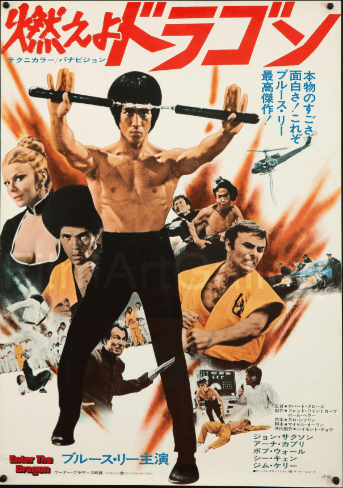
There are other martial arts movies, but for those that have never seen one before, they’re probably thinking of this movie when they imagine a kung fu movie.
To reach the biggest audience, Bruce Lee, who plays the hero Lee, would be teamed with a white man, Roper (John Saxon) and a black one, Williams (Jim Kelly). They’re on the way to the island of Han (Shih Kien, voiced by Keye Luke) to participate in a fighting tournament to discover the world’s greatest fighter, a theme that so many movies would take. Roper owes the mob money, Williams killed two bad cops and is on the run. They’re friends from Vietnam and ready to scam everyone to make money off the tournament.
British intelligence man Braithwaite (Geoffrey Weeks) informs Lee that Han, a former Shaolin Temple student, is running a fighting school that also sells drugs and trades in people. Oh yeah — Lee’s sister (Angela Mao Ying, Lady Whirlwind) was one of Braithwaite’s agents who was killed by O’Hara (Bob Wall), one of Han’s bodyguards.
When they win their fights, everyone gets the woman of their choice. Williams takes several, Roper takes Tania (Ahna Capri), Han’s secretary, while Lee chooses Mei-Ling (Betty Chung), who is an undercover agent there to help him.
This is filled with so many amazing things, such as Bolo Yeung as the main bodyguard, Mr. Han’s fake hands, a gigantic ending filled with so many battles and Lee and Han facing off inside a room full of mirrors, which finds director Robert Clouse taking the end of The Lady from Shanghai.
Kien Shih, who played Han, was a close friend of Bruce Lee’s father, an actor in the Cantonese Opera where Shih had worked as a makeup artist. Their relationship was so close that Bruce addressed Kien as uncle and Kien called Bruce nephew. At one point during filming, Bruce told Kien Shih, “I feel that you will live longer than me.” Kien replied, “Nephew, don’t force yourself too hard. You are overworking yourself.” Lee died weeks before Enter the Dragon was released in Hong Kong.
This movie changed martial arts films, while two other actors who would do the same a few years after, Jackie Chan and Sammo Hung, appear in small roles.
I’ve watched this hundreds of times and it still makes me happy every single time I put it on. It’s just the perfect episodic fighting movie.
On Christmas Eve, Casey Smallwood (Yang Miller) finally gets out of a decade in prison for underage drinking. He plans on telling his prison pen pal Darlene (Evelyn Troutman) — the sister of his girlfriend at the time — how racoons caused her death, but then he gets on a train that’s been taken over by domestic terrorists led by Ranger Rick Danger (Mitch Rose) who have PEN15, a killer holiday satellite, and an army of super intelligent, government trained raccoons.
Directed and written by Travis Irvine, this might have a ton of racoons on the poster but there were only two made with the budget. Whatever, they’re awesome. Like, the cutest bad guys ever and I’d rather watch them kill humans than the heroes of this movie being able to stop them.
This really is a sequel to Coons! Night of the Bandits of the Night and it’s like Under Siege 2: Dark Territorywhich is almost a parody of itself. Your enjoyment of this depends how immature you are. I’m basically a small child that loves poop jokes, so I think that this was made for me. Man, I want to hug those racoons.
Thanks to the British Film Institute, there’s a list of films that played Scala. To celebrate the release of Severin’s new documentary, I’ll share a few of these movies every day. You can see the whole list on Letterboxd.
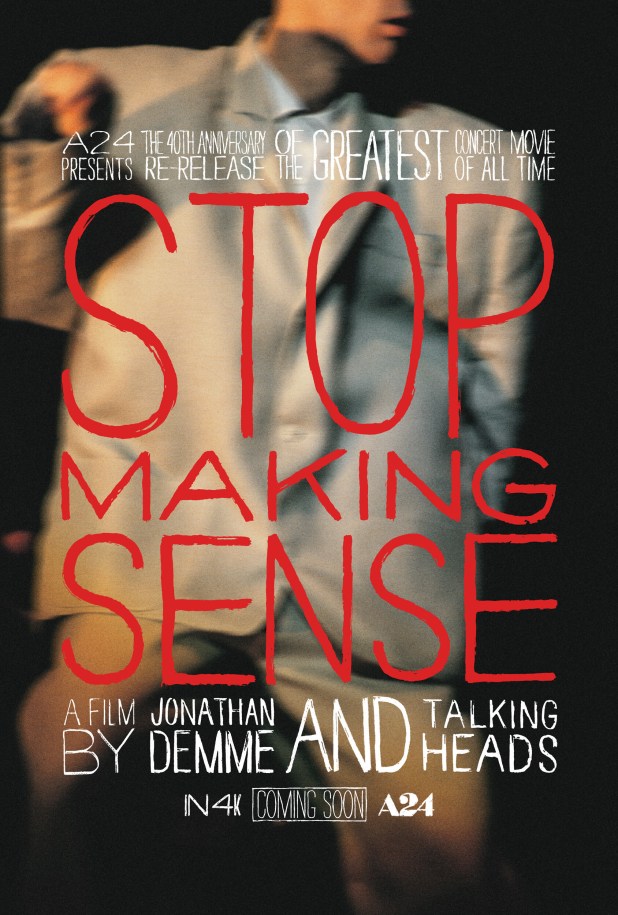
Directed by Jonathan Demme, this concert film was made over four nights in December 1983 at Hollywood’s Pantages Theatre while the band was on tour promoting their 1983 album, Speaking in Tongues. The band, who raised all of the money themselves for this, appear alongside backing singers Lynn Mabry and Ednah Holt, guitarist Alex Weir, keyboardist Bernie Worrell and percussionist Steve Scales.
Starting with Byrne walking on stage with just an acoustic guitar and a boom box to play “Psycho Killer,” the band and the screens behind them build between Weymouth joining for “Heaven,” Frantz for “Thank You for Sending Me an Angel” and Harrison for “Found a Job” with the full band and stage set complete for “Burning Down the House.”
Demme wanted to include more shots of the audience reacting to the performance — we don’t see them until “Crosseyed and Painless” — but when he lit the audience, it led to band feeling insecure and “the worst Talking Heads performance in the history of the band’s career.”
I can’t think of a more perfect concert film, between the performances of “This Must Be the Place (Naive Melody)” — which is the song most important to my wife and me — and Weymouth and Franz becoming the Tom Tom Club to rock on “Genius of Love” while Byrne puts on what would become his signature giant suit. Why the suit? As Byrne answers in the promotional interviews for this, “I wanted my head to appear smaller, and the easiest way to do that was to make my body bigger, because music is very physical and often the body understands it before the head.”
It’s incredible that the A24 4K release is just sitting on the shelf in your local Walmart, ready to be the best piece of media in your collection. Get it as soon as you can.
Thanks to the British Film Institute, there’s a list of films that played Scala. To celebrate the release of Severin’s new documentary, I’ll share a few of these movies every day. You can see the whole list on Letterboxd.
Based on the TV series The Magic Roundabout, this has Dougal the dog remembering a dream or a memory of walking past an abandoned factory and hearing a voice that says “Blue is beautiful, blue is best. I’m blue, I’m beautiful, I’m best!” That voice belongs to Madam Blue (Fenella Fielding), who sends Buxton, a blue cat, to distract everyone from her plans to assume control of the garden where Dougal and his friends live and turn the world blue.
Just like the TV show, this movie uses the footage of the French stop motion animation show Le Manège enchanté — created by Serge Danot with the help of Ivor and Josiane Wood — which was totally rewritten and told by Eric Thompson. The show was broadcast in 441 five-minute episodes between 1965 and 1977. It wasn’t just enjoyed by kids; adults made it a cult show. In 1975, comedian Jasper Carrott released “The Magic Roundabout,” a live comedy routine about the show that went to #5 on the UK singles chart.
Thanks to the British Film Institute, there’s a list of films that played Scala. To celebrate the release of Severin’s new documentary, I’ll share a few of these movies every day. You can see the whole list on Letterboxd.
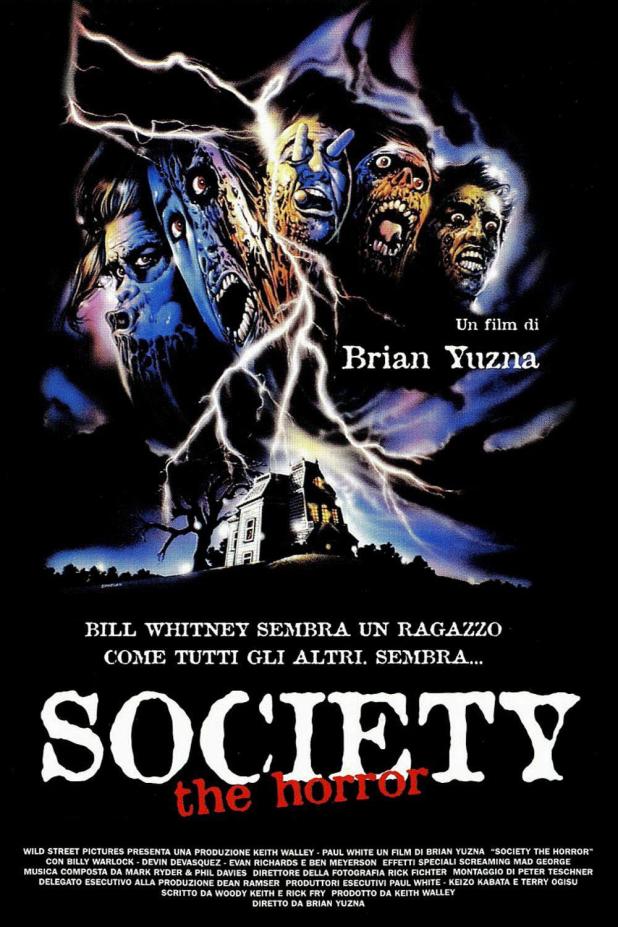
Brian Yuzna produced Re-Animator, but didn’t direct his own film until this body horror comedy which took three years to be released. It’s blessed with special effects by Japanese FX master Screaming Mad George that are really the star of the film.
Bill Whitney (Billy Warlock, son of the best Michael Myers, Dick Warlock) has a great life. His family is rich, he’s popular, he has a new Jeep and a hot cheerleader girlfriend. Yet he doesn’t feel that he fits into high society. This feeling gets worse when his sister’s ex-boyfriend gives him an audio tape of his family engaging in a murderous sex act.
Meanwhile, he keeps noticing a mysterious girl named Clarissa (she masturbates in front of him at a pep rally in a scene that’s frankly sexual in a mainstream non-sex film) and falls for her, despite her hair eating mother. If you’ve noticed that Society may be a completely insane movie, you’re right.
Of course, it turns out that the rich are aliens and Billy’s family is incestual and all of the most well-to-do folks in town are part of a ritual called the shunting, where they suck the life out of poor people. So how do you beat an alien like that? Well, you fist him and pull his asshole inside out, that’s how.
While some of this was based on a project that Yuzna started with Dan O’Bannon, writer Woody Keith claims to have based it on real people that he knew in the Beverly Hills. Gulp.
For fans of Halloween 2, that’s the exact same hospital that was Haddonfield Memorial. So there’s another reason to watch this again.
Thanks to the British Film Institute, there’s a list of films that played Scala. To celebrate the release of Severin’s new documentary, I’ll share a few of these movies every day. You can see the whole list on Letterboxd.
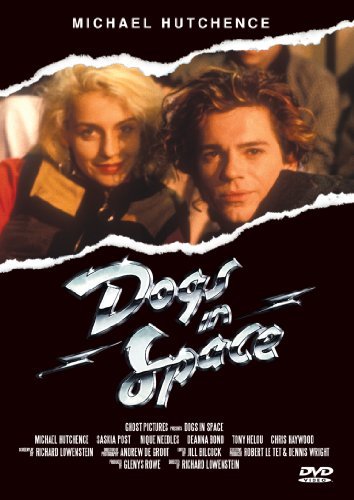
Directed and written by Richard Lowenstein, this is the story of the band Dogs In Space, who are part of the Melbourne’s “Little Band” post-punk music scene in 1978. Two of its members, Sam (Michael Hutchence) and Tim (Nique Needles), live in a group home with Anna (Saskia Post), Luchio (Tony Helou) and The Girl (Deanna Bond).
The script — it’s episodic and rambling, basically about live music, partying and screwing around — was based on Lowenstein’s personal experiences of living in a similar house. He’d directed videos for INXS and wrote Sam’s role for Hutchence. That role is based on Sam Sejavka from the band The Ears, who lived with Lowenstein. He didn’t agree with a lot of this movie, saying “Even though it’s an interesting time that should be documented, I find it hard to believe Richard could do this to his friends. It’s just Richard’s version of what happened. It’s not the correct version.”
Tim is the stand-in for Lowenstein and as for Sejavka, he is in this in a party scene, playing someone named Michael, which is some nice inversion.




 B&S About Movies
You must be logged in to post a comment.