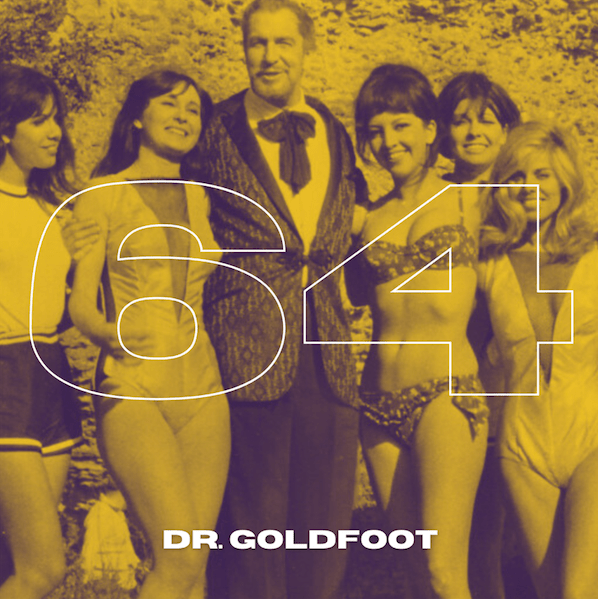
In a world before Austin Powers, Dr. Goldfoot had a Bikini Machine and Girl Bombs. A movie filled with AIP deep cuts and a second that is the only movie Mario Bava made with Vincent Price. Yes, it’s a Eurospy trip along with Frankie Avalon and Fabian.
Bonus: Check out The Weird, Wild World of Dr. Goldfoot on YouTube.
As we start a new year, it’s time to begin a new season of Tales from the Crypt. The sixth season premiered on HBO on October 31, 1984 — along with “Skin Deep” and “Whirlpool” — and was directed by Russell Mulcahy (The Hunger, Highlander and early innovations in music videos like Ultravox’s “Passing Strangers,” Billy Joel’s “Allentown,” numerous efforts for Duran Duran — “Rio,” “Save a Prayer,” “The Wild Boys,” “The Reflex” and so many more — and even the first video MTV played, The Buggles’ “Video Killed the Radio Star) and written by Ron Finley, one of five episodes scribed by this author.
The Crypt Keeper starts the show by cackling, “”From overseas and underworld, it’s the Crypt Keeper Noose Network. Good evening, creeps. In the news tonight, wolfman bites dog, vampires say life sucks, mummy takes the wrap after years in “de Nile,” and illiterate zombies insist they’re better dead than read. This just in. And our top story tonight is a nasty little soundbite about an ambulance-chasing lawyer who is about to bleed in the toughest case of her life. I call it “Let the Punishment Fit the Crime.””
This starts a lot like Nothing But Trouble. As lawyer Geraldine Ferrett (Catherine O’Hara) passes through the small town of Stueksville, she’s pulled over for having a bad license plate—well, a vanity one that states SUE EM —and hauled in front of three judges (all played by Joseph Maher) and defended by a public defender who knows so much less than her, Austin Haggard (Peter MacNicol).
Perhaps if she wasn’t so busy handing out her business card to people in wheelchairs and bragging about her past cases, she might realize that this hamlet is filled with weirdness, like the anachronistic pictures of public hangings in the lobby.
Haggard lives up to his name, a poor lawyer who gets her sentenced to a dungeon and a hundred lashes. Again and again, she tells him, “I’d rather be dead than you.” With each judge she meets, the punishments become harsher and the supernatural lifts up its head, as she’s visited by the ghosts of patients who died once she shut down a pacemaker company.
The true punishment is that she’s given community service and takes over Haggard’s role as he goes to the electric chair for his crimes, happy to be free of this town and what could have been decades of cases like this. He tells her, “I’d rather be dead than you,” as he gets zapped.
This has some more cute wordplay in it. Stueksville may be “the sticks,” but it’s also purgatory, a place where the river Styx could flow. The title comes from Gilbert and Sullivan’s The Mikado — “My object all sublime, I shall achieve in time. To let the punishment fit the crime.” — and explains the punishments of The Lord High Executioner, which are similar to the three judges in this episode.
The title of this episode, “Let the Punishment Fit the Crime,” is in name only when compared to the EC Comics story that appeared in Vault of Horror #33, written by Al Feldstein and William Gaines and drawn by Jack Davis. The tale is about a town wondering what the punishments for crimes will be as children parade coffins through the streets, inspiring the theme of justice and punishment in this episode.
EDITOR’S NOTE: Cinematic Void will be playing on Saturday, January 4, at midnight at the Little Theater in Rochester, NY (tickets here) and Friday, January 17, at 7:30 PM at the Little Theater in Rochester, NY (tickets here). For more information, visit Cinematic Void.
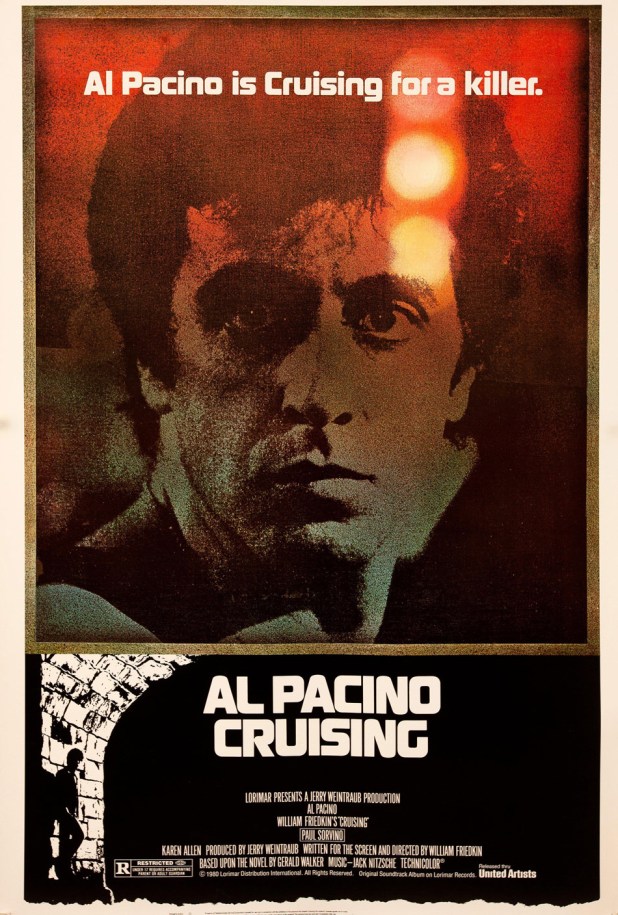
Despite being approached several times with New York Times reporter Gerald Walker’s 1970 novel Cruising, William Friedkin (The Exorcist, Sorcerer and perhaps not as successfully, Jade) wasn’t interested. He changed his mind after an unsolved series of murders in New York’s leather bars.
Articles by Village Voice journalist Arthur Bell and NYPD officer Randy Jurgensen helped inform this film. The latter went into the same deep cover as this film’s protagonist, Steve Burns. Then, Friedkin learned that Paul Bateson, a doctor’s assistant who appeared in The Exorcist, had been implicated in the crimes while serving a sentence for another murder.
Friedkin did some of his research for the film by attending gay bars dressed in only a jockstrap, but by the time the movie began filming, he had been barred from two of the most oversized bars, the Mine Shaft and Eagle’s Nest, due to the controversy surrounding the movie.
Much like The New York Ripper and God Told Me To, this movie feels like one set at the end of the world — New York City near the close of the 20th century. Someone is picking up gay men, murdering them and leaving their body parts in the Hudson.
Officer Steve Burns (Al Pacino)—exactly the type of man the killer has been after—is on the case. Captain Edelson (Paul Sorvino) has assigned him to infiltrate the foreign world of S&M and leather bars. But as the case progresses, he begins to lose himself and his relationship with Nancy (Karen Allen).
Soon, he learns of just how brutal the NYPD is to gay men — even if they’re just suspects. And he finds himself growing closer to his neighbor Ted (Don Scardino, Squirm).
By the end, nothing is truly clear. While the killer may be Stuart Richards, a schizophrenic who attacks Burns with a knife in Morningside Park, it could also be Ted’s angry boyfriend Gregory (James Remar). After all, Ted’s mutilated body is discovered while Stuart is in custody. Or the real killer is still out there — perhaps he’s even a patrol cop (Joe Spinell). The truth is never told.
Spinell is incredible in this, which is no surprise. He used his real life for inspiration, as there’s a line about his wife, Jean Jennings, leaving him and moving to Florida with his daughter. His wife had just done exactly that before this movie was shot.
The actual version of this movie may never be released. Friedkin claims it took fifty rounds to get the MPAA to award the film an R rating. Over 40 minutes of footage was cut, which consisted of time spent in gay bars. The director claims that these scenes showed “the most graphic homosexuality with Pacino watching and with the intimation that he may have been participating.”
This footage also creates another suspect — Burns himself may have become a killer.
When Friedkin sought to restore the missing footage for the film’s DVD release, he discovered that United Artists no longer had it and may have even destroyed all the cut footage.
In 2013, James Franco and Travis Mathews released Interior. Leather Bar is a metafictionalized account of the two filmmakers’ attempts to recreate the lost 40 minutes of Cruising.
There’s a disclaimer at the start that says, “This film is not intended as an indictment of the homosexual world. It is set in one small segment of that world, which is not meant to be representative of the whole.” Years later, Friedkin would claim that MPAA and United Artists required this, hoping that it would absolve them of the controversy that had been all over this production.
That’s because protests had started at the urging of gay journalist Arthur Bell, the aforementioned Village Voice writer whose series of articles on the Doodler’s killing of gay men inspired this movie. There were numerous disruptions to the filming, as protesters blasted music and loud noises at all filming locations, leading to hours of ADR to fix the ruined dialogue.
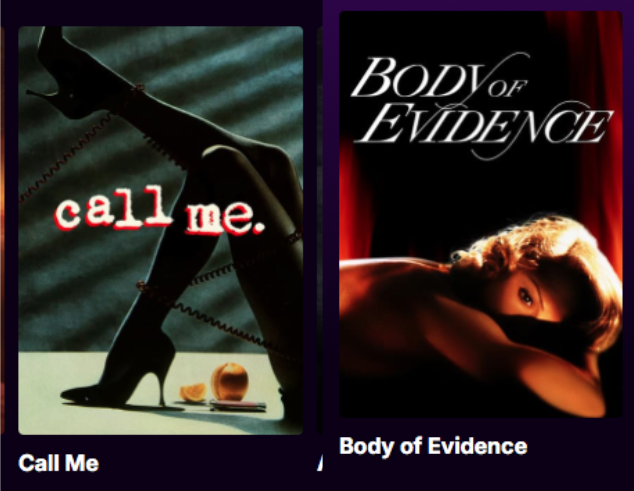
Directed by Uli Edel and written by Brad Mirman (who scripted and produced another American Giallo, Knight Moves), Body of Evidence was yet one more attempt for Madonna to find the screen success that she had in Desperately Seeking Susan as a lead and not a supporting character. But just like Shanghai Surprise, Who’s That Girl — ¿Quién es esa niña? — and Bloodhounds of Broadway, this was critically decimated, and audiences tuned out after the first week in theaters. Strangely, it was released in Japan along with another Madonna movie, the Abel Ferrara-directed Dangerous Game, as Body and Body II. And it’s totally a Giallo by way of the erotic thriller. I mean, if Madonna had someone with black gloves and a knife stalking her, I might lose my mind. There’s still time to make this happen.The Material Girl is Rebecca Carlson, a woman who has led two older men to the brink of the Pearly Gates thanks to her abilities in bed. And maybe some cocaine. But totally because her vagina is Kali, goddess of destruction in labia majora and minora form.
As she proclaims her innocence, Frank Dulaney (Willem Dafoe) becomes her lawyer. There’s no way that she killed Andrew Marsh (Michael Forest), just as there’s no way she could have shtupped Jeffrey Roston (Frank Langella) to the point that he feared for his life. As for Frank, despite being married to Sharon (Julianne Moore, who regrets this movie and the nude scenes she did), reacts to everything Rebecca does as if he’s a wolf in a Tex Avery cartoon. It’s shocking — if this movie is shocking at all, mind you — that no one says, “Frank, put away your dick.”
But he doesn’t, and she restrains him and pours candle wax all over him, which was shocking in 1993, as would be public sex and handjobs on elevators surrounded by people.
Everyone wants Rebecca, which would have been the title for this in the 1940s — and it wouldn’t have that handjob scene — because, well, everyone does. Like Dr. Alan Paley (Jürgen Prochnow), who was trying to get her into bed and instead testifies that she tried to kill his patient when she turned him down. All this court testimony makes Frank think that maybe Rebecca isn’t the pure girl who scalded his balls just a few weeks ago with a Yankee Candle.
Even though Frank can get two big wins — secretary Joanne Braslow (Anne Archer) probably gave the old man, the coke and surprise witness Jeffrey Roston is really gay, which broke Rebecca’s heart — before she gets off. I mean, shegets off the charges, not gets off as she does throughout the movie, like when Frank finally tackles her and handcuffs her like he’s Michael Douglas instead of the Green Goblin.
At the end of the case, she whispers in his ear that she did it. Defense lawyer Robert Garrett (Joe Mantegna) looks super sad, as does Frank, who follows her home — his marriage is over — and learns that she’d be sleeping with Paley as well; he deals with this news by shooting Rebecca twice and knocks her out a window, just in case we need to totally have proof that this evil woman, this seductress, this jezebel, has med her Hayes Code death. Should a car drive her over, and then someone asks if she’s really dead, followed by graphic footage of her body evacuating itself of feces? She’s dead. Real dead.
Frank goes to fix his marriage and tells Garrett he should have won. Instead of being calm, he replies, “I did.” Dude, Madonna is dead. You don’t have to rub it on a man who played Max Schreck and Jesus Christ’s face. You wouldn’t do that to the other guy who pulled that off, Klaus Kinski. Don’t do it to Willem.
Richard Riehle plays a cop in this, and every time I see him, I smile and think of his many roles.
Madonna, Dafoe and Edel spent two weeks rehearsing the sex scenes, which had no body doubles — although Madonna is doubled on the posters by Tori Sinclair, who appeared in fetish videos and Joe D’Amato’s The Hyena under the name Linda Comshav — and Dafoe really tied up, just waiting to get that candle wax all over his putz. Despite perfect camera placement and lighting, she also improvised the scene where she jilled off, or so they’d like you to believe. Despite all this sex, producer Dino De Laurentiis was angry that she released Sex two weeks before the film came out, just like the Dereks having Bo’s nudes in Playboy before Bolero escaped into multiplexes. This is better than that movie, but saying that is perhaps the slightest praise I can muster.
Just like a porn star who doesn’t want to step in any man gravy puddles, Madonna keeps her high heels on in every sex scene. She must have liked the movie because she used samples of it in two of her songs, “Erotica” and “Justify My Love,” which led Wayne Campbell to exclaim, “Take a look at the unit on that guy.”
There were two endings, and they chose the one in which the bad girl gets her comeuppance — no pun intended.
EDITOR’S NOTE: Cinematic Void will be playing this on Thursday, Jan. 9 at 7:30 PM at the Little Theater in Rochester, NY (tickets here). For more information, visit Cinematic Void.
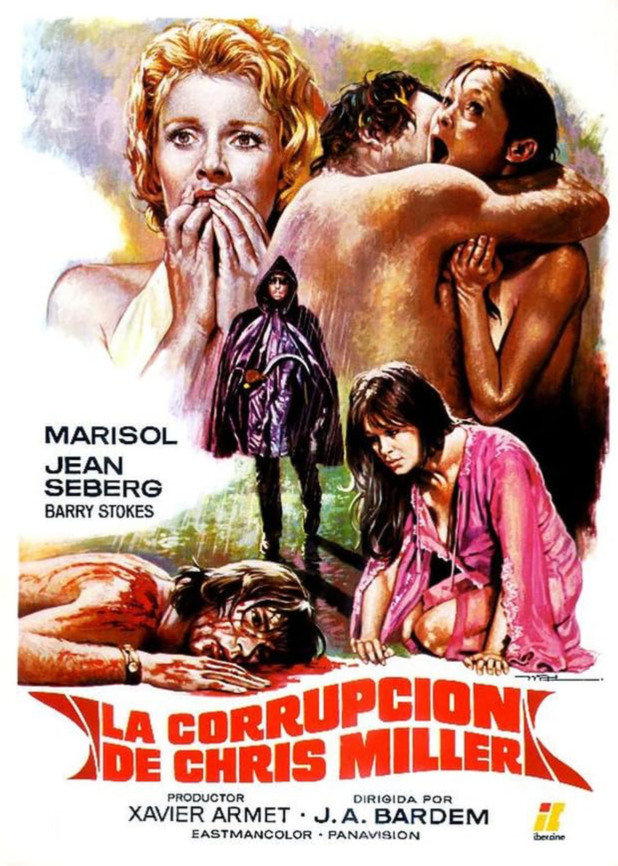
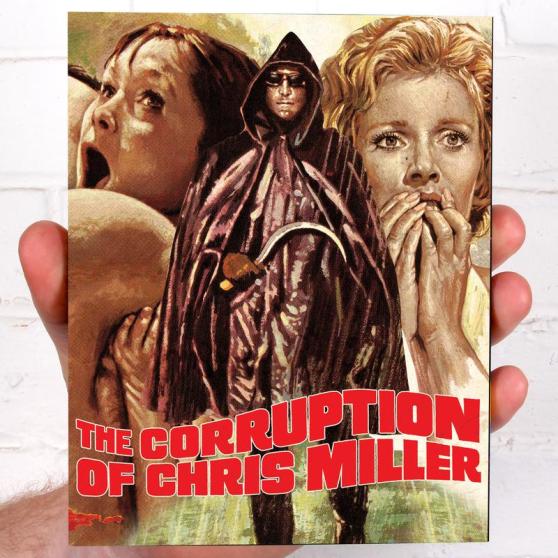
Chris Miller (former Spanish child star Marisol; when she married dancer Antonio Gades, Fidel Castro acted as their godfather) lives with her stepmother Ruth (Jean Seberg, the haunted and doomed beauty who was also in Breathless and Saint Joan). The loss of Chris’ father has damaged both of them, so when a drifter named Barney (Barry Stokes, Prey) shows up, it changes their lives. Maybe not for the better, what with a killer slicing his way through the village…
This Spanish giallo was directed by Juan Antonio Bardem (yes, the uncle of Javier) who also made Death of a Cyclist and wrote A Bell From Hell. It was written by Santiago Moncada, who was also the pen behind Hatchet for the Honeymoon, Ricco and The Fourth Victim.
Ruth blames Chris for her husband leaving, so she uses Barney to seduce her stepdaughter, who is recovering from the dual loss of her father and being assaulted at school. Her plan? When daddy comes home, he won’t love his daughter much any longer because she’s no longer a virgin. Meanwhile, the killer keeps on killing, including a scene where he dresses like Charlie Chaplin.
Also released as Behind the Shutters Sisters of Corruption and , this movie is also a proto-slasher, rife with bloody murders, including a moment when the rain slicker-covered villain kills an entire family in slow motion.
This is a film that deals as much with trauma as murder, that has the sound of running water causing horrifying flashbacks and has no easy ending for anyone in the film, as the guilt of the killings won’t disappear with the death of any suspect.
Vinegar Syndrome recently released this on blu ray, complete with a newly scanned 4K capture from the original 35mm negative. That version will be playing at The Little.
Jade brings together the Dracula and Frankenstein of sleaze, as Robert Evans produces and Joe Eszterhas writes with William Friedkin there to direct — and change the script so many times that Eszterhas needed a $4 million payoff from Paramount to keep his name on the movie. Friedkin later claimed he let everyone down on this movie, including his wife, producer Sherry Lansing. As for what the actors thought, Michael Biehn noted, “I didn’t realize until the read-through that I was the bad guy in it.”
It’s also one of the last roles that Linda Fiorentino would take on, finally ending her on-screen career in 2009, a star with such promise after The Last Seduction. Was it that she was hard to work with? Did Kevin Smith sabotage her career after Dogma was challenging to make? And did people think she was Bridget, her The Last Seduction character?
When asked by Roger Ebert why she always played terrible girls, she replied, “I have this terminal condition called bitchiness, right?” She continued, “Maybe others see what I don’t necessarily see in myself. And a lot of it in Hollywood concerns what you look like. I’m dark, my eyes are dark, and my voice is deep, and how the hell could I play a Meg Ryan role, the way I look.” But then again, she also dated Hollywood fixer and private investigator Anthony Pellicano and FBI agent Mark Rossini, which was rumored to be her using favors to aid in the defense of her actual boyfriend, Pellicano. Was life imitating art imitating life? Rossini used government computers to get case info for Pellicano’s lawyers, which meant he eventually pleaded guilty to illegally accessing FBI computers and was quit/fired from the Bureau. But hey, Linda Fiorentino.
Back to that Ebert interview. It’s intriguing how she pushed for more from this movie: When we were doing Jade, the way Joe Eszterhas wrote the sex scenes was so dated and boring, and I just thought, I can’t do this. And there was a lot of nudity, and I thought, we’ve gotta come up with something a little more interesting to keep me going here. So I did a little random research, you know, and I asked a couple of women I had known who had affairs with men who were very powerful – and invariably those men in powerful positions wanted to be dominated by the woman at the end of the day. They wanted to be the submissive party in the sex act, and it correlated with the level of power. Maybe men with no power want to dominate their women. I just thought, well, this is interesting. And it’s the same for women: Women want to be the dominant party because that’s their fantasy, and the male fantasy is to be the submissive party. And so we got into that in Jade.”
As for her male counterpart in this movie, David Caruso left NYPD Blue after the show’s second season because he wanted a film career. Critics and the media were ready to attack him for that hubris, especially after his first post-TV film, Kiss of Death, also bombed.
And when it comes to Eszterhas, after making $3 million for Basic Instinct, he was due for a fall, which was either going to be this movie, Sliver, Showgirls or all three. He got $1.5 million for this (and $4 million for his next film One Night Stand).
Friedkin was also struggling, as his last two movies were the three demoness movies The Guardianand Blue Chips. In his book The Friedkin Connection, he said that this movie had “a terrific cast—a wonderful script. Great locations. How could it miss?”
Caruso is Assistant District Attorney David Corelli, who visits the murder scene of Kyle Medford, a wealthy businessman who set up several rich and powerful men like Governor Lew Edwards (Richard Crenna) with gorgeous women, including Patrice Jacinto (Angie Everhart). Corelli is told by Edwards and his henchman Bill Barret (Holt McCallany, who most people know from being on Mindhunter, but come on, he got laid and paid as Sam Whitemoon in Creepshow 2) never to let this info out, seeing as how his brakes are soon cut, that’s to be considered a warning.
The seductress who gets the most requests goes by the name of Jade. Seeing as how Anna Katrina Maxwell-Gavin’s (Fiorentino) prints show up on the ancient hatchet — yes, that kind of murder weapon points to this being a Giallo — that killed Medford, it seems like perhaps she could be Jade. She once dated Corelli before marrying his fellow DA, Matt Gavin (Chazz Palminteri). Medford’s safe is filled with sex toys, drugs, videotapes and, oh yeah, bags filled with pubes. But back to those videotapes. Anna Katrina is one of them.
It also seems like she may have killed Patrice, but her husband cuts the interrogation short. Why would she be on those tapes? Well, didn’t he have his affairs? Of course, the governor sends his men, which also includes bad cops Bob Hargrove (Michael Biehn) and Pat Callendar (David Hunt), to kill Allison, who gets saved by Corelli — who was nearly seduced by her — and Gavin — who wanted to kill Corelli for perhaps sleeping with his wife. But all along, it had been Gavin who killed Medford to keep the secrets he and his wife keep, telling her to introduce him to Jade the next time they make love.
Biehn would say of the film. “It was like a jumbled mess. And the movie came out a mess, too. It had great people on it, though. So a great cast, great director… everything but a script.”
Then again, how many giallo makes no sense at all?
But this has an incredible car chase, murder set pieces straight out of Italy, lush production values, a gorgeous heroine/antagonist/who knows in Fiorentino, and they threw a lot of money at this movie to make something that Sergio Martino did for about a tenth of the cost. Plus, there is a moment where Angie Everhardt gets run over by a car not once but twice. Plus, a scene of a naked Palminteri crawling around and begging for Jade to re-enact the movie poster on their bed.
In his book Hollywood Animal, Eszterhas said, “In the week after he was found not guilty and got out of jail, O.J. Simpson went to see two movies. Showgirls and Jade.”
That says something, right?
Several other cuts of this movie exist, including a European cut with more explicit sex scenes—yes, it’s possible—and a director’s cut with a different ending, 12 minutes more story and, yes, lots more carnal moments.
I will never forget this movie for another, as Cal tells Andy when he talks to women to be like David Caruso in Jade. Always keep asking questions. Be calm and kind of be a dick.
EDITOR’S NOTE: Cinematic Void will be playing this film on January 6 at 7:00 PM PT at Los Feliz 3 in Los Angeles, CA. For more information, visit Cinematic Void. For tickets, visit this site. Can’t make it to the movie? Watch it on Tubi.
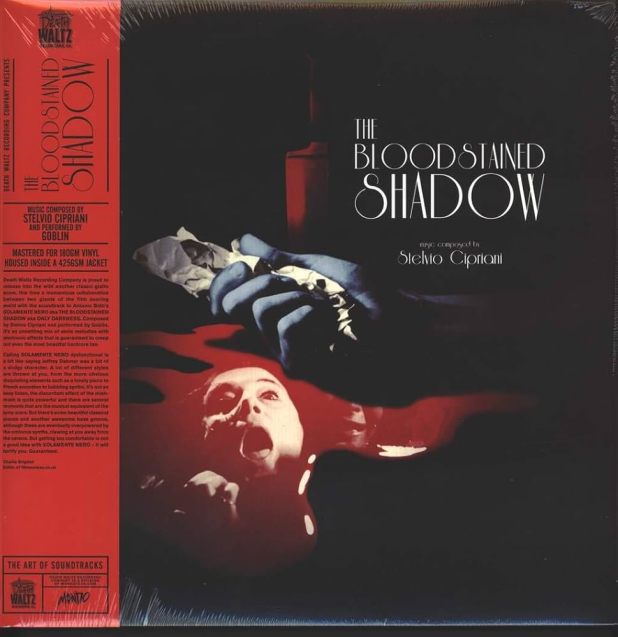
One of my favorite things about giallo are the alternate titles. As if The Bloodstained Shadow isn’t a great name, this movie also goes by Solamente Nero (Only Blackness), which is a way better title. The other thing I love about this genre is that just when I think I’ve seen every good one, I find another to enjoy.
This is the kind of movie that tells you exactly where it stands in the first minutes, as a killer strangles a girl in a field before the credits even start. That murder has never been solved. Years later, a college professor named Stefano has a nervous breakdown. To recover, he comes home to visit his brother Don Paolo, who has become a priest that hates all of the immorality in their small town.
Oh what immorality — there’s a gambler, a psychic, a combination atheist/pedophile and an illegal abortionist with a mentally challenged son who lives in a shack top the list, along with your typical sex and drinking that happens in any town.
Meanwhile, murders have been piling up and whoever is behind it, they’re leaving notes to the priest, warning him that if he reveals who the killer is, he’ll be next. That’s because on Stefano’s first night back home, Don Paolo saw the killer murder the town psychic in the courtyard.
Stefania Casini (Suspiria) also appears as the love interest, Sandra, who helps Stefano come back to normalcy. Well, as normal as a town filled with murder can be. I’m kind of amazed that she wears a belly chain all day. When you get to the love scene, you’ll know what I mean.
There’s also some amazing religious imagery in this one, like a skinned and bloody animal that has been placed in the sacristy to warn the priest that he’s getting too close, or the communion scene that reveals who the real killer is.
Finally, Goblin plays some great music in here, created by composer Stelvio Cipriani. It’s really a great package, thanks to director Antonio Bido, who directed one other giallo, Watch Me When I Kill. I love how the past childhood trauma that the brothers endured continues to permeate their lives as they try to grow up. This is a very adult giallo and by that, I mean that it doesn’t need nudity and gore to tell its tale.
The final segment of the three-part animated series “Justice League: Crisis on Infinite Earths” covers a lot of ground. The heroes manage to survive the anti-matter wave after the death of the Monitor triggers “The Bleed,” a realm where all realities coexist simultaneously, leading to a very crowded situation.
This context sheds light on the state of the multiverse, particularly after John Constantine’s (voiced by Nolan North) Earth was plunged into war with Darkseid. In “Justice League Dark: Apokolips War,” Constantine sends the Flash back in time to kill that New Gods despot when he was still a defenseless child. This act disrupts the time-space continuum and results in the creation of anti-matter waves.
Meanwhile, Lex Luthor of Earth-10 (voiced by Corey Stoll) is leveraging Psycho Pirate (voiced by Geoffrey Arend) to negotiate with the Anti-Monitor in exchange for sparing their reality from villains. However, Luthor also aims to halt the Crisis and is willing to sacrifice multiple worlds to study how the waves function. These worlds include the realm of the Super Friends (Earth-508), “Batman: The Animated Series” (Earth-12), Earth-10, and the Teen Titans’ universe (Earth-2003).
Supergirl seeks redemption for killing the Monitor by remaining inside the sun, enhancing her powers. She confronts the Anti-Monitor and ultimately sacrifices her life. In the meantime, the heroes transform Warworld into a weapon capable of defeating their formidable foe.
Using magic, Constantine employs Superman’s Miracle Machine and Wonder Woman’s sacrifice to create a single universe, where all heroes enter except for The Question (voiced by David Kaye), who refuses on principle. Surprisingly, even Constantine is granted a chance to live, thanks to the Spectre (voiced by Lou Diamond Phillips). However, he follows the Ghost of Vengeance into an unknown world.
This new universe introduces a host of new heroes, including Adam Strange (voiced by Brian Bloom), Bat Lash (voiced by Brett Dalton), Nightshade (voiced by Ashly Burch), Lobo (voiced by John DiMaggio), Captain William Storm (voiced by Dean Winters) and The Losers.
The most poignant aspect of this installment is that it marks the final battle between Batman, voiced by the late Kevin Conroy, and the Joker, voiced by Mark Hamill. This episode is dedicated to Conroy, who sadly passed away last year.
As I mentioned in a previous review, the Crisis impacts all DC universes at various points, which is undeniably tragic. However, it feels akin to Ragnarok—a necessary reset that clears the way for future developments. It would have been interesting if some of the other New Gods had made an appearance. Maybe the death of Darkseid caused them to never be.
In the latest Crisis movie, we learn that the Monitor’s assistant, Harbinger (voiced by Meg Donnelly), is Kara Zor-El, the last survivor of Krypton, also known as Supergirl. This twist combines several Marv Wolfman and George Perez concepts into one narrative, marking a significant change as the story transitions from a comic book to the conclusion of the DC Animated Universe.
The film also introduces Psycho Pirate (voiced by Geoffrey Arend), a minor villain who takes on a significant role in the Crisis. One of the highlights for me in this segment was witnessing a Batman family composed of heroes from different Earths as they all work together to save Earth-2 and Wonder Woman on Earth-43, a world where Amazons are the dominant race.
The true villain, the Anti-Monitor, is revealed at the end. The character is often seen as a homeless man; Pariah turns out not to be the scientist who discovered the Anti-Monitor; instead, he is revealed to be a cursed John Constantine (played by Matt Ryan).
Along with a glimpse of Batman Beyond, this episode also introduces Kamandi (voiced by Will Friedle), Dr. Fate (voiced by Keith Ferguson), the Joker (voiced by Troy Baker), and Solovar (voiced by Darin De Paul). One of my favorite moments from the comics was the friendship between the intelligent ape Solovar and Kamandi, and I’m pleased to see it portrayed in the movie as well.
The Crisis event always makes me nostalgic. I miss the old DC, its quirky world of the ’50s and the concept of multiple Earths. This series intended to simplify things for new readers, but it became even more complicated within a few years. At least the movies have only twenty-five parts, making it a bit more manageable!
Director Jeff Wamester and writer Jim Krieg have done an impressive job with the three-part series, “Justice League: Crisis on Infinite Earths,” which encompasses the twenty-third through twenty-fifth — and final — stories in the DC Animated Movie Universe. As James Gunn prepares to take over DC movies, this series provides a spectacular conclusion.
The hero known as the Flash, voiced by Matt Bomer, takes center stage throughout much of the first part of the series. We learn about his origins, how he first met his wife, Iris (Ashleigh Lathrop), and how the Justice League — featuring Superman (Darren Criss), Batman (Jensen Ackles), Green Arrow (Jimmi Simpson), Vixen (Keesha Sharp), and Martian Manhunter (Ike Amadi) — comes together in response to the threat posed by Professor Ivo (Ike Amadi) and his android, Amazo (Nolan North). The twist is that Lex Luthor (Zachary Quinto) is responsible for giving Ivo a disease, leading to Amazo being unleashed.
After their initial mission, a man named Pariah (Nolan North) sends Flash to Earth-3, which is also featured in the Justice League: Crisis On Two Earthsmovie. However, instead of the Crime Syndicate moving to another world, an antimatter wave erases their reality, and the Flash’s counterpart, Johnny Quick, assists him in returning to his world.
The Flash faces another crisis on the day of his wedding when Harbinger brings him, Green Arrow, Vixen, and Green Lantern John Stewart (Aldis Hodge) to the Monitor’s satellite. The Monitor claims he can prevent the impending death that approaches.
The heroes gather on the satellite, including Earth-2’s Wonder Woman (Stana Katic), her aged husband Superman (Darren Criss), Hawkman (Geoffrey Arend), Robin (Zach Callison), Batman’s daughter Huntress (Erika Ishii), Dawnstar (Cynthia Hamidi) from the 30th century, Doctor Light (Erika Ishii), Mister Terrific (Ato Essandoh), and Aquaman (Liam McIntyre) from Earth-146. In the original DC Comics, this was a world where Superman existed thousands of years earlier than on Earth-1. This world resembles “Waterworld” and substitutes for Lady Quark of Earth-6.
My favorite heroes from Earth-4, the Charlton Universe, also appear. The Blue Beetle, Ted Kord (Matt Lanter), and The Question (David Kaye) are particularly well depicted.
The heroes are tasked with building towers to halt the dimensional wave threatening their world. Barry uses this opportunity to slow down time, allowing him to spend more time with Iris than usual and bond with Amazo. As Amazo passes away, the Spectre (Lou Diamond Phillips) appears to Barry, informing him that he must repay the time and warn the heroes that the Crisis has not yet ended. Before dying, the Flash appears to Batman when he is trapped on Warworld — which appeared in another DCU movie, Justice League: Warworld.
The wave of destruction continues, becoming evident as different realities fade away. This marks the end of the first part!
The joy of the original Crisis lay in the artwork and spotting many beloved heroes. In this installment, fans can identify characters such as Earth-1’s Atom, Atomic Knight, Batwing, Black Lightning, Blackhawk, Blue Devil, the Challengers of the Unknown, Creeper, Elongated Man, Firestorm, Guy Gardner, Hawk and Dove, Katana, Mento, the Metal Men, Metamorpho, Negative Woman, Nighthawk, Red Star, Red Tornado, Speedy, Star Sapphire, Swamp Thing, Tempest, Tomahawk, and Zatanna; Earth-2’s Doctor Mid-Nite, Hourman, Jade, Obsidian, Starman, and Wildcat; Earth-4’s Peacemaker; Earth-S’s Marvel Family; Earth-7’s Thunderer; the Freedom Fighters of Earth-X — a reality where the Nazis triumphed, including Uncle Sam, Doll Man, Ray and Black Condor — and many more.
The DC Universe owes a great deal to Marv Wolfman and George Pérez, whose “Teen Titans” and “Crisis” stories have influenced nearly every medium in which DC tells its tales. This project brought me back to 1985, when I was waiting for each new issue while feeling a bittersweet sadness, knowing that many of my favorite heroes would die and that the multiverse would cease to exist. Well, I was mistaken about that last part.






 B&S About Movies
You must be logged in to post a comment.