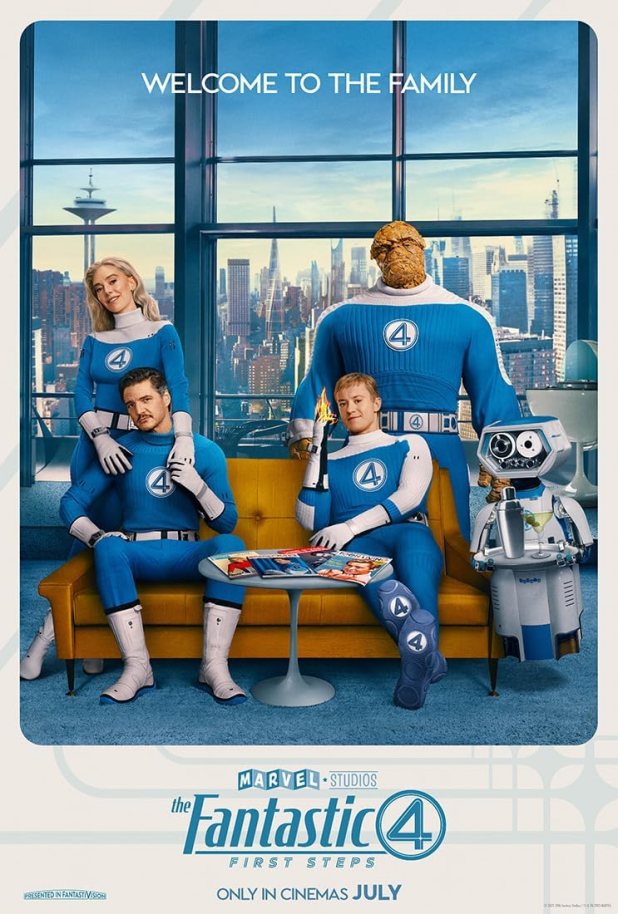
The Fantastic Four: First Steps (2025)

DISCLAIMER: I am a huge nerd and I don’t care about your superhero fatigue.

How ironic is it that it took four times to get the Fantastic Four right?

Sure, the 1994 Roger Corman-produced Fantastic Four gets the characters right, but it didn’t have the budget to make it perfect. Then again, it was created primarily to maintain a copyright.

In 2004, we had Fantastic Four and in 2007, a sequel, Rise of the Silver Surfer. The effects were there, the costumes were close, but they felt too compressed. The Marvel Cinematic Universe was not what it would become, and, well, Galactus was a cloud.

2015 brought the Fantastic Four, the fascinating Josh Trank-directed failure that had no idea what it wanted to be.

As I said several years ago, when I covered that film, “The creators should have taken a note from the cartoon versions, as both the 1994-96 series and the 2006-07 Fantastic Four: World’s Greatest Heroes captured much of what makes these heroes so special. Unlike the Avengers, they are two things: a family and adventure scientists, not truly superheroes.”

The Fantastic Four: First Steps is the first movie that gets that. And gets a better understanding of who these characters truly are.

I was inspired to write this after seeing a social acquaintance describe it as a boring movie, filled with talk instead of action. This kind of upset me, as it showed that this person, like the filmmakers before, didn’t understand who these characters are.

There are two aspects: an intriguing breakdown of the four basic Myers-Briggs archetypes and the distilled personality of Jack Kirby.

In my past advertising life, I volunteered to help teach the Myers-Briggs classes. To keep things simple, we didn’t delve into the sixteen types, but instead focused on the four archetypes: Rationalist, Romantic, Defender, and Creator. We broke them down into marketing terms: Body Copy, Illustration, Logo, and Headline.

Haha, this is a movie review, but let’s go deep.

Oh yeah — spoilers from here on.

The Rationalist (ETNJ, INTJ, ENTP or INTP) is “characterized by their ability to think critically, analyze complex situations and propose innovative solutions. They are known for their independent problem-solving skills, strategic thinking and strong-willed nature.” Other studies will refer to these as the Idealists. They are given to charity and causes, which is who Sue Richards is in this movie. No other film — even several comics — has portrayed her so accurately as she should be. The Invisible Woman isn’t someone blinded by her love for Reed, nor is she a heroine who needs to be saved. She’s dynamic, and her actions change the world for the better beyond her superheroics.

The Romantic (ENFJ, IFNJ, ENFP, INFP) are “typically idealistic and dreamy, and they often have a strong appreciation for beauty.” They are drawn to art, music and writing, while looking for a perfect, true love. Johnny Storm is this personality, someone who the movie notes always has a new girl and who we see designing new costumes for the space mission. Yet he also possesses a strong level of intuition, recognizing that the Silver Surfer’s voice is the same as the space signals Reed has discovered. When he meets her, everyone thinks he has a crush on her, but the truth is that he sees something beneath her cruelty —a humanity that she believes is long gone.

The Defender (ESTJ, ISTJ, ESFJ, ISFJ) is loyal and devoted to family, but may have difficulty expressing their emotions. They follow strict schedules and feel a sense of duty. This is Ben Grimm, The Thing, who is the true heart of the Fantastic Four. The movie shows that he’s the member who remains connected to his Yancy Street community, still shopping at the same places he did when he was a child. He’s the member who cooks dinner for everyone and tries to protect them. As for his emotions, he feels something for the teacher, Roz, but struggles to express his feelings until the night he meets her at the synagogue, when he tells her that he doesn’t want to be around people. He wanted to be around her.

The Creator (ESTP, ISTP, ESFP, ISFP) is a problem solver, but one who often gets lost inside their own thoughts. Usually, they live in the now and “sometimes fail to think about how current actions will lead to long-term consequences.” Reed Richards fits in here, as he’s always thinking of solutions and often forgets — such as when he gave his son Franklin to Galactus, which seemed like a logical decision at the time — how his thoughts will end up angering those he loves. He is constantly thinking of worst-case scenarios and, often, what could versus what will happen. Think of this within the movie, where he confesses to Sue that he always has to think of the most horrible things so that he can protect her, his family and the world.

What the movie truly grasps is that the Fantastic Four are, in many ways, a reflection of Jack Kirby himself.

As the movie ends, this quote emerges: “If you look at my characters, you will find me. No matter what kind of character you create or assume, a little of yourself must remain there.” Then, we learn that Earth-828, where this movie takes place, is named for Kirby’s birthday: August 28.

Director Matt Shakman’s words to Marvel echo this sentiment: “He’s a visionary. We would have no Marvel Studios today without Jack Kirby. He created numerous amazing characters and built this world alongside Stan Lee. So many of our heroes launched from his mind and his pen, and we wanted to honor that. We wanted to honor his distinctive style.”

Marvel Studios president Kevin Feige also said, “We wanted it to be more than just a passing tip of the hat. There are direct lines from his pencil that he drew with at his drawing board by himself, pouring his universe-spanning imagination onto the page. There are direct lines from there into this film.”

In fact, they planned this comic as a tribute to Kirby meeting Kubrick, as seen in the making of 2001, which is, well, fantastic because The King drew a series of continuations to Kubrick’s classic movie and was inspired by it himself, as evident in his collage work.

And most of all, The Thing is Jack Kirby.

According to Jewish Currents, “In the Lee-Kirby collaboration, Lee provided his signature pop sensibility and glib humor, but there’s no question that Kirby was the driving creative force of the team. Of all Marvel characters, Ben Grimm is the most directly autobiographical. Kirby and Grimm were both born on the Lower East Side of New York and grew up poor; Kirby on Delancey Street, and Grimm on a fictional street called Yancy Street. Benjamin Jacob Grimm takes his first and middle names from Kirby’s father and Kirby’s real first name, respectively. Kirby and Grimm both fought in World War II and came home moody and prone to fits of anger.”

They go on to claim that The Thing is one of the few Jewish Marvel superheroes and is an outright golem, a creature from Jewish myth.

Yet there are echoes of Kirby’s life in his other characters. The Invisible Woman, Sue Storm Richards, is named for his daughter Susan. Mr. Fantastic’s drive to support his family and protect them in the fact of overwhelming odds comes directly from Kirby drawing all night long, his superhuman endurance creating more comics and characters in a month than some creators do in a lifetime, all to keep his family fed — no health insurance or safety net until way into the 1970s, when he worked in animation.

Seeing this quote at the end of the movie made me happy because it was a realization that, while Stan Lee is important to Marvel, it was Jack Kirby, who brought his characters to life, that made them happen. Jack of all trades created the Silver Surfer. He never intended Sue to be jealous of other women who were around Reed or a damsel in distress. Many of those things originated from Lee’s word balloons. Depending on which story you believe, Kirby had Galactus show up and had to explain it to Stan; Galactus was literally Kirby trying to confront God and see what God would do if He came down to judge His creations.

How much does this movie love Jack Kirby? It names The Thing’s love interest Rachel Rozman (Natasha Lyonne).

Kirby’s wife’s name? Roz.

Beyond the look and feel of this movie, it gets something right: these are really the Fantastic Four.

Only Johnny could realize that the language of the Silver Surfer was in those recordings, while everyone thought he was just chasing girls.

Only Ben could remind everyone that real people were in the buildings they were about to knock down.

Only Reed could devise a plan to save the world that quickly.

And only Sue rallies the world and inspires them to see how to put it all together.

What really worked is that we don’t need to learn the origin of the Fantastic Four. We can understand it quickly, from the TV special that bookends the film. We can see that they’ve changed their world for the better, not just by fighting monsters and villains, but also through their inventions and Sue’s political skills.

Pedro Pascal, Vanessa Kirby, Ebon Moss-Bachrach and Joseph Quinn become these characters to the point that I was able to shut off and enter their world, a place of mid-century future tech. Sure, we don’t get to see any Mole People with Mole Man (Paul Walter Hauser), and the Red Ghost is absent (too much footage was shot, they say). However, the character moments are everything in this, such as when Reed is shaken to the core by how they barely escaped Galactus (Ralph Ineson) and the Silver Surfer (Julia Garner), cosmic horrors who demand his son’s life in exchange for sparing everyone on Earth.

At once, this can be a movie for people who have no idea about these characters while also rewarding those excited for the appearances of Diablo, Dragon Man, Mad Thinker, Puppet Master, The Wizard, Giganto and Super Ape Peotor (I did say I was a nerd up above, right?*). Writers Josh Friedman, Eric Pearson, Ian Springer and Jeff Kaplan get the most important thing about the FF right.

They aren’t just superheroes. They’re a family.

*Nerdy facts: The Excelsior rocket is named for Stan Lee’s catch phrase; Shalla-Bal was the Silver Surfer’s lover in the original comics; Alex Hyde-White, Jay Underwood, Rebecca Staab and Michael Bailey Smith from the Corman version all show up; you can see Stan and Jack working at Timely Comics in a quick scene and how about that empty Latervia chair setting up the ending?
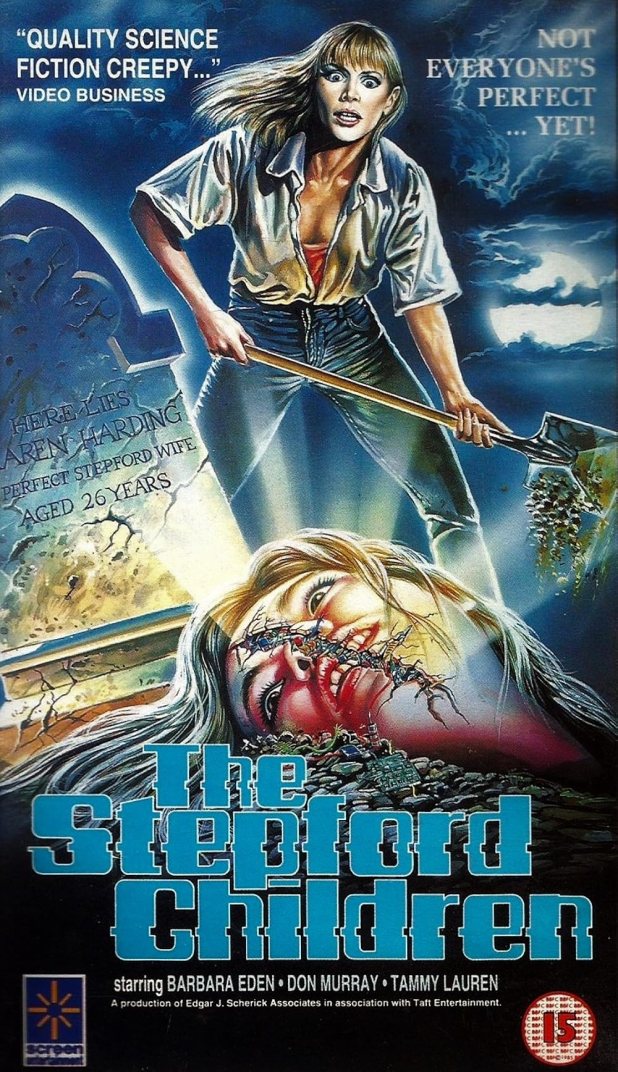
CBS LATE MOVIE: The Stepford Children (1987)

EDITOR’S NOTE: The Stepford Children was on the CBS Late Movie on June 29, 1988.

The second of three TV movie sequels — there was also Revenge of the Stepford Wives, directed by Robert Fuest, and The Stepford Husbands — The Stepford Children is based on the Ira Levin novel The Stepford Wives and the films that came after.

Laura and Steven Harding (Barbara Eden and Don Murray) have brought their kids, David (Randall Batinkoff) and Mary (Tammy Lauren), to Stepford, Connecticut, the same place where Steven’s first wife died. Laura just wants to become a lawyer, but Steven joins the Men’s Association, which is still turning wives into robots. It’s also turning the kids into homework-obsessed drones.

David and neighbor girl Lois (Debbie Barker) start hanging out, as they both love motorcycles. Laura becomes friends with Lois’ mom, Sandy (Sharon Spelman). And she soon learns that while she lets her kids be who they want to be, her husband seems obsessed with making them perfect.

During a school dance, everyone starts to dance to big band standards and when David and Mary switch it up to some rock and roll, they do more than lose control. They freak out and the cops have to come, as the Stepford Children have not been programmed for 80s music. All the men of Stepford chase Lois, causing a motorcycle crash and then David sees them removing her arms at the hospital. The next day, she shows up brand new and dumps him.

A movie that somehow has “replacement Ginger” Judith Baldwin, James Coco, Dick Butkis and Hedwig and the Angry Inch star John Cameron Mitchell all in it? Yes, and it ends in the most astounding of ways, as the entire town must die for the humans to live.

Directed by Alan J. Levi and written by William Bleich, this is way more entertaining than you’d expect. Usually, I say fuck those kids, but this time I rooted for them.

You can download this from the Internet Archive.

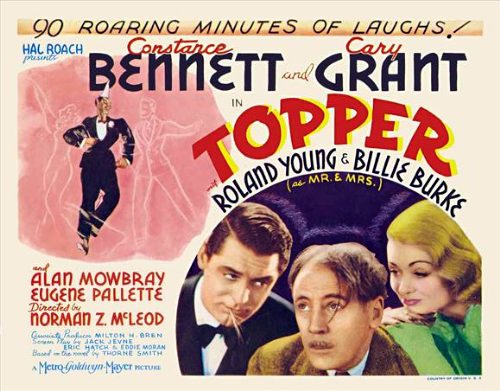
Sizzlin’ Summer of Side-Splitters 2025: Topper (1937)

July 28 – Aug 3 Screwball Comedy: Just imagine, the Great Depression is raging and you’re getting less than a fin a week at the rubber boiling factory, but it only costs two bits to go to the movies all day, so let’s watch some quick-talking dames match wits with some dopey joes!

Based on the novel by Thorne Smith, Topper was a big deal and the first movie that Hal Roach Studios colorized when they decided to convert their black-and-white films to full color.

George and Marion Kerby (Cary Grant and Constance Bennett) are irresponsible rich kids who wreck their car and suddenly learn that they’ve died. They didn’t do enough good to go to Heaven, but are too nice to go to Hell. Their friend, Cosmo Topper (Roland Young), buys their roadster and ends up with them back in his life as ghosts, trying to make his boring life more exciting and helping him improve his marriage to his wife (Billie Burke).

Director Norman Z. McLeod would go on to make Horse FeathersPennies from HeavenThe Secret Life of Walter Mitty and the sequel to this, Topper Takes a Trip. There’s a third film, Topper Returns, which only has Cosmo Topper and is nearly a Giallo. Nom, seriously.

You can watch this on YouTube.

CBS LATE MOVIE: Topper (1979)

EDITOR’S NOTE: Topper was on the CBS Late Movie on February 16, 1983 and January 5, 1984.

Seven-year-old Sam was not upset when things were remade. He loved watching Topper on WPGH’s Sunday Morning Movie, and he was pleased that it was back. Old Sam is the grumpy one.

Old Sam would also like you to know that Andrews Stevens and Kate Jackson are the cutest of couples and are sad that they divorced.

This was the third time a Topper series was attempted — yes, another failed pilot — as there was a 78-episode show starring Anne Jeffreys and Robert Sterling from 1953 to 1956, and another failed pilot in 1973 with Stefanie Powers and John Fink. There was also a 1992 pilot with Tim Curry as Cosmo, Courtney Cox as Marion and Ben Cross as George.

Marion  (Jackson) and George (Stevens) swerve to avoid a bunny and end up as ghosts, stuck on Earth until they earn their way into Heaven. One of those ways they try to help others is to improve the marriage between Cosmo Topper (Jack Warden) and his wife Clara (Rue McClanahan), as well as keep him from being screwed by his unscrupulous business partner Fred Korbell (James Karen).

Charles E. Dubin directed this, along with more than 110 other TV productions. It was written by the husband-and-wife duo of Michael Scheff and Mary Ann Kasica, with George Kirgo. It was based on the original novel by Thorne Smith.

Did you ever want to see Topper in a disco? This is your movie.

You can watch this on The Cave of Forgotten Films or on YouTube.

CBS LATE MOVIE: Cover Girls (1977)

EDITOR’S NOTE: Cover Girls was on the CBS Late Movie on March 2 and August 1, 1983, March 21, 1984, December 30, 1986 and June 1, 1987.

Two models, Linda Allen (Cornelia Sharpe) and Monique Lawrence (Jayne Kennedy), are really spies, sent on a mission by James Andrews (Don Galloway) to track down both an embezzler, Bradner (Vince Edwards), and a criminal named Michael (George Lazenby).

This is a failed pilot made in the wake of the success of Charlie’s Angels. You get Don Johnson as an undercover agent posing as a rock star, Ellen Travolta as a photographer and an appearance by Ray Dennis Steckler’s wife Carolyn Brandt!

Directed by TV vet Jerry London and written by Mark Rodgers, this is enjoyable silliness that I wish had become a series, but I say that about every failed pilot.

You can watch this at The Cave of Forgotten Films or on YouTube.

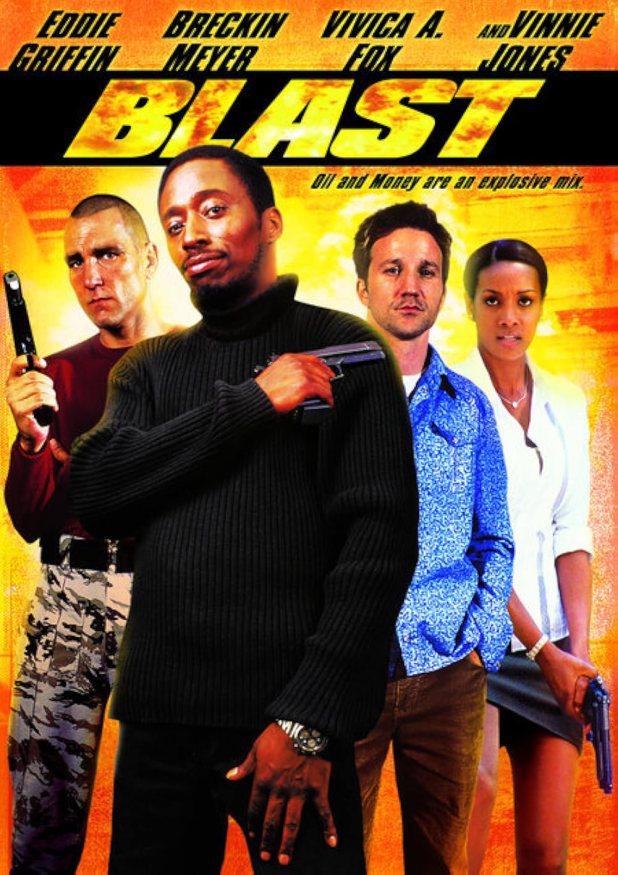
Sizzlin’ Summer of Side-Splitters 2025: Blast (2004)

July 21-27 Eddie Griffin Week: This motherfucker is funny!

Blast is filled with people who seemingly should be doing better.

Like Vinnie Jones, who plays terrorist Michael Kittredge, who is posing as a protester of an oil rig to get his mercenaries onto it and detonate a dirty bomb.

Or Vivica A. Fox, who is FBI Agent Reed, who recruits our hero.

Or that hero, Eddie Griffin, who should be a much bigger star and not in Die Hard on an oil platform as a tugboat captain with an adopted white kid who sounds like a dubbed Italian child. Yes, all the ADR was done way after the movie and none of the actual people did no their voices.

Tiny Lister? You’re Zeus. You shouldn’t be in this.

Nor should Shaggy. It wasn’t me, Shaggy.

Maybe Breckin Meyer should be in this. No, come on, be nice. He deserves some kindness.

Shockingly, this was directed by Anthony Hickox, who had previously made Waxwork, and written by Steven E. de Souza and Horst Freund. Yes, the same de Souza who wrote…Die Hard.

Just like an Italian movie, this takes scenes from Top Gun for the jets, to the point that you can see Maverick’s name on the side of the vehicle. It also takes footage from Backdraft.

Thanks to Matty from the most magical site of all time, The Schlock Pit, I can report that this movie was a remake of the German TV movie Operation Noah. That’s where the Horst Freund credit is from.

You can watch this on Tubi.

CBS LATE MOVIE: See China and Die (1981)

EDITOR’S NOTE: See China and Die was on the CBS Late Movie on March 4, 1984 and June 6, 1985.

Larry Cohen can really do no wrong.

Even with a TV movie budget, he turned this pilot for the TV show Momma the Detective into something great.

Momma Sykes (Esther Rolle) is the momma — you see, right? — of a cop, Sgt. Alvin Sykers (Kene Holliday) and she can’t help but get mixed up in his cases. She reads detective novels all the time and soon finds herself in one, as one of her employers — she’s a maid — was killed soon after coming back to China. Seeing as how she always figures out the killer in her books, she thinks she can do the same now.

She makes her way through the building, getting fired when she pries too much and then getting hired right next door, because finding a cleaning lady as good as her is hard in New York City.

I loved Ames Prescott (Paul Dooley), a cowboy singer in New York who was also a juggler, a magician and anything that would get him on the stage. There’s also a villain of sorts in former NYPD chief Edwin Forbes (Andrew Duggan), who threatens Alvin’s job.

Also: Laurence Luckinbill shows up and he was Sybok, so you should be pretty excited about that. And Estelle Evans and Rosanna Carter also show up as maids; they’re the real-life sisters of Rolle.

You can watch this on YouTube.

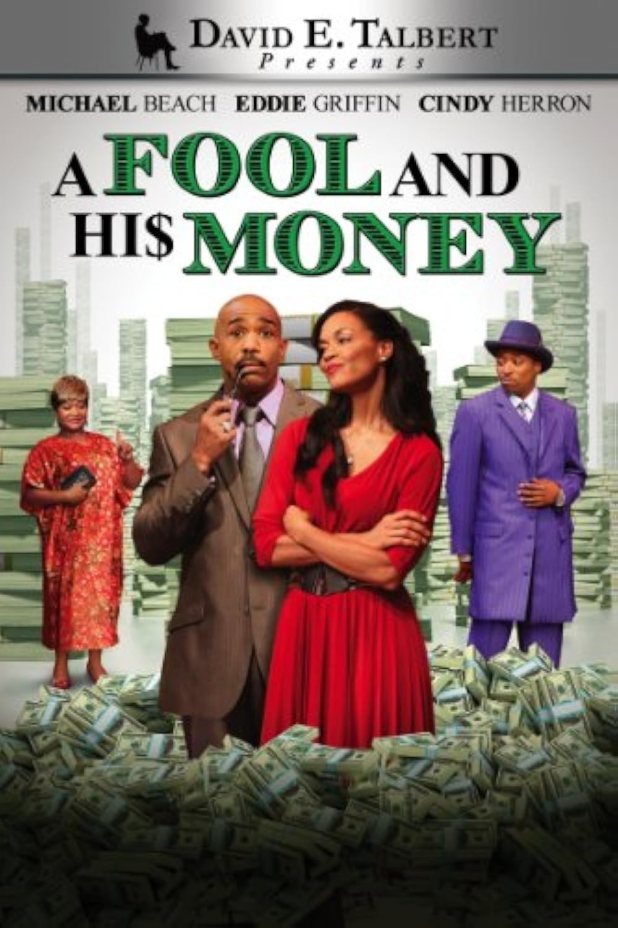
Sizzlin’ Summer of Side-Splitters 2025: A Fool and His Money (2012)

July 21-27 Eddie Griffin Week: This motherfucker is funny!

When I was a little kid, I would often see ads late at night for touring black plays that were coming to churches and community centers, usually starring my favorite actors from Good Times or What’s Happening? I would ask my parents if we could go, and I didn’t understand that this was an experience maybe not for a 7-year-old white kid from the sticks. I still wish I had gon, and this movie proves I would have loved it.

Directed and written by David E. Talbert, this has a logline that made me tune in: “When the blue-collar Jordan family wins a radio contest for a million dollars, they quickly begin to realize that more money means more problems. It seems everybody wants a piece of their new fortune, including a long-lost uncle played masterfully by comedian Eddie Griffin.”

Then again, this IMDB reviewer did not enjoy this: “The story moved extremely slowly. The jokes were mediocre, and the storyline was just so-so. Even so, I will continue to support black playwrights, artists & businesses.”

At least they’re supportive!

There was also a 10/10 review that stated, “If you have an hour and forty minutes to waste, this is OK”, and another 9/10 review that claimed, “For reviews of theatrical singing only.”

Not high praise.

Anyways, the Jordan family is struggling. The factory has closed, leaving the father jobless. His wife is ready to leave him, the son is trying to help out by becoming a gangster, and the daughter is dating the gangster, only for her soldier ex-boyfriend to come home. Only grandma is happy, because all she does is go to church and sing her songs. As for Uncle Eddie (Eddie Griffin), he was once in trouble but seems to have turned his life around, even if no one believes it.

Money changes everything, as they say, but as they also say, more money, more problems. As you can imagine, everything works out fine in the end. It feels like the play where you kind of had to be there, and the movie really isn’t. I worry that people might think I’m enjoying this inauthentically. Still, as a long-time lover of shows like Soul Train and Showtime at the Apollo , which aired during the mid-afternoon on weekends and at night, I would be, with all my heart, singing along and laughing.

You can watch this on Tubi.

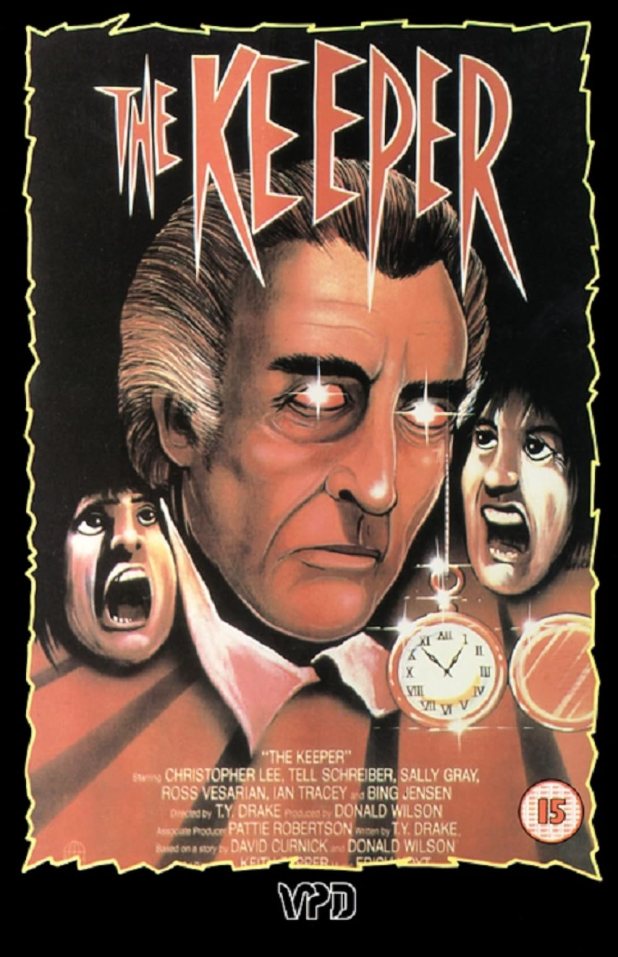
CBS LATE MOVIE: The Keeper (1976)

EDITOR’S NOTE: The Keeper was on the CBS Late Movie on December 19, 1985.

Christopher Lee is The Keeper, the crippled administrator of a secluded and exclusive mental hospital known as Underwood Asylum. It’s where the richest and most well-known families in British Columbia send their mentally disturbed relatives for care. Yet these families are killed off en masse, with their insane relatives suddenly becoming relatively well-off. Dick Driver (Tell Schreiber) is the detective — Triple D, as it were — who is out to find out what’s happening.

In a 1976 interview shared on Reeling Back, Lee had praise for this low-budget movie shot in Vancouver, saying, “I’ve never come across a story quite like this one. The character is extremely well-written. It has so many different sides to it that I said to my wife when I read it, “Here, this is good.” I gave it to her to read, and she said, “Yes, it’s perfect.” I said, “I’m going to do this. I’d like to do this very much.” The story itself appealed to me as a story. One of the major reasons, if not the major reason, I accept a role is because of what the story is and what the story is about.”

Three years later, he was asked of the film in this article: “It was a little movie. Drake directed it on a $135,000 budget, 60 percent of which came from the federal government’s Canadian Film Development Corporation. After Lee had returned to London, “I received a letter from British Equity, passing along a letter from Canadian Equity, advising me not to do the picture. ‘They were concerned because it was a completely non-union project.” The film, one that had appealed to Lee, “because it was an original idea, totally original,” has never been released. “An actor never goes into a picture with the knowledge that it’s going to be a disaster,” he said. “I always hope for the best, and work to do my best for the producers””

The Keeper sat unwatched for nearly a decade before being sold to TV, and in 1985, nine years after its release, it aired on the CBS Late Movie. It was released on VHS.

Directed and written by Canadian singer-songwriter, film director, and screenwriter T.Y. Drake (who would go on to write Terror Train), this film features the detective sending his assistant, Mae B. Jones (Sally Drake) is undercover at the sanitarium, where Lee is putting his patients through their worst fears because, well, he loves to watch that. Then, Dick commits himself to learning more. If you could explain to me what The Keeper’s plan is and how he’s supposed to make it all happen, I’d be so happy.

You can find this movie, but it’s as close to a lost one as there is these days. However, it’s by no means a discovery. It’s…something. I mean, I had fun with it, but as this site should prove to you, I have a distinct lack of taste.

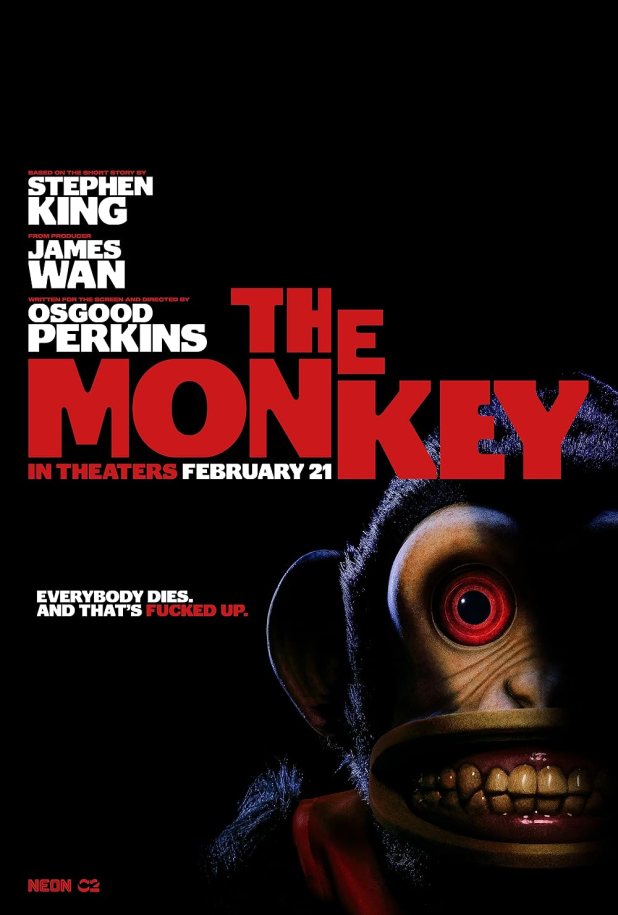
The Monkey (2025)

ABOUT THE AUTHOR: Exploitation-film historian A.C. Nicholas, who has a sketchy background and hails from parts unknown in Western Pennsylvania, was once a drive-in theater projectionist and disk jockey. In addition to being a writer, editor, podcaster, voice-over artist, and sometime actor and stand-up comedian, he’s a regular guest co-host on the streaming Drive-In Asylum Double Feature and has made multiple appearances on Making Tarantino: The Podcast. He also contributes to the Drive-In Asylum fanzine, the B & S About Movies Podcast, and the Horror and Sons website. His most recent essay, “Jay Ward, J-Men, Dynaman, and the Comedy Re-Dub,” will appear in the next issue of Drive-In Asylum.

I was thinking of giving The Monkey a two-word review: “Stupid fun.” But the more I thought about it, perhaps it deserved five words: “Very stupid, sort of fun.” Those lines are accurate, but you want and deserve more, don’t you? Hang with me, and I’ll elaborate.

I rarely enjoy new horror films because I find most of them to be inferior to those from the 1970s and 1980s. For every excellent film by one of my favorite directors of this generation—Robert Eggers, Peter Strickland, or Ben Wheatley—there are a dozen formulaic cash-grabs from filmmakers who don’t understand the genre. Back in the day, with the first cycle of movies based on Stephen King properties, you had three categories of adaptations: masterpieces like Carrie, The Shining, and Dead Zone; low-rent stuff like Thinner, Graveyard Shift, and The Mangler; and things, that, while not great, were either better than expected or at least fun, like Cujo, Christine, and The Night Flyer.

Which brings us to The Monkey, a recent addition to the killer-toy universe inhabited by Chucky and M3GAN, written and directed by Oz Perkins and based on a story from Stephen King’s Skeleton Crew collection. With his first three films—The Blackcoat’s Daughter, I Am the Pretty Thing That Lives in the House, and Gretel & Hansel—Perkins stood out on the playground. He was a talented filmmaker who understood horror (of course; it was in the DNA he got from his father, Anthony) and made idiosyncratic, personal films, which were arty without being pretentious and self-important (yeah, that’s your filmography, Ari Aster). But then he had a huge commercial success with Longlegs, a film that Sam Panico and I despise. A lot of folks, especially critics enamored with “elevated horror,” loved it, comparing it favorably to The Silence of the Lambs and calling it scary as hell. (OK, Nicolas Cage in a dressing gown and a putty nose was frightening … at first.) I, on the other hand, thought it was a mess. Despite having a distinctively cold look and feel, it seemed as though Perkins had simply written down a bunch of commercial ideas that he liked on 3×5 cards and shuffled them to create the screenplay. It was dispiriting watching a fine cast, in a well-made film, trying to inject something, anything into this lazy, borderline insulting, conglomeration of tropes. See Nic Cage chew scenery as a serial killer writing a crazy manifesto in code! But wait. There’s more! Maika Monroe’s a troubled FBI agent on his trail, and guess what? She’s psychic! Wow! Is that Alicia Witt playing an old woman in an old house with scary old dolls, who’s harboring an old secret? And look! There’s Blair Underwood—haven’t seen him in a while—collecting a paycheck in a nothing part. Maybe “dispiriting” is too kind. Longlegs made me angry.

With that background, I approached The Monkey with trepidation. Would this be a return to form for a filmmaker I once liked? I’m afraid the answer is “no.” Once again, Perkins, now a beloved horror icon, leans hard into his own worst traits. The King story about a mechanical monkey toy that can kill in Final Destination style when its key is turned is short and to the point. But, like most of King’s writing, it doesn’t lend itself well to a feature film. Perkins, aware of this, gives the lead character an evil twin and incorporates a non-linear structure with lots of flashbacks. Though the film runs a commendably short 98 minutes, for well over the first hour, my thought was Perkins had only about 20 minutes’ worth of material. And, as others have suggested, this material might have been better served as an episode of a streaming anthology series, like Creepshow or Guillermo del Toro’s Cabinet of Curiosities. Things do pick up with some plot, rather than just set pieces, in the last act, but it’s all yet another trope: sentimental Stephen King reconnected-family boilerplate.

As for the cast, for the second film in a row, Perkins wastes some talented folks who give nice performances. Christian Convery (Cocaine Bear) plays the twins as boys, with Theo James (Divergent and Underworld films) taking over when they become adults. Both are excellent, with James having fun doing a riff on Tim Hutton’s evil twin in George Romero’s flawed, but still very good, adaptation of King’s The Dark Half.

In addition, it was nice to see a movie role for the wonderfully natural Sarah Levy from Schitt’s Creek. Perkins himself plays her husband and proves that he’s not just a filmmaker, but also a competent actor. But both are cardboard cutouts, around only long enough to die gruesome deaths. More about those shortly. Adam Scott shows up in the funny cold opening, which promises a better film, but then he’s gone. And Elijah Wood has an unfunny cameo, which exists only to play to the horror fandom.

But the most egregiously wasted cast member is Tatiana Maslany. Since first seeing Ukrainian-Canadian Maslany playing multiple clones (and those clones impersonating each other) on BBC America’s Orphan Black, I’ve referred to her as the “Meryl Streep of Television.” She’s a phenomenal talent, one of the best actresses working today, who has yet to break out and become a mainstream success. Here, she’s perfect as the boys’ put-upon, bedraggled mother, smoking cigarettes, tossing off quips, lecturing them on the inevitability of death, and making the most of her few scenes before the inevitable.

And I’ve saved the inevitable, all the gory deaths, for last. They’re outside the hopscotch boundaries of a film released to thousands of theaters. I’ll hand it to Perkins, his sense of humor, almost nonexistent in his previous films, is sick. Really sick. I was startled, shook my head, and laughed at the ridiculous ways people die, including via a shotgun, a lawn mower, an errant air-conditioning unit, and stampeding horses. (And wait until you see the cheerleaders on the school bus.) Perkins, cinematographer Nico Aguilar, and editors Greg Ng and Graham Fortin get high-fives for replicating a Tex Avery cartoon. The nuttiness of the violence is the best thing about the film, but even that’s a mixed blessing. Unlike another recent horror film, Malignant, which starts out stupid before becoming stupid and ludicrous—and ultimately stupid and ludicrous but entertaining, The Monkey never finds its tonal footing. Perkins earns my respect for trying something different, but it’s well-nigh impossible to deliberately make a campy cult film. They happen accidentally.

To wind up (feel free to groan out loud), The Monkey’s not great, but at least it’s not dire, like Longlegs. I enjoyed the cast, appreciated the craftsmanship, and chuckled at the set pieces. But that’s about it. I’ll lump it into my category of King adaptations, that, while not dreadful, aren’t anything to lose your feces over, though lots of folks did over The Monkey. Hmmm… Maybe I shouldn’t have monkeyed around with all those keystrokes and instead settled upon a three-word review: “Barely passable junk.”