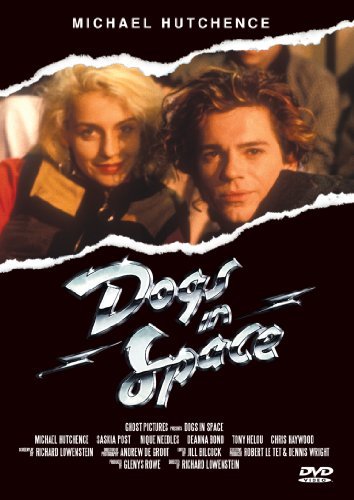
MOVIES THAT PLAYED SCALA: Dogs In Space (1986)

Thanks to the British Film Institute, there’s a list of films that played Scala. To celebrate the release of Severin’s new documentary, I’ll share a few of these movies every day. You can see the whole list on Letterboxd.

Directed and written by Richard Lowenstein, this is the story of the band Dogs In Space, who are part of the Melbourne’s “Little Band” post-punk music scene in 1978. Two of its members, Sam (Michael Hutchence) and Tim (Nique Needles), live in a group home with Anna (Saskia Post), Luchio (Tony Helou) and The Girl (Deanna Bond).

The script — it’s episodic and rambling, basically about live music, partying and screwing around — was based on Lowenstein’s personal experiences of living in a similar house. He’d directed videos for INXS and wrote Sam’s role for Hutchence. That role is based on Sam Sejavka from the band The Ears, who lived with Lowenstein. He didn’t agree with a lot of this movie, saying “Even though it’s an interesting time that should be documented, I find it hard to believe Richard could do this to his friends. It’s just Richard’s version of what happened. It’s not the correct version.”

Tim is the stand-in for Lowenstein and as for Sejavka, he is in this in a party scene, playing someone named Michael, which is some nice inversion.

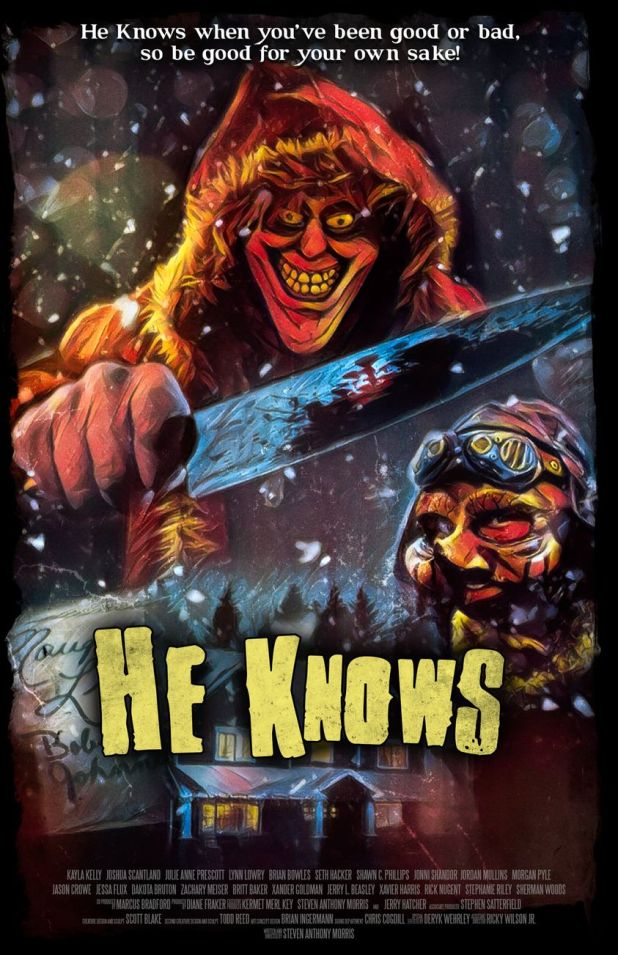
25 DAYS OF CHRISTMAS CHALLENGE: He Knows (2022)

In this movie, directed and written by Steven Morris, a small Midwestern town is filled with depression and drug dependency after a serial killer named Sammy the Elf killed several people over the holidays ten years ago. Today, Christina (Kayla Kelly) is finally coming back to the place of her childhood trauma. She finds a place where all of her old friends are parents and a whole new series of killings.

This has Lynn Lowry in it, which is always a plus in my book, as well as Jessa Flux, who was Carmilla Karnstein in Debbie Does Demons. It has some fun kills in it, but loses energy after the tense opening and the fun animated credits. That said, for the budget that it has, it’s not the worst holiday horror movie that I’ve seen, even if Shawn C. Phillips is in it. Ah, that’s mean and it’s Christmas.

Again, as always, never go back home to the place where your past traumas were. And double down on that over the holidays.

You can watch this on Tubi.

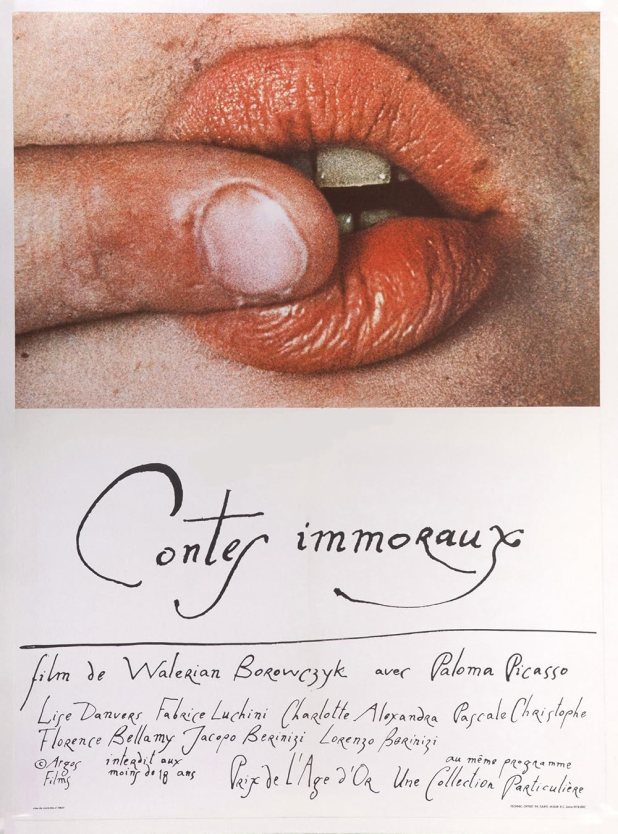
MOVIES THAT PLAYED SCALA: Immoral Tales (1973)

Thanks to the British Film Institute, there’s a list of films that played Scala. To celebrate the release of Severin’s new documentary, I’ll share a few of these movies every day. You can see the whole list on Letterboxd.

Directed and written by Walerian Borowczyk, Immoral Tales is four stories that each have a different tale of lovemaking, starting with “The Tide,” the story of André (Fabrice Luchini) getting head from his 16-year-old cousin (Lise Danvers) in concert with the waves of the ocean. This is taken from a story by surrealist writer André Pieyre de Mandiargues.

It’s followed by “Thérése the Philosopher,” an adaptation of the 1748 novel of the same name that was written by either Jean-Baptiste de Boyer or Marquis d’Argens. Thérése (Charlotte Alexandra) becomes locked out of her room, freeing her to mix her love of Christ with need for sex. There’s an incredibly sacrilegious moment filmed in actual church, which had the director exclaim “Thérèse was played by an English actress. She was only seventeen years old, I remember, and very shy. We had to film her nude scenes in complete seclusion, only my assistant and I were allowed to be there, and he was only twelve! We got permission to film in a real church, a very beautiful and quite famous one, an historical monument. There were no difficulties with the priest; I was very surprised. The man was very tolerant indeed, in spite of all this pipe organ business ! The film was even shown in the church cinema of the village, if you can imagine that!”

The third tale is probably the most famous, as it concerns Elizabeth Báthory (Paloma Picasso) bathing herself in the blood of the young virgins of her kingdom. Picasso is really bathing in 30 gallons of pig blood in this part of the movie. Borowczyk was inspired by surrealist poet Valentine Penrose and the way she related the legend of Bathory.

Finally, Pope Alexander VI’s daughter  Lucrezia Borgia (Florence Bellamy) indulges her passions with her male relatives. There was a fifth story, which ended up being the film La Bête. When Arrow released this on blu ray, they added that film into this one as the third chapter.

Despite being a movie all about sex, this is a gorgeous act of cinema, filled with lush imagery and gorgeous camerawork. There was a time when non-hardcore movies could be made as art and this is a prime example, a film that was second place in the French box office behind another example of softcore, Emmanuelle.

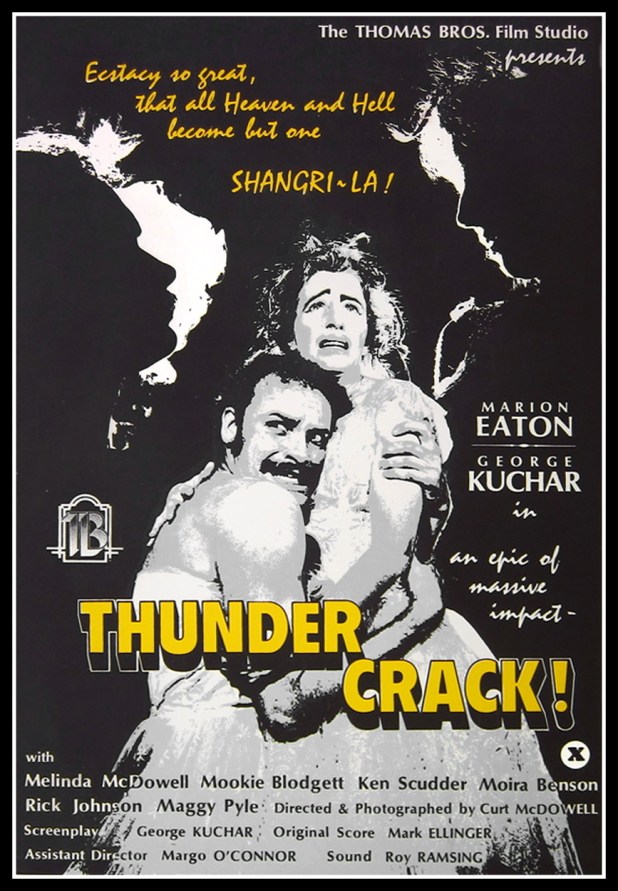
MOVIES THAT PLAYED SCALA: Thundercrack! (1971)

Thanks to the British Film Institute, there’s a list of films that played Scala. To celebrate the release of Severin’s new documentary, I’ll share a few of these movies every day. You can see the whole list on Letterboxd.

In the documentary Scala!!! Or, the Incredibly Strange Rise and Fall of the World’s Wildest Cinema and How It Influenced a Mixed-up Generation of Weirdos and Misfits, it’s said that Thundercrack! played so often, up until the print that the London theater would show fell apart. They had one of only five prints that were made for this movie.

It was directed, shot and edited by Curt McDowell, the lover and student of George Kuchar — the writer of this movie — who described his work as the “prolific regurgitations of an enfant terrible.”

It’s an old dark house in the middle of a thunderstorm. We’ve seen it before, but we’ve never seen a place like Prairie Blossom. Willene Cassidy (Maggie Pyle) shows up in the middle of the night, paying a visit to the drunken Mrs. Gert Hammond (Marion Eaton), who pukes before we even get to know her. Taking pity on the woman, Willene — the wife of country star Simon Cassidy — gives her a bath and masturbates her. If this offends you, it’s best you stop watching this right now.

There’s more than one person seeking to get out of the rain. Chandler (Mookie Blodgett) is the widower of Sarah Lou Phillips, owner of the largest girdle factory in the United States. His wife has recently died as the result of a girdle fire at a cocktail party, falling into a swimming pool with her head on fire. Since then, he’s only slept with men, as women in girdles — nearly every woman in the world owns a House of Phillips brand girdle — he’d lose his erection as he remembers his wife ablaze. Luckily, Sash (Melinda McDowell) has no such underwear and is able to get him off.

Where is Mr. Hammond? He was turned into dust by a storm of locusts. Where is his son? He no longer exists.

When he did, he was a collector of sex toys, which are all over the large house, enabling all manner of sexual acts — real ones, mind you — such as Toydy (Rick Johnson) getting head from Roo (Moira Benson) to get the key to a locked room, but unable to perform until he watches Bond (Ken Scudder) and Willene get it on. Vegetables are also involved. And finally, there’s Bing (George Kuchar), who comes from the circus, a place where he accidentally made love to gorilla named Medusa who hates everyone. She’s in the car waiting for him. And oh yes, there’s a secret in the Prairie Blossom.

Buck Henry was a judge at Filmex, the Los Angeles Film Festival, and selected this as the first X-rated film allowed at that fest. Tons of people walked out. What’s strange is that McDowell was so broke when this came out that he worked as a janitor at The Roxie in San Francisco, where this played almost every Friday at 8 p.m. He married one of the owners, Robert Evans, who took control of his films after McDowell’s death.

How did this get made? Producers John and Charles Thomas were students of Kuchar and heirs to the Burger Chef empire. Two of the rooms of their house were used as the set.

At three hours and with a ten minute intermission, I was worried about this one, yet it won me over. There are numerous scenes that made me laugh at loud and almost every character gets a long and emotionally rich monologue, as well as a chance to get off. It feels like every fifty years or more after this was made that there’s something in it that will offend nearly everyone. I first read about it in my teenage years and it was so hard to find that it took me decades to finally see it. It’s a pleasure to let you know that it was well worth the wait.

A lot of the cast also shows up in Dan Caldwell’s Sip the Wine, another adult film that is about the world of making dirty movies in San Francisco. It may be IMDBS, but it’s said that Marta Kauffman and David Crane named Chandler Bing on Friends after two characters’ names in this.
MOVIES THAT PLAYED SCALA: Pink Flamingos (1972)

Thanks to the British Film Institute, there’s a list of films that played Scala. To celebrate the release of Severin’s new documentary, I’ll share a few of these movies every day. You can see the whole list on Letterboxd.

As late as 1997, when it was re-rated NC-17 “for a wide range of perversions in explicit detail,” Pink Flamingos keeps on offending people in the best of ways.

A movie that has the dedication “For Sadie, Katie, and Les- February 1972” — Manson Family members Susan Atkins, Patricia Krenwinkel and Leslie Van Houten discovered in February 1972 that the death penalty was abolished in California, reducing their sentences — director and writer John Waters and star Divine announced themselves to the world here, despite already making the movies Hag in a Black Leather JacketRoman CandlesEat Your Makeup, Dorothy, The Kansas City Pot HeadMondo Trasho, The Diane Linkletter Story and Multiple Maniacs, films that didn’t escape Baltimore and small screenings.

The filthiest person alive Babs Johnson (Divine) lives with her mother Edie (Edith Massey), son Crackers (Danny Mills) and traveling companion Cotton (Mary Vivian Pearce) in a trailer with pink flamingos in the front yard. Her title is challenged by Connie (Mink Stole) and Raymond Marble (David Lochary) who come to regret ever invoking her wrath, costing them their baby stealing empire and eventually their lives.

Banned in Switzerland and Australia, as well as in some provinces in Canada and Norway as well as Hicksville in Long Island, this movie is less about the plot and more about the urge to shock you. It’s Waters using filth in the same way that his hero William Castle used gimmicks to bring you into the theater. If Joan Crawford was the ultimate gimmick for Castle, Divine served the same role for Waters. She even ate dog feces for the movie (followed by her calling a hospital emergency hotline pretending to be a mother whose son ate the same thing to make sure she would survive). And yet somehow, it’s all rather heartwarming, even if it’s a movie punctuated by Divine’s rants that include incendiary words like “Kill everyone now! Condone first degree murder! Advocate cannibalism! Eat shit! Filth is my politics! Filth is my life!”

Pink Flamingos is as old as me but retains its wild edge when everything else feels dulled down. I often think of it when I am down and am amazed that it exists, a movie that is endlessly watchable and quotable. I’ve resisted writing about it for so long because what else can I add to it? But I feel that I must celebrate it and why it keeps on meaning so much, a movie that I watched people walk out on 25 years after it was made, angry that the movie was just so wrong.

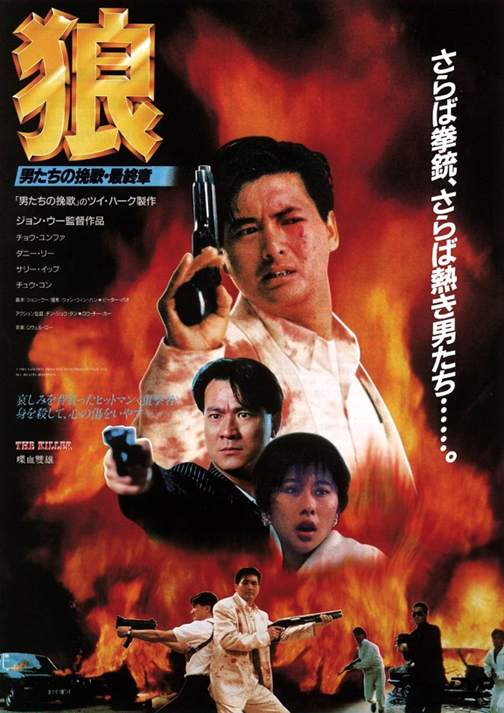
MOVIES THAT PLAYED SCALA: The Killer (1989)

Thanks to the British Film Institute, there’s a list of films that played Scala. To celebrate the release of Severin’s new documentary, I’ll share a few of these movies every day. You can see the whole list on Letterboxd.

I can honestly say that this movie changed my life and the way that I experience film. I found it at Something Weird Video, a Pittsburgh store that had many movies that did the same for many people. My brother and I must have watched this every night for months, obsessing over the gunplay and the honor-bound Ah Jong (Chow Yun-Fat), who must do one last kill to save the sight of a woman he blinded, Jennie (Sally Yeh). It was unlike anything we’d ever seen, nearly an Italian Western in Hong Kong, a place where cops like Detective Li Ying (Danny Lee) can discover that he has as much in common with a criminal than his fellow police officers.

In The Killer, man’s laws don’t matter. What does is the brotherhood that can be built between two men. What matters is the fact that you are responsible for your mistakes, that a child’s life is worth nearly being killed or arrested, that you can show people mercy even after they’ve tried to have you murdered. Movies would change after this, as Hong Kong started making more ballet-like gun violence films, a style that made its way here before director John Woo followed, starting with the JCVD movie Hard Target before making blockbusters like Mission: Impossible 2.

The first time I saw a church filled with broken plaster and bullet casings and doves flying all around, I had one of those moments where I knew that I would never have this experience again. It was like trying a drug for the first time, the rush of a first kiss, holding someone’s hand. My heart started to race and I knew that I had to keep chasing this feeling.

Producer Tsui Hark was extremely unhappy with this film and planned on recutting it, making Li Ying the hero instead of Ah Jong. The schedule to make this was tight and Woo and editor David Wu never were going to make these cuts. Hark didn’t have time and it was such a big success that it enraged Hark, who is said to have starting tossing things out of his office window when he found out.

Woo had a higher aim than most Hong Kong action movies, which are often content to rip off American movies. This was dedicated to Martin Scorsese and inspired by Mean Streets. There’s also a lot of Leone and the movie Le Samouraï in The Killer.

Yet when this first played in the U.S., it was badly subtitled and sold as an action comedy.

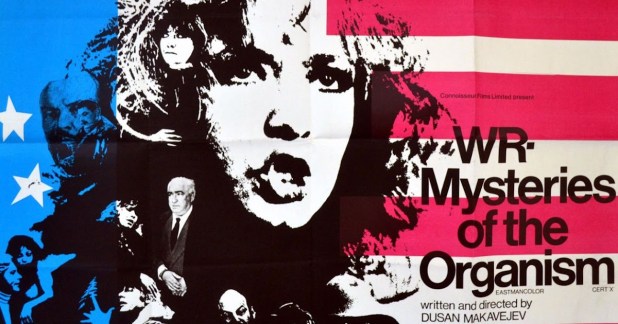
MOVIES THAT PLAYED SCALA: WR: Mysteries of the Organism (1971)

Thanks to the British Film Institute, there’s a list of films that played Scala. To celebrate the release of Severin’s new documentary, I’ll share a few of these movies every day. You can see the whole list on Letterboxd.

Wilhelm Reich was one of the second generation of psychoanalysts after Sigmund Freud. His concept of  muscular armour is part of body psychotherapy, Gestalt therapy, bioenergetic analysis and primal therapy; he came up with the phrase “the sexual revolution.” He also created Faraday cages that built up orgone energy, the energy of life and orgasms, that he claimed could cure cancer. The U.S. food and Drug Administration made them illegal and later burned six tons of his books, sending him to jail where he would die within a year. Freud said of his work, “We have here a Dr. Reich, a worthy but impetuous young man, passionately devoted to his hobby-horse, who now salutes in the genital orgasm the antidote to every neurosis.”

Reich also built cloudbusters that he said could make it rain and chased UFOs. Soon before he was to be released from jail, he died. He left instructions that there was to be no religious funeral, but that a record should be played of Schubert’s “Ave Maria” sung by Marian Anderson. His granite headstone reads “Wilhelm Reich, Born March 24, 1897, Died …”

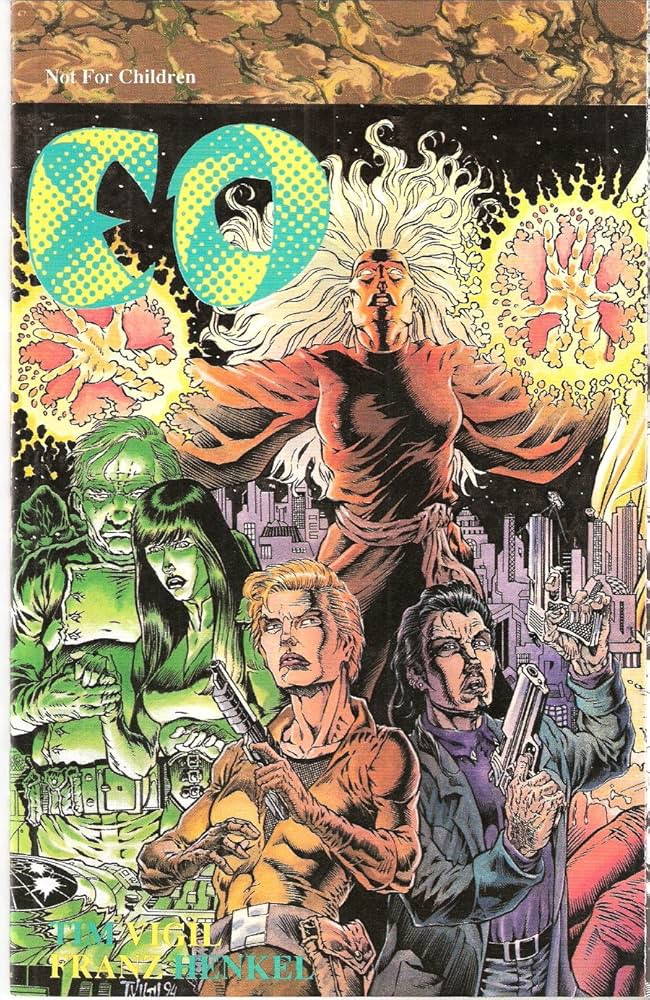
I discovered him by way of the Tim Vigil comic book EO.

W.R.: Mysteries of the Organism, directed by Dušan Makavejev (Sweet Movie) was banned in Yugoslavia for sixteen years and when Makavejev spoke up about it, he was indicted on charges of derision toward the state, its agencies and representatives.

This feels like a cut and paste technique film. Documentary footage and clips from The Vow share the screen with Tuli Kupferberg of the band The Fugs singing “Kill for Peace” and “I’m Gonna Kill Myself Over Your Dead Body,” Betty Dodson drawing people masturbating, the Plaster Casters casting Jim Buckley of Screw magazine, scream therapy and a story where Milena (Milena Dravić) turns down the sexual advances of the worker class to obsess over Vladimir Ilyich (Ivica Vidović), an ice skater who is s symbol of Western corruption. After they finally make love, he beheads her.

Meanwhile, the scientists of 1971 are continuing the work of Reich.

Makavejev rails against Communism, American psychiatry, the buttoned up lack of sexuality in the world and anything that’s offensive, he finds it and shows it. Sweet Movie would take this even further. This is more than a half century old and still feels like a firebomb being set off in public.

25 DAYS OF CHRISTMAS CHALLENGE: Werewolf Santa (2023)

Directed and written by Airell Anthony Hayles, this has a great idea. Santa gets bitten by a werewolf and becomes one during the full moon. This is kind of astounding, because a full moon happens on Christmas only once every 18 years and hasn’t happened since 2018.

Monster hunter influencer Lucy (Katherine Rodden), her cameraman Dustin (Charle Preston), conspiracy expert Rupert (Cian Lorcan) and her parents Carol (Emily Booth) and Charlie (Mark Arnold) end up facing off against Werewolf Santa and stopping him before he makes it to the church during midnight mass.

Somehow, this movie was able to get Joe Bob Briggs to read The Night Before Christmas and I wonder if it was done on Cameo. This has no budget to speak of and scene transitions that look really bad, but at least there are a few laughs and, you know, that title is really good.

You can watch this on Tubi.

MOVIES THAT PLAYED SCALA: Female Trouble (1974)

Thanks to the British Film Institute, there’s a list of films that played Scala. To celebrate the release of Severin’s new documentary, I’ll share a few of these movies every day. You can see the whole list on Letterboxd.

Dedicated to Charles “Tex” Watson, this movie proves that if you thought John Waters was a fluke after Pink Flamingos — not that he hadn’t been already making movies for years — he would return with a movie perhaps even more vicious, strange, upsetting to some and hilarious to others.

Dawn Davenport (Divine) flips out on Christmas when she doesn’t get the cha-cha heels she’s been hinted at for months. She meets a man named Earl (also Divine), who drags her to the city dump and quickly fertilizes her egg on a garbage strewn mattress. She gives birth to Taffy (Mink Stole), a daughter she never wanted, one she often beats into oblivion when she isn’t working as an exotic dancer or committing crimes with her friends Concetta (Cookie Mueller) and Chicklette (Susan Welch).

At the Lipstick Beauty Salon, Dawn meets and marries Gater Nelson (Michael Potter). His Aunt Ida (Edith Massey) wants him to be gay and is upset that he’s now married to Dawn. Meanwhile, the salon’s owners, Donald (David Lochary) and Donna Dasher (Mary Vivian Pearce) have convinced her to become their artistic experiment. Crime and beauty are the same, they say, so they get her to not only keep being a criminal, but to take photos of her crimes.

Dawn and Gater break up, enraging Ida, who throws acid in Dawn’s face. The Dashers convince her to not get surgery and instead to inject makeup like heroin. They also kidnap Ida and place her in a big bird cage, allowing Dawn to chop off her hand. Meanwhile, her daughter tracks down her real father and ends up killing him, causing her to convert to being a Hare Krishna, which enrages Dawn so much that she strangles her just before going on stage to jump on a trampoline and fire a gun into the audience. That’s really Divine jumping like that, which found her training at the YMCA to get it perfect.

All the fame has gone to her head and the rich Dashers quickly sell her out. She’s electrocuted, but not before giving this speech: “I’d like to thank all the wonderful people that made this great moment in my life come true. Ha ha ha ha ha! My daughter Taffy, who died in order to further my career. My friends Chicklette and Concetta, who should be here with me today. All the fans who died so fashionably and gallantly at my nightclub act. And especially all those wonderful people who were kind enough to read about me in the newspapers and watch me on the television news shows. Without all of you, my career could never have gotten this far. It was you that I burn for, and it is you that I will die for. Please remember, I love every fucking one of you.”

This pales in comparison to my favorite speech in the movie, as Dawn screams on stage ” You’re looking at crime personified and don’t you forget it! I framed Leslie Bacon! I called the heroin hot line on Abby Hoffman! I bought the gun that Bremmer used to shoot Wallace! I had an affair with Juan Corona! I blew Richard Speck! And I’m so fuckin’ beautiful I can’t stand it myself!”

Originally called Rotten Mind, Rotten Face, this got its name from when Waters and Stole visited Mueller in the hospital. Asking what was wrong — she had pelvic inflammatory disease — she answered, “Just a little female trouble, hon.”

Red Reed said, “Where do these people come from? Where do they go when the sun goes down? Isn’t there a law or something?”

Always and forever, fuck Rex Reed. That line ended up on the poster and the DVD box.

MOVIES THAT PLAYED SCALA: Variety (1983)

Directed by Bette Gordon and written by Kathy Acker, Variety is the story of Christine (Sandy McLeod), a woman in the city looking for work and ending up in the ticket booth of the Variety, a job that her boyfriend Mark (Will Patton) hates. None of the men that she encounters turn her on, even though a co-worker named Jose (Luis Guzmán) tries. Then she meets Louie (Richard M. Davidson), an older wealthy man who takes her to a baseball game before disappearing. She becomes obsessed with him and her sexuality is awakened by this man and a series of prank phone calls (Spalding Gray is the voice).

According to Downtown Express, “The film is a sort of Who’s Who of downtown street cred: music by John Lurie, cinematography by frequent Jarmusch collaborator Tom de Cillo, script by former sex worker and Pushcart Prize-winning feminist novelist Kathy Acker, and roles played by Spalding Gray, Luis Guzmán, Mark Boone Junior and photographer Nan Goldin, who also took production stills.” Despite that, the theater isn’t really in Times Square. It’s the Variety Photoplays, which was located on Third Avenue between 13th and 14th Streets in the East Village, the same theater as Taxi Driver where Jodie Foster jumps into the cab to escape her pimp.

As a feminist filmmaker, Gordon got criticism and praise for making a film about pornography. Yet I loved Christine’s character, someone fascinated and also upset by the sex that she spends so much of her time around, but it’s not real sex, it’s created for the male gaze. However, it inspires her, even as she reads her sexually frank writing to a boyfriend who doesn’t seem to care, is surrounded by men who just see her as the law of the invisible sex object and the strange man who keeps ghosting her. This movie has stuck with me since I watched it and I wonder, did Louie come back to meet her in that alley?