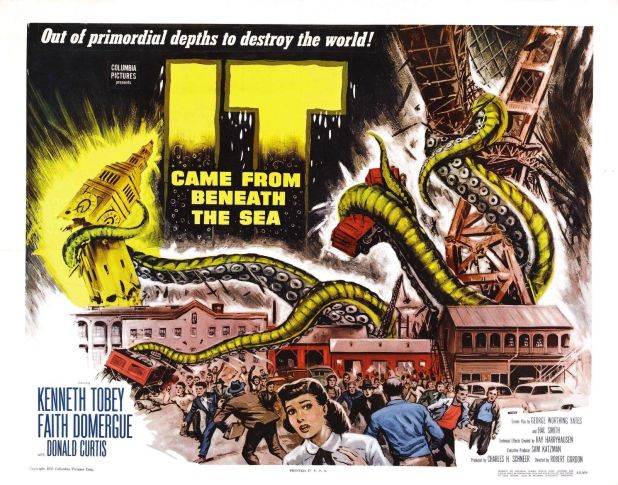
Directed by Robert Gordon and written by Hal Smith and George Worthing Yates, the real star of this movie is the stop motion animation special effects of Ray Harryhausen. It gave me a childhood fear of octopuses as this movie is all about radiation making one of them gigantic and attacking San Francisco after nuclear testing decimates its prey in the Mindanao Deep.
This movie had such a low budget that it led to some innovation, as scenes were shot with handheld cameras inside a real submarine and the beach scenes are all a Columbia soundstage covered with sand and a rear projected ocean. To keep things on schedule, Sam Katzman tore an entire love scene from the script. And money was so tight that Harryhausen only made six tentacles for the monster. You never see all eight.
There was one major issue: the filmmakers weren’t given permission to shoot on the Golden Gate Bridge because the city didn’t want people to think the bridge could sink. So producer Charles H. Schneer put a camera crew in the back of a bakery truck and kept driving it back and forth over the San Francisco landmark.
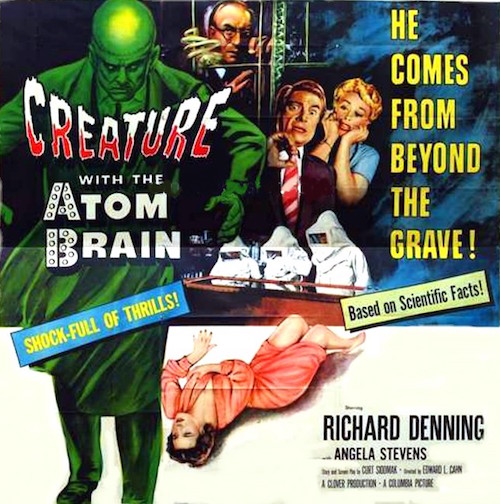
Director Edward L. Cahn started by directing Our Gang shorts but made some of the most important science fiction movies of the 50s, including Invasion of the Saucer Men and It! The Terror from Beyond Space. It was written by Curt Siodmak (The Wolf Man, Frankenstein Meets the Wolf Man, I Walked With a Zombie and Donovan’s Brain.
Gangster Frank Buchanan (Michael Granger) has taken advantage of Operation Paperclip by getting Nazi scientist Wilhelm Steigg (Gregory Gaye) in his employ and using the man to bring back people from the dead with atomic radiation so that they can kill for him. They leave behind atomic fingerprints and how amazing is that?
Made by Sam Katzman’s Clover Productions for Columbia, this was one of the first movies to use squibs. Cahn would make pretty much the same movie all over again as Invisible Invaders.
This movie is memorable to me because it’s the inspiration for the Roky Erickson song of the same name:
Creature with the atom brain Creature with the atom brain Why is he acting so strange Do you think he’s one of them?
Threw the doll right down Ripped it’s guts off And threw it on the ground Creature with the atom brain
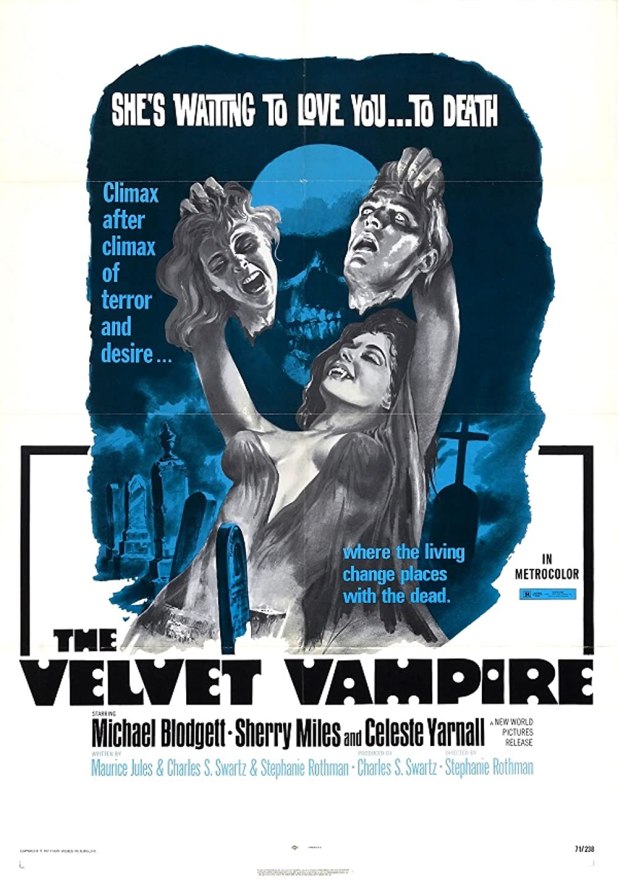
Carmilla was first filmed all the way back in 1932 as Vampyr and that story — beyond inspiring so many of the films in the last paragraph — informs The Velvet Vampire. Never think that Carmilla was inspired by Bram Stoker’s better known novel; it predates Dracula by 26 years.
Director Stephanie Rothman was seeking a movie to make after The Student Nurses and the first thought was The Student Teachers, which she wrote with her husband Charles Swartz. Then producer Larry Woolner wanted to make a movie a lot like Daughters of Darkness and Rothman and Swartz wrote this modern day tale of a female vampire.
The vampire at the center of this movie, Diane Le Fanu, is played by Celeste Yarnall, who was in Henry Alan Towers and Jess Franco’s Eve and Beast of Blood; before retiring from acting to be successful in real estate, writing books on holistic pet care, teaching nutrition and breeding of Tonkinese cats, she had Elvis sing “A Little Less Conversation” to her in Live a Little, Love A Little and acted opposite David Soul in the Star Trek episode “The Apple.” Before this film, she turned down rules that had nudity. But when she got divorced and had a young daughter, she decided to do this movie to pay her mortgage.
She told Alex Ander On Film, “I had just had my daughter on July 4th 1970 and was still breastfeeding when I did the movie, so I brought my daughter with me and everyone was very accommodating, just a joy to work with. It was my first experience having a female director and it was remarkable especially concerning the sexual scenes. Stephanie was very sensitive. She closed the set during the more explicit shots, and there was often just Michael and I and the cameraman. We had a skeletal crew that made sure everything was in place. And then of course, the robes came off…”
Her role is named after author Sheridan Le Fanu, the author of Carmilla — Carl Stoker (Gene Shane), the author fanged character in this movie, gets his name from the Dracula author — and she lives in the desert, luring people into her embrace while never leaving behind the preserved corpse of her husband.
She’s invited Lee Ritter (Michael Blodgett, Beyond the Valley of the Dolls) and his wife Susan (Sherry Miles, The Pack) into the desert, where she rides around in her dune buggy and eventually seduces them both. But Lee’s just a means to an end; Susan is who she really needs. But is she a vampire? Sure, she sucks the venom — and blood — of Susan, but she mainly just eats bloody pieces of chicken livers, has a reflection and walks by day. Yet place a crucifix in her way…
There are moments — like the dream sequence where the young couple makes love in the midst of the sand dunes as Diane emerges through a window to attack them — that feels like the sunbaked California remix of Jean Rollin’s artistic blooddrinkers. It’s also the exact opposite of the kind of film that you’d think it was, an exploitative lesbian sex and blood movie. It has all those things. It just feels classier than it should.
That may be why Dave Kehr of the Chicago Reader said, “Given the genre (horror) and the budget (extremely low), it may seem perverse to say that Stephanie Rothman’s 1971 film is among the best women’s films ever made, but so it is.”
When she appeared at a screening of this film at the UCLA Center for the Study of Women in 2008, she told Ben Sher, “The freedom that existed was the freedom to take what were the genre expectations and do unexpected things with them. Do things that would make them seem relevant to a wider audience than the usual fans of exploitation films. So we included political opinions and we tried to make the stories have more psychological depth. We tried, given the restrictions of the genre, to address some ideas that were ignored by Hollywood and by most other films made at that time. As long as we met the sub-distributors expectations, they didn’t mind if we exceeded them in other ways. In fact, they were happy if we did things that were controversial, because that would give them publicity in the papers. That’s not why we did them, but that was certainly why they accepted these things. As long as the theater wasn’t burned down, it was all right if we exceeded the conventional expectations for this kind of film.”
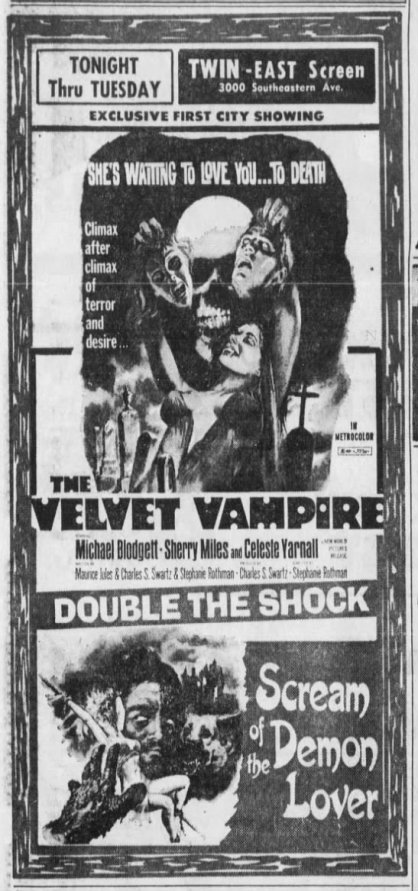
The Velvet Vampire played with Scream of the Demon Lover, which is exactly the kind of sex and horror you expect, not that that’s a bad thing. Rothman never really got the respect she deserved by Hollywood when she was working within it. Indeed, in that earlier referenced interview she claims that MGM brought her in for an interview to discuss this movie when they were making The Hunger with Tony Scott and wanted it to feel like her movie. She replied to them, “Well, if you want a film like The Velvet Vampire, why don’t you get Stephanie Rothman to make it?”
I’ve seen this movie described as stylish trash. While that sounds like the kind of movie I love, I continue to rail against the idea of so bad it’s good and guilty pleasures. This film is gorgeous, steamy and looks and plays way better than it should given its budget and origins. We should celebrate it as a success, not place it into a ghetto of film so that we can feel better about having to celebrate a movie with more humble or commercial origins.
EDITOR’S NOTE: This was originally posted on July 27, 2018.
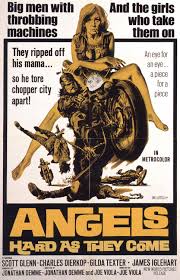
Jonathan Demme (Married to the Mob, Silence of the Lambs) impressed Roger Corman with his writing ability and was asked if he wanted to try a motorcycle movie. His idea? Rashomon on motorcycles. He turned to his friend Joe Viola, a commercial director, and created this film.
Long John (Scott Glenn, Silence of the Lambs), Juicer and Monk (James Inglehart, Randy Black from Beyond the Valley of the Dolls!) get caught up in a busted drug deal before meeting up with the Dragons gang and heading to a ghost town. There, they meet a hippie commune, where Long John falls for Astrid. They argue over the bikers being evil because of Altamont while he counters that hippies have been tainted by Manson.
The Dragons do, too. A fight ensues and Long John’s girl gets raped and stabbed, with the Dragons framing the Angels. Their leader, the General (Charles Dierkop, the gas station attendant in Messiah of Evil) sentences them to fun and games, which means they all get dragged behind motorcycles. Monk escapes and organizes the rest of the gang, leading to a violent battle to end all biker battles.
This movie is packed with long bike riding montages, sex, drugs, debauchery, mayhem and a young Gary Busey. It’s talky, though and if you’re not super into biker movies, this is probably not the one to start with.
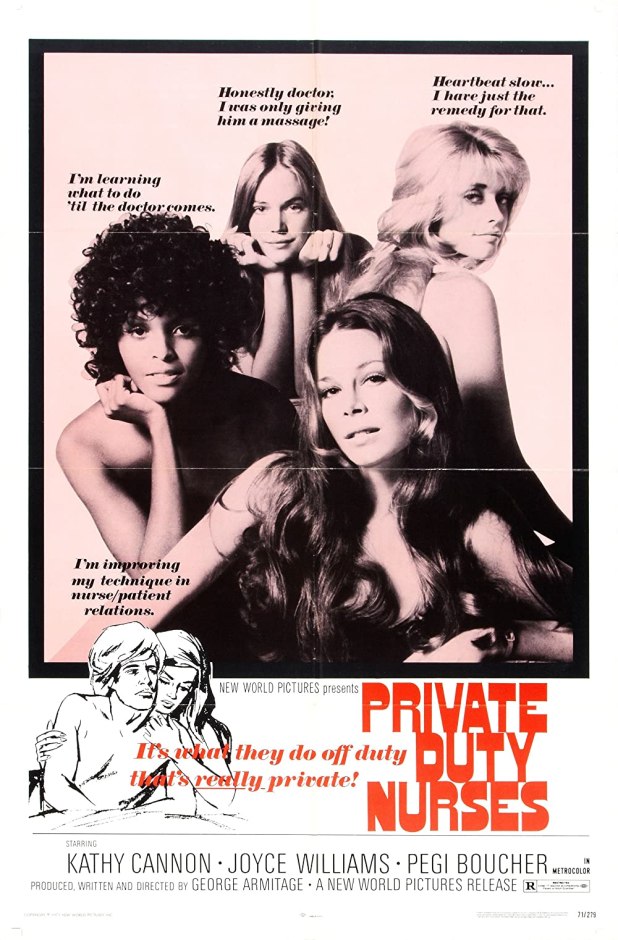
Roger Corman got the idea for this movie — a sequel of sorts to The Student Nurses— after being sent a letter of complaint about that movie from the Private Duty Nurses Association. It’s written and directed by George Armitage, who wrote Gas-s-s-s, Hot Rod, Vigilante Forceand Darktown Strutters. He’d go on to direct and write Grosse Point Blank.
It’s a really similar story to the first Corman nurses film as, you knew it, a group of nurses deal with the issues of the day. There’s Spring (Katherine Cannon, later Donna’s mom on Beverly Hills 90210) who falls for Vietnam vet and bike rider Domino (Dennis Redfield). Lynn (Pegi Boucher) has a water pollution storyline. And Lola (Joyce Williams) has to take a backseat to her black doctor boyfriend who is trying to change the status quo, but just for black men. Women will have to wait or so he states.
The social issues here feel tacked on, the women feel less interesting than the men they’re with — they often take a backseat to them and it feels wrong — and it just seems like we miss the deft touch that Stephanie Rothman brought to the first of New World’s female job movies. That said, the music is by a band called Sky and I kind of liked it; I’m amazed that Doug Fieger in that band was also in The Knack.
Armitage would go on to write the next film in this series, Night Call Nurses, which is a perfect exploitation title that suggests something illicit without ever saying it.
Arch Oboler was a key innovator of radio drama, as well as someone with a big personality and the ego to match. Starting his career with a spec script called The Futuristics and getting into trouble with his first show where he made fun of sponsor American Tobacco, this set the tone for Oboler’s writing career. But after three years of working on scripts he probably hated, Oboler’s script for Rich Kid was picked up by Rudy Vallée which led to a great job writing scripts for Don Ameche on The Chase and Sanborn Hour.
After Wyllis Cooper left the show Lights Out to work in Hollywood (he wrote Son of Frankenstein), the show was given to Oboler. Already a series known for its violence, the new writer upset listeners with his very first episode which ended with a young girl being buried alive and not rescued. Playing at midnight with no sponsor, Lights Out was still under the watchful eye of censors, yet Cooper worked in anti-fascist messages and created episodes like “Chicken Heart,” in which a chicken heart grows so large it destroys the planet. More controversy would follow when he wrote an Adam and Eve script for Ameche and Mae West where West was an Eve that wanted to lose her virginity and voluntarily leave the Garden of Eden. Between that story airing on The Chase and Sanborn Hour on a Sunday and West later trading suggestive back and forth bon mots with Edgar Bergen’s dummy Charlie McCarthy — she said, “Come on home with me, honey. I’ll let you play in my wood pile.” — West was barred from radio until 1950.
Meanwhile, Ameche, Bergen and Oboler got away with it. In fact, Oboler soon started his own NBC radio show Arch Oboler’s Plays. West, who once said “I believe in censorship. I made a fortune out of it,” went on to great success on stage, in Vegas and in the movies. She invested her money in real estate so well that she could pretty much do anything she wanted after this. For example, when one of her boyfriends, boxer William Jones, was denied entry to her Ravenswood apartment building because of a ban on African-Americans, West bought the whole building and changed the rules.
But I digress.
Oboler’s show went up against Jack Benny, but he was also able to adapt stories like Dalton Trumbo’s Johnny Got His Gun. The show ended up being successful and got Proctor and Gamble as a sponsor, coming back as Everyman’s Theatre. Oboloer hated that the sponsors had an ad in the middle of his show and was out of radio for a year before coming back for the World War II propaganda show Plays For Americans. He lost that show when he made a speech at the Radio Institute at Ohio State. Oboler believed that his show should instill hatred of the enemy in the listener, which some took as he was just as bad as the enemy.
After bringing back Lights Out and creating several other propaganda radio shows, there was only one place left for Oboler. Like Orson Welles before him, he went to Hollywood. Some of his better films include Strange Holiday and Bewtitched, as well as the 3D films he innovated like Bwana Devil and The Bubble. He also created the TV series Oboler’s Comedy Theatre, had plays made of his work, published several books and was still writing radio dramas for Mutual Radio Theater as late as 1980. His writing inspired — obviously — Rod Serling as well as Don Coscarelli, who has spoken of how much the Oboler movie The Twonky frightened him as a kid.
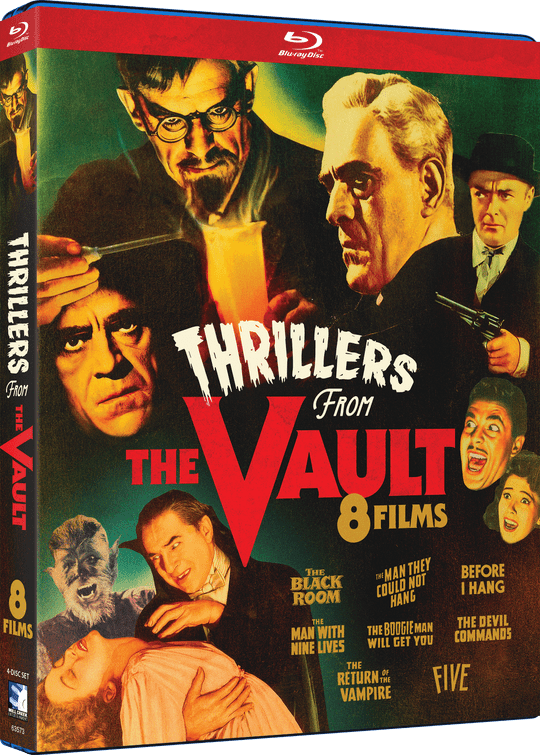
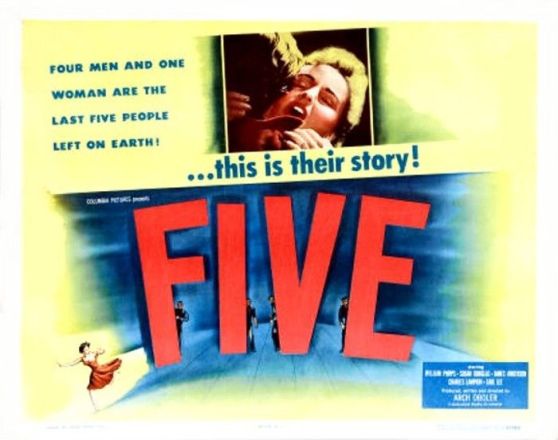
I told you all that to tell you about Five, a movie that stands out on the Mill Creek Thrillers from the Vault set because while everything else is comedic or harmless, Five is absolutely brutal.
The only survivors of a nuclear bomb are the Five: Roseanne Rogers (Susan Douglas Rubeš), Michael (William Phipps), Oliver P. Barnstaple (Earl Lee), Charles (Charles Lampkin) and Eric (James Anderson). Roseanne is pregnant, which is the only thing that stops Michael from assaulting her. Oliver is an old man who quickly dies after meeting the group. And Eric is a racist who can’t work with Charles, a black man.
Eric is the reason why so much goes wrong: he destroys the crops of the group, murders Charles and sneaks off Roseanne and her newly born son after she wonders if she can ever find her missing husband. By the end of the film, Eric has shown signs of radiation poisoning and runs off to die, while Roseanne makes the long walk back to Michael with her child dying on the way. All they can do is tend to the soil and make it one more day together.
One of the first movies to show what the atomic bomb would do, Five pulls no punches, killing people with no concern of age or race.
Speaking of race, having an African-American lead was a big idea in 1951. Obolor saw Lampkin read the James Weldon Johnson poem “The Creation” on a local Los Angeles TV show and it’s the speech that the actor reads in Five. It was possible the first time many in the U.S., Latin America and Europe would have heard African-American poetry.
Even the setting of Five is unique. It was shot in the Frank Lloyd Wright-designed Cliff House on the Eaglefeather ranch that Oboloer owned. It was not without tragedy in real life, as on April 7, 1958, Oboler’s six-year-old son Peter drowned in rainwater. During the 2018 Woolsey Fire, the Cliff House burned to the ground.
Made for just $75,000 — Oboler used recent graduates from the University of Southern California film school and unknown actors — this was sold to Columbia for a profit. This would not be the last end of the world movie; in fact, Planet of the Apes ends on the same beach where Eric washes ashore. It is, however, one of the most somber ones.
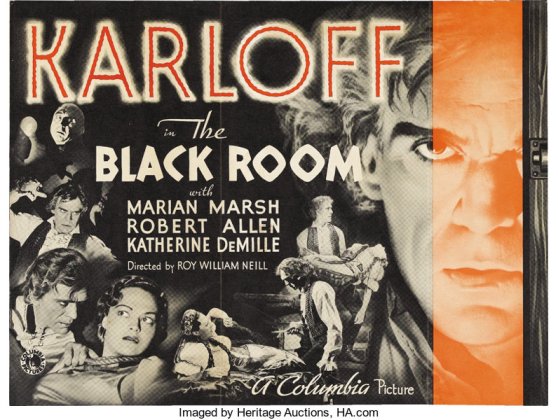
The BlackRoom: Twin brothers are born to a ruling family. One twin inherits a castle and becomes infamous for his sadistic behavior and murders the other twin, assuming his identity. This has a commentary track by Dr. Steve Hoberman.
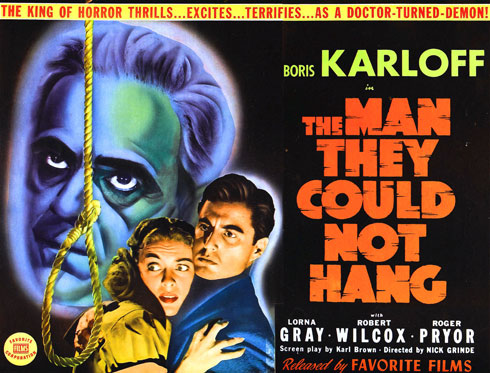
The Man They Could Not Hang: A doctor working on experiments to restore life to the dead is hanged for murder. Brought back to life by his assistant, he sets about murdering the jury that convicted him. Commentary track by C. Courtney Joyner and Heath Holland.
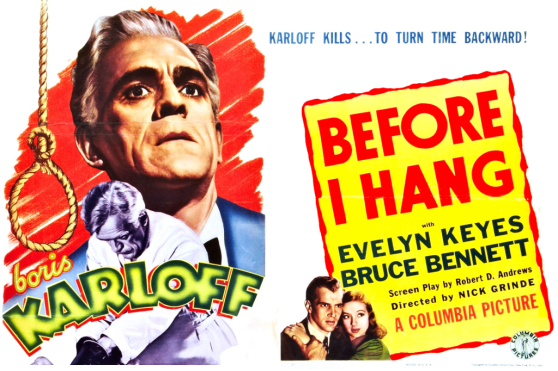
Before I Hang: Sentenced to die for a mercy death, a doctor spends his final days on his experiments. Before his end, he injects himself with serum from a maniac’s blood to deadly effect.
The Man With Nine Lives: A scientist seeks a cure for cancer by freezing bodies in suspended animation, eventually freezing himself. Thawed 10 years later, he continues his research using his enemies.
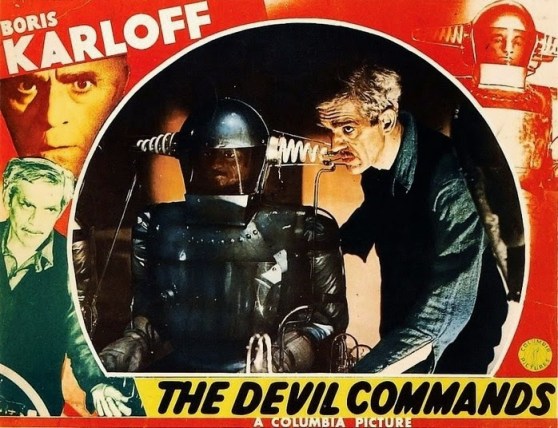
The Devil Commands: A scientist obsessed with communication beyond the grave registers brain activity in a corpse. When he escalates his work taking desperate measures, the bodies begin to pile up. There’s also a commentary track by Tom Weaver.
The Boogie Man Will Get You: An addled scientist and a conniving huckster attempt scientific experiments in the basement of a hotel, leaving bodies piling up in the cellar in this comedic thriller. This has a commentary track by Larry Strothe, Matt Weinhold, Shawn Sheridan and James Gonis from Monster Party Podcast.
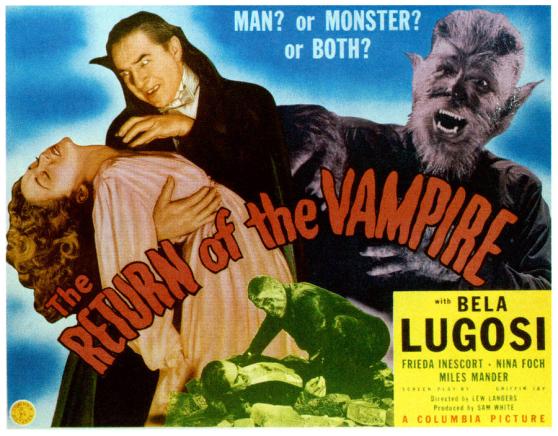
The Return of the Vampire: A 200-year-old vampire prowls the countryside feeding on villagers until a railroad spike is driven through his heart. He is entombed for decades until a German bomb releases him.
Five: A woman and four men survive a nuclear explosion and seek shelter in a house. They must work together, but their clashing visions of the future could lead to their destruction. Includes a commentary track from Tom Waver and Larry Blamire.
This is a great set that has so many of the Columbia films that were part of the Son of Shock Theater TV package, along with Five, which may not thematically fit in with the light horror on this, but is still a worthwhile movie.
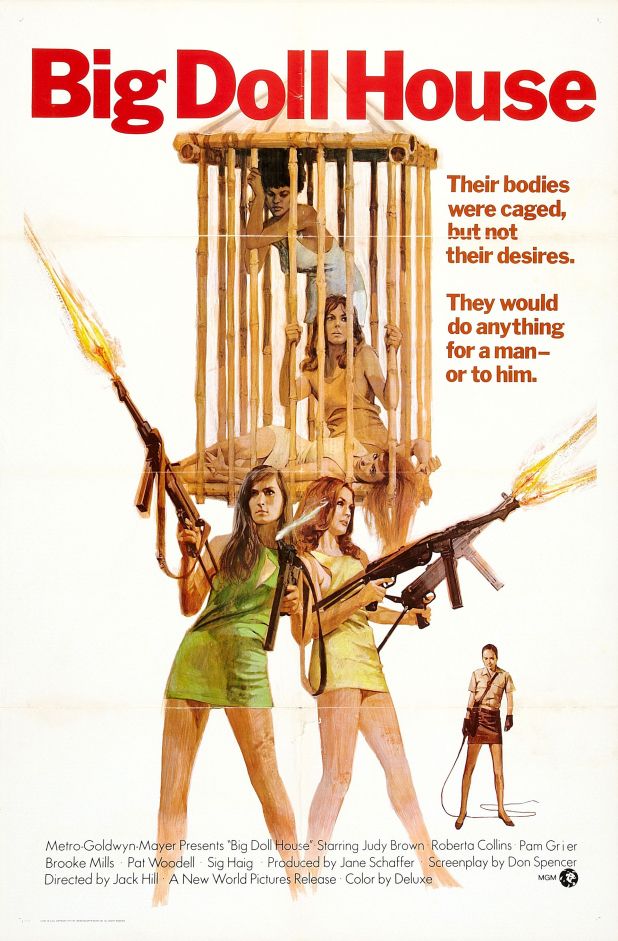
According to Stephanie Rothman, Roger Corman started this film by having James Gordon White write it, but he didn’t like the results. She, her husband Charles S. Swartz and Frances Doel plotted the idea and had Don Spencer write the actual script. Corman wanted her to direct it, but she turned it down. Enter Jack Hill and enter the Philippines, where John Ashley and his partners put up a chunk of the money, leading to this movie getting its unique look.
Collier (Judy Brown, The Manhandlers) is the new girl in prison, there for murdering her old man. That’s Pam Grier singing as we meet the girls on the block: tough lesbian Grear (yeah, Grier), her dominated girl Harrad (Brooke Mills, The Student Teachers), blonde badass Alcott (Roberta Collins, who dominated the screen in Caged Heat, Death Race 2000, Wonder Women and Unholy Rollers), Ferina (Gina Stuart) and her cat, and political dissident Bodine (Pat Woodell, a long way from Petticoat Junction). They’re all under the watchful and brutal eye of Miss Dietrich (Christiane Schmitdmer, The Giant Spider Invasion) and head girl in charge Lucian (Kathryn Loder, an out of control lunatic in this; she was the daughter of a theologian and nearly died of undiagnosed diabetes during the filming of the movie; she’s also in Foxy Brown).
Nearly everything the women in prison genre is known for comes from this movie and the Caged Heat. This also throws in Sid Haig — more movies could use him — and Roberta Collins assaulting a man, snarling “You’ll either get it up or I’ll cut it off!” in a scene that had to titillate as much as it terrified men more than fifty years ago. She also has a movie stealing mud fight with Grier and then you also have Woodell double firing submachine guns and realism be damned, it looks incredible.
When this was cast, Grier was working as the receptionist at the American-International Pictures front desk. Can you imagine coming in for a meeting and Pam Grier is just sitting there? Two years later and she’d be perhaps the biggest non-major studio actress of the 70s. While many of the actresses in this film had to be convinced to do nude scenes, she asked for them. She’d later tell Rolling Stone, “I call it the Brown Nipple Revolution. We weren’t the epitome of sexual attraction for the male audience, in movies, magazines, anything. We were told our brown nipples weren’t attractive. I was trying to break that line of what was acceptable in society.”
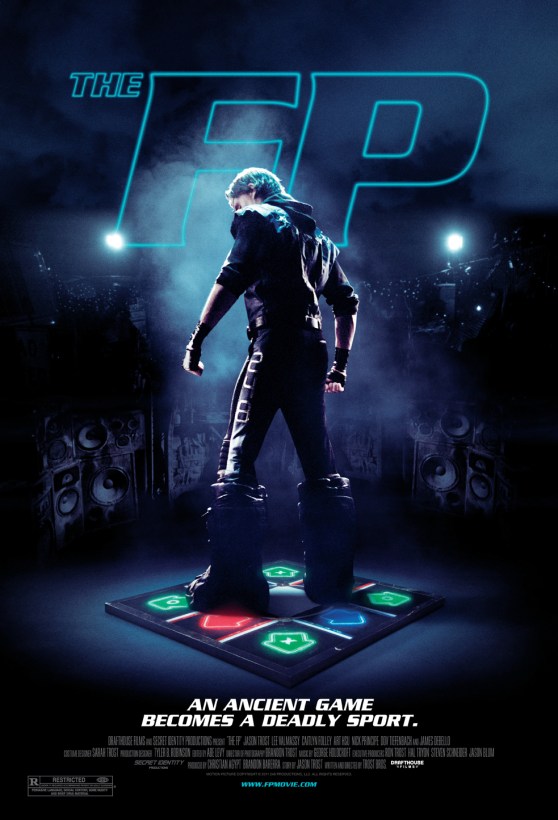
Jason Trost is the director, writer and star of movies like The FP and All Superheroes Must Die, as well as their sequels FP 2: Beats of Rage, All Superheroes Must Die 2: The Last Superhero, FP 3: Escape from Bako and the new FP 4VZ. From dance dance revolutioning post-apocalyptic battles to scarred and embattered superheroes, Jason has brought some amazing films to the screen. I had a blast speaking with him and was thrilled to learn that he’s a filmmaker that really understands his audience and craft.
B&S About Movies: What does it feel like to make a fourth FP movie? You’ve created your own cinematic universe.
Jason Trost: Yeah, somehow for better or worse. It just keeps going. And now I think I’m just too far deep to quit. (laughs)
B&S: I read that the original idea was that The FP sounded like The OC. And now, a decade later, you’ve outlived that reference and have moved on to even bigger and better Armageddons.
Jason: Oh, absolutely. I feel like with each movie, well, they’re all parodies, so to speak. They’re all satirical, parodying new genres and new movies every single time. So the joke just continues to evolve. At this point, the same characters are almost in completely different worlds every time.
B&S: What movie is it this time?
Jason: Obviously, a lot of Indiana Jones and Star Wars. Then there was definitely the Brendan Fraser Mummy movies, Romancing the Stone, things like that. I definitely want this to be a high adventure, going after an artifact movie. I mean, the two main characters are a man and a woman who bicker with each other about their relationship.
B&S: The first film felt like almost all guys and now it’s a relationship movie.
Jason: I’m growing as a person like the characters are growing. I think that’s just kind of inevitable.
B&S: I’ve always liked spiritual sequels more than sequels.
Jason: I just don’t ever want to make the same one twice. I think a lot of franchises really get into that problem, where they’ve just started making the same movie over and over again, but slightly different. Yeah, I know there’s a lot of people that weren’t upset that each one wasn’t just like Rocky where it’s like just another guy to beat up. But I’m like, “That’s gonna get really boring after like two or three of these. You can’t do that forever, guys.”
B&S: You’ve grown up with the series, as it’s been twenty years since you really got started, right?
Jason: It’s fully been 20 years now because I was writing the shorts and coming up with the original things way back when I was 16. And now I’m 36. So yeah, 20 years.
B&S: Are you excited to come back to The FP?
Jason: Definitely. Because every time there’s no rules. I can really just kind of do what I want with it. The only rule per se of this franchise is that each one has to be more ridiculous and the stakes have to be higher every time. If I can do that I can pretty much do whatever I want. I think that’s kind of what I’ve built and set up with this franchise. If you’re still here at this point, you kind of know that’s the deal. Every time it gets to be fresh because they get to go on an entirely new adventure. So I’m excited for that. I’m trying to force myself to make something in between The FB four and five. Something that’s completely different just because I’ve been doing these stories for almost 10 years now. I’d like to just take a second, because I also know that if I go in and make the next one, one day I’ll wake up and I’ll be 45 and will have made 20 of these movies. (laughs) But seriously, I just need some space for a second.
B&S: What’s it like to make a post-apocalyptic movie after pretty much living in post-apocalyptic times?
Jason: I was doing the post on three and four during the pandemic and lockdowns and man, it’s just like the apocalypse in slow motion. You sit there and watch it outside and it’s like the laziest zombie apocalypse ever. (laughs) None of these movies really prepare you for it, because it was very tame in comparison to what we’ve watched. I think we’ve all been built up towards something and what we got wasn’t Mad Max. (laughs)
B&S: I loved All Superheroes Must Die but it felt like you were about ten years ahead with that movie.
Jason: I was way ahead on that. But it’s funny, I still get death threats about that movie. A week goes by and it’s like, “Wow, I didn’t get something horrific.” (laughs) And then you get an email that says, “You’re the worst person ever!” It’s pretty comical at this point. That movie was like ten years ago. Let it go.
B&S: I felt like it was fresh and referenced comics like Brat Pack but it’s original.
Jason: I just wanted to make something different. It’s hard to make superhero movies. There are so many rules with the fan base. It’s like you can’t do this. You can’t do that. Like there’s all these like invisible things and I just wanted to do my own thing.
B&S: The violence in the film is way harsher than what superhero movie watchers had seen.
Jason: Yeah, which you know, I always wanted to see because even at that point, I had superhero fatigue. I had it even before the MCU really took off and it was just like, I want to do something different. All my favorite superhero stories were the dark ones that made sense and they mattered and they were small in scale. And once you start getting into saving the universe, I just start tapping out. Some of my favorite superhero stories always were very small in scale, like Batman saves a family or something. They took out one villain. Not like, the whole league of villains and they control the universe and they control the multiverse. Which is great for FP movies because I have so much content to make fun of. But if I’m talking about serious movies, I’m getting exhausted.
B&S: The superhero fatigue is funny to me because if you read comics through the multiple crises and crossovers, you already experienced that fatigue. Like how many times could a character get killed and come back or there are multiple versions of them? Then again, I grew up in the 70s and we had a TV movie Spider-Man and I realize how lucky we are to have these films. But fatigue always sets in on franchises.
Jason: It’s inevitable. When you release the same movie six times a year, inevitably it’s going to get old to people. It’s interesting because it’s kind of like the most expensive TV series ever made with the Marvel movies, but each episode is in the theater and you only get three or four episodes a year. You can’t just drop in any more. It’s all the same TV series. And I don’t necessarily mean that as an insult. It’s just what they’ve kind of done, it’s like all one movie or TV series. I get that TV shows have good seasons and bad seasons.
B&S: Pop culture has ever had a series like this, because yes, we had James Bond, but the series changed and other actors took over the role.
Jason: I think where they really shot themselves in the foot is branching into TV. I think they needed to keep it special and just keep it in the movies. Because once they’re like, “Oh, to understand this movie you have to watch ten episodes of a TV series.” And I’m like, holy crap, guys. Like, I can carve out time for like a movie every couple of months. But now I gotta watch 15 hours of a TV show? Come on now.
B&S: I feel like that with Star Wars. The period between Star Wars and The Empire Strikes Back was three years with no new content, but that time gave rise to all these ripoffs and I loved that waiting. And I might love those ripoffs like Starcrash as much as the original.
Jason: It makes it special too, because I feel like when you’re waiting for something, you know you’re getting that fever pitch. You can get into fan theories. But I find when you’re constantly barraging people with new content, it takes away the specialness of it.
It also becomes the kind of entertainment where each movie was once just a single serving. And that was fine, right? And then you already forget it like the next week because just like alright. But now, if I’m watching this movie or this show to understand the next movie or TV show, they’re not single forms of entertainment. They’re pieces of a giant jigsaw puzzle. So when you get a quality episode, you’re not paying as much attention or caring. It’s just another episode to get through. You’re not really giving it as much of your time.
B&S: It feels like a responsibility that I have to watch this instead of me wanting to watch it.
Jason: Absolutely. When I see a runtime that’s three hours long…(laughs)
I don’t have time for that. I’ve got like 30 other shows and I’m watching movies. And I just sit there and scroll endlessly and don’t watch anything because everything’s too long. One thing is going to take up three hours of my night?
B&S: Someone asked me if they should watch Terrifier 2 and I asked if they had two plus hours. I grew up when slashers or genre films were 80 or 90 minutes.
Jason: I love it because with those sort of movies, you don’t get all this filler. It’s rare that I see these movies that are over 80 or 90 minutes. And my main note is like the last half an hour and you could see that they were padding out the running time. If you’re familiar with The Simpsons, there’s a lot of times I’m like, “When are we going to get to the fireworks factory?” (laughs)
Back in the 80s, every scene matters. That’s also because back then, people would spend years and years writing these scripts. And now like movies will have a release date before they’ve even started writing the script. So you just have your AI focus group, automatically writing the script, like a writers room programmed on computers that just goes in there and assembles an algorithm of user-friendly marketing-basec content. Two weeks later, you have your script, we start shooting and you’re like…(laughs)
B&S: The big deal of James Gunn’s reboot of the DCU is him saying, “We aren’t shooting until a script is actually finished.”
Jason: That should be a general rule across the board. You’d be shocked because I’ve worked on all these kinds of things. And a lot of my friends have worked on really big $200-300 million dollar movies. They’re never done writing the script! They’re writing the script up until the last day of shooting. It’s constantly just happening and being focus grouped all the way along.
B&S: That’s why I enjoy your films because you’re making something you want to see, not a focus group.
Jason: Thanks, I appreciate that. That’s kind of the motto. We’re like the anti-focus group. (laughs)
I’m making a movie that me and the close people around me want to make. A lot of people aren’t going to like them, but I don’t really care. Instead of trying to appeal to everyone, we’re appealing to the people who like FP movies. They’re going to love these and I’m making these movies for them.
I’m not trying to make FP for everyone. I feel like there are so many movies now where they try to expand their audience and they lose the magic of what they were when they start targeting everyone. Is everyone going to like RoboCop? Probably not. But do some people love it?
B&S: What are the movies that inspire you?
Jason: They’ll come from like the 80s and 90s. Are you asking recently? Because that’s hard. (laughs)
I like all the Verhoeven stuff, James Cameron, some old Arnold movies, 70s sci fi movies, Star Wars and all of the knock offs. Like I’m the sort of person who loved David Lynch doing Dunea lot more than the new one because I thought at least his film had a personality. And a Toto soundtrack! (laughs)
I miss when people made big swings and stuff was crazy. I like being transported to a world where there’s so much creativity and people are really trying to be creative and artistic. As opposed to today, everyone is getting upset with AI generators and basically that’s what the film industry has been doing for the past 10 years. We’re in that now. I like you guys are upset about it now, but that’s kind of just been what we’ve been doing for decades.
B&S: People are just catching on because finally consumers have access.
Jason: It’s just like studios are basically punching an algorithm into a computer. I have my own conspiracy theories, because I know that there are the algorithms out there where your phone can obviously hear you and all that. See whatever your phone sees, you’re going to be targeted with ads.
But we’re getting weird now because there’s something I’ll just be thinking about and it’ll pop up! I’m being tageted with searches for things I haven’t told anyone about and it just pops up and I’m like, “OK, this is getting weird.” (laughs)
Here’s the best part: I have friends who actually grew up in the place I based the FP on and now they’re getting ads for the new movie. They’re actually like targeting people from my past that actually grew up in the town!
B&S: What was it like to work on the Slayer videos for “Repentless,” “You Against You” and “Pride in Prejudice?”
Jason: Those were a blast. It’s surreal. It’s awesome. Like my best buddy BJ McDonnell was directing those. And he was like, “Hey, come on in. Let’s do this. You want to do some Slayer videos?”
I mean, I love Slayer! I grew up on them and it was surreal to hang out with the band and kill people for them. It’s weird because I was in Studio 666 that BJ also directed and he brought me into that. During the shooting of that — I kill one of the Slayer band members, Kerry King — and he was like, “Can I get a picture with you?” And I was like, “This is ridiculous and absurd. Shouldn’t it be the other way around, man?”
B&S: That has to be crazy.
Jason: My greatest performance is not losing my shit in those situations. (laughs)
B&S: You’re in Kazaam. Are you in the Shaquille O’Neal or Sinbad one?
Jason: I was definitely in the Shaquille O’Neal one. (laughs)
Here’s how I know: I was seven or eight and I got in the movie because my dad did the special effects.
EDITOR’S NOTE: This is no Mandela Effect. Jason’s dad Ron Trost did the special effects for Starman, Ghoulies IV, Mortal Kombat and a ton of other movies.
It was over the summer so I was making a living and hanging out with my dad, brother and my sister. And so inevitably, in the background, they need kids, Well, we’re here. And even on big movies, that happens, so I have a lot of weird credits when I was young. The case was my dad was working and I was on the set. (laughs)
But like, Shaq, I have stories! One of the craziest stories — and when I tell people they think it’s fake because it’s so silly — is that Shaq was doing one of his first movies so he ended up being friends with everyone on set. And I remember one time where Shaq and I played basketball against like the crew members at lunch. And he actually put me up on his shoulders to slam dunk the ball. I was like seven years old!
B&S: So you’re the proof that Sinbad wasn’t in Kazaam.
Jason: He was not. I am. And I was there with Shaq. (laughs)
I have my own Mandela Effect! For years, whenever that scene in Independence Day happens when Will Smith punches the alien in the face, I swear he said, “Welcome to Earf!”
I swear that when he got famous, they went back in and ADR’d his voice so he says, “Welcome to Earth” because now he’s a successful actor.
It was an inside joke between me and my friends growing up as kids during high school. We went back and rewatched it again, 15 years later, and we’re like, “Wait a second.” (laughs)
I mean, that’s why in the FP movies, Earth is always Earf. Because of that moment!
B&S: I have a weakness for rappers in movies.
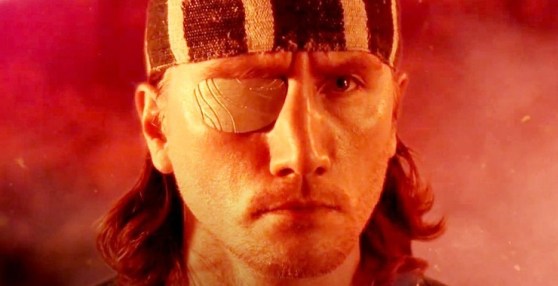
Jason: So how are you on Ghosts of Mars? I went back and rewatched it a couple of weeks ago for the first time in like 15 years. I had a whole new respect for it. I was like, this is exactly what I want. I want more Ice Cube. As time goes on, you kind of respect things from the past.
Lately, I feel like we didn’t really know what true suck was. We didn’t know like the corporate soul of suck! Something objectively might have sucked, but at least it has an identity.
All these movies feel like Mad Libs now. Am I really getting older and just yelling at my lawn? (laughs)
You can check Jason Trost’s FP-4EVZ, a film about a legendary family of rhythm game warriors that must battle their way deep into the future to save what remains of a booze fueled humanity. The film is available on VOD and digital platforms now from XYZ Films.
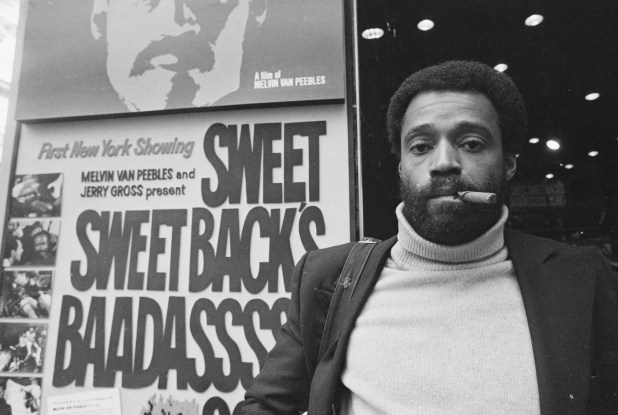
Sweet Sweetback’s Baadasssss Song is incendiary, 51 years after it was made, so I have no idea what it was like when it played theaters in 1971. Melvin Van Peebles started making it as part of his three-picture deal with Columbia Pictures, but at the end of the day, no studio would finance this.
Van Peebles did it all himself, directing, raising the money, writing, scoring, starring, doing his own stunts and even had unsimulated sex that led to this movie being “rated X by an all-white jury” and if that’s not a tagline, tell me a better one.
Not only did he do the stunts, he jumped off a bridge nine times to get the perfect shot. And he got gonorrhea shooting all the sex scenes, then got workers’ comp from the Directors Guild for getting hurt while working, using the money to finish this movie.
He came up with the idea by driving his car into the Mojave desert and driving off the highay and then sitting and staring at the sun, which gave him a revelation. He was going to make a movie “about a brother getting the Man’s foot out of his ass.”
Sweetback grew up in a brothel, learned how to have sex when he was just a kid (that’s Mario Van Peebles, Melvin’s son, between a sex workers thighs in the opening) and has taken his lovemaking skills and big cock to the professional arena, performing every night in the live sex show in the house where he grew up.
His boss Beetle agrees to a deal from two cops. Sweetback looks like a killer they’re looking for and to keep the white public happy, they’re going to arrest him and then release him a day or so later. But then they handcuff him to Mu-Mu, a Black Panther, and when the cops beat the man into oblivion in the middle of nowhere, Sweetback turns his handcuffs into weapons, imposing his will on the Man.
On the run, no one will help our hero. A woman just wants sex for taking off his chains. His boss doesn’t want any trouble. A preacher just wants to keep things as they’ve always been. His episodic journey to freedom leads to drinking water in the desert, using his sex as his greatest weapon and hiding amongst others as dogs are turned on him and black men are attacked by the fuzz at every turn.
It’s mind numbing with quick cuts that seem of today and not older than I am. It was required viewing for members of the Black Panther Party. It was a movie that some black writers thought was as false as blacksploitation. But Spike Lee would one day say, “Sweet Sweetback’s Baadasssss Song gave us all the answers we needed. This was an example of how to make a film a real movie, distribute it yourself, and most important, get paid. Without Sweetback who knows if there could have been a She’s Gotta Have It, Hollywood Shuffle or House Party?”







 B&S About Movies
You must be logged in to post a comment.