Chattanooga Film Festival: A Pure Place (2021)

Irina (Greta Bohacek) and her brother Paul (Claude Heinrich) are Firstlings, the young members of a cult based around an upper caste that strives to remain pure and clean, while its opposite lower members are devoted to making soap, herding pigs and living in darkness and filth. All decisions are made by Fust (Sam Louwyck), who has set himself up as a god-like figure and built his own island world based around Greek and Teutonic mythology. In fact, the goddess Hygieia, who embodies health and cleanliness while being the source of the word hygiene, is worshipped by the cultists.

The promise of Fust is that those who labor in the mud will one day rise to the world above and Irina gets that chance, as a scan shows that her organs are completely milky white, which means something to the strange German man whose family built an empire upon soap which has allowed him to be a deity on Earth. She leaves Paul behind, but their individual stories show that they both remain individuals within this groupthink: she is hand-picked to embody the goddess yet still sees the dirt that exists even on the highest of levels while he starts to ferment a revolution.

“The stage is the intermediate realm upon which we may encounter the gods,” is a statement that Fust makes, but perhaps movies are also that place. This film — directed and co-written* by Nikias Chryssos (Der Bunker) — looks rich and gorgeous, deftly setting apart the united yet divided worlds that make up this film’s world. Cinematographer Yoshi Heimrath makes it look even better, as the close of the movie allows multiple colors to intrude into the pure light and sheer dark that we have emerged from.

Want to see it for yourself? It’s now playing as part of the Chattanooga Film Fest. Virtual tickets are available at www.chattfilmfest.org/

*With Lars Henning Jung.
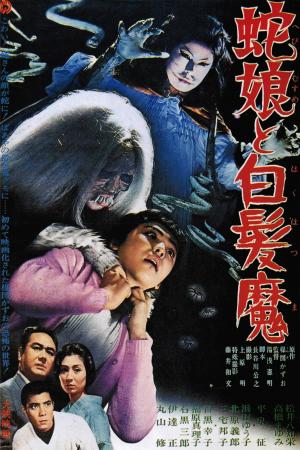
Chattanooga Film Festival: The Snake Girl and the Silver-Haired Witch (1968

Take Noriaki Yuasa, the director of the original eight Gamera movies, and pair him with Kazuo Umezu, who created The Drifting Classroom, and have them make a movie that should be for kids but is the type of motion picture that destroys minds and reaps souls (and is filled with nightmarish visions and brutal murders).

Sayuri has returned to her family after years in an orphanage but trouble has followed her. Before she even arrives, a maid dies of a heart attack, her mother has amnesia from a car wreck and her sister won’t leave the attic, all while her father ignores them to study poisonous snakes and a fanged figure haunts her dreams.

Soon, our heroine is staying up in that attic with her scarred sister who tells her that she just wants to taste her hands and who breaks her dolls and oh yeah, rips a frog in half and throws it in her face. Yes, a kid-friendly movie.

And an amazing one at that.

If you can’t make the fest — you can get a pass NOW at the official site — The Snake Girl and the Silver-Haired Witch recently made its worldwide blu ray debut and home video premiere outside Japan thanks to Arrow. This release also has commentary by film historian David Kalat, an interview with manga and folklore scholar Zack Davisson, a trailer and an image gallery. You can order the blu from MVD.

It’s also available on the ARROW player. Head over to ARROW to start your 30 day free trial (subscriptions are available for $4.99 monthly or $49.99 yearly). ARROW is available in the US, Canada and the UK on the following Apps/devices: Roku (all Roku sticks, boxes, devices, etc), Apple TV & iOS devices, Android TV and mobile devices , Fire TV (all Amazon Fire TV Sticks, boxes, etc), and on all web browsers at https://www.arrow-player.com.

Chattanooga Film Festival: Ming kiyal (1000 Nights) (2021)

There’s a quote at the start of this movie that was so great that I wrote it down: “True love is wild and sad. This is the thrill of two beings in the darkness.”

Director Marat Sarulu, who co-wrote this movie with Emil Jumabaev, also made MoveSongs from the Southern Seas and The Rough River, the Placid Sea. In this film, he explores the relationship between fiction and reality as Nazar discovers the digital artwork of his partner Rumia’s ex-husband Arsen and finds his life changed as he learns that dream and fantasy, as well as reality and imagination, can intermingle and at times seem as one.

Of the film, Sarulu said, “At first, the film unfolds as a theme that can be described as “love amid change.” Here, the social background is removed and transformed into an expressive psychedelic, turning the plot into a complex relationship between reality and fiction. The true author of the story creates within the real flow of life his own secret myth in which he disappears. Dreams, memories and fantasies are intertwined with reality, creating a complex metaphysical pattern.”

Director Boris Troshev has created a world that takes black and white with muted moments of color to take us into worlds that are beyond our own. It’s gorgeous and nearly numbing in the best of ways, a balm for the chaotic world that we exist in. This film is nearly a meditation just as much as it is a movie.

Want to see it for yourself? It’s now playing as part of the Chattanooga Film Fest. Virtual tickets are available at www.chattfilmfest.org/

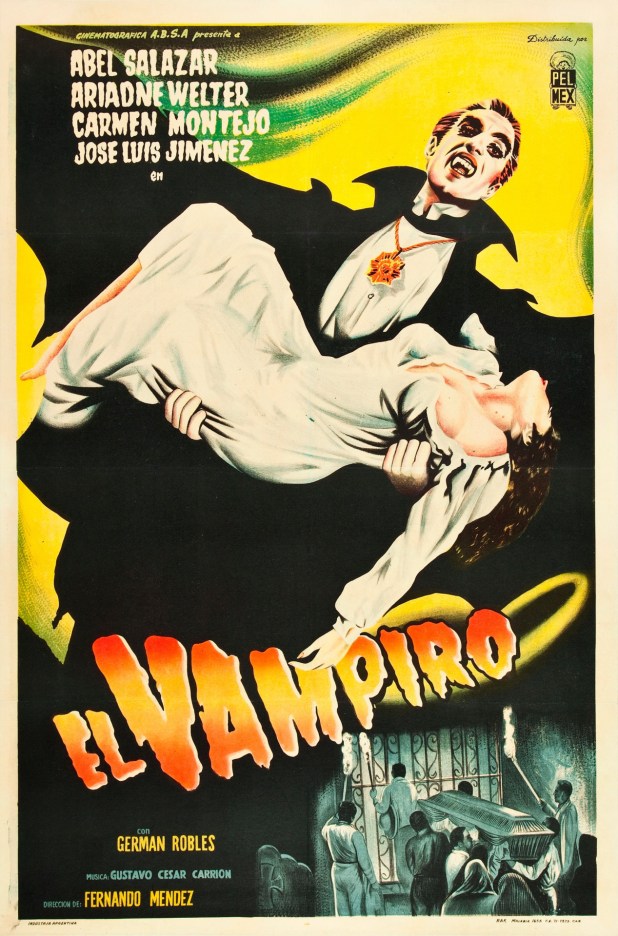
El Vampiro (1957)

The horror boom in Mexican film can be attributed to this movie, one that takes Mexico’s love for the Universall monsters — indeed, there was even a Spanish language version filmed at the same time as Dracula with an entirely different cast and crew — and gives them their own vampiric villain, Conde Karol de Lavud (German Robles).

Marta (Ariadna Welter, El Barón del Terror) is our heroine, back home to plan the funeral of her aunt. Soon, she learns that her home is infested with vampires and they plan on taking the life of her other aunt as well.

While many consider El Vampiro to be the first film to have a vampire with elongated fangs – -a full year before Hammer’s Horror of Dracula — the Finnish movie Valkoinen Peura has a vampiric reindeer woman who has huge fangs. You can also look to Dracula In Istanbul and, of course, Nosferantu for two other canine fanged bloodsuckers before this movie. That said, Robles took the inspiration of Lugosi and created his own take on a vampire that would influence films all over the world.

Director Fernando Méndez also made The Black Pit of Dr. M and Ladrón de Cadáveres, two classic Mexican horror films. It was written by Ramón Obón (Cien Gritos de Terror) and Ramon Rodriguez. Like all great vampires, Conde Karol de Lavud would return soon enough in El Ataúd del Vampiro.

You can watch this on Tubi.

Chattanooga Film Festival: The Timekeepers of Eternity (2021)

The Langoliers may be at the bottom of Stephen King adaptions, but if The Timekeepers of Eternity has any say in things, we’ve been misjudging Tom Holland’s 1995 TV miniseries.

Animator Aristotelis Maragkos has printed every frame of that movie and used collage animation to reconstruct, remix and retell the story in an entirely new way, compressing 180 minutes into 64 and taking Bronson Pinchot’s character of Craig Toomey and making him the lead character and not the villain.

This film takes something we’ve seen before and deliriously recreates it as something bold, brave and fresh.

Beyond just a film, now that The Langoliers has moved into the world of paper, it can make comic book-like movements where multiple characters and angles can appear at the same time while the emotions can come out as darker shapes and jagged lines emitted from the actors. Even the ending moves from King, changing the source material in a way that makes this movie its own piece of art nearly separate from where it was sourced.

In the original film, the CGI Langoliers have been selected on so many worst special effects lists, so imagine my joy when they appear to merely be torn chunks of paper that tear through the reality of this story.

Maragkos spent years making this, but trust me, it was beyond worth the effort.

Chattanooga Film Fest kicks off!

The Chattanooga Film Fest seeks to curate and share the best of cinema’s past and present while educating and inspiring future generations to create films of their own.

By fostering love for cinema of all types from all eras, they hope to create a world in which the medium of motion pictures is treated as culturally and intellectually essential to the human experience as music and art.

I’ll be covering movies for six days of the festival and you can see what’s playing by checking out the Features link. You can also see our breakdown of the films here.

Have a movie you want me to cover? Let me know!

You can watch just about everything from the fest by grabbing a badge right here.

Ella, Lucifer y yo (1953)

She, Lucifer and I is based on the Alberto Insúa novel El Amante Invisible and has Abel Salazar as Jorge, a playboy given the power of invisibility by Lucifer (Carlos López Moctezuma) himself to become more desirable to the ladies. His goal is to win over the gorgeous singer Isabel (Sara Montiel) who has no interest in him, despite his newfound Satanic ability.

Lucifer understands and gives him another idea. Why not wear a mask and court her as if he were a dashing rogue like Zorro? That works, up until when Jorge takes off the disguise and Isobel shoots him dead. Now, the devil must bring him back to lie, because Lucifer didn’t want him. With a soul as cold as Isabel’s, she has a special place in Hell by the side of the First of the Fallen.

Director and writer Miguel Morayta directed more than seventy films, including The Invasion of the Vampires and Dr. Satan. While not a film filled with fright, there’s plenty of light-hearted fun here in an odd movie that comes from an incredibly religious country yet portrays el diablo in a good light.

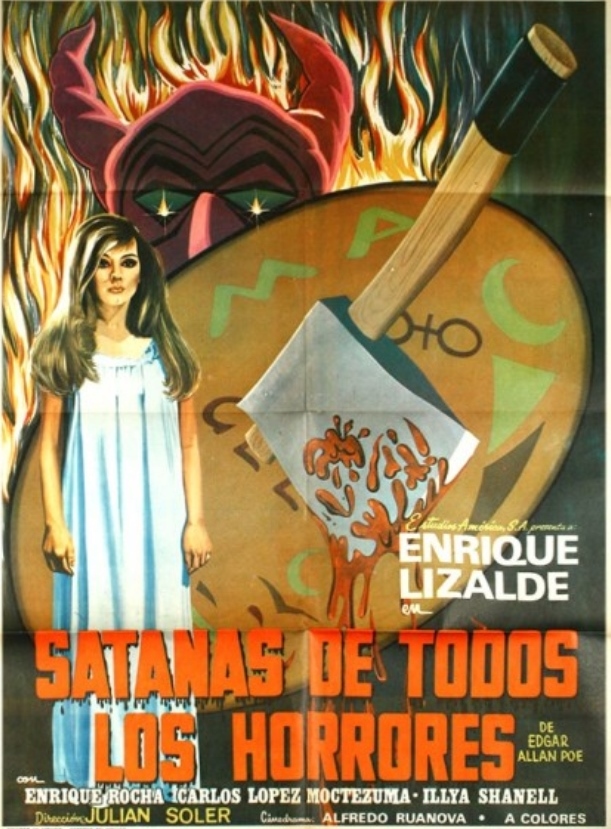
Satanas De Todos Los Horrores (1974)

All the Horrors of Satan is the kind of movie title that you only get from Mexico or Italy and God bless them for it, totally Catholic countries that know how to get only the finest in Satanic sleaze directly into your brain. This doesn’t go as hard as some Mexitrash, but it is The Fall of the House of Usher as made by director Julián Soler.

Eric Gerard and his sister Isabel have been afflicted with a mysterious disease that impacts them both in different ways, as Eric’s senses have become incredibly sensitive and Isabel has become comatose. They’re victims of the Gerard curse, as when there is more than one child, they must go insane and die horribly.

This is a really talkative movie, so if your Spanish isn’t that great and you dislike subtitles, you should probably find something else. That said, Poe probably never intended for his movie to have black magic rituals and I have to say that this is all the better for it.

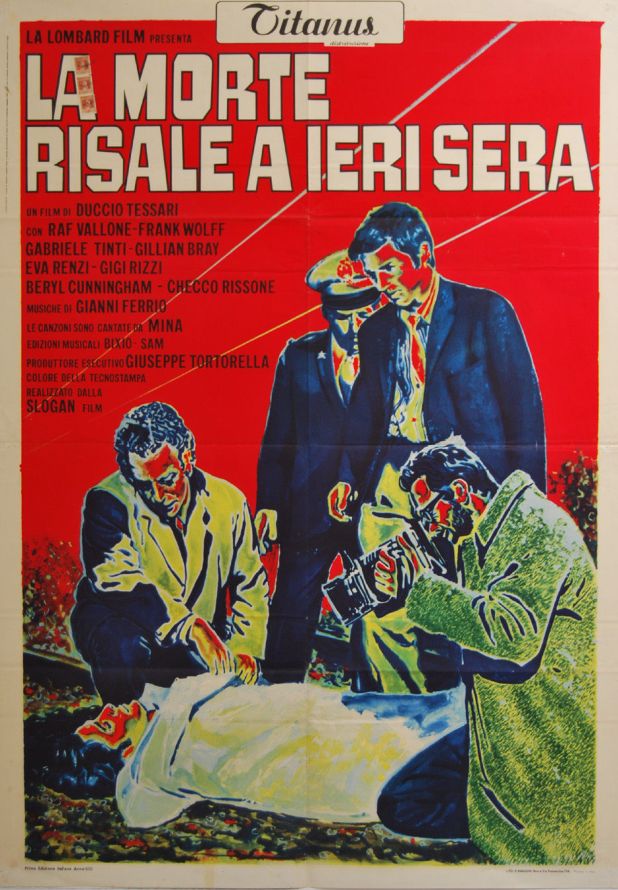
Junesploitation 2022: La morte risale a ieri sera (1970)

June 23: Junesploitation’s topic of the day — as suggested by F This Movie— is gialo! We’re excited to tackle a different genre every day, so check back and see what’s next.

Death Occurred Last Night (also known as Death Took Place Last Night and Horror Came out of the Fog) was based on the Giorgio Scerbanenco novel Milanesi Ammazzano al Sabato (The Milanese Kill on Saturdays) and was directed by Duccio Tessari, who co-wrote A Fistful of Dollars before making his name with A Pistol for Ringo and The Return of Ringo. More to the interest of those who love black gloves and switchblades, he made The Bloodstained Butterfly and Puzzle. He co-wrote the script with Biagio Proietti, who was also the writer of The Killer Reserved Nine Seats and Fulci’s The Black Cat. Tessari even wrote the lyrics to two of the songs in this movie!

Avanzio Berzaghi (Raf Vallone) has come to Milan to find his runaway daughter and works to solve the case himself — much like an Italy proto-Hardcore — at the very same time that detective Duca Lamberti (Frank Wolff) — a character who also appears in the movies Caliber 9 and Cran d’arrêt — and his partner Mascaranti (Gabriele Tinti, husband of Laura Gemser) investigate the seamier side of the city. They finally find her body in a field, burned beyond all recognition. Now, all Berzaghi has left is seeking out revenge that will never be enough.

The film also shows flashbacks of Berzaghi’s relationship with his daughter Donatella (Gillian Bray), a three-year-old child in the body of a fully grown woman with the needs that go with the physical maturity of a twenty-five-year-old. As she lusts after nearly every man she sees, her father had intended to keep her locked up after the death of his wife, but that plan obviously fails.

A cross between giallo and poliziottecschi — each of the two storylines takes each of the genre to heart and then meet at the end — this is a film that doesn’t take its cues from Argento — it was made the same year as The Bird With the Crystal Plumage — and emerges as a unique take on the form with an even more unique soundtrack by Gianni Ferrio which doesn’t sound like any other giallo score — it doesn’t sound like any other music from a film at all — and often puts people off on this movie. Not me.

Speaking of Bird, Lamberti’s wife is played by Eva Renzi, who is so important to Argento’s film. She’s incredible here, not just the most fashionable person in the movie, but her relationship with her policeman husband is one of equal standing.

Want to discover some more giallo? Check out my list of three hundred plus psychosexual murder movies right here.

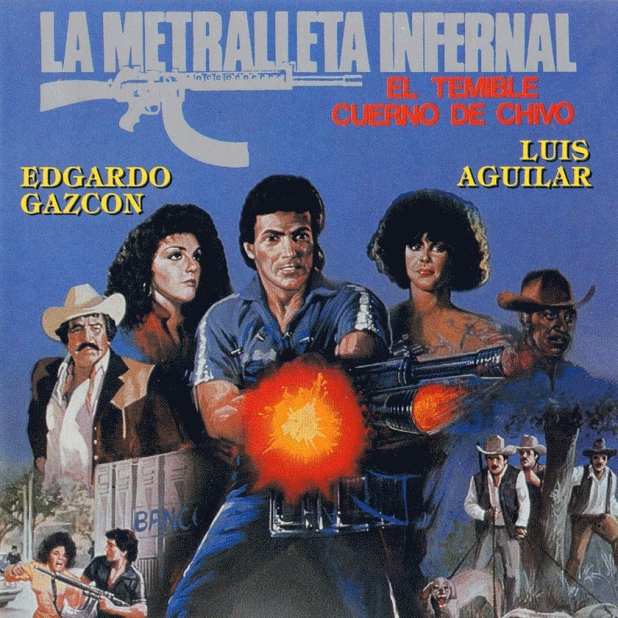
La Metralleta Infernal (1991)

The Infernal Machine Gun has a submachine gun with supernatural powers that never misses. It stars Julian Garza, a Northeastern Mexico singer of more than 150 corridos. A corrido is a popular narrative ballad often about farming life, dealing with oppression or what it’s like to be a criminal. Garza recorded several albums of these songs, including Pistoleros Famosos (Famous Gunfighters), Se Están Robando el Marrano (They Are Stealing the Pig) and Andamos Borrachos Todos (We’re All Drunk). Garza was also part of a subgenre known as narcocorrido or drug ballads.

Roman (Edgardo Gazcon) has a pretty horrible life, as he’s stuck cleaning a bank and staring at the gorgeous Nancy (Claudia Guzman). He never approaches her because of his lowly station and scarred visage. Meanwhile, his brother Juan (Garza) and his girlfriend basically abuse him in between all their gambling.

On the way home from another losing night, Juan searches through a car accident and finds the blessed gun, which he names Cuerno De Chivo (Horn of the Goat). He starts by killing all of the other gamblers, then Roman steals the weapon, robs the bank and kidnaps Nancy, all in a potentially insane plot to fix his face and find true love.

Garza wrote this movie originally as one of his corridos and probably hoped to be the star, but he was 56 when it was made and didn’t fit the idea of a young man finding this powerful firearm. Beyond the gunfighting action, there are plenty of other corridas singers that make appearances both in the film and on the soundtrack.

You can watch this on YouTube.