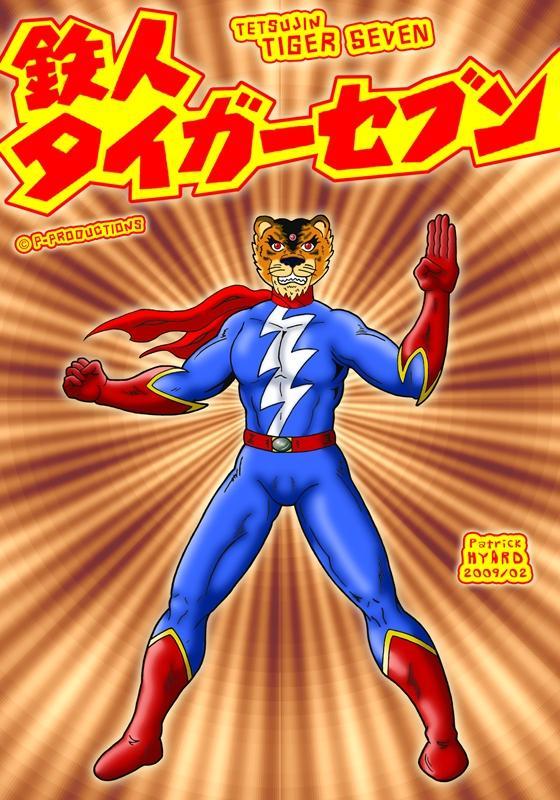
Iron Man Tiger Seven was a Japanese tokusatsu series that aired from October 6, 1973 to March 30, 1974 with a total of 26 episodes. It’s pretty much trying to be Kamen Rider without being Kamen Rider and has a hero born of tragedy, as several Mu monsters — yes, the same Mu that sung under the ocean and is also the home of the KLF — attack a dig that our hero’s human alter ego — Takigawa Go — is part of with his father, who is leading it. He’s stabbed in the heart and his father gives him an ancient heart that he has found in the ruins and a magic pendant that activates his powers when he says, “Tiger Spark.”
I say tragic because moments later, everyone but Takigawa Go gets killed and then a few episodes later, his girlfriend gets killed to, giving him the trademark scarf he wears when in Iron Man Tiger Seven mode.
Then again, he does get a somewhat intelligent motorcycle with rocket boosters and transformative powers that comes to his aid when he roars.
The bad guys in this are astounding with each monster of the week being called “something” Genjin, so we have Kappa Genjin, Merman Genjin, Flying Dragon Genjin, Rat Genjin and the incredible Wolf Genjin, who is a white wolf riding a motorcycle.
The same company that made this also created Kaiketsu Lion Maru, which has three kids in the samurai era who can transform into a human/lion hybrid.
You can watch the first episode on YouTube. There are also episodes with English subtitles on the Internet Archive.
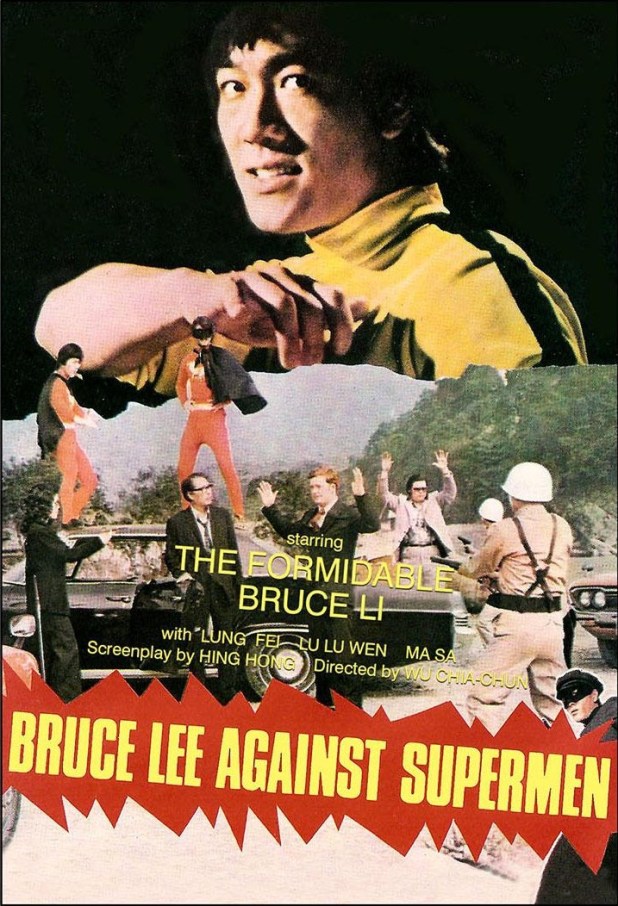
The Three Supermen series somehow has been remixed around the world, starting as an Italian superhero series, making its way to Turkey and now becoming a Hong Kong film also known as Bruce Lee Against Supermen.
When a Chinese scientist learns how to accomplish the grindhouse alchemy of making food from petroleum — maybe learn how to make food from something that’s less scarce than what you’re replacing, this is like turning diamonds into gold — some criminals kidnap him, so Green Hornet gets called in. He politely declines and sends Kato (Bruce Li), who sticks around long enough to send Carter (also Bruce Li) who dresses like Game of Death Bruce Lee.
Also, that’s not Superman that Bruce Li, not Bruce lee fights, but the Italian Supermen, except only one is in it. Anyways, you have to love a movie that outright steals Emerson Lake and Palmer’s “Karn Evil 9” for a car chase, because why not?
Also, Bruce Li has a love scene with Kraftwerk’s “Autobahn” playing.
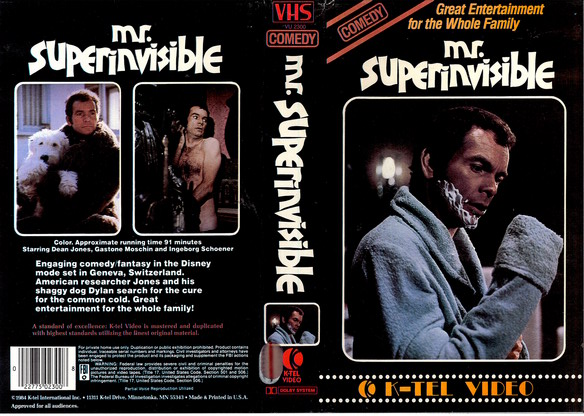
Antonio Margheriti — the man who directed And God Said to Cain and Yor: Hunter from the Future — also made a Dean Jones Invisible Man movie, which blows what’s left of my mind. Want me to go even further? This was released in U.S. theaters by K-Tel.
Yes, it’s a Disney superhero movie, basically, but made in Italian and therefore things like an actor doing Peter Lorre for 1970s kids years past that being something they’d get it is exactly what I expect. And yes, that actor doing it is Luciano Pigozzi, Pag from Yor.
K-Tel started playing this in U.S. theaters in 1973 and kept pushing it past 1975 in matinees that offered the chance to win the dog — a stuffed one — if you attended. I can’t even imagine how much 1973 parents hated their kids to drop them off and be assaulted by this.
Jones is Peter Denwell, trying to solve the mystery of why people get a cold, when his research is stolen and he must use an Indian formula to turn invisible. There are also moments where this formula stops working and Jones is naked. This is, again, a movie for children.
The same year Jones’ co-star Ingeborg Schöner made this, she’d also be in Mark of the Devil, which is really the kind of juxtaposition I can get behind.
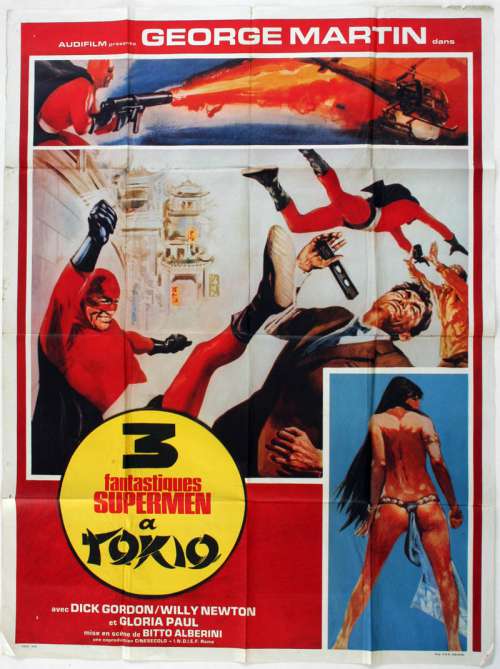
The Supermen series — this is the second in the series — was such a big deal that the series would become popular in Germany and Turkey, with each country making their own remixes of the movies. This is shot Italian style — exteriors in Japan, interiors back home.
The only movie in the series — outside of the aforementioned localized remakes — to never make it to America, this one has the Supermen seeking a miniaturization weapon in Tokyo, which is an excuse to chase women and eat lots of food, including a fried chicken dinner that ends up being dog, perpetuating that horrible racist urban legend.
Bitto Albertini replaces Gianfranco Parolini as director, while the first movie’s Tony Kendall, Brad Harris and Aldo Canti are now played by Jorge Martin (who is also in 1970’s Supermen and 1973’s Three Supermen of the West), Willi Colombini (Pollux from the Steve Reeves Hercules) and Sal Borgese (Superbug, the Craziest Car in the World; Super Fuzz), not for the better. That said, when the miniaturization ray just turns the cast into kids, well…that’s pretty funny (and works in the budget).
Gloria Paul plays an enemy agent in this and was nearly Domino in Thunderball, so that at least gives this some Eurospy credit.
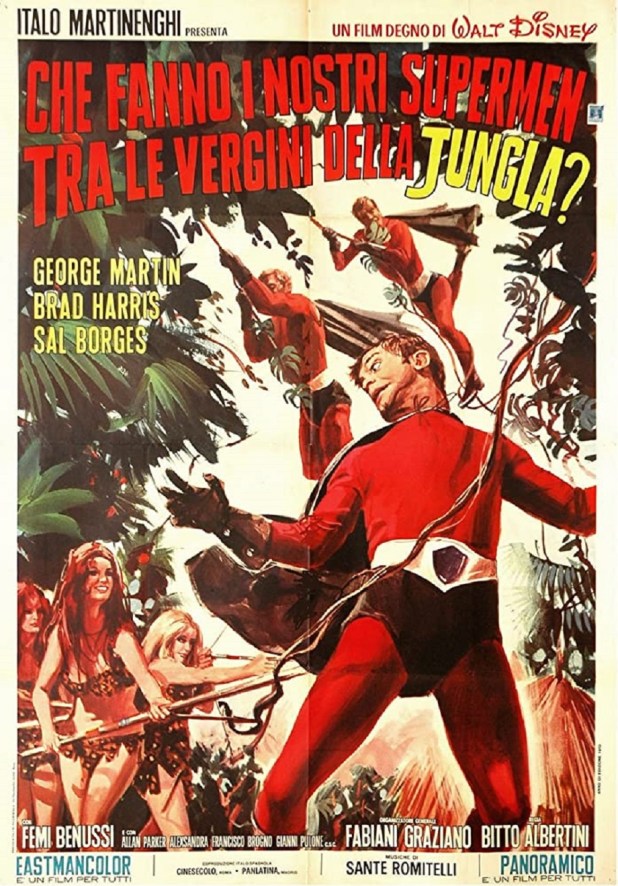
The title of this movie means What are our supermen doing among the virgins of the jungle? but you may know this movie better as Three Supermen In the Jungle, one of eleven films in the Three Supermen cycle of films:
There are attempts at continuity — one of the Supermen, Brad Scott (Brad Harris, The Girl In Room 2A) complains about how they were treated in the previous movie, the two years ago 3 Supermen in Tokyoexcept that he wasn’t even in that film — but the truth is these movies are relatively interchangeable, with the trio always kinda criminals forced to do good for the government.
Along with George (Jorge Martin) and Dick (Sal Borgese), this mission takes them to a uranium mine in the jungle and seeing how this is an Italian movie, you know that they’ll meet cannibals and white female gods to the natives, led by Jungla (Femi Benussi). Personally, I’m shocked that they didn’t beat a monkey into oblivion or murder a turtle just to prove themselves and where they’re coming from.
Director Bitto Albertini made a bunch of these films, as well as some aberrant madness like Escape from Galaxy 3, Put Your Devil Into My Hell, Return of Shanghai Joe and the original Black and Yellow Emanuelle films. Just the director to make what is basically a kid movie.
William Klein settled in Europe after serving in World War II and achieved widespread fame as a fashion photographer for Vogue. Ranked 25th on Professional Photographer‘s list of 100 most influential photographers, he directed Who Are You, PollyMagoo?, The Model Couple and several documentaries in addition to this movie, which critic Jonathan Rosenbaum wrote was “conceivably the most anti-American movie ever made.”
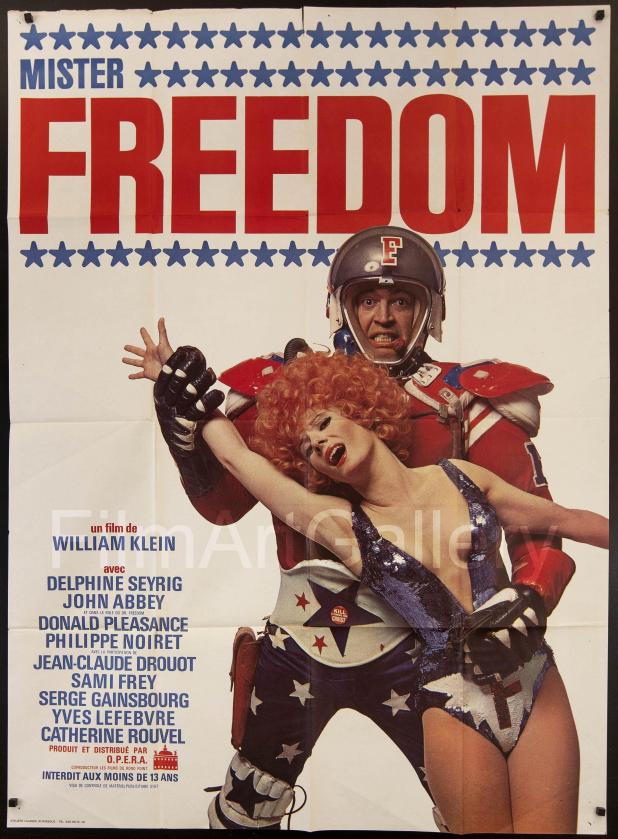
Mr. Freedom (John Abbey) works during the day as a beer drinking cop and at night as a government-sanctioned vigilante. He’s called to the Freedom Tower, which houses the military-industrial complex — to meet with Dr. Freedom (Donald Pleasence!) who wants him to go to France and find the killer of Capitaine Formidable and bring France back to the side of capitalism or die trying, as he’s equipped with a nuke that can wipe out the country instead of letting it fall to the Communists.
Mr. Freedom joins forces with Capitaine Formidable’s widow Marie-Madeleine (Delphine Seyrig, who made a film version of the SCUM Manifesto and Be Pretty and Shut Up, a pre-#MeToo 1977 film that featured Shirley MacLaine, Maria Schneider and Jane Fonda and concerned how women were treated within filmmaking), where he learned that their plan had been to run houses of ill repute to gain intelligence, a plan he endorses, as well as forming his own army that will stop Communism in France and build a “white wall of freedom” around the U.S. — decades before red hats and whitewashed fascism came back in fashion.
He also battles the Russian Stalinist Muzhik Man and Chinese Maoist Red China Man — which upset Marxist-Leninist folks at the 1968 Avignon Festival — and gets a secret tranceiver put into his teeth which sends Communist messages into his brain. This leads to the hero — or villain — building a secret base from which his operatives can start attacking Commiunism, which basically means being criminals themselves and causing anti-US demonstrations.
Mr. Freedom goes Kent State and fires a machine gun into a crowd of peaceful protestors, which causes Marie-Madeleine to reveal that she’s a double agent and killed her own husband. Mr. Freedom kills her just as the demonstrators attack his base and kill his followers. Seeing that France neither wants nor deserves American democracy, Freedom activates his bomb, which only kills himself.
Is it any accident that Mr. Freedom is wrapped up in the red, white and blue, plus football pads?
This feels like an indictment of comic book Hollywood four decades before that was even a thing.
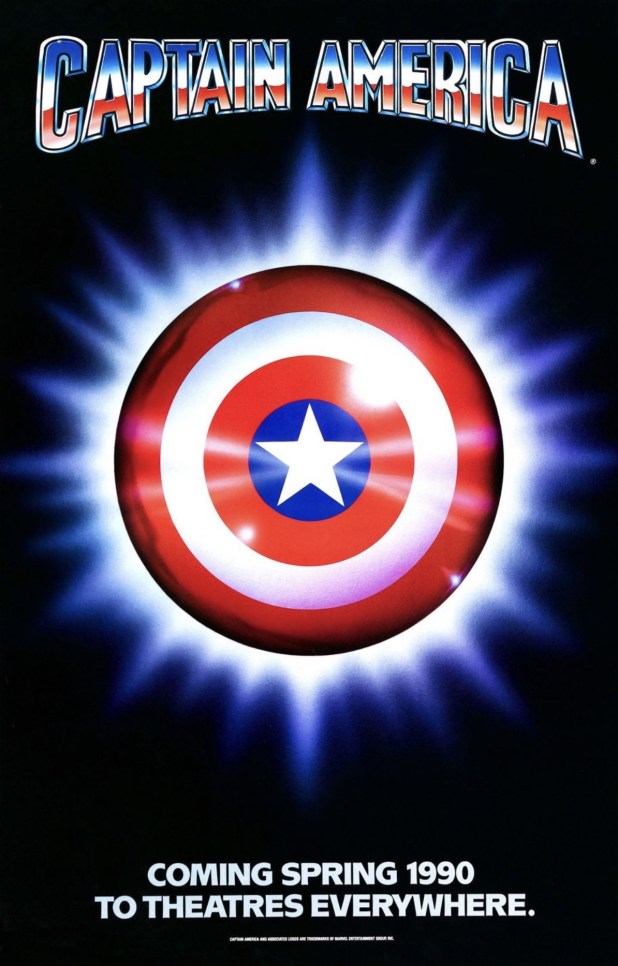
Written by Stephen Tolkin and directed by Albert Pyun — who interned on a Toshiro Mifune TV series under Akira Kurosawa’s Director of Photography before making movies like Cyborg, Alien from L.A., Radioactive Dreams, The Sword and the Sorcerer and so many more — this film started at Universal, who got the rights after the CBS TV movies.
The rights were then sold to The Cannon Group with the idea of Michael Winner directing a script by James Silke (Ninja 3: The Domination) and supposedly starring Michael Dudikoff as Cap and Steve James as the Falcon, the sheer idea of which makes my brain delirious. The Variety ad that announced this movie initiated Jack Kirby’s lawsuit against Marvel, as it claimed that Stan Lee created the character and not he and Joe Simon, who invented Cap all the way back in 1941 and Lee didn’t bring the character back until 1964.
After two years of development, Golan left Cannon in 1989 — stay tuned for August on this site for a sequel to Cannon Month — and as part of the settlement, he was given control of 21st Century Film Corporation and the film rights to Captain America.
Then, comic book fans waited. And waited.
It premiered in 1991 in the Phillipines as Bloodmatch as part of a double feature with Snoopy, featuring an ad that trumpeted Golan as the producer of Superman, which is not as true as saying he was the producer of a Superman, the best not mentioned Superman IV: The Quest for Peace. Also, Jean Claude Van Damme is not in this movie, no matter what that ad claims.
So that’s how we got a Captain America played by Matt Salinger, the son of the writer of The Catcher In the Rye, and fighting Scott Paulin as the Red Skull, who was a child prodigy that the Axis experimented on, sending Dr. Maria Vaselli (Carla Cassola,Demonia) to America where she creates the Super Soldier Syrum.
There’s some good casting here, and by that, I mean character actors that get me a -typing. those would be Ned Beatty, Darren McGavin (the younger version of his General Fleming character is played by Billy Mumy while his A Christmas Story wife Melinda Dillon is in the cast as Steve Roger’s mom ), Ronny Cox as the President and Michael Nouri.
The one thing I do like about this film is that in the years after World War II, the Skull has built a conspiracy crime family with his daughter Valentina De Santis (the character Sin in the comic books, she’s played by Valentina De Santis) that has assassinated everyone from the Kennedy and Dr. Martin Luther King to Elvis, which he claims was the one time they did the wrong thing. Now, they want to brainwash the President and Cap, along with Sharon Carter (Kim Gillingham, playing that role and Bernice, the 1940s girlfriend of our hero), must stop him.
So how weird is it that the son of J.D. Salinger, whose book was often in the hands of programmed assassins, is battle the man who programmed said assassins, at least in this movie?
Ronnie Cox once said that the script to this movie “remains to this day the finest script I have ever read… how those guys messed that film up, I will never know.” And Stan Lee, ever the PR man, said that the reason for the reshoots was because “Pyun did it so well and so excitingly that everyone in the audience [at the screening] kept clamoring for more.”
Sure, True Believer.
As for Jack Kirby, everything you know in comic book movies is the result of his creativity. Even after his death, his family has attempted to gain the money and recognition that that creation deserves. When most comics these days struggle to be released once a month, Kirby was at one point — according to Mark Evanier — drawing twenty pages of comics a week, up to five pages a day, which is about a full issue of a comic every week. All for no real ownership, no insurance and no promises. For just one month’s example, in November 1963, Kirby drew 139 pages of comics and seven covers. His Fourth World era contract was for 15 pages a week, so Kirby gave then twenty.
Think about that the next time you watch everyone make money from his work.
Airing on November 23 and 24, 1979 — the same nights that Salem’s Lot was also on CBS — with the new creative team of director Iván Nagy (perhaps better known as the boyfriend of Hollywood madam Heidi Fleiss) and Wilton Schiller (who produced the last season of The Fugitive and wrote this with his wife, former casting agent Patricia Payne).
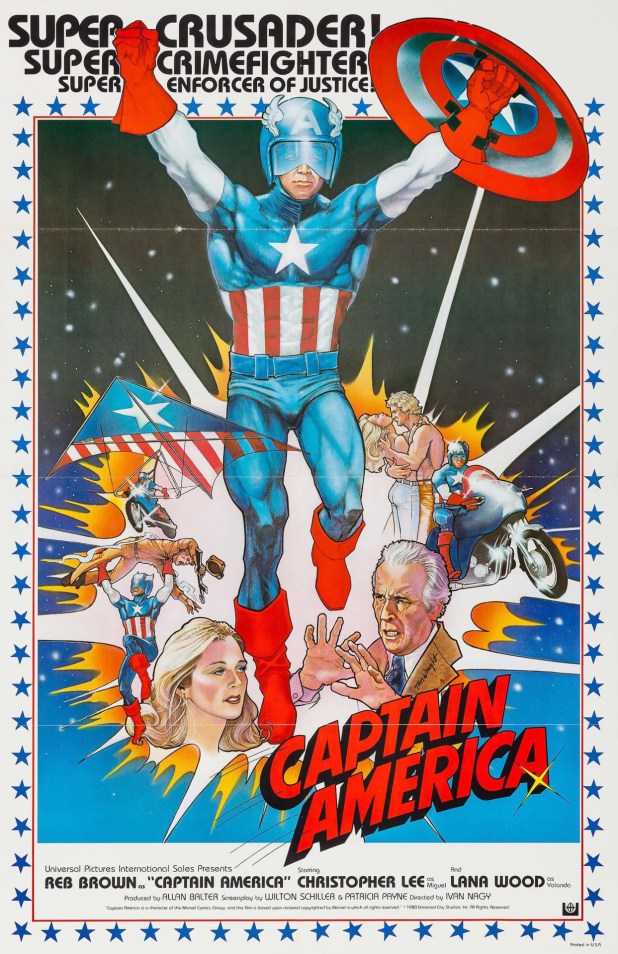
According to star Reb Brown, Captain America wore a helmet in these movies because the California Highway Patrol — you know, CHiPs — said that he must have a helmet to ride a motorcycle on the freeway.
At least he gets to hang-glide this time. And get a decent villain, as Christopher Lee plays General Miguel, who is using an aging formula to hold Portland hostage. Cap has Connie Selleca on his side as a scientist, but this pitch for a series — the second if you count the other TV movie that aired four months before — didn’t get the ratings needed, what with those expensive stunts.
I kind of love reading reviews making light of Steve Rogers being a painter in these movies. That’s totally the character from the comics, one of the few things that made it into this film.
On Friday night, January 19, 1979, a seven-year-old me sat down to watch this and promptly lost his mind.
There was supposedly a directive from CBS to not follow the comics exactly, which makes no sense, because the comics sell the show which sell the comics, but for some reason, no one figured that out yet.
So that’s how this version of Captain America is a legacy hero, even if they get the part about Steve Rogers being a commercial artist right. He’s almost killed by some spies who are trying to get the F.L.A.G. serum that his father invented and gave to himself to become the first Captain America. But all Steve wants to do is roam in his cool van because it’s 1979 and this Earth-CBS version of Cap is Nomad before he’s Cap.
He ends up being saved by the aforementioned F.L.A.G. formula, gets super-strength, a special motorcycle, a clear shield, a motocross-centric costume and the actual job of being the Sentinel of Liberty.
According to star Reb Brown at Comic-Con, CBS planned crossing over his character with Spider-Man (Nicholas Hammond) and the Hulk (Lou Ferrigno/Bill Bixby). Seven-year-old me loves that.
Writer Don Ingalls once worked on the LAPD magazine The Beat, as well as scripting The Initiation of Sarah. Director Rod Holcomb has worked on all sorts of episodic TV, including The Six Million Dollar Man and The Greatest American Hero.
The reviews I’ve seen for this online are a mix of “look how far we’ve come” and “the idea of Captain America is capitalist nonsense.” First, this show is just fine. It’s strange to compare low budget TV movies made forty years ago to glossy multimillion films on so many levels. And Joe Simon and Jack Kirby created Captain America to represent the best of this country and what it could be, a character that two Jewish men created to make a stand for America entering World War II, that protest groups came to their offices to try and find them, that became a character of a man lost out of time and with no country, even fighting the Secret Empire the whole way to the White House, exposing Nixon as a supervillain — who killed himself off-panel! — and then traveled the nation as the aforementioned man with no country called Nomad. And this was no millenial story for social media clout. This was in 1974.
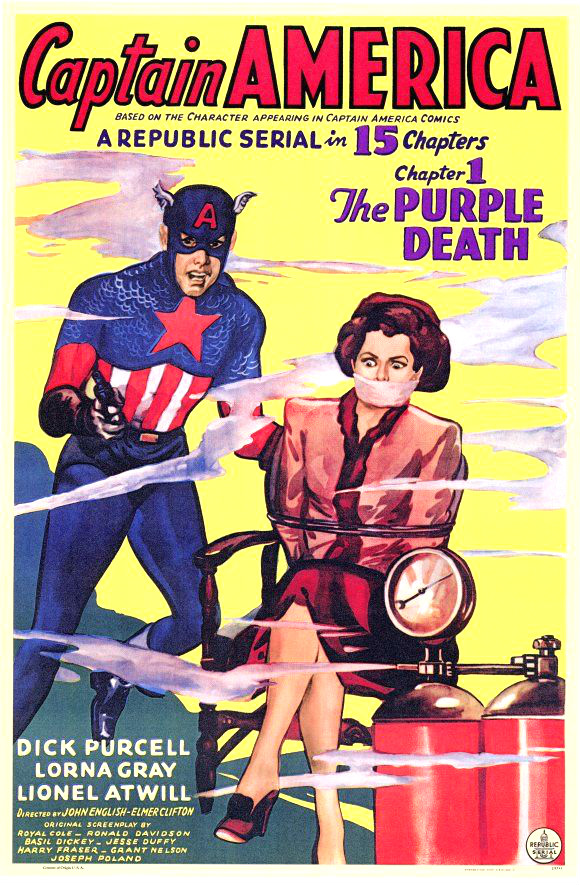
The last Republic serial made about a superhero — and the most expensive serial that they would make — Captain America is about the hero in name only. Republic was famous for making major changes in their adaptations, but these ones get crazy.
Cap isn’t Steve Rogers, he isn’t in the army, there’s no Bucky, he doesn’t fight any Nazis, he uses a gun instead of his shield and he never got the Super Soldier Syrum. Instead, he’s District Attorney Grant Gardner.
Huh?
Therte are a few different theories.
Jim Harmon and Don Glut believe that this was going to be a sequel to 1940’s Mysterious Doctor Satan, which had already substituted the invented superhero The Copperhead for Superman after Republic lost the rights to Paramount to make that serial.
Film restoration director Eric Stedman has the theory that since Republic had made two serials the Fawcett Comics characters Captain Marvel and Spy Smasher, this serial was meant to start Mr. Scarlet, whose alter ego is District Attorney Brian Butler.
After multiple scientists and businessmen — who all went on the same Mayan exploration — kill thenselves and are found holding a scarab, the police ask District Attorney Grant Gardner to bring in Captain America and seeing as how they’re the same person, that’s easy. The bad guy? Lionel Atwill, playing the Scarab. This was a major downturn in the star’s career, as after numerous scandals, he’d been blacklisted by the major studios. That said, he still is working hard in this, made just two years before his death.
He also has a weapon called the Purple Vibrator, so look out.
This was a very successful serial, but sadly, the strain of playing the physical role was too much for lead Dick Purcell, who died a few months after filming was complete.



 B&S About Movies
You must be logged in to post a comment.