Hellraiser: Hellseeker (2002)

We’re at the sixth Hellraiser movie and this one bring back Kirsty Cotton and Clive Barker, who had some influence on the third act.

Trevor (Dean Winters, Mayhem from the insurance commercials) has been arrested for the potential murder of his wife — Kirsty Cotton (Ashley Laurence) — whose body can’t be found. He’s been cheating on her for some time and tricked her into reopening the Lament Configuration. Man, is there anyone positive in Kirsty’s life? PInhead, maybe?

This film follows a very similar plot to the movie that came before it, but doesn’t work as well.

Also, this would be the time in every review where Dimension/Miramax does something horrible to remind you just how evil they were. They placed the cast and crew under a gag order, not even allowing director Rick Bota to promote the film when Fangoria wanted to do a cover story. Laurence, however, ignored them and revealed that she was paid enough money from this movie to only be able to buy a refrigerator.

You can watch this on Tubi.

Hellraiser: Inferno (2000)

Scott Derrickson makes movies that are way better than you’d expect when you first hear about them. He wrote Urban Legends: Final Cut, which is way better than it should be. He’s made several occult-related films that I’ve enjoyed, like The Exorcism of Emily Rose and Deliver Us from Evil, as well as Sinister and Sinister 2, two of the better movies that came in the wake of the Conjuring movies. Since then, he helmed the big budget Dr. Strange and is about to release The Black Phone, which looks great.

Hellraiser: Inferno was his first full-length movie as a director. He partnered with Paul Harris Boardman, who he has worked on several other films with, to write a script that Doug Bradley has said was not originally intended to be a Hellraiser film.

You know, by all rights I should hate this movie, but I loved it. It’s a neo noir within the universe of Hellraiser and that should be absolutely ridiculous — and it is at times — but it works. It’s like a direct-to-video Angel Heart with Pinhead as Lou Cypher and somehow, it just plain works.

Look, if you can’t get Clive Barker, just get Craig Sheffer from Nightbreed. I admire that logic. He plays a detective obsessed with rescuing a child yet he’s often at odds with the way that he handles cases, the strange visions in his head and the therapist he’s forced to visit.

This sequel is the find of this sequel week. Seriously, give it a chance. If it wasn’t the fifth Hellraiser and had more than $50,000 for special effects, lots more people would be discussing it.

You can watch this on Tubi.

Father’s Little Dividend (1951)

ABOUT THE AUTHOR:  Melanie Novak writes about the Golden Age of Hollywood, infusing her weekly movie reviews with history, gossip, and the glamour of the studio era.  You can read her reviews at www.melanienovak.com and follow her on Instagram @novak_melanie.

You may not be familiar with Father’s Little Dividend, but you certainly know the original.  In fact, you can tell a lot about a person by asking them who plays the Father of the Bride.  If you say Steve Martin, you’re likely under fifty.  If you say Spencer Tracy, you’re either a film buff or have grandchildren—make it great-grandchildren—of your own.  

(And if you say Leon Ames, who played Stanley on the 1961-1962 television series, my hat’s off to you.  That’s the deepest of deep cuts, my friend.)

A brief recap on the original:  In 1950, Spencer Tracy plays Stanley Banks, a middle age father who finds out his young and only daughter Kay (Elizabeth Taylor) is getting married and proceeds to lose his mind in the planning of (and paying for!) her wedding.  

In Father’s Little Dividend, MGM brings back the entire cast for a second round of laughs at poor Stanley Banks’ expense when Kay and husband Buckley announce she’s expecting a baby.

After the announcement, everyone is hugging and offering congratulations to the young couple.  Everyone except for Stanley, who’s too busy glowering at the proud papa-to-be.

First he steals my daughter,” Stanley fumes in audience narration, “now he makes a grandpa out of me.”

The prospect of becoming a “grandpa” sends Stanley into a full blown midlife crisis.  In my favorite scene, he spends the day at the gym regaining his youthful vitality and ends up throwing out his back the next morning.

Father’s Little Dividend does an excellent job walking the sequel tightrope—holding onto what people loved about the original without serving them reheated leftovers.  

It keeps Stanley’s curmudgeonly nature and under-his-breath barbs—he calls the baby shower “highway robbery not punishable by law.”  It also maintains the roll-her-eyes tolerance of his wife Ellie, the mutual adoration between Stanley and Kay, and the bottom line truth that for all his grumbling, Stanley is ultimately a marshmallow who wants only to make his wife and daughter happy.

But Dividend also widens the circle to include more time with Kay’s in-laws, who are in a fight to the death with Ellie for the baby’s affection.  Both sets of in-laws endlessly interfere in Kay and Buckley’s life—suggesting Kay move in with them, decorating her nursey, and going behind her back to speak with her doctor about his questionable “modern” methods.

And after the baby is born, the you-better-take-this advice never ends.

All but Stanley, of course, who wants nothing to do with any of it.  And for a daughter overwhelmed with competing opinions, “no comment” is the sweetest sound of all.

And as to the baby that Stanley wants nothing to do with?

He comes around.  Just as we all knew he would.

Dividend is both funny and poignant.  But it also brings out something that feels fresh even today—very few films put a man’s feelings about becoming a grandfather at center stage.

Directed by Vincente Minnelli (Meet Me in St. Louis), and co-starring Joan Bennett as Ellie Banks, this holiday season you can’t go wrong with a double helping of the original Banks family in Father of the Bride (1950) and Father’s Little Dividend (1951).  

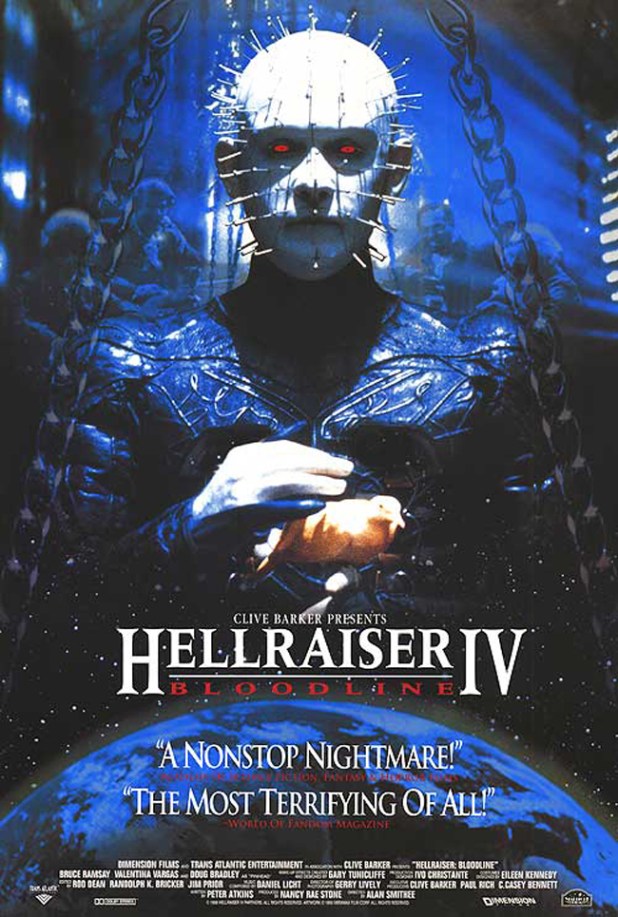
Hellraiser: Bloodline (1996)

Directed by Kevin Yagher and Joe Chappelle, this is the last Hellraiser to play theaters, only has one returning character in Pinhead (Doug Bradley), the last to involve Clive Barker and is both a prequel and a sequel.

Yagher left the production after Miramax demanded new scenes be shot. This is a theme that will appear in nearly every 90s horror movie that Miramax got their weird creepy hands on. The new scenes and re-shoots changed several characters’ relationships, gave the film a happy ending, introduced Pinhead earlier and cut 25 minutes of the original cut Yagher turned in. These were enough changes that he was able to use the Alan Smithee credit.

Dr. Paul Merchant has designed a space station to be in the shape of a giant Lament Configuration. Yes, within four movies, the Hellraiser franchise does what it took Jason Vorhees ten to arrive at. Yes, we’re in space. And we’re also going back in time, as Merchant’s ancestor creates the original box that starts all of these demonic events.

The Merchant bloodline has been cursed ever since they helped open the gates to Hell. There’s also a new Cenobite, Angelique, who tempts people and this puts her into conflict with Pinhead, who only believes in pain. There’s also a Merchant ancestor in 1996 that has created The Elysium Configuration, an anti-Lament Configuration that creates perpetual light and will close the pathways to Hell forever.

Bruce Ramsay ended up playing all of the Merchants and I kind of like that the end of this movie attempts to close the story. But come on. They already made four of these movies and there was no way this would all end here.

How crazy is it that this was Adam Scott’s film debut?

You can watch this on Tubi.

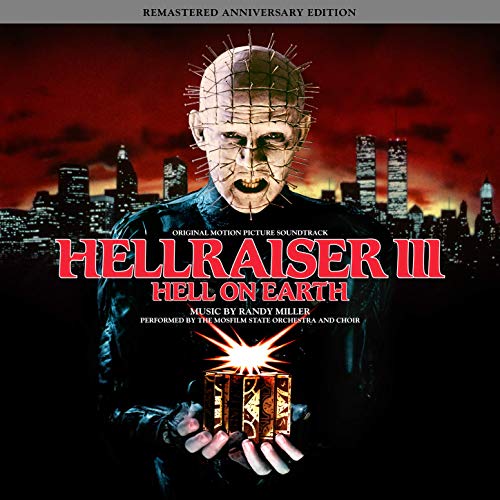
Hellraiser III: Hell on Earth (1992)

Anthony Hickox made both Waxwork movies, so that qualified him to take on the third trip to visit the Cenobites, which was necessary as the two films that had already come out were huge rental successes.

Series creator Clive Barker reprised his role as executive producer, though he was largely uninvolved until post-production, while Tony Randel at least contributed the story.

At the end of the last film, as Pinhead tried to reclaim his humanity, he finds himself split into his demonic form and as the limbo-trapped British Army Captain Elliot Spencer. As for Pinhead, he and the Lament Configuration remain within the Pillar of Souls that appeared as the last movie finished.

The pillar is bought as art by a club owner and when one of his sexual conquests is dragged into it and absorbed, Pinhead emerges and demands more blood. Without the influence of Spencer, Pinhead has become true evil and is using our reality for his own pleasure, which is against the regimented laws that the Cenobites live by.

Ashley Laurence returns for a cameo, as her Kirsty character explains the events of the previous films. And hey — Armored Saint plays the club!

Between the Barbie and CD Cenobites and the more American locale, this film suffers in comparison to the first two movies. That said, when viewed against what was to come, it ends up being pretty decent. The idea that Pinhead lost his faith in humanity after war rings true even many decades later.

You can watch this on Tubi.

WATCH THE SERIES: Watchers

Dean Koontz — whose own website proclaims him as the “International Bestselling Master of Suspense” — has sold over 450 million copies of his books, but it always seems like he’s a little behind Stephen King. I mean, that’s not a bad thing, as King was just a monolith when it came to selling books. But Koontz was successful as well. as in the VHS rental wild late 80s and 90s, so many of his books became movies. Watchers, which is very, very loosely based on one of his books, has three sequels alone.

Other Koontz film adaptions include Demon SeedThe Passengers (based on his noel Shattered), WhispersServants of TwilightHideawayIntensityMr. MurderPhantomsSole SurvivorFrankensteinOdd Thomas and Black River.

Koontz’s golden retriever Trixie was often on his book jackets and even wrote two books, Life Is Good: Lessons in Joyful Living and Christmas Is Good. She was a service dog that had been trained by Canine Companions for Independence (CCI), a charitable organization that provides service dogs for people with disabilities, an organization that Koontz discovered while writing his book Midnight. Over the years, he helped the group raise $2.5 million in funds, so Trixie was their gift to him. So you can see why having a supercanine golden retriever in a story made sense to him — which is what Watchers is all about.
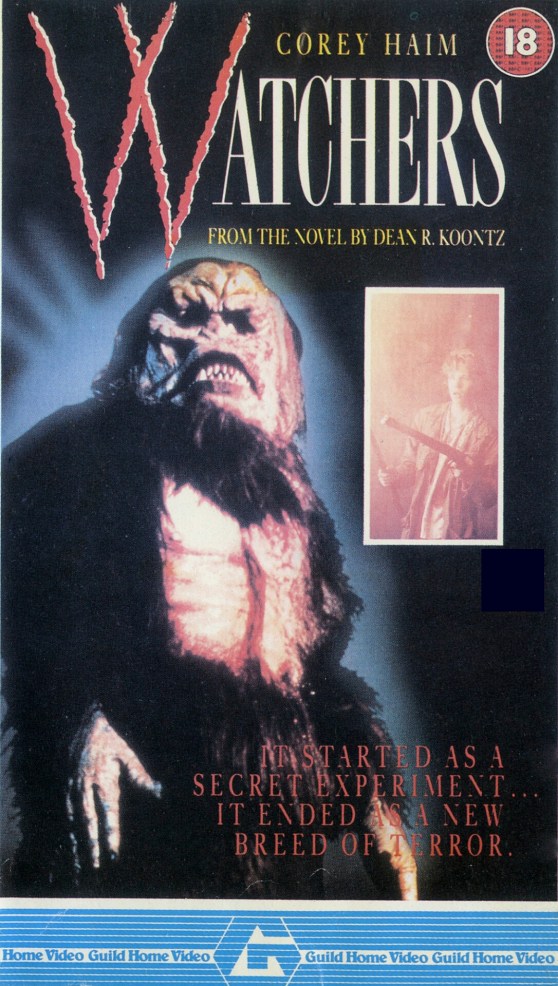
Watchers (1988): It’s a rivalry as old as time: a golden retriever with special abilities battling the mutated monster known as the OXCOM (Outside Experimental Combat Mammal).

The dog soon makes friends with Travis Cornell (Corey Haim) and his girlfriend Tracey (Lala Sloatman, who was dating Haim; she’s also the niece of Frank Zappa and is in Amityville: A New Generation). Of course, the government wants the dog back, so they send NSO agent Johnson (Michael Ironside).

This movie kills everyone it comes across, with either OXCOM or Johnson basically wiping out a small town, whether to kill or to keep the murders secret.

Amazingly, this was originally written by Paul Haggis, who would go on to write Million Dollar BabyCrash and yes, create Walker Texas Ranger.
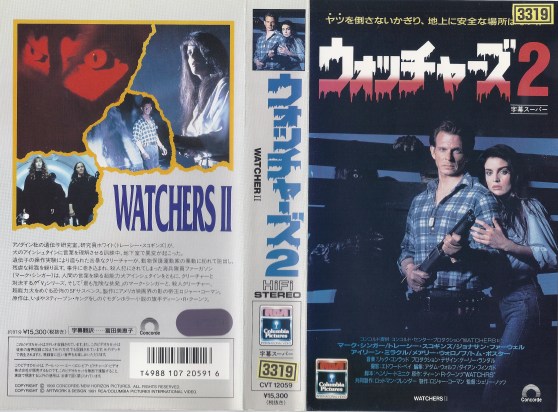
Watchers II (1990): Hey, I think that Marc Singer — he’s the Beastmaster — and Tracy Scoggins — from Dynasty and The Colbys — are fine replacements in this film that finds OXCOM and a golden retriever still battling one another.

Singer is a Marine gone AWOL. Scoggins is an animal psychologist from the top secret laboratory and the OXCOM still is a goofy rubber suit. And sure, this may be the same movie we just watched, but when has a sequel being the same as the first movie ever stopped us?

Screenwriters John Brancato and Michael Ferris used the name Henry Dominic — the same alter ego they’d use for Bloodfist IIFlight of the Black AngelThe UnbornSevered Ties and Mindwarp — as neither were members of the Writer’s Guild of America. Brancato and Ferris would go on to write The Game, as well as The Net.

Thierry Notz also directed The Terror Within which makes a lot of sense once you see this movie.
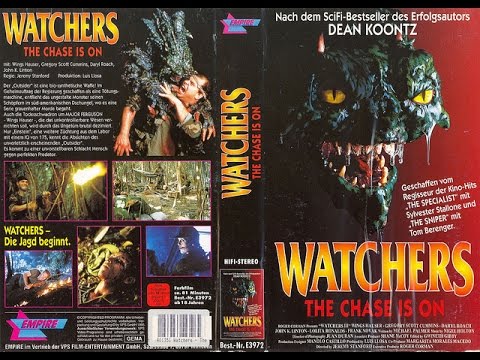
Watchers 3 (1994): Oh yes, this third one was shot in Peru, executive produced by Roger Corman and has one of my favorites, Wings Hauser, in the middle of the never-ending war between mutant and mongrel. Yes, this time it’s the deformed Outsider, which lives only to kill, battling Einstein, a golden retriever with an IQ of 175.

To stop the monster, Hauser is put in charge of a squad of military men and criminals. Now if you’re thinking, “Would Roger Corman rip off Predator?” let me just say that yes, he would. He did. And he would do it again.

Written by the same man who penned Carnosaur 2, let me tell you, I will regret nothing on my deathbed except probably the time I spent watching this movie. Eh, who am I kidding? I’d watch it again if you asked with any nicety in your tone.
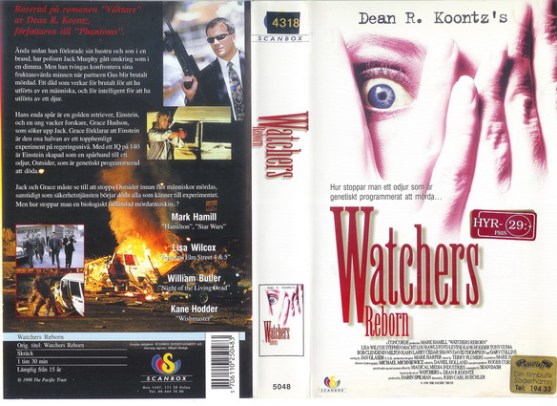
Watcher Reborn (1998): You know what you never realize as a kid? As bad of a director as George Lucas can be, he’s one of the few people able to reign in the hammy tendencies of Mark Hamill, who plays a detective in this one who has just lost his wife and son to a fire that was probably caused by a mutant because that’s how it goes.

Lisa Wilcox, Alice from A Nightmare On Elm Street 4 and 5, plays the scientist who introduces him to a golden retriever, this time named Alex and being not as smart as he was the last time, only having an IQ of 140. This one also has a pit bull and the man who ruined Night Gallery in syndication, Gary Collins, so you know that my heart is on the side of the animals and not the humans. I’m also on the side of all murderous mutants, because as Emily Dickinson wrote, “The heart wants what it wants, or else it does not care,” and we’ve gone about proving this inscrutable wisdom true ever since.”

Low Rawls — yes, the man who sang “You’ll Never Find Another Love like Mine” — has a cameo as a coroner, so if you ever get asked, “What do Lucio Fulci and Lou Rawls have in common?” and a gun is at your temple, I have provided you with the knowledge that will save your life.

Director John Carl Buechler ran Corman’s special effects team for some time before directing movies like DemonwarpCellar Dweller and Friday the 13th Part VII: The New Blood.

Should you watch the Watchers movies? Look, I don’t want to tell you what to do with your life. I mean, you could also ask, “Should you watch a hundred Jess Franco movies in one month?” The answer is always going to be yes for me as I try and get the highest of movie highs, no matter how bad the strain seems to be.


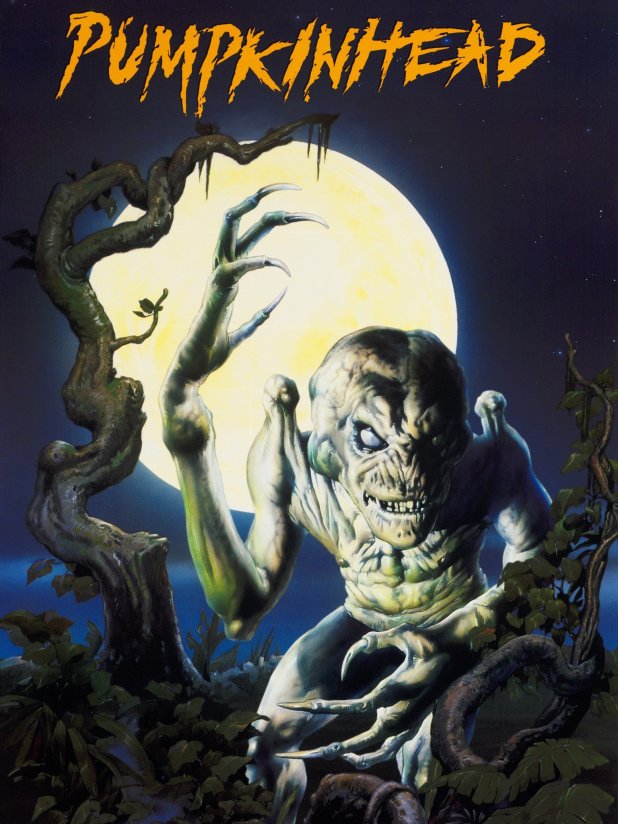
Pumpkinhead (1988)

It felt like at the end of the 80s everyone wanted to make the next great monster. Stan Winston made more monsters than anyone else, so when he got the chance to direct his first film, the monster had better be great.

Sure, Pumpkinhead looks kind of like the xenomorphs from Alien, but it also has a throwback to the energy and foggy menace of classic horror. That may be because writers Mark Patrick Carducci (Neon ManiacsBuried Alive) and Garry Gerani looked to the movies of Mario Bava for inspiration.

It’s also the only monster movie that I know that comes from a poem. Yes, Ed Justin wrote this poem, Pumpkinhead, which inspired the movie*:

“Keep away from Pumpkinhead,
Unless you’re tired of living,
His enemies are mostly dead,
He’s mean and unforgiving,
Laugh at him and you’re undone,
But in some dreadful fashion,
Vengeance, he considers fun,
And plans it with a passion,
Time will not erase or blot,
A plot that he has brewing,
It’s when you think that he’s forgot,
He’ll conjure your undoing,
Bolted doors and windows barred,
Guard dogs prowling in the yard,
Won’t protect you in your bed,
Nothing will, from Pumpkinhead!”

Ed Harley (Lance Henriksen) has already lost his wife, so when a bunch of teenagers accidentally kill his son, he gives gold to a witch to get the revenge the law won’t give him. That revenge is the gigantic Pumpkinhead, which pretty much kills everyone and anyone.

I really loved this when it came out on video, as it really has a dark story to go with the effects and so few horror movies at the time mixed the supernatural with the rural. It just works so well and Winston has a great eye for a first-time filmmaker.

You know who stars in this and you may recognize him? That’d be Mushroom, the dog who plays Ed’s dig Gypsy. He also played Barney in Gremlins. And yes, that’s Mayim Bialik two years before she was Blossom.

Here’s the silliest trivia I have about this movie: it’s cinematographer, Bojan Bazelli, directed Mariah Carey’s “Vision of Love” video.

*I learned this from Horror Geek Life.

Hellraiser II: Hellbound (1988)

Most of the cast and crew of Hellraiser returned to make this movie and you know, despite the reduced budget, the dark tone of this movie and continuation of the themes from the original makes this one of the better horror sequels.

Kirsty Cotton (Ashley Laurence, returning from the first movie) is admitted to a psychiatric hospital where Doctor Channard and his assistant Kyle MacRae listen to her story. She begs them to destroy the bloody mattress her stepmother Julia Cotton (Clare Higgins) died on but Channard ends up being a man who has been obsessed with the Lament Configuration. After a patient slices himself open upon that cursed object, Julia comes back to our reality.

Channard and Julia have been luring mentally disturbed men to his home so that Julia can feed off of them. Meanwhile, Kirsty meets Tiffany, a girl skilled at solving puzzles who is forced by the doctor and his demented mistress to open the gates of Hell with the infernal box at the heart of this story.

Within the dimension of Leviathan, the humans are more duplicitous than the demonic Cenobites that carry out the orders of their master.

Barker had plans to show how each of the Cenobites had once been human and how their own vices lead to their becoming angels to some, demons to others. You’d think that with the success of the first film they could have had a little more money here.

Another intriguing notion is that Julia was originally supposed to rise from the mattress at the end of the movie as the queen of hell and be the recurring character. As the first movie gradually became a success, Pinhead ended up becoming the favorite.

Back in the video rental days, I may have brought this home more than twenty times. I was obsessed by the look of Leviathan’s dimension and the strange sound that it makes — Morse code for God — blew my teenage mind. It still holds up today, despite a litany of lesser sequels (which trust me, we’re getting to).

You can watch this on Tubi.

JOE D’AMATO MONTH: China and Sex (1994)

A very rich man falls in love with Tama, the most gorgeous woman in the brothel. Yet she wants nothing to do with him unless he goes through a spiritual journey and enters the four chambers of forbidden. The name for the director may be Robert Yip (or Chang Lee Sun!) and we all know who that is — Joe D’Amato.

How do you know it’s Joe? Well, in addition to some diners flavoring their shrimp in a very private place, there’s also a graphic castration, a theme that shows up in more than two D’Amato movies, Sesso Nero and Novelle licenziose di vergini ogliose.

This movie also marks the end of an era, as it’s the last Filmirage release. After this, D’Amato would mostly make adult films. Often they were epics like As Aventuras sexuals de UlyssesJoe D’Amato’s Outlaws (the first D’Amato movie I ever saw before realizing that he had a whole career making horror movies) and Decameron: Tales of Desire.

That journey into sex and death doesn’t go well for our protagonist. And this is a movie that few care about. But you know. I’m sad as this week comes to a close, a week filled with nearly seventy Joe D’Amato movies. Thank you for joining me and I hope that you discovered something that you came to love too.


JOE D’AMATO WEEK: Chinese Kamasutra (1994)

Joan Parker (Giorgia Emerald, who only appeared in this film) works in a Chinese library and she turns down every man brave enough to try and pick her up until she finds the Chinese Kamasutra on the shelves and the black and white illustrations get her all excited like The Joy of Sex‘s hairy bodies did for your parents in the mid 70s and she discovers liberation. Also, a sex cult is spying on her because she’s a character in a Chang Lee Sun film.

Yes, that’s Joe D’Amato.

Anyways, this sex cult lives right next to Joan and they’ve been after her forever, even in a past life, and they have a dildo altar because, again, this is a Joe D’Amato movie.

Also, the Kama Sutra is a Hindu Indian book and not Chinese.

I have no idea why Giorgia Emerald only made this one movie. Sure, her performance isn’t the best ever, but she’s incredibly attractive and seemingly perfect for the D’Amato softcore world. As it is, you can tell that he’s not invested at all in this movie and simply making films at this stage to make money. Some moments of strangeness still emerge and for those of us who are completists, this is one more to check off our lists.