El Hacha Diabolica (1965)

El Encapuchado Negro is more than just another villain for El Santo to fight. He’s a supernatural force that has been hunting Santo and his family for four centuries. That’s correct. The silver mask has been passed down from generation to generation and it has magical powers because it was created by a magician all the way back in the 17th-century.

I mean, this thing starts with monks solemnly carrying the dead body of Santo to a tomb back in 1603 and we see the black hooded man claim that he will get back at the deceased man in the silver mask no matter what it takes. That would be 1965, as the axeman shows up as Santo is wrestling Lobo Negro. Bullets don’t stop the killer and he doesn’t show up in photos, but his axe nearly kills our tecnico hero.

Santo also has a girlfriend named Alicia, but he’s certain that he has a past love that he just can’t place. He is, however, willing to pull most of his mask to show her his face and make out — but it’s definitely not Rodolfo Guzmán Huerta under the mask for this scene.

The axeman tries to kill Santo again while he sleeps — in his clothes, no less — and he leaves his axe behind. It has the date 1603 and a small occult symbol on it, but so does Santo’s mask! Oh man, as if I couldn’t get into these movies any more. Santo was saved by a woman’s scream and that woman ends up being the ghost of Isabel de Arango. If Santo can stop El Encapuchado Negro, they can fall in love again. Santo, for his part, is dumbfounded by what is happening.

That’s when we learn the truth, as Santo uses a time machine to send his brain back in time. Back then, a man was in love with Isabel, but she only loved Santo. He tried to kill our hero yet Santo beat him in a swordfight before that rudo sold his soul to Satan and got all the power — and gold and gems — he would need to gain her love. Instead, he chains her up in a dungeon and the man who would be the first Santo goes to a magician named Abraca to gain the powers of Santo.

Santo and the Inquisition capture the Black Hood who is burned at the stake — keep this same storyline in mind for El Mundo del los Muertos — but becomes a bat and flies away. Santo decides to live in a monastary as the loss of his love has destroyed his life.

Oh man. It also turns out that Santo’s scientist friend Dr. Zanoni — the one who made the time machine — was really Abraca and he jumps in front of an axe made for our silver masked superhero.  Santo even tries to break up with Alicia for her own safety after the axe murderer possesses one of his opponent, but she dies that same night.

Santo finally tracks down the killer and finds the skeleton of his lost love — well, the first one, not the blonde who was just axe murdered — chained to a wall. Santo goes off and hits the madman with a torch, then impales him when he transforms into a bat. Isabel becomes human and goes to Heaven while Santo is left all alone as even the room transforms from a gothic tableau to an empty room. Man, what a nihilistic ending for our friend.

You could do worse than watching a man who can disappear and then show up ready to chop off Santo’s head at any moment. I kinda love this movie and would probably be even more into it if El Mundo del los Muertos wasn’t an improved remake.

You can watch this on YouTube.
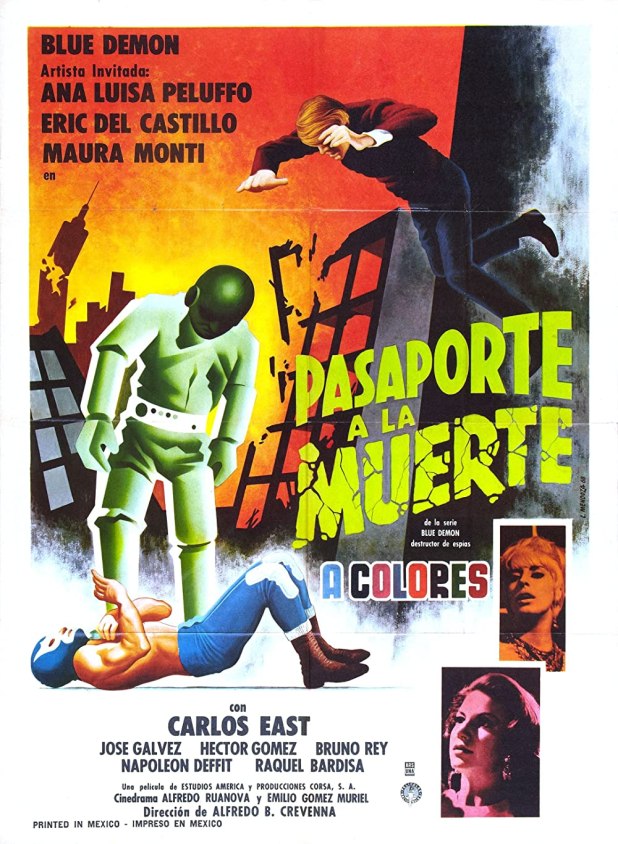
Pasaporte a la Muerte (1968)

Alejandro Muñoz Moreno was the fifth of twelve children, the son of farmers, who worked on the National Railroad, who met the famous Mexican wrestler Rolando Vera and became his student. He soon put on a mask and became the Blue Demon, teaming with The Black Shadow as Los Hermanos Shadow (The Shadow Brothers).

After El Santo defeated Black Shadow and took his mask, Blue Demon became a tecnico. Even though this devil was now on the side of the angels, he and Santo would feud with Blue Demon coming out on top, even winning the NWA World Welterweight Championship from his rival. Even though would star together in films, there was always a rivalry.

Blue Demon shows up in the background of The Killers of Lucha Libre and Fury in the Ring, but he started acting in his own movies in 1964, as Santo had asked for more cash and producer Enrique Vergara wanted to add a second star. You can catch Blue Demon in twenty-five movies — nine with Santo — and three great movies where he leads Los Campeones Justicieros (The Champions of Justice) — whose members include El Medico Asesino, El Fantasma Blanco, El Avispon Escarlata, Superzan, Mil Máscaras, Tinieblas and Rayo de Jalisco (who Blue Demon defeated in a mascara contra mascara match in 1988, the year he retired).

Alfredo B. Crevenna (Planet of the Female Invaders, Santo vs. the Martian Invasion and 150 more movies) was the man behind the camera for this tale of Blue Demon — securely a part of the Eurospy world after his last movie, Blue Demon Destructor de Espías — battling an android. That android is a man in a silver suit with oven mitts, which makes me love this movie even more than I knew that I was going to. There’s also an astounding mascara contra cabellera match between a gigantic rudo and Blue Demon that ends with the losing maniac flipping out and attacking even the barber there to shave his head.

There’s also a swinging nightclub scene with a band named El Klan, which isn’t a name that any band would have today.

Desire (1936)

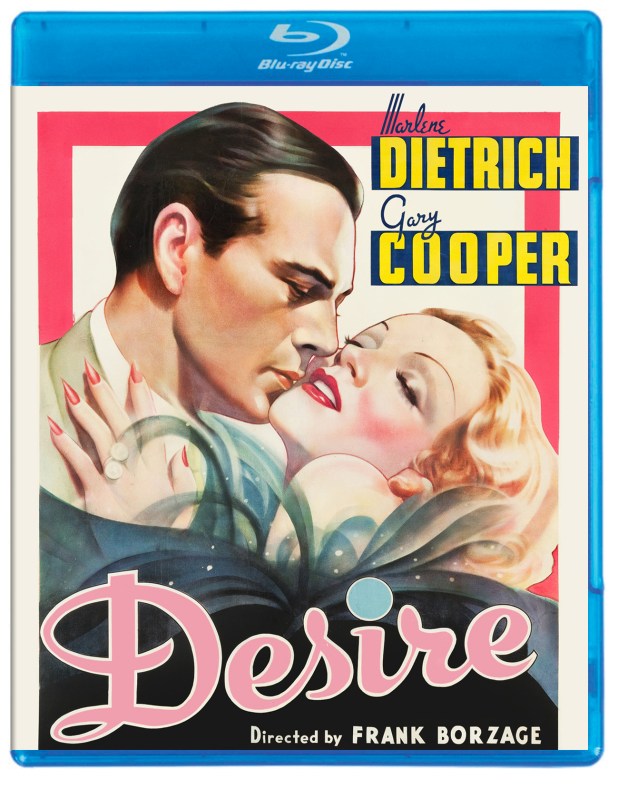
After one of the most elaborate jewel heists in European history — in which our female protagonist convinces not just one, but two men that she’s about to marry them — Madeleine de Beaupre (Marlene Dietrich) has escaped with a small fortune of pearls.

On her way to Spain to fence the goods, she runs into car trouble and is helped by Tom Bradley (Gary Cooper), a kindly American who just wants to help. She leaves him behind but he accidentally ends up with the hot pearls. That means that she has to romance him in the hopes of getting them back. But what happens when she falls for someone instead of just trying to work them?

A remake of Happy Days in Aranjuez, which was based on the play Die Schönen Tage von Aranjuez, by Hans Székely and Robert A. Stemmle, this movie was supposed to be the comeback movie for John Gilbert after a series of failures. Only days before shooting started, he had a heart attack and got replaced by John Halliday.

Supposedly, Gilbert and Dietrich were living together when she tried to use her influence to have him cast opposite her. However, she withdrew her support when he started seeing former fiancée Greta Garbo again. Dietrich then got back with Gary Cooper and Gilbert had a fatal heart attack occurred on the same day that Cooper’s casting was officially announced by Paramount.

Dietrich spoke highly of this movie, saying: “The only film I need not be ashamed of is Desire…” and “Desire became a good film and, moreover, also proved to be a box-office success. The script was excellent, the roles superb – one more proof that these elements are more important than actors.” She must have really enjoyed this movie, because she played the role at least two more times in radio adaptions.

The new Kino Lorber blu ray of Desire has two commentary tracks, with one by Samm Deighan and the other featuring David Del Valle and Nathaniel Bell. The 2K remastering of the film looks great and this is just about a perfect release for lovers of Hollywood history.

Noche de Muerte (1975)

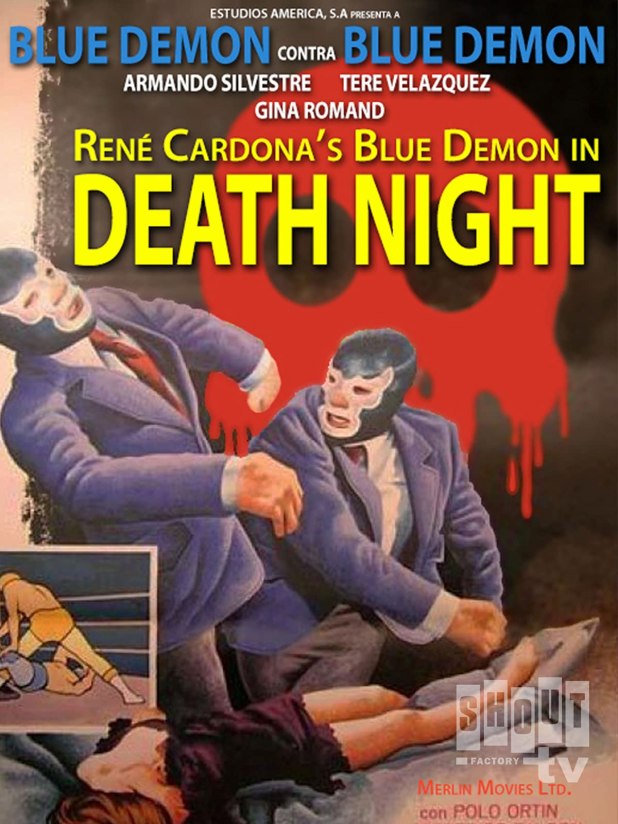
René Cardona directed 146 movies and I’ve made it my lfie’s work to watch as many of them as possible. This one stars Blue Demon and it establishes a conceit that makes a lot of sense: how can anyone tell who is under that blue mask? And what if someone else also wears the mask and starts killing people and robbing banks and jewelry stores?

It’s all the work of the evil Count and El Cosaco, a luchador with a grudge against our hero. But the cops don’t know that. I really love the fact that Blue Demon challenges his evil version to a mascara contra mascara mask and puts his enemy in a submission that doesn’t allow him to move. He yells for the detective who has been tracking him down to take off the man’s mask and prove his innocence. It’s a great way to get across Blue’s grappling skill and makes for a fun ending.

I mean, I did tell you how this ends, but that doesn’t mean you shouldn’t watch it. The version that’s on Shout! TV has some of the best and worst dubbing I’ve ever listened to, which is really how it should be.

Santo contra los Asesinos de Otros Mundos (1973)

Four people have been killed and three of them were very important people. Of all the detectives that Mexico can call, Santo seems like the best pick. The bad guys want $10 million in 24 hours, but with the man in the silver mask looking for them, perhaps the cops are right to not negotiate with maniacs.

It turns out that the killer is a blob, which means that Santo has faced nearly every great movie monster of the past and has now moved into the modern era. But now he has to content with a bad guy who forces him to battle numerous men in gladiator matches before revealing that he has moon rocks that he is growing into creatures willing to do his bidding. Let’s give it up for Santo in this one because he goes all Indiana Jones and instead of a long fight, he just grabs a machine gun and blows away a bunch of henchmen.

Let me go back and break down that scene again. Santo is forced to battle bad guy after bad guy in a room that looks like it has fake stars and one of them has a flamethrower. I don’t know why anyone makes movies any longer when we have movies like this that give you that scene and then remember that the film is really about a blob. That blob not only attacks innocents, it also eats one of the major bad guys and a villain’s girlfriend.

Don’t get too excited about that blob. It really looks like several people under a sheet, which makes me so much happier than any special effect could. I also enjoy a bad guy who makes all of his men wear neckbands that gas them if they screw up.

Director Rubén Galindo also made Santo vs. the She-Wolves which flirts with gothic horror inside the world of the man with the silver mask. It’s great.

Santo y Mantequilla en la Venganza de la Llorona (1974)

Of course Santo should fight La Llorona. And why shouldn’t Mantequilla Nápoles — born José Ángel Nápoles — who was a real-life boxer who went undefeated for forty years also be in this? Plus, who better than René Cardona Sr. to play the crime boss Severo Segovia?

All of this starts when a professor — the learned elders who populate every Santo movie — asks our hero to help him take a medallion from the corpse of Eugenia Esparza, which is really a map to a treasure in gold coins. Santo wisely says no and the professor explains the story of La Llorona, in which Eugenia learned that Gonzaga, the father of her children, was about to marry another man. She makes a deal with Satan that if she poisons her kids and kills herself that the man will be convicted and executed. And if not, she will come back from the dead to torment him, which is exactly what happens as she fills all of the first born children of his family after he is acquitted and the gold — which was stolen from the queen, so this would doom the man — is never discovered.

The next descendent to die will be the professor’s nephew Carlitos. The older man promises Santo that he will give the money to a children’s charity and together, they will break the curse of the crying woman.

Santo and the boxing champ never really fight La Llorona, as it would not be seen as noble to have them battle a woman mano y mano.

Giants and Toys (1958)

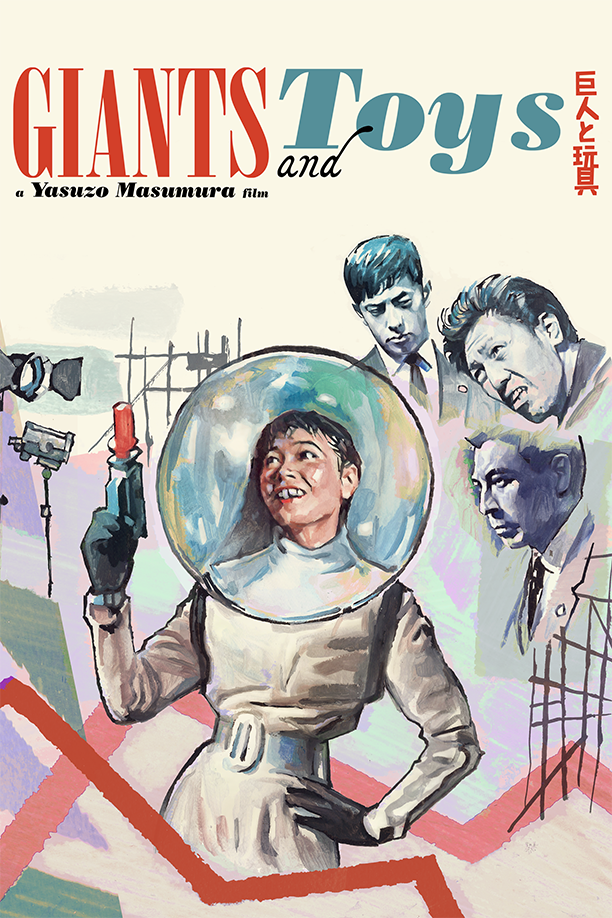
This film is all about the war over caramel sales, with the hunt for a new female mascot to get the public to keep buying candy. One company, World, hires a working class girl with bad teeth, dresses her up in a spacesuit and hopes to win the battle. She ends up becoming a popular idol singer and dancer before she leaves the candy world behind. Meanwhile, the ad man who discovered her spits up blood and makes his assistant sleep with other company’s advertising ladies. Anything goes, because there is a smaller and smaller share left after the market is increasingly dominated by imported U.S. candy.

You know, I’ve worked in advertising my entire life and this movie really feels like something I’ve lived through. This movie’s maverick director Yasuzô Masumura bucked the norm of Japanese society and made films that promoted the value of the individual. He was also the first Japanese filmmaker to study at Italy’s Centro Sperimentale Di Cinematografia, which led him to say, “In Japanese society, which is essentially regimented, freedom and the individual do not exist. The theme of Japanese film is the emotions of the Japanese people, who have no choice but to live according to the norms of that society. After experiencing Europe for two years, I wanted to portray the type of beautifully vital, strong people I came to know there.”

In case you thought all that Daiei Film made was Gamera, Zatoichi and Yokai Monsters, remember that this film — and JokyoRashomon and Ugetsu were all made at this studio.

You can watch Giants and Toys on the Arrow Player. ARROW is available in the US, Canada and the UK on the following Apps/devices: Roku (all Roku sticks, boxes, devices, etc), Apple TV & iOS devices, Android TV and mobile devices , Fire TV (all Amazon Fire TV Sticks, boxes, etc), and on all web browsers at https://www.arrow-player.com.

Head over to ARROW to start your 30 day free trial. Subscriptions are available for $4.99 monthly or $49.99 yearly.

You can also get this on blu ray from Arrow. That release features trailers and new audio commentary by Japanese cinema scholar Irene González-López, a newly filmed introduction by Japanese cinema expert Tony Rayns and a visual essay by Asian cinema scholar Earl Jackson.

La Venganza de las Mujeres Vampiro (1970)

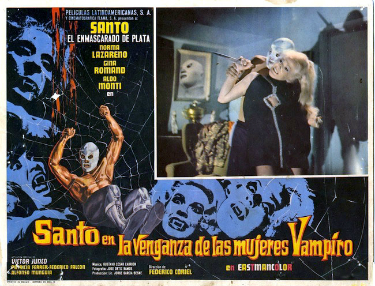
After we watch the vampire Mayra get staked while in her coffin, the action movies to present Day Mexico and Dr. Brancov and his men take her coffin and bring it back to his lab. There, they use human blood to bring the queen of the vampires back to infernal life. You know whose blood they’re going to use? Go-go dancers.

This movie is already better than anything that will be release in our lifetimes.

One of Santo’s ancestors is the one who stopped Mayra last time, so she’s out to kill our hero before he can kill her, including slipping his opponent brass knuckles, trying to cloud his mind while he wrestles and even stabbing him while he sleeps.

This is the kind of movie that can have a disco be a hunting group for vampires, a Satanic sacrifice and a monster in the depths of a mad scientists lab one scene after the other. Trust me, lucha movies will ruin your ability to enjoy any other film drama, much less Merchant Ivory films.

Also: not even the first* or second ** or third time*** that Santo fought vampires!

*El Santo contra las Vampiras Mujeres

**El Barón Brakola

***Santo en El tesoro de Drácula

You can watch this on YouTube.
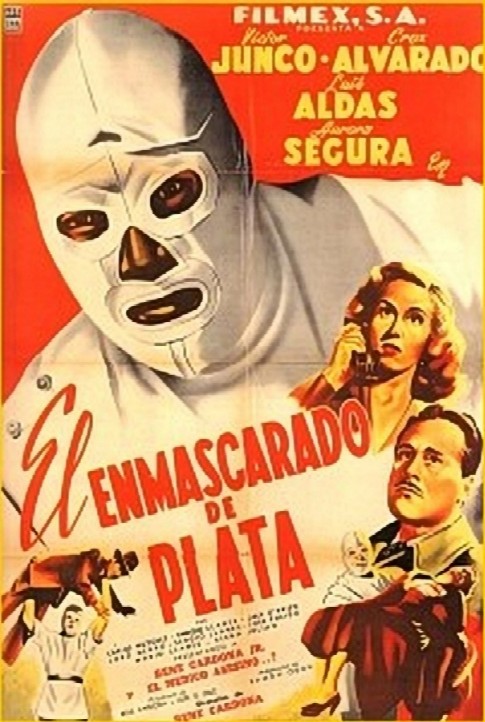
El Enmascarado de Plata (1954)

In 1952, José G. Cruz created a comic book that turned Santo into a Mexican hero. This series ran for 35 years and was the basis for the Santo films, yet before that, director Rene Cardona wanted to make this film. Santo decided to not be in this, as he thought it would fail.

Who can say if he was wrong or right? All we do know is that within a few years, Santo would be a movie star, so maybe he just knew how to pick the right scripts.

This film is filled with villains. There’s Lobo Negro and his street gang, there’s a Silver Mask that gives the orders and another villain in a hood named El Tigre that gives even more orders, but he’s the one to listen to because he’s figured out how to throw lightning and change the weather. You know, if you could do this, wouldn’t you want to do it all the time? Well, El Tigre is more into being a traditional gangster, so perhaps he feels like having all these mereological powers are kinda like cheating.

Our hero is El Médico Asesino and his sidekick Freckles. One wonders how is a man named Killer Doctor the good guy, but these questions are best left unasked.

This isn’t the first lucha movie. That would be Huracán Ramírez, a movie in which actor David Silva played the masked wrestler. Eduardo Bonada wrestled as Huracán Ramírez until he was replaced by Daniel García, who kept the character until he retired; he’s in the movies El misterio de Huracán Ramírez, El Hijo de Huracán RamírezLa Venganza de Huracán Ramírez*. If you ever hear of a wrestler doing a move called a huracánrana, it came from García as Huracán Ramírez. He also played Santo in La Leyenda. Huracán Ramírez regularly teamed with Santo in the ring — but not in the movies — often forming a trio with Rayo de Jalisco.

During a match between this tecnico team and El Signo, El Texano and Negro Navarro — who still wrestles to this day as a maestro-style luchador** — Santo had a heart attack and was saved by Huracán Ramírez. Lifelong friends, he would be a pallbearer for Santo when he was buried in his silver mask. As for El Signo, El Texano and Negro Navarro, the infamy they received from this match led to them becoming known as Los Misioneros de la Muerte (The Missionaries of Death) and their trios-style would make trios matches the most common match form in Mexico.

As for Médico, he would go on to appear in El Luchador Fenómeno and La Bestia Magnifica before becoming one of the most famous Mexican wrestlers of his era. He was the first luchador to have a female second — La Enfermera del Médico Asesino — and teamed with Santo and Enfermero as Ola Blanca (White Wave). He also feuded in Texas with Pepper Gomez, Duke Keomuka and Johnny Valentine as a babyface using the name El Medico. He even had four NWA title matches against Lou Thesz at this time, a major deal in that era.

Sadly, Médico would be dead from advanced cancer just a few years later. There’s an urban legend that his family kept the cancer a secret from him, but for a guy who weighed 275 pounds in his prime to die at around 110 pounds, he had to know something was wrong. Luckily, he had insurance and saved his money, so his family didn’t suffer monetarily. Ironically, his wife worked as a nurse after his death.

His death was enough to reduce his opponents — and partners, El Enfermero famously broke down during a match and just sat on the floor of Arena Coliseo — to tears. He may not be known in the U.S. like Santo or Mil Mascaras, but he was an incredibly important figure in lucha libre history.

Anyways — this film is a footnote in Mexican wrestling movie history, but an important one.

*He is not playing the character in the boxing movies Huracán Ramírez y la Monjita Negra and De Sangre Chicana.

**This ground wrestling escape style is closer to the British World of Sport style than modern lucha, as it has near dance-like motions. It’s the best thing ever. Another example of a star that does this style is El Solar. You can also catch Navarro’s son’s as Los Traumas.

Note: Sources used include Luchawiki and the November 16, 2020 issue of the Wrestling Observer, in which Médico Asesino was inducted into the Wrestling Observer Hall of Fame.

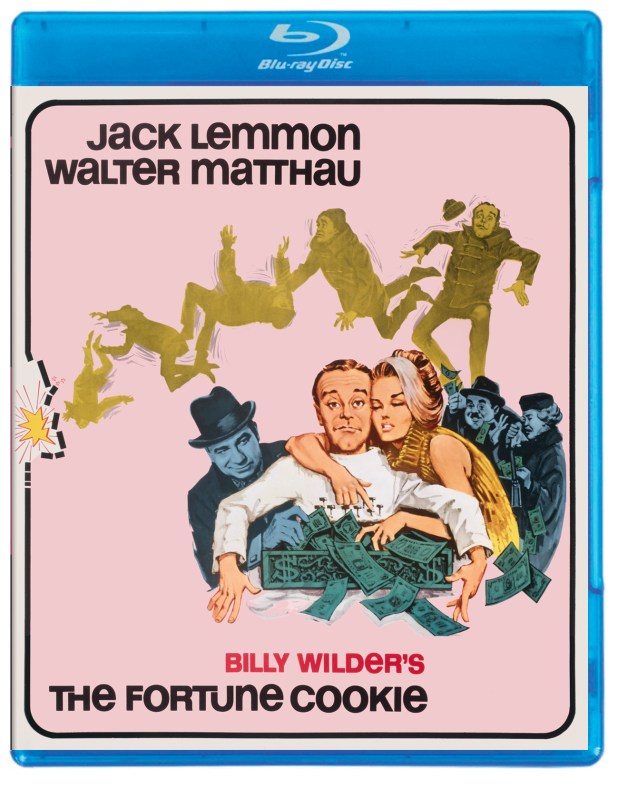
The Fortune Cookie (1966)

The first on-screen teaming of Jack Lemmon and Walter Matthau*, this film won the latter the Best Supporting Oscar. That’s a great reward, as production on the film stopped after Matthau had a heart attack. He lost thirty pounds in the hospital, so if you see any scenes in this movie where he has on a heavy jacket, they were shot after the health crisis.

Lemmon plays cameraman Harry Hinkle and he’s knocked out during a play when Cleveland Browns player Luther “Boom Boom” Jackson (Ron Rich) runs him over. Harry’s fine, but his brother-in-law William H. “Whiplash Willie” Gingrich (Walter Matthau) comes up with a plan to get some insurance money. The only reason Harry plays along? The chance to get his ex-wife Sandy (Judi West) to love him again.

After this film, Lemmon and Matthau would team up for The Odd Couple, Kotch, The Front Page, Buddy Buddy, Grumpy Old Men, The Grass Harp, Grumpier Old Men, Out to Sea and The Odd Couple II. They bonded early in the production process and connected over their love of football. They would remain close for the rest of their lives.

This was directed by Billy Wilder and it sparkles.

You can buy the new blu ray release of this movie from Kino Lorber. It comes complete with the Trailers from Hell episode about the film; commentary from Joseph McBride, author of Billy Wilder: Dancing on the Edge and even a clip of Jack Lemmon asking for extras to show up to the crowd scenes that were filmed in Cleveland’s Municipal Stadium.

*Frank Sinatra and Jackie Gleason were also suggested for the role, but Lemmon insisted that Matthau be in the movie.