An entry in ABC’s Wide World of Mystery (Rock-a-Die, Baby) this quick burst of shot on video is way ahead of its time and way worth watching. Produced by Dan Curtis, directed by Lela Swift (who also helmed Dark Shadows and several of these ABC mini-movies) and written by George Lefferts (whose made for TV career includes several of the 1960’s Special for Women specials and episodes of afterschool specials for both ABC and CBS), it’s all about an orphan (an incredibly young Kate Mulgrew) who discovers an alien TV signal and falls in love with Marc, a man from another dimension played by John Ventantonio (Private Parts).
Sure, she may have just left the mental institution, but who is to say what’s real and what is not in her world? And man, if you only knew Pernell Roberts as the kindly Trapper John, get ready to be upset.
Sadly, so many of these genre TV shows have never been released and many of them are lost. Thanks to YouTube, you can watch this.
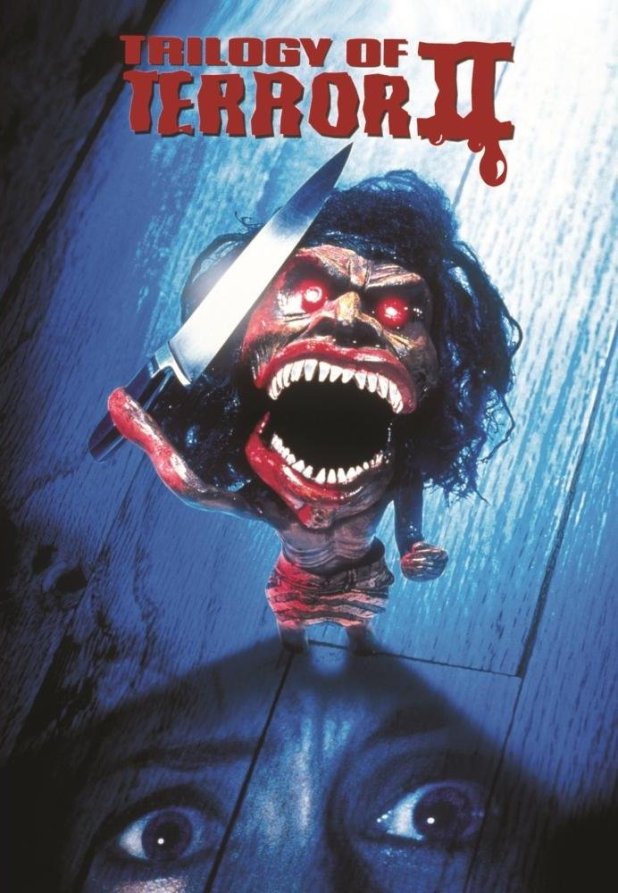
More than twenty years after the original Trilogy of Terror, Dan Curtis would return to the portmanteau with a sequel that takes not only its framework from the original, but even one of the stories from another Curtis anthology. No matter — I devoured this film.
We jump right in to the first story, The Graveyard Rats, which is based on Henry Kuttner’s short story. A wealthy man (Matt Clark, Tuff Turf) learns that his wife (Lysette Anthony, Krull, the 1990’s Dark Shadows) is sleeping around with her own cousin (Geraint Wyn Davies, who was Nick Knight on Forever Knight).
The rich man threatens blackmail; the young man proposes murder; the woman shoves her husband down the steps. After some duplicitous actions by all, the access to the dead man’s money is lost, lovers attack one another and giant rats devour everyone. You know how it goes.
The second story is the Richard Matheson story Bobby, which also appeared to great effect in the Curtis movie Dead of Night. Anthony takes over the Karen Black role here, reappearing in all three stories, as she wishes for the return of her drowned son to horrifying result. This story is just as impactful as it was in the first iteration and has some moments of sheer terror. Well done.
Finally, another Matheson tale, He Who Kills, is quite literally the sequel to the original Trilogy of Terror crowdpleaser Amelia. Yep — that lil’ Zuni warrior is back and the story pretty much follows the same format as the one you know and love. There’s a fun meta moment where a security guard is reading a Dark Shadows comic that made me laugh.
Trilogy of Terror II is a decent movie, but it’s the sequel to a film that’s been the gold standard of made for TV horror for decades. Go in with the knowledge that it can’t live up to that and have some fun.
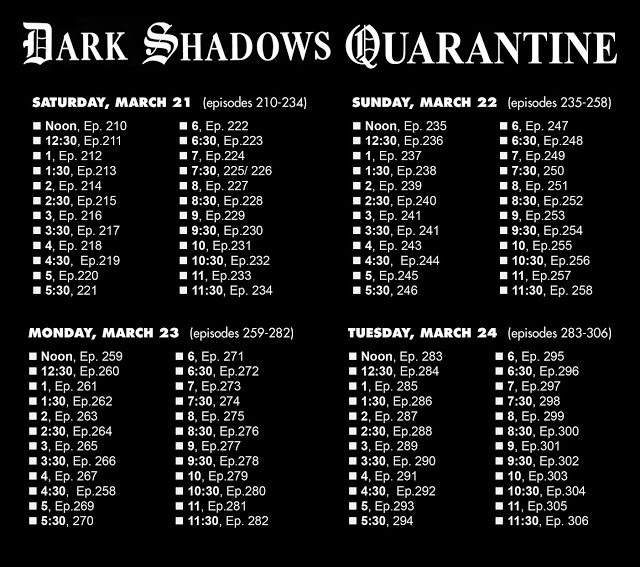
The Collinsport Historical Society is an amazing site that I used as a reference throughout the makings of our Dan Curtis week. And now, they’re working to keep people sane during quarantine with a Dark Shadows watching event.
According to the site: “Beginning every half hour on Saturday at noon, Eastern Standard Time, we’re going to watch an episode of Dark Shadows … beginning with episode 210. From there, it will be a block of 24 episodes ending at midnight. Join other fans on Twitter to talk about these episodes live, using the hashtag #DarkShadows. Here’s a schedule of episodes for the first four days. You can follow me online at @CousinBarnabas and Patrick McCray at @TheRealMcCray. (This whole thing was his idea!) And don’t forget the hashtag … that’s how other Dark Shadows fans will find you. The schedule below will allow you to drop in and out of the event as you please.”
You can watch these episodes on Amazon Prime, Hulu and Tubi. Or, you can be a maniac like we are and have all of them on DVD already. Or VHS, if you’ve been into it long enough.
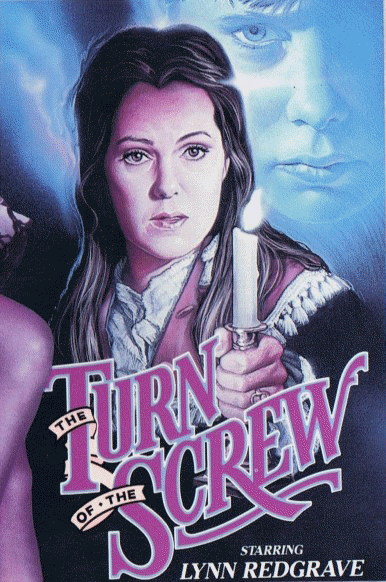
Originally airing on ABC on April 15, 1974, this Dan Curtis-produced and directed film takes the videotaped look of Dark Shadows to the Henry James novel and wraps it all up in a little under two hours. And if you love that gothic fiction soap opera, good news. Music cues from it are all over this made for TV movie.
Lynn Redgrave stars as Miss Jane Cubberly, is hired by Peter Quint and sent to look after young Miles and Flora after the deaths of their parents. Yet wickedness (that word will be used often; I chased my wife around our house screaming dialogue from this movie in my horrible British accent) abounds and perhaps Jane should have never made her way to the Bly house.
The issue with The Turn of the Screw happens with every adaption: people have been trying to figure out the novel since it was first written. The story, the revelation at the end and the characters’ motivations are all up to the individual reader, which makes it difficult to film a movie for everyone.
Kathryn Leigh Scott, who played Maggie Evans on the original Dark Shadows and has written many of the books that have kept the show alive, is in this as Miss Jessel. Megs Jenkins, who plays Mrs. Grose, also had the same exact role in another adaption, The Innocents.
Here’s a great fact: Redgrave is one of four members of her family to appear in an adaptation of this story. Her father Michael was in The Innocents, her brother Corin was in the 2009 version and her niece Joely Richardson played Darla Mandell in the recent version, The Turning.
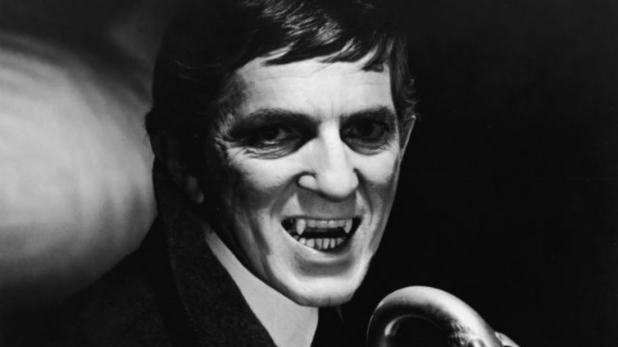
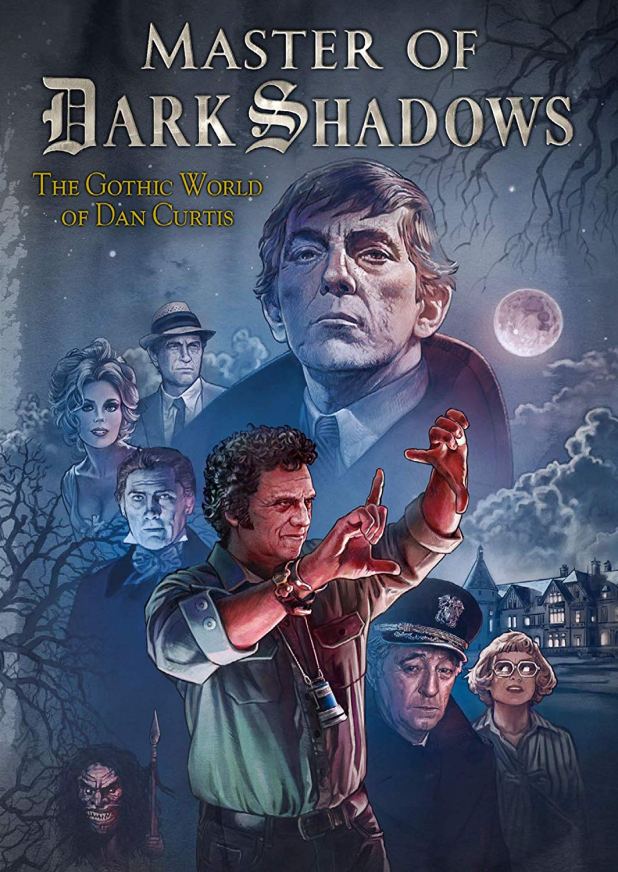
We’ve gone on — and will this entire week — about Dan Curtis and Dark Shadows. Finally, this movie — director by David Gregory, one of the co-founders of Severin Films — is here to tell the story of the creative power that was such a part of American TV horror in the 1970’s. Beyond Dark Shadows, Curtis was known for The Night Stalker, Trilogy of Terror and Burnt Offeringsbefore his two mini-series The Winds of War and War & Remembrance earned rave reviews, won multiple awards and dominated the ratings.
Narrated by Ian McShane, this film has reflections by the late Curtis, along with many of the people who worked with him closest and his family. Look for Dark Shadows stars Jonathan Frid, John Karlen, James Storm, David Selby, Roger Davis, Marie Wallace, Chris Pennock, Kathryn Leigh Scott, Lara Parker, Nancy Barrett and Jerry Lacy, along with Ben Cross from the 1990’s series. And Whoppi Goldberg shows up to share what Dark Shadows meant to her, along with Barbara Steele, who co-produced The Winds of War and War & Remembrance with Curtis.
The DVD, which you can get from MPI Home Video, also has an extra where Jonathan Frid dresses up as Barnabas to attend the White House on Halloween 1969 for Richard Nixon’s daughter!
This is a must-watch and the perfect primer — or review — for all things Curtis.
You can watch Master of Dark Shadows on Amazon Prime.
Although the American swing, jazz, big band, and country musicians of the twenties, thirties and forties starred or performed in comedic, suspense and dramatic films with musical plot lines set in nightclubs and radio stations — it was the year 1955 that set the stage: 1955 is the year that birthed rock ’n’ roll films. The origins of those reels of musical celluloid trace back to Blackboard Jungle — the first film to feature rock ’n’ roll on the soundtrack, and the first film to make the correlation of juvenile delinquency as a byproduct of rock music.
The song featured in Blackboard Jungle, “Rock Around the Clock,” by Bill Haley and the Comets, holds the distinction as the first “rock song” featured in a Hollywood movie. When the song rose to #1 on the charts, it also became the inspiration for the first film to be scripted around a rock song: 1956s Rock Around the Clock; its success, in turn, spawned a quickly assembled sequel in Don’t Knock the Rock, released that same year.
Another influential film was James Dean’s second of his three films: Rebel Without a Cause. Released the same year as Blackboard Jungle, the film served as the blueprint for numerous rock ’n’ roll-based flicks throughout the years. In fact, it’s alleged Elvis Presley was in consideration for the Dean role; it was to serve as Elvis’s big-screen debut. Elvis, the “King of Rock ’n’ Roll”: the first musician to successfully combine county music and the blues of the American Southeast into a new form of music: Rock ’n’ Roll.
Elvis Presley’s first starring role in 1956’s Love Me Tender borrowed the marketing scheme of Bill Haley’s Rock Around the Clock: use the artist as the “star” and utilize their hit song as the title of a movie. And with that, any rock band with a hit song found themselves appearing in, or having films crafted around their group and songs. Just ask the members of Herman’s Hermits, the Dave Clark Five, Cliff Richard and the Shadows, and, of course, the Beatles.
However, the crafting of films around successful musicians — or creating dancing-and-swimming sing-a-long musicals starring Fred Astaire or Esther Williams — wasn’t born in 1955. The first musician on “sound” film was Al Jolson, who starred in 1927’s The Jazz Singer, the first feature-length, nationally distributed motion picture with talking sequences, music and sound effects. Movie goers could see and hear Al Jolson perform “Toot, Toot, Tootsie (Goo’ Bye),” “Blue Skies,” and “My Mammy.”
Country-western star Cindy Walker carved a prolific career not only in music, but in film as well. Cindy Walker holds the distinction of charting Top Ten hits in every decade — from the forties through the eighties. Cindy sold her first song, “Lone Star Trail,” to Bing Crosby in 1940, which lead to her own record deal with Decca Records. She soon found her songs recorded not only by Bing Crosby, but by Van Morrison, Willie Nelson, Roy Orbison, Kenny Rogers, and Elvis Presley. Her best known song, “You Don’t Know Me,” charted three times: first in 1956 for Eddie Arnold; in 1962 for Ray Charles, and again in 1981 for Mickey Gilley. Cindy’s music continues to exist into the 21st century, with the song’s most recent appearance in the Jodie Foster radio-set film, The Brave One.
As result of her writing 39 songs for producer Bob Willis’s western movies of the early-forties, Cindy transitioned into an acting career with the western musicals Ride Tenderfoot, Ride and Frontier Vengeance in 1940, 1942’s Bearcat Mountain Girl, and 1944’s Ti-Yi-Yippe-Aye, then made her final appearance in 1953’s Oil Town, U.S.A. Even one of the bands starring with Cindy in Oil Town, U.S.A, country-western legends Sons of the Pioneers, carved out a film career of their own — long before Billy Haley arrived in 1955 — beginning with 1935’s Slightly Static, up through 1951’s Fighting Coast Guard.
Another film that utilized chart-topping musicians and music as a plot device — long prior to the rock-movie craze initiated with Rock Around the Clock — was the 1943 comedy Reveille with Beverly. The film provides an early peek into the screen career of Frank Sinatra — before his rising to the Hollywood A-List with his star-making turn in 1953’s From Here to Eternity, which served as his acting debut.
In speaking of Frank Sinatra: Billy Haley and Elvis Presley would not have made the transition to film, and Elvis would not have had an acting career, if not for Mr. Sinatra blazing the trail. Mr. Sinatra first appeared on the silver screen as a member of the Tommy Dorsey Orchestra/Band in 1941’s Las Vegas Nights and 1942’s Ship Ahoy. After earning his first screen credit as a solo artist with a music performance in Reveille with Beverly, he moved onto his now classic roles in From Here to Eternity, Von Ryan’s Express, and Ocean’s Eleven.
An interesting point on Reveille with Beverly: the setting inside a radio station also served as the plotline utilized in numerous, early rock ’n’ roll films. The film stars noted dancer and singer Ann Miller (the Madonna/Britney Spears of the day) as disc jockey “Beverly Ross,” who cons her way into a gig at a military radio station charged with entertaining the troops. While there, she organizes a big band/swing show with performances by some of radio’s biggest stars of the day: Frank Sinatra, Freddy Slack and his Orchestra, Duke Ellington, the Mills Brothers, and Count Basie.
America’s fascination with the radio not only provided Hollywood with a plot device for films; the “voices” of the radio also transitioned to the silver screen. Prior to the radio careers of disc jockey Alan Freed in the fifties, Wolfman Jack (The Midnight Hour) and Casey Kasem (The Incredible 2-Headed Transplant) in the sixties, and Rick Dees (The Gladiator) in the seventies transitioning from behind the microphone to the front of the camera, Hollywood made an actor out of legendary Los Angeles radio personality Fred Crane.
Best known for his cameo appearance as one of Scarlett O’Hara’s beaus in the 1939 classic Gone with the Wind, it is Fred Crane’s voice that opens the film with the line: “What do we care if we were expelled from college, Scarlett? The war is going to start any day now.”
Crane began his radio broadcasting career as the staff announcer for Jack Benny’s radio program on the NBC Radio Network. In 1946, Crane began his prolific radio career in Southern California on 1330 AM KFAC Classical Radio. He remained with the station, placing frequently in the Top Five for drive-time ratings, until the station’s demise in 1988. During his 40-plus years on KFAC, he segued into a television acting career with the series Hawaiian Eye, The Lawman, Lost in Space, 77 Sunset Strip, Surfside 6, The Twilight Zone, Voyage to the Bottom of the Sea, and was a regular on General Hospital in the seventies. His film roles include 1949’s The Gay Amigo, and a co-starring role as the henchman “Duke” in the theatrical version of the hit TV Western, The Cisco Kid.
As with the films of the fifties, the musically-plotted films dating to the thirties and forties served as showcases for the current music stars of the day. These progenitors to the rock ’n’ roll films of the fifties also padded their short running times with concert clips and/or on-screen performances, due to the film’s lack of a real script or plot.
Film was the perfect medium; a marketing tool in a world not yet exposed to today’s multi-channel universe of cable television and Internet-based marketing. Television was not a necessity of the masses; it was a luxury not afforded to every household in America. The same goes for the attendance of music concerts. The most cost-effective and affordable entertainment to the masses was the local movie house or drive-in theater (and that portable radio perched on the top of your grandmother’s refrigerator or that transistor radio in your pocket); both served as the only way many Americans could see their favorite music stars of the radio perform — in person.
There’s a LOT of radio station-based films and this list of recent B&S About Movies reviews only scratches the surface.
If I had all the time in the world, I’d write up more detailed essays on more of the films from the industry that I love. So, here are a few quick ones.
Airheads (1994) Dog Day Afternoon goes rock. Only this time, instead of a bank, it’s a radio station as three aspiring alt-metal heads (Brandon Fraser, Steve Buscemi and Adam Sandler) launch a desperate attempt to have their music aired on Los Angeles’ KPPX “Rebel Radio.” Michael McKean of the rock ‘n’ roll flicks This is Spinal Tap and Light Of Day is the station program director, Joe Mantegna (U.S TV’s Criminal Minds) is (excellent as) radio personality “Ian the Shark,” and Judd Nelson is the record executive. MTV’s Kurt Loder, Motorhead’s Lemmy, and Howard Stern’s Stuttering John Melendez (Stuttering John, the band, placed a song in the film) appear in cameos. White Zombie and The Galactic Cowboys (as the Sons of Thunder) perform; Anthrax and Primus appear on the soundtrack. Director Michael Lehmann returned with the radio station rom-com, The Truth About Cats and Dogs.
* Many thanks to Gregg Harrington over at the Neon Maniacs podcast for coming to the rescue and reviewing this awesome, grungy slice of ’90s nostalgia for B&S, as we just didn’t have time to give it a full review proper.
Eldorado (1995) This Canadian grunge-drama follows a disc jockey who serves as the background for multiple storylines. Lloyd is a disc jockey for an alternative station that’s in love with a bartender at a local punk club, who’s involved with a liquor store clerk. The rest of the Gen X slackers: a rollerblading criminal with a wealthy friend who cares for the homeless, and a shrink with an uncooperative patient.
The Four Corners of Nowhere (1995) In A Matter of Degrees, shenanigans at the campus radio station served as the backdrop for a group of misguided college students in Providence, Rhode Island. In Singles, the grunge rock scene of Seattle served as the backdrop. In The Four Corners of Nowhere the romantic comedy takes place in Ann Arbor, Michigan, as a college radio disc jockey uses the lives and relationships of his local coffee shop friends as fodder for his radio program. It’s the usual collection of aspiring musicians, law students and artists searching for the meaning of live.
On the Air Live with Captain Midnight (1979) This less effective ode to radio piracy-by-van (so it also qualifies as a “vansploitation” flick; see Van Nuys Blvd.) appeared on The USA Network’s weekend Night Flight programming block in the early ‘80s. It stars Tracy Sebastian, aka Trey Loren, as the titled pirate who drives his pirate operation up and down Van Nuys Blvd., much to the chagrin of an F.C.C agent portrayed by John Ireland (Incubus). Jim Ladd of L.A.’s KMET radio also co-stars. One of Tracy’s earliest roles was in his parents’ ‘Gator Bait and he starred in Rocktober Blood.
Pump Up the Volume (1990) A high school loaner, nicely played by Christian Slater (True Romance), leads a double life as “Hard Harry,” a sarcastic pirate disc jockey bunkered in his parent’s basement. He soon invites the wrath of the school’s administration as he begins to question the school’s operating methods. Those parents: they just don’t understand. He spins “Titanium Expose” by Sonic Youth and the Pixies’ “Wave of Mutilation,” along with Soundgarden, Peter Murphy, and Henry Rollins fronting the Bad Brains on “Kick out the Jams.” It’s all from the pen of Allan Moyle, who brought you Times Square (itself partially set in a radio station jocked by Tim “Dr. Frank-N-Furter” Curry) and Empire Records.
Rude (1995) A Canadian radio romp similar to Eldorado, only with the on air banter of a pirate radio disc jockey, Rude. He’s the plot-connective between the lives of several people living in Toronto’s tough inner city: an ex-drug dealing mural artist tries to reconnect with his family after being released from prison, an aspiring boxer destroys his career by participating in the assault of a gay man, and a woman faces the outcome of an abortion.
Times Square(1980) While Tim Curry received top-billing in the initial ad campaign he’s barely in the film, shooting all of his scenes in two days—but what a great two days of shooting. His underground DJ Johnny LaGuardia takes advantage of two misanthropic (lesbian) runaways from the opposite sides of the tracks that are championed by the cultural malcontents New York’s 42nd Street. Give it up for the Sleeze Sisters!
* Many thanks to Jennifer Upton for picking up the slack and writing a full review proper for Times Square. Be sure to visit her blog where she frequently writes about horror and sci-fi: Womanycom.
The Rest of the Best:
Alan Partridge (2013): When a media conglomerate takes over a small British radio station, a self-absorbed disc jockey (comedian Steve Coogan) becomes the reluctant hostage negotiator for the disc jockey he got fired.
Bad Channels (1992): A publicity-hungry shock jock battles an alien using the station’s signal to capture and shrink human females in this “sequel” to Full Moon’s Demonic Toys and Dollman. Actually, it ties into five Full Moon movies (I think), but who’s counting?
* Hey, wait a minute . . . my boss, Sam, reviewed this one already? Doh! There’s too many films on this site! And here’s another take courtesy of our good friend John Leavengood over at Movies, Film and Flix.
The Brave One (2007): Jodie Foster stars as a popular New York liberal radio talk jock who goes “Death Wish” over the murder of her fiancée.
Comfort and Joy (1984): Only Scottish writer-director Bill Forsyth, who gave us the adored HBO favorite Gregory’s Girl, can come up with a movie about mobsters, radio stations . . . and ice cream. After a radio disc jockey’s life goes into a comedic, downward spiral after his kleptomaniac girlfriend leaves him, he becomes involved in the rivalry of two Italian families over the city of Glasgow’s ice cream market.
* Our thanks to fellow film blogger TenSecondsFromNow at Film-Authority.com for bringing up the fact that we forgot to mention this movie.
Pirate Radio (2009): A group of rogue British DJs takes on the British establishment. Also known as The Boat that Rocked, it’s based on the famed ‘60s station Radio Caroline.
Private Parts (1997): Howard Stern’s New York Times best-selling biography becomes one of the most accurate—and funny—portrayals of radio on film.
Radio Days (1987): Woody Allen’s love-letter to listening to the radio of his youth.
Talk Radio (1988): Eric Bogosian shines as the acidic Dallas DJ Barry Champlain that’s based on the tragic 1984 assassination of radio host Alan Berg.
Talk to Me (2007): Don Cheadle (of the Iron Man and Avengers franchise) portrays real life ex-con Petey Green who went on to became a top-rated Washington, D.C disc jockey.
The Upside of Anger (2005): Kevin Costner is an alcoholic ex-ballplayer and sports radio talk jock involved with his widowed neighbor and her three daughters.
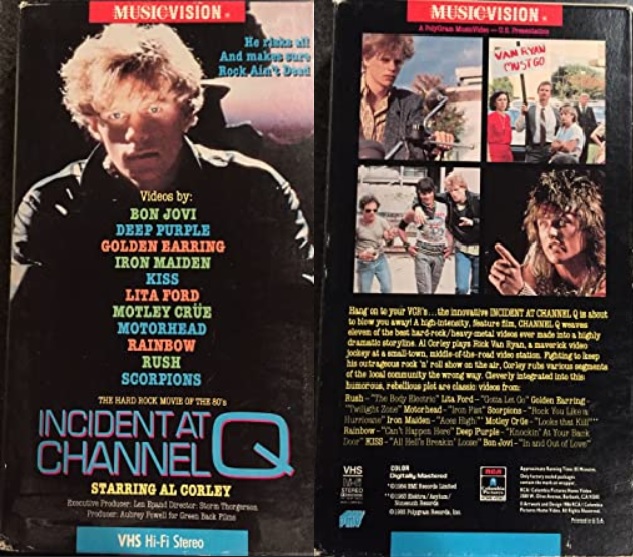
After posting our review of Charles Band’s Bad Channels for our “Radio Week” of reviews regarding films set inside radio stations (March 15 to 21), this Al Corley-starring and Storm Thorgerson-directed movie (well, long-form Escher’s “Magic Mirror” video that features videos within the video) popped into my head. Yeah, it takes place inside an UHF-TV station and not a radio station; it features a VJ and not a DJ. But my memories of Incident at Channel Q “peanut butter into my chocolate,” if you will, with Bad Channels courtesy of an old Books-A-Million location (or was it a Waldenbooks?) that carried used copies of VHS tapes in their cut-out bins.
Courtesy of Amazon
If you were a metal head in the early ‘80s, this movie holds fond memories for you. If you’re a younger lad and a new inductee to the world of ‘80s metal, courtesy of the hosts of SirusXM Satellite Radio’s Hair Nation, who’ve mentioned this slice of metal nostalgia on several occasions, you’re clamoring for a copy.
And I am clamoring for one ever since my copy became infected by the blue screen of death alongside my copy of The Dark Backward. Frack you, Starbuck.
If there’s ever an old VHS that needs an official DVD/streaming reissue, Incident at Channel Q is the movie. (Shameless plug: read our “10 Movies That Were Never Released to DVD” featurette.) Hell, we’d even settle for a forbidden world grey market impress at this point. The VHS and even rarer Laser Disc pop up on seller sites from time to time—if you want to donate a kidney for it. And how is it the IMDb page for Incident at Channel Q is a barren wasteland? There’s no photo stills? Not even an image of the VHS? It’s not even rated at Rotten Tomatoes? Not even a Discogs page for its soundtrack?
Yeah. You’re damn right it’s time to show this VHS gem the love. Load the tape. Let’s rock.
Courtesy of Philadelphia Mausoleum of Contemporary Art at philamoca.org
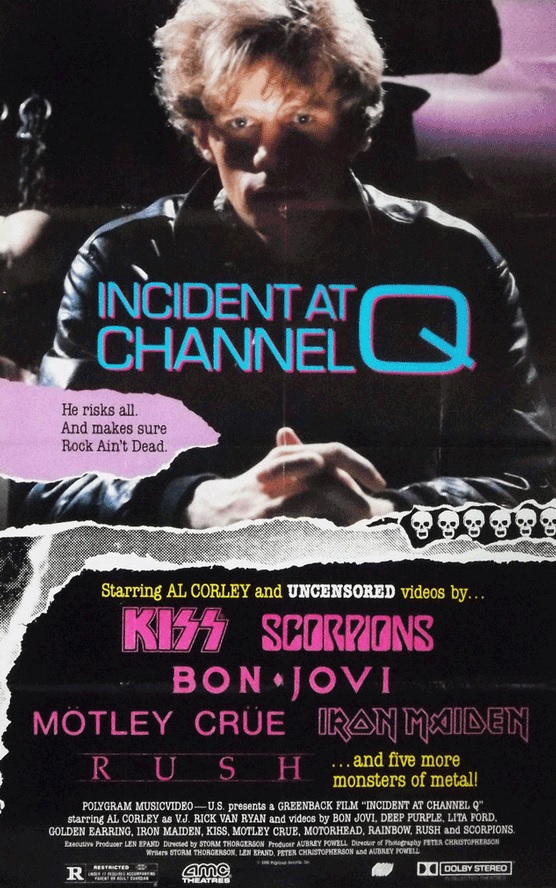
As you look at the theatrical one-sheet, you notice the logo for AMC Theatres: the theatre chained backed the production and distributed it as an exclusive midnight movie—which was my first exposure to it. Later, I rented the RCA/Columbia Home Video copy from my corner video store. And I begged the horseshoe-haired, garlic-pepperoni halitosis guy running the joint to please sell me the one-sheet hanging in the store. Of course, he did not. (Insert “word” for lower abdominal appendage. Frack you, film nerd.)
The Midnight Movie
Prior to the advent of video stores and cable television in the ‘80s, the midnight movie was a ‘70s marketing gimmick for non-commercial films, mainly exploitation films and just about everything that made the dreaded “video nasties” list. (Shameless plug #2: check out our three part “Exploring: Video Nasties” featurette.)
Sam Raimi’s The Evil Dead, the animated rock flick Heavy Metal, and Pink Floyd: The Wall broke as midnight movies.
For those of us too young to go to concerts: We got to see Led Zeppelin for the first time in The Song Remains the Same (1976). We became “Dead Heads” courtesy of The Grateful Dead Movie (1977). We got a double dose of Black Sabbath and Blue Oyster Cult with Black and Blue (1981). Our first AC/DC concert (distributed by Fred and Beverly Sebastian of Rocktober Blood fame; also a midnight movie, natch) was AC/DC: Let There Be Rock (1980). And how can we forget The Rocky Horror Picture Show. (Shameless plug #3: read about Kim Milford, the original Rocky, and his rock flick Song of the Succubus.)
And since the nascent MTV video network wasn’t cleared for broadcast in all markets and all cable systems, the only way you could see rock videos—besides an errant, overnight video program on some low-wattage UHF-TV station—was in a movie theatre—some of which would run videos before their midnight movie features; in-between if it was a double feature.
Incident at Channel Q: Behind the Q
It’s the brainchild of the British graphic design company Hipgnosis founded by Storm Thorgerson and Aubrey Powell. Do we really have to rattle off all of the top-selling album covers they’ve designed? Name a classic rock artist from the ‘60s to the ‘80s and, odds are, Hipgnosis designed the cover. (Def Leppard’s High ‘n Dry, with the image of a man diving into a swimming pool? That’s a rejected Pink Floyd Hipgnosis cover, for example.) When music videos became de rigueur, Hipgnosis incorporated Green Back Films—and the hits continued with Robert Plant’s “Big Log” and “Owner of Lonely Heart” for Yes, just to name a few. Hipgnosis formed Green Back in a partnership with Pink Floyd associate and noted documentarian Nigel Lesmoir-Gordon. One of Lesmoir’s films was the “ancient future” classic, The Colors of Infinity, starring science-fiction writer Arthur C. Clarke.
If you’ve familiar with Christian Slater’s “Hard Harry” from the Pump Up the Volume (1990), then you’re up to speed on the antics of VJ Rick Van Ryan (Al Corley), a sarcastic agent provocateur at a struggling South Florida UHF-TV station, Q 23 (actually Fort Lauderdale’s WKID-51 doubling for the small-town of “Springfield”), which flipped to an all-rock video format. As with Karlan Pickett being hired over at KRZY “Power 98” in the frames of Power 98: the management hates the jock, but they “love the numbers,” so the Devil’s radio, uh, TV station, it is.
Of course those teenaged metal-scamps love Rick! But, uh-oh, the Christian conservatives lit the torches and sharpened the pitchforks demanding that “satanic program,” Heavy Metal Heaven, be taken off the air because, well, you know, there are souls to be saved. And like any Nancy Pelosi-fearing Christian who doesn’t “hate people,” but “prays for them,” the station’s God-fearing hosts and sponsors want Rick off the air. And to that end: a couple of right-wing bullies are hired to “wise up Rick” with a good ‘ol fashioned, Christian beat down, you know, for God and country. To hell with the Devil: even if it means grievous bodily harm, for the bible told them so.
That’s it, Rick’s had enough. So taking a cue from the staff of the “other station” with a Q—Los Angeles’ QKSY-FM 7-11 (FM), he barricades himself inside the TV station and rallies the metal head masses (well, okay, 12 people) in an Airheads-style revolt.
The Rock Video Rundown
Incident at Channel Q is pure homage (most critics miss that point) to those old Alan Freed DJ-starring films from the ‘50s—Rock Around the Clock, Rock, Rock, Rock, Mister Rock and Roll, Don’t Knock the Rock, and Go, Johnny, Go!—and to that end: it’s all about musical numbers and not the story. Sometimes, with those old rock flicks, the bands didn’t even appear “live” in the film as “actors”; the film would “cut away” to a TV performance (of an old band clip, natch) that the kids were watching. So Rick Van Ryan loading up videos is the equivalent of that narrative approach. Thus, while it would have been awesome to have had Iron Maiden showing up for a live parking lot concert to support Rick’s quest, we get video clips inserted into the action from:
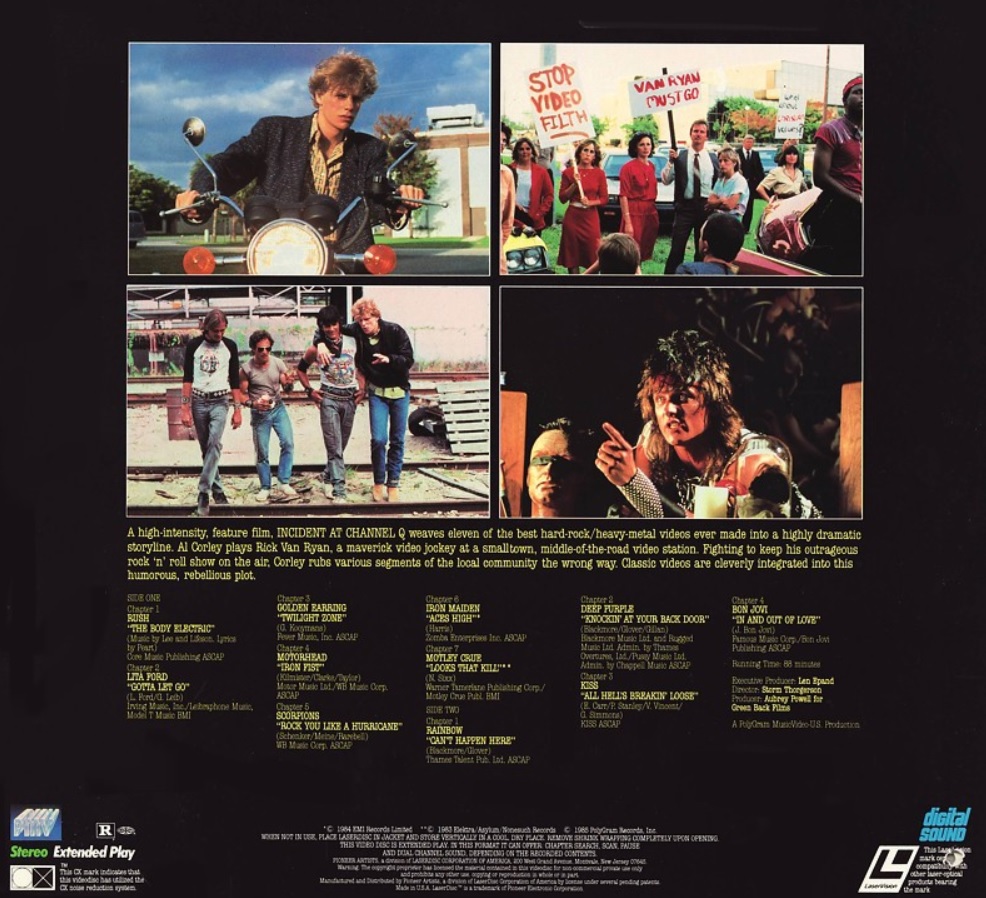
Rush – “The Body Electric” Lita Ford – “Gotta Let Go” Golden Earring – “Twilight Zone” Motorhead – “Iron Fist” Scorpions – “Rock You Like a Hurricane” Iron Maiden – “Aces High” Motley Crue – “Looks that Kill” Rainbow – “Can’t Happen Here” Deep Purple – “Knockin’ at Your Back Door” Kiss – “All Hell’s Breaking Loose” Bon Jovi – “In and Out of Love”
Hell, yeah! Incident at Channel Q is an ‘80s rock fan’s dream, with some of the greatest metal videos of all time featuring more than enough poofy hair, tight pants and studded leather, debauchery, depravity and post-apocalyptic imagery (shamless plug #4: check out our month-long homage to apoc films with our two-part Atomic Dustbin round up) to satiate our devil-influenced, MTV nostalgia.
The Cast
None of the South Florida community actors cast in the film starred in anything else after making their feature film debuts on Incident at Channel Q. But proving everyone has to start somewhere:
Camera and Lighting Department gaffer Greg Patterson embarked on a successful career in his field, working on Stallone’s The Specialist, The Dark Knight Rises (2012) and Harrison Ford’s most recent film, The Call of the Wild (2020).
Barry J. Anderson was another of the South Florida acting hopefuls who auditioned for one of the metal scamps, but earned a part as one of the background acting, protesting metal hoards (so jealous, I’d love to have been one of them, but I wasn’t acting at the time). In addition to working as a recurring background actor on Miami Vice in the series’ squad room, Anderson became a special effects engineer and make-up artist on several Florida-produced “video nasties,” such as Ted V. Mikels’s Astro Zombies: M4 (2012), then worked his way up to more prestigious horror films, such as George Romeo’s Day of the Dead (1985), Scared Stiff (1987), The Unholy (1988), the remake of Hairspray (2007), as well as the Jeepers Creepers and The Butterfly Effect franchises.
Actor Charles Knight, who played the character Horowitz, the station’s engineer with hopes of becoming a metal host at Channel Q (he appears on the bottom right corner on the rear of the VHS and Laser Disc artwork), came by his role, accidentally, by way of his ex-girlfriend actress. His actress ex was auditioning for a principal role in Miami Beach as he waited in his car outside. A “British dude” leaned in and asked Knight if he was there to audition. Knight explained why he was there. The British dude said that Knight “had the look that they wanted” and invited him in for a cold reading. He read for the part of Vinnie, but the role had already been promised, so he was cast-on-the-spot as Horowitz. Charles Knight still resides in Florida and has acted in a couple indie films.
The Al Corley Lowdown
The Wichita, Kansas-born Al Corley got his start as a doorman at New York’s famed Studio 54 in the late ‘70s and appeared in a VH 1 Behind the Music special to recount his experiences. The contacts Corley made at the club transitioned him into an acting career; he was soon cast as the first Steven Carrington for 37 episodes during the 1981 to 1982 season of the popular ABC-TV prime time soap opera Dynasty. (And, in prime soap opera fashion: Corley was recast with a “new” actor via “plastic surgery after an oil rig explosion.” No, really.)
During those years, Corley was in a relationship with Carly Simon. So deep was the love that he appears on one of her album covers; that’s his back to the camera on the album artwork for 1981’s Torch (this Carly Simon blog regarding her album covers chronicles Corley’s involvement). You know Carly from the ‘70s song “Anticipation” and her James Bond theme song “The Spy Who Loved Me.” (Shamlesss plug #5: April is “James Bond Month” at B&S About Movies.)
But Corley was always a musician first and foremost (his Discogs page) and he, like American TV actors David Soul, Rick Springfield, Don Johnson, and David Hasselhoff before him, embarked on a successful European singing career across three albums: Square Rooms (1984), Riot of Color (1986) and Big Picture (1988). His debut album produced two European Top 20 singles/videos: “Square Rooms” and “Cold Dresses,” with the title cut single reaching number one in France. His other Top 100 Euro-hits were “After the Fall” from Riot of Color and “Land of the Giants” from Big Picture.
Those hits, in turn, netted Corley the lead in the 1989 West Germany-produced feature film Hard Days, Hard Nights (aka Beat Boys), a very loose, pseudo-Beatles bioflick about a Liverpudlian rock band’s quest for stardom in Hamburg. And rock on this: Corley’s co-star, in his acting debut, was Nick Moran: you know, Scabior from the Harry Potter franchise. Moving into directing, Corley fronted the MGM rom-com Bigger Than the Sky (2005; you can watch it for free on Vudu).
This Is The End, My Friend
And that, my wee rockers, is the story behind Incident at Channel Q . . . and you can rock with this full video-soundtrack recreation I cooked up on You Tube.
What’s that? You need more punks and metal heads on film? Ack! Not more shameless plugs! Then check out our explorations “No False Metal Movies” and “Ten Bands Made Up For Movies.” And these excellent Letterboxd lists (see, we plug others) for Heavy Metal Movies and Punks on Film will also help you on your quest for ye metal.
Keep the horns high! That’s it for “Radio Week” kids. We’ll have an “Exploring: Radio Stations on Film” round up with links to all of this week’s films this evening at 6 PM.
About the Author: You can read the music and film reviews of R.D Francis, as well as short stories based on his screenplays, on Medium. You can learn more about his work on Facebook.He also writes for B&S About Movies.
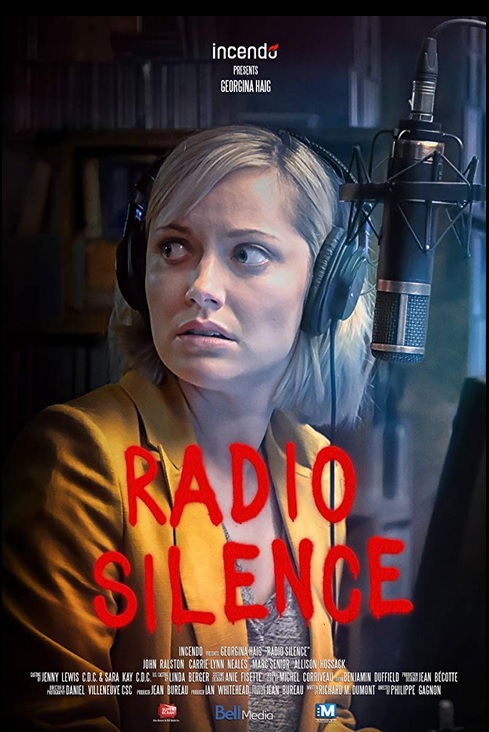
A female radio psychologist taunted by a killer is familiar damsel-in-distress fodder for the Lifetime cable network, which also aired the similarly-plotted The Night Caller (1998), Requiem for Murder (1999), and A Lover’s Revenge (2005).
Dr. Jill Peterman (Canadian actress Georgina Haig, who’s very good), a Minneapolis, Minnesota (aka Toronto), “relationship therapist” who advocates a tough-love approach when counseling her listeners, walks away from the business when a listener, “Alexis,” takes her advice of “end this pathetic life” of allowing a man to cheat on her, literally—and she commits suicide on the air.
A year later, with WRMD 96.5 FM at the bottom of the ratings and ready to change to an automated dance format, her old General Manager persuades her to return to the air—with the guilt trip that she’ll be “saving everyone’s jobs.” As she settles back into her show, the mysterious calls from “Alexis” begin. Then her billboards around the city are vandalized with the words “How Do You Sleep?”—a message that’s repeated on the greeting cards enclosed with the deliveries of black roses.
Let slip the red herrings of noir.
Did Alexis actually kill herself? Is she the one leaving threats? Or is someone else behind them? The police never found a woman who committed suicide matching that name and they believe it was a prank—even a rating-grabbing station stunt that backfired. Could it be the win-at-all-costs station owner, her producer, or her promotion-driven production assistant? Is it the barista at the local coffee house who is Dr. Jill’s #1 fan? Is any of this real and is it all in Jill’s head?
The radio studio is a poorly done build that’s darkly lit to hide the “studios” shortcomings of its ubiquitous equipment-strewn business desks and—not another recording studio mixer being used as an audio board. Ugh. But at least there’s some digital touch screen audio equipment used. And the expositional industry jargon between the station owner and general manager about terrestrial radio competing with podcasting, ratings and format changes give the proceedings a sense of reality.
You can watch this Canadian TV movie—reimaged with the sensationalistic When Murder Calls for its U.S debut—for free on You Tube and You Tube.
About the Author: You can read the music and film reviews of R.D Francis on Medium and learn more about his work on Facebook. He also writes for B&S Movies.
The question is not how far one will go to take a life, but how far one will go to save a life in this German-produced slasher-noir where Andrew Kevin Walker’s Seven (1995) and 8MM (1999) meets Eric Bogosian’s Talk Radio (1988) and Allan Moyle’s Pump Up the Volume (1990).
The “Roc Doc,” an acidic and opinionated amateur psychologist, operates the basement-bound Radio Nighthawk as he spins ‘60s American soul records and expounds on the news of the day—and he makes the mistake mocking the police for failing to prevent the gruesome murders of the media-dubbed The Night Slitter.
“How difficult can it be to prevent The Night Slitter from breaking down his next victim into individual parts?” Roc Doc ponders.
“Why don’t you put your money where your mouth is,” calls-in The Night Slitter. “After all, everyone has a body buried in the basement. The ego is not master in its own house, Roc Doc.”
And so begins the cat and mouse game with the Roc Doc forced to stay on the air—and admit to his own inner monster and skeletons—if he wants to save the life of The Night Slitter’s current victim: he’s audibly torturing the daughter of the grizzled police inspector on his trail.
Beginning as a Euro-festival acclaimed 20 minute short released in 2010, this 95-minute feature length version—alternately known as Der Tod hört mit (Death Listens) and On Air in other quarters—borrows its inspiration from the New French Extremity film movement spearheaded by Alexandre Aja’s worldwide hit High Tension (2003).
It made its U.S debut under the title Radio Silence via the festival circuit, where it won multiple Best Film and Best Director awards at the Screamfest Horror Film Festival in Los Angeles, the Sacramento Horror Film Fest, the Atlanta Horror Film Festival, and the Rhode Island Int’l Film Festival.
You can watch the full film—with English subtitles—on TubiTv. You can catch up on the cycle of French Horror Films with this great roundup on Scoopwoop.
About the Author:You can read the music and film reviews of R.D Francis on Medium and B&S Movies, and learn more about his work on Facebook.
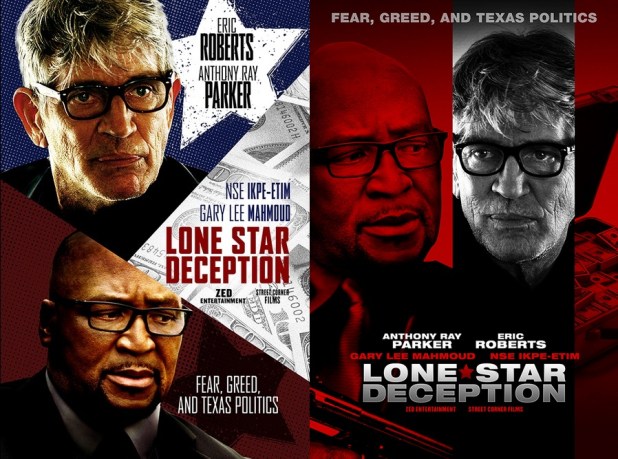
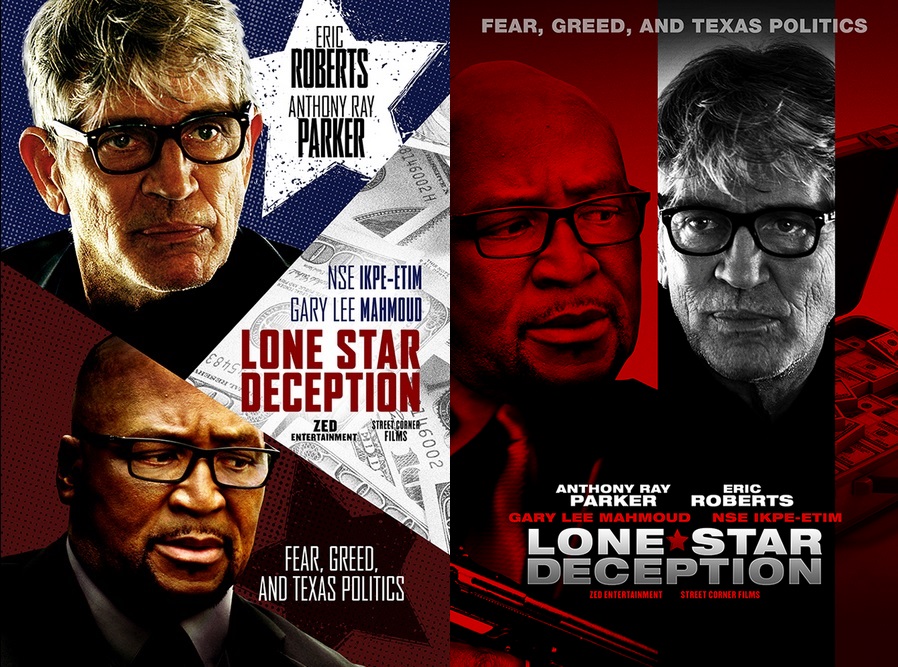
Fear, greed, and political intrigue is the name of the game for Bill Sagle (Eric Roberts, of the recently reviewed “radio week” flick Power 98), a philandering, narcissist Texas oilman who uses his wealth and power to control the political scene—and that arrogance means his machiavellian ethos knows no limits. And with him losing money with oil at $40 a barrel and his ever-increasing gambling debts (when we first meet Sagle, he’s on Learjet with a bunch of hookers on the way to Las Vegas), he hedges his bets with his nephew, Stuart Sagle (Gary Lee Mahmoud of TV’s Law and Order: SVU and Blue Bloods), into the governorship of Texas for a little ‘ol down home puppet regime.
When local mobster Jimmy Sloan, who’s in cahoots with Tony Cabrisi, who’s the brother of Stuart’s wife, sets up Stuart in a prostitution-blackmail plot, Bill Sagle hatches a new plan: groom his long-time employee, Tim Bayh (Anthony Ray Parker of Peter Jackson’s The Frighteners, the Wachowski’s The Matrix, and John Cena’s The Marine), an ex-Marine, a Silver Star Afghanistan war vet, and Harvard graduate as the first Black gubernatorial candidate of Texas. Yes, this Texas oilman is of the J.R Ewing variety and he will play the race card because, in his world, the end justifies the means. The first black candidate for governor? The contributions will roll in. And it’s all about skim. Always was.
Will Tim Bayh make history? Not if Bill Sagle’s “enemies” have a say in the matter. And Tim has his own skeletons from the Afghan war rattling in his closet. As Tim avoids assassination attempts and his family becomes targets of blackmail, kidnapping, and extortion schemes, he must decide: stay in the race and make history, or quit the race for the sake of his family? And will he use his ex-military training to scorch-earth those wanting to destroy him? His campaign manager did say that “politics is like war,” after all.
Does this all stretch credulity? Yep. But Jamie Foxx kicked ass as President Sawyer in White House Down, so why not Governor Bayh in Lone Star Deception?
As part of our aforementioned “Radio Week” (March 15 to 21), we reviewed MGM Studio’s 1972’s blaxploitation entry, Melinda. In that noirish tale, an L.A. jock’s life spirals out of control and he goes “scorched earth” on the mobsters who kidnapped his girlfriend—the same predictament suffered by Governor Bayh. If Lone Star Deception was made in 1973, you’d have a blaxploitation flick analogous to the political, double-crossing intrique of one of Quentin Tarantino’s favorites: Detroit 9000.
For those of us familiar with Eric Roberts’s mindboggling 570-plus journeyman actor oeuvre (A Husband for Christmas, A Talking Cat), we go into his films of late with the knowledge that his role will be a small one, and sometimes, a pivotal one. And that rest of the cast backing him are unknown, mostly amateur (local community) actors who, while they give it their all, offer strained performances, to say the least.
While this film is clearly Anthony Ray Parker’s well-deserved time to shine (he’s been in front of the camera since the mid-‘90s, so it’s nice to see his name on top of a marquee), there’s more than enough Eric Roberts (more so than in most of his previous films; I’ve watched Roberts films where he’s either in one scene or all of his scenes take place on one set) in the frames to satiate our fix for his always welcomed presence. And Parker, as well as Gary Lee Mahmoud (who’s actually in the film less than Roberts), each hold their own alongside Roberts. Another highlight on the acting front is the Robert Foxworth-reminding Brian Thornton (TV’s Walker, Texas Ranger, Friday Night Lights, Queen of the South) playing Parker’s war buddy, Mark. He has a pleasant, quite cool about him; I’d would have enjoyed more of him on screen.
According to the film’s against-the-odds production history, Lone Star Deception (its working title was The Candidate) took over two years to finish, which entailed six different shoots done by three directors and burnt through three producers, four writers, and two casting directors. And Roberts, ever the professional, stuck by the producers through it all, making himself always available. Roberts not only came back for one filming without compensation, but he returned to Houston (once more unto the breach, dear friends!) for the Worldfest Houston Film Festival where he accepted a well-deserved Lifetime Achievement Award. (Something that Tom Sizemore didn’t do for the Texas premiere of his own trouble-produced neo-noir, Zyzzyx Road.) And that’s why we love Eric Roberts: he’s loyal to the indie filmmaker and he always delivers on screen. (Don’t worry Tom, we dig you too: we reviewed several of your films at B&S About Movies.)
Now, when you have that much drama and personnel turnover on a film production, it usually means you’ll end up with a disjointed film lacking in consistency across all the disciplines. (Our recent review of 1968’s Terror in the Jungle serves as the best, uh, worst case example of that brand of filmmaking.)
Such is not the case with Lone Star Deception.
Director and co-screenwriter Don Okolo, along with writer Ed DeZevallos, know their Shakespeare; the bard, of course, was film noir before film noir, with his medieval noirs of anti-heroes and femme fatales rife with love and jealousy, betrayal and revenge (even racism, in the case of Othello).
As result, Lone Star Deception hits all the film noir cues—with Parker’s Tim Bayh reminding of William Holden’s Joe Gillis in Sunset Blvd., Fred MacMurray’s pasty of Walter Neff in Double Indemityand John Garfield’s Frank Chambers in The Postman Always Rings Twice. Each are somewhat well-intentioned, yet flawed indivduals who, in a desire to make a better life, subject themselves to a tail-spinning world of shady characters rife with deception and double crosses. The Seven Deadly Sins in Sagle’s Divine Comedy are funny that way.
Are Okolo and DeZavallos on par with Orson Wells’s and Laurence Olivier’s Shakespearian productions of Macbeth and Hamlet? Is Parker on par with John Garfield? No. But this isn’t Tommy Wiseau’s The Room either. So drop the clichéd Ed Woodian critical smart asseries at the door, ye film bard.
The frames of their story concerned with the dangers of greed and the quest for power are clean; it’s competently shot and decently acted with enough suspense and action to hold your interest—enough that you’re willing to overlook the film’s awkward, rough patches in the cinematography, editing, and SFX departments (a quality that holds true to one of my favorite films: Flywheelby first-time Christian filmmaker Alex Kendrick). If Parker’s Tim Bayh gubernatorial hopeful was a black female, Lone Star Deception would play well (less the profanity, natch) as part of the Lifetime Network’s roster of damsel-in-distress pseudo-noirs.
The bottom line: You’ll be seeing more on screen from Parker, Mahmoud, and Thornton, and from behind the camera with Okolo and DeZevallos (perhaps one with the ubercool Tom Sizemore? Hint.) And that’s no deception.
You can learn more about Lone Star Deception at the film’s official website. The film, distributed by TriCoast Entertainment, has made the festival rounds (where it won awards), played in Texas theatres, and will soon be released on DVD and all the usual PPV and online streaming platforms.


 B&S About Movies
You must be logged in to post a comment.