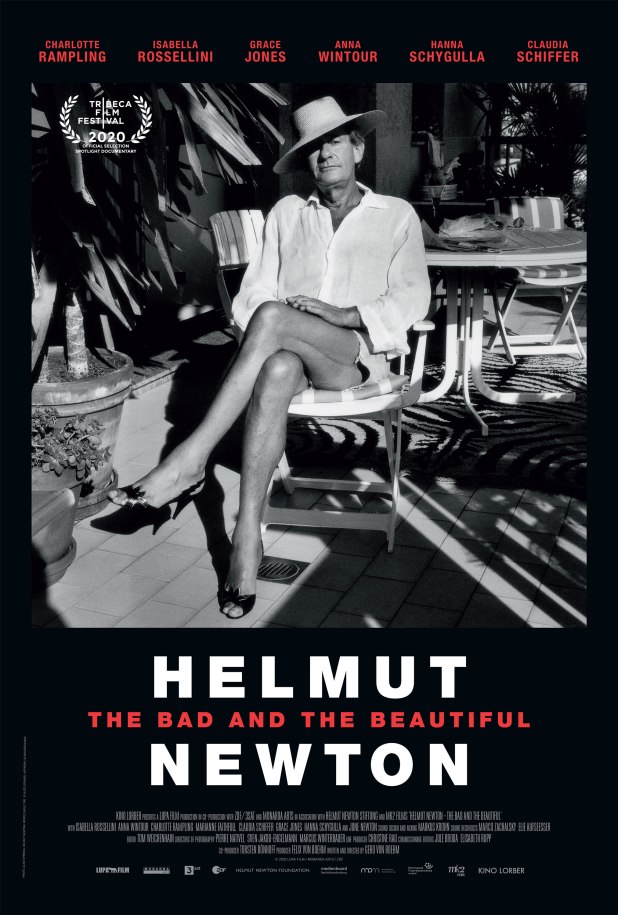
We’ve often discussed the line between arthouse and grindhouse. There’s a similar division between glamour and smut. As one of the great masters of photography, Helmut Newton found fame exploring the female form. But were the women in his pieces empowered or exploited? These provocative, sensual and at times subversive images are the real stars of this film, which also features Newton’s home movies and archival footage of the artist in the media.
Grace Jones, his muse Charlotte Rampling, Isabella Rossellini, Anna Wintour, Claudia Schiffer, Marianne Faithfull, Hanna Schygulla, Nadja Auermann, and Newton’s wife June (photographer Alice Springs) all make appearances here, discussing how Newton’s photography impacted their lives and how they saw themselves as attractive beings.
Directed by German filmmaker Gero von Boehm, this documentary is packed with the very images that it discusses. Of course, Grace Jones steals the show. But did you expect any less?
No matter where you stand on the divide between treasure or trash, you’ll find plenty of intriguing material here. Despite his death in 2004, his work has stood the test of time. His work is such a part of our psyche, particularly with Playboy, which published an entire book of his work for the magazine. There is also an incredible shot of Jerry Hall that he shot from Adam, his giant nudes and even the portrait of Thatcher that Vanity Fair assigned to him.
Time referred to Newton as The King of Kink. But was he? Or just someone unafraid to shock, to play with gender roles and a man that encouraged women to own their fantasies — provided he could take the photos of the evidence? Make up your mind for yourself.
You can watch this film online on Kino Marquee as of July 24. Thanks to Kino Lorber, who was kind enough to send us a review copy.
Imagine a film so plagued with legal and productions issues that even the pseudonymised Alan Smithee doesn’t want to take a credit—and it took almost 30 years before the film screened to a mass audience.
Such a film is Rock ‘N’ Roll Hotel . . . yes, we know the hotel’s sign uses an ampersand, while film title uses the contraction . . . that’s just one of this film’s many problems.
Image courtesy of Spectacle Theatre, New York
And those problems began in the fall of October 1982 in Richmond, Virginia, at the once opulent Jefferson Hotel, a location where French director Louis Malle previously completed his 1981 independent comedy-drama My Dinner with Andre (which Gene Siskel and Roger Ebert gave “two thumbs up”). By the time Hollywood came a-callin’ in Richmond for its next film, the hotel fell into urban decay and became the home of transients.
But no one ever got a chance to give a thumb—up or down (but probably a lot of middle fingers)—for Rock ‘N’ Roll Hotel. Well, they did . . . 27 years after the fact, in 2010. But more on that later. . . .
Executive Producers Howard and Francine Schuster, along with producers Peter Rodis and William Gilmore (who saw the film as a “tax-shelter” movie), and Stiff Records’ signee Rachel Sweet and her father/manager (who envisioned the film as her transition from music into film) rose about a $4 million for the project. None had produced a film prior—or since. And speaking of “taxes”: the reason Richmond was chosen over the also-scouted locations of Atlanta and Orlando was Virginia’s generous “tax incentive/tax break” program for film and television productions.
The film’s genesis was rooted in the 3-D craze sweeping cinemas in the early ‘80s with the likes of Amityville 3-D, Comin’ at Ya!, Jaws 3-D, and Friday the 13th 3-D,” and Treasure of the Four Crowns cleaning up at the box office. The Schusters, along with cinematographer and stereoscopic film expert John Rupkolvis, were behind the development of a new type of inexpensive 3-D filmmaking called Arrivision—and the Schusters wanted to make their own movie to showcase the new 3-D technology.
The director the Schusters chose for their “3-D rock ‘n’ roll teen horror musical”—a “director” who never directed a film before—was film composer and arranger Richard Baskin (Nashville, Welcome to L.A., Honeysuckle Rose), a Baskin-Robbins ice cream scion, Barbara Streisand’s then live-in boyfriend, and brother to Saturday Night Live writer Edie Baskin. Richard Baskin’s street cred as a songwriter and composer for films is what got him the job on this planned musical—actually a long-form MTV-style rock video. The set director, just starting out in the feature film business, was noted music video director Mary Lambert (the Go-Go’s, Madonna, Motley Crue, Janet Jackson), who became a film director in her own right (1989’s Stephen King’s Pet Cemetery). Also on the set as the film’s music consultant was Seth Justman, the longtime keyboardist and songwriter for the J.Geils Band.
Okay, so all of these people have skills. So far, so good. . . .
The script, described as “unfinished and unfocused” and “unyielding” over the years by those involved in the production, centered on the career of the Third Dimension, a young n’ sassy, new-wave rock trio fronted by Lisa, portrayed by Akron, Ohio, born and U.K.-transplanted singer Rachel Sweet, who issued European hit singles on the Stiff Records label (home to Elvis Costello and Nick Lowe). The faux band also featured Johnny, a leather-jacket clad guitar player portrayed by Judd Nelson in his feature film debut (two years away from his back-to-back breakthrough roles in The Breakfast Club and St. Elmo’s Fire), and Rick, a scarf-clad bassist portrayed by the big screen-debuting Matthew Penn, he the son of director Arthur Penn (Bonnie and Clyde, Alice’s Restaurant, Little Big Man). (These days, Matt is a prolific TV series director with over one hundred fifty credits.)
The cast was rounded out by older, fading actors brought in as fading classic ’50s rockers: comedian Dick Shawn (It’s a Mad, Mad World, The Producers), now ubiquitous character actor Joe Grifasi (Brewster’s Millions, Honky Tonk Freeway), and Broadway singer-actress Donna McKechnie (TV’s Dark Shadows), who replaced Stella Stevens (The Poseidon Adventure). Also starring was Bruce Springsteen’s E-Street Band saxophonist Clarence Clemons (himself a Chesapeake, Virginia native) as a motorcycle-riding disc jockey, along with MTV VJ Colin Quinn as a fast-pattering DJ.
Judd Nelson, Rachel Sweet, and Matthew Penn as the Third Dimension
The plot—such as it is—is your typical good vs. evil story centered around a rock ‘n’ roll battle of the bands contest held in the old, sinister “Rock ‘N’ Roll Hotel.” Sweet’s new wave-inspired Third Dimension are, of course, the good guys; the washed-up ’50s rock-crooning the Weevils, fronted by Shawn and backed by the cougaresque McKenchnie and the piano-playing Grifasi, are determined to win the contest at any cost.
As you’ll can see from the two trailers and promotional video we’ve linked-up below (at the end of the review): everything is way out there—and not making a whole lot of sense, as continuity and narrative are out the window.
It seems the sinister, evil classic ’50s rockers, the Weevils (escaping from Brian De Palma’s Phantom of the Paradise), have perfected the skills of hypnotism, have control of three white-clad tempting Fates to lure men to their sexual demise (always on the make for Nelson and Penn), and have access to a time machine—which comes in handy when you need an inebriated Beethoven and stoned Jimi Hendrix to show up for few laughs; Frankenstein lumbers around the halls amid zombies; there’s a dancing chorus of haunted pants; an old, snoring corspe takes a nap in front of a television; there’s a wheel-chair bound, rat-faced talent agent; Shawn’s Weevil King of Evil sashays around in wares typical of King Ludwig II of Bavaria; Joe Grifasi cops n’ mocs Elton John’s wardrobe and stage antics. There’s sad trombone “Wah-Wah-Wah” fanfare-styled humor that would give T.L.P Swicegood (The Undertaker and his Pals) pause. There’s a ten-minute, song-and-dance car crusin’ number with Nelson and Penn shredding guitars as Sweet sings. There’s homages to Devo paired with Shawn crooning ’50s rockabilly tunes. Oh, and everyone is shoving things into the camera to play up the the “3-D” effects.
So, yes . . . the mise-en-scène kinetics of The Rocky Horror Picture Show is definitely a touchstone in the rock ‘n’ roll tomfoolery, as Rock ‘N’ Roll Hotel wears its hopes as another Rock ‘n’ Roll High School on its sleeves. The more discerning rock flick connoisseurs will reference Allan Arkush’s Get Crazy (1983; his gonzo tribute to the closing of the Lower East Side New York rock club, the Fillmore East), Menahem Golan’s crazed, futurist rock tale, The Apple (1980), and the Weinstein’s Miramax debut release, the obscure Playing for Keeps (1983; which also deals with the shenanigans at a “rock ‘n’ roll” hotel). Then there’s the VHS aficionados who will go deeper with It’s a Complex World (1991), a nutty tribute (Elvis and Captain Lou Albano show up) to Providence, Rhode Island’s late rock club, Lupo’s Heartbreak Hotel.
No way this is going to work. . . .
Almost immediately, Baskin, it’s been said, found himself in way over his head—and all hell broke loose over the script, shooting schedule, and budgets one week into shooting. And the production shut down for a week. Then Seth Justman—who was also new to feature film directing—took the director’s chair based on his heavily-rotated MTV videos for J.Geils’ “Love Stinks” and “Centerfold,” along with “Shake it Up” by the Cars. Of course, by this point, the screenplay, written by Russ Dvonch of Rock ‘n’ Roll High School fame (and worked in various capacities on Roger Corman’s Deathsport and Avalanche), was rewritten by an unknown writer-friend of Justman’s, Janice Shaprio (with no other credits to her name since).
Needless to say, the new director and script doctoring didn’t help.
The film disintegrated in a flurry of lawsuits, speculations and accusations. There were claims the original negatives were lost or stolen, lost in a lab accident, or it was because the film lab processing the negative went bankrupt. The ensuing lawsuits quickly bankrupted the Schusters—and they fled to Australia. Other rumors claim the film was cut up by Bob and Harvey Weinstein and spliced into Playing for Keeps (1986), their debut feature for Miramax Studios—which was another Matthew Penn-starring film (thus assuring some sense of continuity) that also served as the leading lady debut of Marisa Tomei. (The practice of cutting a failed, unfinished film into another also occurred with the Runaways feature film, We’re All Crazy Now, which ended up in the film duBeat-e-o.) And why was that assumed? Because the Weinstein’s film also centered on a trio of New York high schoolers who decide to turn an old, grand mansion into a “Rock n’ Roll Hotel” (a claim which has been reportedly disproven, at least according to the materials-research I’ve read).
In truth: The Sweet and Nelson-starring film finally appeared in a March 1983 issue of Variety—released under the auspices of another set of filmmaking relations: Menahem Golan (who just directed an equally wacked out rock flick, The Apple) and his cousin, Yoram Globus, for their Cannon Pictures. The press release stated they were set to debut the film at the Movie Lab on Santa Monica Boulevard in Los Angeles on March 9 and 10 at 3 p.m; and that it would have a New York showing at the Waverley Theater on Sixth Street during the weekend of March 11 and 12.
Variety ’83 ad courtesy of Cinedelphia Film Festival
But alas, the showing weren’t a serious attempt to distribute the film, but simply to fulfill the terms of the project’s “tax shelter” agreement to investors that that film must appear in a major city over the course of a weekend (see Tom Sizemore’s Zyzzyx Road and Christian Slater’s Playback for examples; Roger Corman’s abortive 1994 version of The Fantastic Four also applies). At that point, Rachel Sweet and her father shanghaied the film and claimed they “finished it,” shooting new footage and shifting more of the film’s focus on Rachel—and that the film aired on HBO in the mid-eighties (a claim which the programmers of HBO deny).
Then, in February 2010, Craig Hodgetts, one of the set designers on the film working under Mary Lambert, discovered a raw VHS tape labeled “‘Rock and Roll Hotel,’ 83 min., 1986,” in a box of production sketches and photo stills from the film in the archives room of his architectural firm in Culver City, California. And that copy does, in fact, carry a “Richard Sweet Productions” title card. So, it seems, the Sweet’s claims that they finished the film and that it aired on HBO are true. And this is the version that has no director credit—not even Alan Smithee.
So what happened to the original 35mm “3-D Wondervision” version showing off all that great 3-D camera work? What happened to the print shown in Los Angeles and New York in 1983? Where’s the 1986 version?
Today, all that exists is the digitized, low-tech 2-D direct-from-VHS copy that occasional plays around the Richmond area in an art house-drafthouse environment and the occasional U.S film festival—the one found in a box in Hodgetts’s closet.
TRAILERS ‘n’ CLIPS: Yes, we have ’em! But you know those ‘ol HTML bugs and video sharing sites. Code breaks and “unofficial” uploads by fans — and not reissue shingles — are sometimes deleted. So, you can link-out to watch this trailer and promotional video on You Tube and another trailer on Vimeo.
MANY THANKS: To Dale Brumfield of Style Weekly Magazine, Cinedelphia Film Festival (as of 2021, the site is currently dead/festival no longer exists), and James River Film Journal for their efforts in preserving the memory of this truly lost rock ‘n’ roll film that assisted in preparing this review for our first “Rock ‘n’ Roll Week” at B&S About Movies.
MORE THANKS, 2022: Just when you think your review-writing was for naught, only to be lost somewhere, forgotten on a file server . . . someone discovers it, shares it on social media, and the subsequent readers reach out to express their enjoyment of the piece. So, thanks to those half-dozen or so that FB’d me (including two who worked on the film!) with their gratitude. Yeah, it is fun to reminisce with these films and chat them up with the fans and the crew. Your vibes keep me bangin’ at the keys! Turns out it is not as fruitless as it sometimes feels (my “Exploring 50 Grunge Films” piece received the same, positive social media responses).
MORE MOVIE LINKS: Oh, and since Rock ‘N’ Roll Hotel qualifies as a Box Office Failure—hey, everyone gave it their best, for sure—be sure to check out out recent, week long February tribute week to “Box Office Failures.” Do you need more faux rock band flicks? Sure you do! Then check out our “Ten Bands Made Up for Movies (and a whole lot more)” featurette.
About the Author: You can learn more about the writings of R.D Francis on Facebook.He also writes forB&S About Movies.
You’re Penelope Spheeris and you amazed the disenfranchised punk and metal hoards with your debut feature film: 1981’s epic punkumentary The Decline of Western Civilization. (Yes, we did DoWC II and DoWC III). Yeah, we know her most popular film—and the highest-grossing film of her career—is the rock-centric (and very cool) Wayne’s World. But that’s for the mainstream Queen and Alice Cooper fans. (Okay, so for two Halloweens I dressed up as Wayne: once recruiting my blonde sister, then my blonde girlfriend, as Garth.)
For guys like me and Sam (he bullied for wearing a Samhain t-shirt to school; me, The Clash), this dark tale of two Los Angeles brothers escaping their alcoholic mother and a runaway escaping her pedophile father that come find solace in the surrogate family formed by a band of punk-rock squatters, who end up battling the local rednecks for supremacy of an abandoned housing tract, is Penelope’s best known film.
. . . And if wishes were horses, beggars would ride, so says the Scottish proverb. And if VHS-repeat viewings (today, it’s DVDs and online streams) were dollars, Suburbia would be Penelope Spheeris’s highest-grossing film—so goes the B&S About Movies analog edict. That’s right, Wayne. Don’t let the door on Stan Mikita’s Donuts hit you in the arse on the way out . . . and party on.
The original Vestron Video VHS with New World Pictures’ dopey post-apoc artwork.
The formula that makes Suburbia work is the same formula that makes Jonathan Kaplan’s juvenile delinquency rock fest Over the Edge (1979) work: Instead of casting the ubiquitous 30-year-actors as “teenagers” that is typical of a major studio, teen-centric flick (outside of two newbie-trained actors, OTE’s teen cast were first timers), Spheeris not only cast real teenagers, she cast the film with non-professional street kids and punk rock musicians to play all of the roles. One of those punks (the pet rat-loving and stray doberman-training Razzle) was Flea, who would later star in Spheeris’s punk-inspired western, Dudes (1987); he soon surpass the musical careers of D.I, T.S.O.L, the Vandals (all who perform and act in the film) as the bassist of the Red Hot Chilli Peppers. (D.I performs “Richard Hung Himself,” T.S.O.L “Wash Away” and “Darker My Love,” and The Vandals “The Legend of Pat Brown.” The Vandals would also appear in Dudes to perform “Urban Struggle.”)
It’s that neophyte casting that feeds the cinéma vérité narrative style of Suburbia and lends to natural actions and authentic dialog that, while scripted and staged, ranks Suburbia alongside Adam Small’s punkumentary Another State of Mind (1984) as one of the greatest punk films—and teenagers-in-revolt (i.e., juvenile delinquency flicks)—ever made. Yeah, we watched Francis Ford Coppola’s adaptations of S.E Hinton’s beloved early ’70s young adult novels The Outsiders and Rumblefish—both released the same year as Suburbia—but while competently crafted and acted, neither rings with the true sounds of celluloid liberty.
Courtesy of Shout Factory reissuing Suburbia as part of their Roger Corman Cult Classics DVD series in 2010, you can’t not find a copy. In fact, two of my local county library branches carry it. That’s more than I can say for the old Vestron Video VHS: I was a member of six video stores (three mom n’ pops, three chains) and only two carried it. And the two stores that did, thanks to New World Pictures’ dopey post-apoc artwork, they filed it in the sci-fi section—right next to copies of duBeat-e-o. Thankfully, the subsequent DVD and soundtrack CD reissues retained the original artwork of the theatrical one-sheet and Engima Records’ soundtrack LP (images via IMDb/Discogs).
You can stream that Shout Factory version for free on TubiTV, which also carries Spheeris’s follow ups to Suburbia: 1985’s The Boys Next Door (Tubi), itself a juvenile delinquency classic (that also ranks alongside 1979’s Over the Edge), and 1987’s Dudes (Tubi) . But if you’d rather ditch the ads, there’s a rip of Suburbia on You Tube. You can also listen to the soundtrack in its entirety on You Tube as you read the liner notes over on Discogs.
Music trivia flotsam and jetsam: Alex Gibson led L.A.’s BPeople for several years in the late ‘70s; the quartet started out as the Little Cripples (never recorded) with bassist Paul B. Cutler. When BPeople (a somber Joy Division-styled quartet with synths and saxophone) disbanded as result of lead singer Michael Gira relocating to New York to form the Swans (doing shows alongside Sonic Youth (Desolation Center), Gibson embarked on a solo career; Paul B. Cutler formed 45 Grave with Don Bolles of the Germs.
We all came to know 45 Grave with their death-punk classic “Party Time” from their debut album Sleep in Safety (1983; Enigma) via its inclusion on another punk flick classic, Return of the Living Dead. And we know the Germs courtesy of their appearance in The Decline of Western Civilization, which featured songs from their Joan Jett-produced debut, GI (1979; Slash).
The Vandals and D.I (an outgrowth of the Adolescents) each continued recording into the mid-2000. As The Vandals contributed songs to several more soundtracks (Glory Daze), drummer-bassist Joe Escalante made his leading man debut in the direct-to-video punk flick, That Darn Punk (1996).
T.S.O.L, through a plethora of roster upheavals and style changes (hard core, metal, and back again), continue to record. They also performed “Hit and Run” in another L.A. punk flick, The Runnin’ Kind (1989), as well as provide songs to The Return of the Living Dead and Dangerously Close. They also provided “Flowers by the Door” and “Hear Me Cry” to Hear Me Cry, an ’80s installment of the CBS Schoolbreak Special (yeah, we found it on You Tube).
Gibson parlayed his scoring work on Suburbia into a career as a music editor, most notably for the resume of Christopher Nolan, which culminated with his winning an Academy Award in 2018 for sound editing on the film for Nolan’s Dunkirk.
And good ol’ Roger Corman, never one never one to waste a set, costume, or frame of footage (Battle Beyond the Stars into Galaxy of Terror into Space Raiders; Eat My Dust recycled into Grand Theft Auto), used the concert sequences from Suburbia in White Star (1983), a Dennis Hopper-starring German rock flick that New World repurposed for the U.S. VHS market under the lame title, Let it Rock.
Update, May 2023: Our thanks to the gang at Film Scene for pull-quoting our review as part of their promotional materials for their May 10th showing of Suburbia as part of their Late Shift at the Grindhouse Film Series. It happens every Wednesday at Film Scene at the Chauncey in Downtown Iowa City.
About the Author: You can learn more about the writings of R.D Francis on Facebook. He also writes for B&S About Movies.
The Mentors started in Seattle but moved to Australia, where its three original members — Edon “El Duce” Hoke, Eric “Sickie Wifebeater” Carlson (guitar) and Steve “Dr. Heathen Scum” Broy — turned their garage punk metal into its own genre called rape rock. They were pretty much unknown until the PMRC hearings exposed America to the lyrics of their song “Golden Showers,” which features the line “Bend up and smell my anal vapor / Your face is my toilet paper.”
Depending on how seriously you took The Mentors, that pretty much determines how much they upset you.
This documentary covers their career — warts and, well, all warts really — including the claim that Courtney Love paid El Duce $50,000 to kill her husband Kurt Cobain, which led to Hoke telling this story on the Jerry Springer Show and in The National Enquirer and the movie Kurt & Courtney, even naming the person who did kill Cobain (who also shows up in this movie!). El Duce passed a lie detector test, despite the theory that Mentors pal Rev. Bud Green invented this story to sell to supermarket tabloids and get more publicity for the band. Further adding to conspiracy is that Duce died soon after, the victim of a train, murder or just suicide.
The Mentors wear their executioner hoods in honor of Mark of the Devil and Duce appeared in Du-beat-e-o and the the adult film Backstage Sluts alongside Motörhead, Korn and Limp Bizkit members, all telling their best groupie stories while porn stars act them out.
Obviously, while The Mentors still tour, their willingness to offend and pretty much be drunken and drugged manaics don’t really hit into today’s world. That said, at least they woule always keep their masks on.
While I was fascinated by this movie, if you are easily — or even not so easily — offended, perhaps you should skip this one.
“Thanks for killing my mom.” “Hey, no problem.” — Kitty Carryall and Patch Kelly
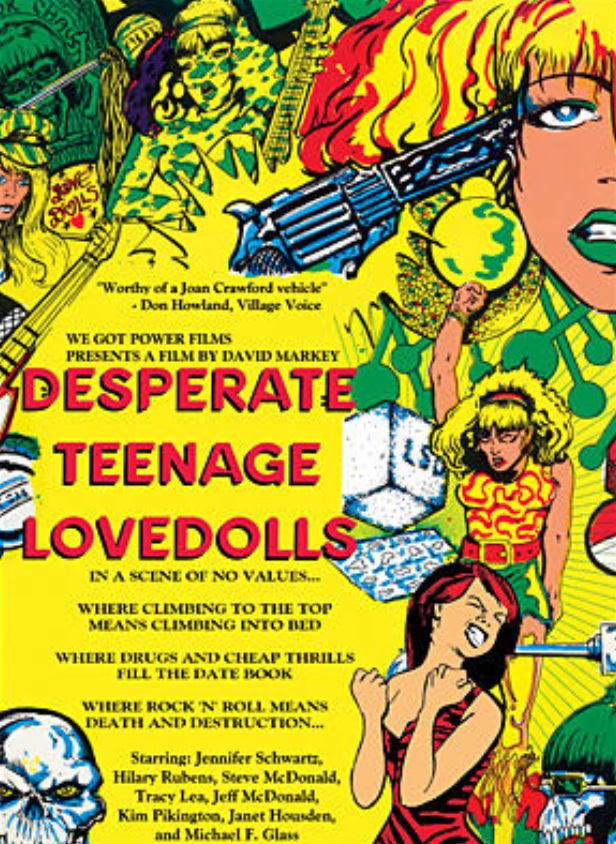
What do you get when you shoot a film for less than $300 on Super-8 film with a bunch of your friends from the L.A. punk scene (Dez Cadena of Black Flag and DC 3, Jeff and Steve McDonald of Red Kross, Vicki Peterson of the Bangles)? You get Dave Markey’s amateurish — but much loved — campy mirco-classic about the rise and fall of punk rock band.
When the mothers of lead singer and guitarist Kitty Carryall (know your Brady Bunch trivia!; portrayed by screenwriter Jennifer Schwartz), bassist Bunny Tremelo (Hilary Rubens), and drummer Patch Kelly (Janet Housden; later became a legal consultant on films) decide that punk rock isn’t proper for young ladies, the trio runs away to fulfill their rock ‘n’ roll dreams.
Out on the (comical) mean streets of Los Angeles, the Lovedolls are forced to fend for themselves against gangs (Kurt Schellenbach of the Nip Drivers) and rival bands. Also working against them is their sleazy manager Johnny Tremaine (Steve McDonald of Redd Kross) who uses them for sex and his own personal gain, and a rival girl gang, the She Devils (Annette Zilinskas, then of the Bangles and later with Blood on the Saddle; became a film animator) who work at sabotaging the Lovedolls. The girls finally decide they had enough and decide to strike back at those who wronged them.
Director Dave Markey has made this available as a free stream on his official You Tube channel, along with the director’s cut of the sequel Lovedolls Superstar, also on his You Tube channel. You can enjoy a playlist re-creation of the soundtrack to Desperate Teenage Lovedolls on You Tube and an upload of the soundtrack to Lovedoll Superstar on You Tube. Both the DVD and CD of Desperate Teenage Lovedolls are readily available in the online marketplace, as well as used copies of the ’80s-issued VHS and LP versions. (Thank the analog gods for comic books stores renting odd-ball VHS titles, and record stores carrying used vinyl . . . why did I sell the album? Ugh! Oh, because of bought it for $10 and sold it for $80 because the car needed gas.)
You also also can watch Markey’s punkumentary, 1994: The Year Punk Broke — starring Nirvana, Sonic Youth, Babes in Toyland, and Dinosaur, Jr. — on Daily Motion and (as a 15-part upload) on You Tube.
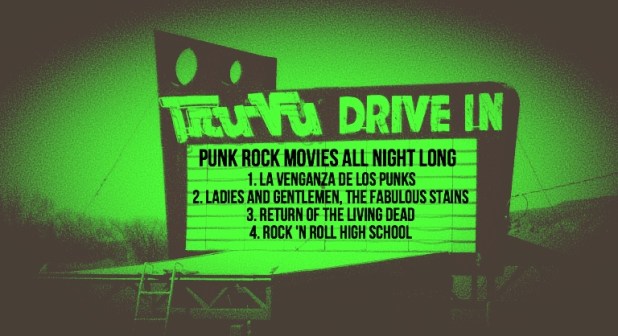
Punk rockers have had it rough on screen. Either they’re playing a gang that needs to be taken care of by the law or they’re ruining neighborhoods or they’re just plain dumb. Very few films take the sheer unbridled joy on punk and shove it in your face in an enjoyable way.
This week, we invite you to crank up your speaker as loud as it goes, spit at the screen and declare that there really is no future with these four films.
MOVIE 1: La Venganza de Los Punks (Damian Acosta Esparza, 1987): As if the first installment Intrepidos Punks, this movie begins with main villain — or hero — Tarzan getting out of jail and wiping out every man, woman and child related to his cop nemesis before jumping on a giant tricycle and leading a gang of mohawked and bedazzled punkers to the caves, where they will scream “Long live death, cocaine, marijuana and alcohol!” in the midst of a blood, drug and Satan filled orgy. This movie is everything your parents worried punk would bring to your life and everything that you hoped that it would.
MOVIE 2: Ladies and Gentlemen, The Fabulous Stains (Lou Adler, 1982): Punk promised leaving the steel town of my childhood behind, just as it does for Corinne Burns. Somehow, despite being made 38 years ago, this movie knows the score. A band that skirts sexuality while doing all it can to make it ugly and not putting out, the only thing that ruins the perfection of this film is the insipid MTV tacked-on close.
MOVIE 3: Return of the Living Dead (Dan O’Bannon, 1985): What was the best allure of punk in this film? The fact that The Cramps, The Damned and 45 Grave blared out of the speakers in your mainstream multiplex? Or was it the fact that Linnea Quigley, as Trash, pretty much is the most attractive vamp you’ve never seen in the pit? Perhaps. But to me, the real punk rock soul of this movie is that it doesn’t trust anyone. Not the government, not the kids to save us and hell, not even movies. “You mean the movie lied?” Yes, Freddy. Even George Romero, the king of social commentary being hidden by horror, lied to you.
MOVIE 4: Rock ‘n Roll High School (Allan Arkush and Joe Dante, 1979): Despite the people wearing crisp new Hot Topic Ramones t-shirts, they never really meant much to mainstream America after they were gone. And it was better that way. The Ramones were destined to make it huge, but they really weren’t, and we never had to worry if they’d sell out, because no one outside of the geeks wanted what they had to sell. Except in this movie, which seemingly takes place in an alternate world where a woman of PJ Soles’ caliber could fall so hard for Joey, where a snarling principal (“Do your parents know you’re Ramones?”) could see her school blown up real good and where all Dee Dee has to say is, “Hey, pizza! It’s great! Let’s dig in!” The scene with “I Want You Around” in it never fails to make me cry, as it’s the best distillation of the joys of having your life in front of you and having no idea what to do with it that I’ve ever seen on screen. When I started my first ad job, I listened to “Ramones Mania” non-stop to ensure that even though I was surrounded by capitalism, I’d never forget that I’d said “Gabba gabba hey” to a world where money didn’t matter.
What are your punk rock movies? Let us know. Want to do a drive-in week of your own? We’ve got space for you.
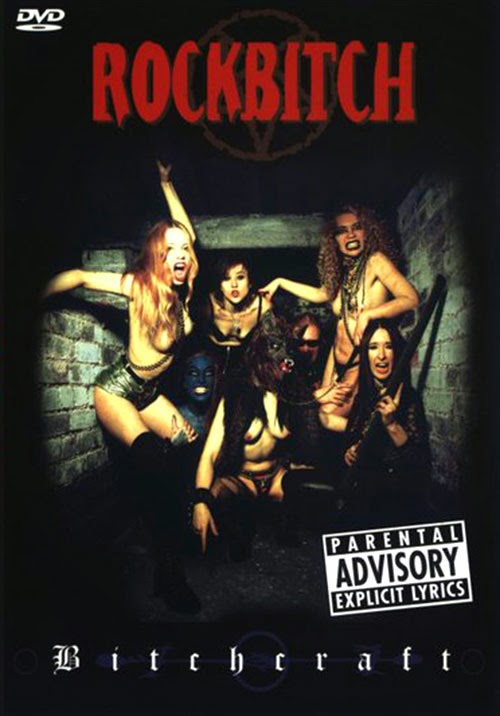
For years, whenever I’d look through someone’s list of bootlegs, they always had this movie listed. I always wondered why and then I watched this movie.
Rockbitch used to be called Red Abyss and was, like most magic-based things in the UK, part of a matriarchal, polygamous pagan community. The band was called Cat Genetica before that and was started by bassist Amanda Smith-Skinner (“the Bitch”) and guitarist Tony Skinner (“the Beast”).
Somehow along the way, their music got heavier and they decided to start getting nude on stage, then pretty much putting on live BDSM sex shows while performing. Think The Genitorturers in the U.S., because they were also obsessed with female genital mutilation, eating disorders, body dysmorphia and menstruation.
After a notorious series of concerts, TVAmsterdam arranged a concert in Zaandam, recording the experience and adding extra footage to create this documentary. Rockbitch is an acquired taste musically, but if you like NWOBHM-style bands, you’ll probably like them. You may have some difficulty getting past their constant nudity, whipping and on-stage oral sex, but they subscribed to a feminist ideal that stated that women had just as much a right to own their sexuality and make a rock show out of it as the guys did.
While the band never broke any laws in the areas where they performed and often tried to only do private shows, they ceased performing live in 2002.
Amanda and Jo from this band went on to form Syren, who supported Hawkwind on some tours. Julie, the lead singer, still performs under the name Krow, with the majority of her output being “noise terror punk.”
Rockbitch comes off like a more serious, more overtly sexualized Cradle of Filth, but one who also had a message of empowerment at their core, not just titillation. In 2017, a Swedish documentary on witchcraft and its feminist connections became the first to ever get to go inside the still-active Rockbitch commune and their pagan roots.
While most of their audiences may have come to get turned on, I love the audacious in-your-face nature of the band. Rock and roll was once, well, something. And it was dangerous, too.
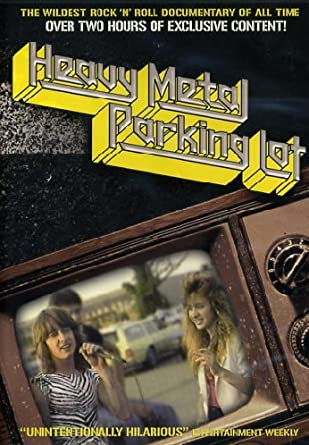
Jeff Krulik’s films — Mr. Blassie Goes to Washington, Led Zeppelin Played Here, Ernest Borgnine On the Bus — show a deep love and fear, often at the same time, for pop culture.
The film itself is simple: a group of young metal fans get inordinately wasted while waiting to get in to a Judas Priest/Dokken concert at the Capital Centre in Landover, Maryland on May 31, 1986. Everything captured is real and that’s what makes it pure magic.
This film was a VHS bootleg fave for years until music rights issues were cleared up. Since then, follow-ups and sequels — Heavy MetalPicnic and Neil Diamond Parking Lot — have been made. But the fact that you can easily find this movie now does not dilute its magical power. The sad truth is that probably all of these kids, including the ones who wanted to have rough sex with Glenn Tipton, have all grown up and are afraid of the next wave of music that came in its wake, as well as still out partying without masks or social distancing.
I will say, a youth of metal shows proves to me that none of this is fake. I lived this life. I had a girlfriend who tried to bring a pound of weed inside a glass jar inside a show once. I burned my feet because Three Rivers Stadium’s field was so hot during Monsters of Rock — yes, Rokken with Dokken. And while I’ve never been so drunk that I don’t remember a show, I used to have a roommate that would routinely piss his pants instead of leaving the front row.
Upon the advent of the DVD format into the VHS-driven (Betamax lost that analog throwdown) market, the rock ‘n’ roll documentary market became flooded with one smug and pretentious, paint-by-the-numbers vanity ego-doc unfurling at a mind-numbing pace with unrelatable and emotionless subjects spewing historically-skewed “facts” that were in desperate need of an editor: insert a brevity-lacking, babbling head here, a photo here, a backstage dust-up here, a performance clip here, etc., and so on. . . .
The end result: welcome to Walmart’s $5.00 electronics’ department cut-out barrels. Or be lost, swirling along the digital rims of TubiTV’s or Amazon Prime’s backwash.
That is not this movie.
Image of the 1991 reissue by Time Bomb Records courtesy of moosehorncorp/eBay
This is a movie that, if somehow Mike Ness and French filmmaker Jean Rouch, the father of cinèma vèritè (who was still alive and cinematically active at the time), became friends, Another State of Mind would have been the movie they made.
This debut effort by the writing-directing team of Adam Small (later the writer of Pauly Shore’s Son in Law and In the Army Now, Jamie Kennedy’s Malibu’s Most Wanted, Disney’s upcoming hidden camera experiment, Epic Offenders) and Peter Stuart (became a prolific TV documentarian) should be held in the same regard as American documentarian D.A Pennebaker*, who applied his truthful, vèritè eye to rock ‘n’ roll and gave us an inside look at the life of Bob Dylan in Don’t Look Back (1967). Small and Stuart should be as revered as the Maysles Brothers, who upped vèritè game with their chronicle of the Rolling Stones in Gimme Shelter (1970). If staunch independent filmmaker John Cassavetes filmed Faces (1968), his Academy Award nomination for Best Original Screenplay, not as a vèritè tale of a middle-aged couple’s disintegrating marriage, but of an indie-punk band’s disintegrating tour, it would be Another State of Mind: a tale that, although it’s classified as a documentary, has more of a three-act, dramatic-narrative arc (like the just released 2020 chronicle of the life of Suzi Quatro, Suzi Q).
Front image of the original 1984 VHS issues by Magnum Entertainment courtesy of Jim Idol/Depop.com
If you, like myself and everyone else of middle school and high school age at the time, were exposed to this — not via the poorly distributed Magnum VHS — through its mid-to-late ’80s multiple airings during the USA Network’s “Night Flight” weekend programming block (I watched it the first time and was hooked; the second time it ran, I taped it . . . segueing out of, of all things, the 1975 Dr. Who arc “Genesis of the Daleks,” courtesy of PBS), you know the story: a tale of how the good intentions of a group of friends disintegrates against life’s harsh realities of their career choices as musicians.
It all began when Small and Stuart became involved with The Better Youth Organization of Los Angeles, a family-operated record label (aka BYO Records) by the brothers Stern: Shawn and Mark of the band Youth Brigade**. Tired with the now poignant issues of police brutality (against youths) and the negative views by local city governments toward punk music and the scene (explored in the 2020 documentary Desolation Center starring ’90s alt-bands Sonic Youth and Firehose), the Stern’s decided to fight back: not with brawn, but brains.
The Better Youth Organization logo/courtesy of BYO Records
So the Stern’s decided to join forces with their friend, Mike Ness, who fronted his own band, L.A.’s Social Distortion**, on a cross-county tour of the U.S and Canada — along the way, they meet up with their friend, Ian MacKaye, who fronted his own band in D.C., Minor Threat** — to promote punk music and the burgeoning “alternative” youth culture in a positive light: to prove that not all “punks” are criminals; that they are caring, articulate, and responsible for the world around them.
The six week, ten thousand mile tour from Los Angeles, up through Calary, Canada, and into D.C., among the 11 friends comprised of bands members and roadies, quickly falls apart amid clashing egos, overbearing political pontificating, cancelled shows, and a broken down and unrepairable old school bus that leads to poverty and hunger. Not only did the tour destroy the friendship between Ness and the Stern’s: Mike’s band broke up and left him stranded in D.C. Everyone returns to Los Angeles with bruised egos and hard feelings, victimized by the very unity they wanted to promote to the world.
Back image of the original 1984 VHS issue by Magnum Entertainment courtesy of Jim Idol/Depop.com
As pointed out in my recent review of Liam Firmager’s perfectly brilliant Suzi Q: Adam Small and Peter Stuart eschew the predictable “talking head” pedestrian cookie cutters that slice away at so many doughy rock docs. They chose to tell a story that, while a “document” per se, it unfolds as a musical biographical drama. However, unlike other rock bioflicks, (the popular The Doors, Ray, and Walk the Line, along with emotionless-mimic Bohemian Rhapsody and the overly arty-pretentious Rocketman), Another State of Mind is a real story: one of no sugar-coated filtering to sweeten their subjects; one of no compression or compositing of characters or fabrication of pseudo-events for “dramatic effect” to present their subjects in a positive light. Rock stars aren’t the “superhero” savors of humanity: that’s the commercialized-attitude that crushed Cobain’s soul. Musicians are mortal human beings with hopes and dreams, success and regrets, joys and pain.
And that’s how you a make what many have said, is the “greatest rock ‘n’ roll documentary every made.”
Only it’s not a documentary. It’s one of the greatest rock ‘n’ roll dramas ever made — Bohemian Rhapsody and Rocketman be damned.
Where to watch: Say what? No official online streams? Not even on TubiTV? Bogus! This should be streaming alongside Surburia, which they carry. Not even on You Tube Movies alongside The Decline of Western Civilization, X: The Unheard Music, Ladies and Gentleman: The Fabulous Stains, and Breaking Glass (all USA Network “Night Flight” also rans)?
Eh, no worries! We found three clean (free) rips direct from the uncut VHS (not from the edited USA “Night Flight” broadcast) on You Tube to choose from HERE, HERE, and HERE (caution: mild, brief female nudity courtesy of the gorgeous, sandwich shop-working death rocker, Valerie). But if you want the nostalgia of the “Night Flight” version, you can watch it HERE.
Caveat Emptor, ye ol’ tosser: While the 1984 Magnum Entertainment VHS clamshell version is available in the online marketplace, they’re ultra-rare and pricey. The 1991 cardboard-sleeved Time Bomb Records/Filmworks reissue version is more readily available and affordable. The 2004 U.S. DVD version by the Bicycle Music Company is easy to find and affordable. Euro-customers can pick up the Time Bomb/Epitaph and Kung Fu Europe versions (but know your regions and shipping fees).
Oh, and if you’re a VHS purist (like me) and eschew the DVD format whenever possible (I still rather watch my VHS-taped-from USA Network’s “Night Flight” version over my official VHS), you may want to yield to the DVD version: Mike Ness, the Youth Brigade’s Sean and Mark, along with Small and Stuart provide insightful commentaries.
And if you’re wondering: there’s no LP or CD soundtrack available (official or bootleg; one was never issued). But no worries, I re-created it on You Tube for you to enjoy.
Uh, oh. Here comes the asterisk non-sequiturs:
* Speaking of D.A Pennebaker: Since this is “Rock ‘n’ Roll Week” at B&S About Movies — and we can’t get to everything — be sure to check out his rock chronicles Eat the Document (1966; also with Bob Dylan), the iconic Monterey Pop (1968), and David Bowie’s Ziggy Stardust and the Spiders from Mars. There’s a reason why Pennebaker was granted an Academy Honorary Award Oscar in 2013. If you’re a rock dog: watch these movies.
** “These are real bands?” face-squinches Cindy, my then Aqua-Net poufed, non-punk versed girlfriend, her adorable ears awashed in the AOR spews of Loverboy, The Cars, and Quiet Riot. She actually thought Another State of Mind was all made up. . . . Which reminds of my ol’ stoned, college buddy, Steve. He thought This Is Spinal Tap was a real document on a real band: “No, dude. I’ve seen their records in the cut out bins. I definitely remember seeing Intravenus de Milo.” And his brilliant insight (laughing) when Nigel Tuffnel broke out the violin bow: “What a loser! Look! He’s trying to be Jimmy Page!” What can I say: weed, followed by a two servings cheesy-jalapeno nachos and Mr. Pibb chaser, don’t mix well with mockumentaries.
Yes, Cindy. There really is a Social Distortion, Youth Brigade, and Minor Threat. And Santa Claus. Chicks.
Oh, and Steve runs a roofing company these days. Don’t call on him to fix your roof . . . not unless you want Jeff Spicoli swingin’ hammers on your abode.
About the Author: You can learn more about the writings of R.D Francis on Facebook. He also writes for B&S About Movies.
EDITOR’S NOTE: Thanks to Paul Andolina for being part of our music week. Paul writes often on our site, most often about Nicolas Cage and pro wrestling movies. Now, he’s back to talk about Heavy Trip, a heavy metal movie from Finland. To read more of his work, check out his sites Wrestling with Filmand Is the Dad Alive?
Leave it to the Finns to make one of the best movies about heavy metal that I’ve ever seen. Granted I haven’t seen a ton of films about heavy metal but I have been a metalhead for a long time. The store that I used to frequent and buy used metal cds no longer exists but this film certainly brought back the magic of discovering a new band.
Heavy Trip is about a group of guys who have a black metal band that mostly plays covers. They long for a gig but refuse to get one until they have written an original song. They play in a basement space below a reindeer slaughterhouse that is owned and operated by their guitarist Lotvonen’s dad. Rounding out the band is the ever shy Turo, the vocalist, Pasi, the living metal encyclopedia that is the bassist, and Jynnky, who has been dead twice, their drummer. After some failed original riff attempts, Lotvonen is inspired by a reindeer carcass caught in the processor, and the boys finally have their sound. They are really pleased with their song, Flooding Secretions.
They happen to have a chance encounter with Frank Massegrav, the promoter of Northern Damnation, a huge metal festival in Norway, when he comes to the slaughterhouse to buy blood. He is accidentally doused in the blood and pissed, storms off but not before Jynnky chases down his truck and hands him their demo. Turo goes on to tell the local florist, Miia, about meeting Frank, and says that he has a gig in Norway. Things get totally out of hand when news of this spreads across their small town. Suddenly the band is no longer ridiculed and is openly praised by all the residents. Things end up going tits up at a local gig when it is revealed they don’t actually have a gig in Norway.
This movie has some absolutely nutters scenes, including the band taking their promo shot by speed camera, a mental patient that turns violent when met by sudden movements who can only be calmed by metal, a fight with a wolverine, Turo puking on the town’s mayor while performing the first time in front of a live audience, and the entire third act of the film is bar none the greatest road trip segment put to film.
This movie is not only a great comedy but probably one of the funnest movies I’ve seen that involves metal in any capacity. I would highly encourage anyone who is a fan of metal to check it out. It’s irreverent, it’s heartfelt, and it is entirely metal. You can check it out on Amazon Prime.








 B&S About Movies
You must be logged in to post a comment.