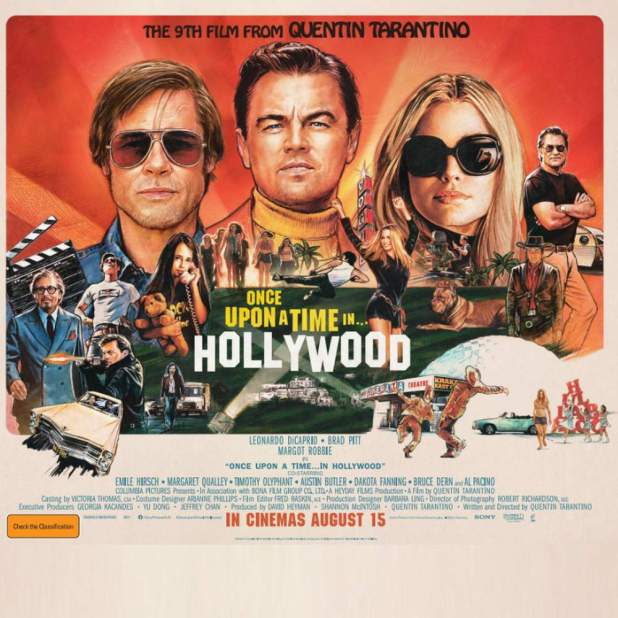
Once Upon a Time In…Hollywood (2019)

If you haven’t noticed — I mean, we did a Quentin Tarantino week on this site and have published articles about the 37 Movies That Make Up Kill Bill and the Movies That Influenced Quentin Taratino — but I enjoy the man’s films. So when Once Upon a Time In…Hollywood was announced as a film all about the Manson Family, I was a bit worried.

I’m not a part of my generation that worships Charles Manson and thinks he really had anything interesting or relevant to say. In fact, I’ve compared him to advertising consultants and TED talk speakers, two groups that I find as abhorent as the man who ordered the murder of everyone in the house where Sharon Tate lived and believed that the “White Album” was to be the start of a race war that his Family alone would survive.

I didn’t want a Tarantino film all about Manson. And good news. This movie is anything but. Instead, it’s a love letter to the end of the studio system as Hollywood moves from dashing square jawed leading men to neurotic antiheroes for a few years before blockbusters would change the game all over again.

This is the first Tarantino film not to be associated with producer Harvey Weinstein, with Sony Pictures winning the distribution rights, as they met Tarantino’s demands, least of which is final cut.

At its heart is the relationship between two men: Rick Dalton (Leonardo DiCaprio) Dalton and Cliff Booth (Brad Pitt), which is somewhat modeled on the relationship between Burt Reynolds and Hal Needham.

Rick is a veteran of war movies and 1950s Westerns like Bounty Law — based on Wanted Dead or Alive, which starred Steve McQueen. Unlike McQueen, Dalton’s foray into the movies did not go so well. He got his show cancelled and now has to be content with playing the bad guy of the week, always going out on his back.

His best friend Cliff is a veteran of the actual war who went on to become the stunt man that makes Rick looks so good. There’s been a rumor going around that Cliff killed his wife Billie (Rebecca Gayheart), but the movie neither confirms or denies this. We can tell that Cliff is a capabale man because of the way he can leap onto a roof with no ladder and because he dresses like Billy Jack without the hat. He lives alone in a trailer on the outskirts of a drive-in theater with his pit bull Brandy.

Now that the work is drying up, Cliff mostly drives Rick around town, as our hero is a drunk. One of those drives takes Rick to meet Marvin Schwarz (Al Pacino), who tries to talk him into leaving Hollywood behind and doing cowboy movies in Italy.

In marked contrast to Rick’s spiral is the rise of his neighbors, Roman Polanski (Polish actor Rafał Zawierucha) and Sharon Tate (Margot Robbie). Rick dreams that if he could just meet them, he knows that his life would be so much different. In fact, everyone dreams of Tate, including Steve McQueen (Damian Lewis, who looks near picture perfect), who laments that “Yeah, I never stood a chance” to win Tate over. The entire Playboy Mansion scene is wonderful, from the logo that bursts onto the screen to the cues of who each and every person is.

What follows are nearly three rambling hours in 1969 Hollywood, from encounters at Spahn Ranch with the aofrementioned Mansons to a fight between Cliff and Bruce Lee on the set of The Green Hornet, Stuntman Mike’s — from Death Proof — brother Randy (still Kurt Russell) showing up and married to Zoe Bell, the typical bare female feet you expect from a Tarantino film, Sharon Tate going to watch herself in The Wrecking Crew while a poster for The Mercenary is on screen for an extended time, Rick’s acting emerging on the set of Lancer, a young Method actress named Trudi (Julia Butters) who steals the show, Rick’s trip to Italy where he works with Antonio Margheriti and Sergio Corbucci and a last night of bromance drinking that turns into a pitched battle between Tex Watson, Susan Atkins and Patricia Krenwinkel against Rick, Cliff and Brandy, who are armed with cans of dogfood and an audience pleasing — SPOILERS PLEASE! — flamethrower.

There are the little in the margins moments that fans fo Tarantino love, too. A premiere for an adult film at the Eros Theater is in the script just to get a cheer from the crowd when this movie premieres at Quentin’s New Beverly Theater, its modern name.

I just love how Rick sings “The Green Door,” a song about not knowing what’s going on at a party when soon, the stars of Hollywood would be celebrating drugs and porno chic, with films like Behind the Green Door. Rick starts off clueless but his self-aware nature grows, particularly in the scene where he cries in front of Trudi.

Plus — Clu Gullagher shows up as a bookstore clerk!

My worries about the Manson Family in this film were unfounded. Sharon Tate exists as an angel here, above and beyond the cares of the characters that somehow live in the same world as her. She dances alone, not only at the Playboy Mansion but throughout the reality this film has stitched together. She’s as much of an ideal and McGuffin as Pulp Fiction‘s briefcase. Her mentioned what a great actor Rick was is enough to make him forget that he just stared death down and might have almost lost the only person in the world who truly loves him, no matter what.

And how about Timothy Oliphant as James Stacy? The sadness of real life is that Stacy was hit by a drunk driver while driving his motorcycle — he pulls away on it at the end of the shoot — leading to him getting his left leg and arm amputated. He had formerly been married to Connie Stevens and Kim Darby, and to compound the sadness, he was arrested for molesting an 11-year-old girl and stalking two others in 1995.

Is Trudie Fraiser really supposed to be Jodie Foster? Did Cliff really kill his wife (I’d kill for a Tarantino American giallo all about this)? Will Rick’s career change now that he’s finally had that one pool party at the Tate house? How amazing is it that Tarantino could change history not just once in Inglorious Basterds but now all over again? Where can I get those amazing fake Italian movie posters?

I don’t really want to say much more. As Tarantino himself said before the film earned a seven-minute standing ovation at Cannes, “I love cinema, You love cinema. It’s the journey of discovering a story for the first time. I’m thrilled to be here in Cannes to share ‘Once Upon A Time…in Hollywood’ with the festival audience. The cast and crew have worked so hard to create something original, and I only ask that everyone avoids revealing anything that would prevent later audiences from experiencing the film in the same way. Thank you.”
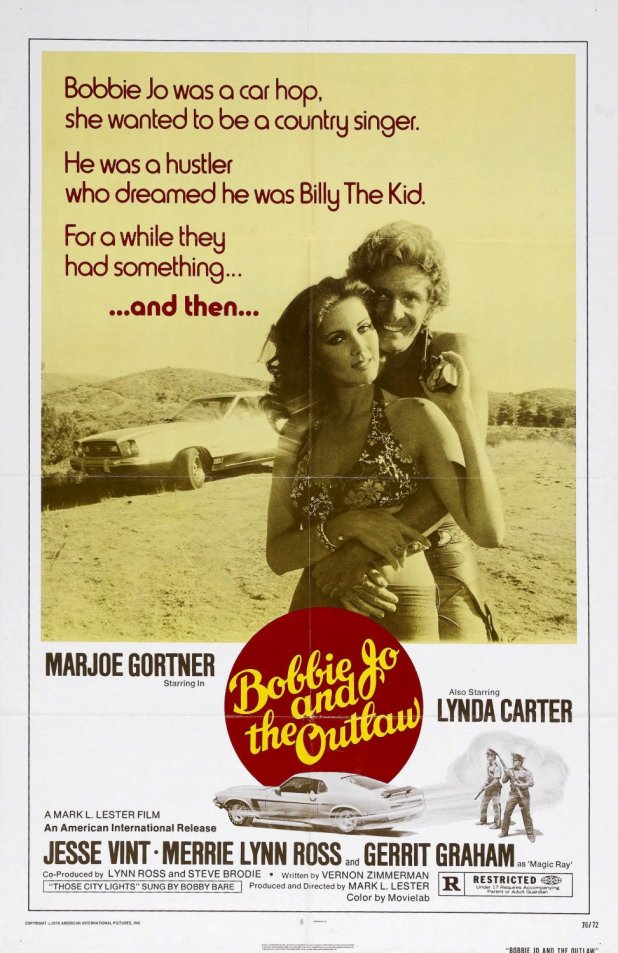
Bobbie Jo and the Outlaw (1976)

Mark Lester’s IMDB list is filled with drive-in and VHS era gold. There’s Steel Arenatruck Stop WomenRoller Boogie (with Linda Blair, of course), Class of 1984 and it’s kinda/sorta spiritual sequel Class of 1999FirestarterCommando and Showdown in Little Tokyo.

This American Internation Pictures release was written by Vernon Zimmerman, who has gifted us with just as many demented films as Lester. You can thank him for Teen Witch — Top That! — as well as Fade to Black and Unholy Rollers.

Together, these two titans of, well, movies that only I love joined up to make a modern Bonnie and Clyde redneck film starring former child minister Marjoe Gortner and future Wonder Woman Lynda Carter.

Young country singer and dreamer Bobbie Jo Baker (Carter) runs away from her job as a carhop to ride around in a Ford Mustang with Lyle Wheeler (Gortner), who fancies himself the modern-day Billy the Kid. Gortner was the second choice for the lead after Sylvester Stallone backed out, which would have made the Lyle role seem much more menacing.

Belinda Balaski, who is in nearly every Joe Dante movie, shows up, as does Peggy Stewart (she’s an actress from the cowboy era who was also in the redneck film Black Oak Conspiracy) and Gerrit Graham, who was Beef in Phantom of the Paradise and also made appearances in TerrorVision and Chopping Mall.

You should watch this movie to see Marjoe do mushrooms, but for many, there’s a major other reason to see this movie, called out on the poster. If only they had spelled Lynda Carter’s name correctly…

If you think the world hasn’t changed, just take a look at the main selling point of this film: the opportunity to see Lynda Carter topless. 

You can watch this on Amazon Prime.

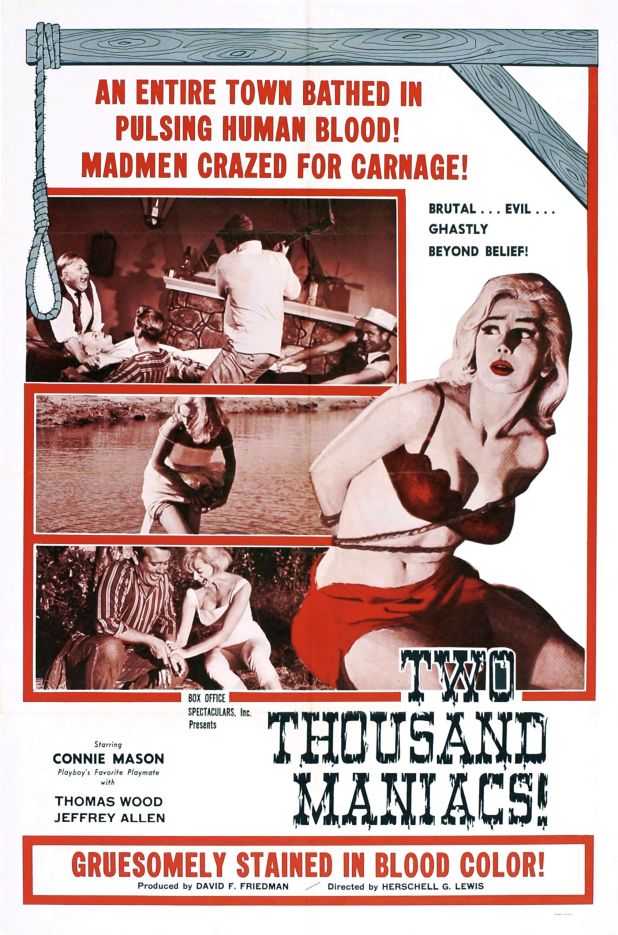
Two Thousand Maniacs! (1964)

It takes a certain kind of genius — or maniac — to make a gore drenched version of Brigadoon. I was explaining this movie to someone and said that the main reason why I like it so much is the completely joyful way in which the townsfolk of Pleasant Valley go about their murderous rampage. This is the time of their lives — well, post-death lives — and it’s worth hollering and singing and shouting about.

Shot over two weeks in the small Florida town of St. Cloud — not yet a cog in the omnipotent wheel of the Disney vacation empire yet — and featuring the gleeful participation of nearly every citizen in that sleepy community, this movie established the danger of the South to North audiences, a theme that would reach its creative apex in Tobe Hooper’s The Texas Chainsaw Massacre.

Yankee tourists, made up of the Millers, the Wells and unmarried folks Tom White and Terry Adams (Lewis’ muse, if he ever had one and only because he never sliced off one of her limbs or cut out her tongue, Connie Mason) have followed the detours to Pleasant Valley where they’re the guests of honor for the centennial celebration.

Yes, a hundred years ago, the Union troops marched through the town and killed every man, woman and child. What a thing to celebrate!

The town’s mayor, Joseph Buckman (Taalkeus Blank, who used the name Jeffery Allen, could do such a Southern accent that Lewis would also use him in Moonshine Mountain, This Stuff’ll Kill Ya! and Year of the Yahoo!), and the townspeople show everyone great hospitality at first, but before you can say Mason-Dixon Line they’re slicing off their guests body parts, drawing and quartering them, getting rolled down the hill in a nail-filled barrel, having rocks dropped on them and all other manner of grisly crowd pleasing hijinks.

After kidnapping little Billy, Terry and Tom make it out of town and come back with the police, only to discover that the town never existed. When they leave, the townspeople return and wonder what the world will be like when they come back in 2065 before disappearing into the fog.

This was Lewis’ favorites of his films and he even published a tie-in paperback version of the story.

Yes, that’s Herschell Gordon Lewis singing the theme song, too. You have to admire his dedication to filmmaking. This was produced by David F. Friedman, who met up with Kroger Babb before a career that has everything from nudie cuties and roughies to gore and Naziploitation, which he produced under the name Herman Traeger.

More movies should be like Two Thousand Maniacs!, but so few have the gumption to even try.

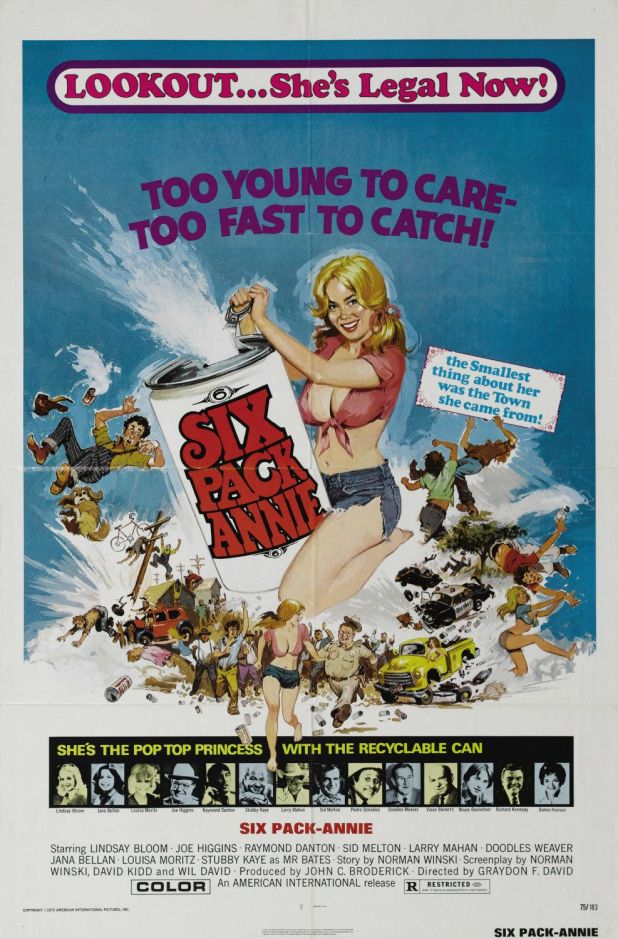
Sixpack Annie (1975)

American International Pictures — AIP — was formed in 1954 by Samuel Z. Arkoff and James H. Nicholson with the goal of releasing double features that appealed to young males, 19-years-old to be exact, as they found that was the optimum audience for their films. That was based on the Peter Pan syndrome, which their PR department believed went like this:

A. A younger child will watch anything an older child will watch;
B. An older child will not watch anything a younger child will watch;
C. A girl will watch anything a boy will watch
D. But the boy will not watch anything a girl will watch;

Therefore: to catch your greatest audience you zero in on the 19-year-old male.

Arkoff even believed that the perfect drive-in movie followed the ARKOFF Formula:

  • Action (exciting, entertaining drama)
  • Revolution (novel or controversial themes and ideas)
  • Killing (a modicum of violence)
  • Oratory (notable dialogue and speeches)
  • Fantasy (acted-out fantasies common to the audience)
  • Fornication (sex appeal for young adults)

For decades, AIP would find the exact double features that its audience was looking for. They had a stable of winning directors in their employee, like Roger Corman, Alex Gordon, Lou Rusoff, Herman Cohen, Bert I. Gordon and imported films from the UK, the Phillipines, Italy, Germany and more.

AIP would move on from science fiction to Poe adaptions to beach party movies to biker films to horror and anything else that would sell. They employed everyone from Jack Nicholson to Peter Fonda, Dennis Hopper, Fabian and so many more.

In 1972, James H. Nicholson resigned from AIP to work on the 20th Century Fox lot, setting up Academy Pictures Corporation. They only had two released before he died of a brain tumor, sadly, which were The Legend of Hell House and Dirty Mary Crazy Larry.

As the 1970s went on, AIP would move into even more genres, like kung fu, gangster and blaxploitation films. They also started moving into the mainstream with movies like Cooley High, The Amityville Horror, Love at First Bite, Meteor, Force 10 from Navarone, The Island of Dr. Moreau and C.H.O.M.P.S., as well as the final film they imported, Mad Max. However, AIP started to price themselves out of business with higher budgets and finally combined with Filmways in 1980. Arkoff bought himself out and started a new production company soon afterward. Meanwhile, Filmways/AIP became Orion Pictures.

The films of AIP read like a laundry list of the greatest films in exploitation history. I could create an entire website just to chronicle their greatest. This is but one of them.

The best part of this movie is the poster, created by the venerable AIP PR team, screaming headlines at you like “Lookout… She’s Legal Now! She’s Out to Tear the Town Apart!”, “She’s got the boys glad and the sheriff mad!” and “She’s the pop top princess with the recyclable can.”

Somewhere in the south lies Titwillow, where our heroine Sixpack Annie Bodine (Lindsay Bloom, who was somehow both Miss Omaha and Miss Utah in her beauty pageant career before appearing in movies like this and eventually becoming switchboard operator Maybelle on The Dukes of Hazzard) is taking her friend Mary Lou to work at the diner.

You don’t get a name like Sixpack Annie drinking soda pop out of the bottle. She chugs a can of brew as she drives her pickup truck, earning the ire of Sheriff Waters (Joe Higgins, who resume keeps on saying Sheriff in everything from Green Acres to Sigmund and the Sea Monster, the TV show Annie and The Man from Clover Grove). He chases her into the diner and literally slips on a banana peels while all the old timers laugh their asses off. Among their number is Doodles Weaver, who was the uncle to Sigourney as well as being a comedian and character actor. His scene in 1971’s The Zodiac Killer is one I always point to as his strangest. He’s also in plenty of redneck movie fare like BigfootMacon County LineTrucker’s WomanRoad to Nashville and Li’l Abner. He’s also in The 30 Foot Bride of Candy Rock, the only movie Lou Costello made without his usual partner Bud Abbott, and Won Ton Ton, the Dog Who Saved Hollywood, Michael Winner’s cameo laden film about, well, a dog saving Hollywood.

But I digress. Aunt Tess, the owner of the diner, is $5,641.87 behind on the mortgage to Mr. Piker the banker. This is important to the plot, as when the sheriff arrests Annie and her man Bobby Joe (a pre-Tron and Scarecrow and Mrs. KIng Bruce Boxleitner) for swimming naked — which does not seem like such a punishable crime — he offers to pay the Aunt Tess’ debt if she marries him. She agrees, but it turns out he doesn’t have anywhere near that much dough.

Annie and Mary Lou decide to go to Miami next, where Annie’s sister Flora (Louisa Moritz, Myra from Death Race 2000 and one of the first women to come out against Bill Cosby) lives in splendor thanks to her escort business. She suggests that if the girls want to save the diner, they should get a sugar daddy of their own. That said, all of the potential GFE benefactors are losers, like a sneezing married man (Sid Melton, who would go on to play Alf Monroe on Green Acres and Sophia’s dead husband on The Golden Girls), a man dressed as Napoleon, a swindler named Oscar Meyer who steals all their money (Ray Danton, who was married to the lovely Julie Adams and would go on to direct plenty of episodes of Magnum P.I.) and a Texan (Richard Kennedy, Dr. Kaiser from Ilsa, Harem Keeper of the Oil Sheiks as well as appearances in The Witch Who Came From the Sea and Invasion of the Blood Farmers) with a jealous wife who nearly kills Annie.

The girls make it back to the diner with no money to help, just in time for a jewelry salesman named Mr. Bates (Stubby Kaye, Marvin Acme from Who Framed Roger Rabbit?) who buys her necklace for $7,000. Just like Dorothy in The Wizard of Oz, Six Pack Annie had the power to go home all along.

Six Pack Annie was the only movie that Fred G. Thorne ever directed, but one of the three screenwriters, David Kidd, would go on to write The Swinging Cheerleaders and Carter’s Army.

You can watch this movie on Amazon Prime.

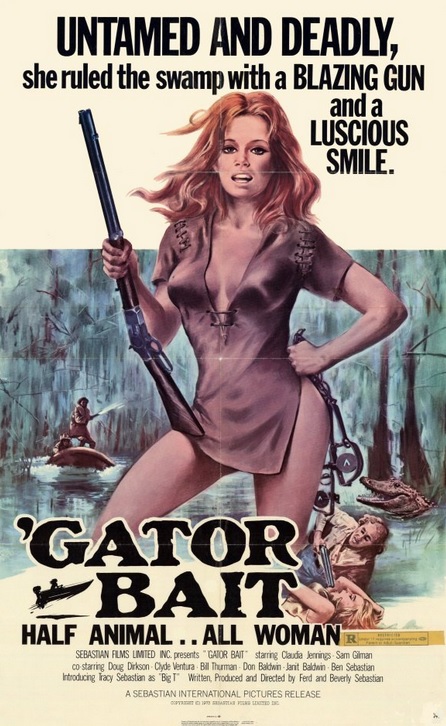
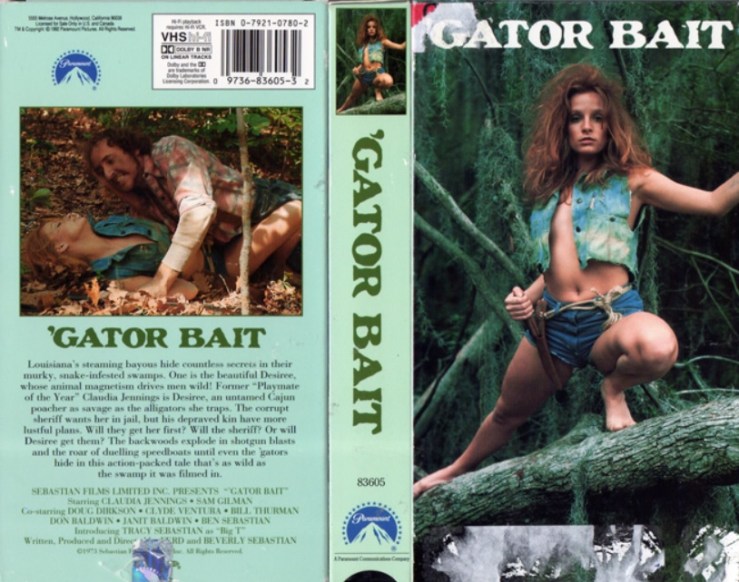
‘Gator Bait (1973)

Sam’s Note: I’m glad that Redneck Week will not just be me exploring these movies. R. D Francis has joined me with a review featuring perhaps the most popular actress of the genre, Claudia Jennings.

Prior to their mid-‘90s conversion to Christianity and retirement from the industry, Sebastian International Pictures was a family affair run by the husband and wife writing, directing, and cinematography team of Ferd and Beverly Sebastian; their sons Benjamin and Tracy (aka Trey Loren), and daughter, Jan, worked behind the scenes and sometimes stepped in front of the camera on the family’s films.

The Sebastians’ company edict mirrored Roger Corman’s: Make ‘em fast, make ‘em cheap and, when opportunity knocks, always produce a knockoff of a then-popular film. So when John Boorman struck box office gold with his redneck-revenge horror, Deliverance (1972), the Sebastians’ response was ‘Gator Bait. Made for a few hundred thousand—less than John Carpenter’s reported $300,000 budget for Halloween, ‘Gator Bait grossed double-digit millions on the drive-in circuit.

The “bait” for this swamp romp is Desiree Thibodaux (Playboy Playmate Claudia Jennings), a barefoot and daisy duke-wearing Cajun huntress carrying on the family’s gator poachin’ business (after the off-camera deaths of her ma and pa) and taking care of her mute, little brother, Big T, and her teen sister.

In steps the dopey-deputy son (Clyde Ventura of Poor Devil) of Sheriff Joe Bob Thomas (B-Movie stalwart Bill Thurman, Creature from Black Lake). Seems sonny boy is decidin’ he wants to git-em-sum of that “wildcat” and tries to arrest Desiree for poachin’. (Take note: In the Louisiana bayous: justice equals rape.) In her escape, Desiree tosses a burlap bag of poached snakes into dopey-deputy’s boat, which he subsequently shoots holes in—to kill the snakes—and shoots his redneck-rapist boat pilot in the process.

Guess what lies sonny boy done be tellin’ his pappy?

“S**t, boy, I just paid $300 for that there boat!” says Sheriff Joe Bob.

Yee-haw! Sheriff Joe Bob is roundin’ up ‘emself a posse with his “buddy,” T.J Bracken (Sam Gillman, an ex-Marvel comic artist who starred alongside Charlton Heston and James Coburn in The Last Hard Men), a daddy who be bull whippin’ his horny son after catchin’ ‘em tryin’ to rape his sister. Oh, and the plot twist: the reckneck-rapist boat pilot was T.J’s third son.

And with that: Joe Bob and his sonny boy, along with T.J and his two horndog sons . . . well they’s be a-goin’ to git Desiree and bring her to “justice.” And when you’re dishin’ out “bayou justice,” you murder-rape Desiree’s teen sister (Janit Baldwin of Humongous and Linda Blair’s Born Innocent), in order to apprehend (read: rape) Desiree.

Hell yeah! Desiree goes “John Rambo” on their asses, drawin’ em deeper n’ deeper into the swamp. As the inbred-bunch turn on each other, T.J lets more of the plot out of the snake sack: Sheriff Joe Bob had a “thing” with Desiree’s Ma, and Desiree’s Pa used Ma as “gator bait” for cheatin’ on ‘em, and the sheriff shot Pa in “self-defense.” Oh, and it turns out T.J is really Desiree’s pappy, so T.J’s three sons have been lustin’ ‘efter their own sister!

Well, it looks like this is the end to the Sheriff and T.J’s own gator poachin’ business and Desiree will have the market cornered.

Claudia’s other flicks in the redneck/hicksploitation cycle are the Bonnie and Clyde-cum-Big Bad Mama rip-off, The Great Texas Dynamite Chase and, for Corman, well ‘ol Rog wasn’t letting Smokey and the Bandit zoom by without producing a cheap knockoff, so Claudia starred alongside Ben Gazarra’s “Bandit” in Moonshine County Express. As part of Claudia’s two-picture deal with the Sebastians (she got a free Caribbean vacation via the film shoot), she starred in The Single Girls (with Greg Mullavey of I Dismember Mama fame).

Prior to their retirement, the Sebastians produced a 1988 sequel: Gator Bait II: Cajun Justice, where Big T—just a kid in the 1973 original—carries on the family business and teaches his wife (Jan MacKenzie; aka Sebastian, their daughter) the ways of the swamp—which she uses to extract Cajun revenge.

The Sebastians have since come to reacquire the rights to most of their Vestron Video and Paramount-distributed catalog, releasing their films on DVD via their Panama Films imprint through various online retailers. You can also learn more about Claudia Jennings at her official tribute site.

Ferd Sebastian
July 25, 1933 — March 27, 2022
Obituary

About the Author: You can read the music and film reviews of R.D Francis on Medium and learn more about his work on Facebook.