An interview with Matt Frame, the creator of Camp Death III in 2D!

We had a blast watching Camp Death III in 2-D! this week and had the feeling that whoever made it did so with a genuine love for the horror (and slasher) genre. Instead of assuming, we did our homework and did this interview with writer/boom operator/sound editor/director/editor/cinematographer/visual effects/producer and even actor (he was Scrotar the Squirrel #2!) Matt Frame.

B &S About Movies: Tell us about the process of making Camp Death III in 2D. I read that it took 14 months?

Matt Frame: Filming took 14 months. The post production (editing, vfx, etc) took me a further two and a half years. So from casting to final cut it was a 4+ year undertaking. Lots (and lots!) of obstacles to overcome in that time. But that’s nothing new for a low budget film. Especially one that is a weird and ambitious as this one.

B&S: How did you fund the project? Did you really walk all day with a coconut?

Matt: All day and night! 24 hours straight with a coconut strapped to my waist. My left knee is still feeling the effects. That brought in about $16,000. The rest was raised from my credit card and my poor suffering family 😉

B&S: What’s your favorite slasher? Is there one that you think is forgotten and you’d like to call attention to?

Matt: Favorite horror flick is Halloween III: Season of the Witch. Friday the 13th Part III 3D is my warm blanket slasher. As for forgotten films? Not sure if these are truly forgotten but my list would be: Alligator (1980), Christmas Evil (1980), Humanoids from the Deep (1980), Hell Night (1981), House on Sorority Row (1983), Psycho II (1983), The Hitcher (1986) and The Blob (1988).

B&S: Why was Friday the 13th Part 3D your main inspiration?

Matt: Probably the opening scene, the recap from Part II. Original idea was to have our heroine put the head of Ms. Van Damme on her hand and manipulate it like a puppet. However, by that point in the filming, we were totally broke so I settled for a real puppet. It doesn’t make a lick of sense but I love that about the film. We had to use creative problem solving to plug narrative holes so that’s why it’s so damn weird!

B&S: Did you have any plans to film this in 3D?

Matt: Not really. In fact, the title was changed from Camp Death III: The Final Summer to Camp Death III in 2D! only two months back. By that point, I really wanted to make an 80’s-centric 3D sequel. You know, gratuitous joint passing into the camera, eyeball on a string kind of 3D. So, this film’s title is a joke tie-in to the (unmade) sequel title, Camp Death III, Part 2 in 3D! Fingers crossed we’ll get the opportunity to make it.

B&S: How many deaths are in the film? How did you get so many of them done (and under budget)?

Matt: Oh, at least 75. We had a fundraising evening called ‘Night of the Living Deaths’ where we had aspiring actors choose a way to die. We had a murder menu with deaths ranging in price between $0 and $50. We then killed them on camera and included it in a murder flashback sequence during the campfire scene. We killed 68 in one night. Made about $500. Here’s a link to the event.

B&S: How are you planning to distribute the film?

Matt: We already tried Netflix but was given a thumbs down. Something about the ‘content’ didn’t sit right with them 😉

So we’re going the traditional route at present. We have submitted to 35+ horror themed film festivals, all of which take place before Christmas. By that time we should have a pretty good idea if Camp Death III has legs. It’s such a bizarre film that it’s hard to tell what we have on our hands.

Ideally though, Shudder would make a good home for it, in my opinion of course.

B&S: What are your next plans?

Matt: Hustle Camp Death III for the next 6-8 months, at least. It was such a struggle to finish the film that I remain highly motivated to make sure it’s given the best chance of success. When all is said and done the film might end up being a total dud but at least it would have been given a chance.

The dream, of course, is to make the sequel Camp Death III, Part 2 in 3D! I’d love another crack at this thing with a bit of a budget and with all of the lessons learned. Fingers crossed!

B&S: What are some of your current favorite horror (or any genre) films?

To be honest, I am stuck in the 80’s. I do watch modern films (just watched Hereditary — awesome and The Meg and Mile 22 — pure, unadulterated shit) but they don’t seem as important to me. My passion is for films made from 1975-1989 (especially horror) and so those are the films I return to the most often. The podcast ‘The 80’s all Over’ is my go-to.

B&S: What are your comedy inspirations? Is there a uniquely Canadian POV?

Matt: Parents are British so grew up on the absurdist UK stuff that we got here on Canadian TV in the 80’s. Monty Python, Fawlty Towers, Benny Hill, Two Ronnies, etc, etc. I think that played a big role in shaping my (admittedly) bizarre sense of humor.

Thanks, Matt! How awesome are his horror picks? I hope everyone gets a chance to see his movie and support it, as it’s a blast. Make sure to visit and like the Camp Death III in 2-D! Facebook page and watch the trailer below!
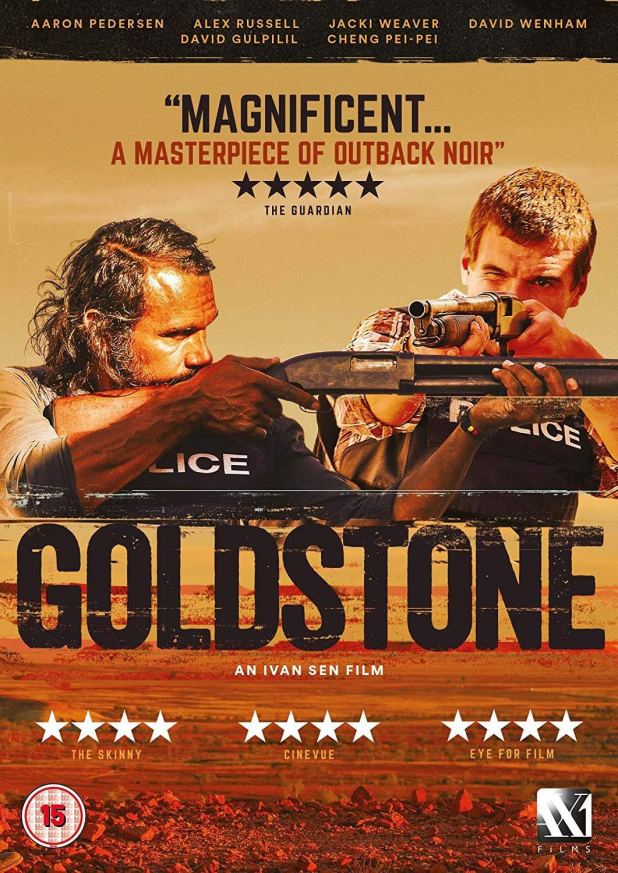
 

Goldstone (2016)

Three years after successfully exposing the corruption in his hometown in the film Mystery Road, Indigenous Detective Jay Swan’s next case takes him to the mining town of Goldstone to find a missing tourist. What he finds is even more corruption and deceit than before.

Jay is no saint — he’s drunk the moment he pulls into town and is arrested by a young local cop named Josh. They eventually become friends and begin to work the case together. The deeper they go, the more seedy things get.

There’s a mine trying to expand their operations. There’s local leader Maureen, who is trying to bribe the area’s indigenous people into using the raw materials on their land. And there’s a van filled with Asian women who are being forced to sell themselves to pay for their debts.

“I want to clean away the dust. I want to make it shiny again,” says one man. But even though they’re the heroes of this tale, Jay and Josh are nearly destroyed by it. You can see in the pain in each view of Jay’s face as he comes back through the desert.

Selected as the greatest Australian film of 2016 by The Guardian, Goldstone has been described as “film noir meets the Great American Wrestern in the Outback.” It’s finally available in the U.S. as of September 11 from MVD Entertainment.

I really enjoyed Jacki Weaver (a 2-time Oscar nominee for Animal Kingdom, Silver Linings Playbook) as the mayor. She presents herself as someone that cares for the people in her area, but only certain people. It’s sobering to realize that even across the world, the people who originally lived in an area and the immigrants who are new to it are as ostracized as they are here in America.

If you’re looking for a crime drama that takes place in an environment that is just a bit unfamiliar, Goldstone is the movie for you.

Disclaimer: I was sent this movie by its PR team, but as you know, that has no bearing on my review.

DEADLY GAME SHOWS: Deathrow Gameshow (1987)

I hate Troma movies. I don’t give a fuck who gets upset by that fact. They’re puerile and poorly produced pieces of pablum. And if they were created to be real movies instead of with an eye to be goofy, I’d probably like them. I mean, I love Burial Ground, but I don’t think anyone set out to make that movie as a meta-commentary on the state of horror. Other than the original The Toxic Avenger, I’ve disliked every film they’ve upchucked out. And sadly, I feel the same way about today’s film (which isn’t a Troma film, but sure feels like one).

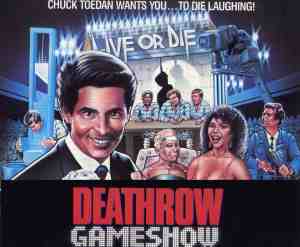
At LA station KSIK, the top-rated show is John McCafferty’s (no Beaver Brown Band) Live or Die. Condemned death row prisoners are given one last chance to entertain the masses before they get executed, as well as the chance to win prizes for their families. People love to watch it, but also love to tell McCafferty how much they hate the show (this was a surreal Matrix glitch deja vu moment watching this post The Gong Show Movie).

The problems start when the Spumoni crime family is offended when their boss is executed in a game where wires are hooked to his penis while a sexy girl dances for him. Only when McCaffrey touches the man’s shoulder does he become erect and die. They send Luigi Pappalardo, the best hitman in the world, to kill the host. Things get worse when Luigi’s mom wanders onto the set and is killed.

Note: Luigi is played by an actor named Beano. Yes, that is his name.

Meanwhile, our hero is in love with Gloria Sternvirgin, a member of Woman Against Anything Men Are For. She’s against his show until she’s in danger of being killed, of course.

Along the way, there are TV commercials and cutaways to other happenings at the TV station. This would work much better if the film were in the hands of a Paul Verhoeven (see Robocop or Starship Troopers). Or even Weird Al. But here, the cheapness and lack of talent — look, these are never usually bad things, but here they were grating — becomes apparent.

What also hurts the film is that it sets you up to see comical gore and then delivers it off camera. The only disgusting thing about this film is watching the hitman eat throughout.

Sorry you didn’t win, Deathrow Gameshow. But hey, you don’t go home empty-handed. Tell them what they’ve won, Johnny!

“A year’s supply of…”

DEADLY GAME SHOWS: The Gong Show Movie (1980)

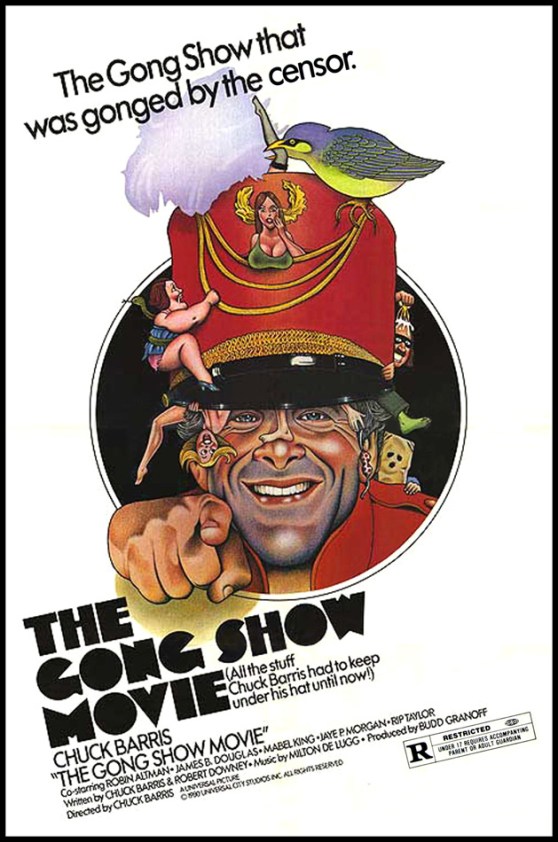
It’s hard for me to explain the cultural behemoth that The Gong Show was when it debuted. Originally airing on NBC from June 14, 1976 to July 21, 1978 (and in first-run syndication from 1976 to 1980), the show was basically a talent contest with celebrity judges that graded the talent and could gong — meaning they’d have to stop their act — those who had no talent to speak of.

Sure, there were clunkers, but the show also featured real talent, such as Andrea McArdle (Broadway’s Annie), Cheryl Lynn (disco hit “To Be Real”), Paul Reubens and John Paragon (who would go on to become Pee Wee Herman and Jambi the Genie), Police Academy’s Michael Winslow, Boxcar Willie, Oingo Boingo (which had future composer Danny Elfman in the band), actress Mare Winningham and more.

But more famously, there were reoccurring characters like the Unknown Comic (he wore a bag on his head) and Gene Gene the Dancing Machine, as well as risque acts like the Popsicle Twins, who basically performed oral sex on, well, popsicles. They are considered the main reason why the show was moved from NBC to syndication (and one of the times when creator Chuck Barris said he began to reconsider his career). Of note, the other reason NBC canceled the show, judge Jaye P. Morgan flashing her breasts, appears in this film uncensored.

Barris is an interesting character study himself. He wrote the song “Palisades Park,” as well as creating The Dating Game and The Newlywed Game. He never intended to host the show, but did so to save it. Watching his appearances today, you’re reminded that while there weren’t as many entertainment options in the 70’s, there was plenty of coke. Where life gets really wild is that in his book Confessions of a Dangerous Mind, he confessed that states that he worked as a CIA assassin, killing 33 people while acting as a chaperone on The Dating Game‘s big vacation dates (although the CIA denies this and Barris even later stated that the novel was his fictionalized account of how his life would have been different had he become an agent).

Which brings us to 1980’s The Gong Show Movie.

Written by Barris and Robert Downey Sr., the film is all about a week in the life of the show (including a nervous breakdown which Barris may have really had at one point, of which he said, “I had a small nervous breakdown out there, doing strange things. When I see films of the last shows, I was walking around, busting up [studio] flats on the air. That was the behavior of a host who was bored to death.”).

Indeed, Barris starts the film exhausted and miserable, in direct juxtaposition to his manic on-air character. The first song, “Sometimes It Just Don’t Pay to Get Up,” (which was, like all the movie’s songs, written by Baris) sets up the defeatist tone. Barris is overwhelmed by the attention the show brings him as well as the work it takes to get the show on the air.

We see a quick glimpse of the show — hey, there’s the Unknown Comic, there’s Hard Boiled Haggerty, there’s Tony Randall — just so we remember why we’re here. Yet even in the moments where the film tries to be fun, a man named Melvin and his chicken dance leads to a heart attack after Barris makes the man do encore after encore. Even when Barris tries to atone by visiting the man in the hospital, he is faced with a constant barrage of people wanting to try out for the show — including the sick man!

What was it about the 70’s that led to the need to see our heroes get shat upon? Think of the trials that Rocky endured in his sequel or Altman’s Popeye whose miserable life includes the fact that he hates spinach?

The film then descends into auteur — or maybe vanity — territory as Barris attends a country music recording session which turns into a montage. He watches a man abuse his wife and intervenes, only to have them both attack him (a bit taken from Buster Keaton’s Our Hospitality). And then, a discussion with his girlfriend ends up with him being attacked by two men whose mother he had gonged (character actor par excellence Vincent Schiavelli is one of them).

Another montage of clips follows, including Danny Devito singing, a group of girls in Alice Cooper makeup, a priest swearing, old women with falsetto voices, eggs being smashed and poured onto people, a crucified man singing “Please Release Me,” the infamous Popsicle Twins performance and Jaye P. Morgan’s baring her breasts uncensored.

Barris is harassed about the content of the show by his boss as he leaves. He sneaks into a restaurant where the maître d’ Raoul (Rip Taylor!) gives him a table inside the kitchen and the cook forces him to listen to a song. Meanwhile, another man is cooking naked in the background. The new boss finds him at dinner and follows him the whole way into the bathroom, where an excited fan pisses on Barris.

The boss even follows him to his house, where he interrupts breakfast in bed. This is followed by a montage of people waking up, with the Unknown Comic waking to his bag headed wife and Jaye P. Morgan in bed with numerous men.

Barris then meets with Morgan to discuss her behavior and that she acts too dirty on the air. Then it’s time for another montage of people getting ready for the show shot cinéma vérité style. Then Della Barris, Chuck’s real-life daughter, shows up and announces her plans to marry NBA star Bill Bridges. It’s at this point that I discovered that Barris’ love interest in the film, Robin Altman, was really his girlfriend at the time. In a 1980 People article, Barris said, “Robin used to work in our accounting department, but she was going with someone else, so I had to play it just hugs and kisses and copping a little feel. Then I threw my back out, and she came over with these heating pads because she had the same problem. We’ve been living together ever since.” The 70’s and 80’s, everyone!

Then it’s time for another montage, which ends with a pause on Barris’ face that stays on screen for way too long to hammer home the host’s nervous breakdown. Barris meets a doctor who he tells just how much he hates The Gong Show and how he needs to do something meaningful. She tells him that he needs to get away.

Somehow, Barris telling a joke leads to an argument which leads to him breaking up with his girlfriend. Which, of course, leads to another montage. Actually, it’s just one scene of him alone in the park with sad music. No, I take that back. It’s time for another montage, set to another listening of “Sometimes It Just Don’t Pay to Get Up.”

But Barris can’t escape The Gong Show. Even heading to a small diner in the middle of nowhere leads to the waitresses auditioning. So he heads to the airport and tries to fly out of town. A guy walks right up to him in line (Phil Hartman!) with a gun, because pre-9/11 these things just happened.

Barris takes a one-way ticket to Morocco and walks into the middle of the desert. If you think you’re not going to get a montage, you haven’t been watching this movie. We get view after view of Chuckie Baby crossing the desert to the tune of a sad piano.  Finally, a helicopter lands and his boss gets out. Everyone wants him back and the USC Trojan marching band appears, marching over the dunes (seriously, after playing on a coked up Fleetwood Mac’s “Tusk,” this is not the strangest thing this school band has ever been involved in). Everyone in Barris’ life comes out to sing a big musical number, including Gene Gene the Dancing Machine. Everyone thanks him as they sing “Don’t Get Up for Me.”

How does it all end? Another montage of show clips that ends with a man farting out a candle, which causes the new boss to faint. Did you expect anything different?

This is a film packed with cameos and character parts, like Mabel King (Mama from What’s Happening!), Harvey Lembeck, Ed Marinaro, baseball star Steve Garvey, Jamie Farr, Rosey Grier, Kitten Natividad and Taylor Negron, who must show up for a cameo in every movie made in the 1980’s.

You can watch this as a time capsule. You can watch it as a fascinating study in determining the difference between an auteur film or a vanity project. Or you can just be happy to see uncensored clips from the show. If you were born after The Gong Show graced the airwaves or have no interest in celebrity-obsessed 70’s pop culture, none of this will make sense.

The Gong Show Movie was in and out of theaters in less time than it took you to read this article. It did play on HBO, but wasn’t released on VHS. It finally came out on blu ray from Shout! Factory in 2016.

Camp Death III in 2D! (2018)

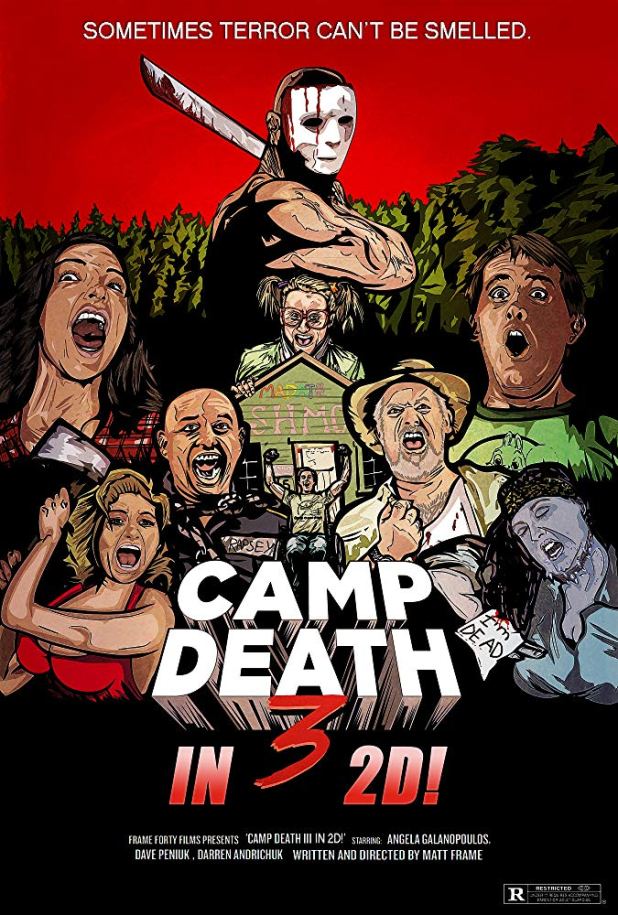
One of the coolest parts of doing this site is having filmmakers reach out to us. For example, this email: “My name is Matt Frame, director of ‘Camp Death III in 2D!’ Enjoyed your Friday the 13th Part III review and thought my film might be up your alley. It’s a comedy/horror parody of ‘Friday the 13th Part III 3D.’ We just completed the film and are about to launch our festival run. We’d be honored if you would consider watching the first 5 minutes of the film and/or the trailer. If you dig what you see then feel free to watch further.”

Good news, Matt. We watched the whole movie!

Matt sent us the link for his “$35,000 Canadian opus,” which he also told us, “someone described it as ‘the most horrible GOOD movie I’ve ever seen’ so bear that in mind.” I told him that I spend good money on Claudio Fragasso movies that no one in the United States knows or cares about, so there was a good bet I’d love whatever he did.

For someone like me that not only spent an entire week reviewing the entire Friday the 13th series, loves Sleepaway Camp and can count the slashers in my DVD collection in triple digits, Camp Death 3 in 2D! hits all the right buttons. It also helps that its gory heart in firmly in Caddyshack and Zucker, Abrahams and Zucker territory. Sure, there’s a narrative here, but the film works best as a collection of sight gags. Those are my favorite kind of films, where the description is as simple as “a family goes on a vacation, hijinks ensure” or “there’s a golf tournament, hijinks ensue.”

Camp Crystal Meph has reopened…again. Yet the scurvy and male pattern baldness ravaged death machine known as Johann Van Damme can’t be stopped. Head Counsellor Todd Boogjumper has a dream to convert the camp into a rehab center for adults who are either completely stupid or unable to contain their violent impulses. Joined by his Uncle Mel (who once was talked by the trees into fighting a lake), his guitar playing girlfriend Rachel and other counselors, the camp opens again. But now, the killings begin again. Is it Johann? Is it a copycat? Is it the squirrels who roam the camp and try to kill Uncle Mel every few minutes?

Crowdfunded in 2014, this movie took 14 months to shoot all over British Columbia. It looks awesome and is also a film unafraid to use B roll cutaways to establish mood (and then establish, establish and establish again). One of the ways it was funded was by director Matt Frame setting a world record by non-stop walking for 24 hours and 109 kilometers with a coconut strapped to his waist.

If you’re looking for gore, look no further. This one features around 80 onscreen deaths that Joe Bob Briggs would have a field day describing. Sure, there’s some computer aided stuff, but there’s also plenty of practical blood spraying here. Between all the red stuff and the frequent allusions to a whole red rainbow of slashers and other films, there’s plenty to enjoy here.

How funny is it? Well, that depends. My sense of humor runs toward The Kentucky Fried Movie variety as much as it does Mr. Show and SCTV, so I liked a lot of the jokes. You’ll also find more to like here the more 1980’s movies you’ve seen. It’s also completely unafraid to be beyond politically incorrrect in its humor, so if you’re eaisly offended, you might want to find another movie (or get a little more open minded).

Thanks for sending this our way, Matt. You’ve made our day! For more info on the film, head on over to its Facebook page!

Contamination (1980)

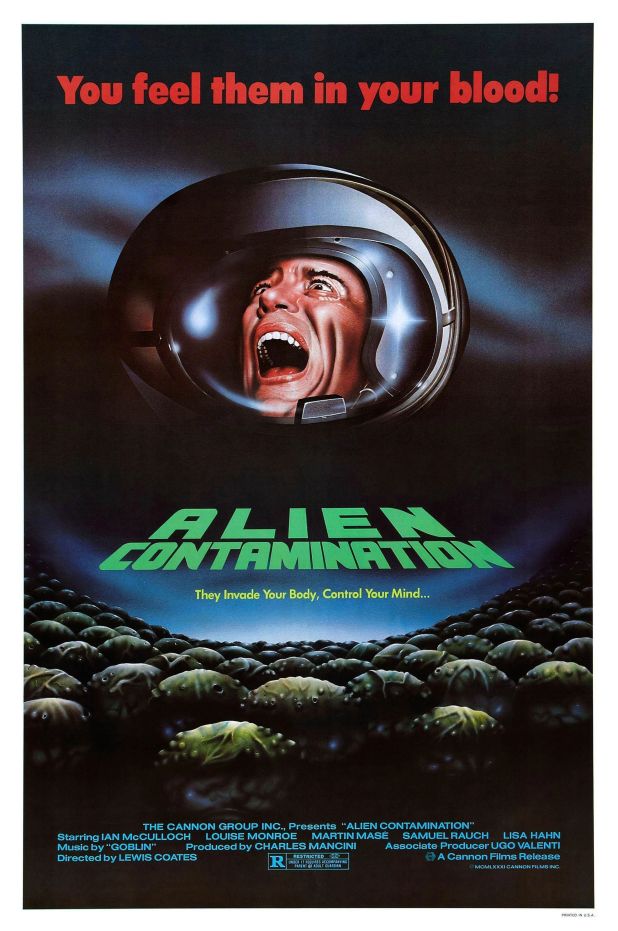
As a large ship drifts into New York City, you may wonder, “Am I watching Zombi?” No, you’re watching Contamination or Alien Contamination, but the similarities may be international. Both films shared the same production offices and director Luigi Cozzi (Starcrash, Hercules) was so impressed that he wanted to hire the same cast, but only ended up with Ian McCulloch.

The ship is packed with large containers of coffee, which really hide green eggs that pulsate and make droning sounds. The crew of the ship is more than just dead. They’re in pieces and the rescue team soon discovers why. The eggs tend to explode, spraying acid all over the place that’s toxic to anything human. As soon as it touches them, they explode in glorious slow motion bursts of red food color and Karo syrup.

The military soon links the green eggs with a recent mission to Mars that caused one astronaut to disappear and the other, Commander Hubbard (there’s Ian McCulloch!) to become a drunk. He joins Colonel Stella Holmes and New York cop Tony Aris (Marino Masé, The Red Queen Kills Seven Times) on the case, which takes them all the way to a Columbian coffee plantation (well, the movie was funded by Columbia cocaine dealers) and Hubbard’s old partner, who is now in the thrall of a gigantic alien cyclops (!).

Originally intended as a straight sequel to Alien, this movie enters James Bond territory at times and is not afraid — at all — to wipe out characters left and right. It also has a scene where a green egg menaces a girl in the shower, which should be frightening yet comes off as hilarious. That said, this has a loud Goblin soundtrack that makes this seem like a much better movie than it is.

But hey — who can hate a movie with dialogue like this?

NYPD Lt. Tony Aris: Jesus Christ, the whole world is going to be wiped out and all this broad’s worried about is getting changed!

Colonel Stella Holmes: Listen, Aris, if I have to die with the rest of the world then I want to have a proper dress on and clean underwear.

That’s better than the first few minutes of the film, where almost the entire dialogue is muffled. But hey — you can either choose great dialogue or awesome gore. Guess which one you get here?

Want to see it for yourself? Shudder and Amazon Prime both have this streaming and you can get the Arrow blu ray at Diabolik DVD.

UPDATE: You can also watch this with commentary from Joe Bob Briggs on Shudder.

DEADLY GAME SHOWS: Turkey Shoot

Australia. Not far from now. In Camp 47, social deviants are sent to be re-educated. But more likely, they’re about to end up as cannon fodder for a government-sponsored turkey shoot, as the rich and powerful will finally get the chance to hunt the ultimate game — man.

Also known as Escape 2000 and Blood Camp Thatcher, this film presents a world where those that help rebels or are sexually promiscuous are seen as the enemy. That’s where Camp Master Thatcher (Michael Craig, The Vault of Horror) and his enforcer, Ritter (Roger Ward, Mad Max) come in. Hardly anyone gets rehabilitated in their camp. Most are killed. And that’s the odds that Chris (Olivia Hussey, Black Christmas), Rita, Paul (Steve Railsback, Lifeforce), Griff and Dodge are up against. They’re offered their freedom if they can escape against hunters out to kill them.

Those hunters are Tito, who drives an armored backhoe and has a werewolf for backup. Yes, a werewolf, who wears a top hat. There’s also the Secretary of State Mallory, who has the hots for Chris and Jennifer, a sadistic, stylish and sapphic femme fatale with a crossbow.

Director Brian Trenchard Smith (Stunt Rock, Night of the Demons 2, Dead End Drive-In) knows exactly what kind of movie this is. It’s like candy for your brain, filled with nudity, gun battles and gore. This was remade in 2014, but that version has been treated like the werewolf in this film, who gets cut in half by that backhoe. Man, that scene makes me cry every single time. I love that goofy werewolf and that he’s in this film despite all common sense.

The bad guys are as bad as it gets. The good guys are up against the world. Heads explode. People get shot with crossbows. Little toes get cut off. This movie really has something for everyone.

Remember: disobedience is treason, treason is a crime, crime will be punished!

If you want to check it out for yourself, it’s on Shudder!

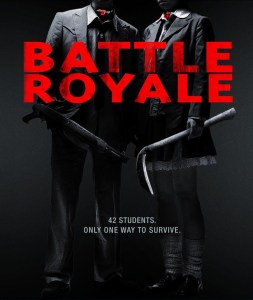
DEADLY GAME SHOWS: Battle Royale (2000)

The director of Battle Royale, Kinji Fukasaku (Tora! Tora! Tora!, Battles Without Honor and Humanity) spent his childhood working in a munitions factory during World War 2. One day, it came under fire and the children were caught in the explosion. Those that survived, like Fukasaku, had to dispose of the bodies of their friends. This is when he realized that adults were lying about the war and he developed a hatred for them that lasted most of his life.

Based on the novel by Koushun Takami, the actual Battle Royale is an annual event where one Japanese class is selected to fight. Only one can survive (see The Hunger Games, which while its own work, had to have been inspired by this story). And the rest of the country watches the event live on TV. It’s also population control as Japan faces an economic recession (see The Purge).

Class 3-B is gassed on a field trip, fitted with collars that can read their vitals (and blow their heads off) and sent to a briefing room where they encounter their former teacher, Kitano (Takeshi “Beat” Kitano, a cultural force in his own right). There’s a crazy scene here where a cheerful girl explains the rules of Battle Royale in the same way you’d explain how to play a video game. But after Kitano kills two students — including the one who wounded him and caused his retirement from teaching — for horseplay, everyone knows that this is no game.

Within six hours, 12 of the 42 students are dead, mostly at the hands of Mitsuko Souma and Kazuo Kiriyama, two girls who take the Mean Girls and Heathers archetype to its logically homicidal endgame.

The two main characters, Shuya Nanahara and Noriko Nakagawa, are determined to survive together. Along the way, there are twists, turns, double crosses and over the top amounts of violence. They’re assisted by Kawada, who has already won a past Battle Royale at the cost of his girlfriend’s life.

By the end, only Kiriyama is trying to win the game. Everyone else is trying to beat the system and escape the island. After a large battle, it seems at the end only Kawada survives, as he kills our heroes. But it’s all a ruse — he knew that Kitano can hear everything on the microphones they wear. Kitano then sends everyone else home, as he wants to kill Kawada himself.

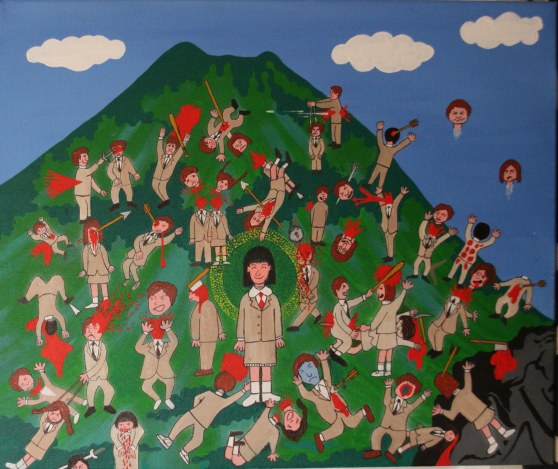
As the three enter Kitano’s base they find an unhinged painting of the entire class, all foretelling how they would die, with only Noriko as the sainted survivor, painted as if she has ascended to godhood.

Beat Takeshi painted this himself for the movie.

He tells them that she was the only one worthwhile and he wants her to kill him. His daughter had rejected him, as we learn when he tries to reconnect with her throughout the film. He threatens her with his gun and Shuya shoots him. It turns out that his gun was just a water pistol and before he dies, his daughter calls one last time to argue with him.

As they leave the island, Kawada dies from his wounds, happy that he has finally found true friendship. Our heroes are now on the fun, branded as murderers, but are determined to never stop running.

The casting for this film was just wild — 6,000 hopefuls tried out with 800 being trained and of those, 42 made it into the movie.

When released, the film was R15, a rating in Japan that keeps those 15 and under away from the film. Fukasaku complained that this audience needed to see the film most of all, but the government condemned the movie. This led Fukasaku to say to teenagers, “you can sneak in, and I encourage you to do so.” And while it’s played in the US at some limited engagements, it’s never been formally released in the wake of Columbine.

A film this visually intense, action-packed and boundary pushing? Of course, it’s influenced Western culture. And you need look no further than Quentin Tarantino’s Kill Bill, where Chiaki Kuriyama, the actress who played Takako Chigusa, was cast as Gogo Yubari. And the Marvel Comic Avengers Arena took young superheroes and pretty much ripped off this film, even using a variation of the logo.

There’s been talk of an American remake and even a TV show on the CW, but luckily, this has never happened. Why remake what is pretty much a perfect film, filled with cultural winks, ultraviolence and an actual message and transform it into a Westernized mess? Check this out on Shudder.

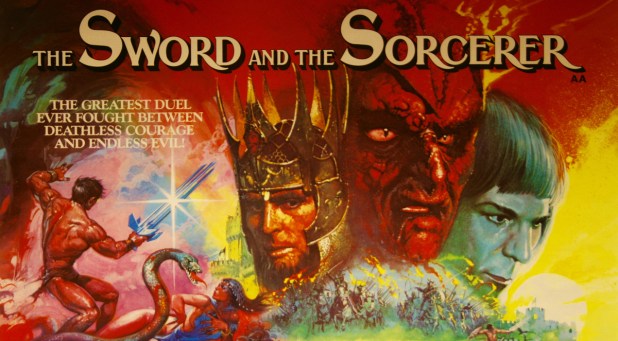
The Sword and the Sorcerer (1982)

King Cromwell (Richard Lynch, Bad DreamsGod Told Me To) has come the whole way to Tomb Island to find Xusia (Richard Moll, contractually obligated to be in all 1980’s sword and sorcery movies, although a bad reaction to the contacts needed for his makeup caused Moll to only physically appear in the opening scene), a dead sorcerer who holds the key to defeating King Richard.

But Cromwell realizes that Xusia will turn against him, so he stabs the demonic magician and chases him off a cliff. He doesn’t need him any longer — he’s destroyed all of his enemy’s army. Prince Talon arrives just in time to watch his father die, but doesn’t lose his family’s sword, a triple-bladed number that shoots blades. He’s going to need it to avenge the deaths of his mother and father.

Eleven years later and Talon (now played by Lee Horsely, TV’s Matt Houston) leads a group of mercenaries back to the country of his birth, ready to get his revenge. And oh yeah — Xusia is still around.

Cromwell attacks the city of Edhan, taking Prince Mikah (Simon MacCorkingdale, Jaws 3D) captive and nearly getting his sister Alana too, before she is saved by Talon, who also agrees to rescue her brother if he can have her for one night.  Of course, as soon as our hero leaves, Alana gets taken by Cromwell.

Talon rescues Mikah, but is captured by Cromwell, who forces Alana to marry him. He invites the four neighboring kings to the ceremony, where he’s crucified Talon (obviously Conan the Barbarian was an influence). But our hero is insanely strong and he pulls himself off the crucifix as Mikah and his soldiers attack the castle (one of them, Phillip, is Reb Brown from Yor, Hunter from the Future).

Cromwell takes Alana to the castle’s dungeons, where his second-in-command Machelli reveals himself to be Xusia. Talon uses his sword to defeat him, then bests Cromwell in mortal combat. Finally, a giant snake attacks Alana, but Talon saves her and defeats Xusia again.

Talon might be the rightful heir, but he gives his crown to Mikah, then gets what he really wants: Alana. After a night of what we can only imagine is some solid cocksmanship (and perhaps a marital aid that works just like his sword), he and his men do a collective group walk of shame as they head out looking for new adventure.

The end of the film promises “Watch for Talon’s Next Adventure Tales of an Ancient Empire,” but a sequel would not appear until 2012.

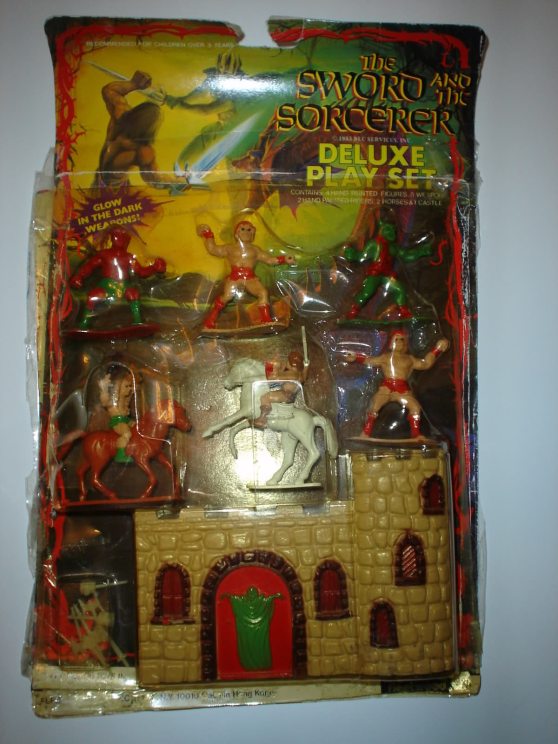
Despite being rated R, the cheapo toy company Fleetwood released both miniature figures and a replica sword from the film!

This is probably Albert Pyun’s (Cyborg) best film. It’s fun, quick and filled with plenty of swordfights and blood. Is it great? No, of course not. It’s an 80’s VHS rental that you watch with your favorite substances and yell at the screen. What’s not to enjoy?

It’s also impossible to find. Or you could get your copy just like I got mine — from the fine folks at the VHSPS. There’s also a RiffTrax version available on Amazon Prime.

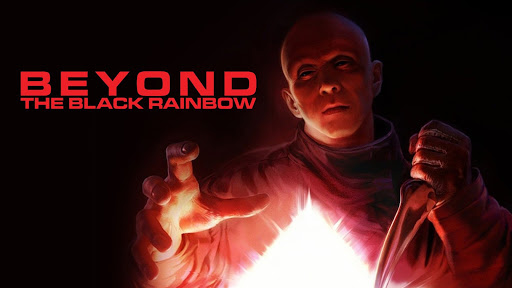
Beyond the Black Rainbow (2010)

The Arboria Institute was founded in the 1960’s to find the connective tissue between science and spirituality, finally helping humans to achieve perpetual happiness. But as the first numbers appear on the screen, spelling 1983, you know that something has gone very, very wrong.

Now, Arboria’s work is being continued by his disciple, Dr. Barry Nyle. To the outside world, Barry seems like a wonderful fellow. But a bad psychic trip in 1966, Barry hasn’t been quite the same. He is married to a woman who seems like a servant that exists only to praise him. He’s addicted to prescription medicine. And his hair is gone and his eyes have gone black, facts he hides with a wig and contact lenses.

It gets worse. He’s also been keep Elena, Arboria’s daughter, in a prison below the hospital that’s inspired by Lucas’ THX-1138. Her psychic powers — gained by being submerged into a black mass as a baby — have been given to her to accelerate human evolution. As her father says, “You will be the dawning of a new era for the human race… and the human soul. Let the new age of enlightenment begin!” Barry has different plans, isolating her in a room with only a television that suppresses her mental powers.

Day after day of intense interrogations follow as Barry wants to determine how Elena’s powers work. Or perhaps he just wants to have sex with her, as a nurse discovers that his notes are full of strange symbols and a violent need to possess Elena. So the good doctor does what any of us would do. He takes a bunch of psychedelics and manipulates Elena into destroying the nurse. She wanders out of her room but is soon stopped by a creature in a red space suit called a Sentionaut.

Keep in mind that this movie is full of long, drawn out sequences, almost like a shoegaze song come to vibrant visual life. You’re either going to love this movie or hate it — it’s not one for easy watching.

Arboria is now senile as we see a flashback to how Barry failed at his attempt to achieve transcendence and killed Elena’s mother. Her father was completely unfazed by this, only concerned with submerging his daughter into the blackness. As we finish the flashback, Barry murders the doctor. He then shows his wife his true face, trying to explain the pain of his life before murdering her.

Elena finally escapes, meeting a mutant and another Sentionaut who reveals his face to her — he is a child. Barry has decided that he must face Elena and is prepared to destroy her with a ceremonial dagger. As he gets closer to her, he is sure that a group of stoners had sex with her, so he murders them all.

In the final confrontation, he is no match for Elena, who keeps his feet stuck to the ground. Symbolizing his failed leap forward in 1966, he tries to jump forward only to kill himself by hitting a rock. Elena then wanders into a town, following the lights of television.

After the credits, an action figure Sentionaut appears as we hear a voice in reverse speak and the title “Wherever you go, there you are.”

Obviously, that’s a reference to Buckaroo Banzai. This is a movie filled with visuals and longing, as if it’s nostalgic for a future that we only saw in the past. Director Panos Cosmatos is the son of George P. Cosmatos, the director of Rambo: First Blood Part II, Cobra and Leviathan. In fact, this film was financed with the royalties of one of Cosmatos’ biggest films, Tombstone. Panos has stated in interviews that this film was a way of dealing with the deaths of his parents, combining his father’s popcorn sensibilities with his mother’s experimental art.

You can spot the influences in this film from space. The 1966 sequence has the stark high contrast look of E. Elias Merhige’s The Begotten. Kubrick’s ghost hangs on nearly every frame. The director has cited Manhunter as the inspiration for the color choices. And because it was all shot on 35mm, it has a grainy look that recalls the past more than any gleaming future. I also need to call out the Carpenter influenced soundtrack and inclusion of a Venm song, too.

The actual story here is pretty simple. But the way it’s told and the way the movie unfurls is why this stands out. You can play spot the references, you can try and figure out the film’s stance on identity or you can just zone out and enjoy. Or you can hate this movie and think that it’s incredibly self-indulgent. The choice is yours. Obviously, I’m going to watch this a few hundred times to get all I can out of it. You can check it out on Shudder.