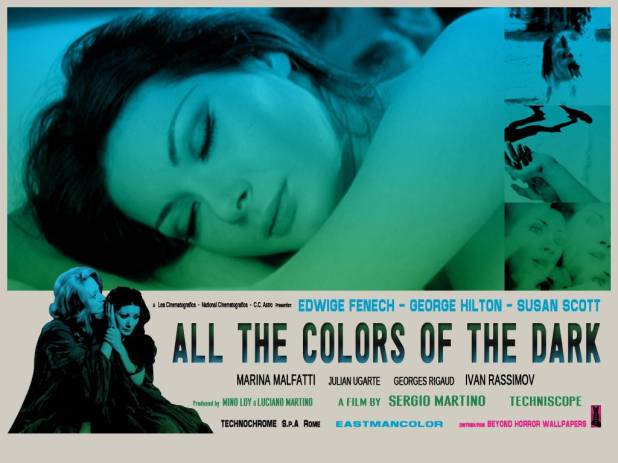
All the Colors of the Dark (1972)

The first five and a half minutes of 1972’s All the Colors of the Dark (also known as Day of the Maniac and They’re Coming to Get You!) subvert what I call Giallo’s “graphic beauty” in intriguing ways.

An outdoor scene of a stream slowly darkens, replaced by an old crone with blackened teeth, dressed as a child and a dead pregnant woman are both made up to be anything but the gorgeous creatures we’ve come to expect from these films; even star Edwige Fenech (The Strange Vice of Mrs. Wardh, Five Dolls for an August Moon and so many more that I could go on and on about) isn’t presented in her usual role of a sex symbol. She’s covered in gore, eyes open and lifeless. As the camera zooms around the room and begins to spin, we see a road superimposed and hear a car crash. Even when Edwige’s character in this film, Jane Harrison, wakes up to shower, we’re not presented with the voyeuristic spoils that one expects from Giallo’s potent stew of the fantastique and the deadly. She stands fully clothed, the water more a caustic break with the dream world than an attempt at seducing the viewer or cleaning herself.

Again — in a genre where words possess little to no meaning — we are forced to wait five and a half minutes until the first dialogue. Richard (George Hilton, Blade of the Ripper), her husband, bemoans that he must leave but feels that he can’t. His therapy is a glass of blue pills and lovemaking that we watch from above; his penetration of her intercut with violent imagery of a knife entering flesh.  Instead of the thrill we expect from this coupling, we only sense her distance from the proceedings.

As Richard leaves her behind, we get the idea of the madness within their apartment: a woman makes out on the sidewalk with a young hippy man who asks when he’ll ever see her again. Mary (Marina Malfatti, The Night Evelyn Came Out of Her Grave, The Red Queen Kills Seven Times), a mysterious blonde, glares down at him, somewhat knowingly. His wife looks lost and trapped. Without dialogue, we’ve already sensed that some Satanic conspiracy is afoot. Echoes of Rosemary’s Baby? Sure, but you could say that about every occult-themed 1970s film — the influence is too potent, a tannis root that has infected all of its progeny.

Last year, a car crash took the life of Jane’s unborn child. Her sister Barbara (Nieves Navarro, Death Walks at Midnight, Emanuelle and the Last Cannibals) has advised therapy, which Richard laughs at. As Jane waits to see the doctor, she sees a man with the bluest eyes (Ivan Rassimov from Planet of the Vampires and Django in Don’t Wait, Django…Shoot!) — eyes we’ve seen before, eyes that hint at blood and murder and madness.

Even when surrounded by people, such as on the subway, Jane is lost in her thoughts and in another world, one of inky blackness and isolation punctuated only by the cool blue eyes of the sinister man who tracks her everywhere she goes. Even the teeming masses of the city make her feel more lost; only the light of the above-ground world erases the nightmare of her stalker. That is — until he finds her in the park, where she screams for him to stop following her. The camera is detached, following her from high above, watching her run away, needing the refuge of her home. Even then, the man is still there, banging on the door, demanding to be part of her reality.

The thing is — Richard has no faith in his wife’s sanity. And even when he’s telling her sister, Barbara, how he doesn’t trust psychiatry, he’s also watching her undress in a mirror. This scene really hints that they’ve had sex in the past (perhaps the past was just five minutes ago).

Jane finally finds a kindred soul—her neighbor, Mary, whom we saw earlier in the windows. Mary tells Jane of the Sabbath, the black mass and how it helped her. She sees Jane as a lost soul who needs to be saved and agrees to take her to her church.

The blue-eyed man returns, chasing Jane past a spiraling staircase, ax in hand. The camera spins, making us dizzy as it cuts from the building to the man to Jane’s car to the man. Jane demands to be allowed to go to the Sabbath as she fears the madness that seems ready to overtake her.

As we approach the old mansion where the rite will occur, we feel more of a sense of belonging, a warmer color palette instead of the washed-out nature of the urban sprawl we’ve experienced until now. Everything is lit by a candle. Mary appears to have achieved a glow, and Jane stands in stark contrast to the beatific zombies of the assembled congregation. A taloned priest murders a dog in front of Jane’s eyes as Mary caresses her (trust me, this isn’t a Fulci realistic dog murder, although I hid my mutt Angelo’s eyes for this scene). The priest tells her that if she drinks the blood, she will be free. Hands and lips and bodies overtake her as an orgy breaks out, a bacchanal that she seems to want none of. This sex is presented as horror, as anything but pleasure, yet Jane seems ill-equipped to resist.

Immediately, we see her enjoying her husband, no longer frigid and everything back to normal, as he says. However, Jane tells her that she doesn’t feel real any longer. She walks to the bathroom, seeing multiple reflections of herself that harken back to the kaleidoscope effect we saw as the priest took her to the altar.

No matter what peace, love, and sex happen, Jane can’t escape the blue-eyed man. Even on a romantic lunch date with her husband, he’s there, outside, waiting for her. A taxi drives her back to her home, the only sanctuary against the invasion that the man presents. As she goes through her husband’s effects, she finds a book of the supernatural emblazoned with a pentagram. He claims it’s just a second-hand book and accuses her of hiding things from him.

Jane returns to the Satanic church, this time willing to give herself over and actually seeming to enjoy lovemaking for the first time in this film. Mary intones, “Now you’ll be free.” Again, the long-fingernail priest takes her while the blue-eyed man watches her, his hands covered in blood. The members of the church dance around her as Mary calls to her. The priest tells her that Mary no longer exists. She is free to go, as she brought Jane to the church. The final act is for Jane to murder her, to send her away. Jane screams that she can’t do it, but Mary tells her that they must part, that this act will free her, as she lowers herself onto the dagger that Jane clutches.

Jane awakens, fully clothed, in a field. The blue-eyed man is there, telling her, “Now you are one of us, Jane. It’s impossible to renounce us.” He offers his hand, telling her to follow him. She’s expected. He takes her to an altar that is the same design as the pendant we just saw her wear during the orgy. She demands to know where Mary is, but the only answer she gets is that she belongs to the cult and will now be protected. Mary is gone, and Jane’s sacrifice allows her to be free. They show her Mary’s body, covered in black lace, as she runs screaming.

Perhaps in retaliation for the ritual, dogs chase her through the woods, tearing at her, stopped only by the blue-eyed man who knocks her out. She awakens, clad in virginal white, surrounded by white sheets. Her husband leaves a note in lipstick on her mirror. She looks, and the symbol is on her arm, which is covered in blood. When she goes to Mary’s apartment, an old woman lives there instead.

Jane is totally lost — the ritual has brought her nothing but more madness and the blue-eyed man even closer. Her husband is away on business, her sister is on vacation, and her therapist is dismissive. Even her apartment walls, which offer security, have become a maze of fear. The colors shift to Bava-esque hues of blackness and reds as we see the blue-eyed man attack her over and over again, with constant repetition of the frame as she screams — and then there’s no one there, just the room filled with red and a broken piece of pottery embedded in her hand.

After examining Jane, the doctor leaves her with an elderly couple. Her husband can’t find her and asks Barbara to help.

Jane awakens in a white room — of course, the blue-eyed man is waiting outside the house in the gauzy early morning hours. Yet there is an ominousness about the proceedings — no one is there. A tea kettle is boiling on the stove while the old man and woman sit there, in still repose, dead at the breakfast table. She’s trapped in the room with them as she frantically calls for help. She tells her doctor that the man is there and has killed everyone. He calmly tells Richard and Barbara that he has another patient to deal with, as he doesn’t trust Richard and wants to keep him in the dark. However, he does reveal the truth to Barbara. That lack of trust goes both ways as Richard follows the doctor.

Meanwhile, the blue-eyed man finds Jane, telling her she cannot renounce them. He tells her that the knife that he holds killed her mother when she tried to deny them. And it’s the same knife that killed married. He tells her she is beyond reality and will never find it again.

Following the sound of a hound, she finds the doctor’s car in the driveway — and, of course, he’s dead, too. The blue-eyed man gives chase and finally tries to kill her, but he’s stopped at the last minute by Richard, who stabs him with a rake. He stomps on the man’s hand repeatedly, revealing the tattoo symbol he stares at.

Meanwhile, Mary arrives home to a green-hued apartment, where Richard is smoking and accusing her of being part of black magic. He sees the symbol when he watches her undress, and she tells him that she wants him, that she can make him forget her sister. She promises him untold power and that he can become anyone he wants. As she leans in for a kiss, he shoots her, tossing the envelope of a letter that he received that explains it all.

Cut to a hazy white room where Jane has been given a sedative. An inspector — the priest from the cult! — demands to see her. Richard arrives and embraces her, telling her he will take her out the main door. They speed away in a car and return to their apartment. But all is not well — Richard is killed by an unseen person, and Jane is left holding the dagger. The police that arrest her all have the symbol on their wrists and are led by the leader. The camerawork becomes tighter and claustrophobic as we see the cult descending on her.

Wait — it’s all a Wizard of Oz dream, with the police and her husband at her bedside, explaining the film’s entire plot, which ends up even more ridiculous than everything that we’ve seen up until now (which is really saying something). Turns out there was no real magic. The cult was just a drug ring. Mary was real and just a heroin addict. Her sister was behind it all because she wanted all of the money from the will of their mother’s murderer, who wanted to give 600,000 pounds to both of them.

Jane rejects this reality, saying that this cannot be true after all that she’s seen. The cop replies that he kept trying to call her, and she never answered, so he wrote it all in a letter — the letter that Richard showed Barbara after he shot her. It’s worth noting that the American version of the film ends with Jane being killed by the cult and all of the ending — nearly six minutes worth of important story and denouement — exorcised.

We return to where we were, with Richard going upstairs — just like we’ve seen before. Jane screams that she knows what will happen. The cult leader attacks him, blaming her for Barbara’s death. Richard follows him to the roof, where they fight, and the priest is thrown from the roof. Jane tells Richard that she knew the man was there; she knew that her husband had killed her sister, that it wasn’t a suicide, and that some strange force was guiding her. She asks for help, and the credits roll.

With this film, director Sergio Martino (Torso, 2019: After the Fall of New York) crafted an intriguing blend of the supernatural and the Giallo. Even the procedural elements come only after the film has descended into surrealism as if a cold glass of water splashed in the face of a viewer who needs an explanation. Magic is madness, and we can’t even trust our heroine at the end when she begs to escape the power inside her.

This film is terrific, with Edwige Fenech turning in a strong performance. You really feel the isolation and madness that surround her and empathize with her. The strong visuals and the break from the genre conventions of masked killers, gloved hands and inept police make watching this film an absolute joy. From beginning to end, it makes you question not only the reality that it presents but also the objective trustworthiness of our heroine. And while it betrays an obvious inspiration to the aforementioned Rosemary’s Baby, it is not slavish in its devotion, making a powerful statement on its own merit.

Here’s a cocktail recipe.

They’re Coming to Get You

  • 1.5 oz. J&B
  • .5 oz. lemon juice
  • .5 oz. simple syrup
  • 1 egg white
  • 3 dashes Angostura bitters
  1. Shake all ingredients in a cocktail shaker filled with ice.
  2. Strain into a glass and enjoy.

The Case of the Bloody Iris (1972)

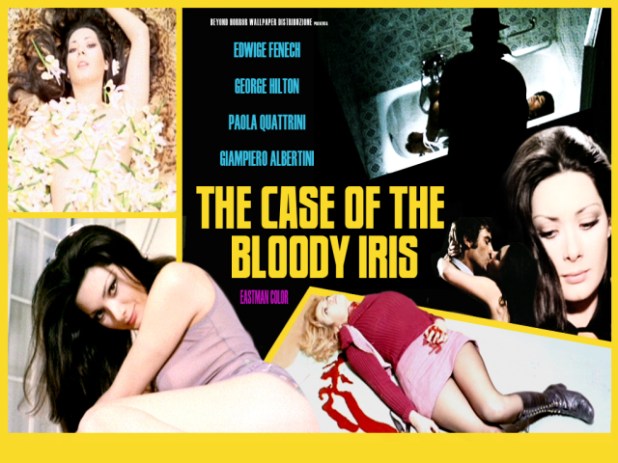
1970’s The Bird with the Crystal Plumage became a worldwide hit, bringing giallo to the world. But by 1972, in its native Italy, the films had already become self-aware parodies of the genre. Witness 1972’s The Case of the Bloody Iris (originally titled Why Are There Strange Drops of Blood on Jennifer’s Body?), directed by Giuliano Carnimeo (Exterminators of the Year 3000). Yes, I lied when I said I’d be watching all Sergio Martino movies. I’ll make it up to you, I promise.

We start with the hallmark of this style: a beautiful woman slashed to death by a masked killer in a public location — this time an elevator in a modern high-rise. That body is discovered by a black exotic dancer — well, she’s more of a wrestler who challenges men in the crowd to fight her on stage — who soon becomes the next victim in a bathtub drowning with a killer that references the look of the killing machine behind Bava’s Blood and Black Lace.

That leaves us with two models, Jennifer Lansbury (Edwige Fenech, Your Vice is a Locked Door and Only I Have the KeyStrip Nude for Your Killer and many more — she even had a cameo in Hostel 2) and Marilyn Ricci, who become friends with Andrea Barto, the architect of the building (George Hilton, All the Colors of the Dark) and move into the vacant room of the first victim. Nevermind that the police believe that Andrea is the killer!

Meanwhile, Jennifer’s ex-husband, Adam, used to use her for strange group sex rituals — we see a flashback of him giving her communion and initiating her into the group. He’s been stalking her, trying to get her back. Turns out he could make love to anyone he wanted and was the jealous type. “You’re not any man’s special girl because any man can take you,” he tells her. She tells him that she wants to belong to someone special. He replies by attacking her in an alley and tries to inject her with a needle. She escapes and he exclaims that she will “come crawling back on her knees.”

The cops bumble their way through the investigation, more concerned with naked women than they are with the case itself. Oh yeah — Marilyn fakes her death in the same tub the black victim died in, driving Jennifer crazy. And also — Andrea is afraid of blood. And then again there’s that nosy old Mrs. Moss who keeps showing up to find the bodies and has a subscription to Killer Man comics. And another red herring — Adam tries to kill Andrea. Whew — so much to keep track of!

Here comes another one — the murderer keeps showing up in the window of the apartment, scaring Jennifer. And then Adam shows up to attack her. Running from her apartment, she finds refuge at her neighbor Sheila Heindricks’ place. However, Sheila turns out to be a lesbian — with a violin playing dad — who wants to molest her. She runs back to her place to find a blood stained orchid and Adam’s dead body.

There is some good news. Even though the police think Andrea is the killer, Jennifer still falls in love with him. They make love while the police watch. The next day, Marilyn says hello to someone in the street and is stabbed in front of the world. She falls into Andrea’s arms, covering him in blood before dying in Jennifer’s arms. Covered in gore, the blood freaks out the architect, who runs into the streets to hide.

Wow — like I said, this film almost becomes a parody of giallo convention as it piles on things. Why does the old man play violin all night long? Why is Andrea afraid of blood? Why are the police so incredibly stupid? Oh! I forgot about Arthur, the camp gay pornographer!

Turns out that Mrs. Moss has a scarred up son that lives in her place. He attacks Jennifer when she sneaks in, then Mrs. Moss calls her a whore around 19 times in 2 sentences. When Jennifer brings the police, the son is nowhere to be found.

The killer starts luring Jennifer all over the place, from a junkyard to the basement — along with her lesbian neighbor. A blast of steam decimates the next door sister of Sappho and the lights go down, leaving our heroine trapped. Turns out Andrea has been following her since the junkyard and demands Jennifer follow him in a way that reminds her of her horrifying ex-husband.

So whodunnit? Do you really want to know? Well, it wasn’t the old lady. And it wasn’t the architect. And it wasn’t our heroine. So that leaves…the violinist! He blamed the women of the world for turning his daughter to sin, taking her from him. He also killed the old woman’s son. He dangles Jennifer over a big stairwell, but she’s saved at the last minute by Andrea. A battle ensues, leaving blood all over his face, which gives us a flashback of his father dying in a car crash, bleeding all over his face as he was a child. Luckily for all concerned, Jennifer used the reel to reel in the violinist’s apartment to record his confession.

Whew. Your head is going to spin when you watch this one, trust me. That said — if you haven’t really gotten your brain trained toward giallo, you may want to skip this. I can never really figure out what other folks are going to like! But if you enjoy murder, models and murky plots, well, this one is for you.

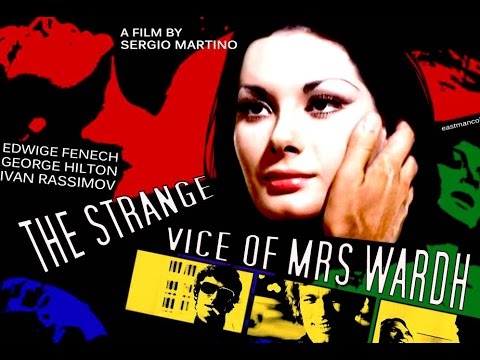
The Strange Vice of Mrs. Wardh (1971)

Sergio Martino’s directorial efforts have run the gamut — from straight exploitation (Mondo Sex and Mountain of the Cannibal God, which features Stacy Keach and Ursula Andress, as well as real animal mutilation which we’d never endorse) to horror (Island of the Fishmen, which in addition to starring Barbara Bach and Joseph Cotten, was re-edited by Jim Wynorski and re-entitled Screamers), post-apocalyptic action (2019: After the Fall of New York and Hands of Steel, which is more Terminator rip off than Road Warrior), spaghetti westerns, crime dramas, war films, comedies and even Italian TV, where he’s worked for the last several decades. But this week we’re here to discuss his contributions to the world of giallo.

This is his first effort and the start of the ensemble case in which he’d use in his films. George Hilton would appear in four of his films, Ivan Rassimov in three and one of the queens of the giallo, Edwige Fenech, would star in three (in fact, she was married to Sergio’s brother, the late producer Luciano Martino, at one time).

Wondering why this film isn’t just titled The Strange Vice of Mrs. Ward? Turns out a woman named Mrs. Ward sued before the release, claiming that the film would ruin her good reputation, so they changed the title. Yes, Italy, the country where you can make a movie called Zombi 2 and have nothing to do with the original film still has legal settlements such as this. You can also find this movie under the titles Blade of the RipperNext! and The Next Victim.

Julie Wardh (Fenech) is the wealthy heir to a retailing company. But she’s also a fragile flower, back in Vienna, a city packed with memories and former lovers. She’s married to Neil (Alberto de Mendoza from Horror Express and A Lizard in a Woman’s Skin), a man so wealthy and powerful that he leaves for business the moment they land.

As Julie rides alone in the rain, her car is stopped by the police who are on the hunt for a killer. The sound of the wiper blades reminds her of the last time she was here, recalling a vicious fight between her and a lover who repeatedly slapped her around before they made love in the rain. There’s a gorgeous shot here at the end, where the lovers are to the left of the camera while rain descends on them, almost illuminating them and a sports card pushes into the right foreground. Compared to other giallo which seem content to merely ape Argento or seem like boring police procedurals, Martino aspires to art within his direction (which honestly is why this site is planning on a week of his films).

A green light and honking horns snap Julie from her reverie and she returns to her apartment, where she takes strange notice of a car. Her apartment has been left exactly as it was the last time she was here — it’s a white pop art explosion of metallic, green and blue lines contrasted with oval windows — and just as she’s getting ready to take a bath, the buzzer rings. A dozen roses with a note attached: The worst part of you is the best thing you have and will always be mine – Jean.

We cut to a party, where Caroll (Conchita Airoldi, who would go on to produce Cemetery Man) is trying to hook Julie up with her cousin George (George Hilton, All the Colors of the Dark, The Case of the Bloody Iris) as a catfight between two girls in paper dresses goes down. Tell you what — if I am to learn anything from giallo, it’s that every party in 1970’s Italy was packed with drugs, crazy music and the chance that anything from a fistfight to an orgy could happen at any minute. People had to be exhausted all the time. Jean (Ivan Rassimov from Planet of the Vampires, Your Vice is a Locked Door and Only I Have the Key, Eaten Alive!), the guy who sent the roses and was the man she remembered in the earlier flashback, is there extending a salute. This enrages Julie, who leaves the party, but he follows her into the street. He reminds her that she belongs to him, but she counters that she married Neil to escape him, which is cemented when Neil shows up and punches the dude. Jean just laughs, looking at both of them, knowing that he owns Julie body and soul.

This leads to a flashback where Jean pours champagne all over her, soaking her dress, then smashes the bottle of champagne, showering her in glass shards. He uses what’s left of the bottle to slice up her dress and skin before he takes her. Their coupling is a mix of pleasure and pain, covered in blood, that she had to escape. But did she want to?

So what then is Mrs. Wardh’s strange vice? Is it for men that are bad for her? Is it for pain and dominance? Or some combination of both? As we learn, she’s caught between three men — her husband, whose cool indifference and emotional (and physical) unavailability is just as cruel as her former lover Jean, who owns her to the point that she is nearly his again before Neil showed up to hit him. And the third side of this love rectangle (is there such a thing?) is George, who is the porridge to her Goldilocks — the just right combination of both. Yet there is a fifth side to this — making it a love pentagon (!?!) — with Julie wanting to be a good woman, true to her vows and not to her need to be beaten, bloodied and forced. She is torn between her desire and her need to fit into the moral code of the world. So much of giallo is based on this — created in a country where the Holy Seat of a religious empire sits smack dab in the middle of Rome. Religion and morality nearly shook hands with the sexual revolution and excesses of the pre-AIDS 1970s.

Ah, but let’s not forget that a proper giallo needs a murder, which this film delivers with a quick slash in the shower. That said — what strikes me about Martino is that unlike Argento, he cares more about the story and the characters than creating murder art set pieces. The conversation between Carol and Julie isn’t just words on a page, they’re vital clues into her mental state. Whereas Carol’s casual amorality is revealed, saying that the killer — who we just saw attack the showering girl — is taking out her competition, Julie worries about her values. She married Neil for security and protection, but not the monetary or physical kind. She wanted protection from herself, as she feels that her loss of control and willingness to submit to the violent impulses of men makes her a sinner.

George shows up to meet Julie and get to know her better. He even tells her that he loves to court women when their husbands are around, cuckolding them. Julie claims that that leaves her cold, while Carol claims that she’d bed him, family or not. They decide to go to lunch together, which seems to be more about George staring at Julie than sustenance. Julie demands that George take her to the bus station, but instead he takes her all over the countryside on his motorcycle (What is it with Fenech’s character and dudes that ride bikes? Is it the freedom that it represents?) while he wears white leather fringe, a look that is very 1971. He calls her the moment that she enters the house and she tells him that she likes him way too much, so she can never see him again. Of course, he’s already there and enters the front door before kissing her. She tries to get away, but he keeps telling her that he is in love with her. She begs him to not complicate her life, that she is not the girl he thinks she is. Their kiss is artfully compressed into a second kiss that occurs much later that same day — an intriguing way to show the passage of time and the growth of their relationship.

As they kiss in the dark, a car nearly hits them, which Julie is sure is Jean. She tells him to take her anywhere, which ends up being his apartment. The car returns and its driver watches from the window as Julie and George make love (or, more to the point, she knees him in the crotch while laying upon him, but whatever works for them, I guess).

Later, Julie gets more flowers from an anonymous admirer. Her husband asks who they are from and she wishes aloud that they came from him. There’s another note attached — “Your vice is a locked door and only I have the key.” She tells him that she realizes that diplomats only love other diplomats. He replies that she feels that he has always failed and wronged her. He asks if she is content. “I’m more than content,” comes her reply.

The black gloved killer is watching her and calls her to blackmail her, saying that he will tell her husband. She goes to talk to Carol and claims that it’s Jean. Carol responds that the killer’s last victim was “that whore at the party” and Jean couldn’t be the killer, as he doesn’t go after women like that. Carol embraces free love and says that if Julie is into George, then why should she have to hide it? Also: Carol just walks around her apartment naked (and also has a crazy cover up that is all black with red feathers) and Julie is just fine with it. Carol offers to go to where the blackmailer/killer wants her to drop off the money.

Julie nervously chainsmokes while watching a motorcycle race, a scene intercut with Carol going to meet the killer. To show the escalation of worry, Martino piles on the jump cuts and quick switches between the two women. Whereas Julie is trapped within her worry and the walls of her apartment, the carefree Carol is all alone within a huge park. Alone until the killer reveals himself, slashing her with a straight razor. Again — the killings are rather matter of fact in contrast to the set-ups in this film.

The police get involved, finally investigating Jean. They go to his apartment, which is covered with photos of naked women and exotic animals. Then, they interrogate him with her in attendance. It’s just an excuse for him to keep trying to seduce her and inform the police that Julie has a blood fetish, so she could be the killer, too. George has also been brought in for questioning, to which Jean says, “Now I know why my flowers have no effect on you.”

Neil arrives to take Julie home, but later George says that he wants to speak to her husband and take her away from the city. She says that she has to see this out, she has to discover who killed her best friend when it should have been her.

As Julie returns home, she finds herself in a dark parking garage. The headlines of a car cut into the inky blackness before she is nearly run over. She runs for the elevator, watching for the killer and the numbers of her floor to get closer. Yet the doors open to reveal the killer! Julie runs from him, even attempting to hit him with her car. She barely makes it inside the apartment, screaming at the door. Her husband lets her in but she’s in hysterics. There’s a lot of this scene that feels like it influenced Halloween 2‘s elevator scene. I’m not alone in feeling like that sequel is a giallo. Check out this awesome article from Bill at Groovy Doom to see what I mean.

Neil has had enough and decides to go to Jean’s house and confront him. He tells Julie that he will go alone, but she is afraid and rushes to be with him. They explore his dark house, finally finding Jean’s body in the tub. Julie is overcome and passes out in her husband’s arms. When they get outside, Jean’s car is gone and flowers have been left in the backseat with another poem. Neil throws the flowers down in disgust.

We cut to a dream sequence of George, a laughing Carol and Jean covered in blood, slapping her around. Her husband wakes her up and shows her the photo of the killer. She asks her husband to protect her, but he leaves. She calls and begs George to come get her. He promises to take her to Spain, a place that will make her forget the rest of the world (people continually promise this to Julie, such as Carol’s offer that a place will make her forget she’s on a diet or that an affair will make her forget her sadness).

Neil comes back home to learn that Julie has left. Meanwhile, the killer tries to attack another woman, who unmasks, disarms and stabs him. He makes one last attempt to kill her, but passes out from blood loss.

Meanwhile (!), George and Julie are spearfishing. The camera work here slows down, turning around our lovers (You can’t tell me that DePalma didn’t watch at least a few giallo, even though he claims to have only seen The Bird with the Crystal Plumage and has been dismissive of Argento’s work. Sure, all of his films and giallo betray the and of Hitchcock, but some of these films seem way too close). They discover that the killer has died, but George disappears and someone starts following Julie. She arrives back at their apartment to hear the sound of dripping water. We follow the sound to the bloody curtains of the tub as water and blood spill out. The camera begins to spin back and forth before she sees Jean’s dead body, screams and passes out. George arrives and tries to wake her up, but she’s catatonic. George finds the cause of Julie’s worry — rust had been dripping onto the floor, looking like blood.

Julie awakens and her mood gives way to madness. She’s sure someone is there and yet there is no one. As she realizes this, she attacks a wall and is chloroformed from behind by…Jean! George is rushing a doctor to see her, explaining her vice for blood that excites and repels her at the same time. But Jean is too busy dragging her to the kitchen, where he duct tapes the window shut. He opens a gas line and locks the door (using an ice cube?), leaving her to die. We hear her heart beating out as it’s cut with shots of the doctor and George rushing to her. She makes an attempt to stand but cannot. And it’s too late — Julie is dead.

Neil comes to see the police and blames George for what the police are classifying as a suicide. Jean waits in a secluded area for George, who greets him with a smile. He asks him for the money — turns out that they were in this together. Even after explaining that they both have an alibi, Jean asks again for the money. George shoots him and leaves a gun in his hand, making it look like a suicide.

Turns out that Neil and George were in on this too — Neil has paid off his debts and with Carol gone, George is the only heir to a fortune — much like Hitchcock’s Strangers on a Train. As they drive away laughing, Neil sees Julie on the side of the road and demands that Neil turn around. To their surprise, it is her — followed by the police. A chase leads them off the side of the road to their death. The doctor has saved her life and it seems like he’s fallen for her.

Wow. The Strange Vice of Mrs. Wardh was but the first of Martino’s giallo films, but it’s great. It kept me guessing until the end with none of the b roll travelogue footage and red herrings that plague so many other films in the genre. What a movie to spend the middle of the night into the morning with!

Here’s a drink recipe.

The Strange Cola of Mrs. Wardh (tweaked from this recipe)

  • 1 1/2 oz. J&B Scotch
  • 5 oz. cola
  • 4 dashes Angostura Orange Bitters
  • An orange wedge
  1. Put on your black leather gloves and use a switchblade to slice an orange wedge.
  2. Fill a tall glass with ice and pour in the J&B and cola.
  3. Add the bitters, then squeeze in the orange juice and use the rest of the wedge for a garnish.

Sergio Martino week starts Monday!

Next week, we’ll explore five movies from director Sergio Martino, particularly from his 1971-1973, when he made five different giallo in quick succession — all completely different takes on the form, so different that it seems like it could come from five different voices. These films are:

The Strange Vice of Mrs. Wardh — A married woman comes back to Venice for the first time in a year, bringing bad memories, bad relationships and murder into her life.

The Case of the Bloody Iris — A new apartment comes with plenty of baggage — namely murder.

All the Colors of the Dark — A woman loses her mother and a child, but could lose her mind, life and soul when she becomes involved with a Satanic cult.

Your Vice is a Locked Door and Only I Have the Key — A woman battles against her husband’s mistreatment with an interfamily affair and murder.

Torso — A masked killer stalks college students while obsessing over baby dolls.

It’s hard putting one sentence descriptions on some of these, as they go way against the giallo format. These are stylish, rich films packed with gorgeous — and grotesque — imagery and aren’t as well known as Argento’s films. They’re well worth discovering — and you can join us on Monday for the first one, The Strange Vice of Mrs. Wardh.

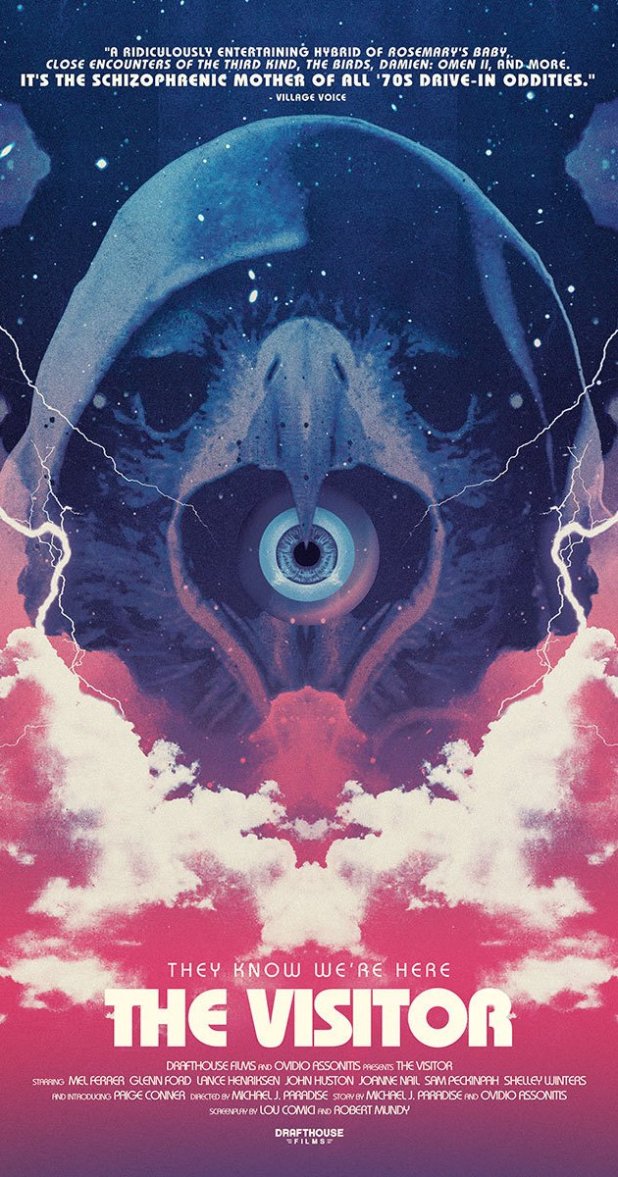
The Visitor (1979)

In 2013, when the Alamo Drafthouse presented the uncut version of this film for the first time in the United States, they referred to it as an “unforgettable assault on reality.” Those words best describe what is otherwise an indescribable film.

But I’m going to try.

Maybe a recipe will help.

Take Chariots of the Gods, and some of Rosemary’s Mary, then a little bit of The Omen, throw it in a blender and then pour the whole thing down the sink.

No? Maybe a synopsis.

We start in Heaven, or somewhere very much like it, where Franco Nero (the original Django) is one of those space gods that Erich von Däniken wrote about. He tells the bald children who surround him that there was once a war between two aliens, one good and one bad. The bad one — who is either called Sateen or Zathaar — was defeated, but not before he slept with a whole bunch of Earthwomen. Cue the Book of Enoch in the Lost Books of the Bible. Or cue the Scientology myth of Lord Xenu. Or Xemu, because he has two different spellings, too.

Only one child is left — a young girl — and a vast conspiracy wants her mother to have another child — a brother this time — so they can mate. The Christ figure sends John Huston — yes, the director of The Maltese Falcon and The African Queen — and the bald children to a rooftop somewhere in Atlanta to stop this plot. To do that, the children become adult bad men and dance around a lot while Huston walks up and down the stairs to triumphant music. If you think I’m making that last sentence up, you’ve never been blessed with this movie.

Meanwhile, Lance Henriksen (Near DarkAliens) is Ted Turner, pretty much. His name is Raymond Armstead and he owns the Atlanta Rebels basketball team that plays at the Omni and is dating Barbara (Joanne Nail, Switchblade Sisters), who of course is the woman who has the seed of the gods inside her. Her daughter Katy is 8 years old and already using her powers to help the Rebels win their games. But that isn’t all the help Raymond is getting. The rich, powerful and ultra-secretive Zathaar cult control the world and are helping his team become winners. All he has to do is marry Barbara, knock her up and let their kids fuck. Hopefully, they have a boy, or Raymond is gonna have to get in the saddle all over again.

Raymond can’t even do that right and the leader of the bad guys, Mel Ferrer(The Antichrist and Eaten Alive!) is upset and ready to quit on Raymond. Barbara doesn’t want more kids and certainly doesn’t want another child. But who can blame her? Her daughter is one creepy little girl. Her daughter knows all about the conspiracy and begs her mom to get married so she can have a brother (and this is where, in person, I’d throw in “…to have sex with” but I’d use the f word). How creepy is Katy? Well, she kills a bunch of boys with her mental powers because they make fun of her while she ice skates. And then she accidentally shoots her mother at a birthday party. Yep, it’s as if The Bad Seed met Carrie!

Then, as all 70’s occult movies must, the stars of Hollywood’s golden age make appearances!

Glenn Ford, the actor, plays a cop that Katy curses out and uses hawks to make wreck his car!

Shelley Winters plays Barbara’s nurse who once had one of the space babies and killed it, but can’t bring herself to kill Katy! According to interviews, Winters really smacked around Paige Conner, the actress who played Katy!

Sam Peckinpah, the director (!), plays an abortionist who removes one of the space babies from Barbara after the conspiracy pays a bunch of things to artificially inseminate her. Turns out Peckinpah had trouble remembering his lines, which is why we never learn that he’s Barabara’s ex-husband! Then is he Katy’s dad? Who knows! His voice is even Peckinpah’s! They had to ADR all of his dialogue.

In response to the abortion, Katy shoves her mom through a fish tank. She also decides to throw her down the stairs, Whatever Happened to Baby Jane-style. And by throw her down the steps, I mean do it over and over and over again.

Meanwhile, John Huston is still going up and down stairs. Finally, they HAVE HAD ENOUGH (I like to emphasize that so you get the gist) and sent their John Woo-ian flock of doves to fight the hawks. And meanwhile, Mel Ferrer and all his men show up dead with black marks on their bodies.

And Katy? Well, as Huston tells us, kids can never be evil. She gets her head shaved and goes to space to meet Instellar Jesus Christ. The title comes up as insane music blares.

Writer/director/insane man Michael J. Paradise (Giulio Paradisi) also was in Fellini’s 8 1/2 and La Dolce Vita. What inspired him to this level of cinematic goofiness? He was helped along by Ovidio G. Assonitis, whose resume includes writing Beyond the DoorMadhouse and Forever Emmanuelle before becoming the major stockholder and CEO of Cannon Pictures in 1990. That may explain some. But not all.

I know I often write things like “I don’t have the words to describe this” when I do these reviews — especially after I write a few hundred words all about said subject. But this is one time that that statement is not pure hyperbole. Just watch the trailer and prepared to lose your grasp on normalcy!

The Visitor defies the logic of good and bad film. It can only be graded on the is it an absolute film, ala Fulci or Jodorowsky. It is something to be experienced. You can watch this movie on Shudder.