Bill Condon wrote Strange Invaders and Strange Behavior before this movie, which didn’t fare as well with the public and critics as the original movie.
Maybe the movie Bernard Rose wanted to make would have been better. Virginia Madsen told Horror News Network, “They originally wanted us to do Candyman 2, but they didn’t like Bernie’s idea for the sequel. They made the Candyman into a slave which was terrible because the Candyman was educated and raised as a free man. Bernie wanted to make him like an African American Dracula which I think it was so appealing to the African American community because they finally had their own Dracula. The Candyman was a poet and smart. He wasn’t really a monster. He was sort of that classical figure. The sequel that Bernie wanted to make was a prequel where you see the Candyman and Helen fall in love. It was turned down because the studio didn’t want to do an interracial love story.”
There was also a plan to turn the Clive Barker story “The Midnight Meat Train” into the second movie years before that story became its own adaption.
That said, this movie — which explores the legend and shows that the Candyman was really an artist named Daniel Robitaille who was born to free slaves after the Civil War — isn’t horrible. It’s just that Candyman is one of the greatest horror movies ever, so making a sequel is such a major burden.
So this one is a slasher where the original was a meditation on race and rage. Maybe I should say something nice about the score.
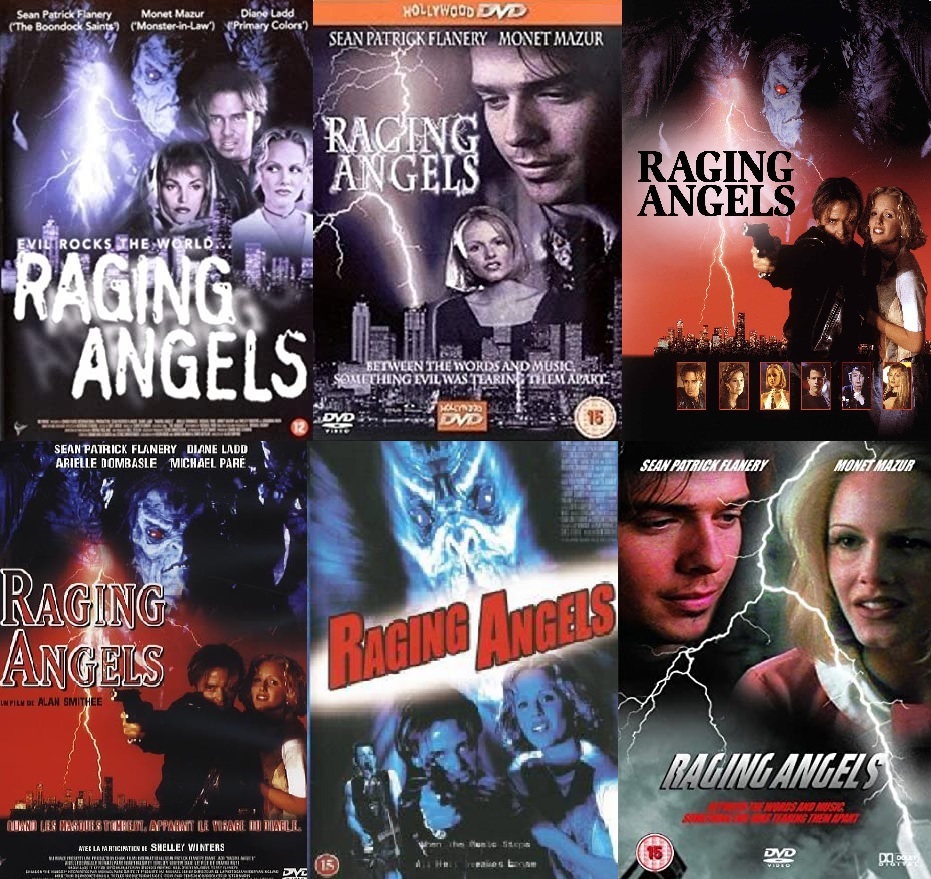
“Between the worlds and music, something evil was tearing them apart.” — Vidmark’s alternate, copywriter hornswogglin’
As the televangelist-inspiring carnival barkers of old once said, “Step right up! You ain’t seen nothin’ yet!”
So, if you are keeping track of your rock ‘n’ roll flicks, and we know you are, you know that Michael Paré (Moon 44) and Sean Patrick Flanery (Boondock Saints, forever!) each made two of them: Sean Patrick Flanery made this, and the even more obscure grunge chronicle, Girl (2000), while Michael Paré made this, and Eddie and the Cruisers.
In Girl, Flanery was an ersatz-Cobain who becomes the love interest of a wayward, college-bound high school girl. In Eddie and the Cruisers, Paré was an ersatz-Jim Morrison who faked his death.
Here, Flanery’s aspiring, oh-so-not-metal rocker (which a film of this genre needs: metal) runs afoul of Paré’s, well, faux-Tom Cruise — if his Stacee Jaxx from the abysmal Rock of Ages was running Scientology and brainwashing teens into hard rock zombies, like Damian in Black Roses. Oh, only if this film were as cool as that last sentence. . . . If this film was as cool as American Satan.
Of the many foreign and domestic VHS and DVD sleeves issued. The original, disembodied floating-head design trope, wins . . . at least this time.
I just don’t know how to describe Raging Angels . . . this political sci-fi rock n’ roll heavy metal horror romantic musical (Phew!). I don’t know how to assume the “Christian” intent of the film, if any . . . what was its spiritual inspiration? And with five screenwriters (well, two on “story” and three scribes) — and with our fair director taking an “Alan Smithee” credit (plot spoiler: It’s Asian actress Hisako Tsukuba aka’ing on the writing front as Chako van Leeuwen; this is a “Chako Film International Production,” after all) — there’s no way to know whom is wholly responsible for this biblical-plot plethora pathos of analog schadenfreude. (One of the scribes taking a pass on it was Kevin Rock, who worked on sequels to The Howling, Warlock, and The Philadelphia Experiment, as well as Roger Corman’s rights-holding tax shelter, The Fantastic Four.)
Imagine Menahem Golan’s biblical tale of the Book of Genesis‘ Adam and Eve colliding with Johann Wolfgang von Goethe’s Faust in The Apple, with its subplot regarding the power of love and music . . . and you thought producer Richard Zanuck greenlighting Russ Meyer, an independent X-rated filmmmaker, and Roger Ebert, a first time, inexperienced screenwriter, for a 20th Century Fox “sequel” with Beyond the Valley of the Dolls was a weird picture, with its cautionary tale of innocent hopefuls chewed up and shat out by the Tinseltown music industry.
I just don’t know. . . .
No matter how you pack it . . . see what we mean?
Did the tape of Jon Mikl Thor’s Rock ‘n’ Roll Nightmare end up inside the VHS sleeve of Sam Raimi’s The Evil Dead on Hisako Tsukuba’s personal home video shelf? Perhaps, after watching Keanu Reeves in The Devil’s Advocate — and taking into consideration his work as a metal head and musician River’s Edge and Bill and Ted’s Excellent Adventure — Tsukuba decided to re-imagine Al Pacino’s Lucifer-as-a-lawyer as a cult-leading rock star? Perhaps it was one too many spins of the likes of ’80s Christian (aka “White Metal”) bands Stryper, Believer, Deliverance, Holy Solider, Messiah Prophet, Whitecross, Trouble (okay, settle, they’re “Doom Metal”), and X-Sinner? (If only I just rattled off the soundtrack listing with that sentence, but alas, I have not.)
Oh, the majesty of it all, with this film’s pinches from Brian De Palma’s Phantom of the Paradise (Gramercy’s concert hall headquarters; the concert assassination), They Live (recruiting the wayward homeless to boost their ranks), and John Frankenheimer’s The Manchurian Candidate (conspiracy, subversion, and government overthrow).
The beauty of Raging Angels is that it is inherently meta: The filmmakers (well, again, Asian actress Hisako Tsukuba, who co-produced Joe Dante’s Piranha, as well as ALL of its sequel/remakes) are using film to push what is best described as a (Tsukuba’s) socialism viewpoint; that a united, one-world welfare state under a supreme leader is the only way for the world to succeed in perpetual peace — which is the very message pushed by the film’s rock star-cum-celebrity spokesperson, Tom Cruise, er, Colin Gramercy (Paré). Ah, it turns out, Gramercy (in a plot twist), isn’t Satan-as-a rocker; he’s been brainwashed by Satan (a George Soros-styled billionaire philanthropist) as the chief advocate for a dopey, 501 c3 tax-evading pseudo-religion masquerading as a “self-help” book and tape-schilling amalgamate.
Like Daddy Rich pimpin’ his prosperity theology says: “There’s a good place in this world for money, and it’s right here in my pocket.”
Yes, praise Green Jesus! By watching this film . . . you will see the light! For watching Raging Angels will quell the “raging angels” within. This film will lead to your spiritual enlightenment . . . as you will learn how to be “your own god.” Yes you can! Just like “prosperity gospel” (i.e., “money gospel”) megachurch overseers Joel Olsteen and Creflo Dollar whom “God tells” to pick the pockets of the flock to buy the Houston Astrodome (to turn into a church; get those flood victims out of here: this ain’t no horse stable with mangers) and private 747s (fitted in real gold-plated fixtures, natch) to “spread the good word.” Hey, God can’t live or fly in junk, dear flockster. Hey, there, Lamor “Brooklyn Bishop of Bling” Whitehead (finally caught by the F.B.I). So, forget that utility bill and tithe to Gramercy: for “God” will provide the water, light, and curb-side pick-ups. The Coalition for World Unity will provide the room and board and you’ll never have to work again . . . as long as you “obey” the word. OBEY!
Eh, sorry, Ol’ Scratch, for I’ve stopped believing. Your attempt to brainwash me into socialism via a bad movie . . . you created a recruitment video for atheism. Besides, your film doesn’t even have backmasking? How can you make a movie with this subject matter and not have someone playing records backwards!
Anyway . . . our not-so-metal-warrior, Chris D’Amico (Flanery), is an arrogant, temperamental rocker on the way up who believes in his hype; and with his alcohol abuse out of control, his band sacks him. And the band he fronts is . . . none other that the aforementioned Holy Solider — ripping through Ronnie James Dio-era Rainbow with “Gates of Babylon” (on screen; here’s the clip), which is this film’s lone high mark (on the soundtrack we also hear their original, “The Pain Inside of Me“). And Chris ends up like Pete Best and Chad Channing (know your Nirvana heritage), as Holy Soldier nets a deal and achieves great success . . . as a metal band . . . during the height of the grunge era (put a pin in that, for more, later).
So, our now penniless rocker, who has beat the bottle and stowed the cockiness, needs a gig. He and his musician-girlfriend, Lila Ridgeway (ex-daytime TV actress Monet H. Mazur, in her feature film debut), audition for gigs in Colin Gramercy’s new, worldwide satellite-cable concert (Paré, unlike in his star-making turn as Eddie, actually sings here, with “The Hunger”). And Colin wants Lila as a back up singer, who quickly falls under the cult-rocker leader’s spell (for all good televangelists have that enclave of chicks to help work through those sermons), but not Chris.
Uh, oh . . . but Lila is changing. She’s not the same girl, anymore. And the drinking didn’t make Chris wreck his car, it was Satan (literally; a ghostly image appears in the windshield). But Lila ain’t buying the excuses, anymore. She dumps him on Gramercy’s word.
Cue Chris’s Grandma Ruth (Shelley Winters!), who, thanks to her horrific dreams and visions (that screws up his new band’s audition), starts with the nagging warnings that “Chris is in danger.” Well, the demons won’t have any of that. Let the demon attack begin. But not before our dead Grandma recruits the eccentric, religious-psychic-preacher Sister Kate (Diane Ladd!) to save Chris and Lila’s souls from eternal damnation. The demeaning of Jesus Christ down to evil-warding, biblical-verse spells and religious trinkets, ensues.
Eh, on the upside: everyone is trying. Grandma Shelly and Aunt Diane are going at it with gusto, and Sean Patrick and Paré always sell the drama — no matter how awful it usually is, as is the case with most of their films.
Finally!
Yes, the final good vs. evil showdown we’ve been waiting for at Colin’s global, subliminal worldwide satellite concert, is here — the concert that will transform the citizens of Earth to the Coalition for World Unity way-of-life once and for all! Well . . . I think it’s best you watch the clip of the final battle, for the rest of the story.
(Sorry video embed elves, not this time; we’re hyperlinkin’ the final battle clip.)
See what we mean . . . did you click through?
Where’s Jon Mikl Thor when we need his bare-chested, bad-ass metal warrior self? Where’s Billy Eye Harper, Lynn Starling and Headmistress with the epic concert show closer? Ah, now I see why the CWU needs to subliminal message their concert: because the concert, with their screeching Christian symphonic rocker signing, Mozart (“One World”), and Colin Gramercy’s “life changing” epic, “The Hunger,” is — as is any Christian “rock concert” held in a church’s chapel-cum-gymcafeditorium that I’ve been too — absolutely, utterly awful (and when you realize the music sucks, they “kidnap” you by blocking the door and will not let you leave before the show’s over . . . and not even then. Screw you, One Bad Pig. Your Red Hot Chilli Peppers-for-Jesus schtick, sucked. At least Ronnie James Dio didn’t abduct me and force me to listen and indoctrinate me).
And that is what is ultimately missing from Raging Angels, the one thing that would have taken this Satan-steals-souls-with-rock-music mess over the top: a soundtrack on the level of the “No False Metal” classic Black Roses. For Raging Angels needs the likes of Lillian Axe, Lizzy Borden, and Carmine Appice’s King Kobra masquerading as the faux bands of the film. This film needed Metal Blade Records’ Brian Slagel as its music consultant to transcend it as the “No False Metal” classic it so wants to be . . . and utterly fails to be.
Granted, Sean Patrick Flanery impresses here (yes that is him singing, with “Come In My Mind“; in fact, here he is belting “One Step Forward” in Girl), but for as much as I enjoy any film with the ‘Flan, his character and the related songs are a bit too — through no fault of his own — douchy to pull off the demonic side of the proceedings. The rest of the soundtrack’s mostly B-Side castoffs — faux-Led Zeppelin’ers Kingdom Come (“What Love Can Be”), Golden Earring (?) (“Twilight Zone”), Boston (“Livin’ for You”), The Mission U.K (“Wasteland”), and well, what do you know, the aforementioned Stryper (“To Hell with the Devil”), and Sweden’s “dance rockers” Army of Lovers (“Supernatural”) (a big deal in Europe, but not in the U.S.) — just aren’t lathing the grooves on my vinyl. And, yes, shockingly, that snippet of “Arrow” by a band called Candlebox is the very same, we-relocated-the-band-to-Seattle-to-be-a-grunge-band, Candlebox. (Odette Springer, who scored Cirio H. Santiago’s Mad Max-rips Dune Warriors and Raiders of the Sun, scores here, as well as co-writing, with Hisako Tsukuba, Monet Mazur’s character’s vocal showcase, “I’m Crying Out for You.”)
And if the lack of metal in this Satanic music flick ain’t cuttin’ it, then, chances are, neither are the not-so-special effects.
When was this made? Well, based on the dated-soundtrack, certainly not during the post-1990 grunge-era. Raging Angels reeks as a film shot at some point during the hair metal ’80s — courtesy of its à la Rock ‘n’ Roll Nightmare, practical-sfx rubbery monsters (taking into account that film’s epic “Plan 9 from Outer Space” Satan vs. Angel battle) and burgeoning-technology CGI. Yeah, the dank n’ moldy aromas of years-languishing on the shelf — as most “Alan Smithee” films do — to then be thou looseth on the shelves of oneth’s local Blockbuster Video, permeates.
In the end, what we ultimately have in the frames of Raging Angels isn’t a errant, “No False Metal” heavy-metal horror film: we have an evangelical Christian Cinema precursor to the rash of low-budget, direct-to-video evangelical Revelation/Apocalypse films triggered by Christian author Tim LaHaye’s mid-’90s end-of-the-world Left Behind novel series. Those best-sellers were, of course, produced into a tetraology franchise by Canadian’s Paul and Peter LaLonde Christian-based Cloud Ten Pictures, which specializes in end-times films.
So, forget about the Black Roses and Rock ‘n’ Roll Nightmare analogies. The true spiritual cousins to Raging Angels are those proselytizing flicks starring past-their prime actors, such as the Apocalypse tetraology (1998 – 2001) with Gary Busey, Corbin Bernsen, Jeff Fahey, Margot Kidder, Mr. T, and Nick Mancuso, Six: The Mark Unleashed (2004), with Eric Roberts and Stephen Baldwin, David A.R White’s dopey Rapture-flicks, such as The Moment After (which rip off Schwarzenegger’s End of Days to lesser-and-lesser effect), and the biggie of the bunch: The Omega Code starring Casper Van Dien and Michael York. Raging Angels is all of those premillennialist flicks — only with a Satan-recruits-with-music plot device, and worse production values.
Eh, whatever, ye leaders of the CWU. If douchy music from tapered haircut and scruffy soul-patched dudes is the way to global peace, then give thee chaos. At least Satan has better music to-be-brainwash-by. At least I learned that the way to rock is to sling my axe behind my back and wear glittery tank tops.
Here’s the trailer to check out. As for the VHS tapes: they’re out there, but watch out for those DVDs, they’re grey DVD-r rips. And while they look really good, I am still not jammin’ on those Euro Region 2 copies, either. Emptor the caveats and know your regions before you go hard digital, kids.
In all of my years coveting this film for the VHS collection, I never found a copy. Sure, I could easily buy a copy online these days, but, well . . . it’s just not the same as discovering a copy in a video store’s cut out bin — or at today’s library book drives or second hand stores, is it? For the joy is the thrill of the analog chase and the celluloid discovery . . . and then having your expectations deflated as you struggle to get through the movie, and then apologize to your VCR.
Eh, I’ll just free-with-ads stream it on Tubi with ya’ll.
See the light with Christian Cinema!
Don’t fear Satan! Hail Sammy Curr!
All of the Italian and Spanish Omen ripoffs you can handle.
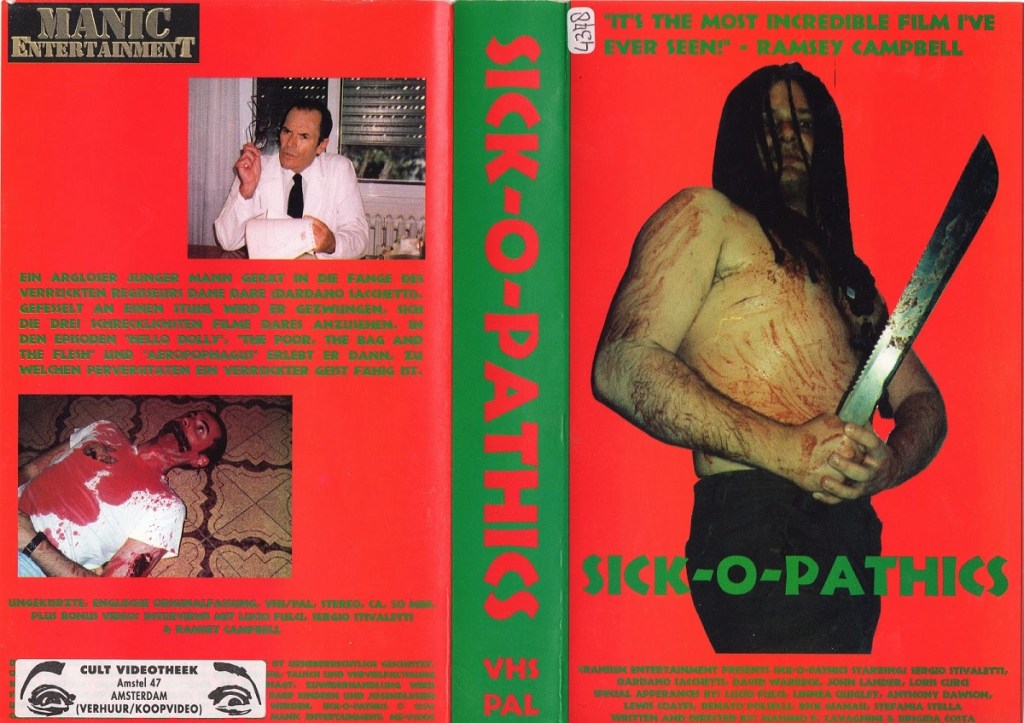
Okay, so let me get this straight in my head: This is a 55-minute, Italian-made anthology horror of three tales consisting of a killer sex doll, a killer handbag . . . and a parody of Joe D’amato’s Anthropophagous. And — being ever the good sport — Dardano Sacchetti, the writer of, well, a large portion of our favorite films at B&S About Movies, appears in the frames.
Just wow. You made my youth worth living, Dardano!
But Sacchetti isn’t the only Italian icon, here: Underground horror greats Linnea Quigley (recently of The Good Things Devils Do), David Warbeck, and Sergio Stivaletti appear, as well as directors Joe d’Amato, Luigi Cozzi, and Lucio Fulci; the late maestro’s daughter, Antonella, has a cameo as a pregnant lady . . . whose fetus is blown out of her vagina into the air. Yes, it’s like that. No, really. And it’s all very dumb, and it’s all very cheap, and it’s all very sloppy . . . and it is extremely sick. So, hell yes, we love it!
Just wow. We never heard of this one. We never once seen it on a U.S. video shelf. And here we are, 26 years after the fact, lovin’ it, over on You Tube.
Look, if the trailer doesn’t sell it . . . turn in your B&S membership card. For we never knew ye. If it does, well, pair this up with Nigel the Psychopath for a Halloween double feature.
About the Author: You can learn more about the writings of R.D Francis on Facebook. He also writes for B&S About Movies.
Written and directed by Kim Henkel, who wrote the original film, this take on the Sawyer family has sadly been forgotten, but it had — as so many films do — a rocky creation, a two year period where it disappeared and features two big stars who pretty much don’t want anything to do with it. It’s also the last movie in the original timeline of the films before remake and reboot and reimagining became the constant status quo for chainsaw movies.
I can see why some people dislike this movie. After all, there’s now a thousand-year-old secret society paying off the Sawyers — who now choose pizza over human flesh — to kill people to keep the population in a constant state of fear. Or maybe they do it so people can achieve transcendence through that terror. Leatherface, who used to be a killing machine, now struggles with not only his ability to capture and murder the teenagers, but his sexuality, cross-dressing and screaming like a child.
He also does not use a chainsaw.
The real center of this story is Renée Zellweger’s Jenny, who Henkel wrote the story around, claiming that was about “her transformation, her refusal to shut up, to be silenced, to be victimized. And by extension her refusal to be oppressed.” In the director’s cut, it’s shown that she’s been abused her whole life, so the terror of the Sawyers leaves her unafraid.
Actually, they’re now the Slaughters, not the Sawyers, and led by the other big star in this production — he wasn’t at the time — Matthew McConaughey as Vilmer Slaughter, a maniac who combines the characteristics of the HItchhiker, Chop Top and Leatherface with a cybernetic leg and the need to self-scar himself. His wife Darla reveals much of the conspiracy theory in the film, except that she also claims that she has a bomb implanted in her skull and that Vilmer is from space.
This movie played 27 theaters, then Japan and then disappeared for two years, as CAA wanted nothing to ruin the success of McConaughey. It finally played in twenty cities in 1997. Yet it has its fans, as no less a Chainsaw fan as Joe Bob Briggs said, “This is the best horror film of the 90s” and called this “a flick so terrifying and brilliant that it makes the other two Chainsaw sequels seem like “After-School Specials.”
The end of the film features John Dugan, Grandfather from The Texas Chainsaw Massacre,Paul A. Partain, who was Franklin and Marilyn Burns, who was Sally. I love that she locks eyes with Kenny as the movie closes. I also adore that this movie has so many Texas bands, like “Der Einziger Weg” by Debbie Harry and Robert Jacks (who was Leather in this), plus songs by Roky Erickson and Daniel Johnston.
6. IT CAME FROM THE SEA: Some kind of threat from below the brine.
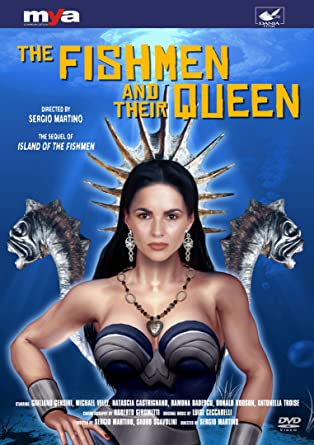
Sergio Martino can do no wrong. Seriously, even when he’s combining footage from Island of the Fishmen AKA Screamers and 2019: After the Fall of New York into one TV movie, I can’t be anything but entertained.
Two teenagers are stuck in the hell that is the end of all things, with radioactive waste everywhere and barely a chance to survive against the horse-riding, masked and completely berserk (and great) Exterminator Warriors. When an old man named Socrates and his magic dog Lampo take them to the island of the fish people — who are ruled by a stunning queen (Ramona Badescu, who also sang the movie’s theme song) — everything seems like it’s about to get better,
Man, I love the scene where one of the kids waves to one of the mer-men and they wave back in an action that was meant in anger in the original film.
Well, it turns out that the queen has enslaved the fishmen and is trying to destroy a masked dwarf that the kids save along with Selva the jungle girl, whose sister — and rightful queen of the island — has been turned into a wooden statue. That means that our heroes must set free the fishmen and save the transformed ruler.
This movie makes less sense than any other late-period Martino movie and I’m counting Uppercut Man and American Tiger in that. This is as dumb as it gets, ending with a spaceship leaving Earth for no reason other than there was no crane that lowered a god in either of the two movies strip-mined to make this one.
Speaking of American Tiger AKA American Rickshaw, the first time I went to Scarecrow, I wanted to see just how deep their library was. Even before Cauldron Films released the film on blu ray, Scarecrow had it on VHS. That made me believe in them.
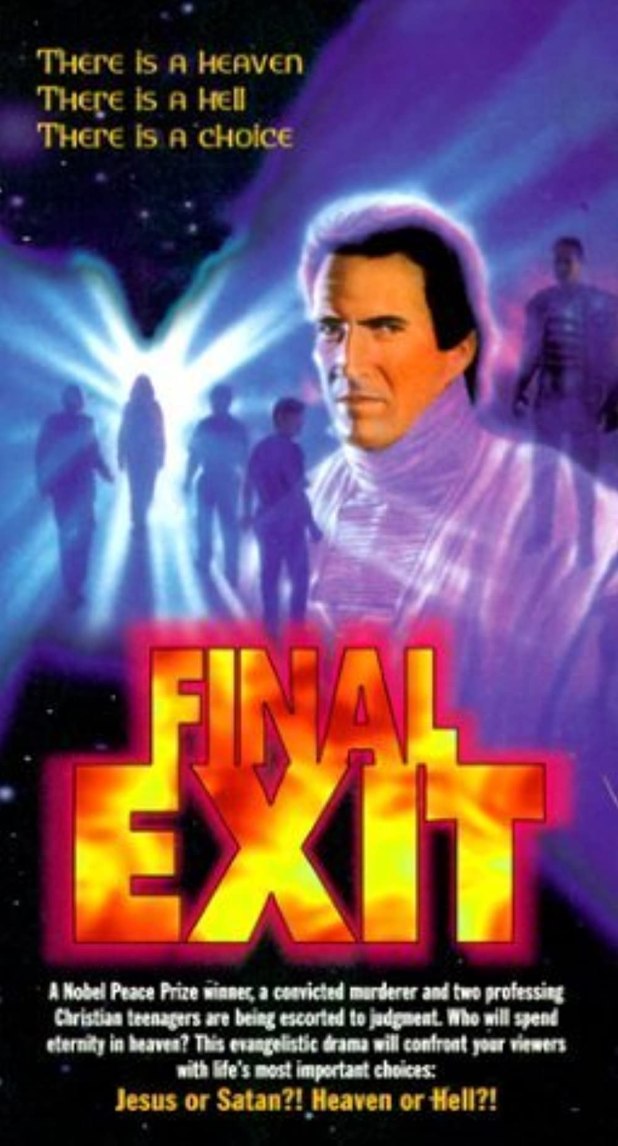
Stop me if you’ve heard this on before. A Nobel Peace Prize winner, a convicted murderer and two professing Christian teenagers meet St. Peter at the Pearly Gates and, well, make a movie. Final Exit is an “evangelistic drama will confront your viewers with life’s most important choices: Jesus or Satan? Heaven or Hell?”
Oh man, yeah. This is why I watch movies.
As a kid, I repeatedly encounter Jack Chick tracts that, if anything, pushed me away from the path that Mr. Chick wanted me on. This Was Your Life is a really good overall view of the world of Chick: a man has led an ordinary life full of sin, wasted what God gave him and is thrown into Hell and he’ll never get out. Variations on this theme appear, telling us that even the clergy — especially Catholics — can still go to Hell. Reading so many of these so often as a kid led to the man that I am today.
In case you haven’t been amazed by what the Christian side of the world endorses these days, this movie will set you straight. Of course, the serial killer will go to Heaven because he made a very specific prayer the night before he was executed and he would have never found Heaven without the death penalty. The Nobel prize winner did amazing, wonderful, astounding things in his life and ended war and saved lives, but he was selfish and did it all for himself and not God, so he’s going to burn.
And then the movie reminds you that even though this man stopped some wars, there will still be more wars. Also, one of the serial killer’s victims is innocent, but never found God, so they show her being removed from Hell for just a moment before pushing her back in.
Writer/director Danny Carrales has made a ton of movies like this, moving up from SOV quality to actual films. His latest one, 2018’s Beyond the Darkness — and you just know that I love that he used the name of a Joe D’Amato movie — has lighsaber-looking things on the cover, which means I need to track it down and do a full deep dive. And oh yeah, Carrales is also a professor at Jerry Falwell’s Liberty University.
Some people ask me, “How did our country get like this?” We always were. It just used to be tracts, SOV videos and the 700 Club wasn’t watched by everyone and shared like social media. It’s someone’s POV, no matter how much you disagree with it. And you know, no matter what you do, you’re going to Hell.
So, after reviewing the North Carolina-shot rock flicks Rockin’ Road Trip (that featured Marietta, Georgia’s Guadalcanal Diary) and Bandwagon (shot by and featuring members of Raleigh, North Carolina’s the Connells) for our latest “Rock ‘n’ Roll Week,” I recalled this SOV vampire obscurity also shot in North Carolina — and it stars another of that state’s alt-rock ’90s musicians: Greg Humphreys of Mammoth Records’ Dillon Fence, who hailed from the city of Chapel Hill.
Yeah, I know. “Who?” you ask. “Where?”
Oh, Chapel Hill and Raleigh-Durham North Carolina. What might have been. Damn, you Pacific Northwest, with your Seattle to Portland flannel and Doc Martins tomfoolery.
The scene is now! Get the Athens out of here, Stipe.
The scene fermenting in that southern local college town dates back to the early ’80s, when all ears learned towards Athens, Georgia — the city that unleashed ubiquitous college rockers R.E.M on our pre-MTV radios. Then, with MTV in full swing, we came to discover Jason & the Scorchers (“Absolutely, Sweet Marie”), and then, with grunge mania in full swing — as record companies searched for instant “Nirvana” — a band that named their album after a toilet manufacture and their band name inspired by TV’s CHiPs, Seven Mary Three, continues to rock our classic rock radios with their one-hit wonder, “Cumbersome.” And, in keeping with the grunge era: one of alt-rocks most respected bands — connected to the history of Nirvana, the “Dirty Nirvana,” if you will — the Melvins, signed with the label that gave us these sounds . . . and those heard in this movie.
That label was Mammoth Records based in Chapel Hill, North Carolina, a label noted as the first independent label (before Epitaph hit it big with the Offspring and that annoying “Come Out and Play” drek that leaves me wanting the loathsome Spin Doctors . . . and I loath them, as well) to produce not one, but two platinum records. The first, of course, was American Standard by Seven Mary Three. The second was by Chapel Hill’s Squirrel Nut Zippers, which released six albums with Mammoth from 1994 to 2000; their second album, Hot, released in 1996 — as the alt-rock craze inspired by Nirvana began to cool (and Mammoth ended their distribution deal with Atlantic Records; they were briefly under the RCA umbrella) — became Mammoth’s second platinum record. If you picked up copies of the soundtrack to The Crow (1994) and The Crow: City of Angels (1996), you heard the sounds of Mammoth’s Machines of Loving Grace and Seven Mary Three alongside the bigger hit sounds of Nine Inch Nails, Rage Against the Machine, Hole, and White Zombie. The mid-90s U.S. TV series My So Called Life spun the likes of the label’s Frente!, the Chainsaw Kittens, and Juliana Hatfield.
Other Mammoth artists you may know came courtesy of the oft-played MTV’s 120 Minutes spins of the Chainsaw Kittens, while the channel’s Headbanger’s Ball spun Fu Manchu. And, back in the days of the mainstream press needing grungy fodder for their pages, you may have come to know Juliana Hatfield (who recorded for the label with the Blake Babies; the band turned into the very cool Antenna when she went solo) as result of her relationship with the Lemonheads’ Evan Dando; they were, sort of, a safer Kurt and Courtney-light, if you will. (In addition to those bands, my personal favorites from the Mammoth roster, which I had the pleasure of spinning my alt-radio days, were Dash Rip Rock, Machines of Loving Grace, Vanilla Trainwreck, and . . . Dillon Fence.) Unable to reach the heights of most the label’s other artists — or fellow scenesters the Connells (who made it to late night network television, to no avail), Dillon Fence, as lead by Greg Humphreys, released three (really fine) albums: Rosemary (1992), Outside In (1993), and the one that should have broke then nationally, Living Room Scene (1994), which fell under Atlantic’s East/West alt-imprint through Mammoth.
Okay. Okay. I know. Get to the movie, already, R.D.
If you haven’t figured it out, writer/director Walter Michael Bost (with an assist from the one-and-gone Steven D. White) was raised in Winston-Salem, North Carolina, (another scenester hotspot) and went to college at The University of North Carolina at Chapel Hill, majoring in Radio, Television and Motion Pictures and Business Administration.
From his humble beginnings with Immortal, Bost developed a still-going-strong career working in various capacities — mostly in the sound departments — for over 70 films and TV series, most notably U.S. TV’s Felicity, The District, Veronica Mars, and iZombie. He returned to writing and directing with the recent streaming series, The New 30.
So, as with the Connells’ John Schultz logically working within his (then) means, writing what he knew, and around locations he knew he could secure — and with his friends-on-the-cheap cast and crew (including Greg Humphreys of Dillon Fence; Mammoth label head Jay Faires provided the soundtrack) — Bost decided, we’re guessing, to combine two of his loves: the North Carolina music scene he haunted and the vampire movies that haunted his youth. (Did you sleep with towels around your neck, Walt? I sure as hell did.)
Of course, as with A Matter of Degrees and Bandwagon before it, when news of this North Carolina-indie rockin’ with all of the alt-rock bands we loved (Archers of Loaf! Reverb-o-Ray! Dillon Fence! Squirrel Nut Zippers! — each who appear on stage in the film) hit the alt-rock presses (Alternative Press, B-Side, Option), myself and my fellow radio, roadie, and club rats went looking for it.
Were we disappointed with this tale of indie rock vampires?
Sorry. Another You Tube trailer bites the dust.
But not as much as we were with Rockin’ Road Trip (the music is better, here), but we still didn’t dig this rock ‘n vamp romp as much as A Matter of Degrees (the quintessential college-rock film and soundtrack) and Bandwagon. Courtesy of its SOV production values (a genre we jam on at B&S; we have a full, packed week of SOVs coming in September) — and the fact that it’s about vampires — I pair this rock ‘n’ horror piece with writer-director Blair Murphy’s pretty fine Jugular Wine (1994), which, again, because of the alt-press coverage afforded the film due to Henry Rollins appearing in the film (acting, not musically), we grunge-kiddies searched it out.
Jugular Wine — even with its admitted, but charming, weaknesses — is clearly the better film. Depending on one’s Daltonness down at the Road House, opinions vary: Immortal is either an insightful, slow burn — or a too-long lesson in boredom that could have benefited from a tighter, 80-minute home video cut. However, one has to consider the music-basis of the film, so the music segments are greatly extended vs. most rock films of its ilk. And, while the B&S crew is more understanding when it comes to the realms of against-the-budget shot-on-video films, it’s a production style that doesn’t appeal to everyone. So, are music heavy segments awash in hazy-to-muddy video tape-lighting your jam?
Dex Dregs (Andrew Taylor, who also crewed and wrote music for the film) is a Kurt Cobainesque guitarist trying to make his bones (pardon the pun) on North Carolina’s college music scene. As with George A. Romero’s Martin (1978), this film’s — in my opinion — raison d’être, Dex runs with that film’s Martin Mathias: a trouble young man who believes himself to be a Bram Stoker-like vampire. Or is it a figment of his mind?
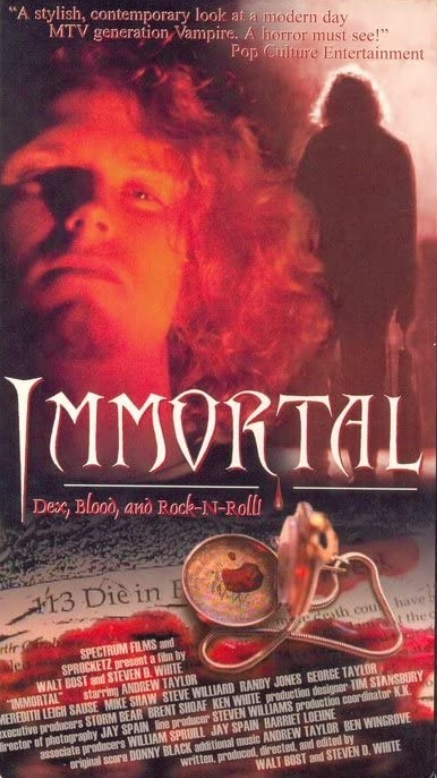
As Dax tries to make his mark on the music scene amid the mortals, he comes to discover music is no longer his addiction or his key to immorality — his quest for fresh human blood is his reason for being. As he makes his music (in what I see as an AIDS or cocaine addiction allegory; again, think Cobain), Dax struggles to keep his lusts in check and hidden from his bandmates and his girlfriend Linda (Edith Snow, aka Meredith Leigh Sause, currently in production on the indie horror, Prom Queen) . . . until he succumbs and feeds off a groupie and one of his guitar students — and a movie star who returns to his home town (Greg Humphreys). Will Dax find a “cure” courtesy of Wiley Wrestling? The mysterious albino (Frank J. Aard, later of the abysmal 2008 remake of 1986’s April Fools Day), who was the lone survivor of a horrific train wreck (the “113 Die” you see in the theatrical one-sheet), also wants his gold pocket (with a W.W inscription) in Dax’s possession, returned.
Upon succumbing to his lust and feeding off Linda, his addiction destroying his love, Dax takes to the streets playing for pocket change. Then a strange woman walks by and tosses an engraved pocket watch into his guitar case — inscribed with the initials “D.D.”
Courtesy of cwustman/eBay. Good luck finding a copy of the Permanent/Spectrum soundtrack. Sounds like another Rocktober Blood hornswoggle, to me.
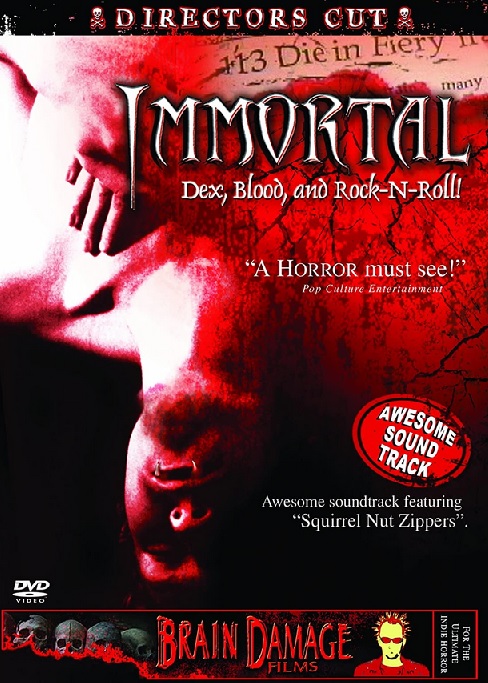
This is an SOV’er that is impossible to find on VHS (well, it used to be, before http reared its ugly bytes), and you can forget about the streams, free or pay, but the fine folks at Brain Damage Films resurrected this lost rock ‘n’ horror flick to DVD in 2007 — in a directors cut. Now, the VHS original runs at — what I feel — a too long one hour and forty minutes. As of press time, we’ve been unable to determine if the DVD reissue is longer or shorter than the original 1995 VHS issue.
You can find DVD copies at online retailers, such as Amazon and Best Buy. VHS copies are available on eBay/eBay. Brain Damage no longer lists the DVD in their catalog, so you’re at the mercy of used online copies.
Since the Squirrel Nut Zippers hit platinum after the films release, they’re now put to the forefront in the film’s reboot marketing.
And, sorry, Chum. There’s no trailers, clips, or music from the film in the online realms to share. But Googling any of the bands, as well as Mammoth Records, will expose you to the music behind the Chapel Hill and Raleigh-Durham, North Carolina scene that inspired the film.
You say you’re interest in more film shot in Chapel Hill, North Carolina? Well, you can dig into them courtesy of this IMDB filming locations list for the city. And here’s an IMDB list for Raleigh. And, in the mother of all lists, Wikipedia has a list of everything shot in the state. Be sure to swing by Greg Humpheys’s blogspot/social media portal and say “hi,” and let him know we remember him over at B&S About Movies. His new 2021 solo album, Spanish Steps, is out now.
About the Author: You can read the music and film reviews of R.D Francis on Medium and learn more about his work on Facebook.
How in the hell did I become the defacto biographer on the career Robert Rundle? There’s no place to run: I accept my hell in life.
The rumor is this appeared on the USA Network in the ’80s? Nah, that has to be urban legend.
But I shouldn’t complain, as I am fortunate that the B&S About Movies’ staff has been unable — thank god — to locate a copy of Rundle’s fourth film, Vampire Hunter (1994). That Linnea Quigley starrer seems not to exist or at the very least it was never completed/released. The IMBb page is a barren wasteland and no VHS nor DVD greys pop up on a Google search. And that’s a shame (no, really) because watching another Linnea Quigley film (we recently reviewed 2020’s The Good The Things Devils Do) is something to strive for.
However, Rundle’s second film, Dark Harvest (1992) is out there. That one is written and directed by James I. Nicholson, the writer behind Armand Gazarian’s Badlanders, which we scratched off our apoc list a few months back. But it’s not a Rundle joint, per say, since he only produced it. Besides, I just don’t have the strength for another movie about another group of 30-year old college kids running afoul of a possessed scarecrow on an ancient Indian burial ground. I just can’t. I have my celluloid masochist limits, after all. Maybe if Rundle wrote and/or directed it, I’d take the plunge. . . .
Of course, we reviewed Rundle’s debut as a writer and director, the mess than shoved me down this defacto hell hole in the first place: Cybernator (1991). And, because we had a Ponch, a Stringfellow, and a Don Stroud in the frames, we went ahead and gave Rundle’s second writing and directing effort — and third film, overall — The Divine Enforcer (1992), a tosser. And a toss. . . .
For Rundle’s sixth and final film — not counting his three shorts, Hell’s Paradox, The Vessel, and Killswitch (shot in ’96, ’03, and ’05; probably created to entice investors) — Raw Energy (1995), he earned a co-writer’s credit alongside side director Donald G. Jackson.
Uh, no. I won’t. And can’t (thank god), as Sam the Bossman is B&S About Movies’ defacto Donald G. Jackson archivist — and one thorny crown of the Rundle variety on my head is one thorny crown too many. Besides: a movie about virtual reality serial killers on a Z-budget? No way. Not even when the great William Smith appears in a put-a-name-on-the-VHS sleeve role.
And that bring us to this: my final, for all eternity and ever more, Robert Rundle film review.
In this, his fifth film, which also served as his fourth directing credit, Robert Z’Dar, returning from his walk-on in The Divine Enforcer, stars in Run Like Hell: a film that took Rundle — and two more screenwriters, Steven Stein and Alan Hall: a duo that wrote nothing since <smart ass remark about them never writing another film, removed> — to wrangle to completion.
Okay, so Robert Z’Dar is the only person we recognize here and care about, as the rest of the cast look — and act — like porn actors trying to go mainstream-legit, and probably are. Unlike Cybernator, with its bumbling time-projection into a Bladerunneresque “future” filled with ’80s Japanese-import cars, brick buildings, and ’50s-era Aunt Martha’s furnishings, Rundle had the good sense to get out of the big city and into the budget-sensible desert — so we can swallow the fact that we are in a 2008 on a 1995 costume budgeted-version of (skimpy n’ scanty) ’80s punk rockers.
So, if you know your apocs: a budgetary voiceover war n’ sickness-catastrophe has ravaged the Earth. The main culprit for man’s downfall: da wimin — single, indepenent women, in particular. So the U.S government declares them as the single most existential threat — trumping white supremacy, voter I.D. supression, and anything anti-green in Rundle’s brave new world. So, to the chagrin of AOC and the Squad: the women are locked up. And guess who the maniacal warden is: everyone’s favorite ex-Maniac Cop.
How dare you! How dare you let the women run free to destroy the world!
Yee-haw. We got ourselves a shot-on-video T&A apocalypse!
Ugh, finally . . . the voiceover is done. Let’s head off to the showers with four babes — Elsa, Sally, Darla, and Shotgun — in thongs. Well, that’s done: prison break time. Oh, no, not another “Paradise City” to strive for, again. Hey, not if Warden Z’Dar’s cheapjack, motorcycle ridin’ (wooden-acting) cyborg bounty hunter-assassin (well, the actor is “trying” to be robotic, after all) has anything to say about it.
What’s this?
A lone-wolf desert Ninja warrior who’s been able to fight off the mutants to make a life for himself in a wasteland junk yard? Well, time for the inept fight choreography at the old factory as chicks in thongs learn how to fight and fire-up chainsaws for the big showdown with our motorcycle-helmeted cyborg and Robert we-love-him-but-he-ain’t-no-Humongous Z’Dar because this ain’t no Mad Max . . . or America 3000 . . . Robot Holocaust . . . or, I never thought I’d say this: Fire Fight . . . for that matter. Hey, at least Mr. Miyagi of the Wastelands helped the girls lose the up-the-crack thongs for pairs of shorty-shorts and plaid schoolgirl skirts, and finally harnessed their racks in halter tops and tied-off tee-shirts.
Sorry, kiddies. There’s no online freebie streams (lucky me, joy, joy: working the contacts, I got hold of an VHS copy). But we did find this nifty “Under Three Minutes” version of the film to enjoy: if the three minute scene below doesn’t ward you off, first. Or, if you skip both, you can check out this touching six-minute tribute on the career of Robert Z’Dar set to the tune of Mötley Crüe’s “Primal Scream” — that’s infinitely better than the actual film he stars in, here.
Yeah, you hate to rag on the guys that are just passion-trying, but after having four films — Cybernator, Dark Harvest, The Divine Enforcer, and Vampire Hunter (if it was even made at all) — under your belt, shouldn’t your films get better as you progress, learning more about the craft with each film?
Uh, did you really think I’d suffer the fool that is Raw Energy, after this hour and twenty minutes of non-T&A apoc titillation, one rife with clumsy cinematography (I think that’s what it’s called) and worse, well, editing . . . I think?
Uh, no. I am running like hell from from this hand basket of VHS flotsam.
And so concludes B&S About Movies wrangling the career of Robert Rundle in our digital hand basket. Amen.
The resume:
Cybernator (1991) — writer/director
Dark Harvest (1992) — producer
The Divine Enforcer (1992) — writer/director
Vampire Hunter (1994) — director
Run Like Hell (1995) — writer/director
Raw Energy (1995) — co-writer/producer
Robert — then a young Robbie Rundle — got his start in the business an actor on the early Martin Kove (Rice Girl) and James Houghton (prolific U.S. daytime-drama actor and writer, but also Purple People Eater, More American Graffiti, and I Wanna Hold Your Hand) Warner Bros./CBS-TV series Code R, which ran for 13 episodes from January to June 1977. The series was concerned with a South California island’s Emergency Services team.
Editor’s Note: This review previous ran on June 20, 2021, as part of our “Ron Marchini Week.” We’ve brought it back for our first “Philippines War Week” of films. yes. We said, “first” week. As usual, we go overboard, so we’ll have a second week of films come December 5 to the 10th.
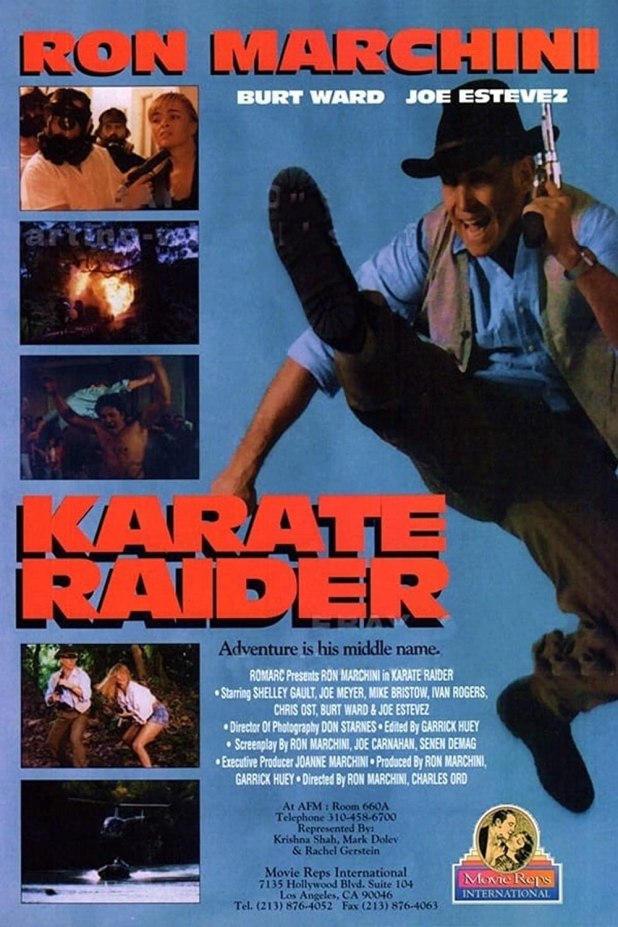
Jake Turner (Ronald L. Marchini, who co-wrote and co-directed this) is on a rescue mission to liberate Jennifer Boyden, a DEA agent and the daughter of his old sergeant, who is being held by Pike (Joe Meyer, who has been in a bunch of Marchini’s films), an American drug lord in the jungles of Colombia. I mean, what was he doing anyway? Punching people for money?
Joe Estevez is in this, in case you need to know about the quality level of this film. This is a movie made for those with the kind of resolution that can watch five Philippines-shot war movies in a day and tell each and every one of them apart.
Also known as Fight to Win, this was also given the completely wrong title of Karate Commando: Jungle Wolf 3, a sequel in name only. In Greece, it was called Hamos stin agria zougla (Doom in the Wild Jungle). Now that’s a movie title. And yes, we’ve reviewed the first Jungle Wolf and it’s sequel, which is also known as Return Fire, just to add to the “sequel” confusion.
Perhaps the nuttiest thing about this movie is that the co-writer was Joe Carnahan, who went on to make Smokin’ Aces, The A-Team, Boss Level and The Grey, as well as the upcoming Western version of The Raid. Or is it? Because this is a movie that has Burt Ward as an evil doctor who helps out the drug kingpins and it’s just a cameo. And it’s also a film that was only released in the Netherlands, which must have appreciated an Indiana Jones-referencing title 24 years after Raiders of the Lost Ark.
You can watch this on YouTube. Trust me, this is not Delta Force 3.
At some point, Jonathan Taylor Thomas was a thing. So was Chevy Chase. And I guess so was Farrah Fawcett. So imagine all of them in a movie where JTT wants his mom to never marry again and Chevy wants to be the man that breaks that cycle of her never finding the right stepfather for her son and you have Man of the House.
Becca loves this movie and asks to watch it frequently, which I figure has to do with the fact that we have a major age gap. Yet I watch it with her and enjoy how much she enjoys it.
The battles between would-be father and son continue as they both join the Minotauk Indian Guides led by Chet Bronski (George Wendt). And oh yeah — a mobster and his son that Chevy’s character sent to prison both want revenge.
Somehow, Disney made this movie without cleaing C+C Music Factory’s “Gonna Make You Sweat” and Enigma’s “Return to Innocence” for the soundtrack. I have no idea how that happens.
Director James Orr also made They Call Me Bruce, a movie that Becca would absolutely refuse to watch with me, as well as Mr. Destiny, a movie that she has also watch in the multiple dozens of times. Orr also dated Fawcett until he was convicted of misdemeanor battery after attacking her for allegedly refusing his marriage proposal.












 B&S About Movies
You must be logged in to post a comment.