Cyber Ninja (1988)

Also known as Mirai Ninja: Keigumo Kinin GaidenWarlord and Robo Ninja, this is one of the few successes I can think of when it comes to making a movie out of a video game.

In a future time — hey let’s call it 200X, that line never gets old — cyborgs and humans at war when one of the cyberninjas decides to save a human princess destined to be sacrificed to the machine gods. And if Shiranui the cyberninja ends up being related to the humans and hoping to find his old body, then so be it, and so be machines that have moved beyond zeros and ones to their own digital religion that can summon demons.

Director Keita Amemiya also made Moon Over Tao: Makaraga, which is another wild take on traditional Japan myth mixed with future tech, and Zeiram amongst many other efforts. This looks absolutely wild and you know, do you need an involved story when you have walking feudal buildings and ninjas with laser swords?

There’s a bad guy named Dark Overlord — at least in the English dub — and the evil army is called the Lords of Darkness, so this is like the drawing a metal kid would make in their notebook when they should be paying more attention in school, but no, they should in no way be paying attention because if I paid less attention and drew more and only cared about movies more, my life would be infinitely better than the drone to the grave workaholic that I grew up to be.

Star Virgin (1988)

Japan is under constant threat from monsters and so is Eiko’s vaunted virginity. So when Tokyo is in danger, she must put her innocence undr threat as well so that her super powers can activate and then things can get simple. I mean, the idea that a woman’s chastity has to be threatened to save a male-dominated country is such a multi-layered thing for my brain to wander around, but then things get simple and Eiko starts beating on frog monsters and taking bubble baths and you’re like, well, I guess I don’t need to use my brain any longer.

Maybe this movie is smarter than it looks, as Star Virgin fights the Statue of Liberty at one point.

This was made by Pony Canyon, who also made video games, and yes, of course there’s a video game tie-in.

You can watch this on YouTube.

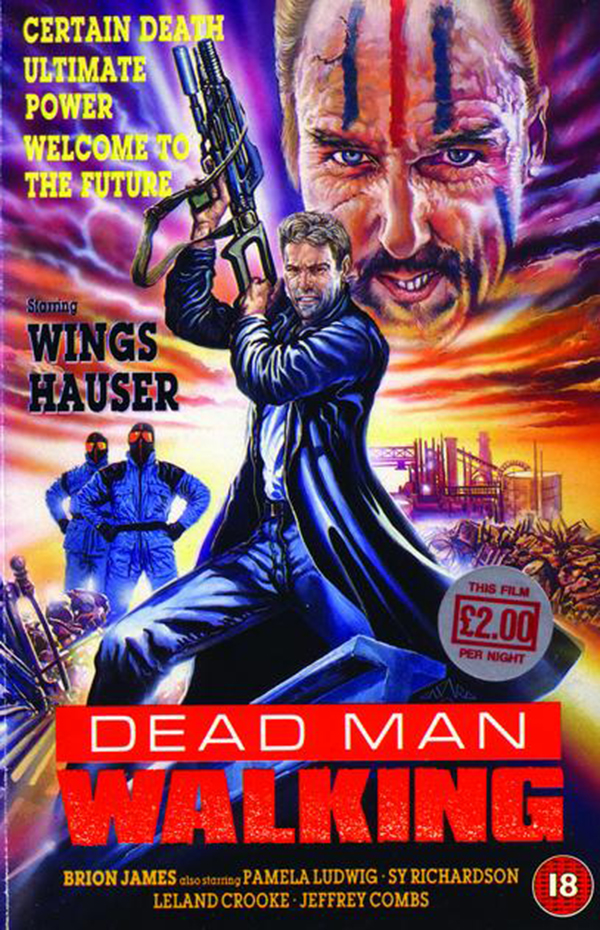
GREGORY DARK WEEK: Dead Man Walking (1988)

Dead Man Walking has most of the same cast as Gregory Dark’s 1990 film Street Justice — Brion James, Wings Hauser, Sy Richardson — but throws in Jeffrey Combs. And for that, I rejoice.

Chazz (Combs) is trying to save his boss’s daughter Leila (Pamela Ludwig) from a maniac plague victim named Decker (James), so he teams uo with a merc with the same plague (Hauser) to get in and out of the Plague Zone with the girl.

So yeah — in 1997, people get the bubonic plague and even if they survive, they become Zero Men who will die soon enough, which gets them relegated to controlled areas of their own kind. The corporations have the cure, but we know how that works. The people will never get it.

This movie also has chainsaw roulette, which is much more interesting than thinking about a pandemic any more than I have to.

Frankenstein General Hospital (1988)

Dr. Bob Frankenstein (Mark Blankfield, who was also in Jekyll and Hyde… Together AgainThe Midnight HourDracula: Dead and Loving It, the TV show Fridays and took the role of Navin Johnson from Steve Martin in The Jerk, Too) has changed his name to Dr. Robert Frankenheimer and works as an intern at a Los Angeles hospital called, well, General Hospital.

A joke that lands is that Frankenheimer’s lab is in black and white while the movie is in color. And hey — that’s Leslie Jordan as Iggy the assistant and Irwin Keyes as the monster with the brain of a sex mad teenager. One of the doctors, Dr. Alice Singleton, is Kathy Shower, whose resume includes Commando SquadBedroom Eyes IIAmerican Kickboxer 2 and The Further Adventures of Tennessee Buck.

Keep an eye out for Bobby “Boris” Pickett, the man who sang “Monster Mash.” It’s a song I can’t sing too long, as if I do, I sing it all day for every single question that I am asked and yell things like, “I was working in the lab late one night” and “It was a graveyard smash.”

Director Deborah Sahagun’s only other directing job was Patients, a TV movie that she also wrote, so maybe she specialized in medical comedy.

But this one…don’t show up looking for this comedy to be funny.

You can watch this on Tubi.

WATCH THE SERIES: Mr. Vampire

There are five Ricky Lau-directed Mr. Vampire movies — Mr. VampireMr. Vampire II, Mr. Vampire III, Mr. Vampire IV and Mr. Vampire 1992 (the only direct sequel) followed by several connected movies by other directors, such as Billy Chan and Leung Chung’s New Mr. Vampire (these first six movies will be the ones that we’ll be covering), Lam Ching-ying’s Vampire vs Vampire and Magic Cop (AKA Mr. Vampire 5), Chan’s Crazy Safari (also known as The Gods Must Be Crazy II), Andrew Lau’s The Ultimate Vampire, Wilson Tong’s The Musical Vampire, Wu Ma’s Exorcist Master, Wellson Chin’s The Era of Vampires and Juno Mak’s tribute to this series, Rigor Mortis. There are also two TV series: Vampire Expert and My Date with a Vampire.

All of these movies have the Chinese vampire in common. Called the jiangshi, these hopping corpses of Chinese folklore are as much zombies as they are vampires. They first appeared in Hong Kong cinema in Sammo Hung’s Encounters of the Spooky Kind.

Mr. Vampire (1985)

Master Kau (Lam Ching-ying) is pretty much Dr. Strange by way of Taoist priesthood, as he keeps control over the spirits and vampires of China from his large home, which is protected by many talismans and amulets, staffed by his students Man-Choi (Ricky Hui) and Chau-sang (Chin Siu-ho).

Master Yam hires Kau to move the burial site of his father to ensure prosperity for his family. However, the body looks near perfect, showing that it may be a vampire. Taking it home, Kau instructs his students to write all over the coffin with enchanted ink. They forget to do the bottom of the coffin, which means that the vampire escapes and murders his rich son, turning him into a jiangshi.

Wai (Billy Lau) is a policeman who is sure that Kau is responsible (he also has a grudge because a girl (Moon Lee) he likes has eyes for Kau), so he arrests him even as the vampire begins killing others. Kau’s students are tested by a vampire’s boat and also a seductive spirit, but when Master Yam becomes a fully vampiric demon, only the help of another Taoist priest named Four-Eyes (Anthony Chan) can save the day.

Based on stories producer Hung heard from his mother, this movie nearly tripled its budget at the box office. Just a warning — not just Italian movies have real animal violence. There’s a moment where a real snake is sliced apart instead of a fake one due to budget. The snake was used to make soup, but there’s no report on whether the chicken whose throat was cut on screen was used as stock after.

Golden Harvest tried to make an American version — Demon Hunters — with Yuen Wah playing Master Kau and American actors Jack Scalia and Michele Phillips (taking over from Tonya Roberts) were in Hong Kong to film scenes, but the movie was stopped after just a few weeks.

Mr. Vampire 2 (1986)

This film is more about a vampire family than continuing the story of the first movie, despite being directed by Ricky Lau and bringing back female star Moon Lee and Lam Ching-ying.

Archaeologist Kwok Tun-Wong (Chung Fat) and his students have found not just one jiangshi but a mother, father and their son, all kept still because of the magical talismans on their foreheads. Intending to sell the boy on the black market — who would want a child hopping vampire is a question we may not be able to answer — the talismans are removed and Dr. Lam Ching-ying (yes, Lam Ching-ying used his real name for the role), his potential son-in-law Yen (Yuen Biao) and his daughter Gigi (Lee) must stop the plague of the vampires.
Mr. Vampire 3 (1987)

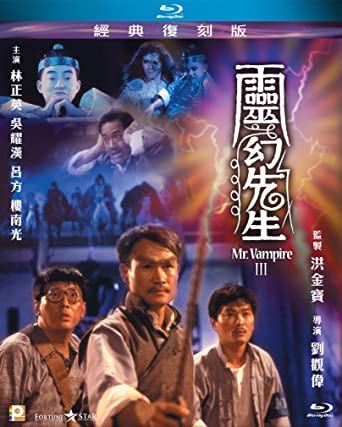
Uncle Ming (Richard Ng) isn’t a great Tao priest like Uncle Nine (Lam Ching-ying), but like an HK version of The Frighteners, he has help from two ghosts. Big and Small Pai. He comes to a small town where supernatural bandits are ruling the night, all led by the evil — I mean, with a name like this, she should be malificent — Devil Lady (Wong Yuk Waan).

This movie has a first for me — evil spirits trapped in wine jars and then friend in hot oil. This is definitely closer to the spirit of the original film, which made fans pretty happy. Also, a witch with a skull inside her hair and a Sammo Hung cameo as a waiter!

If you’re used to the pace of American movies, you may want to drink plenty of Red Bull or Bang before starting this one.

Mr. Vampire 4 (1988)

Four-eyed Taoist (Anthony Chan) and Buddhist Master Yat-yau (Wu Ma) are neighbors, but engaged in a sort of humorous war of words, pranks and ideologies with each other. As a convoy passes their homes — including a vampire that is soon hit with lightning and becomes super powerful — they must put aside their dislike and work together.

You may miss Lam Ching Ying, who for the first time isn’t the lead in a Mr. Vampire sequel. There’s nearly an hour, however, where the two leads try to destroy one another with not a hopping bloodsucker in sight. So while the stereotypical gay character isn’t fun at all, there’s still the knowledge you’ll gain, like eating garlic to defeat a curse.

Mr. Vampire 1992 (1992)

After three sequels, it’s finally time to make an actual sequel to Mr. Vampire, with Master Kau (Lam Ching-ying), Man-choi (Ricky Hui) and Chau-sang (Chin Siu-ho) all coming back.   What a wild story they’ve been brought back for, as the soul of an aborted fetus lives within a statue before seeking to take over the fetus that is growing within Mai Kei-lin (Wuki Kwan), the one-time love of Master Kau.

There’s also The General (Billy Lau), Mai Kei-lin’s husband, who is bit by his vampire father and seeks to escape his curse with the help of Kau.

Also — this is a comedy.

What’s most amazing — to me — is that I found my copy of this in my small Western Pennsylvania hometown, in the literal sticks, an all-region DVD that I can only assume came from a foreign exchange student at one of the local small colleges, as there were several other similar films. $1 later and my movie room has hopping vampires on the shelves.
New Mr. Vampire (1987)

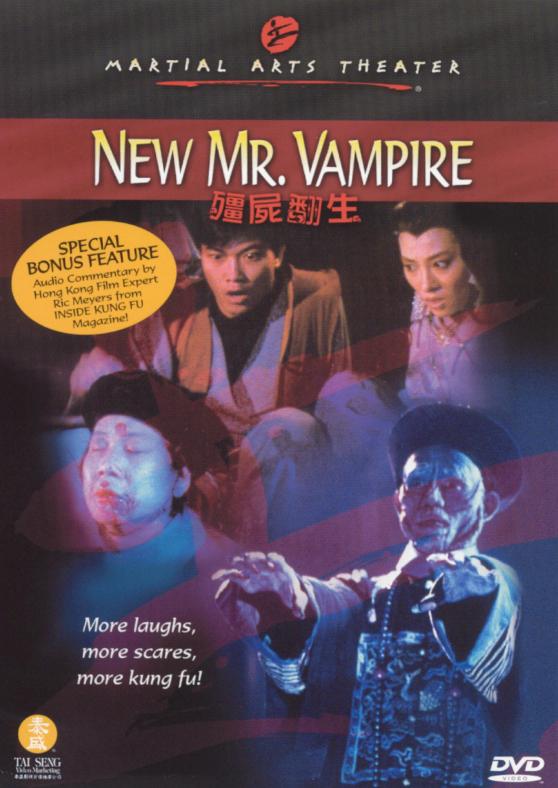
Don’t confuse this New Mr Vampire with Mr. Vampire 1992. This installment was directed by Billy Chan and has Chung Fat and Huang Ha as rival brothers Master Chin and Master Wu, with Chin Siu-ho (playing Hsiao Hau Chien) and Lu Fang (known as Tai-Fa) as their disciples.

This is my least favorite of the jiangshi movies I’ve seen, except for the fact that the filmmakers seem intent on making John Carpenter pay for taking so many Hong Kong movie mythos for Big Trouble in Little China by outright stealing music from Halloween and Escape from New York.
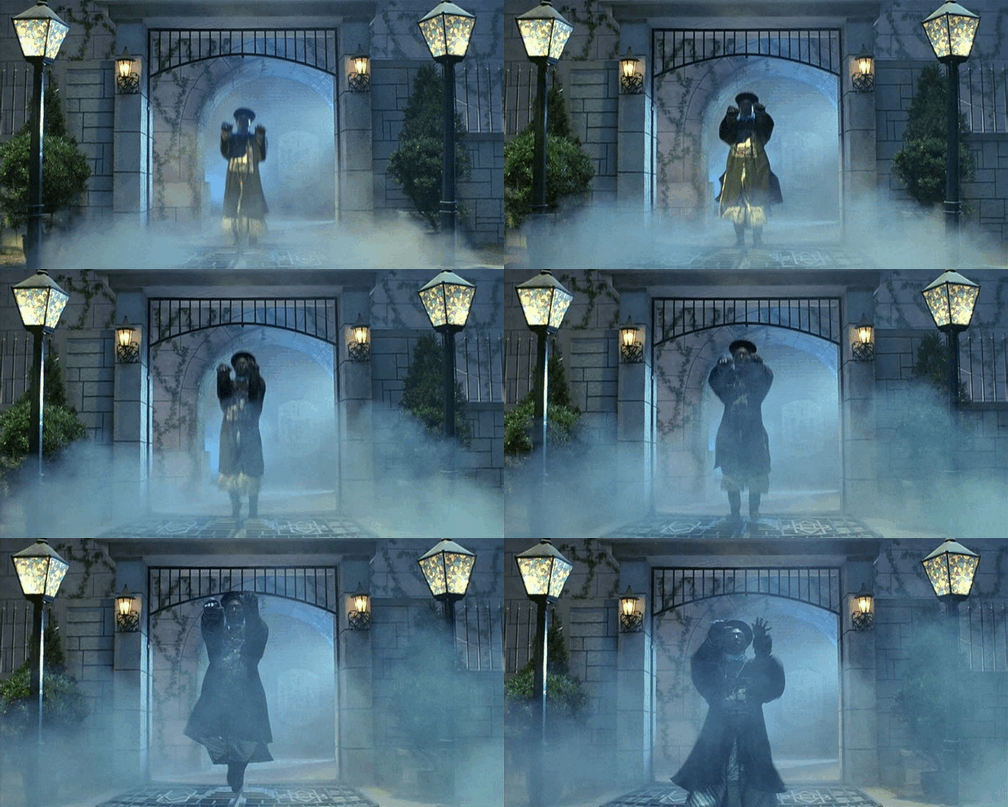
Are you willing to take a journey into the world of Chinese vampires? Let us know what you find. Remember, if you get bit, just take a bath in rice milk, then grind down their fangs or drink their blood to heal yourself.
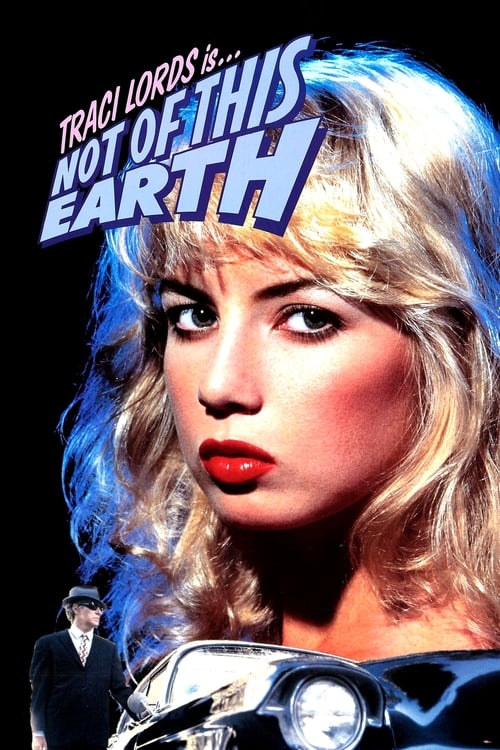
Not of This Earth (1988)

Director Jim Wynorski made Roger Corman a bet: he could remake the 1957 film with the same budget and schedule thirty years later.

Luckily, he had a not-so-secret weapon. Let’s be honest: Traci Lords being in a Merchant-Ivory movie about malaria would make me watch that movie ten times in a row. Wyrnorski is a smart guy. After all, he told John McCarty in The Sleaze Merchants: Adventures in Exploitation Filmmaking from the ’50s to the ’90s, “While we were at an optical house doing some effects work for Big Bad Mama II, I came across an original print of the old Corman film. Kelli Maroney was there, and Raven, and we had a big hoot watching it. So I said “I think we could have a blast remaking this picture.” And they said “Well, who are you going to get to play the Beverly Garland part?” There were some newspapers lying around, and I saw a story in one of them about Traci Lords. So I said, “Let’s get Traci Lords!” She even looks a little bit like Beverly Garland.”

Lords, however, didn’t want to be found in the wake of the scandalous idea that she made adult films underage. But he convinced her to be in it and was surprised that she improved as an actress as the filming went on.

Traci plays Nadine Story, a nurse who soon gets hired to be the personal blood transfusion person for Mr. Johnson, who is really an alien from the planet Davanna. So yeah, it’s a vampire movie — and fits into the “Not-So-Classic Monsters” theme this week — while also being an alien movie.

To get the movie under budget, some scenes are directly lifted from other Corman movies, like a stalker from Hollywood Boulevard and a foggy scene of a woman being followed from Humanoids from the Deep.

The opening also has a quick blast of scenes from past Corman movies like Forbidden WorldBattle Beyond the Stars, Galaxy of Terror, Battle Beyond the Sun and Piranha.

This being a Wynorski movie, he filled it with plenty of gorgeous women. So look out for Rebecca Perle (Savage Streets), Becky LeBeau (Bubbles in the hot tub from Back to School; her voice is dubbed by Michelle Bauer), Roxanne Kernohan (Critters 2), Monique Gabrielle (61 magical films to choose from and I’ll pick Young Lady Chatterley II), Ava Cadell (Ava from the world of Andy Sidaris), Cynthia Thompson (Body Count), Kelli Maroney (Night of the Comet) and Kim Sill (AKA Kimberly Dawn, AKA Kim Dawson, star of a ton of movies you snuck watch on Cinemax in your puberty).

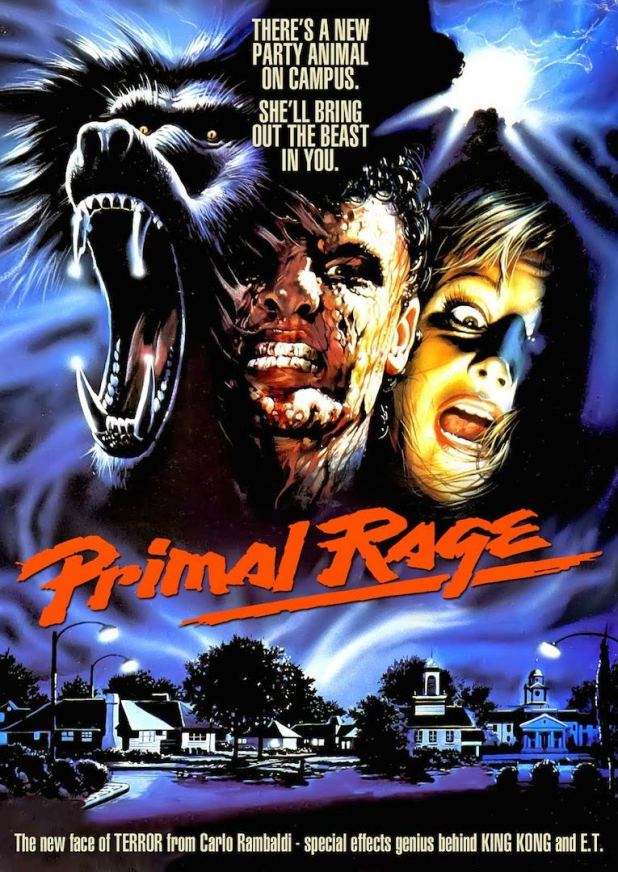
Primal Rage (1988)

Vittorio Rambaldi wrote the script and did the special effects on Nightmare Beach and if you recognize his last name, then you already realize that he’s the son of Italian effects legend Carlo Rambaldi. This was the first movie he directed and he got Umberto Lenzi to write it, which is a great plan, along with James Justice, who used the name Harry Kirkpatrick to write and direct Nightmare Beach but I kind of think he’s also Lenzi, because he also used that name along with Humphrey Humbert, Bob Collins, Hank Milestone, Humphrey Milestone and Humphrey Logan.

A scientist at a Florida university create a rage virus while performing experiments intended to restore dead brain tissue. And then when two college journalists breaks into the campus lab, one gets bitten by an infected babboon and spreads the virus to a gang of rapists dressed like the Cobra Kai on Halloween and a co-ed abortion lover named Debbie (Sarah Bruxton from Nightmare Beach)who all start killing other people on a smaller level as the virus in Lenzi’s Nightmare City.

Man, this movie has it all. There’s Bo Svenson as a scientist! Some of the grossest effects you’ll see in a movie as people drip pus everywhere! A Halloween party with Darth Vader! An Alf doll! Bartles and James wine coolers! An Avoid the Noid poster! Man, this is the most 1988 movie there’s ever been and I just can’t get enough of Italian filmmakers needing to prove it to you that their movie comes from America so badly that it seems like it had to come from another planet.

The music in this really takes it to another level. And yes, the song “Say the Word” also shows up in…you guessed it, Nightmare Beach. Man, they should have just called this one Nightmare Fraternity.

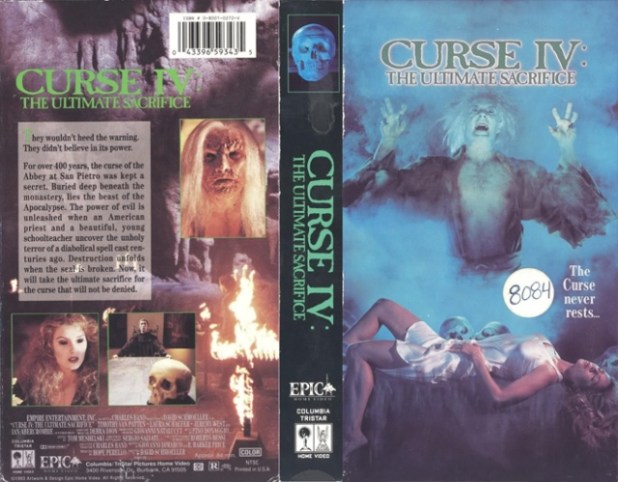
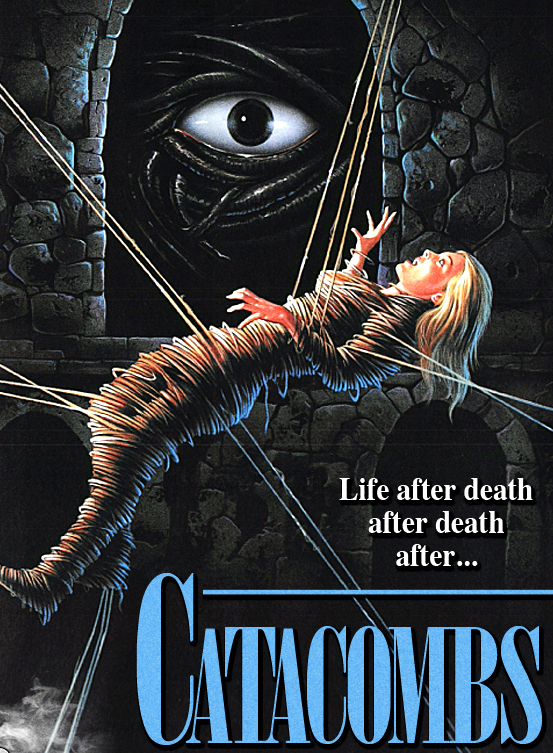
Curse IV: The Ultimate Sacrifice (1988)

Yes, you may notice that the fourth Curse move was made two years after the third. We can blame that on the fact that it was the last officially completed film by Empire Pictures before the company was seized for failure to pay on loans.

This delayed the movie by five years and TriStar Home Video released it direct-to-video as Curse IV: The Ultimate Sacrifice with no connection to The CurseThe Curse II: The Bite or The Curse III: Blood Sacrifice.

It’s directed and written by David Schmoeller, whose Tourist Trap and Puppet Master are both great movies.

Teacher Elizabeth Magrino arrives at the Abbey of San Pietro en Valle to see the abbey’s first Prior had his vision healed within the catacombs thanks to the Miracle of the Celestial Light. There’s also the issue of a demon that had been trapped in the monastery that has now possessed an albino leper, which is really a sentence that you should go back and read again.

Making this movie work is a solid Italian crew, including cinematography by Sergio Salvati (The Beyond, The House by the Cemetery), a score by Pino Donaggio and production design by Giovanni Natalucci (Once Upon a Time in America, The Stendhal Syndrome). There’s one scene worth watching this movie for, as a possessed statue of Jesus remembers how amazing The Eerie Midnight Horror Show was and gets down off the cross and kills a monk.

Poltergeist III (1988)

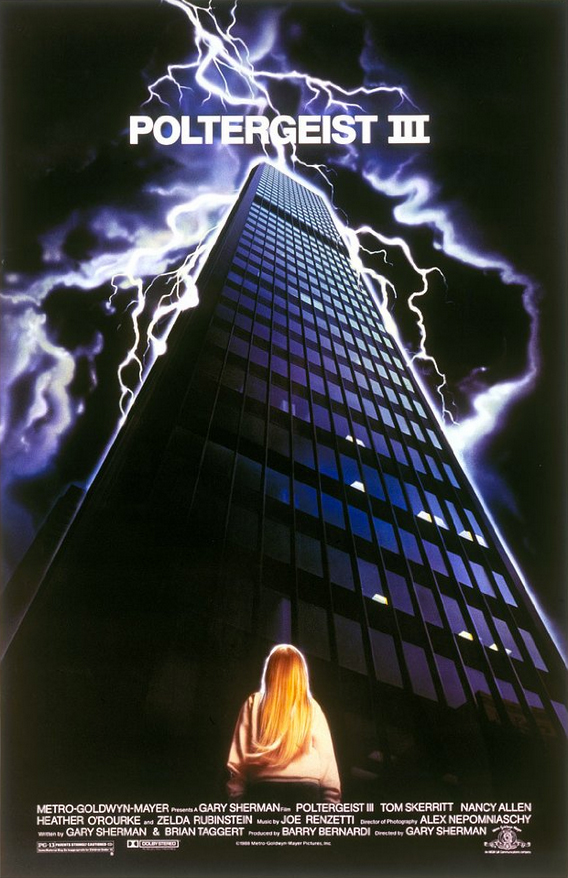
Gary Sherman made Death LineDead & BuriedWanted: Dead or AliveVice Squad and Lisa, so the guy knows how to make down and dirty horror and action, right? Despite this being the third film in the series, it’s a big budget movie for Sherman, but only Heather O’Rourke and Zelda Rubinstein from the original film and sequel came back.

Now, Carol Anne Freeling (O’Rourke) is in a Chicago high rise and being watched over by Bruce and Pat Gardener (the dream team of Tom Skerritt and Nancy Allen). Bruce thinks they just want to get rid of their problem daughter while she’s told that she’ll be attending a school for gifted kids.

One of the doctors in that school thinks that Carol Anne is insane and not touched by evil, so he keeps making her bring up the events of the last film and despite her parents efforts of sending her far away to confuse the horrifying Rev. Henry Kane (no longer Julian Beck, but now Nathan David with Corey Burton doing the voice), all that talking about him brings him right back to her. Not even psychic Tangina Barrons (Rubinstein) can save her, as he uses dopplegangers of Carol Anne to murder her and Bruce’s daughter Donna (Lara Flynn Boyle) to kill the doctor.

Of course, everyone must battle in the land beyond death and Pat has to prove that she can be Carol Anne’s mother. Sure, the end sets up a fourth movie, but it never happened.

That may be because real life found a way in.

At the time this movie started production, O’Rourke had been ill with flu-like symptoms and subsequently underwent medical treatment as the movie was filming. The theory was that she contracted giardiasis from well water at her family’s home and given the diagnosis of Crohn’s disease. She was prescribed cortisone injections to treat the disease and those injections resulted in facial swelling of the cheeks, which you can see in some scenes.

After O’Rourke completed filming, she returned home to California with her illness in remission. A few months later, she became sick again, her condition rapidly deteriorated and she died a month later as the movie was in post-production.

O’Rourke’s cause of death was ruled congenital stenosis of the intestine complicated by septic shock. It was a shocking tragedy that left an unfinished film that no one was sure how to release.

Meanwhile, Sherman still wanted to reshoot the end of the film and his complicated effects were all done in camera.

The movie was released with little to no marketing, as MGM didn’t want to exploit the death of the young actress. Skerritt and Allen were discouraged from giving interviews about the film to avoid questions.

It’s not great, but the effects are worth watching. The end — where Kane is obviously not defeated — is pretty cool. Too bad no one has done anything with him. Maybe he should go to Amityville.

Caddyshack II (1988)

It took eight years for a sequel to Caddyshack to get made, perhaps the greatest “hijinks ensue” movie ever made. I say that phrase because it’s such a simple concept: a quick statement like “A day in the life of a golf course…and hijinks ensue.”

The beauty of the original film is that despite the out there characters like Chevy Chase’s Ty Webb and Rodney Dangerfield’s Al Czervik, the story is really about the struggles of Danny Noonan (Michael O’Keefe), a working-class kid forced to follow the whims of the incredibly rich in the hopes that he can work toward a better life. It also comes from actual life, as writer Brian Doyle-Murray, his brothers Bill and John, too — was a caddie at Indian Hill Club in Winnetka, Illinois. His brothers Bill and John Murray, and director Harold Ramis had all been in Danny’s caddy shoes at one point. Most of the people in the movie were all based on actual members of the clubs that they had worked at.

Ramis told the A.V. Club that he went in with the right intentions: “They said, “Hey, we’ve got a great idea: The Shack is Back! And I said, “No, I don’t think so.” But they said that Rodney really wanted to do it, and we could build it around Rodney. Rodney said, “Come on, do it.” Then the classic argument came up which says that if you don’t do it, someone will, and it will be really bad. So I worked on a script with my partner Peter Torokvei, consulting with Rodney all the time. Then Rodney got into a fight with the studio and backed out. We had some success with Back to School, which I produced and wrote, and we were working with the same director, Alan Metter. When Rodney pulled out, I pulled out, and then they fired Alan and got someone else. I got a call from [co-producer] Jon Peters saying, “Come with us to New York; we’re going to see Jackie Mason!” I said, “Ooh, don’t do this. Why don’t we let it die?” And he said, “No, it’ll be great.” But I didn’t go, and they got other writers to finish it. I tried to take my name off that one, but they said if I took my name off, it would come out in the trades and I would hurt the film.”

This moment of wondering why this movie is being made and feeling is that it’s the wrong idea? That will come up throughout the discussion of this movie.

So instead of Rodney, we get Jackie Mason. Sure, they’re both older Jewish comedians who married much younger women late in their lives, but that’s about all they have in common. Rodney’s character was an everyman who seemed to be using the audience as his therapist, bemoaning the way he was treated with lines like “I know I’m ugly. I said to a bartender, “Make me a zombie.’ He told me that God beat him to it.” To me, Mason always felt like he was lecturing the audience, somewhat above it*.

Dan Aykroyd is one of my favorite actors, but he’s basically coming on to be Bill Murray. And while Jonathan Silverman and Michael O’Keefe are somewhat interchangeable, there’s a large divide between Robert Stack and Ted Knight. And that’s no slight to any of these actors, but when you’re placed in the same exact role as a movie that is beloved, you’re going to get compared. After all, Ted Knight is my favorite villain in any movie. He’s perfect in his role. And while I love Robert Stack, I can only see him in heroic roles or parts that make fun of his heroic nature.

I mean, I love Randy Quaid, but his role was written for Sam Kinison, who would have destroyed audiences with that part.

To be fair, Dangerfield was to be in this, but a month before production, he bailed, realizing that it wouldn’t work. He kept adding to his contract, demanding final cut and royalties and getting everything he wanted, except to be released from the film. This all ended up with him facing a $10 million dollar lawsuit.

But there still needed to be a movie.

As for director Allan Arkush, he told Sports Illustrated “I should have never made this movie! What was I thinking?” He told us — in an interview we were honored to get to conduct — “You should never make a movie for the wrong reasons. You should only make movies about something where you know no one else can make it better than you.”

So what’s it all about, you may ask.

Kate Hartounian (Jessica Lundy, who was in Bright Lights, Big City and Vampire’s Kiss the same year this was released), the daughter of real estate developer and working man Jack (Mason), seeks to improve her social status by following the advice of her friend Miffy Young (Chynna Phillips) and asks her dad to join the Bushwood Country Club.

Of course, seeing as how her dad builds housing that normal people can afford, he doesn’t fit in with club members like Chandler Young (Stack), his wife Cynthia (Dina Merrill, Operation Petticoat) and Mr. Jamison (an always welcome Paul Bartel).

Sure, hijinks ensue, but it’s hard to get behind the blustering Mason, who strangely attracts Diane Cannon, making this into something of a science fiction movie. The gopher can now talk (someone get Frank Welker in the booth stat!) and Chevy Chase shows up for all of five minutes, most of which consists of him being a sexist boor to scare off multiple women in a scene that may have seemed funny in 1988 but seems beyond gross in 2021 (I know, I know — let’s not place our modern values on movies from the past; I’m also the guy who brings you all sorts of aberrant Italian and Spanish gut-churning filth, right?!? But maybe I just agree with the “medium talent” assessment of Chase).

The hardest thing to deal with in this movie that it’s made by incredibly talented people placed into a thankless struggle to make something halfway decent. I mean, Harold Ramis and PJ Torokvei (who wrote Armed and DangerousBack to SchoolWKRP in Cincinnati and Real Genius) wrote the script with rewrites by Jeffrey Price and Peter Seaman, who wrote Who Framed Roger Rabbit together**.

The thing that really sticks out to me is that Caddyshack works whether or not you play golf, but if you love the game, you can see the nuances and enjoyment of the sport within the movie. In the sequel, golf just seems to be something in the background, other than the miniature golf course finale that closes the movie.

I guess you should add the phrase, “Don’t remake Caddyshack” to other important lessons like “Never fight a land war in Asia” and “Never go against a Sicilian when death is on the line.”

In our aforementioned chat with the director, this movie was summed up quite simply:

B&S: So why Caddyshack II?

ALLAN: Yes, exactly. Why Caddyshack II? There are no more questions to be answered.

*Indeed, Arkush said –after seeing Mason perform two nights in a row — “I started to get a very different impression of him. The thing that occurred to me was that he didn’t connect with the audience in any sort of personal way. That’s not necessarily a good thing for someone who’s supposed to be your lead. At least when Rodney says, “I get no respect,” there’s an empathy that he evokes from the audience.”

**To be fair, they also wrote Wild Wild West and How the Grinch Stole Christmas, so perhaps…