Slumber Party Massacre II (1987)

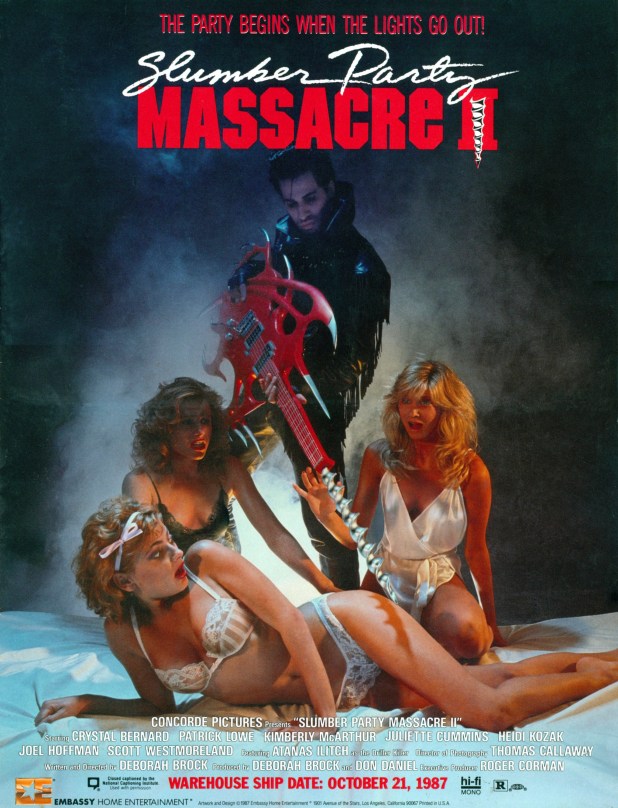
You can pish posh this movie by its title or the fact that it rips off A Nightmare on Elm Street or that it’s ridiculous that it has a slasher who has a Warlock guitar with a giant drill at the end. Or you can just do what I did: utterly enjoy every single minute of it. Also, of note, this is the only slasher series to be completely directed by women.

I never saw the original film and I’m here to tell you that I don’t think that matters at all. All you need to know is that Courtney Bates (Crystal Bernard from Wings) survived, teaming with her sister to kill the dreaded Driller Killer (and no, not the one from the Abel Ferrara film.

Now that she’s in high school, Courtney is dealing with nightmares from the ordeal from the first film. She’s also made friends with Amy (Kimberly McArthur, Playboy Playmate January 1982), Sheila (Juliette Cummins from Friday the 13th: A New Beginning, the scummiest of the entire series) and Sally (Heidi Kozak, Friday the 13th Part VII: The New Blood, who noticed during filming that her jean shorts got shorter every day, due to a costumer literally doing that each night, continuity be damned), who have all started an unnamed band (although the songs are performed by the very Go-Go’s-sounding group Wednesday Week).The girls decide to go away for the weekend so they can work on songs, but they end up watching Rock ‘n Roll High School (director Deborah Brock would go on to direct the sequel to that movie) which leads to a pillow fight and Sheila ripping off her bra, because women can make exploitation movies too.

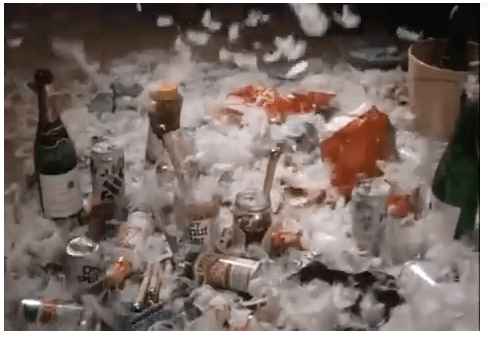
Surprise! Bros Jeff and T.J. sneak up and spy on the girls before busting in and frightening them. The house is a mess as a result. This image sums up everything there is to know about this movie:

If it seems strange that this movie often focuses on name brand sodas. Mostly Pepsi, but also New York Seltzer. Yet I know that there’s also no way that any of those brands want to be associated with this film.

Later that night, Courtney and Valerie fall asleep in the same bed and our heroine has a dream that the killer murders her friend, then she wakes up in the kitchen floor. Her visions get more and more intense, but the arrival of potential boyfriend Matt makes her happy.

I say that and then within moments, she sees Sally’s zits burst her entire head open. No one can find Sally, so the cops get called. Officers Krueger and Vorhees show up — this is also a film that refers to the last movie’s house as the Cravens and Courtney’s last name is Bates — but assume the teens are all on drugs when Sally shows up alive. Oh yeah — Sally has the last name Burns to pay homage to Sally Hardesty in The Texas Chainsaw Massacre, who was played by Marilyn Burns.

Everyone else goes to town for dinner, leaving Courtney alone with Matt. He surprises her with a cake, like he’s the Jake Ryan to her Samantha Baker, and they start to have sex. Keep in mind that she never blows out the candles and we keep cutting to the cake, blazing away. The killer appears and impales Matt, throwing one of his bloody appendages onto the burning candles. He chases Courtney downstairs right into her friends, who call 911. Of course, the cops blow them off, so they’re on their own against a 1950’s rockabilly greaser with a total 1980’s guitar, trapped in a neon-hued house with Patrick Nagel prints on the walls.

Just as Sally argues with the cops, we see the drill come through the backside of the wall, covered in her blood. Sheila and T.J. get injured and almost get away, but the killer catches them after an angry neighbor (producer Don Daniel as Mr. Damnkids) tells them to get off his driveway and T.J. bites the big drill.

Meanwhile, Courtney, Amy and Jeff try to leave in a car, but the killer drills right through Jeff. The girls run into the house and barricade themselves inside, which means that they don’t come to the aid of Sheila, who gets killed after the killer breaks the fourth wall, saying “Now it’s time for the fun part,” and sings a song called “Let’s Buzz.”

Should every slasher have musical numbers? Nope. But at this point of the movie, I was inclined to follow this wherever it led.

Amy falls to her death as the girls run away through a construction site, while Courtney uses a propane tank to light the killer up. In the morning, the police come and we think it’s all over. No, this movie has more endings than a Tolkien film. First, Amy comes back to life and laughs in the killer’s voice. Then, Courtney wakes up in Matt’s arms, who ends up being the killer. Finally, she is in a mental asylum and the killer’s drill appears near her bed.

Originally called Don’t Let Go, this is probably one of the strangest slashers I’ve seen that doesn’t have Bigfoot kill someone with an oven (Night of the Demon, please stand up). There’s also a scene where a dead and frozen chicken leaps from a refrigerator ala the zombie head in probably Fulci’s only contribution to Zombi 3, then proceeds to leak chocolate sauce/blood all over our protagonist.

Slumber Party Massacre is 77 minutes of your life that you’ll be glad you wasted. From catchy 80’s singalongs to softcore dreams that descend into graphic violence and a killer who owns every scene of the film — and has nothing to do with the first or third movies in this trilogy — this is why I stay up all night and watch movies.

You can get the Shout Factory release at Diabolik DVD or watch it for free with your Amazon Prime membership.

PS – Don’t steal anything from this movie. The notice at the end reads: Any unauthorized exhibition, distribution or copying of this film or any part thereof [including soundtrack] is an infringement of the relevant copyright and will subject the infringer to severe civil and criminal prosecution as well as a midnight call from the Driller-Killer.

Opera (1987)

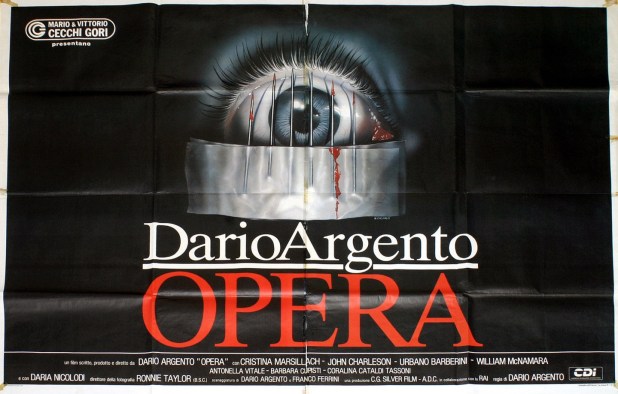
Mara Cecova is a diva and the star of a whole new way of performing Verdi’s Macbeth. But when she’s hit by a car as she argues with the director in the middle of the street, her role goes to her understudy, Betty. Ironically, in his book Profondo Argento, director Dario Argento claimed that the person playing the role of Betty, Cristina Marsillach, was the most difficult actress he would ever work with.

Despite her initial worries, Betty becomes an instant success on her opening night. At the same time, a black-gloved killer sneaks into one of the boxes to watch before murdering a stagehand with a coathanger. Grab your barf bags and motion sickness pills, everyone, Argento is behind the camera!

Of all the powerful shocks in Opera, perhaps the one that means the most to the viewer is that we share Betty’s torture — she’s repeatedly gagged, tied up and forced to watch the killer at work again and again as he tapes needles under her eyes. If she blinks too long or shuts her eyes, they’ll be shredded. It’s like Fulci’s wettest dream ever. In the same way, we are nearly complicit with the crimes we are forced to watch, particularly because they get more and more artfully composed.

Throw in the fact that Betty believes that the hooded killer is the same person who murdered her mother, she follows the giallo path for a protagonist and confides in someone else rather than the police. Her reason? The killer may know who she is.

Inspector Alan Santini (Urbano Barberini, Demons) is on the case, because there are so many clues, like the fact that the producer’s pet ravens were found dead after the show. As for Betty, she runs from the police and calls her agent Mira (Daria Nicolodi, Argento’s former wife and the writer of Suspiria and star of Shock) for advice.

Betty’s costume gets cut to ribbons, so she asks the wardrobe girl for help. While she works on the dress, they find a gold bracelet that they can almost read. But here comes the killer and his needles again, forcing her to watch him kill one more time. The wardrobe girl accidentally swallows the bracelet, so of course, we watch as the murderer slices her throat open to get it back.

Betty runs back to her apartment where Santini is waiting. He promises to send a detective named Soavi to watch over her (yep, The Church director Michele Soavi), but she doesn’t trust the man and leaves her apartment. That’s when her agent answers the next knock on the door by looking through the peephole. What follows is the most grand kill in the entire film — which is saying something — as we follow the bullet POV-style out of the gun and directly through her eyeball. Again, Fulci is somewhere wringing his hands.

Nicolodi had just ended a long relationship with Argento and did not want to be in this film. However, the shocking and complicated murder of her character changed her mind, even if she had to deal with an explosive device being put on the back of her head to achieve the final shot.

Betty escapes the killer again and runs to the opera house, convinced there is a connection between the murderer and her long dead and totally abusive mother. The next night, as she performs, the producer unleashes what is left of his ravens in the hopes that they’ll find the killer. Oh, they do alright — tearing his eyeball out of his head — FULCI ARE YOU THERE, IT’S ME DARIO — and rewarding you, the viewer, with POV shots that threaten you with vertigo. I’m getting dizzy even typing this.

I don’t want to give away the killer or even the second ending where the killer isn’t really dead. I just want to talk about the sheer Argento-ness of the final scene, where Betty wanders in a field and releases a lizard, giving him his freedom. Argento claims that this ending was inspired by Thomas Harris’s Red Dragon. Of interest, the director does NOT like the Michael Mann movie Manhunter. Me? Well, I love that movie. But I’d love to see Argento’s take. There’s was also a thought to another ending where Betty would fall in love with the killer.

Your enjoyment of this film really comes down to how much you like shocking amounts of bloodshed and Argento’s arty side. He based the film on his own failed staging of Macbeth, basing the role of the nervous producer on himself. And the idea of pins under the eyes? It comes from a joke about how Argento hated when people looked away during the death scenes in his films.

Believe it or not, Orion Pictures planned on releasing an R-rated version of this in the US called Terror at the Opera with eleven minutes of mayhem removed, as well as the Swiss Alps epilogue. Argento refused and Orion was losing money at a fast clip, so the movie only saw a limited video release. 

Opera is something else — filled with style and brutality. I loved it, but remember my warning as to how much you can handle. You can check it out on for free with an Amazon Prime membership.

WATCH THE SERIES: A Nightmare on Elm Street part one

I’ll admit it. I’m guilty. I’ve unfairly maligned this franchise because of where it ended up versus where it began. And it’s time that I rectified that situation. Over the past few weeks, I’ve been watching them all over again from the beginning and have come to change my opinion. Well, at least until the fifth film.

The original film was based on a lot of director/writer Wes Craven’s life, as well as Asian Death Syndrome, a medical condition that impacted a group of refugees who had left behind Laos, Cambodia and Vietnam, yet were still trapped by nightmares of war. Many of them refused to go to sleep as a result and some even died while sleeping.

He also was inspired by a satirical horror movie his Clarkson University students made in 1968 which was filmed along Elm Street in Potsdam, New York. And the film’s villain, Freddy Krueger, is based on an incident where a young Craven felt like an elderly neighbor was coming after him. The name comes from a childhood bully that kept beating on Craven and it’s not the first time that he used that name, as Krug from The Last House on the Left is also named for this past teenage demon.

Freddy Krueger doesn’t look like any of his slasher brethren. With every other slasher wearing a mask, Craven wanted a villain who could talk and threaten his victims, while striking even more fear into their hearts with his burned and scarred visage. He also based his soon to be iconic sweatshirt on the pattern of DC Comics superhero Plastic Man, but changed the colors to red and green as he learne dd that those were the colors that clash the most in the human retina. And his weapon wouldn’t be a knife, but an entire glove made of them.
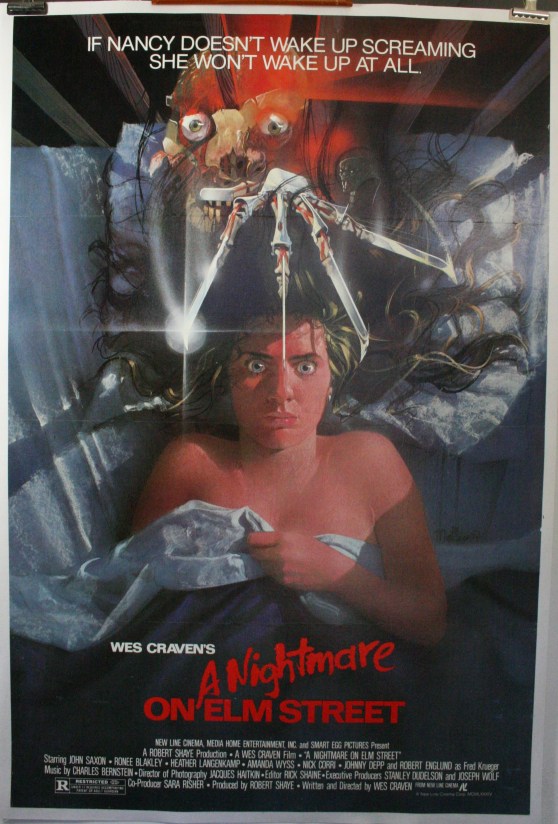
A Nightmare on Elm Street – 1984

Upon watching this again for the first time in probably thirty years, I was struck by how European the movie feels. Perhaps it’s the color tones throughout, suggesting the patina of Italian horror cinema (both Fulci and Craven cite surrealist filmmaker Luis Buñuel as an influence). It could also be John Saxon having lead billing. Or just that it doesn’t feel like any horror cinema that was currently being made in the United States.

The real villain of this piece is not Freddy Krueger — more on him in a bit — but the parents of Elm Street who have allowed secrets and their assumed authority over their children to do unspeakable and unspoken things. All of them are haunted by it, divorced, depressed and self-medicating with over-dedication to their jobs or their addictions.

There are stories that David Warner was originally going to play Freddy, but that’s been disproven. After plenty of actors tried out and failed to win the part, it went to Robert Englund, who darkened his eyes and acted like Klaus Kinski (!) to get the part.

The other feeling I have about this movie is that it owes a major debt — as all horror movies post 1978 do –to John Carpenter’s Halloween. Much like that film, the true horror happens within the foliage of the suburbs, with shadow people showing up and disappearing. Much of the action on the final night happens within two houses. One of the main characters has the ultimate authority figure, a policeman, for a father. And the cinematography by Jacques Haitkin glides near the characters and around them, much like the Steadicam shots that start Carpenter’s film.

The film starts with Tina Gray (Amanda Wyss, who puts the events of Better Off Dead into motion by breaking up with Lloyd Dobler) waking up from a nightmare where a disfigured man chases her with a bladed glove. I loved the way this scene looks, as you could almost consider Freddy off brand here, as his arms grow comedically long and he moves way faster than he would in the rest of the series. Yet by keeping him in the shadows, he’s absolutely terrifying.

When Tina awakens, her nightgown has been slashed and she’s afraid to go to sleep again. She learns that her friends, Nancy (Heather Langenkamp, who left Stamford University to be in this), Glen (introducing Johnny Depp) and Rod (Jsu Garcia, credited as Nicki Corri) have all been having the same dream. To console Tina, they all stay at her parent’s house overnight. But when Tina falls asleep, Krueger is waiting. Rod awakes to find Tina flying all over the room and up the walls — an astounding effects sequence in the pre-CGI era — and he flees the scene after her death.

Soon, Rod is arrested by Lieutenant Don Thompson (Saxon), Nancy’s father. Freddy now starts pursuing her, chasing her as she falls asleep in class (look for Lin Shaye as the teacher) and later in the bathtub, as his claw raises like a demented and deadly phallus between her thighs. Rod tells her how Tina dies and now she knows that the same killer is definitely after her (Garcia’s watery eyes and lack of focus made Langenkamp think he was acting his heart out; the truth is he was high on heroin for real in this scene). She tries to find the killer, with Glen watching over her, but he’s a lout and easily falls asleep. Only the alarm clock saves her, but no one can save Rod, who is hung in his sleep while rotting in a jail cell.

Nancy’s mom Marge (Ronee Blakley, who was married to Wim Wenders, sang backup on Dylan’s song “Hurricane” and is also in Altman’s Nashville) takes her to a sleep clinic, where Dr. King (Charles Fleischer, Roger Rabbit’s voice) tries to figure out her nightmares. She emerges from a dream holding Freddy’s hat to her mother’s horror. Soon, she reveals to her daughter that the parents of Elm Street got revenge on Freddy Krueger, a child murderer after a judge let him go on a technicality. In a deleted scene, we also learn that Nancy and her friends all lost a brother or sister that they never knew about.

While Nancy is barred up in her house by new security measures, Glen’s parents won’t allow him to see her. Soon, he’s asleep and is transformed into an overwhelming fountain of blood. Nancy falls asleep after asking her father to come in twenty minutes. He doesn’t listen and she pulls Freddy into our world. On the run, she screams for help until her father finally comes to her aid, just in time to watch a burning Freddy kill his ex-wife and them both disappear.

This is an incredibly complex stunt where Freddy is set ablaze, chases Nancy up the stairs, falls back down and runs back up — all in one take! At the time, it was the most elaborate fire stunt ever filmed and won Anthony Cecere an award for the best stunt of the year.

Nancy then realizes that if she doesn’t believe in Freddy, he can’t hurt her. She wakes up and every single one of her friends is still alive, ready to go to school. As the convertible hood opens up in the colors of the killer’s sweater, she realizes that she’s still trapped by Freddy, who drags her mother through a window.

In Craven’s original script, the movie simply ended on a happy note. Producer Robert Shaye wanted the twist ending so that the door was open for a sequel, something Craven had no interest in. Four different endings were filmed: Craven’s happy ending, Shaye’s ending where Freddy wins and two compromises between their ideas.

Obviously, the series would continue. And the follow-up would be one that left many unsatisfied.

A Nightmare on Elm Street Part 2: Freddy’s Revenge – 1985

With Craven stepping aside, Jack Sholder (Alone in the Dark, which was the first New Line movie before the original Elm Street and The Hidden) was selected as the director and David Chaskin was selected to write this (it was his first Hollywood script and he’d go on to write I, Madman and The Curse).

Chaskin’s theme for the film — which until the documentary Never Sleep Again: The Elm Street Legacy he would always say was just subtext — is the main character Jesse (Mark Patton) coming to grips with his homosexuality. Patton struggled with his anger over this film for years, as he felt betrayed as the filmmakers knew that he was in the closet. Between this role and playing a gay teenager in Come Back to the Five and Dime, Jimmy Dean, Jimmy Dean, he feared being typecast at best and labeled at worst. Yes, in 1985, this was the world that we lived in.

Chaskin claimed in interviews that Patton just played the role too gay, but Patton bristled at that claim. The emotional stress led Patton to quit acting for some time to pursue a career in interior design. That said, Chaskin claims that he has tried to reach out and apologize to the actor over the years.

Director Sholder has said that he didn’t have the self-awareness to think that the film had any gay subtext, but an unfilmed scene almost had Krueger slide a knife into Jesse’s mouth. Makeup artist Kevin Yagher talked Patton out of filming that scene for the sake of his career.

Years later, Patton would write Jesse’s Lost Journal, a series of diary entries that would set his feelings — and his character’s — straight, pardon the horrible pun.

The sequel starts with a dream sequence where Jesse Walsh (Patton) dreams of being stuck inside a school bus with Freddy at the wheel. Jesse’s circle of friends include Lisa, who he’s friends with but too shy to ask out, and Grady (Robert Rusler, Sometimes They Come Back), a frenemy that seems more like a crush.

Jesse has moved into Nancy Thompson’s home, which was on the market for five years after she was institutionalized and her mother killed herself. His family has Clu Gulager from Return of the Living Dead as his dad, Hope Lange from Death Wish as his mother and a little sister that he bothers when she’s trying to sleep.

Lisa and Jesse discover Nancy’s diary, which explains how ridiculous the house is to live in. It’s always 97 degrees, birds attack you at will before they spontaneously combust and your parents accuse you of setting it all up.

Meanwhile, Jesse is dealing with all sorts of strangeness, like a sadistic gym teacher who really likes to go to punk clubs and get whipped. One night, a dream takes him to that bar and the gym teacher makes him run laps in the middle of the night. That gym teacher is played by Marshall Bell, who was George in Total Recall, the host for Kuato. Freddy possesses our hero and the coach gets clawed up in the shower. The cops find Jesse wandering the highway naked, which doesn’t seem all that weird to his mother.

Lisa and Jesse go to Freddy’s lair in an abandoned factory, then she has a pool party. Yes, I just wrote that sentence. At the party, they kiss and have perhaps the most awkward make out session ever, until Freddy causes changes in Jesse’s body that make him run to Grady for help. Yes, he gets so upset about making up with a girl that he runs to his male crush, only to transform into Freddy in an astounding practical effects sequences and kill Grady. He returns to the pool party and lays absolute waste to the partygoers as Freddy before getting chased off by multiple shotgun blasts.

Only Lisa’s love — and kisses — can bring Jesse out of Freddy. But it’s all for nothing, as the nightmare from the beginning becomes real and their schoolbus turns into a deathtrap. Even though their friend Kerry (who has the best outfits in the movie) tries to calm them down, Freddy’s claw emerges from her chest.

A Nightmare on Elm Street 3: Dream Warriors – 1987

After the much-criticized second installment (I actually really enjoyed it, as it has a lot of European flair and its subject matter seems like a middle finger in the face of teenage boys who would seem to be its biggest audience), Wes Craven returned to write the inspiration for this script, which was originally about the phenomenon of children traveling to a specific location to commit suicide (think Japanese murder forests).

Frank Darabont and Chuck Russell took that direction and convinced New Line that the series should go further into Freddy’s dream world. The success of this film proved that A Nightmare on Elm Street would be a franchise, as this film made more than the first two movies put together. The team would go on to create 1988’s remake of The Blob before Darabont went into making Stephen King adaptions and Russell would direct The MaskThe Scorpion King and Collateral.

Kristen Parker (Patricia Arquette) is obsessed with the abandoned house on Elm Street (which one assumes is the last house on the left), making papier-mâché sculptures (which makes for a great compressed credit sequence, showing headlines of what has gone on before) and dreaming of Freddy chasing her. She awakens from her nightmare to discover that she’s slicing her own wrists as her mother Elaine (Brooke Bundy) has to interrupt her sleepover date to save her daughter’s life.

Kristen ends up in Westin Hospital, run by Dr. Neil Gordon (Craig Wasson, Body Double), battling the orderlies and doctors who want to sedate her. Check out a young Laurence Fishburne here as orderly Max Daniels! She’s eventually helped by the new therapist — Nancy Thompson! — who recites Freddy’s nursery rhyme to her. Continuity be damned, Nancy’s grey streak is now on the opposite side of her head.

We meet the rest of the patients, who will soon become the Dream Warriors: Phillip the sleepwalker (Bradley Gregg, Class of 1999), wheelchair-bound Will  (Ira Heiden, Elvira, Mistress of the Dark), streetwise Kincaid, actress Jennifer (Penelope Sudrow, After Midnight), the silent Joey and Taryn, a former drug addict (Jennifer Rubin, who is also in a movie that totally rips off this one, Bad Dreams).

The Dream Warriors is pure entertainment. Freddy makes his move toward being more of a joking character while transforming into a snake, a TV set, a gigantic puppet master and even turns his fingers into drug-filled hypodermic needles. Kristen can pull the rest of the teens into her dreams, which they’ll need as Freddy and all of their doctors are pretty much against them.

Dr. Neil learns from Sister Mart Helena the true origins of Freddy, the bastard son of one hundred maniacs, and how he can stop him. Enlisting Nancy’s dad (John Saxon returns!), Neil digs up Freddy’s bones, which are still deadly, while Nancy tries to save as many of the kids as she can within the dreamworld.

The film puts an end to Nancy’s saga while setting things up for a new cast of characters to do battle with Freddy. At least that’s what you’re supposed to think, as A Nightmare on Elm Street 4: The Dream Master pretty much wipes the slate clean within the first ten minutes. We covered it not long ago, so follow the link to read more.

We’ll be back soon to cover the rest of these films! Don’t fall asleep!
2018 Scarecrow Psychotronic Challenge Day 29: La Venganza de los Punks (1987)

Day 29 of the Scarecrow Psychotronic Challenge is all about gangs. Specifically, one where a group of ne’er-do-wells do some serious menacing. I’ve been wanting to talk about this movie for some time, so this gives me the perfect opportunity to blow some minds.

The sequel to 1980’s Intrepidos Punks, this one ups the ante from the very first five minutes. After Tarzan (luchador El Fantasma, father to Lucha Underground’s King Cuerno) is freed from prison, he instantly gets revenge on the man who put him away, Marco (Juan Valentin) by interrupting the cop’s daughter’s quinceanera. His gang proceeds to rape and kill every single person there, leaving Marco alive so that he can be tormented by his loss.

Let me sum this up the best way I can: Tarzan and his gang look like the best Italian post-apocalyptic movie ever, if a Mexican wrestler led a gang that’s mostly made up of Japanese women wrestlers circa the Crush Girls era that had constant Satanic orgies. Tarzan even yells, “Long live death, cocaine, marijuana and alcohol!” at one point, sending me into ecstatic bliss.

Marco’s partner says that “We are all guilty. We are all accomplices. All of us!” Probably no one listened to the police chief when he claimed that the gang was only the tip of the iceberg at the end of  the last film. Now, Marco is getting kicked off the force, slowly eating soup and planning his horrible vengeance on the gang.

This movie quite literally comes from inside my brain. It’s the only place where luchadors can lead Satanist drug gangs against an ex-cop willing to take things so far that he pours acid on people, all whilst a surf punk band jams out and curvy dancers gyrate to their completely offbeat (and off beat) performance. Everybody has aluminum foil on their spikes or metallic hair or is naked or has a bad dye job or looks likes the random dudes you beat up in Final Fight. Throw in a black mass where a goat is beheaded and devoured and you have the feel good movie of 1987!

The only thing I don’t like about this movie is its ending, which Roberto Ewing’s the entire movie as one bad dream. Fuck that. If you just stop the movie right before that, all will be much better with your world. I also want there to be more movies in this series and am willing to Kickstart anything that attempted to make this happen.

Prison (1987)

Before Renny Harlin did Die Hard 2 (or The Adventures of Ford Fairlane). Before Viggo Mortensen was in the Tolkien films. Before Tiny “Zeus” Lister was Deebo in Friday. Before Kane Hodder played Jason for the first time in Friday the 13th Part VII: The New Blood.

Before all these things, there was Prison.

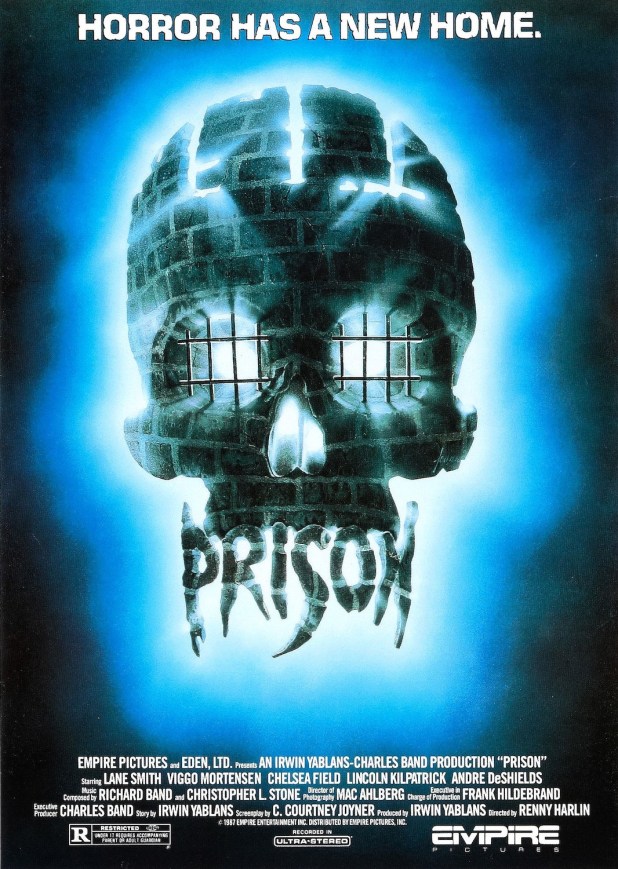
In 1964, inmate Charlie Forsythe (Mortensen) is electrocuted for a crime he did not commit. And thirty years later, when the Creedmore Prison is re-opened, his spirit is there and ready to get revenge on Eaton Sharpe (Lane Smith, district attorney Jim Trotter III in My Cousin Vinny), who knew he was innocent. Now, he’s the warden!

Unless Forsythe repays the debt he owes, every inmate will die, including  Burke (also played by Mortensen). And what a cast of felons, including Lincoln Kilpatrick (Chosen Survivors), Tom Everett (Death Wish 4: The Crackdown), André De Shields (The Wiz himself!), the previously noted Lister, Larry Jenkins (Fletch), Hodder and more. And according to IMDB, “Most of the inmate extras in the film were portrayed by real-life inmates from a nearby prison to add realism to their performances. The armed guards on the towers were, of course, armed with live ammo at the time. Stephen E. Little (Rhino) was a former Hollywood stuntman, who was still a member of SAG, who happened to be serving time for manslaughter that he committed during a bar-room brawl.”

Helping the convicts is a doctor who advises the prison be closed, played by Chelsea Field (Teela from Masters of the Universe and wife of Scott Bakula).

Sure, it’s the same idea as DestroyerShocker and House 3/The Horror Show. But it’s entertaining enough and has a surprising amount of gore. It won’t bore you, that’s for sure. There’s a great scene of a convict’s guts exploding onto the mess hall as everyone tries to eat that I loved!

Scream Factory put this out awhile back. You should grab it and see what you think.

2018 Scarecrow Psychotronic Challenge Day 20: The Lost Boys (1987)

Day 20 of the Scarecrow Psychotronic Challenge is 20. VIDEO STORE DAY. The most important day of this challenge. Watch something physically purchased from an actual video store. If you live in a place that is unfortunate enough not to have one of these archival treasures then watch a movie with a video store in it at least. #vivaphysicalmedia! Sadly, the last Family Video locations that were within a half an hour of our house closed at the beginning of the year. It was incredibly depressing, despite the fact that we bought a lot of films in the closing of the store. But it felt like going to the estate sale of one of your best friends. I teared up a bit in the parking lot, because there’s nowhere left other than Redbox to look for new films. And well, those boxes may be convenient, but they just aren’t the same.

That means that I had to look for something with a video store scene in it. And that leads me to The Lost Boys, a movie that pretty much sums up the 1980’s, the days when video was king.

When I first put in The Lost Boys, my wife mentioned that she would watch it for a few minutes. Of course, she ended up watching nearly the whole thing, remarking how attractive every guy in it is, how she dressed as Star for Halloween as a little girl and reciting the dialogue word for word. After all, she says, it is the perfect 1980’s movie.

Michael (Jason Patric, who my wife also loves in Speed 2: Cruise Control) and Sam Emerson (Corey Haim, whose 976 hotline was called by my wife every single day) are the children of divorce, moving with their mother Lucy (Dianne Wiest, who my wife loves in Practical Magic) to the tourist town of Santa Carla.

They’ll be living with their strange grandpa (Barnard Hughes, Sisters) and trying to acclimate to what just might be the murder capitol of the United States (it used to be Youngstown, Ohio, a town I grew up close to). Just look at the boardwalk — it’s covered with posters of missing kids.

At a concert (once, SNL was funny and did this sketch based on this scene) featuring a shirtless and oiled up man playing saxophone (he’s actually called The Believer if you read the Vertigo Lost Boys comic book that came out in 2016). Michael falls in love quickly with Star (Jami Gertz, Less than Zero), which brings him into the orbit of the Lost Boys, led by David (a perfect Kiefer Sutherland).

Meanwhile, Sam is meeting Edgar and Alan Frog (Corey Feldman, another of my wife’s 976 call loves and Jamison Newlander, who is in the 1988 remake of The Blob), two comic shop working kids who are really fearless vampire killers. They claim that Santa Carla is the hometown of numerous vampires and that his brother could be one of them.

Tying into today’s theme of video stores, the kids’ mom soon meets Max (Edward Herrmann, Overboard), a kindly video shop owner who seems at odds with the Lost Boys that run the boardwalk (Bill S. Preston, Esq. himself, Alec Winter, is amongst their number).

The divide between brothers before and after puberty is clearly delineated by this film, as Sam is content to sing old soul songs in the bathtub with Michael is out there chasing strange women, hanging from railroad bridges and watching rice turn into maggots. You can also see this movie as the struggle between growing up and growing away from your family. Or dealing with a mother who is starting to date again and how that changes your perceptions of her. There’s also the fact that the title itself is a reference to J.M. Barrie’s Peter Pan stories, boys who will never grow up.

Of course, everything leads to a final conflict between the Emersons and the Lost Boys, with Max as their secret leader. I always loved how the video store owner’s goal all along was to finally find a mother for his motley collection of vampiric ruffians. The way he reacts when she isn’t afraid of them at the video store telegraphs this upon repeated viewings. And does anything beat grandpa’s last line? “One thing about living in Santa Carla I never could stomach: all the damn vampires.”?

After starting his directing career with The Incredible Shrinking Woman and D.C. Cab, Joel Schumacher really did an amazing job on this film. You can almost forgive him for his work on the Batman films. No, not really. You can never forgive that.

This really is the perfect 80’s film. I always felt for the vampires more than the humans. Never grow up. Never die. Never age. How does that sound bad? Sure, you have to kill other gangs on the boardwalk, but is that such a rough life?

There were plans to make a sequel named The Lost Girls with David returning as the villain — noticeably he’s the only vampire that doesn’t dissolve — but it just never worked out. There are several direct to video sequels to this that I’ve never seen, Lost Boys: The Tribe (featuring brother Angus Sutherland as the lead vampire) and Lost Boys: The Thirst. A fourth film was in the works, as well as a Frog Brothers TV show, when Warner Premiere went out of business.

Finally — I just want to mention how perfect this scene in What We Do in the Shadows is.

BIGFOOT WEEK: Henry and the Hendersons (1987)

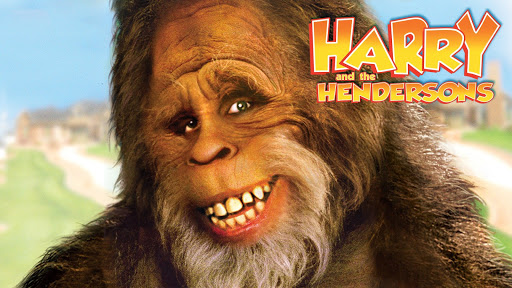
George Henderson (John Lithgow) and his family are heading back from a trip to the Cascade mountains — the first trip where he hasn’t bagged an animal. That’s when he hits a big critter with his Ford Country Squire. More than that, he’s hit a sasquatch. And once he gets it strapped to the roof, he learns that it’s not dead. Nope, now it’s part of the family.

Harry soon escapes their suburban home before going wild throughout Seattle before becoming part of the family — just in time to leave them behind and go back home. He just has to avoid being captured or killed by Jacques LaFleur, a hunter who has been after Bigfoot so long that he’s become a joke.

This is another of the films that Becca watched nearly every single day, along with every Halloween film. She knows every character by name, every beat of the story and is able to explain each and every nuance of the story.

Hey — I’m always happy when Don Ameche shows up in a movie. Since my childhood, he’s always been known as John, half of The Bickersons with Frances Langford as Blanche. Here, he plays Dr. Wallace Wrightwood, a man whose life was ruined by his search for Bigfoot.

Rick Baker did an amazing job on the FX here, placing Predator actor Kevin Peter Hall into a complex costume that makes him look exactly as we imagine a Sasquatch to look like. I love the sequence at the end where Harry’s real family reveals themselves in the forest, including a child! No wonder this movie won an Academy Award for Best Make-Up.

Here’s some trivia for you. Co-writer Bill Martin also wrote songs for Harry Nilsson’s “Harry” album and can be seen wearing a bear costume on the album’s art. That’s where Harry gets his name — he’s named for Nilsson (Son of Dracula). Plus, cryptozoologist Loren Coleman claims that David Suchet’s Jacques character is based on Rene Dahinden, a Canadian by way of Switzerland researcher who was a big advocate for the Patterson-Gimlin film. He also claims that Ameche’s character is a combination of Sasquatch researchers John Green, Peter Byrne and Dr. Grover Krantz.

This led to a TV series and will be, one imagines, one day remade as an inferior reimagining. You can watch it for yourself on Netflix.

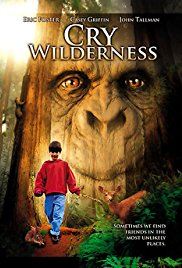
BIGFOOT WEEK: Cry Wilderness (1987)

Cry Wilderness comes from that most painful of all movie genres — the earnest family-friendly film with a message. This is the kind of movie that your church youth group would show on a Saturday afternoon after some lessons on Jesus. But see, I grew up Catholic, so my Saturday afternoons were spent watching Hammer films and hoping that my family would go to church that night so I could stay up watching Chiller Theater and sleeping in.

Once you grow up, some of those movies seem cloying and ridiculous. I didn’t encounter Cry Wilderness as a kid. No, I got blasted with both barrels of its strangeness as a fully grown adult.

This is the kind of movie that demands that you be OK with the fact that Bigfoot can show up and visit young Paul Cooper and warn him that his father will die unless he leaves his fancy school behind and, well, cry wilderness.

It’s also a movie where seasoned outdoorsmen have no idea how to properly handle weapons, continually pointing them directly at people, planting the muzzle of rifles into dirt and even running with their fingers directly on the trigger.

There are also mystical Native Americans, a park ranger who never wears his uniform, raccoons who know how to knock on doors, a child who is obsessed with said raccoons to the point where he allows them to get in the kitchen sink and eat, a bad guy principal who is the worst Xerox of William Daniels ever, a school that’s cool with a student wearing a Bigfoot medallion as part of his uniform and moments where the film goes completely out of focus. Make those numerous moments.

Are you cool with seeing Bigfoot’s zipper? How much b roll footage is too much? And are you ready for earnest country rock and a movie that feels like it was made in 1978, not 1987?

Topping it all off is the fact that many of the people in this film were also involved in one of my favorite bits of sheer lunatic filmmaking, The Nightmare Never Ends, which is also part of the even more manic Night Train to Terror.

You can watch it yourself by grabbing the DVD from Vinegar Syndrome. Or, if you enjoy Mystery Science Theater 3000, you can check out their take on the film on Netflix.

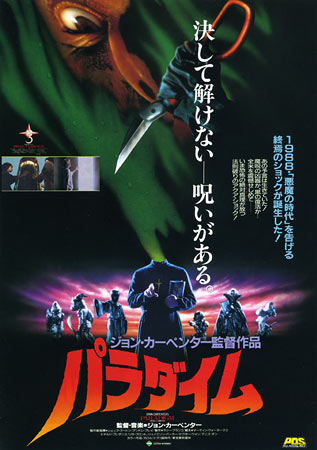
Prince of Darkness (1987)

The second film in John Carpenter’s “apocalypse trilogy” (The Thing and In the Mouth of Madness are the other two), this was the first movie in his deal with Alive Pictures, which guaranteed him complete creative control if he made each film at a budget of $3 million dollars.

This is probably the only horror movie that you’ll see that is all about theoretical physics and atomic theory, as well as secret religious orders and the Antichrist. There’s also plenty of Nigel Kneale (Quatermass and the Pit) influence here, which Carpenter tips his hat to by using the alias Martin Quatermass for the screenplay. From messages from the future to ancient evil finally being unleashed on the modern world, it could be a Kneale film, but the British writer was displeased with being associated with the film (he had previously worked with Carpenter to script Halloween 3: Season of the Witch, although his name was removed when he objected to producer Dino De Laurentiis adding more gore to the film).

A priest (literally, that’s his name, but he’s played by long-time Carpenter associate Donald Pleasence, although I’ve also heard him referred to as Father Loomis) discovers that a member of the Brotherhood of Sleep has died just before an important meeting with the Pope. It turns out that an abandoned church in inner city Los Angeles contains a container of green liquid that is the secret to the inverse side of God, literally an Anti-God.  Whatever is inside that container is alive and able to transmit long streams of complex data that needs to be analyzed by Prof. Howard Birack (Victor Wong, Big Trouble in Little China) and his students.

One by one, those students are taken over by the Anti-God or killed by the homeless people and insects that surround the building, led by Alice Cooper.  Also, every single person who hasn’t been killed or taken over starts to have the same dream, one where a shadowy figure emerges from the church. Each time they have this dream, a warning sent from the year one-nine-nine-nine, they see more detail. This part of the film, shot on video, played on a television and then reshot with Carpenter’s voice intoning the warning message, are some of the strangest and most surreal sequences ever included in a mainstream film.

Soon, one of the researchers has been transformed into a vessel for Satan and the evil forces are attempting to pull the Anti-God out of a mirror. Much like Ghosts of Mars and Assault on Precinct 13, this is another Carpenter riff on Howard Hawks’ Rio Bravo, with a group of survivors stuck inside a building, trying to survive an evening worth of attacks.

I can’t say enough about how much I love this movie. It has great little character bits, moments of true horror and even some great compressed storytelling. I love that instead of a long explanation of how a physics professor and a Catholic priest would be close friends, one student just off-handedly mentions that they both were part of a BBC exploration of God’s existence. That’s all we really need to know and it lets us answer that and move on to more important matters.

You just need to watch this movie. Luckily, Shout! Factory has released a great version of it. I mean, how can you not love a film that theorizes that Jesus was an alien and the Catholic Church has known that all along and kept the secret that another alien, an evil one, was on its way…or has a scene where someone just keeps typing “I live!” over and over again, then this message: You will not be saved by the holy ghost. You will not be saved by the god Plutonium. In fact, YOU WILL NOT BE SAVED.”

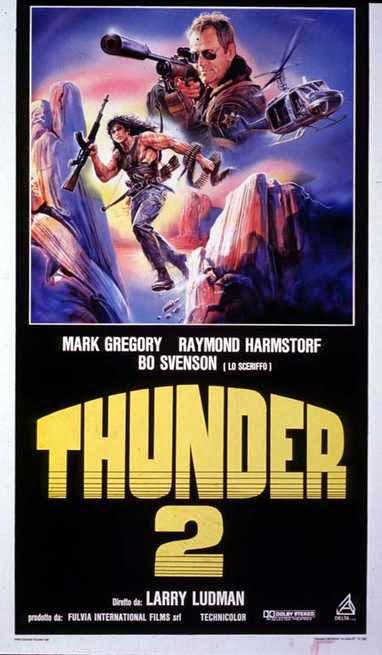
MARK GREGORY WEEK: Thunder 2 (1987)

In the first forty minutes of Thunder 2, the movie recaps the first film, is a rookie cop drama, tells us about corrupt cops and then becomes an Italian exploitation version of Cool Hand Luke. If you’re not in, you’ll never be in. This is why I watch movies.

Remember the last time we saw Luis Martinez — Thunder to you and me? He was blowing up an entire town and fucking up cops. Well, now he is a cop! How did this happen? How could this not happen?

Even crazier — he gets assigned to the town that he fucked up and has to work with the same cops who ruined his life. That said, Thunder proves to be a pretty good cop, even winning the trust of his old archnemesis, Sheriff Roger (Bo Svenson). He even busts a transgender person who nearly knocks him out!

Of course, the cops are still corrupt. Deputy Rusty Weissner still has it out for Thunder and sets him up, making it look like he’s a drug dealer. Thunder has to go to prison and try to survive the box. If only he didn’t have the worst drunken attorney ever!

Thunder breaks out, taking a cop car with him. He tries to get a fair trial, but Rusty attacks him and flips over the jeep carrying Thunder, his pregnant wife and the drunken lout. Thunder’s wife loses the baby and he goes on the run again. When he meets her at the hospital, she tells him to get revenge.

Oh he does. There’s an army on Native Americans, exploding crossbow weaponry, tomahwaks and Mark Gregory stiffly walking around wearing warpaint. Holy shit, this movie! It’s everything fabulous about Italian exploitation without zombies or sex crazed killers.

Fabrizio De Angelis returned to direct the sequel and he brought along the most prolific writer in Italian sleze with him, Dardano Sacchetti. Magic ensued.

In the end, the sheriff just lets Thunder go as he’s innocent. He tells him not to ever come back and his drunk lawyer laughs and take a shot. In front of a cop. They pull away and the sheriff takes out a rifle, watches them in the scope and shoots. The end.

Were they trying to make a Billy Jack ending?

Take my word for it. This movie is perfect. I mean, Mark Gregory hanging off a helicopter? Slouch walking around dressed as a cop? Native Americans having their own special doctors? This movie says it all.

You can find this at Revok or if you look around on YouTube hard enough.

Feed Shark